Year: 2019

26 Jul 2019

Poolside.fm is the most fun you will have on the internet today

Hey the internet can be a heavy place – especially these past few years. But sometimes, it still delivers the goods: Poolside.fm is the goods. This website is a time machine to a simpler time in computing, recreating a late 80s desktop in your browser window, complete with the perfect soundtrack and non-stop low-fi period-appropriate videos.

Poolside.fm isn’t itself new (the site originally launched in 2014), but this new design based on classic Mac OS takes it to a new level. It’s the product of a group of designers including Niek Dekker and Marty Bell, and this fresh look is everything – plus, you can change the theme if you want to make it even more personalized.

The ‘audio player app’ has a few different stations, and if you want to get even more serious about it, you can sign up for an account and save tracks to your own playlist. Even without an account, you can share your favorite tracks from the three stations (‘Poolside.fm,’ plus new stations ‘Hangover Club’ and ‘Tokyo Disco’) with friends with a link.

In short, it’s the browser tab you’ll love rediscovering mid-workday after losing track of it in a mess of open work tabs, and it’s ideal for a background soundtrack that’s always good without you having to think about it.

26 Jul 2019

WhatsApp reaches 400 million users in India, its biggest market

WhatsApp has amassed more than 400 million users in India, the instant messaging app confirmed today, reaffirming its gigantic reach in its biggest market.

Amitabh Kant, CEO of highly-influential local think-tank Niti Aayog, revealed the new stat at a press conference held by WhatsApp in New Delhi on Thursday. A WhatsApp spokesperson confirmed that the platform indeed had more than 400 million monthly active users in the country.

The remarkable revelation comes roughly two years after WhatsApp said it had hit 300 million users in India. WhatsApp — or Facebook — did not share any India-specific users count in the period in between.

The public disclosure today should help Facebook reaffirm its dominance in India, where it appears to be used by nearly every smartphone user. According to research firm Counterpoint, India has about 450 million smartphone users. (Some other research firms peg the number to be lower.)

As WhatsApp becomes ubiquitous in the nation, the service is increasingly mutating to serve a number of needs. Businesses such as social-commerce app Meesho have been built on top of WhatsApp. Facebook backed Meesho recently in what was its first investment of this kind in an Indian startup. Then of course, WhatsApp has also come under hot water for its role in spread of false information in the nation.

As ByteDance and others aggressively expand their businesses in India, Facebook’s perceived dominance in the country has come under attack in recent months. ByteDance’s TikTok, which has amassed 120 million users in India, has been heralded as the top competitor of Facebook by many.

A WhatsApp spokesperson also told TechCrunch that India remains WhatsApp’s biggest market. In 2017, Facebook said its marquee service had about 250 million users in India — a figure it has not updated in the years since.

WhatsApp, which has about 1.5 billion monthly active users worldwide, does not really have any major competitor in India. The closest to a competitor it has in the country is Messenger, another platform owned by Facebook, and Hike, which millions of users check everyday. Times Internet — an internet conglomerate in India that operates several news outlets, entertainment services and more — claims to reach 450 million users in the country.

At the press conference, WhatsApp global chief Will Cathcart said WhatsApp also plans to roll out WhatsApp Pay, its payment service, to all WhatsApp users towards the end of the year — something TechCrunch reported earlier.

Its arrival in India’s burgeoning payments space could create serious tension for Google Pay, Flipkart’s PhonePe, and Paytm. For Facebook, WhatsApp Pay’s success is even more crucial as the company currently has no plans to bring cryptocurrency wallet Calibra to the country, it told TechCrunch on the sidelines of Libra and Calibra unveil.

In a series of announcements this week, WhatsApp also unveiled a tie-up with Niti Aayog to promote women’s entrepreneurship. “By launching ‘gateway to a billion opportunities’ and our digital skills training program, we hope to shine a light on the amazing work already happening and build the next generation of entrepreneurs and change makers,” said Cathcart.

On Wednesday at a conference in Mumbai, Cathcart announced a partnership with the Indian School of Public Policy, India’s first program in the theory and practice of public policy, product design and management, to bring a series of privacy design workshops to future policy makers. These workshops will explore “the importance and practice of privacy-centric design to help technology make a positive impact on society,” the Facebook-owned platform said.

26 Jul 2019

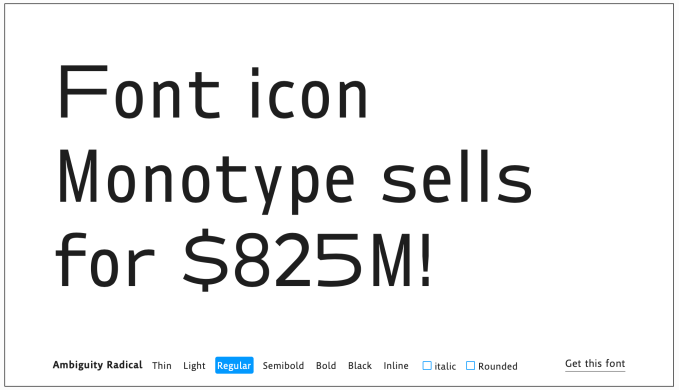
Iconic font company Monotype is getting acquired by PE firm HGGC for $825M

A new chapter is opening up for Monotype, the font and imaging technology specialist that is associated with some of the more iconic evolutions in typefaces in the digital age (if you know Times New Roman or Arial, you know Monotype) . Today, the company announced that private equity house HGGC is acquiring it for $825 million in an all-cash deal.

HGGC will be paying $19.85 per share for the company, effectively taking it private: Monotype has been around since 1887 and more recently traded on Nasdaq under the ticker “TYPE.” (The sale price represents a significant premium on the stock’s closing price yesterday of $16.16.) The deal has already been approved by the company’s board of directors and is expected to close in Q4 of this year.

The deal caps off a period of the company working to update and expand its focus beyond that of typeface technology — an area where it established itself as a leader in the pre-digital era but continued to play a role with the growth of digital fonts, with partnerships with the likes of Microsoft (licensing fonts for operating systems), and building new font libraries for a globalised internet (such as a collaboration with Google called the Noto Project, designed to build a font that would work across 800 languages and 100 writing scripts).

That expansion notably took Monotype from typefaces to images — a key and prescient evolution considering the use of emojis today replacing words. The company in the last four years made a number of acquisitions to that end, including Olapic and Swyft Media.

And after a prolonged and overall declining trajectory, now it’s the one getting acquired,

“Over the last several years, Monotype has strategically shifted its business from primarily serving a small group of OEM manufacturers to one that addresses the needs of thousands of brands and millions of creative professionals worldwide,” said Scott Landers, President and Chief Executive Officer, in a statement. “As a private company, we will have the financial support and added flexibility to invest in ways that deliver more value and improve the overall experience for our customers. This transaction is a testament to our talented employees and their dedication to serving our customers, and we look forward to partnering with HGGC as we continue helping customers maximize their customer engagement in today’s digital, mobile and global landscape.”

Indeed, Monotype is still best known for fonts, and you can go to its site to buy and experiment with new ones, or work with Monotype to create your own.

Screenshot 2019 07 26 at 13.23.29

Under the wing of the PE firm, the company — which has been modestly profitable, with results also reported today showing net income of $10.3 million on revenues of $63.2 million — is likely to get more investment, less scrutiny under the unrelenting eye of the public markets, and possibly some reorganization for whatever comes next.

“We have been impressed with the quality and expertise of the Monotype team led by Scott, whose relentless commitment to customers has helped brands realize their full identity and express it to the world,” said Rich Lawson, CEO and Co-Founder at HGGC, in a statement. “We look forward to working together to help advance Monotype’s strategy and continue delivering the products and services that allow for brand expression and differentiation.”

26 Jul 2019

Tencent brings cloud service to Japan in global push

The world’s largest video game publisher is looking outside its home country for growth. Tencent, the Chinese internet behemoth that operates WeChat and a few blockbuster games, announced on Friday that its cloud service has entered Japan as part of the firm’s international push in 2019.

Tencent Cloud was already serving clients in Japan prior to the announcement, TechCrunch has learned, but this is the first time it has officialized the entry, which might be a sign of Tencent’s ambition to speed up global expansion. The international push comes at a time when Tencent’s domestic business is under pressure following China’s new gaming regulation.

Indeed, Tencent’s cloud computing division is targeting up to five-fold growth in revenue this year and Japan will be a key market, said Da Zhiqian, vice president of Tencent Cloud.

Tencent’s cloud business is the second largest in China with an 11% market share, according to industry researcher IDC. That puts the Shenzhen-based company behind its arch-rival Alibaba, which accounts for 43% of the local cloud market. The cloud computing battle outside China is only more competitive with the presence of giants AWS, Microsoft Azure and Google Cloud, which lead with a respective share of 31.7%, 16.8% and 8.5% in 2018, according to research firm Canalys.

But Tencent could be an appealing hosting solution for smaller gaming companies who look to the giant for lessons. The company’s attempt to replicate the success of Honor of Kings outside China fell apart, but it quickly shifted gears by launching a Steam-like gaming platform WeGame X focusing on Chinese games developed for overseas markets. Meanwhile, its mobile version of PlayersUnknown Battleground is making headway globally as revenue surges.

Tencent can also tap into its vast portfolio network around the world. Huya and Douyu, two top game live streaming companies in China that are both backed by Tencent, have ramped up international expansion in recent times and they surely need some cloud computing help to ensure low video latency. It goes the same way with Tencent-backed short-video app Kuaishou, which is fighting TikTok inside and outside China.

Tencent’s cloud engine for games supports features that can smoothen communication between teammates, including the likes of multi-player voice chat, 3D voice positioning, voice messaging and speech to text recognition. The company is providing cloud infrastructure service in 25 countries and regions and has deployed over one million servers worldwide as of May. Besides games, Tencent said it will also roll out cloud solutions tailored to e-commerce, video streaming and mobile mobility clients in Japan. Its local partners include gaming company Pitaya and IT firm E-business.

26 Jul 2019

SpaceX succeeds with first untethered StarHopper low altitude ‘hop’ test

SpaceX is racking up wins this week, after a successful second launch attempt for its CRS-18 mission earlier this evening, and now with a first short-hop free flight for its StarHopper prototype spacecraft on Thursday night, again on its second try after a scrub earlier this week.

This test involved flying StarHopper to the relatively modest height of just 20 meters (around 65 feet, which is roughly how tall it is to begin with), where it moved around only very slightly, guiding itself under its own navigation. The StarHopper then returned to Earth as planned, so all indications are that this was a good test that went exactly as intended by the SpaceX crew.


StarHopper is a scaled down test vehicle designed to help SpaceX run crucial preparation trials for the new Raptor engine ahead of building its full-scale Starship reusable spacecraft. Starship is the next launch vehicle SpaceX is developing, which is intended to be fully reusable (its current rockets are only partially able to be refurbished and reflow) and which SpaceX CEO Elon Musk envisions eventually being able to take over all mission activity for the company, including transfer of crew and cargo to Mars. Once ready, it’ll be paired with SpaceX’s future ‘Super Heavy’ launch rocket for extra-orbital launch capabilities.

An untethered hop is a key milestone in SpaceX’s planned development, and it’s been trying to get this done for a couple of weeks now. Musk has already said that he anticipates flying the full-scale Starship prototype. Mark 1 and Mark II of which are both in simultaneous development at both Boca Chica in Texas, and at SpaceX’s Florida facility.

26 Jul 2019

Twitter Q2 beats on sales of $841M, posts big EPS of $1.43 due to one-off tax benefit, mDAUs up to 139M

Two days after Facebook reporting growing numbers (even amid its regulatory turmoil), its social media counterpart Twitter today announced its Q2 results. The company made $841 million in overall revenues, up 18% on a year ago; with EPS and net income respectively at $1.43 and $1.1 billion, a huge bump due to a “significant income tax benefit” related to the establishment of a deferred tax asset for corporate structuring for certain geographies, Twitter said. Without that tax benefit, net income was a more modest $37 million and EPS was $0.05.

Monetizable Daily Active Users — Twitter’s new, preferred audience metric — is now at 139 million, which Twitter says is up 14% on a year ago.

The figures beat on revenues, but missed by quite a bit on EPS (if you remove the one-off tax benefit): Analysts were expecting earnings per share of around $0.19 on revenues of just over $829 million for the quarter. A year ago, Twitter posted an EPS of $0.17 on sales of $710.5 million, and last quarter, the company handily beat analyst expectations on sales of $787 million and diluted EPS of $0.25.

The US continues to be Twitter’s revenue engine, the company said. It accounted for $455 million of its sales, up 24%, while international revenue was $386 million, up just 12%. Japan continues to be Twitter’s number-two market, up 9% and accounting for $133 million of its overall sales.

One of the more notable figures in this latest report is a new metric called “monetizable daily active users”, which Twitter has introduced to replace monthly and daily active users. mDAUs is based on Twitter users who logged in or were “otherwise authenticated and accessed Twitter on any given day through twitter.com or Twitter applications that are able to show ads,” according to the company.

The advertising aspect is the key part: Twitter’s previous metrics, the more established MAU and DAU figures that other companies typically provide, did not distinguish which users were served ads, and which were not.

Twitter’s argument has been that MAUs and DAUs are not a great picture of the company’s business prospects because of that fact, and so it announced some time ago that it would stop reporting these figures, moving instead to mDAUs.

Be that as it may, it’s notable that the MAU figure had been a problematic one for Twitter: in the last quarter, the company’s MAUs were 330 million, a drop of 6 million users compared to a year ago, and people had been using the generally sluggish growth (and sometimes decline) of those numbers to underscore the contention that Twitter had a growth problem.

Moving to mDAUs is a way for Twitter to de-emphasize that view and to put a spotlight on more encouraging numbers: those that show Twitter is increasing its advertising base. Nevertheless, Twitter acknowledges that it’s not standard, and so harder to use as a comparable against anything other than Twitter itself. “Our calculation of mDAU is not based on any standardized industry methodology and is not necessarily calculated in the same manner or comparable to similarly titled measures presented by other companies,” it noted in a recent letter to shareholders.

The company is still relatively young, and continues to tinker and make changes — some big, some small — to both its backend and user interface. Some have been made to address some of the larger issues that people have been (often critically) vocal about, such as coping with harassment or making the site more user-friendly for power-Tweeters, new adopters, and everyone in between. Others are to continue building Twitter as a business, which means making it more advertising and media-partner friendly.

Not all the changes are always positive. There’s been a fair amount of backlash over the company’s new destop design, which it introduced this month. It will be interesting to see how and if it proves to be a headwind in future quarters.

More to come.


26 Jul 2019

SoftBank announces AI-focused second $108 billion Vision Fund with LPs including Microsoft, Apple and Foxconn

SoftBank Group announced today that it will launch its second Vision Fund with participation from Apple, Foxconn, Microsoft and other tech companies and investors. Called the Vision Fund 2, the fund will focus on AI-based technology. SoftBank said the fund’s capital has reached about $108 billion, based on memoranda of understandings. SoftBank Group’s own investment in the fund will be $38 billion.

It is worth noting that the second Vision Fund’s list of expected limited partners does not currently include any participants from the Saudi Arabia government (the first Vision Fund’s close ties to people, including Crown Prince Mohammed bin Salman, who have been implicated in the murder of journalist Jamal Khashoggi, has understandably been a major source of concern for investors, companies and human rights observers).

But SoftBank Group also said is still in discussions with other participants and that the total amount of the fund is expected to increase. The full list of participants who have signed MOUs so far are: “Apple, Foxconn Technology Group, Microsoft Corporation, Mizuho Bank, Ltd., Sumitomo Mitsui Banking Corporation, MUFG Bank, Ltd., The Dai-ichi Life Insurance Company, Limited, Sumitomo Mitsui Trust Bank, Limited, SMBC Nikko Securities Inc., Daiwa Securities Group Inc., National Investment Corporation of National Bank of Kazakhstan, Standard Chartered Bank, and major participants from Taiwan.”

SoftBank’s intention to launch Vision Fund 2 was first reported earlier this week by the Wall Street Journal. The new fund is expected to decrease SoftBank’s reliance on Saudi Arabian investment and also potentially change the relationship between startups, corporate giants like Microsoft and investors.

26 Jul 2019

Unity, now valued at $6B, raising up to $525M

Unity’s private valuation is climbing but it’s growing unclear whether the company’s leadership is planning to take the 15-year-old gaming powerhouse public anytime soon.

The company announced today that is has received signed agreements from D1 Capital Partners, Canada Pension Plan Investment Board, Light Street Capital, Sequoia Capital, and Silver Lake Partners to fund a $525 million tender offer that will allow Unity’s common shareholders — the majority of which are early or current employees — to sell their shares in the company.

The tender offer gives employees “the opportunity for some liquidity,” Unity CFO Kim Jabal says. The total amount raised will depend on the enthusiasm of common shareholders to sell their stakes in Unity.

This event could potentially signify that the company is pushing back its timeline for an IPO, keeping employees that have been sitting on equity for several years happy as Unity labors on in private markets. It’s worth noting that the company has raised hundreds of million previously with the same intent of buying back employee shares.

It was reported earlier this year that Unity was targeting an IPO in the first half of 2020.

The company also confirmed that it wrapped up a $150M Series E funding round in May that doubled the company’s valuation to $6 billion. The announcement confirms the valuation we reported on in May though at a higher amount of capital raised.

SF-based Unity has more than 2,000 employees. The company builds developer tools which are used game studios to create video games across a number of platforms. The company claims that half of all games are created using the company’s game engine.

25 Jul 2019

Senate Intelligence Committee releases first volume of its investigation into Russian election hacking

The Senate Select Committee on Intelligence today released the first volume of its bipartisan investigation into Russia’s attempts to interfere with the 2016 U.S. elections.

Helmed by Select Committee Chairman Richard Burr, the Republican from North Carolina, and Virginia Democratic Senator Mark Warner, who serves as Vice Chairman, the committee’s report Russian Efforts Against Election Infrastructure,” details the unclassified summary findings on election security. 

Through two and a half years the committee has held 15 open hearings, interviewed over 200 witnesses, and reviewed nearly 400,000 documents, according to a statement and will be publishing other volumes from its investigation over the next year. 

“In 2016, the U.S. was unprepared at all levels of government for a concerted attack from a determined foreign adversary on our election infrastructure. Since then, we have learned much more about the nature of Russia’s cyber activities and better understand the real and urgent threat they pose,” Committee Chairman Burr said in a statement. “The Department of Homeland Security and state and local elections officials have dramatically changed how they approach election security, working together to bridge gaps in information sharing and shore up vulnerabilities.”

Both Sen. Burr and Sen. Warner said that additional steps still needed to be taken.

“[There’s] still much more we can and must do to protect our elections. I hope the bipartisan findings and recommendations outlined in this report will underscore to the White House and all of our colleagues, regardless of political party, that this threat remains urgent, and we have a responsibility to defend our democracy against it.”

Among the Committee’s findings were that Russian hackers exploited the seams between federal and state authorities. State election officials, the report found were not sufficiently warned or prepared to handle an attack from a state actor.

The warnings that were provided by the Federal Bureau of Investigation and the Department of Homeland Security weren’t detailed enough nor did they contain enough relevant information that would have encouraged the states to take threats more seriously, the report indicated.

 More work still needs to be done, according to the Committee. DHS needs to coordinate its efforts with state officials much more closely. But states need to do more as well to ensure that new voting machines have a voter-verified paper trail. 

So does Congress. The committee report underscores that Congress need to evaluate the results of the $380 million in state security grants which were issued under the Help America Vote Act and ensure that additional funding is available to address any security gaps in voting systems and technologies around the U.S.

Finally, the U.S. needs to create more appropriate deterrence mechanisms to enable the country to respond effectively to cyber attacks on elections.

The Committee’s support for greater spending on election security and refining electoral policy to ensure safe and secure access to the ballot, comes as Senate majority leader, Mitch McConnell of Kentucky has blocked two election security measures that were attempting to come before the Senate floor for a vote.

New York Democratic Senator Chuck Schumer, tried to get consent to pass a House bill that requires the use of paper ballots and included new funding for the Election Assistance Commission.

In a statement explaining his rejection of the Bill, McConnell told The Hill, “Clearly this request is not a serious effort to make a law. Clearly something so partisan that it only received one single solitary Republican vote in the House is not going to travel through the Senate by unanimous consent.”

McConnell also rejected a consent motion to pass legislation that would require that candidates, campaign officials, and family members to reach out to the FBI if they received offers of assistance from foreign governments.


25 Jul 2019

SpaceX launches ISS mission using twice-flown Dragon for the first time

SpaceX has launched CRS-18, the 18th commercial resupply mission its flown for NASA to deliver experiment, research and supply materials to the International Space Station. This mission’s cargo included IDA-3, the second automated docking ring set to be installed on the ISS, which will enable autonomous docking capabilities for future commercial spacecraft visiting the station with both crew and cargo on board. CRS-18 took off from Cape Canaveral in Florida at 6:01 PM ET (3:01 PM PT) on Thursday, after an attempt Wednesday was scrubbed due to weather.

There are around 5,000 lbs of cargo on board the Dragon launched for this mission. CRS-18 also carried an research mission into engineering organic tissue for use in 3D bioprinting from a company called Techshot, as well as experiments in tire material manufacturing from Goodyear. There’s even Nickelodeon’s signature green slime (yes, the slime you’re thinking of) which is being sent up care of the ISS U.S. National Laboratory to help astronauts educate students on how fluid operates in microgravity environments.

SpaceX previously flew the Falcon 9 first stage rocket booster used on this mission just two months ago for the last ISS resupply mission, CRS-17. That’s a quick turnaround for one of its refurbished rockets, and another sign that it’s making good progress in its goal of achieving fully reusable launch capabilities. The Dragon cargo capsule used for this mission also flew before – twice, including for CRS-6 in April, 2015 and once again in December 2017 for CRS-13.

sped up crs 18 falcon 9 launch

The landing of the Falcon 9 from CRS-18, sped up 2X.

This launch included a recovery attempt for the Falcon 9, too, and it returned and landed as planned at the company’s LZ-1 landing zone at Cape Canaveral Air Force base. The first-stage booster separated from the second stage and Dragon craft as planned, and then returned to Earth, landing successfully after a controlled descent. This was SpaceX’s 44th successful recovery of a Falcon 9 first-stage after launch.

Next up for the Dragon capsule is for it to dock with the ISS, which is set to happen on Saturday. It’ll then have its cargo unloaded by the astronauts on board the station, and receive 3,300 lbs of return cargo which it’ll bring back to Earth with a return trip that’ll conclude with a splash down in the Pacific Ocean.