21 Mar 2018

Layoffs at bike-share startup Zagster following $15 million raise

Zagster, the bike-share startup that raised a $15 million round last month, has laid off some employees, TechCrunch has learned. Zagster has since confirmed the layoffs, but has yet to comment on the number of those affected.

“Coming off the heels of our recent financing, we’ve re-structured to accelerate expansion of Pace, with a heavier focus on building in-market teams to greatly expand bike fleets, drive higher ridership, and partner with local businesses to sponsor Pace parking,” Zagster CEO Tim Ericson said in a statement to TechCrunch. “We did have to let a number of people go with roles not aligned to our Pace strategy. We’re extremely appreciative of their contributions and are helping them through the transition.”

The shift from docked to dockless bike-sharing is what prompted the layoffs, Ericson said. Within the U.S. dockless market, Ericson said he sees two models emerging: free-floating and lock-to.

“We believe the U.S. market will move to lock-to, with cities regulating and enforcing lock-to parking within three years,” Ericson said. “Zagster has a strong lead in lock-to, with exclusive rights to operate in more than 100 cities and colleges.”

Zagster’s Pace is one of the newer entrants to the bike-share space, which consists of a number of startups and larger companies battling for contracts with cities all over the world. Pace, which launched just a few months ago (in December), currently operates in Tallahassee, Florida and Knoxville, Tennessee. With the funding, Zagster plans to launch Pace in additional cities this year.

Zagster also operates a bike-share solution for municipalities looking to offer their own city-specific services. Zagster, which launched in 2007, operates more than 200 bike-shares across 35 states in the U.S.

Zagster’s plan, Ericson said, is to convert its bike-shares to the Pace brand and model, with the ultimate goal of creating a nationwide dockless system across 35 states by the end of 2019. Over the next three months, Zagster plans to quadruple the Pace footprint by launching in six new cities.

This year has been full of bike-share news, from JUMP scoring an exclusive contract to operate its stationless bike-share service in San Francisco to both LimeBike and Spin unveiling their own take on e-bikes.

21 Mar 2018

Clari raises $35M for its AI-based sales platform, expands into marketing and supply chain management

Clari — a startup that has built a predictive sales tool that provides just-in-time assistance for sales people close deals and for those who work in the bigger chain of command to monitor the progress of the sales operation — is capitalising on the big boom in interest for all things AI in the business world. The company is today announcing that it has closed a Series B round of $35 million, funding that it will be using to build out its own sales and marketing team and expand its platform capabilities.

The round was led by Tenaya Capital, the VC fund that started its life as a part of Lehman Brothers, along with participation from other new investors Thomvest Ventures and Blue Cloud Ventures, and previous investors Sequoia Capital, Bain Capital Ventures and Northgate Capital. It brings the total raised by Clari to $61 million.

Andy Byrne, the founder and CEO who is a repeat entrepreneur and has been involved in several exits, said the funding closed “definitely at an upround, and much bigger than we thought it was going to be,” but declined to give a number. For some context, Clari, according to Pitchbook, had a relatively modest post-money valuation of $83.5 million in its last round in 2014, so my guess is that it’s now comfortably into hundred-million territory, once you add in this latest $35 million.

The funding comes at an interesting time for AI startups, particularly those aimed at enterprise IT.

When Clari first emerged from stealth in April 2014, the idea of applying AI to solve pain points for non-technical people in organizations was a fairly nascent and still-novel concept.

Fast forward to today, things have moved very fast, as is often the case in the tech world. Now, you can’t seem to move for all the enterprise IT startups that are either using or claiming to use AI in their solutions. There are so many startup hopefuls, and so many organizations looking for the best way to use AI to improve their business and operations, that there are even startups being founded to manage that opportunity of connecting the two pieces together, such as Element AI.

“I’m not saying we were clairvoyant for targeting the idea of using AI for sales in 2013,” Byrne said. “There has been a large macro trend and if you happen to be a small company that is along for the ride. When we first launched, we had this thesis about AI for sales. Now it’s not the number three or two priority for sales teams, it’s number one. It’s everywhere. Businesses want to invest and spend more money on AI and making things more efficient.”

Clari says that its customer base has tripled in the last year, with customers including Adobe, Audi, Check Point Software, Equinix, Epicor Software Corporation, GE, and PerkinElmer.

Clari’s approach for using AI for the sales team comes in two main areas. First, the company’s system is aimed to reduce some of the busywork that salespeople have in maintaining and updating files on people, by bringing in a number of different data sources and using them to provide composite pictures of target companies that salespeople might have had to otherwise compile with more manual means. Second, Clari puts a lot of focus on its “Opportunity-to-Close (OTC) solutions” — a type of risk-analysis for salespeople and their managers to help them figure out which leads and strategic directly would be the most likely to produce sales.

“Working with Clari since inception, we have been impressed with its growth and strong execution,” said Aaref Hilaly, Partner at Sequoia Capital, in a statement. “Clari has fast become indispensable to many of the most successful sales teams, giving them visibility into their most important metrics: rep productivity, pipeline health, and forecast accuracy.”

Indeed, risk and outcome is a smart area to be in: using AI to help model this is a key area of focus in enterprise IT at the moment, according to feedback I’ve had from a number of others in the enterprise world.

“If you have 150 opportunities presented to you as a salesperson, how do you choose 10 where you should spend your time?” Byrne asked. “A more traditional CRM platform has never showcased your risk and outcomes.”

While up to now Clari has focused on providing intelligence on what is already in a company’s account database, the next step, Byrne noted, is to draw on data from around the web, providing completely new business leads to the sales team.

When we last covered a funding round for Clari, we noted that the company’s laser focus on sales was something that made the company stand out for investors: nailing one aspect of a business’s operations without distractions from other parts of the organization and what it could be spending time solving elsewhere (in fact, when you think about it, the very goal that Clari has been aiming to achieve for salespeople through its product).

But four years on, the company is now widening that ambition. It’s applying its AI engine now to help marketeers weigh up the best opportunities for reaching out to prospective customers; and interestingly it sounds like it will also be applying its engine to product development and specifically supply chain management.

Byrne described one customer, a medical device maker, that was encountering “inefficiencies” around what they should build and when to meet market demand. “Now that they can predict and forecast order bookings and revenue targets, and what’s happened is that their supply chain has become more efficient,” he said. “It is great example of how our AI is now being expanded.”

“The Clari team has leveraged its deep AI expertise to build a unique platform that surfaces predictive insights for sales reps, managers, and execs during the opportunity-to-close process,” said Brian Paul, MD at Tenaya Capital, in a statement. “We see a massive opportunity for AI to transform how sales teams operate which is clearly validated by Clari’s customers and the impressive growth the team has achieved.”


21 Mar 2018

Jimmy Iovine said to be transitioning to consulting role at Apple

Back in January, reports surfaced that Jimmy Iovine was planning to exit Apple later this year — four years after selling Beats to the company. The music exec issued a semi-denial at the time, stating that he was committed to his bosses and still “in the band.”

The latest update to Iovine’s reported on-again-off-again relationship with Apple Music comes by way of The Wall Street Journal, which positions the move not as a full exit, so much as a reduced role. According to the report, Iovine will be swapping his current oversight role in august for something more of the consulting variety.

The Interscope Records co-founder is one of the last few top execs left post-Beats acquisition. Apple’s interest in the company’s iconic headphone offerings have long taken a backseat to Apple Music, the service the company built atop Beats Music.

It’s since become a centerpiece of the company’s streaming content offering, and the basis of products like the HomePod. The product has been seeing strong growth (with 38 million paid subscribers at last count) and become a legitimate Spotify competitor, courtesy of its positioning inside the Apple software ecosystem.

The Beats brand marketshare, meanwhile, has slipped as Apple has taken a stronger interest in its own headphone offering, by way of AirPods. The company has continued to update Beats devices, incorporating its W1 bluetooth chip into recent generations of products, but AirPods and HomePod are very clearly the face of the company’s music hardware, moving forward.

Iovine’s new role at the company will likely see a lot less day-to-day input with the company, and the consultant role could certainly be just an act of good faith, with the executive showing a commitment to the brand even after his shares have vested.

21 Mar 2018

Pandora doubles down on ad tech with acquisition of AdsWizz for $145 million

Pandora announced this morning it’s acquiring digital audio ad technology firm AdsWizz for $145 million, as a combination of at least 50 percent cash, with the remaining paid in either cash or stock at Pandora’s discretion. The company, whose technology will be used to upgrade Pandora’s own ad tech capabilities, will continue as a subsidiary headed by CEO Alexis van de Wyer.

AdsWizz offers an end-to-end technology platform that powers music platforms, podcasts and broadcasting groups. Customers include Cox Media Group, iHeartRadio, TuneIn, Entercom, Omnicom Media Group, Spotify, Deezer, PodcastOne, GroupM, and others.

Its software suite includes a variety of ad technology capabilities, including dynamic ad insertion, advanced programmatic platforms, ad campaign monitoring tools, and more.

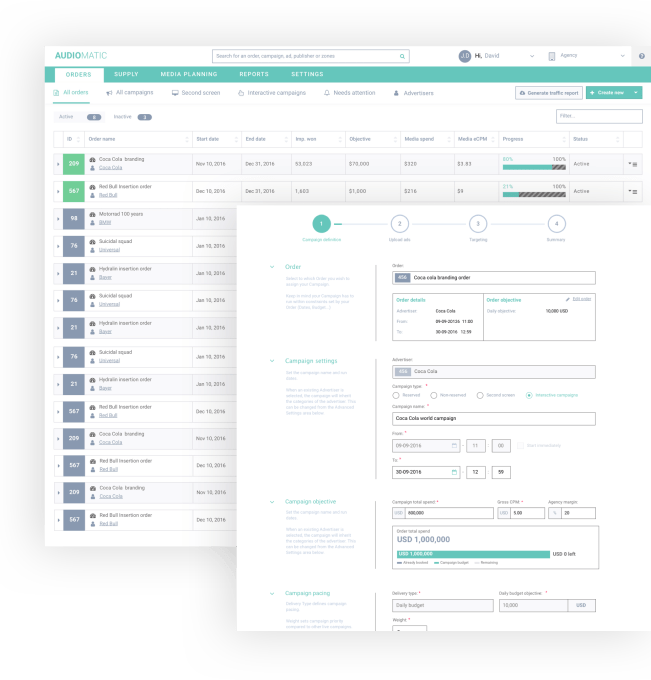
Above: AdsWizz’ AudioMatic platform for programmatic buying 

It has also developed a number of new audio formats, like ShakeMe which has users shake their phones to trigger an action while listening to an ad; ads that can target users based on an activity like jogging or a situation like cold weather; ads that can be customized based personalized data; and others.

Pandora says it will leverage the acquisition to capitalize on the growth in digital audio advertising, which is up 42 percent year-over-year, according to the IAB.

We understand that Pandora was interested in where AdsWizz’ roadmap aligned with Pandora’s specifically in the areas of audio monetization and ad-buying capabilities. It believes that by joining forces, it will be able to ship and launch new products faster.

Once integrated with Pandora, advertisers will be able to transact through AdsWizz’s global marketplace across Pandora and other audio publishers, the company says. Pandora says that it will continue to invest in AdsWizz technology that supports its core business and the wider industry – or, in order words, Pandora isn’t ripping away AdsWizz from its competitors in streaming at this time.

“Since I joined Pandora six months ago, I have highlighted ad tech as a key area of investment for us. Today we took an important step to advance that priority and accelerate our product roadmap,“ said Roger Lynch, CEO of Pandora, in a statement. “With our scale in audio advertising and AdsWizz’s tech expertise, we will create the largest digital audio advertising ecosystem, better serving global publishers and advertisers — while improving Pandora’s own monetization capabilities.”

The deal comes at a time when Pandora continues to generate the majority of its revenues from advertising, despite its entry into the subscription business with its own rival to Apple Music and Spotify. In its Q4 2017 earnings, the company reported $97.7 million in subscription revenue that offset a 5 percent year-over-year decline in advertising revenues. Meanwhile, ad revenues clocked in at $297.7 million, down from $313.3 million in the same quarter the year before.

It also follows a rough year for Pandora which saw its original founder and CEO Tim Westergren exit, along with Chief Marketing Officer Nick Bartle and President Mike Herring, as part of a larger exec shakeup.

In addition to AdsWizz CEO van de Wyer, Pandora’s acquisition will add 140 people to the company from across all AdsWizz locations, including its San Mateo headquarters.

Pandora has not been as acquisitive as rival Spotify, having generally purchased businesses that are of strategic importance at the time, instead of smaller teams with interesting technology. It’s best known for its acquisitions of Rdio and Ticketfly in 2015, though the latter was handed off to Eventbrite last year.

“We know that the value we have created for all our stakeholders – brands, publishers and listeners – comes from our ability to create engaging and well-targeted advertising experiences. That will not change,” said van de Wyer, in a post on AdsWizz’ website. “Our focus has always been digital audio, with a unique expertise in innovative monetization solutions. That will not change. What will change is our ability to grow even faster, to develop technology more rapidly, to accelerate our ability to provide solutions that meet the increasingly sophisticated needs of advertisers and digital audiences. And to have an even bigger impact on people’s lives,” he added.

The new acquisition does not impact the first quarter 2018 guidance or the full year 2018 commentary provided at Pandora’s last earnings, the company notes. The transaction is expected to close in the second quarter of 2018, and is subject to regulatory approval.

21 Mar 2018

Gfycat looks to be a hub of content for AR experience development

If all goes well, some GIF creators may start seeing their GIFs show up in augmented reality experiences, based on a new deal that’s happening with Gfycat this morning.

Gfycat said it would be working with a company called Metaverse that, like many tools of its kind, is looking to make it easier to build applications in a more plug-and-play matter — this time for building augmented reality apps. Gfycat has more than 130 million monthly active users and in particular gears its tools toward creators, and this could be another step in helping those creators get their content out to the masses as activity in augmented reality starts to continue to pick up. It’s certainly not that pretty right now, but these small agreements can sometimes be the start of increasingly robust toolsets for developers.

To be sure, there’s a number of caveats. The most obvious one is that the GIFs created by those creators have to have a transparent background. After all, it would be weird for them to show up in the real world with a weird kind of background that blocks off the rest of reality and kind of sack the whole “augmented reality” concept. But at the same time, it does start to offer a kind of pseudo-home for creators that are looking to crack into AR as well as also offering developers looking to build games or other apps and opportunity to have easy access to content to get started.

We’ve seen from the explosion of games like Pokémon Go and others that augmented reality games are increasingly going to be A Thing. Niantic may have created a pivotal use case for that with a strong brand, but while looking a bit janky right now, it’s possible that a simple game developer might figure out some niche use case in AR that will actually blow up. That starts with having access to good content, and something like this would help get them started.

All this might be completely moot if Apple and others roll out an increasingly simple interface for AR app development like more robust tools in ARkit, where developers would just sidestep platforms like Metaverse in order to just build their own interfaces. But having a hub of content to start from is also an important step in figuring out where to even begin.

The GIF space is increasingly blowing up. We’ve already talked about how a bunch of these major platforms are continuing to grow with Giphy saying it has 300 million daily active users. Tenor, another GIF platform, meanwhile nets around 12 billion searches a month for its own GIFs.

21 Mar 2018

Showcase your country’s startups at Disrupt SF

Here’s a big TechCrunch global shout-out to all countries interested in showcasing their best and brightest technology startups. Come to Disrupt San Francisco 2018 on Sept. 5-7 at the Moscone Center West and join more than 1,200 early-stage startups in Startup Alley, the very heart of every Disrupt event. A country pavilion waits just for you.

We’re looking for delegations of international startup groups, government innovation centers, incubators and accelerators to claim a country pavilion in Startup Alley. Are you ready to step on a world stage, show off your emerging companies and be recognized as a world leader in tech innovation?

Startup Alley is prime real estate, where hundreds of founders from everywhere in the world — and investors looking to fund them — gather to meet, connect and network. And maybe even produce a unicorn or two.

If you want to exhibit in Startup Alley as part of a country pavilion, your delegation startups must meet one low bar: they have to qualify as Pre-Series A companies. If they do, we want to hear from you, so shoot our Startup Alley manager an email at priya@techcrunch.com. Tell us about your delegation and where you’re from, and we’ll provide more information about the application process.

Countries that have participated in previous TechCrunch events include Argentina, Austria, Belgium, Brazil, the Caribbean, Catalonia, the Czech Republic, Germany, Hungary, Hong Kong, Korea, Japan, Lithuania, Taiwan, Ukraine and Uruguay. We believe that innovation and great ideas know no geographical boundaries, and we strive to increase the diversity within our country pavilions at every Disrupt.

We’re so serious about inviting the world that we’re putting our money where our mouth is. Sign on for a country pavilion and you’ll receive a discount off each Startup Alley company’s exhibitor package, and you’ll get organizer passes to the event. Plus, if you book your pavilion before July 25, your startups will receive one additional Founder ticket to attend Disrupt SF. You’ll find ticket pricing info here.

And in case you haven’t heard, Disrupt SF 2018 is going to be the only Disrupt event in North America this year. Not only that, by moving to a new venue, we’re tripling our floor space, and we plan to host more than 10,000 attendees. It’s our biggest Disrupt ever.

Don’t forget about all the phenomenal programming that Disrupt offers. We’ve expanded to four distinct stages — including the Main Stage featuring interviews with tech titans and icons. You can expect programming that spans 12 tech category tracks: Artificial Intelligence, Augmented/Virtual Reality, Blockchain, Biotech, Fintech, Healthtech, Investor Topics, Justice/Diversity, Mobility, Privacy/Security, Robotics and Space (as in “outer”).

Then there’s the illustrious StartUp Battlefield, where competitors vie for a grand prize of non-equity cash, investor love and serious bragging rights, a virtual Hackathon (more details on that coming soon), Q & A Sessions that let you dive deep on crucial tech, hands-on workshops and after parties.

If you’re a founder or an investor, you need to know about our CrunchMatch platform. It’s a quick, easy and efficient way to cut through the noise and connect with and meet the people looking for funding and the folks looking to provide it.

Disrupt San Francisco 2018 takes place on Sept. 5-7 at the Moscone Center West. Don’t miss the chance to showcase the best tech companies in your country. Email us about reserving your country pavilion today.

21 Mar 2018

Peer-reviewed study shows Cardiogram and Apple Watch can accurately determine atrial fibrillation

Over the past year, Cardiogram and UC San Francisco (UCSF) have presented a series of findings on how well consumer wearables like the Apple Watch and Android Wear can detect medical conditions in their users, including diabetes as well as hypertension and sleep apnea.

Now, the startup is reaching a new milestone, this morning publishing the first large-N peer-reviewed clinical study showing that the Apple Watch and other wearables can detect atrial fibrillation with a high degree of accuracy.

The study, published in JAMA Cardiology, included 9,750 participants who used Cardiogram while enrolled in UCSF’s Health eHeart Study. The company collected more than one hundred million heart rate and step counts from users, and that data was fed into a deep learning model to determine whether a particular user had atrial fibrillation. Results from the study show that the condition can be detected at 97% accuracy (c statistic), with a sensitivity (true positive rate) of 98%, and a specificity (true negative rate) of 90%. The study is a continuation of earlier work that Cardiogram had previously presented.

One of the major aspects of the study that Cardiogram is highlighting is that their deep learning model, named DeepHeart, required significantly less training data than comparable models targeting medical conditions. Only 6,338 electrocardiograms (ECGs) were required to build the model, which was 8 layers. This is an important development, since ECGs are both expensive and time consuming to perform at scale. The company has published the methodology of their deep learning model on arXiv.

Discussing the study, Brandon Ballinger, a co-founder of Cardiogram, explained to me that “This is super important. Every healthcare company needs to be built on a foundation of hard, clear evidence.” Ballinger noted that medical journal articles like the one published today are the only mechanism for building trust among health care professionals. “So we are super excited to reach this milestone.”

One caveat of the study is that it focused on patients with a known risk of atrial fibrillation, and further research needs to be conducted to determine how well the company’s deep learning model can prospectively detect the condition in patients with no treatment history.

Cardiogram will continue to develop more studies going forward. “Just like Google invests in search quality, we are always going to be investing in clinical research,” Ballinger said. He said that the company is developing random control trials — the gold standard in healthcare clinical studies — as well as launching an economic analysis to evaluate whether consumer wearables may improve the cost structure of health care diagnostics.

A broader challenge is what to do with these results. Ballinger said that “consumer wearables can be used for accurate detection of these conditions, but we need to figure out the workflow.” If Cardiogram detects atrial fibrillation for instance, what should happen next for the patient? Should they go to a cardiologist and get follow-up tests, should they be sent an at-home detection kit? At scale, those decisions will have staggering consequences for patient outcomes as well as health care costs, and more work has to be done to properly and rigorously develop these workflows.

Cardiogram, which was founded by Ballinger and Jonathan Hsieh in 2016, has raised $2 million in venture capital from A16Z’s Bio Fund. The app works both on Apple Watch as well as Android Wear watches with a heart rate sensor such as the Huawei Watch. The lead authors of the study were UCSF physicians Gregory Marcus, who is Director of Clinical Research in the Division of Cardiology, José Sanchez, and Geoff Tison.

21 Mar 2018

Dropbox boosts its price range for its IPO as it nears an $8B valuation

Dropbox said it would be increasing its IPO price range – the range which it will sell its shares for its initial public offering — from $16-$18 per share to $18-$20 per share and giving the company a valuation that could reach close to $8 billion, according to an updated filing with the Securities and Exchange Commission.

Including all shares offered from stockholders selling in this offering, the “greenshoe” and the actual IPO, Dropbox will have a valuation between $7.2 billion and $7.96 billion. It’s below Dropbox’s previous $10 billion valuation, but it’s still a signal that investors are interested in buying up Dropbox’s IPO, which will be the most well-known enterprise name to go public this year. Cloud security company Zscaler went public earlier this month and immediately saw a massive pop, but Dropbox will probably be lumped into a similar boat as Snap as a signal to whether investors are going to be interested in hyped startups.

There will indeed be some shareholders selling stock in this offering, though it looks like for the most part the ownership is going to stay the same. There are a lot of reasons to sell a stock beyond just getting liquidation, such as paying taxes for other share options and exercises, so it’s not clear exactly what the motivations are for some employees for now.

Dropbox has more than 500 million users, 11 million of which are paying users. While originally born as a consumer service, the company has sought to crack into the enterprise in order to help build a robust second line of business to tack alongside its typical consumer operations. Dropbox at the start had the benefit of spreading via word of mouth thanks to its dead-simple interface, but since then has started building out new tools geared toward larger businesses, such as Dropbox Paper.

It’s also what’s made this IPO a somewhat tricky one. The process for this is normally the same, with the company setting a price range and then throwing it out there to see who bites. If things go well, the range goes up. If things go poorly, like the case of Blue Apron, the range is going to drop. This could always change at the last minute, but you can take this as another step toward its eventual listing, which is expected to happen later this week.

21 Mar 2018

Roblox, the Club Penguin for Gen Z, is now cash-flow positive

I’m familiar with Roblox because my 8-year old daughter watches YouTube videos of kids playing the game almost every day. I’m also familiar with Roblox because she whined while we were running errands one weekend that she needed to “get on the internet right now” because she had scheduled a playdate with a friend in Roblox. And I’m familiar with Roblox because the other day, she uttered, “ugh, this obby,” which forced me to turn to Google like the old person I am to find out what the heck an obby was.

(It’s an obstacle course, in Roblox lingo, by the way.)

You see, I’m not the core demographic for Roblox, the massive gaming platform that now sees over 50 million kids playing every month. I’m a grown-up.

Roblox users tend to be young – ages 8 through 18 play the game, though the core demographic is really more 9 to 15.

For those unfamiliar, Roblox is a universe of user-generated 3D virtual worlds, where kids can engage in open-ended play. They customize their own characters, and then do things like run through obstacle courses, build the roller coaster of their dreams, pretend to be a superhero, ride a hot air balloon to a castle in the sky, go scuba diving, run a pizza parlor, and much more.

But more importantly, kids aren’t generally playing alone.

“A lot of kids come to Roblox to play with their friends,” explains Craig Donato, Roblox Chief Business Officer. “It’s like a virtual playground where they tend to jump from game to game with their friends – almost like jumping like I used to jump from like the swing set to the monkey bars.”

Kids can chat in the game, which is moderated both automatically to filter out bad words, as well as by human moderators. There are also “report abuse” features, and Roblox scans all user-gen content before it’s added to the platform.

But often, kids aren’t using in-game chat – they’ll call each other on FaceTime and play Roblox together. And sometimes record long YouTube videos of them just goofing around in the game.

Also of note, everything in Roblox has been built by other players, typically kids or young adults. That’s why the company of ten years only really began to take off a couple of years ago – when there was finally enough user-generated content to keep kids engaged.

Users often start off by playing Roblox in elementary school, then in middle school download Roblox Studio, the company’s creation engine, to build their own games and experiences. By high school, those who have learned to code start to customize their games even further.

To date, there are over 15 million user-generated games on Roblox, with over 11 million titles released last year alone. Those 11 million titles were produced by over 2 million creators, up from 1 million creators the year prior. 1,500 of those titles have topped 1 million views.

The games themselves are all free-to-play, with the creators instead charging for virtual items that kids can buy with virtual cash called Robux.

Roblox says it paid out more than $30 million to its creator community in 2017. (The company splits revenue from the games with creators, keeping about 30 percent after payment processing and hosting costs.)

“The top creators on the platform – which are typically high school kids – are making two to three million dollars a year,” notes Donato.

Roblox, in other words, is hitting its stride.

Today the company is announcing these metrics and others, along with news that it’s now cash-flow positive having generated hundreds of millions in 2017 billings, up 150 percent over last year. It’s now bringing on a CFO, Mike Guthrie, previously CFO at TruCar, to help it figure out its next steps.

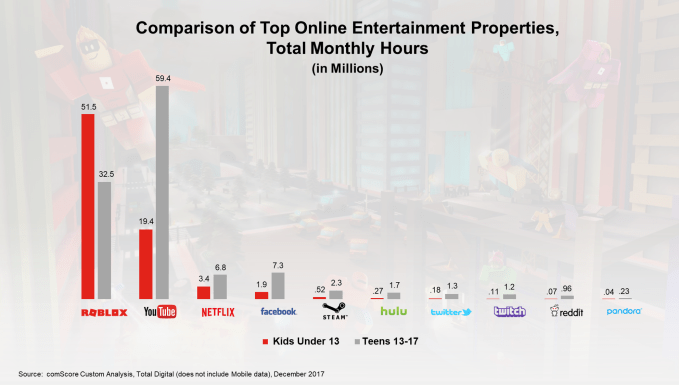
To determine its position in the state of the entertainment industry, Roblox had comScore compile data on how it compares to other online entertainment properties during the month of December 2017, and found that kids under 13 were spending more time in Roblox (51.5M hours) than on YouTube, Netflix or other social properties. And Roblox came into second place for teens, behind YouTube.

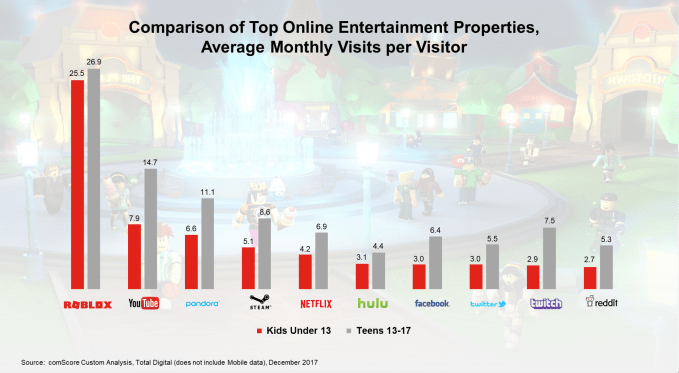
Roblox also saw more monthly visits during the month, for both kids and teens.

Around half Roblox usage is on mobile, with 40 percent on desktop and 10 percent on consoles.

With its community now well-established in the U.S., Roblox is preparing to take its gaming platform international this year, by adding support for other languages besides English, and other currencies.

It will also expand its efforts with physical goods, where it today has action figures and has started to sell branded apparel. Roblox books based on the intellectual property created by its community will be released, with creators getting a split of these revenues, too.

However, physical goods aren’t a large part of Roblox revenues, nor is advertising, which only constitutes around 5 percent of revenue. Most of it comes from the user-gen content.

Roblox will soon go after more brand partnerships, as well, like one it did recently with Warner Bros. to promote the movie “Ready Player One” in-game. And it will double its 300-person team to 600 over the next year.

To date, Roblox has raised over $100 million in funding from Meritech, Index Ventures, First Round Capital, and Altos Ventures.

21 Mar 2018

Apple Watch gets new bands for spring

Apple has unveiled new Apple Watch bands for spring.

Bands include Woven Nylon bands direct from Apple, Nike bands, and Hermès bands. Long story short, there are a bunch of new colors and styles.

[gallery ids="1610118,1610119,1610120,1610121,1610122"]

The Woven Nylon bands focus on stripes, alternating white with another color (Black Stripe, Blue Stripe, Gray Stripe and Pink Stripe). Meanwhile, the Sport band is coming out in Denim Blue, Lemonade, and Red Raspberry, while the Sport Loop comes in Flash Light, Hot Pink, Marine Green and Tahoe Blue. And then there’s Classic Buckle, which comes in Spring Yellow, Electric Blue, and Soft Pink.

Meanwhile, The Nike Sport Loop will now be sold separately, coming in Black/Pure Platinum, Bright Crimson/Black, Cargo Khaki, Midnight Fog, and Pearl Pink, while the Nike Sport will come in Barely Rose/Pearl Pink, Black/White and Cargo Khaki/Black.

Finally, Hermès will be revealing new Apple Watch bands with an accent color. The 38mm Double Tour will come in Indigo or Blanc with rouge H polished edge and contrasted loop, and the 42mm Single Tour Rallye will offer the same colors.

Apple sold more than 18 million Apple Watch units last year.