20 Mar 2018

Zuck and Sandberg go M.I.A. as Congress summons Facebook leadership by name

The bad thing about making your face synonymous with with the company you run: When you go M.I.A., everyone tends to notice.

The callout posts began over the weekend. Normal Facebook users don’t always track the tech press outrage cycle, but a flurry of reporting on Facebook’s mishandling of the private data of 50 million users, and Facebook’s subsequent mishandling of that mishandling — this after everything else — it seemed to stick in their craw.

Worse yet for Facebook, lawmakers that they’d already pissed off were happy to circle back for a second round after the company weaseled out of the first one. By Monday, a few angry, constituent-rousing tweets had snowballed into the kind of itemized list of questions that comes with a due date.

Congress is mad. And it might be as mad about this poorly handled Cambridge Analytica debacle as it is about getting stood up the last time around. Without any kind of public statement from one of the faces of the company, Facebook users are starting to feel stood up too.

Where in the world is… anyone?

Where does that leave Facebook leadership? So far, it’s nowhere to be found. No semi-intelligible non-apology calling to bring the world closer, if only we could, from Zuck. No lukewarm screed from Sandberg addressing a tertiary and much safer company concern. No nothing.

Ever since Facebook scooped the New York Times’ story on its company blog — “after a week of inquiries from The Times, Facebook downplayed the scope of the leak and questioned whether any of the data still remained out of its control. But on Friday, the company posted a statement expressing alarm and promising to take action…” — the most vocal company statements have come from Facebook Deputy General Counsel Paul Grewal and the potentially outgoing head of information security Alex Stamos. It goes without saying that having a lawyer and the noble hacker guy who tried to quit out in front is not the most flattering look for a company so synonymous with its leadership team, namely Zuckerberg and Sandberg.

Sandberg specifically was named in a damning bit of the New York Times story on Stamos’s near rage-quit. That portion described how, according to sources, Stamos advocated for an aggressive investigation into Facebook’s Russia headache to the “consternation” of Facebook executives. Sandberg was the only named executive. That language has since been softened, describing how Stamos and Sandberg “disagreed early on over how proactive the social network should be in policing its own platform” but calling their relationship “reproductive.”

Zuckerberg and Sandberg did not attend a Tuesday town hall on the issue (nor were they scheduled to, as the Verge reported) and that’s apparently left employees wondering where their fearless leadership has gone too.

Facebook’s feet to the fire: Round One recap

Late last year, Facebook General Counsel Colin Stretch joined lawyers from Twitter and Google to testify on the role the platform may have played in spreading viral disinformation during the 2016 election.

In a trio of public hearings, members of the Senate Judiciary and Senate and House Intel committees raked Facebook’s legal stunt double over the coals, occasionally tossing a question to Twitter or Google. It was a lot of careful lawyerspeak and a handful of cooperative gestures with no actual legislative buy-in. No one much was surprised.

The spiciest moments came when Sen. Amy Klobuchar got Facebook counsel to admit that, if left unregulated, there would be no one to make them accountable for their actions. Stretch could only agree.

Facebook alone in the hot seat

This time around, Facebook might not clamber out of the hot water so easily. While the company had ample cover last time thanks to Google and Twitter’s twin implications in the controversy over Russian-bought political ads targeting U.S. voters, this time Facebook stands alone. The revelation that Facebook data on as many as 50 million users appears to have made its way into a political data operation with no consent from users is Facebook’s burden to bear alone.

Congress has legitimate interest in protecting users subject to the ad revenue-driven whims of a supposedly self regulating tech platform, and unfortunately for Facebook, big tech regulation is starting to look like something most people can get behind. The calls to get Zuckerberg under oath before Congress are picking up steam across at least three major congressional committees, not to mention the FTC and Parliament in the UK.

Senate Judiciary Committee

Sen. Amy Klobuchar kicked off the Zuckerhunt over the weekend. Now, she’s flanked by colleagues on both sides of the aisle.

“The last time we had a hearing, Google and Twitter and Facebook sent their lawyers, which undoubtedly were expensive because they did a damn fine job of dodging and bobbing and weaving and they didn’t say a damn thing – which is what they were paid to do, or not to do, as the case may be,” Republican Senator John Kennedy told Politico. “This time, I hope the principals come and we can have a frank discussion.”

On Tuesday, Senate Judiciary ranking Democrat Dianne Feinstein joined lawmakers calling for Zuckerberg himself to testify.

Senate Commerce Committee

On Monday, Republican Commerce Chairman John Thune joined Senators Roger Wicker and Jerry Moran to assert its jurisdiction over data privacy and consumer protection issues at the fore of the Cambridge Analytica conversation. The committee will weigh Zuckerberg’s response to a letter it sent in deciding to summon him to testify.

“Mark Zuckerberg ought to be subpoenaed if he doesn’t appear voluntarily, to appear under oath, in public, along with other CEOs in the same space,” Sen. Richard Blumenthal told reporters on Monday night.

Senate Intelligence Committee

On Tuesday morning, the ranking Democrat on the powerful Senate Intelligence Committee also called for Zuckerberg to take the stand. Warner, a vocal critic of Facebook’s initial response to the Russian ads revelations, isn’t one to let the company off the hook.

Before Warner’s call, Senate Intel member Ron Wyden — one of the biggest privacy advocates in Congress — issued a letter to Zuckerberg seeking answers on a number of detailed points on Monday, including how many privacy audits the company has conducted for apps on its platform and if Facebook has ever notified individual users of privacy violations of this nature. It’s likely that Wyden, who issued Facebook an April 13 deadline for his questions, supports Warner’s zeal for getting Zuck under oath.

Senate Intel chairman Richard Burr has yet to demand Zuckerberg’s appearance.

The bipartisan calls for accountability have been fast and firm. Unfortunately for Facebook, being mad at Facebook is something that brings people together — perhaps another unforeseen risk of building the world’s biggest social network.


20 Mar 2018

Salesforce is buying MuleSoft at enterprise value of $6.5 billion

Salesforce today announced that it intends to buy MuleSoft in a deal valued at a whopping $6.5 billion. That’s not the selling price, but the amount the company has been valued at based on stocks, bonds and cash on hand. The exact price was not available yet, but the company did indicate it was paying 44.89 per share for Mulesoft, a price that represents 36 percent premium over yesterday’s closing price, according to Salesforce .

What’s more, the deal values each Mulesoft share at $36 in cash and 0.0711 shares of Salesforce common stock.

Rumors began swirling this morning after a story broke by Reuters that the CRM giant was interested in MuleSoft, which launched in 2006, and went public almost exactly a year ago.  It gives Salesforce a mature company to add to its arsenal with 1200 customers. It also gives them an API integration engine that should help the company access data across organizations regardless of where it lives.

This is particularly important for Salesforce, which tends to come in and work with a company across enterprise systems. As it builds out its artificial intelligence and machine learning layer, which it has branded as Einstein, it needs access to data across the company. A company like Mulesoft gives them that.

But of course, Salesforce gets more than tech with this purchase, which it can integrate into its growing family of products. It also gets major customers like Coca-Cola, VMware, GE, Accenture, Airbus, AT&T and Cisco. While Salesforce may have a presence already in some of these companies already, Mulesoft gives them entree into areas they might not have had and gives them the ability to expand that presence.

This is a developing story.

20 Mar 2018

Tradewind Bioscience attacks the physiology of tumors to treat cancer

Cancer remains the one counterpoint to the march of medical progress that has scored human history over the last 200 years.

Last year 600,920 people in the U.S. died from cancer, and another 1.7 million received an initial diagnosis of the disease. Globally, one in six people die from cancer, according to the World Health Organization.

In the past decade, research in the field has expanded the possible treatments of the disease from surgery (which was the only option until the 20th century), radiotherapy, chemotherapy and hormonal therapy.

Among the most promising of these new treatments are those which attack the functions of the tumor itself. New epigenetic therapies, therapeutic viruses, novel nanoparticles, and immune therapies look at external responses to cancerous growths — sequencing out mutations that can lead to cancerous growths; creating new pathogens that only attack cancer cells; building new particles that attack cancer cells; or boosting the ability of the body’s natural immune system to attack cancer cells. By contrast these treatments look to stop the growth of tumors by focusing on inhibiting the biological processes that encourage that growth.

Tradewind Bioscience, which is launching today at Y Combinator’s winter demo day, is taking this approach.

While research on these new potential therapies is only now making its way into scientific journals (with most studies published within the past three months), Tradewind co-founders Dr. Thaddeus Allen and Dr. Ron Buckanovich have mostly kept their research under wraps after having studied different cancers for more than a decade.

Non-small cell lung cancer in a 54 year-old woman. Photo courtesy of Flickr/Oregon State University

Allen began his research roughly 14 years ago at the University of California, San Francisco under the tutelage of the Nobel Prize-winning cancer researcher Dr. J. Michael Bishop, where he was studying the way a certain protein, EGFL6, affected the growth of lung cancer cells.

Bishop’s lab was one home for novel cancer research, but UCSF wasn’t alone in breaking new ground on cancer research. Half a continent away, Buckanovich was doing his own studies on the role that the same protein played in the growth of ovarian cancer cells in his lab at the University of Michigan .

“He had filed a patent through the University of Michigan,” Allen says of how he first came across Buckanovich’s research. “I found him on Google patents and I found the patent first. I contacted the tech transfer office and they put me in touch with [him]. Probably the best thing I’ve done in the course of this adventure was to form that relationship with Ron and the University of Michigan.”

Buckanovich published his research on the link between ovarian cancer and the EGFL6 protein in 2016, and it was the jolt that Allen needed to reach out and begin work on Tradewind in earnest.

“I thought long and hard about how we proceed,” Allen says. “This protein is incredibly important in how cancers survive and spread around the body. I had that idea four years ago… and it took me that time to get the courage to say okay let’s get this together.”

In the interim, Allen had been quietly amassing a body of research of his own on how the protein may affect lung cancer cells. “I wanted to keep things secret until things had progressed to a certain point. A point of inevitability,” he says. “I really want to be the one to make this work.”

Serous carcinoma. Photo courtesy of Flickr/Ed Uthman

That Tradewind’s therapy is potentially able to treat two very different kinds of cancer is remarkable because cancer is considered to be a very unique disease. It’s a parasite that’s specific to the genetic makeup of its host. In fact, the specificity of cancer to an individual is what makes the disease so difficult for the body to fight.

“We’re taking on the possibility that they’ve really hit on something that — as opposed to going after some downstream things — are in the physiology of these cancers,” says Diego Rey, Y Combinator’s visiting partner focused on healthcare and biotech startups. “When you go downstream in these [treatment] processes it’s a little bit like whack a mole,” says Rey. 

Rather than attack the cancer, Tradewind’s therapy tries to attack the root of the disease. How it grows and spreads through the body.

“We’ve been able to tease out [some] main things that [the protein] does,” says Allen. “It regulates cancer stem cels… the ones that allows the cancer to grow… And it plays a really prominent role in the survival of cells.”

In primary tumors — the initial cancerous mutations — Allen and Buckanovich discovered that the protein they identified plays a major role in controlling stem cells which allow the tumor to grow. That same protein is important in keeping cancers alive as they spread through the body.

“The secreted protein feeds back on the cells and allows them to live as they exit the tumor and find new homes in different tissues,” says Allen. “What the antibody can do… it can bind to the secreted protein and now the protein can not feed back on the cancer cell and bind to the receptors that it’s supposed to bind to. So now it can’t provide that survival signal to the cancer cell.”

The expression of this protein in a patient can also be a useful indicator of the potential to develop cancer. “If you have lots of this protein it’s very likely that you will succumb to a cancer,” says Allen. “[And] it’s really the highly metastatic cancers. These are the deadliest. These are the ones that will spread around the body to different tissues.”

For Allen and Buckanovich, the development of their therapy means that patients could one day get an intravenous infusion of antibodies that would inhibit the production of the protein they identified, rather than getting a bolus of incredibly toxic chemotherapy or undergoing radiotherapies.

“That is actually what Y Combinator has urged us to refocus on,” Allen said. “We’ve been so busy trying to convince people that the target is fantastic.”

Once out of Y Combinator Allen predicts that his new company will need between $7 million and $10 million to get to a first stage of clinical trials within the next three years.

Both he and Buckanovich think that the treatment could be effective beyond their fields of expertise in lung cancer and ovarian cancer.

“Tumors use EGFL6 to tell the cancer cells to migrate and then divide. You’re telling the cancer cells to metastasize,” says Buckanovich. “[But] we have also shown that it helps cancer cells to initiate.”

Buckanovich says that’s the key to what he and Allen are trying to do. “The protein is made not only by the tumor cells but it is made by the host,” he says. “Think of it like soil. If cancer is the seed… if we can prevent there from being a fertile soil for any of these seeds to grow. It may be more applicable than just the subset of cancers that make this protein… In an ideal world this drug would be preventative. We might be able to treat [cancer] with a benign course of antibodies.”

20 Mar 2018

Get ready to start seeing more local ads on YouTube

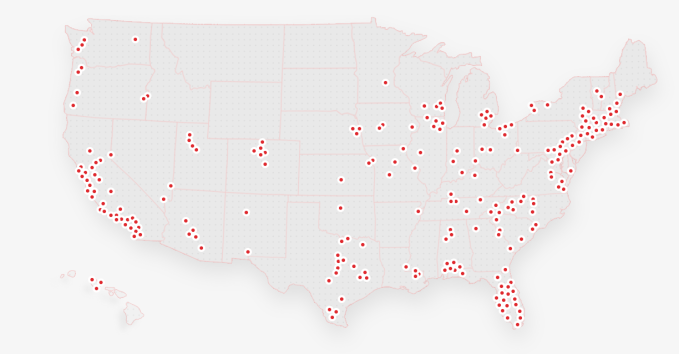
YouTube’s video ad creation service aimed at helping small business reach YouTube viewers is now available more broadly across the U.S. The company announced this morning that YouTube Director onsite, as the service is called, is now live in over 170 U.S. cities, up from only 9 previously – Atlanta, Boston, Chicago, Los Angeles, San Francisco, Washington D.C., New York, Tampa and Seattle.

This is significant expansion, in terms of reaching potential YouTube advertisers who would have otherwise not had the resources to write, film and edit a professional ad for YouTube.

The service is kind of a bargain for the small businesses, too. Hiring a pro to create a professionally produced video could cost $1,000 or more. But YouTube is basically doing it for free – well, free with a catch.

It’s available at no charge for any business that commits to spending at least $350 to advertise the video on YouTube. However, that’s in line with the low-end of buying airtime for a 30-second local TV ad, which ranges from $200 to $1,500+, depending on time slot.

YouTube Director onsite works by connecting area businesses with YouTube-approved filmmakers, who will schedule call with the advertiser to learn about the business and help them to write a script. The filmmaker then comes to the business to film the video, and returns an edited version the next week. YouTube’s ad experts help get the video upload to the site, and aid the business in crafting their YouTube ad campaign.

The company hasn’t shared any comprehensive metrics on how well these ads perform, but did note in a blog post a single case study where a custom guitar shop saw a 13x return on ad spend, and a 130 percent increase in revenue from the ad. The YouTube Director onsite website also features a number of other ads created via the service, to showcase the professional quality of what can be produced.

The company has claimed for years that YouTube ads are more effective than TV because they allow targeting – but that’s an argument that can be made for may sorts of online ads. In addition, YouTube reaches a younger demographic, so small businesses should keep in mind that they may need other ways to reach to those over the age of 35, for example.

The timing of this U.S. expansion is relevant because YouTube just last week announced new AdWords experiences that tie together Google searches with YouTube advertising and calls-to-action.

“Soon you’ll be able to reach people on YouTube who recently searched for your products or services on Google. For example, an airline could reach people on YouTube who recently searched Google.com for ‘flights to Hawaii.’ We call this custom intent audiences,” explained the recent Google’s announcement.

The company had previously allowed Google account user data to influence YouTube ads, starting in 2017. With custom intent audiences, advertisers can now create a keyword list for their video in AdWords. They can then combine this targeting feature with YouTube’s new direct response video ad format, TrueView, which offers a customizable call-to-action in a video ad.

The ads created by YouTube Director onsite will support this feature as well, allowing the businesses to capture leads or referrals, or something else that’s important to their specific businesses.

In other words, if you thought having the shoes you abandoned in a retailer’s shopping cart following you around the web was weird, wait until YouTube starts showing you ads for local businesses that match up with what you’ve just been googling. (By the way, Google does let you opt out of personalized ads if that’s how you roll.)

20 Mar 2018

Cambridge Analytica CEO Andrew Nix has reportedly been suspended

Andrew Nix, the CEO of the London-based voter profiling company Cambridge Analytica — which harvested private information from more than 50 million Facebook users without their permission to analyze their voter behavior — has been suspended from his job, according to Bloomberg’s David Meyers.

We’ve reached out to the company for more information but have yet to hear back from our sources there.

Nix’s suspension won’t come as a shock to many, considering footage that was filmed over the last year by Britain’s Channel 4 News and which surfaced yesterday. The video comes on the heels of investigative reporting by the Guardian, The Observer and the New York Times that has shown how the company used data to target groups and design messages that appealed to their interests.

In one minute-long clip, Nix boasts of entrapping politicians to meet its clients’ needs. Nix can be overheard saying in one recording, “It sounds a dreadful thing to say, but these are things that don’t necessarily need to be true as long as they’re believed.”

It gets worse, as anyone who read about Nix in the Guardian yesterday can attest.

From its report:

When the reporter asked if Cambridge Analytica could offer investigations into the damaging secrets of rivals, Nix said it worked with former spies from Britain and Israel to look for political dirt. He also volunteered that his team were ready to go further than an investigation.

“Oh, we do a lot more than that,” he said over dinner at an exclusive hotel in London. “Deep digging is interesting, but you know equally effective can be just to go and speak to the incumbents and to offer them a deal that’s too good to be true and make sure that that’s video recorded.

“You know these sort of tactics are very effective, instantly having video evidence of corruption.”

Nix suggested one possible scenario, in which the managing director of Cambridge Analytica’s political division, Mark Turnbull, would pose as a wealthy developer looking to exchange campaign finance for land. “I’m a master of disguise,” Turnbull said.

Another option, Nix suggested, would be to create a sex scandal. “Send some girls around to the candidate’s house, we have lots of history of things,” he told the reporter. “We could bring some Ukrainians in on holiday with us, you know what I’m saying.”

Cambridge Analytica was reportedly embedded with the Trump campaign beginning in 2016.

Talking to the trade magazine Ad Age at the time, a consultant who had worked with the company noted that no one in Washington took the firm terribly seriously, either. “Everyone universally agrees that [Cambridge’s] sales operation is better than their fulfillment product . . . The product comes late or it’s not quite what you envisioned.”

“What’s the old saying?” asked another source in the same article. “All hat, no cattle?”

According to the Guardian, Nix, 42, studied the history of art at Manchester University and worked as a financial analyst in Mexico and the U.K. before joining SCL, a strategic communications firm that is parent to Cambridge Analytica.

Nix later set up Cambridge Analytica with the help of Robert Mercer, a billionaire patron of right-wing outlets like Breitbart News. Steve Bannon, the former executive director of Brietbart who served as Trump’s chief strategist until last August, was formerly a vice president with the outfit.

20 Mar 2018

Cambridge Analytica CEO Andrew Nix has reportedly been suspended

Andrew Nix, the CEO of the London-based voter profiling company Cambridge Analytica — which harvested private information from more than 50 million Facebook users without their permission to analyze their voter behavior — has been suspended from his job, according to Bloomberg’s David Meyers.

We’ve reached out to the company for more information but have yet to hear back from our sources there.

Nix’s suspension won’t come as a shock to many, considering footage that was filmed over the last year by Britain’s Channel 4 News and which surfaced yesterday. The video comes on the heels of investigative reporting by the Guardian, The Observer and the New York Times that has shown how the company used data to target groups and design messages that appealed to their interests.

In one minute-long clip, Nix boasts of entrapping politicians to meet its clients’ needs. Nix can be overheard saying in one recording, “It sounds a dreadful thing to say, but these are things that don’t necessarily need to be true as long as they’re believed.”

It gets worse, as anyone who read about Nix in the Guardian yesterday can attest.

From its report:

When the reporter asked if Cambridge Analytica could offer investigations into the damaging secrets of rivals, Nix said it worked with former spies from Britain and Israel to look for political dirt. He also volunteered that his team were ready to go further than an investigation.

“Oh, we do a lot more than that,” he said over dinner at an exclusive hotel in London. “Deep digging is interesting, but you know equally effective can be just to go and speak to the incumbents and to offer them a deal that’s too good to be true and make sure that that’s video recorded.

“You know these sort of tactics are very effective, instantly having video evidence of corruption.”

Nix suggested one possible scenario, in which the managing director of Cambridge Analytica’s political division, Mark Turnbull, would pose as a wealthy developer looking to exchange campaign finance for land. “I’m a master of disguise,” Turnbull said.

Another option, Nix suggested, would be to create a sex scandal. “Send some girls around to the candidate’s house, we have lots of history of things,” he told the reporter. “We could bring some Ukrainians in on holiday with us, you know what I’m saying.”

Cambridge Analytica was reportedly embedded with the Trump campaign beginning in 2016.

Talking to the trade magazine Ad Age at the time, a consultant who had worked with the company noted that no one in Washington took the firm terribly seriously, either. “Everyone universally agrees that [Cambridge’s] sales operation is better than their fulfillment product . . . The product comes late or it’s not quite what you envisioned.”

“What’s the old saying?” asked another source in the same article. “All hat, no cattle?”

According to the Guardian, Nix, 42, studied the history of art at Manchester University and worked as a financial analyst in Mexico and the U.K. before joining SCL, a strategic communications firm that is parent to Cambridge Analytica.

Nix later set up Cambridge Analytica with the help of Robert Mercer, a billionaire patron of right-wing outlets like Breitbart News. Steve Bannon, the former executive director of Brietbart who served as Trump’s chief strategist until last August, was formerly a vice president with the outfit.

20 Mar 2018

Amazon surpasses Alphabet in market value

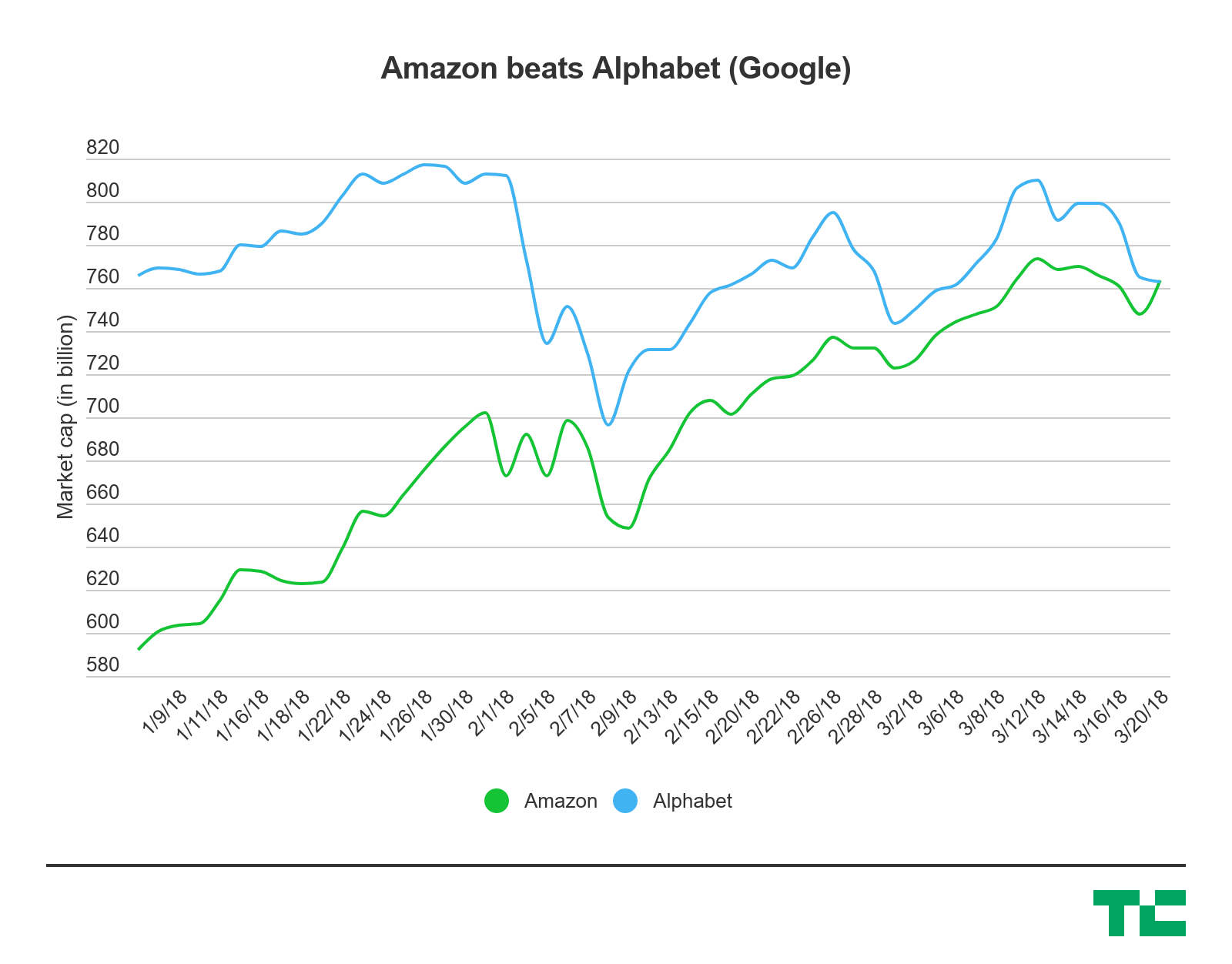
Amazon is currently the second biggest company in the world when it comes to market capitalization. The company is currently worth $763.27 billion (NASDAQ:AMZN) while Alphabet (NASDAQ:GOOG) is “only” worth $762.98 billion.

Amazon has had an incredible quarter. Stock is up nearly 29 percent since early January. As for Alphabet, its shares have gone up and down.

And if you look at today alone, Amazon is up 2 percent, while Alphabet is flat. Alphabet can still pass Amazon again before the stock market closes. But it sounds like the writing is on the wall.

The only company that is currently more valuable than Amazon is Apple. There’s still quite a long way to reach Apple as Apple’s market capitalization is… $892 billion.

20 Mar 2018

This tortoise shows kids that robot abuse is bad

When humanity’s back is against the wall and the robots have us cornered I’d say I’m all for whanging a few with a baseball bat. However, until then, we must be kind to our mechanical brethren and this robotic tortoise will help our kids learn that robot abuse is a bad idea.

Researchers at Naver Labs, KAIST, and Seoul National University created this robot to show kids the consequences of their actions when it comes to robots. Called Shelly, the robot reacts to touches and smacks. When it gets scared it changes color and retracts into its shell. Children learn that if they hit Shelly she will be upset and the only thing missing is a set of bitey jaws.

“When Shelly stops its interaction due to a child’s abusive behavior, the others in the group who wanted to keep playing with Shelly often complained about it, eventually restraining each other’s abusive behavior,” Naver Labs’ Jason J. Choi told IEEE. The study found that Shelly’s reactions reduced the amount of abuse the robot took from angry toddlers.

The researchers showed off Shelly at the ACM/IEEE International Conference on Human Robot Interaction last week.

20 Mar 2018

Oracle’s cloud biz heading in the wrong direction right now

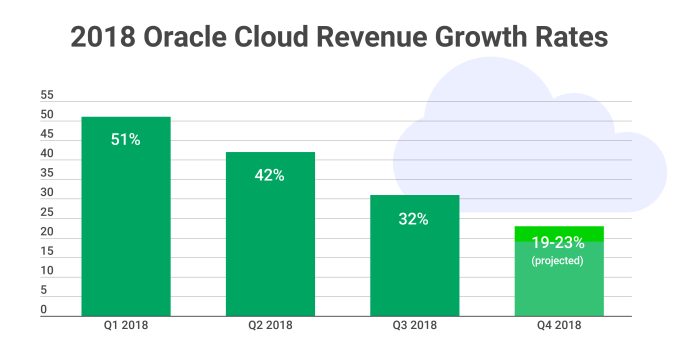
Oracle announced its quarterly earnings last night, detailing that its cloud business grew 32 percent to $1.6 billion in the quarter. That might sound good at first blush, but it’s part of three straight quarters of reduced growth — a fact that had investors jittery over night. It didn’t get better throughout the day today with Oracle’s stock plunging over 9 percent as of this writing.

When you consider that enterprise business is shifting rapidly to the cloud, and that the cloud business in general is growing quickly, Oracle’s cloud numbers could be reason for concern. While it’s hard to nail down what “cloud” means when it comes to technology companies’ earnings because it varies so much in how each one counts infrastructure, software, or platform; the general trend from Oracle seems contrary to the eye-popping growth numbers we have seen from other companies.

Oracle against the world

Oracle’s cloud revenue broke down as follows: SaaS, up 33 percent to $1.2 billion, and platform and infrastructure revenue combined up 28 percent to $415 million. To put those figures into context, consider that last quarter Alibaba reported overall cloud revenue of $533 million,which was up a whopping 104 percent year over year.

Looking purely at Infrastructure services, Canalys reported that in the third quarter of 2017, Microsoft grew at around 90 percent year over year, while Google grew around 75 percent YoY. Even market leader Amazon, which controls over 30 percent of the market, had around a 40 percent growth rate, fairly remarkable given its size.

All of that suggests that Oracle, which came to the cloud late, should be on a higher growth trajectory than it’s currently showing.That’s because it’s generally easier to grow from a small number than it is from a big number to bigger number (as Amazon has had to do).

The company’s on-prem software revenue continues to grow (which includes lucrative license and maintenance revenue from existing customers), and still accounts for the vast majority of its top line. However, at this point, you would think Oracle would want to see that revenue growth shifting away from on-prem and towards its cloud business.

What’s worse is that co-CEO Safra Catz predicted in the earnings call with analysts that the cloud growth could dive even further next quarter. “Cloud revenues including SaaS, PaaS and IaaS [all cloud business combined] are expected to grow 19% to 23% in USD, 17% to 21% in constant currency,” she told analysts this week.

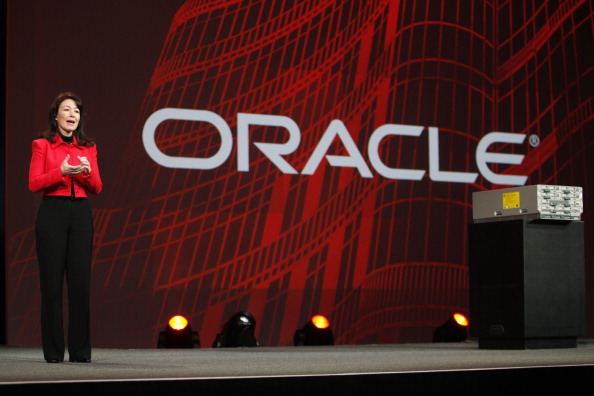
Oracle co-CEO Safra Catz Photo: KIMIHIRO HOSHINO/AFP/Getty Images

Looking for a brighter future

Chairman Larry Ellison tried to point to the fully automated cloud database product announced at Oracle OpenWorld last fall as a proof point of a brighter cloud future, but so far the numbers are not bearing that out. It’s worth noting that he did also indicate that more automated cloud products are on the way.

Oracle has spent the last several years putting a lot of cloud pieces together, and as Catz pointed out, they don’t have to invest further to handle additional capacity in their SaaS business, but with the numbers heading in the wrong direction that may not be the problem.

Oracle certainly has enterprise credibility, and that should bode well for its cloud business, but as a late comer to the market we should be seeing much brisker overall growth than this. Over time that may happen, but for now Wall Street was not happy with Oracle’s results and the firm probably has to show more from its cloud products before they can change investors’ minds.

20 Mar 2018

Toyota pauses automated driving testing on U.S. roads following Uber accident

Automaker Toyota has temporarily ceases its public road testing of its fully autonomous ‘Chauffeur’ system in the U.S. after an accident earlier this week saw an Uber self-driving test vehicle strike a pedestrian, which ultimately resulted in her death.

Police have stated that initial findings suggest the accident would’ve been extremely difficult to avoid regardless of whether a human or an AV system was in control at the time, because of how quickly the victim crossed in front of the moving vehicle (outside of a crosswalk), but Toyota has indicated to Bloomberg that it’s stopping testing for now due to the potential “emotional effect on [its] test drivers.”

Toyota spokesperson Brian Lyons noted that the automaker couldn’t speculate on the cause of the crash or its implications for the future of the self-driving industry, which is a fairly standard line I’ve heard across automakers and others involved in the industry thus far, and which suggests a fair reluctance to make any lasting material decisions before all information is available regarding the Uber incident.

Toyota has been working on both its ‘Chauffeur’ fully automated driving system, as well as ‘Guardian,’ an advanced-driver assist system that is designed to institute fail-safes for intervening to prevent accidents when a human driver’s behavior puts themselves or others in danger.