20 Mar 2018

Facebook has lost $60 billion in value

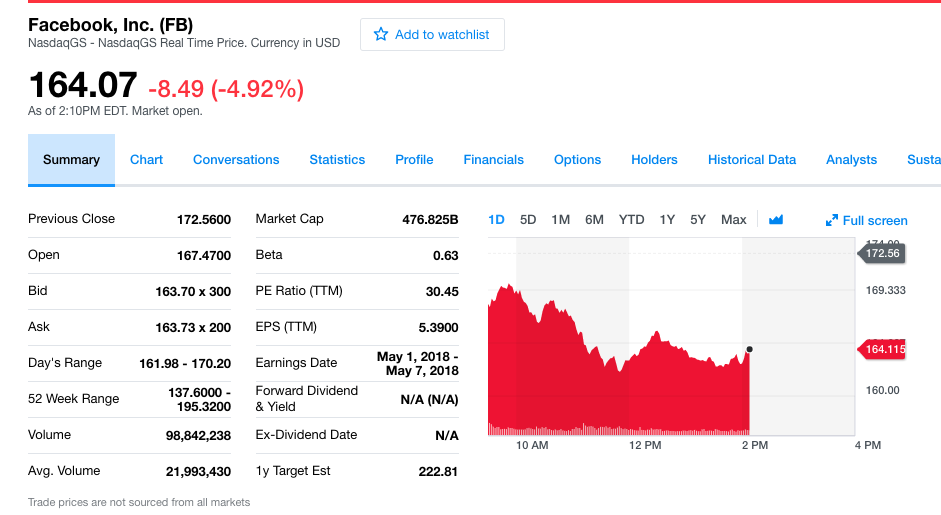
Facebook is having a bad day… for the second day in a row. Following the Cambridge Analytica debacle, Facebook shares (NASDAQ:FB) are currently trading at $164.07, down 4.9 percent compared to yesterday’s closing price of $172.56.

More importantly, if you look at Monday and Tuesday combined, Facebook shares are down 11.4 percent compared to Friday’s closing price of $185.09. In other words, Facebook was worth $537.69 billion on Friday evening when it comes to market capitalization. And Facebook is now worth $476.83 billion.

That’s how you lose $60 billion in market cap.

20 Mar 2018

Senate Intel Committee gives Homeland Security its election security wish list

In a press conference today, the Senate Select Committee on Intelligence presented its urgent recommendations for protecting election systems as the U.S. moves toward midterm elections later this year.

“Currently we have an election upon us, and the past tells us that the future will probably hold another set of threats if we are not prepared,” Senator Kamala Harris said.

The bipartisan committee offered a set of measures to defend domestic election infrastructure against hostile foreign nations.

Before launching into the findings from its committee-wide examination of current practices, written up in an accompanying report, the group emphasized that states are “firmly in the lead” in conducting elections, although the federal government should work closely to provide funds and information.

Although there are many factors that can mitigate the risk to U.S. elections, election equipment itself, particularly internet-connected systems, remains a core concern in the report:

“States should rapidly replace outdated and vulnerable voting systems. At a minimum, any machine purchased going forward should have a voter-verified paper trail and no WiFi capability. If use of paper ballots becomes more widespread, election officials should re-examine current practices for securing the chain of custody of all paper ballots and verify no opportunities exist for the introduction of fraudulent votes.”

Because financial need varies from state to state, the committee recommended legislation that would create a grant program through which states could apply for election security funds, including the funding needed to conduct system audits.

“States should use grant funds to improve cybersecurity by hiring additional Information Technology staff, updating software, and contracting vendors to provide cybersecurity services, among other steps,” the report states.

The rest of the report focused on how to bolster U.S. election infrastructure and practice against foreign attacks. Now that the potential vulnerability of U.S. election systems is widely known, Russia may not be the only adversary looking to poke holes in U.S. systems.

“It may not be the Russians next time,” Sen. James Lankford said. “They have set a pattern that others could follow.” That means that Iran, North Korea or even domestic hacktivist groups could be following along.

The committee recommends that the U.S. work with allied countries to create international cyber standards to deter hostile nations from taking advantage of current gray areas in cyber policy, making it clear that attacks on election systems are “hostile acts.”

“We need a more transparent cyber doctrine so that other nation-states are on notice,” New Mexico Senator Martin Heinrich said.

The committee made multiple mentions of the Department of Homeland Security’s failure to coordinate with states — and state-level distrust of that department — during the 2016 election. In the past, information sharing between federal and state officials has been hampered by slow processes for obtaining the proper security clearances for state and local election workers.

“The Intelligence Community should work to declassify information quickly, whenever possible, to provide warning to appropriate state and local officials,” the report states.

States also lag behind when it comes to knowledge and implementation of basic cybersecurity best practices like two-factor authentication. The committee urges DHS to work to educate the states to establish a set of best practices to mitigate risk.

Tomorrow, the committee will have a chance to hand their wish list over in person. Homeland Secretary Kirstjen Nielsen will appear in the first of a three-panel hearing, alongside Obama-era secretary Jeh Johnson who oversaw the department during the 2016 election.


20 Mar 2018

YouTube rolls out a new feature that lets you ‘go live’ from the desktop without an encoder

YouTube today is rolling out a new feature that will allow video creators to start a live stream from their web cam without downloading encoding software, which can be complicated to set up. Now, streamers will be able to click the “Go Live” button in the YouTube header to start the stream, or visit the URL youtube.com/webcam. No additional configuration will be required, the company says.

The feature currently works only on the Google Chrome browser, but will expand to other browsers in time.

Before today, YouTube users would have to use encoding software to capture content – including their desktop, camera, and microphone – and send it to YouTube to be live streamed.

The new feature is meant to make the process of live streaming from the desktop easier and quicker, which could potentially enable more YouTube users to take advantage of the functionality.

YouTube has already been testing an early version of the software with a handful of creators, including RawBeautyKristi, who used it for a beauty tutorial, saying, “normally, you have to do this encoder bulls*t…this is so much easier this way. I feel like I’ll live stream way more with this.”

Curtiss King TV used it for fan updates, and Kens Kreations tested it out for product reviews.

Today, Oakland Raiders quarterback Derek Carr announced the news of the feature on his YouTube channel.

The addition comes at a time when the live streaming market is heating up, with competitors like Twitch for game streams, Twitter’s Periscope, and Facebook Live, all vying for a piece of the action. Facebook, in particular, has been targeting the creator community, including with this week’s launch of a Patreon clone for subscription patronage, and other ways to allow creators to make money.

YouTube says that the new web cam feature is only one of several ways it’s planning to make it easier for creators to go live in the future.

The company has also scored deals with several device manufacturers including Asus, LG, Motorola, Nokia and Samsung who will add a live stream feature directly in their camera apps on select upcoming devices in the months ahead. The feature, which takes advantage of the new YouTube Mobile Live deep link, is expected to come to other devices throughout the year, says YouTube.


20 Mar 2018

Apple’s autonomous vehicle fleet has nearly doubled in the last two months

Apple seems to be ramping up its autonomous vehicle efforts, nearing doubling the number of vehicles in its fleet since January.

The company now has 45 autonomous vehicles in California registered with the DMV, according to the Financial Times. This makes Apple’s AV fleet the second largest in the state of California, outsized only by General Motors.

In April 2017, Apple received its first permit to test three autonomous vehicles. By January of this year, the company was testing 27 autonomous vehicles, and in just two months the company has nearly doubled its efforts, with plans to start testing vehicles in Arizona.

That said, regulatory hurdles may be rising. On Sunday night, one of Uber’s autonomous test vehicles was involved in an accident, fatally colliding with a pedestrian in Tempe Arizona.

This is the first time an AV accident has resulted in a human death, and Uber has suspended testing of its fleet in all the cities where it operates.

In the wake of this incident, regulators may take a more measured approach to deployment.

20 Mar 2018

Amazon adds fingerprint authentication to Key app for Android

Building technology is all about learning as you go. Amazon knows this, and has today added fingerprint ID to the new Amazon Key app, which enables in-home delivery of goods.

The Key app was announced in October, alongside the Cloud Cam, which lets users watch goings on in their homes as delivery professionals come in and out of their space.

Given that the app essentially controls who gets in and out of your home, it would be problematic if your phone got into the hands of someone malicious. So Amazon has added an additional layer of security, your fingerprint, to the Android version of the app.

An Amazon spokesperson told TechCrunch that fingerprint authentication is coming soon to iOS.

Amazon recently acquired smart doorbell maker Ring in a deal reportedly valued at $1.1 billion, which presumably furthers the mission of truly last mile deliveries. Late last year, Amazon also acquired security startup Blink for a reported $90 million.

But Amazon isn’t the only one dabbling in in-home deliveries. WalMart partnered with August Lock last year to allow delivery people to bring groceries and other goods all the way into the home and put them away.

Amazon CloudCam is available starting at $199, but the door lock used with the Key app is sold separately.

20 Mar 2018

Google’s simple new app lets you draw white lines

Today, a bunch of app developers showed off their latest AR apps for Google’s augmented reality platform, but Google didn’t stay too still either.

The team at Google released what could be one of its simplest apps ever. It’s called an “experiment,” and with good reason — it’s literally just an app for drawing white lines. “Just a line,” takes the baton from the company’s Tilt Brush virtual reality painting app and strips away every custom tool and setting, leaving you with the ability to annotate the world with digital white lines suspended in space and anchored to reality.

The big difference is a lot more people have ARCore-compatible phones than have VR headsets, so this is going to be a cool first experience with “3D painting” for a lot of people.

Users hold up their phones and use their fingers to draw lines; the interface relies on a ton of physical movement, using the phone itself as the main controller. Users can record videos of their creations and download them after if they want to look at all the pretty lines they made.

You’ll need an ARCore-compatible phone to try out the app; you’ll also probably need to manage your expectations for what you’re getting. You can just make lines! That is it.

Download it here.

20 Mar 2018

IBM’s smart assistant is called…Watson Assistant

You saw this one coming, right? This week at its Think 2018 Conference in Las Vegas, IBM showed off its own take on the growing smart assistant category, aimed firmly at enterprise applications. Naturally, the company’s using the Watson name for the offering, and tacking on “Assistant” for good measure.

Unlike Alexa, Siri and Google’s own offering of the same name, however, Watson Assistant won’t be a chipper, consumer facing offering loaded up on IBM-branded smart speakers. Rather, the company’s plan here is to operate mostly behind the scenes, white labeling the technology for use by companies.

In fact, the offering is so behind-the-scenes that IBM’s already rolled it out in a bunch of spots, including the Munich Airport and the Royal Bank of Scotland. The big Think unveiling also finds the company adding IFTTT as a partner along with Harman — a bit of a odd choice, given that its parent company has its own smart assistant. But then, Bixby is, well, Bixby

The plan is to make Watson Assistant the foundation of voice-based offerings in places like hotel rooms, stores and cars, so company can leverage IBM’s technology to build their own custom solutions. It’s precisely what IBM’s been gunning for with Watson — a way to make its sophisticated underlying technology more readily available to the consumer.

“The contextual element is important,” the company said in a release announcing the offering. “Watson Assistant isn’t just designed for a single location such as your home. And, it doesn’t just respond to a person’s commands and provide generic information that’s publicly available. It can be accessed via voice or text interaction and gets to know a person more through each and every interaction, gaining greater insight into who they are, what makes them happy and more.”

20 Mar 2018

Andy Rubin and Robert Full will be speaking at TC Sessions: Robotics May 11 at UC Berkeley

We’re gearing up to bring you the second TC Sessions: Robotics on May 11 at the UC Berkeley campus. We’ve got a great show on-tap, with some of the premier names in the robotics/AI/automation world, from research to startups to big companies. As we noted last week, we’ll be joined by Berkley professor Pieter Abbeel and big names from the VC world, including Meyer, Renata Quintini and Rob Coneybeer.

Today, we’ve got a pair of new names we’re excited to share with you.

Funding Robotics Startups

Andy Rubin’s love of robotics earned him the nickname “Android” while working for Apple in the late-80s. Rubin leant the name to the software startup he founded in 2003, which was later acquired by Google and formed the basis for the world’s largest mobile operating system. While at Google, Rubin also headed the company’s robotics division. These days, he supports robotics startups as the head of Playground Global.

The Bay Area-based venture fund and incubator maintains Rubin’s passion for the category by funding a number of key robotics companies that run the gamut, from artificial intelligence to agriculture, delivery and warehouse fulfillment. Playground’s key robotics investments including Canvas Technology, Commonsense Robotics, Farmwise, Righthand Robotics, Skydio and Zippy.

We’ll speak to Rubin about Playground’s numerous investments in the space and the ways in which automation will transform the future.

Biologically-Inspired Robots

A biologist by training, UC Berkeley professor Robert Full’s scientific background gives him a unique approach to the world of robotics. His research has inspired a wide range of different robots taking their cues from nature, specifically animal locomotion. Cockroaches have served as an unlikely source of inspiration for robots with jointed exoskeletons that can fit into tight spaces. The sticky substances found on gecko feet, meanwhile, have given rise to synthetic dry adhesives.

Professor Full’s work has led to the creation of two UC Berkeley Labs,  CiBER, the Center for interdisciplinary Bio-inspiration in Education and Research, and the Poly-PEDAL Laboratory, which studies the motion of many-footed animals. Full’s work has also made its way into surprising spaces, including Pixar’s A Bug’s Life, which used his expansive knowledge of animal movement as a foundation for its computer animation.

Professor Full will be joining us to discuss how nature can help build a better robot.

We Want to Hear From Your Robotics Company

It wouldn’t be a real TechCrunch event without a good, old fashioned startup pitch. As we mentioned last time, we’re searching for four early-stage robotics startups to show off their goods for our panel of VCs and a crowd of students and roboticists. If your company has what it takes, you can apply here.

We’re also looking for companies to participate in demos and serve as the subject for some upcoming TechCrunch videos. If that sounds like a good fit, fill out this form here.

Early-bird tickets are on sale now. (Special 90 percent discount for students when you book here!)

If you’re interested in a sponsorship, contact us.

20 Mar 2018

Netlify wants to make it easier for web developers to use AWS Lambda event triggers

Netlify has a vision of changing the way we develop websites, making it simpler to connect the front-end design to backend services execution. Today, the company announced another step in that vision when it introduced AWS Lambda functions on Netlify.

The company aims to reduce much of the complexity associated with web development. You design your front end in HTML and javascript, then Netlify helps you connect to a set of services you might be using such as Stripe for payments or MailChimp for email newsletter management. Netlify has abstracted away the concept of a web server, which it says is slow to deploy and hard to secure and scale. By shifting from a monolithic website to a static front end with back-end microservices, it believes it can solve security and scaling issues and deliver the site much faster.

They don’t care what tools you use to build the site. You simply design it and Netlify can handle all of the back-end coding directly at the edge where it is executing. In that sense, it is part Content Delivery Network, part developer automation engine.

This ability to build faster more dynamic websites caught the eye of Andreessen Horowitz’s Peter Levine, who led the firm’s $12 million Series A investment last August. “[The founders] had the brilliant idea of using microservices and APIs to build more flexible, dynamic websites; deploying to the edge to create a more high-performance end-user experience; and integrating with Github to easily create and manage the application,” Levine said.

Today’s announcement takes that service approach a step further. Lambda is AWS’s so-called serverless tool. It enables developers to create functions that run based on a particular trigger event without worrying about running a server 24/7. This fits perfect with Netlify’s approach to web development, which has essentially removed the web server from the web publishing process.

In this case, the company has created an easier way to run Lambda functions. They believe that while web developers like the idea of event triggers, the AWS workflow has been too complicated. By providing an easier way to create event triggers, especially around developer identity, it will lower the barrier to entry.

“We saw the promise [of Lambda] was obvious, but the fact that there wasn’t a workflow around it made it hard to use. We have a workflow for front-end publishing, so [we decided] let’s do same thing for serverless,” company co-founder Christian Bach explained.

“Each Lambda trigger becomes a tiny micro service you can talk to from the browser,” he said. For example, to make a payment using Stripe you need to code your secret Stripe credentials to enter the payment gateway. “To make that little call, you needed to run a server from somewhere. People would build a Rails application just for that little functionality,” Bach said.

With the Netlify approach, you type in your credentials via a few lines of code then use a Lambda trigger with a little bit of Netlify glue code. This solves the issue of where that code lives and how you manage it, he said.

It’s probably not a coincidence that Levine, who sees Edge computing as a big tech driver moving forward, led the Series A investment for Andreessen Horowitz and has joined the Netlify board.

“I’ve been talking for a while about edge computing and Netlify is part of the broader trend of services at the edge. ​The company has developed the way to build and deploy modern websites,” Levine said.

The company was founded in 2015 and has raised $14.1 million.

20 Mar 2018

Google bought Manhattan’s Chelsea Market building for $2.4 billion

Google has just confirmed its long-rumored purchase of Manhattan’s Chelsea Market building for $2.4 billion — all in all not a bad price, given that a one-bedroom on the West Side is going for around $2.3 billon these days (granted, that’s a rough estimate from someone who lives in Queens).

It’s a prime bit of real estate in one of the New York’s hippest areas, and just a couple of blocks away from the company’s current Manhattan headquarters on 111 8th Ave.

Google’s been slowing trickling over into the space already, moving a few of its New York employees over to rented offices. Along with a smattering of Google employees, the 1.2 million-square-foot building also houses Major League Baseball and the Food Network, along with one of Manhattan’s most beloved and heavily trafficked food courts.

The company’s not revealing specifics on its timeframe for moving the whole of its offices into the space, but noted in a post, “With our purchase of the building, we’ve agreed to work together with Jamestown [Properties] to ensure a smooth transition with little or no impact to the community and tenants of the building.”

How that will impact the likes of MLB remains to be seen, but from the sound it, the food hall will remain intact for the time being. Likely Google will keep it mostly as it, given that it’s a big part of both the building and surrounding neighborhood’s appeal. Even if it can’t really compete with Google’s own cafeteria.