19 Mar 2018

Amazon’s new GameOn API helps developers add eSports competitions to their games

Here’s a curious bit of news for your Monday morning: Amazon wants to be the backend for gaming tournaments. They’ve built a new, AWS-powered platform called “GameOn” for third-party developers, allowing them to easily add things like tournaments, leaderboards and leagues to their games.

Fittingly for Amazon, there’s a product fulfillment aspect to the new API — competition organizers can offer up real-world prizes to players (assuming said prize is available on Amazon), and Amazon will handle the process of getting it to the winner. The developer would have to pay for the prize, of course — but they won’t have to deal with getting a player’s address, packaging and shipping the prize, etc.

At the end of a competition, winning players would see something like this:

Tap the box and a browser window opens to an Amazon page. Login to your Amazon account, accept the prize, and bam — it’s on its way. It’s a rather clever way for Amazon to get their branding that much deeper into eSports, even if the rest of this API is hidden behind the curtain.

(If real-world prizes aren’t what you’re going for, the API can also help dole out in-game unlocks/rewards)

Competitions can be open to all, locked down on a regional basis, or even tightly GPS-restricted to those at the right place at the right time.

GameOn is built-on top of AWS and designed to work cross platform; as long as the system your game is running on can make API calls — be it mobile, console, or a computer — it should all work just fine.

Amazon tells me that the system will be free to use until May 1st. After that, the first 35,000 tournament plays per month will be free, after which they’re $0.003 a pop. A few developers have already jumped on board, Amazon says, including Eden Games (developers of Gear Club, pictured up top), Vector Unit (developers of Beach Buggy Racing) and Lima Sky (of Doodle Jump fame).

Though timed for GDC, we might’ve been able to see this news coming for a while now. Amazon confirmed earlier this month that it had acquired GameSparks, a competitive-gaming-as-a-service API built in a mighty similar vein.

More information can be found on Amazon’s GameOn page here.

19 Mar 2018

Uber said to be negotiating sale of self-driving tech to Toyota

Uber might begin selling its autonomous driving systems to outside companies, including major automakers, according to a new report from Japan’s Nikkei. The report claims that Uber has had talks with Toyota regarding supplying the automaker with self-driving tech, and that the two are currently in negotiations around how this would work, with talk of putting the autonomous tech developed by Uber into a Toyota-made minivan.

The deal comes as a Toyota VP and Toyota Research Institute CEO Gill Pratt met with Uber CEO Dara Khosrowshahi at Uber’s Pittsburgh Advanced Technologies Group R&D center. Uber has also teamed up with Volvo to co-develop self-driving technology, and uses the XC90 SUV as its test platform for its own current autonomous vehicles.

For Uber, partnering with more automakers could mean speedier development of its own AV systems, and a way to prime the market for a network of autonomous ride-hailing vehicles sourced from consumer and automaker fleets. Rival Lyft is making its own autonomous systems with Magna, one of the world’s leading auto suppliers, and the fruits of that collaboration could put it in fine form to see its products introduced in many automaker vehicles.

Meanwhile, Toyota has just introduced a new company springing out of its Toyota Research Group – TRI-AD, or Toyota Research Group-Advanced Development, which will focus specifically on brining TRI’s work on autonomous driving to market. This recent move could be an indicator that TRI’s work on self-driving isn’t translating to something ready for commercial products quite quick enough, so teaming with Uber could be a means to try to help accelerate those efforts.

This isn’t a done deal yet, however, according to the report, so anything could happen. But it’s an interesting glimpse into the autonomous driving strategy at both Uber and Toyota.


19 Mar 2018

SearchInk rebrands as omni:us, aims its hand-writing reading AI at insurance industry

Back in 2016 a startup called SearchInk, launched out of Berlin with the aim of combining machine learning with handwriting recognition. The upshot would be the ability to semantically label handwritten documents. Pretty nifty. It went on to raise €4.2 million in seed funding, but after developing this AI to read hard-written documents, it went in search of a market and business model. Not an easy thing to do. After all, what industry needs hand-written documents read at scale, when so many documents today are born digital in the first place? It turns out there was one after-all: the insurance industry.

In that sector, claims forms, emails and invoices are currently processed manually. But CEO and co-founder Sofie Quidenus-Wahlforss realised that her company’s technology could significantly reduce the time and cost spent on administrative tasks, as well as the risk of human error.

So today, SearchInk rebrands as omni:us, a next generation AI service with two main products aimed squarely at the insurance industry: omni:us Claim and omni:us Policy. The idea is to be able to process digital documents, some of which contain handwriting, by classifying them and extracting the valuable data.

Omni:us is launching these products first in the DACH region, and claims to be working with over half of the top 10 insurance providers. It also says it can deploy its claims management and policy extraction products into an organisation within a matter of weeks. It’s now raise a total of $6.5 million from individual angels and VC, including Anthemis.

Quidenus-Wahlforss said: “Industry predictions show that insurance data will grow by 94% in 2018, 84% of which will be in highly variable documentation. However, in the future, there is also huge potential to apply omni:us technology to many other diverse industries such as finance, manufacturing, transportation and healthcare.”

She added that “We see customers improving their claims turn around time by 80% and all of that at 75% of the original costs. Why is this the case? Fundamentally, because with omni:us manual interventions can be reduced to a minimum, due to the supervised machine learning approach. One of our clients could speed up the comparison by an average 90% at only 80% of the costs.”

Furthermore, the AI could analyze policies with an annual value of only 250 Euro, which normally be a waste of a human being’s time and effort.

Omni:us is now in the process of raising a further funding round this year, opening an office in the US and growing its team.

19 Mar 2018

VentureFriends, the Athens-based VC, outs new €45M fund

VentureFriends, the Athens-based VC that has backed the likes of Homie and Weengs, is announcing its new fund, with a first closing of €45 million.

VentureFriends II’ sees the VC firm pick up where its original €20 million fund left off, with a remit to do seed investments in Greek startups and beyond that have global ambitions.

Specifically, the VC fund, which counts LPs as the European Investment Fund, the Greek ESIF FoF, Equifund and several individuals and family offices, is on the look out for seed-stage tech startups in its sweet spot of e-marketplaces, e-commerce, and SaaS.

I’m told it plans to write a company’s first cheque of up to €1 million. There’s also the option to add another €5 million to the fund, with a final closing target of €50 million, although this may not come to fruition.

Notably, VentureFriends’ second fund has already disclosed a first investment, participating in Stasher’s recent funding round. The startup (formerly known as CityStasher) is billed as an ‘Airbnb for luggage’ and offers a network of brick and mortar businesses across Europe that will store your luggage for a few hours in between commutes.

Meanwhile, the two year-old ‘VentureFriends I’ made 21 investments during its lifetime, which feels like a pretty rapid deployment of capital. These have mostly been in Greece-based startups with an international outlook, including Blueground, a company offering high-quality mid-term accommodation for business executives ad expats. The company manages over 700 properties in New York, Dubai, Athens and Istanbul.

Another example cited by VentureFriends is Welcomepickups, which two years into existence is now present in 20 cities in Europe and Asia. The startup can be thought of as a travel concierge, spanning transfer services, essential products, pre-ordered tickets to top attractions, tips and tailor-made experiences led by locals.

The two Partners of VentureFriends are Apostolos Apostolakis and George Dimopoulos. Apostolakis previously co-founded e-shop.gr, the first e-tailer in Greece, and in 2011 he co-founded e-food, a food delivery marketplace acquired in 2015 by Delivery Hero, providing a major exit for the Greek startup ecosystem. He and Dimopoulos were also among the first angel investors in Taxibeat, the taxi app that sold to Daimler in February 2017.

19 Mar 2018

Alibaba doubles down on Lazada with fresh $2B investment and new CEO

Alibaba is increasing its control of Lazada, its e-commerce marketplace in Southeast Asia it acquired control of in 2016, after it injected another $2 billion into the business and replaced its CEO with a long-standing Alibaba executive.

Alibaba’s first investment came in April 2016 when it bought 51 percent of Lazada for $1 billion, and it added another $1 billion last summer to increase its equity to around 83 percent. With today’s news, Alibaba has invested $4 billion to date which it said will “accelerate the growth plans” and help further tie the Lazada business into Alibaba’s core e-commerce service.

There’s already been plenty of evidence of increased ties between Alibaba and Lazada. The latter began offering products from Alibaba’s Taobao marketplace across Southeast Asia last year, and Alibaba has replaced Lazada’s tech team leadership with executives of its own. The latest shakeup is the appointment of Lucy Peng as Lazada’s new CEO to replace Max Bittner, who was installed by former owner Rocket Internet back in 2012.

Peng, who is one of Alibaba’s original 12 founders, has been Chairwoman of Lazada and is executive chairman of Ant Financial, Alibaba’s fintech affiliate company. Bittner will remain involved as “senior advisor to Alibaba Group” and apparently involved in future strategy, including further international expansion opportunities.

Lazada has progressed significantly since Alibaba’s first investment — which came at a time when the business had been close to running out of money — but the reality in Southeast Asia is that e-commerce in the region is a loss-making industry with plenty of competition.

Amazon entered the foray last year, but it remains only in Singapore, while Shopee is a two-year-old entrant bankrolled by Sea, formerly Garena, which raised over $1 billion in a U.S. IPO last year.

Alibaba hasn’t just limited its Southeast Asia approach to backing Lazada. The firm also invested $1.1 billion in Tokopedia which competes with Lazada in Indonesia, Southeast Asia’s largest economy and the world’s fourth most populous country.

19 Mar 2018

Andrew Yang is running for President to save America from the robots

In the first episode of the new “Interesting People in Interesting Times” podcast, recorded at the March 5th Andrew Yang, tech entrepreneur, founder of Venture for America, and author of The War on Normal People: The Truth About America’s Disappearing Jobs and Why Universal Basic Income Is Our Future, discusses his latest endeavor — vying for the Democratic party nomination to run for President of the United States.

Yang outlines his radical policy agenda, which focuses on Universal Basic Income and includes a “freedom dividend.” He talks about the very real and immediate threat of artificial intelligence, how new technologies are erasing millions of jobs before our eyes, and why we need to put humanity first. He also addresses “the big four” and what he plans to do about Amazon.

During the interview, Yang called out governments inability to address large scale problems and the challenges that technology is creating in modern American society.

“I believe that we need to start owning these realities [of automation and artificial intelligence taking away jobs] and these challenges as a people, as a country, and as a society, and start being honest. I’m running for president to solve the big problems and to show that these things are not beyond us,” Yang says.

Yang’s own plan to address the increasing power tech companies are wielding in the world involves something called a “freedom dividend”, which would paid for by a value-added tax. The revenue from that tax (levied on “gains from the big four”) would be redistributed via the “freedom dividend” to citizens, Yang says.

Yang also discusses his idea for incentivizing social contributions in his vision of a new American society.

“People talk about the things that should be valued, like caring for the elderly, but we don’t pay those people now. Journalism is another example. My plan is to supplement the freedom dividend with a new digital social currency that is meant to map to pro-social activities,” says Yang. “There are many things that the monetary market right now will not value appropriately: raising children, arts and creativity, caring for the elderly, environmental sustainability, even science. Our society does not reward these things appropriately. My plan would be to create a new currency and put the new currency against it. This new currency can be traded in for dollars, but if you [do that] you’d tax it, which no one would do, so you’d hoard them like Amex points. You can trade [these new digital currency points] and have this parallel economy based around things that we know are good.”

Listen to the podcast here:

https://itunes.apple.com/us/podcast/interesting-people-in-interesting-times/id1357410414?mt=2

19 Mar 2018

Report: Police are increasingly asking Google for area-based user data to solve crimes

According to a new report from a Raleigh, N.C. television affiliate WRAL, Google might have quietly helped local detectives in their pursuit of two gunmen who committed separate crimes roughly one-a-half years apart. How? According to the story, Raleigh police presented the company with warrants not for information about specific suspects but rather data from all the mobile devices that were within a certain distance of the respective crime scenes at the time the crimes were committed.

In one of its homicide cases, Raleigh police reported asked Google to provide unique data for anyone within a 17-acre area that includes both homes and businesses; in the other, it asked for user data across “dozens” of apartment units at a particular complex.

As the outlet notes, most modern phones, tablets and laptops have built-in location tracking that pings some combination of GPS, Wi-Fi and mobile networks to determine each device’s position. Users can switch off location tracking, but if they’re using a cellular network or relying on WiFi to connect, their devices are still transmitting their coordinates to third parties.

Google hasn’t responded to a request for more information that we’d sent off earlier today. But in response to WRAL’s investigation, a company spokesman declined to comment on specific cases or discuss whether Google has fought requests from the Raleigh investigators, saying only that: “We have a long-established process that determines how law enforcement may request data about our users. We carefully review each request and always push back when they are overly broad.”

According to a Raleigh Police Department spokesperson, the requested account data was not limited to devices running Google’s Android operating system but rather all devices running any kind of location-enabled Google app. The department began using the tactic after learning about a similar search warrant in California’s Orange County, said this spokesperson.

Meanwhile, a Wake County district attorney tells WRAL that the data that investigators have sought from Google contain only anonymized account numbers without any content included, though it sounds from her comments as though Google has been complicit in supplying further information when forced to do so.

“We’re not getting text messages or emails or phone calls without having to go through a different process and having additional information that might lead us to a specific individual,” she tells WRAL.

Google says that in recent years, it’s been receiving between disclosure requests for between 75,000 and 80,000 users every six months. As of January 2017, which is the last time it publicly updated its transparency report

about requests for user data, it says it produced data roughly 65 percent of the time that it was asked to do so.

Google doesn’t publicly disclose what kind of data it provides to governmental and other authorities. Further, in cases where it does hand over data, it may be under court order not to identify the individuals impacted.

Either way, the area-based search warrants Raleigh detectives have sought seem to be a newer trend, one that will undoubtedly concern Fourth Amendment advocates anew. For one thing, in addition to potentially violating the privacy of Google users and subjecting them to unreasonable searches, one can imagine people being wrongly accused by sheer dint of being tied to a murder scene via cell phone location records.

In fact, it has happened already.

It’s also easy to imagine that someone with nefarious designs might leave his or her cell phone behind. Indeed, says WRAL’s investigation, in two separate cases where Raleigh investigators have presented Google with area-based search warrants — one involving a fire and another sexual battery — there was not evidence that either the arsonist or attacker had a cell phone.

19 Mar 2018

Facebook and the endless string of worst-case scenarios

Facebook has naively put its faith in humanity and repeatedly been abused, exploited, and proven either negligent or complicit. The company routinely ignores or downplays the worst-case scenarios, idealistically building products without the necessary safeguards, and then drags its feet to admit the extent of the problems.

This approach, willful or not, has led to its latest scandal, where a previously available API for app developers was harnessed by Trump and Brexit Leave campaign technology provider Cambridge Analytica to pull not just the profile data of 270,000 app users who gave express permission, but of 50 million of those people’s unwitting friends.

Facebook famously changed its motto in 2014 from “Move fast and break things” to “Move fast with stable infra” aka ‘infrastructure’. But all that’s meant is that Facebook’s products function as coded even at enormous scale, not that they’re built any slower or with more caution for how they could be weaponized. Facebook’s platform iconography above captures how it only sees the wrench, then gets shocked by the lightning on the other end.

Sometimes the abuse is natural and emergent, as when people grow envious and insecure from following the highlights of their peers’ lives through the News Feed that was meant to bring people together. Sometimes the abuse is malicious and opportunistic, as it was when Cambridge Analytica used an API designed to help people recommend relevant job openings to friends to purposefully harvest data that populated psychographic profiles of voters so they could be swayed with targeted messaging.
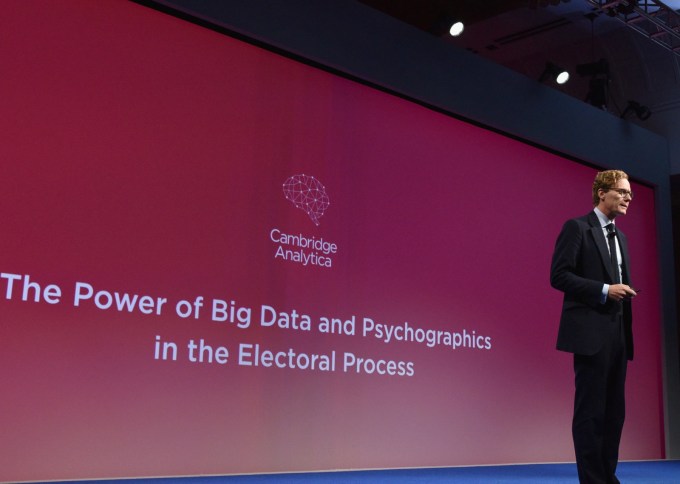
NEW YORK, NY – SEPTEMBER 19: CEO of Cambridge Analytica Alexander Nix speaks at the 2016 Concordia Summit – Day 1 at Grand Hyatt New York on September 19, 2016 in New York City. (Photo by Bryan Bedder/Getty Images for Concordia Summit)

Whether it doesn’t see the disasters coming, makes a calculated gamble that the growth or mission benefits of something will far outweigh the risks, or purposefully makes a dangerous decision while obscuring the consequences, Facebook is responsible for its significant shortcomings. The company has historically cut corners in pursuit of ubiquity that left it, potentially knowingly, vulnerable to exploitation.

And increasingly, Facebook is going to lengths to fight the news cycle surrounding its controversies instead of owning up early and getting to work. Facebook knew about Cambridge Analytica’s data policy violations since at least August 2016, but did nothing but send a legal notice to delete the information.It only suspended the Facebook accounts of Cambridge Analytica and other guilty parties and announced the move this week in hopes of muting forthcoming New York Times and Guardian articles about the issue (articles which it also tried to prevent from running via legal threats.) And since, representatives of the company have quibbled with reporters over Twitter, describing the data misuse as a “breach” instead explaining why it didn’t inform the public about it for years.

“I have more fear in my life that we aren’t going to maximize the opportunity that we have than that we mess something up” Zuckerberg said at a Facebook’s Social Good Forum event in November. Perhaps it’s time for that fear to shift towards ‘what could go wrong’, not just for Zuck, but the leaders of all of today’s tech titans.

Facebook CEO mark Zuckerberg

An Abridged List Of Facebook’s Unforeseen Consequences

Here’s an incomplete list of the massive negative consequences and specific abuses that stem from Facebook’s idealistic product development process:

  • Engagement Ranked Feed = Sensationalized Fake News – Facebook built the News Feed to show the most relevant content first so we’d see the most interesting things going on with our closest friends, but measured that relevance largely based on what people commented on, liked, clicked, shared, and watched. All of those activities are stoked by sensationalist fake new stories, allowing slews of them to go viral while their authors earned ad revenue and financed their operations with ad views delivered by Facebook referral traffic. Facebook downplayed the problem until it finally fessed up and is now scrambling to fight fake news.
  • Engagement Priced Ad Auctions = Polarizing Ads – Facebook gives a discount to ads that are engaging so as to incentivize businesses to produce marketing materials that don’t bore or annoy users such that they close the social network. But the Trump campaign designed purposefully divisive and polarizing ads that would engage a niche base of his supporters to try to score cheaper ad clicks and more free viral sharing of those ads.
  • Academic Research = Emotion Tampering – Facebook allows teams of internal and external researchers to conduct studies on its users in hopes of producing academic breakthroughs in sociology. But in some cases these studies have moved from observation into quietly interfering with the mental conditions of Facebookers. In 2012, Facebook data science team members manipulated the number of emotionally positive or negative posts in the feeds of 689,000 users and then studied their subsequent status updates to see if emotion was contagious. Facebook published the research, failing to foresee the huge uproar that ensued when the public learned that some users, including emotionally vulnerable teenagers who could have been suffering from depression, were deliberately shown sadder posts.
  • Ethnic Affinity Ad Targeting = Racist Exclusion – Facebook’s ad system previously let businesses target users in “ethnic affinity” groups such as “African-American” or “Hispanic” based on their in-app behavior as a stand in for racial targeting. The idea was likely to help businesses find customers interested in their products, but the tool was shown to allow exclusion of certain ethnic affinity groups in ways that could be used to exclude them from legally protected opportunities such as housing; employment, and loans. Facebook has since disabled this kind of targeting while investigates the situation.
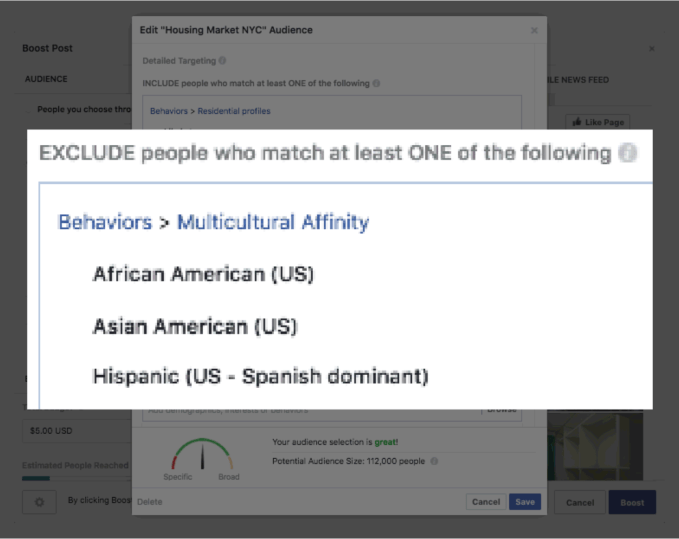
    Exclusionary ethnic affinity ad targeting, as spotted by ProPublica

  • App Platform = Game Spam – One of Facebook’s earliest encounters with unforeseen consequences came in 2009 and 2010 after it launched its app platform. The company expected developers to build helpful utilities that could go viral thanks to special, sometimes automatic posts to the News Feed. But game developers seized on the platform and its viral growth channels, spawning companies like Zynga that turned optimizing News Feed game spam into a science. The constant invites to join games in order to help a friend win overwhelmed the feed, threatening to drown out legitimate communication and ruin the experience for non-gamers until Facebook shut down the viral growth channels, cratering many of the game developers.
  • Real Name Policy = Enabling Stalkers – For years, Facebook strictly required to use their real names in order to reduce uncivility and bullying facilitated by hiding behind anonymity. But victims of stalking, domestic violence, and hate crimes argued that their abusers could use Facebook to track them down and harass them. Only after mounting criticism from the transgender community and others did Facebook slightly relax the policy in 2015, though some still find it onerous to set up a pseudonym on Facebook and dangerous to network without one.
  • Self-Serve Ads = Objectionable Ads – To earn money efficiently, Facebook lets people buy ads through its apps without ever talking to a sales representative. But the self-serve ads interface has been repeatedly shown to used nefariously. ProPublica found businesses could target those who followed objectionable user-generated Pages and interests such as “jew haters” and other disturbing keywords on Facebook. And Russian political operatives famously used Facebook ads to spread divisive memes in the United States and pit people against each other and promote distrust between citizens. Facebook is only now shutting down long-tail user-generated ad targeting parameters, hiring more ad moderators, and requiring more thorough political ad buyer documentation.
  • Developer Data Access = Data Abuse – Most recently, Facebook has found its trust in app developers misplaced. For years it offered an API that allowed app makers to pull robust profile data on their users and somewhat limited info about their friends to make personalized products. For example, one could show which bands your friends Like so you’d know who to invite to a concert. But Facebook lacked strong enforcement mechanisms for its policy that prevented developers from sharing or selling that data to others. Now the public is learning that Cambridge Analytica’s trick of turning 270,000 users of Dr. Aleksandr Kogan’s personality quiz app into info about 50 million people illicitly powered psychographic profiles that helped Trump and Brexit pinpoint their campaign messages. It’s quite likely that other developers have violated Facebook’s flimsy policies against storing, selling, or sharing user data they’ve collected, and more reports of misuse will emerge.

Each time, Facebook built tools with rosy expectations, only to negligently leave the safety off and see worst-case scenarios arise. In October, Zuckerberg already asked for forgiveness, but the public wants change.

Trading Kool-Aid For Contrarians

The desire to avoid censorship or partisanship or inefficiency is no excuse. Perhaps people are so addicted to Facebook that no backlash will pry them their feeds. But Facebook can’t treat this as merely a PR problem, a distraction from the fun work of building new social features, unless its employees are ready to shoulder the blame for the erosion of society. Each scandal further proves it can’t police itself, inviting government regulation that could gum up its business. Members of congress are already calling on Zuckerberg to testify.

Yet even with all of the public backlash and calls for regulation, Facebook still seems to lack or ignore the cynics and diverse voices who might foresee how its products could be perverted or were conceptualized foolishly in the first place. Having more minorities and contrarians on the teams that conceive its products could nip troubles in the bud before they blossom.

“The saying goes that optimists tend to be successful and pessimists tend to be right” Zuckerberg explained at the November forum. “If you think something is going to be terrible and it is going to fail, then you are going to look for the data points that prove you right and you will find them. That is what pessimists do. But if you think that something is possible, then you are going to try to find a way to make it work. And even when you make mistakes along the way and even when people doubt you, you are going to keep pushing until you find a way to make it happen.”
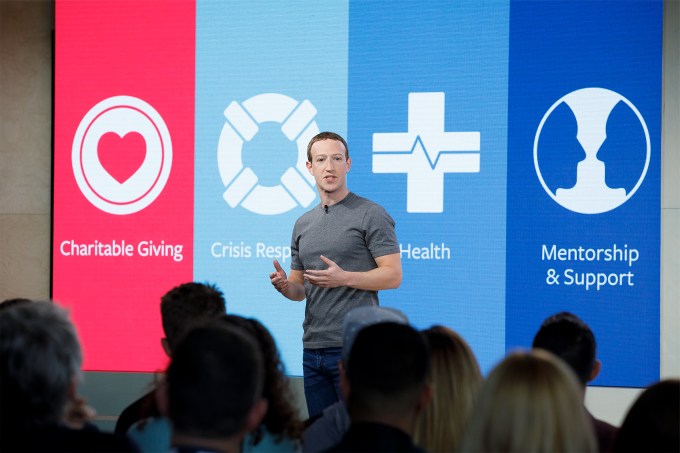
Zuckerberg speaks at Facebook’s Social Good Forum

That quote takes on new light given Facebook’s history. The company must promote a culture where pessimists can speak up without reprise. Where a seeking a raise, reaching milestones, avoiding culpability, or a desire to avoid rocking the Kool-Aid boat don’t stifle discussion of a product’s potential hazards. Facebook’s can-do hacker culture that codes with caution to the wind, that asks for forgiveness instead of permission, is failing to scale to the responsibility of being a two billion user communications institution.

And our species is failing to scale to that level of digital congregation too, stymied by our insecurity and greed. Whether someone is demeaning themselves for not having as glamorous of a vacation as their acquaintances, or seizing the world’s megaphone to spew lies in hopes of impeding democracy, we’ve proven incapable of safe social networking.

That’s why we’re relying on Facebook and the other social networks to change, and why it’s so catastrophic when they miss the festering problems, ignore the calls for reform, or try to hide their complicity. To connect the world, Facebook must foresee its ugliness and proactively rise against it.

For more on Facebook’s non-stop scandals, check out these TechCrunch feature pieces:

18 Mar 2018

Facebook has suspended the account of the whistleblower who exposed Cambridge Analytica

Tech hath no fury like a multi-billion dollar social media giant scorned.

In the latest turn of the developing scandal around how Facebook’s user data wound up in the hands of Cambridge Analytica — for use in the in development in psychographic profiles that may or may not have played a part in the election victory of Donald Trump — the company has taken the unusual step of suspending the account of the whistleblower who helped expose the issues.

In a fantastic profile in The Guardian, Wylie revealed himself to be the architect of the technology that Cambridge Analytica used to develop targeted advertising strategies that arguably helped sway the U.S. presidential election.

A self-described gay, Canadian vegan, Wylie eventually became — as he told The Guardian — the developer of “Steve Bannon’s psychological warfare mindfuck tool.”

The goal, as The Guardian reported, was to combine social media’s reach with big data analytical tools to create psychographic profiles that could then be manipulated in what Bannon and Cambridge Analytica investor Robert Mercer allegedly referred to as a military-style psychological operations campaign — targeting U.S. voters.

In a series of Tweets late Saturday, Wylie’s former employer, Cambridge Analytica, took issue with Wylie’s characterization of events (and much of the reporting around the stories from The Times and The Guardian). 

Meanwhile, Cadwalldr noted on Twitter earlier today she’d received a phone call from the aggrieved whistleblower.

Not cool, Facebook. Not cool at all.


18 Mar 2018

Wing It is a Facebook Messenger bot meant to get you out of the house

“I should go on a weekend trip,” you think to yourself. “I’ll go to the mountains!”

And then the weekend comes and all the hotels are booked and you’re tired and the mountains are far and hey look, Netflix!

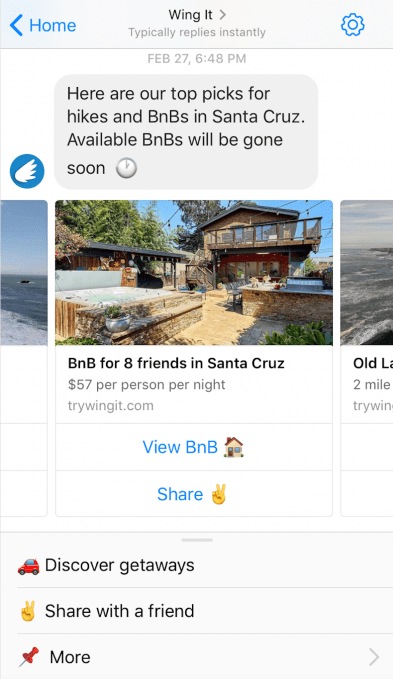
Wing It is a Facebook Messenger bot that tries to get you out of that rut. You punch in your criteria, and it’ll pop up every once in a while when it finds trips that fit the bill, recommending accommodations and an activity or two in the area.

Wing It asks just a few questions off the bat: Where do you live? How far do you want to go? Is it just you and a partner, or a big group of friends? How much is each person looking to spend?

A few minutes later, it’ll respond with a short list: a few places to stay and some things you might want to do while there. Right now, that’s mostly hikes and trails; eventually, the Wing It team hopes to expand their knowledge base out to things like kayaking trips, rock climbing, or nearby surf spots.

Wing It focuses on things that are far enough away to feel like a vacation, but close enough to do on a whim. While early iterations of the bot tried to offer up trips involving last minute flights, they’ve since learned to focus on things within driving distance. “People would say they’d go on a last minute flight… 98% of people would say ‘I’m in!’. Then you send’em that, and give them the option to book it, and… nothing.”

The underlying concept of a trip planning search engine is by no means new, but there’s something nice about the way it all fits together here. Too many weekend trips die in the planning phases — that moment when you dive into Airbnb and drown under a million options and decide to do it later. Wing It boils it all down to a handful of choices based on what it already knows you’re looking for.

That slimmed down and curated offering is what Wing It’s co-founders, Luis De Pombo and Gabriel Ascanio, are going for. After meeting in school, they started working together on side projects on the weekends. They’d try to mix up the scenery by traveling to new locales on the weekends, only to spend half their time just searching for the right place.

So why a Messenger bot? “Because of the ease of reaching people”, Gabriel tells me. There’s no app to download – you just start a conversation with the bot. Meanwhile, the team can iterate on their concept almost instantly. If the data shows users are liking a feature, they can play it up with no need for a downloaded update; if they change something and usage tanks, they can reverse course on the fly.

Wing It is part of Y Combinator’s Winter 2018 class, and has yet to raise funds beyond that.