18 Mar 2018

Regulators in the UK are also calling for more hearings into Facebook and Cambridge Analytica

As more details emerge about Cambridge Analytica’s use of Facebook data in the U.S. presidential election, members of Parliament in the UK are joining congressional leadership in the U.S. to call for a deeper investigation and potential regulatory action.

The Chair of parliamentary committee investigating “fake news”, the conservative MP Damian Collins, accused both Cambridge Analytica and Facebook of misleading his committee’s investigation in a statement early Sunday morning indicating that both companies would be called in for more questioning.

Alexander Nix denied to the Committee last month that his company had received any data from the Global Science Research company (GSR). From the evidence that has been published by The Guardian and The Observer this weekend, it seems clear that he has deliberately mislead the Committee and Parliament by giving false statements,” Collins wrote in a statement to the press. “We will be contacting Alexander Nix next week asking him to explain his comments, and answer further questions relating to the links between GSR and Cambridge Analytica, and its associate companies.”

On Friday, Facebook announced that it had suspended the account of Cambridge Analytica for violating the social media company’s terms and conditions by obtaining user data from a third party source without users’ permissions.

The announcement, made late Friday night, was designed to preempt reports published by The New York Times and The Guardian that would have exposed the fact that Cambridge Analytica had obtained information on 50 million Facebook users — and that Facebook had known about the improper availability of that user data for two years.

The use or abuse of that data by Cambridge Analytica in work that it had done with Donald Trump’s campaign for President in 2016 and potentially for other businesses in the run up to the election is at the heart of Donal

Before basically verifying the accuracy of the story, Facebook had threatened both The Times and The Guardian with legal action to try and kill it.

The company’s response to the reports aren’t impressing anyone — and could land more than just its chief counsel in the hot seat.

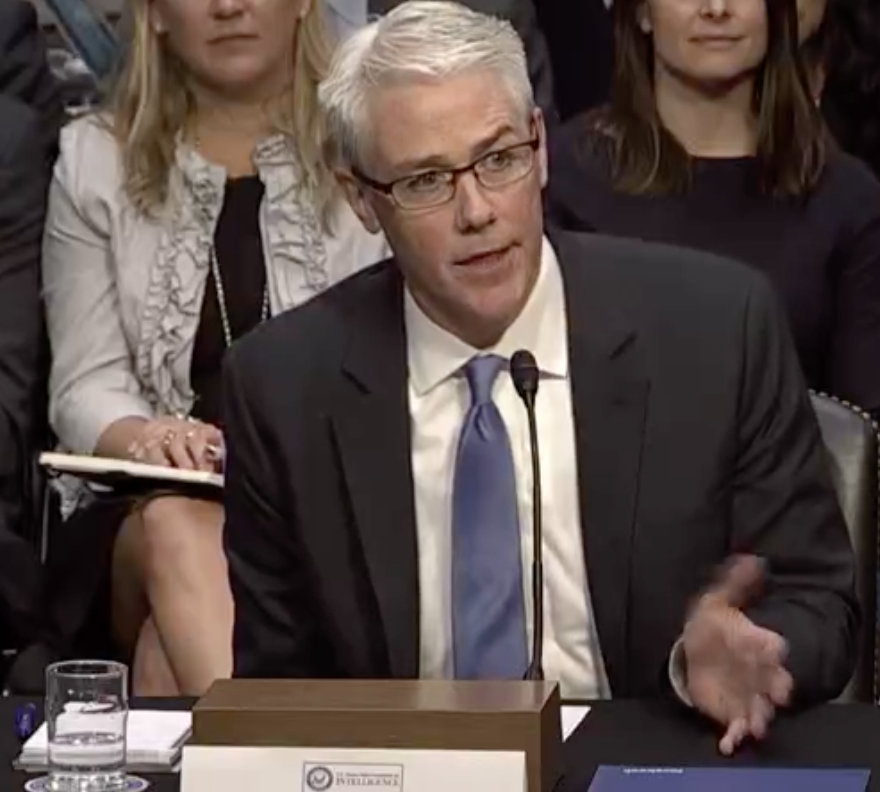
Facebook Chief Legal Officer Colin Stretch

“We have repeatedly asked Facebook about how companies acquire and hold on to user data from their site, and in particular whether data had been taken from people without their consent. Their answers have consistently understated this risk, and have also been misleading to the Committee,” Collins wrote.

He went on to accuse Facebook of “deliberately answering straight questions from the committee” and failing to supply the Committee with evidence relating to “the relationship between Facebook and Cambridge Analytica.” Evidence that had been promised when members of Parliament went to Washington to quiz Facebook about its role in various political campaigns in the UK.

“I will be writing to Mark Zuckerberg asking that either he, or another senior executive from the company, appear to give evidence in front of the Committee as part our inquiry. It is not acceptable that they have previously sent witnesses who seek to avoid asking difficult questions by claiming not to know the answers. This also creates a false reassurance that Facebook’s stated policies are always robust and effectively policed,” Collins wrote.

“We need to hear from people who can speak about Facebook from a position of authority that requires them to know the truth. The reputation of this company is being damaged by stealth, because of their constant failure to respond with clarity and authority to the questions of genuine public interest that are being directed to them. Someone has to take responsibility for this. It’s time for Mark Zuckerberg to stop hiding behind his Facebook page.”

18 Mar 2018

Aalo is do-it-yourself, customizable, re-purposable furniture

Buying furniture sucks. Getting rid of it later is worse.

Aalo, part of the Y Combinator Winter 2018 class, is trying to fix both sides of that equation. They want you to design and build your own furniture… and when you’re done with it, turn it into something else. They’ve built a system of interlocking, interchangeable parts which you can use to build their designs or create your own.

“Furniture”, here, mostly means things to sit your stuff on at this point — not stuff you sit on. Think bookshelves, tables, and shoe racks — not couches, beds, and chairs just yet (though people have built benches with it.)

Some examples:

[gallery link="none" ids="1608424,1608422,1608423,1608425"]

The system is currently made up of around ten different components, from different lengths of beams to different types of connectors and mounts. Furniture can be ordered in pre-arranged kits — but if you’re feeling creative, each component can be ordered individually.

Each piece is powder-coated aluminum in white or black, super strong, and snaps together with just an Allen wrench. Here’s a quick GIF of the company’s founder, Sejun Park, building a headphone stand at our office (sped up for the sake of file size – actual assembly time was ~20 seconds):

Aalo was born out of a good ol’ failed DIY attempt. Sejun bought a shelf for his new apartment from a nearby big box store, but the one he liked best was a bit too long for his wall. He busted out his hacksaw and started cutting away at the wood to slim it down… only to realize that it wasn’t really wood at all, but a thin wood veneer wrapped around a cardboard core. Previously a manufacturing engineer for Toyota/Lexus, he realized there had to be a better way.

The price of anything you build would vary based on the components involved. It tends to work out to be a bit pricier than stuff you’d find at Ikea or Target, but less than what you might find in a designer store. That headphone stand up above would cost about $35, for example; their design for a shoe rack, meanwhile, goes for $80.

I love the idea of taking an old piece of furniture and turning it into something new, and that it’s built into the core of this whole system. Tired of your TV stand? Break it down, turn it into a bike rack. Don’t want that table anymore? Tear it apart, order a few small pieces, and turn it into a couple plant stands.

Sejun tells me that in time, the system should be able to look at the components you own and recommend other things you might build from them — tapping a community-driven catalog of creations, perhaps — before shipping you only the parts you need.

18 Mar 2018

Aalo is do-it-yourself, customizable, re-purposable furniture

Buying furniture sucks. Getting rid of it later is worse.

Aalo, part of the Y Combinator Winter 2018 class, is trying to fix both sides of that equation. They want you to design and build your own furniture… and when you’re done with it, turn it into something else. They’ve built a system of interlocking, interchangeable parts which you can use to build their designs or create your own.

“Furniture”, here, mostly means things to sit your stuff on at this point — not stuff you sit on. Think bookshelves, tables, and shoe racks — not couches, beds, and chairs just yet (though people have built benches with it.)

Some examples:

[gallery link="none" ids="1608424,1608422,1608423,1608425"]

The system is currently made up of around ten different components, from different lengths of beams to different types of connectors and mounts. Furniture can be ordered in pre-arranged kits — but if you’re feeling creative, each component can be ordered individually.

Each piece is powder-coated aluminum in white or black, super strong, and snaps together with just an Allen wrench. Here’s a quick GIF of the company’s founder, Sejun Park, building a headphone stand at our office (sped up for the sake of file size – actual assembly time was ~20 seconds):

Aalo was born out of a good ol’ failed DIY attempt. Sejun bought a shelf for his new apartment from a nearby big box store, but the one he liked best was a bit too long for his wall. He busted out his hacksaw and started cutting away at the wood to slim it down… only to realize that it wasn’t really wood at all, but a thin wood veneer wrapped around a cardboard core. Previously a manufacturing engineer for Toyota/Lexus, he realized there had to be a better way.

The price of anything you build would vary based on the components involved. It tends to work out to be a bit pricier than stuff you’d find at Ikea or Target, but less than what you might find in a designer store. That headphone stand up above would cost about $35, for example; their design for a shoe rack, meanwhile, goes for $80.

I love the idea of taking an old piece of furniture and turning it into something new, and that it’s built into the core of this whole system. Tired of your TV stand? Break it down, turn it into a bike rack. Don’t want that table anymore? Tear it apart, order a few small pieces, and turn it into a couple plant stands.

Sejun tells me that in time, the system should be able to look at the components you own and recommend other things you might build from them — tapping a community-driven catalog of creations, perhaps — before shipping you only the parts you need.

18 Mar 2018

Phlur, a fragrance startup launched by a former Ralph Lauren exec, is raising fresh funding

There’s no shortage of ideas being backed when it comes to direct-to-consumer e-commerce companies that are cultivating their own brands. We’ve seen everything from slippers to toothbrushes to, perhaps most famously, razor blades.

Among the newer frontiers being funded right now: ingredient-conscious perfumes. For example, the  New York-based, venture-backed cosmetics company Glossier began marketing a proprietary perfume called You last October that’s designed to change in character on the skin over time. (“You” complete the product, it says.)

Late last year, an L.A. based called Skylar that uses only natural ingredients raised also attracted venture funding: $3 million from Upfront Ventures and serial entrepreneur Brian Lee, who also founded The Honest Company. (Skylar’s founder previously worked at Honest.)

Now another new entrant, Austin, Tex.-based Phlur, appears to be shaking the trees for venture capital. The company — which was launched publicly less than two years ago by Eric Korman, a former president of global e-commerce for Ralph Lauren — is targeting up to $8 million in venture funding, according to an SEC filing that shows it has raised at least $2.4 million toward that end. Among its backers is local venture firm Next Coast Ventures.

The money follows $6 million that Phlur has already raised, including from Next Coast, for what it describes as scents for both men and women that are made with “responsibly sourced” ingredients.

Its packaging is also environmentally friendly, it says; it’s made with 20 percent recycled glass.

We reached out to Korman yesterday to learn more and we’ll update this post if we hear back. But certainly, it’s easy to understand why consumers might appreciate companies that promise that they needn’t visit a fragrance counter ever again.

It’s easy to appreciate investor enthusiasm for perfumes, too. Three giants — L’Oréal Groupe, Coty, and Estée Lauder — still make up the bulk of fragrance sales, and millennials are looking for new options that don’t necessarily remind them of their parents. There’s been a spate of M&A in the beauty sector — and not yet in the fragrance sector, meaning there’s still opportunity there. Not last, the beauty industry is a very big business, with one estimate projecting the global fragrance market alone will be worth about $92 billion by 2024.

These new brands are simply playing into a years-long trend of consumers caring much more about everything that touches them, from their food to their house-cleaning products. As startups provide them with more transparency into how fragrances are made — and at far less cost than companies that pay for counter space at retail stores — expect to see many more next-gen fragrances, as well.

18 Mar 2018

What it’s like using the Owl car security camera

When you get a new car, and you’re feeling like a star, the first thing you’re probably going to do is ghost ride it. This is where the Owl camera can come in.

I’ve been testing Owl, an always-on, two-way camera that records everything that’s happening inside and outside of your car all day, every day for the last couple of weeks.

The Owl camera is designed to monitor your car for break-ins, collisions and police stops. Owl can also be used to capture fun moments (see above) on the road or beautiful scenery, simply by saying, ‘Ok, presto.’

If Owl senses a car accident, it automatically saves the video to your phone, including the 10 seconds before and after the accident. Also, if someone is attracted to your car because of the camera and its blinking green light, and proceeds to steal it, Owl will give you another one.

For 24 hours, you can view your driving and any other incidents that happened during the day. You can also, of course, save footage to your phone so you can watch it after 24 hours.

Setting it up

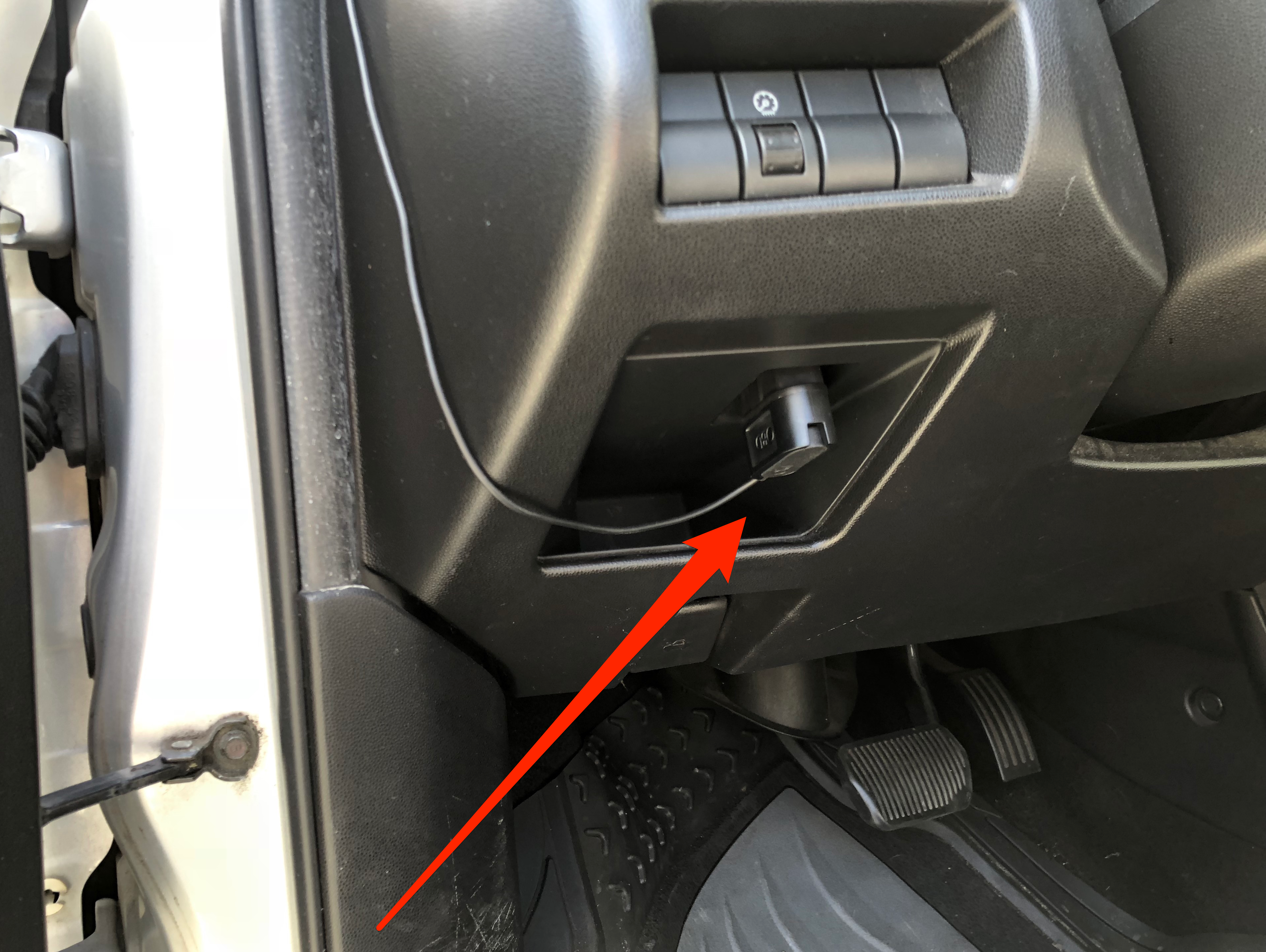
The two-way camera plugs into your car’s on-board diagnostics port (Every car built after 1996 has one), and takes just a few minutes to set up. The camera tucks right in between the dashboard and windshield. Once it’s hooked up, you can access your car’s camera anytime via the Owl mobile app.

I was a bit skeptical about the ease with which I’d be able to install the camera, but it was actually pretty easy. From opening the box to getting the camera up and running, it took fewer than ten minutes.

Accessing the footage

This is where it can get a little tricky. If you want to save footage after the fact, Owl requires that you be physically near the camera. That meant I had to put on real clothes and walk outside to my car to access the footage from the past 24 hours in order to connect to the Owl’s Wi-Fi. Eventually, however, Owl says it will be possible to access that footage over LTE.

But that wasn’t my only qualm with footage access. Once I tried to download the footage, the app would often crash or only download a portion of the footage I requested. This, however, should be easily fixable, given Owl is set up for over-the-air updates. In fact, Owl told me the company is aware of that issue and is releasing a fix this week. If I want to see the live footage, though, that’s easy to access.

Notifications

Owl is set up to let you know if and when something happens to your car while you’re not there. My Owl’s out-of-the-box settings were set to high sensitivity, which meant I received notifications if a car simply drove by. Changing the settings to a lower sensitivity fixed the annoyance of too many notifications.

Since installing the Owl camera, there hasn’t been a situation in which I was notified of any nefarious behavior happening in or around my car. But I do rest assured knowing that if something does happen, I’ll be notified right away and will be able to see live footage of whatever it is that’s happening.

My understanding is that most of the dash cams on the market aren’t set up to give you 24/7 video access, nor are they designed to be updatable over the air. The best-selling dash cam on Amazon, for example, is a one-way facing camera with collision detection, but it’s not always on. That one retails for about $100 while Amazon’s Choice is one that costs just $47.99, and comes with Wi-Fi to enable real-time viewing and video playback.

Owl is much more expensive than its competition, retailing at $299, with LTE service offered at $10 per month. Currently, Owl is only available as a bundle for $349, which includes one year of the LTE service.

Unlike Owl’s competition, however, the device is always on, due to the fact it plugs into your car’s OMD port. That’s the main, most attractive differentiator for me. To be clear, while the Owl does suck energy from your car’s battery, it’s smart enough to know when it needs to shutdown. Last weekend, I didn’t drive my car for over 24 hours, so Owl shut itself down to ensure my battery wasn’t dead once I came back.

Owl, which launched last month, has $18 million in funding from Defy Ventures, Khosla Ventures, Menlo Ventures, Sherpa Capital and others. The company was founded by Andy Hodge, a former product lead at Apple and executive at Dropcam, and Nathan Ackerman, who formerly led development for Microsoft’s HoloLens.

P.S. I was listening to “Finesse” by Bruno Mars and Cardi B in the GIF above.

18 Mar 2018

Here are the top states and cities for startups in the South

The American South may not be the first region that comes to mind when you hear the phrase “hotbed of tech entrepreneurship,” but, slightly misguided perceptions aside, it’s home to a diverse and growing collection of startups.

Here, we’re going to take a deep dive into the startup funding data for the region.

What is “the South?”

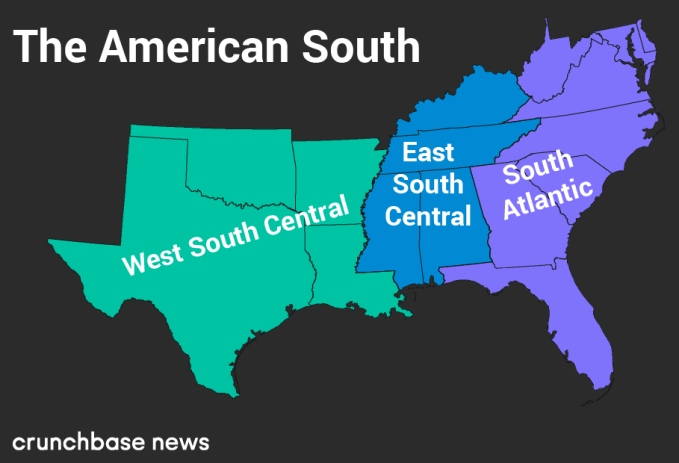
Just like it’s a common pastime for many city dwellers to argue about the precise boundaries of neighborhoods, there’s often some disagreement about the exact contours of the U.S.’s various regions. To quash rabble-rousing from the get-go, we’re using the U.S. Census Bureau’s definition of “the South” on its official map of the United States. Below, we display a map of the states we’re going to look at today.

Much like barbecue, the South is not a monolithic concept. So to incorporate some regional flavor into the following analysis, we’re also going to use the same regional divisions that the U.S. Census Bureau uses.

By doing this, we’ll be able to get a better idea of the relative contribution states from each sub-region make to startup activity in the South overall.

The ebb and flow of deal and dollar volume

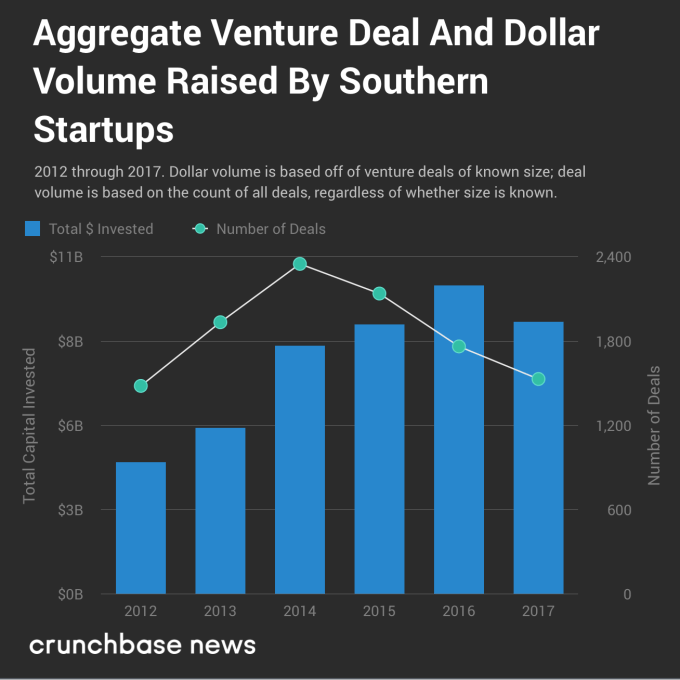
As is the case with most of the country, the South appears to be experiencing a shift in startup funding as we move toward the latter half of a bull run in entrepreneurial activity. The chart below shows a divergence in overall deal and dollar volume over time.

Much like in the rest of the U.S., reported deal and dollar volume are heading in different directions. Part of this may be due to reporting delays — it can sometimes take a few years for seed and early-stage rounds to get added to databases like Crunchbase’s . Nonetheless, there is a slow and generally upward creep in round sizes at most stages of funding. And that’s not just a Southern thing; it’s a country-wide trend.

Let’s disaggregate these figures a bit. We’ll start with deal counts and move on to dollar volume from there.

A closer look at southern venture deal and dollar volume

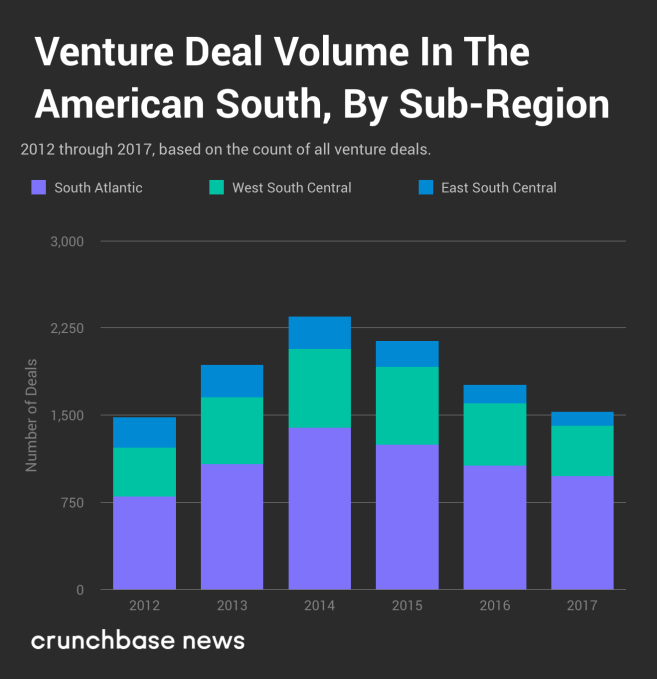
In the chart below, you’ll see venture deal volume broken out by sub-region.

Over the past several years, reported venture deal volume has been on the downswing. From a local maximum in 2014 through the end of 2017, it’s down almost 35 percent overall. But that’s not the whole picture. The relative share of deal volume has changed, as well.

Although it’s not immediately clear just by looking at the chart above, startups in the South Atlantic sub-region have accounted for an increasingly large share of the funding rounds. For example, in 2012, South Atlantic startups attracted 54 percent of the deal volume. In 2017, that grows to 64 percent. Startups in the West South Central sub-region have pretty consistently pulled in between 28 and 30 percent of the deals, so where’s the loss coming from? Startups headquartered in Kentucky, Tennessee, Mississippi and Alabama pulled in just 8 percent of deals in 2017, compared to 18 percent in 2012.

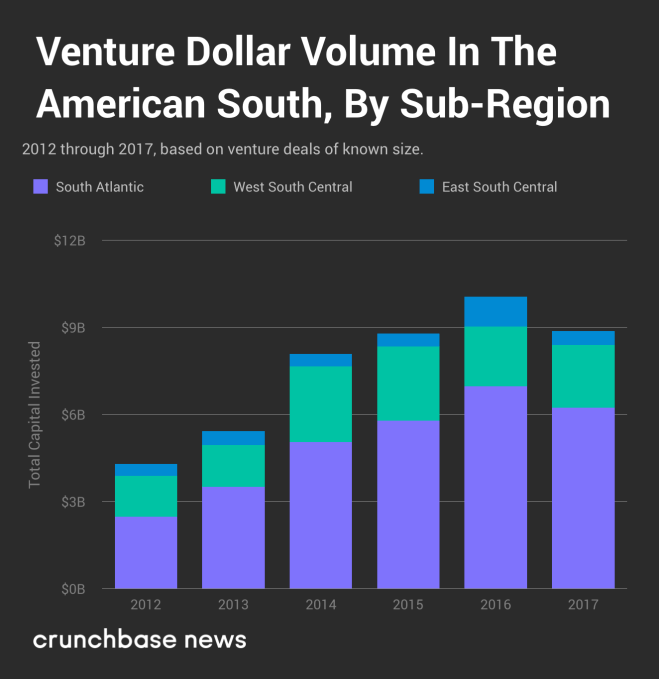
It’s a similar story with dollar volume.

In general, dollar volume follows the same pattern, albeit with a bit more variability. Regardless, startups in the South Atlantic sub-region are hoovering up an ever-larger share of venture dollars, and there’s little to indicate that trend will reverse itself any time soon.

Where are the regional hotspots for deal-making in the south?

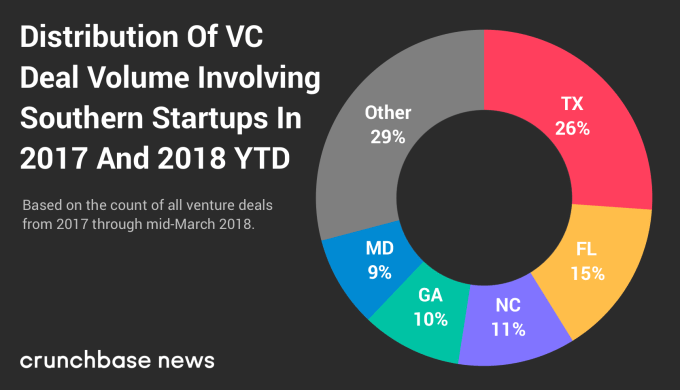
Let’s see which states accounted for most of the deal volume. The chart below shows the geographic distribution of deal-making activity by startups in each Southern state from the beginning of 2017 through time of writing. It should come as no surprise that much of the activity is concentrated in states with higher populations.

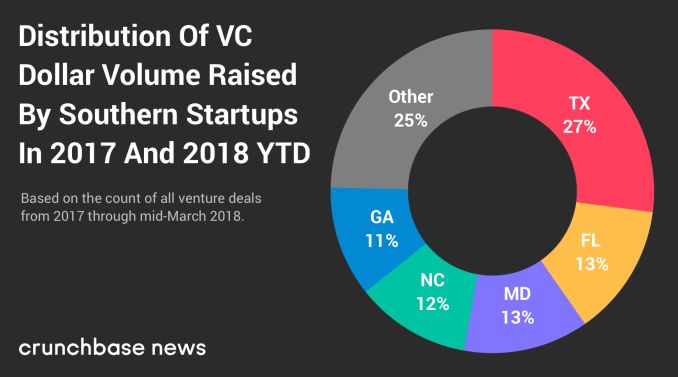
And here’s the distribution of dollar volume among southern states.

Despite some variation in which states are at the top of the ranks, the share of deal and dollar volume raised by startups in the top three states is remarkably similar, coming in at between 52 and 53 percent for both metrics.

The top startup cities in the south

We started by looking at the South as a whole and then drilled into its sub regions and states. But there’s one layer deeper we can go here, and that’s to rank the top startup cities in the South.

In the interest of keeping our rankings fresh and timely, we’re covering activity from the past 15 months or so, from the start of 2017 through mid-March 2018. But before highlighting some of the more notable hubs, let’s take a look at the numbers.

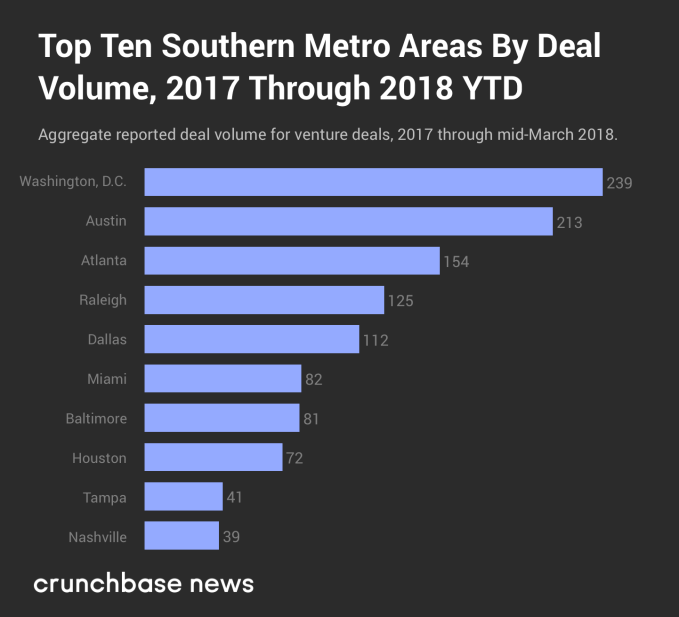
In the chart below, you’ll find the top 10 metropolitan areas where Southern startups closed the most funding rounds.

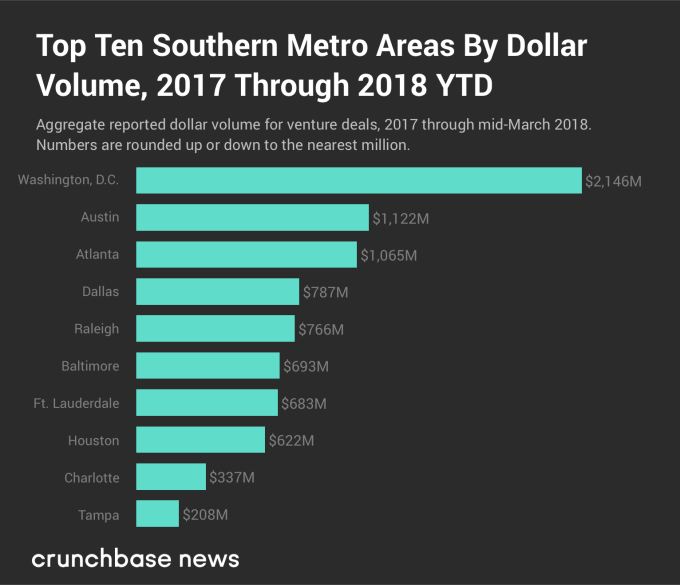
The chart below shows reported dollar volume over the same period of time.

Much like we saw at the state level, the top five startup cities — ranked by both deal and dollar volume — are the same, although there’s some variation between where each one ranks. In order, the D.C., Austin and Atlanta metro areas rank in the top three for each metric, while Dallas and Raleigh, NC switch off between fourth and fifth place.

Startups capitalize on the nation’s capital

To be frank, Washington, D.C.’s top-shelf ranking was a bit of a surprise. It may be the fact that Austin, TX plays host to South By Southwest, a somewhat more relaxed culture and/or a preponderance of excellent breakfast taco and barbecue joints, but to many — ourselves included — the city feels like it would have a more active startup scene than the nation’s capital. But that’s not exactly the case. The D.C. metro area had more venture deal and dollar volume than Austin for seven out of the last 10 years, and startups based in the nation’s capital have raised more than twice as much money so far in 2018.

D.C.-area startups have recently raised some notable rounds. Just a couple of weeks prior to the time of writing, Viela Bio raised $250 million in a Series A round (in late February 2018) to continue funding research and testing of its treatments for severe inflammation and autoimmune diseases. And on the later-stage end of things, education technology company Everfi raised $190 million in a Series D round that had participation from Amazon founder and CEO Jeff Bezos, former Alphabet executive Eric Schmidt and Medium CEO Ev Williams. Other D.C. companies, including Mapbox, Upside.com, Afiniti and ThreatQuotient, have all raised late-stage rounds within the past 15 months.

Startup ecosystems in Southern cities may pale in comparison to places like New York and San Francisco, but it wouldn’t be wise to discount the region entirely. A large number of interesting companies call the lower half of the Lower 48 home, and as the cost of living continues to rise on the east and west coasts, don’t be surprised if many current and would-be founders opt to stay down home in the South.

18 Mar 2018

EdTech is having a renaissance, powered by the emerging world

So-called ‘EdTech’ has seen many false dawns over the years. After being lauded as the teaching platforms of the future, most MOOCs (Massive Open Online Course platforms) have not quite lived up to the superlatives made for them, and the sector has had trouble coming up with more innovative ideas for a while.

But that appears to be changing if a new wave of startups is any indication. In Dubai this weekend I was invited to judge a number of education startups which are really trying to move the need on EdTech, and in particular on a sector with almost unlimited potential. That is, education platforms aimed at the emerging world, where the hunger for scalable education is almost incalculable.

Consider this: Ethopia, now a far more stable country that it once was, contains more people under 25 than almost anywhere else, and it has a population of over 100 million people. And consider the potential for EdTech to transform countries like India, for instance. This is going to be a very interesting market in the future, as well as being an urgent issue. According to UNESCO, 264 million children do not have access to schooling, while at least 600 million more are “in school but not learning”. These are children who are not achieving even basic skills in maths and reading, which the World Bank calls a “learning crisis”.

A taste of what is to be found in this sector was showcased today at the “Next Billion Edtech Prize,” launched at the Global Education & Skills Forum (think: Davos/WEF for Education) by the Varkey Foundation to recognize the most innovative technology startups destined to have a radical impact on education in low income and emerging world countries.

The overall winner in the competition was Chatterbox, an online language school powered by refugees

This web platform harnesses the wasted talent of unemployed professionals who are refugees, offering them work as online and in-person language tutors. Based in the UK, where there is a language skills shortage estimated to cost the economy £48bn every year, Chatterbox has now signed up several UK universities and major non-profits and corporations to use its services. Having raised a seed round from impact-fund Bethnal Green Ventures, it’s now looking for further funding to expand.

Co-founder and CEO Mursal Hedayat was three years old when she arrived in the UK as a refugee from Afghanistan with her mother, a civil engineer who spoke English and three other languages fluently. “I watched her become unemployed in the UK for more than a decade. Refugees with degrees and valuable skills still face shockingly high levels of underemployment. An idea like Chatterbox has never been more urgently needed,” she says. (Indeed, the conference later heard from Al Gore who quoted research that showed millions of people will become refugees due to climate change in the next few decades).

Chatterbox’s fellow finalists for the $25,000 prize on offer were equally interesting.

Dot Learn was almost literally the same as ‘Silicon Valley’s PiedPiper. It makes online video e-learning far more accessible on slow connections for users in low-income countries, especially because it compresses educational video so making it cheaper to access. Its technology reduces the file-size of learning videos, requiring 1/100th of the bandwidth to watch. At current data prices in Kenya and Nigeria, this means a student or learner can access 5 hrs of online learning for about the cost of sending a single text message ($0.014). The startup was a notable finalist during TechCrunch’s Battlefield Africa.

TeachMeNow is a gig-economy platform for teachers. This marketplace connects teachers, experts, and mentors to students. The technology combines scheduling, payments and live virtual sessions that can connect on any device allows tens of thousands of teachers to create their own online businesses, with some earning over $100,000 last year. In addition, schools and companies including Microsoft use TeachMeNow software to create their own-branded online learning communities.

Sunny Varkey, Founder of the Varkey Foundation and the Next Billion Prize says he launched the prize because “over a billion young people – a number growing every day – are being denied what should be the birthright of every single child. The prize will highlight technology’s potential to tackle the problems that have proven too difficult for successive generations of politicians to solve.”

Other notable finalists included Learning Machine. This using the blockchain as a secure anchor of trust makes verifying the authenticity of a document instantaneously, specifically education documents like university degrees. They are now working to put all the educational records of Malta online.

Localized is a new platform for college students and aspiring professionals in emerging economies to find career guidance, role models and expertise from global professionals who share language and roots (think Slack meets Quora for college students in emerging markets, drawing on diaspora expertise).

The Biz Nation is an EdTech startup focused on empowering youth with technology skills, soft skills, entrepreneurship and financial intelligence through a methodology that improves user’s learning about creating a business.

18 Mar 2018

Everything is terrible: an explanation

Facebook is a breeding ground for fake news and polarized outrage, accused of corrupting democracy and spurring genocide. Twitter knows it has become a seething battleground of widespread, targeted abuse — but has no solution. YouTube videos are messing with the minds of children and adults alike — so YouTube decided to pass the buck to Wikipedia, without telling them.

All three of those sentences would have seemed nearly unimaginable five years ago. What the hell is going on? Ev Williams says, of the growth of social media: “We laid down fundamental architectures that had assumptions that didn’t account for bad behavior.” What changed? And perhaps the most important question is: have people always been this awful, or have social networks actually made us collectively worse?

I have two somewhat related theories. Let me explain.

The Uncanny Social Valley Theory

“Social media is poison,” a close friend of mine said to me a couple of years ago, and since then more and more of my acquaintances seem to have come around to her point of view, and are abandoning or greatly reducing their time spent on Facebook and/or Twitter.

Why is it poison? Because this technology meant to provoke human connection actually dehumanizes. Not always, of course; not consistently. It remains a wonderful way to keep in contact with distant friends, and to enhance your relationship and understanding of those you regularly see in the flesh. What’s more, there are some people with whom you just ‘click’ online, and real friendships grow. There are people I’ve never met who I’d unhesitatingly trust with the keys to my car and home, because of our interactions on various social networks.

And yet — having stipulated all the good things — a lot of online interactions can and do reduce other people to awful caricatures of themselves. In person we tend to manage a kind of mammalian empathy, a baseline understanding that we’re all just a bunch of overgrown apes with hyperactive amygdalas trying to figure things out as best we can, and that relatively few of us are evil stereotypes. (Though see below.) Online, though, all we see are a few projections of those mammal brains, generally in the form of hastily constructed, low-context text and images … as mediated and amplified by the outrage machines, those timeline algorithms which think that “engagement” is the highest goal to which one can possibly aspire online.

I am reminded of the concept of the Uncanny Valley: “humanoid objects which appear almost, but not exactly, like real human beings elicit uncanny, or strangely familiar, feelings of eeriness and revulsion in observers.” Sometimes you ‘click’ with people online such that they’re fully human to you, even if you’ve never met. Sometimes you see them fairly often in real life, so their online projections are just a new dimension to their existing humanity. But a lot of the time, all you get of them is that projection … which falls squarely into an empathy-free, not-quite-human, uncanny social valley.

And so many of us spend so much time online, checking Twitter, chatting on Facebook, that we’ve all practically built little cottages in the uncanny social valley. Hell, sometimes we spend so much time there that we begin to believe that even people we know in real life are best described as neighbors in that valley … which is how friendships fracture and communities sunder online. A lot of online outrage and fury — the majority, I’d estimate, though not all — is caused not by its targets’ inherent awfulness but by an absence, on both sides, of context, nuance, and above all, empathy and compassion.

The majority. But not all. Because this isn’t just a story of lack of compassion. This is also a story of truly, genuinely awful people doing truly, genuinely awful things. That aspect is explained by…

The Intransigent Asshole Theory

Of course the Internet was always full of awful. Assholes have been trolling since at least 1993. “Don’t read the comments” is way older than five years old. But it’s different now; the assholes are more organized, their victims are often knowingly and strategically targeted, and many seem to have calcified from assholedom into actual evil. What’s changed?

The Intransigent Asshole Theory holds that the only thing that’s changed is that more assholes are online and they’ve had more time to find each other and agglomerate into a kind of noxious movement. They aren’t that large in number. Say that a mere three percent of the online population are, actually, the evil stereotypes that we perceive so many to be.

If three of 100 people are known to be terrible human beings, the other 97 can identify them and organize to defend themselves with relative ease. 97 is well within Dunbar’s number after all. But what about 30 of a 1,000? That gets more challenging, if those thirty band together; the non-awful people have to form fairly large groups. How about 300 of 10,000? Or 3,000 of 100,000? 3 million of 100 million? Suddenly three percent doesn’t seem like such a small number after all.

I chose three percent because it’s the example used by Nassim Taleb in his essay/chapter “The Most Intolerant Wins: The Dictatorship of the Small Minority.” Adopting his argument slightly, if only 3% of the online population really wants the online world to be horrible, ultimately they can force it to be, because the other 97% can — as empirical evidence shows — live with a world in which the Internet is often basically a cesspool, whereas those 3% apparently cannot live with a world in which it is not.

Only a very small number of people comment on articles. But they are devoted to it; and, as a result, “don’t read the comments,” became a cliché. Is it really so surprising that “don’t read the comments” spread to “Facebook is for fake outrage and Twitter is for abuse,” given that Facebook and Twitter are explicitly designed to spread high-engagement items, i.e. the most outrageous ones? Really the only thing that’s surprising is that it took this long to become so widespread.

Worst of all — when you combine the Uncanny Social Valley Theory with the Intransigent Asshole Theory and the high-engagement outrage-machine algorithms, you get the situation where, even if only 3% of people actually are irredeemable assholes, a full 30% or more of them seem that way to us. And the situation spirals ever downwards.

“Wait,” you may think, “but what if they didn’t design their social networks that way?” Well, that takes us to the third argument, which isn’t a theory so much as an inarguable fact:

The Outrage Machine Money Maker

Outrage equals engagement equals profit. This is not at all new; this goes back to the ‘glory’ days of yellow journalism and “if it bleeds, it leads.” Today, though, it’s more personal; today everyone gets a customized set of screaming tabloid headlines, from which a diverse set of manipulative publishers profit.

This is explicit for YouTube, whose creators make money directly from their highest-engagement, and thus (often) most-outrageous videos, and for Macedonian teenagers creating fake news and raking in the resulting ad income. This is explicit for the politically motivated, for Russian trolls and Burmese hate groups, who get profits in the form of the confusion and mayhem they want.

This is implicit for the platforms themselves, for Facebook and Twitter and YouTube, all of whom rake in huge amounts of money. Their income and profits are, of course, inextricably connected to the “engagement” of their users. And if there are social costs — and it’s become clear that the social costs are immense — then they have to be externalized. You could hardly get a more on-the-nose example of this than YouTube deciding that Wikipedia is the solution to its social costs.

The social costs have to be externalized because human moderation simply doesn’t scale to the gargantuan amount of data we’re talking about; any algorithmic solution can and will be gamed; and the actual solution — which is to stop optimizing for ever-higher engagement — is so completely anathema to the platforms’ business models that they literally cannot conceive of it, and instead claim “we don’t know what to do.”


In Summary

  • Only ~3% of people are truly terrible, but if we are sufficiently compliant with their awfulness, that’s enough to ruin the world for the rest of us. History shows that we have been more than sufficiently compliant.
  • Social networks often dehumanize their participants; this plus their outrage-machine engagement optimization makes fully 30% of people seem like they’re part of those 3%, which breeds rancor and even, honestly no fooling not exaggerating, genocide.
  • (Are those the exact numbers? Almost certainly not! My point is that social networks cause “you are an awful, irredeemable human being” to be massively overdiagnosed, by an order of magnitude or more.)
  • A solution is for social networks to ramp down their outrage machine, i.e. to stop optimizing for engagement.
  • They will not implement this solution.
  • Since they won’t implement this solution, then unless they somehow find another one — possible, but unlikely  — our collective online milieu will just keep getting worse.
  • Sorry about that. Hang in there. There are still a lot of good things about social networks, after all, and it’s not like things can get much worse than they already are. Right?
  • …Right?


18 Mar 2018

Facebook’s latest privacy debacle stirs up more regulatory interest from lawmakers

Facebook’s late Friday disclosure that a data analytics company with ties to the Trump campaign improperly obtained — and then failed to destroy — the private data of 50 million users is generating more unwanted attention from politicians, some of whom were already beating the drums of regulation in the company’s direction.

On Saturday morning, Facebook dove into the semantics of its disclosure, arguing against wording in the New York Times story the company was attempting to get out in front of that referred to the incident as a breach. Most of this happened on the Twitter account of Facebook chief security officer Alex Stamos before Stamos took down his tweets and the gist of the conversation made its way into an update to Facebook’s official post.

“People knowingly provided their information, no systems were infiltrated, and no passwords or sensitive pieces of information were stolen or hacked,” the added language argued.

While the language is up for debate, lawmakers don’t appear to be looking kindly on Facebook’s arguably legitimate effort to sidestep data breach notification laws that, were this a proper hack, could have required the company to disclose that it lost track of the data of 50 million users, only 270,000 of which consented to data sharing to the third party app involved. (In April of 2015, Facebook changed its policy, shutting down the API that shared friends data with third-party Facebook apps that they did not consent to sharing in the first place.)

While most lawmakers and politicians haven’t crafted formal statements yet (expect a landslide of those on Monday), a few are weighing in. Minnesota Senator Amy Klobuchar calling for Facebook’s chief executive — and not just its counsel — to appear before the Senate Judiciary committee.

Senator Mark Warner, a prominent figure in tech’s role in enabling Russian interference in the 2016 U.S. election, used the incident to call attention to a piece of bipartisan legislation called the Honest Ads Act, designed to “prevent foreign interference in future elections and improve the transparency of online political advertisements.”

“This is more evidence that the online political advertising market is essentially the Wild West,” Warner said in a statement. “Whether it’s allowing Russians to purchase political ads, or extensive micro-targeting based on ill-gotten user data, it’s clear that, left unregulated, this market will continue to be prone to deception and lacking in transparency.”

That call for transparency was echoed Saturday by Massachusetts Attorney General Maura Healey who announced that her office would be launching an investigation into the situation. “Massachusetts residents deserve answers immediately from Facebook and Cambridge Analytica,” Healey tweeted. TechCrunch has reached out to Healey’s office for additional information.

On Cambridge Analytica’s side, it looks possible that the company may have violated Federal Election Commission laws forbidding foreign participation in domestic U.S. elections. The FEC enforces a “broad prohibition on foreign national activity in connection with elections in the United States.”

“Now is a time of reckoning for all tech and internet companies to truly consider their impact on democracies worldwide,” said Nuala O’Connor, President of the Center for Democracy & Technology. “Internet users in the U.S. are left incredibly vulnerable to this sort of abuse because of the lack of comprehensive data protection and privacy laws, which leaves this data unprotected.”

Just what lawmakers intend to do about big tech’s latest privacy debacle will be more clear come Monday, but the chorus calling for regulation is likely to grow louder from here on out.

17 Mar 2018

YouTube is reportedly introducing your kids to conspiracy theories, too

In a recent appearance by YouTube CEO Susan Wojcicki at the South by Southwest Festival, she suggested that YouTube is countering the conspiracy-related videos that have been spreading like wildfire on the platform — including videos telling viewers that high school senior and Parkland, Fl. survivor David Hogg is an actor.

Specifically, Wojcicki outlined YouTube’s plans to add “information cues,” including links to Wikipedia pages that debunk garbage content for viewers if they choose to learn more. (Somewhat strangely, no one had told Wikipedia about this plan.)

Either way, the platform is going to have do much better than that, suggests a new Business Insider report that says YouTube Kids has a huge problem with conspiracy videos, too. To wit, the three-year-old, ostensibly kid-friendly version of YouTube is showing its young viewers videos that preach the nonsensical, including “that the world is flat, that the moon landing was faked, and that the planet is ruled by reptile-human hybrids,” according to BI’s own first-hand findings.

In fact, when BI searched for “UFO” on YouTube Kids, one of the top videos to appear was a nearly five-hour-long lecture by professional conspiracy theorist David Icke, who covers everything in the clip from “reptile human bloodlines,” to the Freemasons, who he credits with building the Statue of Liberty, Las Vegas, Christianity, and Islam, among other things. (The Freemasons also killed President John Kennedy, he tells viewers.).

Business Insider says YouTube removed the videos from YouTube Kids after its editorial team contacted the company. YouTube also issued the following statement: “The YouTube Kids app is home to a wide variety of content that includes enriching and entertaining videos for families. This content is screened using human trained systems. That being said, no system is perfect and sometimes we miss the mark. When we do, we take immediate action to block the videos or, as necessary, channels from appearing in the app. We will continue to work to improve the YouTube Kids app experience.”

That’s not going to be good enough for parents who are paying attention. Hunter Walk, a venture capitalist who previously led product at YouTube and has a young daughter, may have summed it up best in a tweet that he published earlier this afternoon, writing that “when you create and market an app to kids, the level of care and custodial responsibility you need to take is 100x usual. Clean it up or shut it down pls.”

YouTube has been reluctant to tinker with is recommendation algorithm because its “main objective is to keep you consuming YouTube videos for as long as possible” Wired noted this past week. (Crazy theories are apparently quite sticky). Wired also reported that despite a recent uproar about all the conspiracy theory content, YouTube still doesn’t have clear rules around when whether these videos violate its community guidelines, which cover bullying, hate speech, graphic violence, and sexually explicit content.

Wojcicki said during her festival appearance that “People can still watch the videos, but then they have access to additional information.”

Hopefully, YouTube will come up with a more sophisticated solution to the spread of misinformation, especially when it comes to its younger viewers. We don’t yet know the scale of this particular issue (we’ve reached out to YouTube to see if the company is able and willing to discuss it in further detail). But as it is, this editor doesn’t allow her kids to watch YouTube Kids without strict supervision for fear of what they might see. At this point, we’d be surprised if parents at YouTube did otherwise.