15 Mar 2018

FitHouse aims to make fancy fitness classes more affordable

Fitness-oriented New Yorkers aren’t facing a shortage of classes that they can sign up for, but the prices can add up — Clément Benoit, founder of a new startup called FitHouse, said boutique classes cost an average of $35 per session.

FitHouse, on the other hand, is charging $99 per month for unlimited classes. Contrast that not just with a traditional studio, but also with ClassPass, where pricing in NYC ranges from $45 (for two to four classes) to $135 (for eight to 12 classes) per month.

In many ways, FitHouse offers a more traditional model than ClassPass — instead of giving subscribers access to a classes run by other studios and instructors, it’s building a studio of its own. Benoit said this gives the company more control over the experience, and a bigger piece of the revenue, which he said “we redistribute to both the user and the instructors.”

Beyond the pricing, Benoit said FitHouse also stands out because of its approach to real estate. It’s looking to take over empty spaces that require a minimum amount of investment to make them ready for classes. And it’s signing six-month leases with the possibility of a longer-term extension, so that it can quickly spin up new locations in new neighborhoods, with a minimum of risk.

FitHouse has already opened its first location in New York’s Bowery neighborhood, with plans to launch 12 locations across the city over the next year.

Clément Benoit

Clément Benoit

Benoit also said he’s attracting the best instructors by putting them front-and-center in FitHouse’s marketing and scheduling, and by paying them 10 to 25 percent more than they’d normally make to teach a class. (Though to be clear, these instructors aren’t working with FitHouse exclusively.)

Benoit, by the way, is a tech entrepreneur who sold his last-mile delivery startup Stuart to GeoPost last year. (And he’s already raised a $3 million round from Global Founders Capital, Xavier Niel and Fabrice Grinda.) He admitted that FitHouse’s technology isn’t the most flashy part of the offering, but he said it’s still important that the startup created its own frontend and backend infrastructure.

“Just the fact that we have information on the user, we can deliver a personalized check in: You came last week, you had a great class with this instructor, how did you like it?” he said. “No studio does that. They don’t control the tech.”

15 Mar 2018

Abra adds 20 cryptocurrencies to its wallet app

Abra, a global currency wallet that was the belle of the early Bitcoin ball, has just added 20 cryptocurrencies and 50 fiat currencies, a feature that allows you to top up and send cash and cryptocurrencies from inside the wallet.

“Bitcoin, Ether, Litecoin, Ripple, Bitcoin Cash, Ethereum Classic, Dash, Zcash, Bitcoin Gold, Stellar Lumens, DigiByte, Dogecoin, Golem, OmiseGO, Qtum, Augur, Status, Stratis, Vertcoin and 0x are the initial 20 cryptocurrencies,” the company wrote.

“Abra developed a first-of-its kind smart contract investing platform that uses bitcoin technology to allow users to hold exposure to cryptocurrencies and fiat currencies on a smartphone much the same way Fidelity allows you to buy an ETF in the old world,” said founder Bill Barhydt. “With this model, we can enable exposure to any asset — Abra has only started with crypto and fiat.”

The system allows you to convert between currencies with “no transaction fees, at any time with no limitations.” It seems to work similarly to ShapeShift, another solution that allows nearly instant conversions between currencies.

There are also a few tricks up Abra’s sleeve, including the clever use of smart contracts to reduce the volatility associated with currency trades. They write:

Consumers can add money to their wallets using a bank account, an American Express credit card in the United States or using bitcoin purchased outside Abra from anywhere in the world. They can then invest in any of the 20 cryptocurrencies offered on the Abra app, quickly, easily and safely. To develop the new wallet and integrated exchange, Abra built a first-of-its-kind platform using price-stabilized crypto tokens, called stablecoins, that facilitates holding both fiat coins as well as cryptocurrencies through a combination of litecoin and bitcoin based smart contracts. This unique multi-sig smart contract based investment platform uses Pay To Script Hash scripts on the litecoin and bitcoin blockchains that simulate investment contracts the way a gold ETF is a contract based on USD. Abra acts as the counter-party (i.e. the other signatory) to the P2SH scripts, enabling the company to now run a market making operation that hedges away its counter-party risk on these scripts.

In short, Abra is trying mightily to ensure that buys and sells won’t drastically change due to volatility.

Abra has raised $40 million in funding to date following its Series B round at $16 million in October 2017. Investors include Foxconn Technology Group, Silver8 Capital, Ignia, Arbor Ventures, American Express Ventures, Jungle Ventures, Lerer Hippeau and RRE Ventures.

“In addition to the 50 fiat currencies, Abra previously supported Bitcoin and Etherium, but found that their users wanted the ability to invest in alternate cryptocurrencies in an easy and quick manner — without the hassle of multiple transactions and fees,” said Barhydt.

15 Mar 2018

TheSkimm raises $12 million for its snarky newsletters

Seven million women (and men) love TheSkimm. 

With its daily newsletters designed to keep you in the loop on the latest news and pop culture, TheSkimm has developed a loyal following, and even recruits fans called “Skimm’bassadors” to help spread the word.

That word-of-mouth hype is helping and the startup has seen enough growth to warrant more funding. TheSkimm is announcing a $12 million round led by GV (Google Ventures), with participation from Spanx founder Sara Blakely as well as existing investors like RRE Ventures and Homebrew.

Co-founded in 2012 in New York by former TV news producers Carly Zakin and Danielle Weisberg, the company has expanded beyond its newsletters targeting millennial women and offers subscription products, too. TheSkimm’s app includes a calendar of upcoming news and televised events. It also has podcasts and an e-commerce business.

Revenue is said to have more than doubled year over year since 2016, partly due to the subscriptions, but also due to native advertising and affiliate licensing. The staff has doubled as well and recently moved into a new headquarters.

The latest funding, which adds to the over $16 million already raised, will be used to add more subscription services and also further expand into video and podcasting.

TheSkimm also has plans for data analysis.


15 Mar 2018

DHS and FBI detail how Russia is hacking into U.S. nuclear facilities and other critical infrastructure

With a joint alert from the FBI and DHS, the Trump administration has formally accused the Russian government of “multi-stage intrusion campaign” targeting the U.S. energy grid for the first time. The alert provides some specifics about an emerging threat that could translate a cyberattack into practical chaos for a country in the crosshairs of such an attack.

The alert elaborates on “Russian government actions targeting U.S. Government entities as well as organizations in the energy, nuclear, commercial facilities, water, aviation, and critical manufacturing sectors” — a goal consistent with suspected Russian cyberattacks like last year’s NotPetya malware which focused on industrial targets and past hacks of energy systems in Ukraine.  The joint report by FBI and DHS links to Symantec research from October 2017 that detailed efforts by a “sophisticated attack group” then only known as Dragonfly which “[appeared] to be interested in both learning how energy facilities operate and also gaining access to operational systems themselves.”

It’s clear from the alert that Russian reconnaissance efforts to probe critical infrastructure systems were also paired with an effort to override control for those systems:

“DHS and FBI characterize this activity as a multi-stage intrusion campaign by Russian government cyber actors who targeted small commercial facilities’ networks where they staged malware, conducted spear phishing, and gained remote access into energy sector networks. After obtaining access, the Russian government cyber actors conducted network reconnaissance, moved laterally, and collected information pertaining to Industrial Control Systems (ICS).”

To carry out their aims, the attackers employed a blend of technical attacks, social engineering and basic online sleuthing. In one instance, the report describes how the hackers downloaded a small image displayed on a target’s public human resources page. By blowing up the photo, the attackers revealed a “high-resolution photo that displayed control systems equipment models and status information in the background” — a considerable oversight and evidence of just how unevenly implemented basic operational security precautions can be in the energy sector.

During the early stage of compromising a system, the alert states that the threat actors used spear-phishing attacks originating from an already-hacked legitimate account and watering hole domains, among other methods. After infiltrating a system, the attackers made organized efforts to cover their tracks, deleting logs and removing installed applications, including the VPN software FortiClient.

More technical detail is available in the document itself on the US-CERT website.

15 Mar 2018

DHS and FBI detail how Russia is hacking into U.S. nuclear facilities and other critical infrastructure

With a joint alert from the FBI and DHS, the Trump administration has formally accused the Russian government of “multi-stage intrusion campaign” targeting the U.S. energy grid for the first time. The alert provides some specifics about an emerging threat that could translate a cyberattack into practical chaos for a country in the crosshairs of such an attack.

The alert elaborates on “Russian government actions targeting U.S. Government entities as well as organizations in the energy, nuclear, commercial facilities, water, aviation, and critical manufacturing sectors” — a goal consistent with suspected Russian cyberattacks like last year’s NotPetya malware which focused on industrial targets and past hacks of energy systems in Ukraine.  The joint report by FBI and DHS links to Symantec research from October 2017 that detailed efforts by a “sophisticated attack group” then only known as Dragonfly which “[appeared] to be interested in both learning how energy facilities operate and also gaining access to operational systems themselves.”

It’s clear from the alert that Russian reconnaissance efforts to probe critical infrastructure systems were also paired with an effort to override control for those systems:

“DHS and FBI characterize this activity as a multi-stage intrusion campaign by Russian government cyber actors who targeted small commercial facilities’ networks where they staged malware, conducted spear phishing, and gained remote access into energy sector networks. After obtaining access, the Russian government cyber actors conducted network reconnaissance, moved laterally, and collected information pertaining to Industrial Control Systems (ICS).”

To carry out their aims, the attackers employed a blend of technical attacks, social engineering and basic online sleuthing. In one instance, the report describes how the hackers downloaded a small image displayed on a target’s public human resources page. By blowing up the photo, the attackers revealed a “high-resolution photo that displayed control systems equipment models and status information in the background” — a considerable oversight and evidence of just how unevenly implemented basic operational security precautions can be in the energy sector.

During the early stage of compromising a system, the alert states that the threat actors used spear-phishing attacks originating from an already-hacked legitimate account and watering hole domains, among other methods. After infiltrating a system, the attackers made organized efforts to cover their tracks, deleting logs and removing installed applications, including the VPN software FortiClient.

More technical detail is available in the document itself on the US-CERT website.

15 Mar 2018

Silicon Valley companies are undermining the impact of artificial intelligence

Leveraging machine learning and artificial intelligence to glean information from large data sets is the greatest technology opportunity of a generation. After a decade of acquiring talent from startups and research universities, tech companies like Facebook, Google and Uber have amassed some of the best AI teams in the world.

However, we are not seeing the impact we deserve beyond the tech sector. Unfortunately, progress in other industries has become collateral damage to the tech sector’s race for AI talent, and this issue has received little attention.

Over the last five years, 90 percent of AI startups in Silicon Valley have been acquired by leading tech companies. These acquisitions have been largely unrelated to a successful product: Often, companies are in nascent stages and their products are either shelved by the acquiring company altogether, or the technology is embedded as a feature in another core offering. Outside of a few highly targeted cases, it’s a strategy aimed first at getting the talent in-house, then figuring out what to do with them.
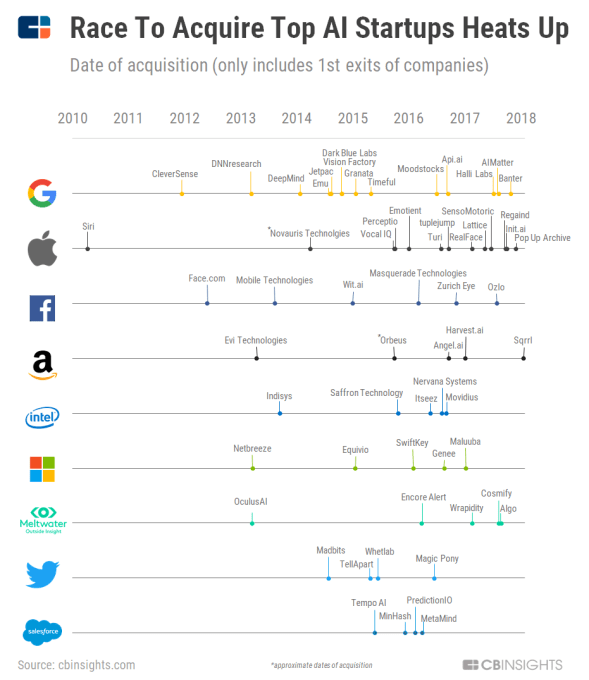
Source: CB Insights

On a micro-level, this is a highly rational strategy across the tech innovation ecosystem. Leading technology companies have the capabilities, cash and scale to leverage this talent and technical expertise into profitable products down the road. For their part, venture capitalists feel safer investing at higher prices in early-stage AI companies because a lucrative technology or team acquisition provides downside protection if they are unable to build a big business. Lastly, management teams may be tempted by early acquisition offers that are priced much higher than non AI-centric companies with equivalent product maturity or market traction.

In the AI arms race, though, the name of the game is not just getting ahead, but depriving competitors of the AI talent that could make them competitive. While tech companies compete for the promise of future AI-based offerings, they are not just depriving their competition of talent, but the rest of the economy, as well.

On a macro-level, this hoarding strategy is undercutting 95 percent of the impact AI could have on the global economy and society at large. Aggregate revenue of the five leading U.S. tech companies (Apple, Alphabet, Microsoft, Amazon, Facebook) represent less than 5 percent of total U.S. GDP. Yet tech giants are buying up companies and directing them to focus on R&D, rather than building AI applications for specific, non-tech industry problems that can have an impact today.

Some argue that tech incumbents are best suited to bring industry-specific solutions to bear. Just look at cloud computing and how many industries have used it to increase their productivity — maybe the same will be done for AI and data services. I don’t believe this is likely to happen quickly, for two reasons: (1) tech companies have plenty of their own purposes in mind, and (2) the best AI solutions are designed around a specific problem and workflow.

You can see this already playing out in a few ways:

Today, your Facebook photos are automatically tagged. This is a core feature enhancement designed to increase customer engagement. Recommendations on everything from Google to Netflix to Amazon are increasingly likely to result in increased customer purchases as a result of leveraging machine learning to scan a broader array of profile information. Both of these represent core needs for major tech companies and are not likely to translate into relevant offerings for other industries. Personally, I think it’s a shame that so many great AI minds are working on comparatively incremental feature enhancements.

There is a huge opportunity for AI-based products and companies targeting applications in industries outside the tech sector.

Second, tech companies are building up AI workforces as part of their moonshots and experimental labs that are focused on reimagining incumbent industries on tech terms and building the core IP and research that could make this possible. History indicates that when tech companies set out to reinvent entire categories, many commonly fail at first (recall Webvan, or Marc Andreesen’s LoudCloud). Incumbents don’t react quickly enough (consider Safeway’s response to Webvan, and IBM or HP’s reaction to LoudCloud).

Finally a new disruptive effort eventually succeeds a decade or two later (to complete this example, consider Amazon regarding groceries, and AWS or Opsware regarding cloud computing). In this arena, consumers and tech companies ultimately win, while major incumbents that should have had the inside track are leapfrogged because of the talent and technology gap accumulated during the initial efforts.

Even when specific projects fail, tech incumbents’ research labs reap a side benefit in recruiting power: they get AI talent in through the door and allow them to continue their research, publicizing it and adding to the narrative that tech companies are the best place to conduct research (you get free lunch and dinner!).

The net result of this situation is that, today, AI talent and technology are largely denied from companies outside of tech. Incumbent industries, like insurance, won’t see improvements to their bottom line because a computer can win at Go. This is unfortunate, because although industry applications may seem less “disruptive,” they could have a far more significant impact on a shorter timescale.

So what can other industry leaders do? Incumbent industries must respond aggressively or risk being cut out of the next decade of innovation, which will be largely driven by AI and data analytics. This means (1) acknowledging what is at stake, (2) creating an environment to attract, retain and focus the type of talent required and (3) aggressively seeking said talent.

We’ve begun to see action in a few areas:

With the prospect of self-driving cars, the automotive industry faces an existential risk.  Jon Lauckner at GM has been at the center of some bold moves forward, including the $1 billion acquisition of Cruise and a $500 million investment in Lyft. Ford and Delphi have also been active with acquisitions like Argo AI and NuTomony.
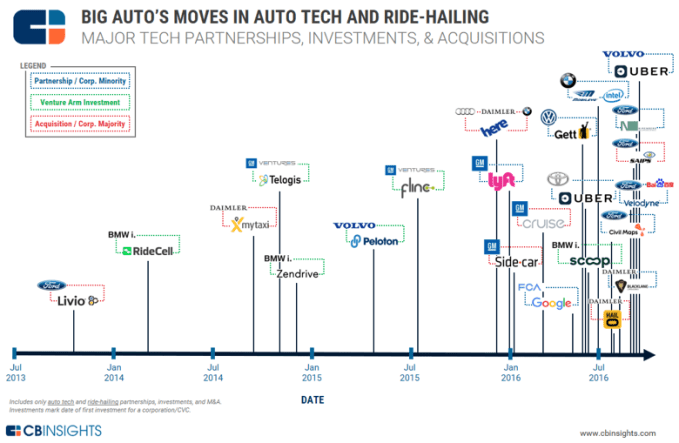
Source: CB Insights

Agriculture also presents a good example of action in recognition of what’s at stake: Two major AI acquisitions have happened in the last five years. Monsanto acquired Climate Corporation to advance their effort into a data-driven future wherein they can provide customized insights and advice to farmers for planting crops. This past year, John Deere acquired Blue River Technology, which takes this a step further, leveraging computer vision to deliver customized insight and action on every individual plant in real time as a tractor moves through the field.

To be sure, acquiring talent is far from the only means to advance as an incumbent, but building the core talent, technology and business model for future success has proven challenging for entrenched incumbents. Netflix is one of the few examples of success, innovating their way from a DVD-based business to a streaming one. Still, it was a painful transition, taking tremendous vision, cannibalization of their own sales and a 75 percent drop in share price before their fortunes turned skyward.

Right now, there is a huge opportunity for AI-based products and companies targeting applications in industries outside the tech sector, and there is relatively little competition in the short and intermediate term — moonshots at major tech companies have a spotty record and largely target a distant future. In the meantime, incumbents have historically failed to capitalize on major technology transformations, and outside of the few examples mentioned, history appears poised to repeat itself unless companies take proactive measures.


15 Mar 2018

Silicon Valley companies are undermining the impact of artificial intelligence

Leveraging machine learning and artificial intelligence to glean information from large data sets is the greatest technology opportunity of a generation. After a decade of acquiring talent from startups and research universities, tech companies like Facebook, Google and Uber have amassed some of the best AI teams in the world.

However, we are not seeing the impact we deserve beyond the tech sector. Unfortunately, progress in other industries has become collateral damage to the tech sector’s race for AI talent, and this issue has received little attention.

Over the last five years, 90 percent of AI startups in Silicon Valley have been acquired by leading tech companies. These acquisitions have been largely unrelated to a successful product: Often, companies are in nascent stages and their products are either shelved by the acquiring company altogether, or the technology is embedded as a feature in another core offering. Outside of a few highly targeted cases, it’s a strategy aimed first at getting the talent in-house, then figuring out what to do with them.

Source: CB Insights

On a micro-level, this is a highly rational strategy across the tech innovation ecosystem. Leading technology companies have the capabilities, cash and scale to leverage this talent and technical expertise into profitable products down the road. For their part, venture capitalists feel safer investing at higher prices in early-stage AI companies because a lucrative technology or team acquisition provides downside protection if they are unable to build a big business. Lastly, management teams may be tempted by early acquisition offers that are priced much higher than non AI-centric companies with equivalent product maturity or market traction.

In the AI arms race, though, the name of the game is not just getting ahead, but depriving competitors of the AI talent that could make them competitive. While tech companies compete for the promise of future AI-based offerings, they are not just depriving their competition of talent, but the rest of the economy, as well.

On a macro-level, this hoarding strategy is undercutting 95 percent of the impact AI could have on the global economy and society at large. Aggregate revenue of the five leading U.S. tech companies (Apple, Alphabet, Microsoft, Amazon, Facebook) represent less than 5 percent of total U.S. GDP. Yet tech giants are buying up companies and directing them to focus on R&D, rather than building AI applications for specific, non-tech industry problems that can have an impact today.

Some argue that tech incumbents are best suited to bring industry-specific solutions to bear. Just look at cloud computing and how many industries have used it to increase their productivity — maybe the same will be done for AI and data services. I don’t believe this is likely to happen quickly, for two reasons: (1) tech companies have plenty of their own purposes in mind, and (2) the best AI solutions are designed around a specific problem and workflow.

You can see this already playing out in a few ways:

Today, your Facebook photos are automatically tagged. This is a core feature enhancement designed to increase customer engagement. Recommendations on everything from Google to Netflix to Amazon are increasingly likely to result in increased customer purchases as a result of leveraging machine learning to scan a broader array of profile information. Both of these represent core needs for major tech companies and are not likely to translate into relevant offerings for other industries. Personally, I think it’s a shame that so many great AI minds are working on comparatively incremental feature enhancements.

There is a huge opportunity for AI-based products and companies targeting applications in industries outside the tech sector.

Second, tech companies are building up AI workforces as part of their moonshots and experimental labs that are focused on reimagining incumbent industries on tech terms and building the core IP and research that could make this possible. History indicates that when tech companies set out to reinvent entire categories, many commonly fail at first (recall Webvan, or Marc Andreesen’s LoudCloud). Incumbents don’t react quickly enough (consider Safeway’s response to Webvan, and IBM or HP’s reaction to LoudCloud).

Finally a new disruptive effort eventually succeeds a decade or two later (to complete this example, consider Amazon regarding groceries, and AWS or Opsware regarding cloud computing). In this arena, consumers and tech companies ultimately win, while major incumbents that should have had the inside track are leapfrogged because of the talent and technology gap accumulated during the initial efforts.

Even when specific projects fail, tech incumbents’ research labs reap a side benefit in recruiting power: they get AI talent in through the door and allow them to continue their research, publicizing it and adding to the narrative that tech companies are the best place to conduct research (you get free lunch and dinner!).

The net result of this situation is that, today, AI talent and technology are largely denied from companies outside of tech. Incumbent industries, like insurance, won’t see improvements to their bottom line because a computer can win at Go. This is unfortunate, because although industry applications may seem less “disruptive,” they could have a far more significant impact on a shorter timescale.

So what can other industry leaders do? Incumbent industries must respond aggressively or risk being cut out of the next decade of innovation, which will be largely driven by AI and data analytics. This means (1) acknowledging what is at stake, (2) creating an environment to attract, retain and focus the type of talent required and (3) aggressively seeking said talent.

We’ve begun to see action in a few areas:

With the prospect of self-driving cars, the automotive industry faces an existential risk.  Jon Lauckner at GM has been at the center of some bold moves forward, including the $1 billion acquisition of Cruise and a $500 million investment in Lyft. Ford and Delphi have also been active with acquisitions like Argo AI and NuTomony.

Source: CB Insights

Agriculture also presents a good example of action in recognition of what’s at stake: Two major AI acquisitions have happened in the last five years. Monsanto acquired Climate Corporation to advance their effort into a data-driven future wherein they can provide customized insights and advice to farmers for planting crops. This past year, John Deere acquired Blue River Technology, which takes this a step further, leveraging computer vision to deliver customized insight and action on every individual plant in real time as a tractor moves through the field.

To be sure, acquiring talent is far from the only means to advance as an incumbent, but building the core talent, technology and business model for future success has proven challenging for entrenched incumbents. Netflix is one of the few examples of success, innovating their way from a DVD-based business to a streaming one. Still, it was a painful transition, taking tremendous vision, cannibalization of their own sales and a 75 percent drop in share price before their fortunes turned skyward.

Right now, there is a huge opportunity for AI-based products and companies targeting applications in industries outside the tech sector, and there is relatively little competition in the short and intermediate term — moonshots at major tech companies have a spotty record and largely target a distant future. In the meantime, incumbents have historically failed to capitalize on major technology transformations, and outside of the few examples mentioned, history appears poised to repeat itself unless companies take proactive measures.

15 Mar 2018

Lightning Labs just raised millions from Jack Dorsey and others to supercharge blockchain transactions

Lightning Labs, a young, Bay Area-based startup, is trying to make it easier for users to send bitcoin and litecoin to each other without the costly and time-consuming process of settling their transactions on the blockchain.

It has investors excited about its work, too. The company is announcing today that it has raised $2.5 million in seed funding to date from a kind of list of big names in payments and beyond, including Square and Twitter co-founder Jack Dorsey, Square exec Jacqueline Reses, serial-founder-turned investor David Sacks, Litecoin creator Charlie Lee, Eventbrite co-founder Kevin Hartz, BitGo CTO Ben Davenport and Robinhood co-founder Vlad Tenev, along with The Hive, Digital Currency Group and others.

In an enthusiastic tweet earlier today, Sacks characterized the company as “one of the most important projects in crypto overall.”

Why is it notable, exactly? For starters, Lightning Labs works off Lightning Network, a protocol that’s sometimes called the second layer of bitcoin. (Think of it a little like HTTP.) Boosters of this newer layer, including Lightning Labs, see it as a way to exponentially boost the number and speed of transactions of the bitcoin blockchain without increasing the size of blocks — batches of transactions that are confirmed and subsequently shared on bitcoin’s public ledger.

It’s all a little confusing to people still trying to get a handle on how the blockchain works, but the Lightning protocol essentially aims to let two or more people — and eventually machines — create instant, high-volume transactions that still use the underlying blockchain for security.

Here’s how it works: Let’s take two people. They assign funds on the blockchain into an entry that requires both to sign off on what they plan to spend. Say this is $20. After that transaction is recorded, they can transact that amount of money between each other as many times as they want. If they want to change the amount of that spend, they just update the entry on the blockchain. If they want to involve more people in this transaction, they can do this, too.

If you’re wondering whether there’s room for grift if these transactions move further from the blockchain, so were we. But one of the core tenets of Lightning Labs’s technology, it says, is that it allows you to do away with counter-party risk. You don’t have to trust someone you are transacting with because — ostensibly, anyway — no one can steal your cryptocurrency.

First, a so-called cryptographic “proof” is created when users initially broadcast that first transaction (and updated versions of it) to the blockchain. And that proof ensures that if one party tries to steal from another, not only will it be incapable of doing so, but as a penalty for trying, the thief’s currency will be awarded to the person they were trying to swindle.

As for people who try hopping offline in the middle of a transaction with the aim of stealing someone else’s cryptocurrency, there are separate safety measures in place in the form of time-out periods that, when they expire, ensure that the currency sender gets back his or her money. The blockchain acts as a kind of unbiased arbiter.

As for sending money to multiple parties, that’s called multi-hop routing and payments are conditional upon knowledge of a random number. Either the entire payment goes through across all participants or it’s canceled, so no one party can compromise the transactions.

Lightning Labs isn’t the only outfit that has sprung up around these smart Lightning contracts, but it’s the furthest along, suggests co-founder and CEO Elizabeth Stark, who says more than 1,800 developers are part of her company’s Slack channel and that thousands of volunteers helped Lightning’s seven-person team find glitches in the alpha version of its open-source software.

That outside help enabled Lightning to, starting today, roll out a beta version that’s open to anyone.

It’s only truly developer friendly at this point. (You have to write command code to use it. Stark says a much friendlier user interface will be available down the road.) Stark also suggests that because the beta version is just being released that people only transact with the amount of money they might carry in their wallet. In fact, there are limits on how much you can transact using its software, which Stark says is less to protect users from theft than from them “putting their life savings in bitcoin on Lightning.” (The presumption: that people will actually start using bitcoin as a currency instead of a commodity to hang onto, thanks to the Lightning protocol.)

Finally, Lightning Labs’s technology — which is enabling people to transact with bitcoin and litecoin for now — is available on desktops only, though a mobile version is coming.

We asked Stark yesterday about the origin of the company. A former lecturer at Stanford and Yale who taught about digital copyrights, she said she realized in 2016 that if bitcoin was going to be “used by the entire world, it couldn’t happen on blockchain.” Like a lot of people, too, Stark says she got excited by the prospect of micropayments, including for artists and musicians.

When she separately edited a paper about the Lightning protocol and realized it might be possible to send high volumes of small payments — for there to be a genuine currency of the web — she suggests she jumped in with both feet with co-founder and CTO Olaoluwa Osuntokun.

“He’s the genius behind our software,” she says of Osuntokun, who has two computer science degrees from UC Santa Barbara and who graduated in 2016.

To learn more, you might check out this talk that Stark gave on the seeming importance of the layers that Lightning Labs and others are building atop the blockchain.

15 Mar 2018

Lightning Labs just raised millions from Jack Dorsey and others to supercharge blockchain transactions

Lightning Labs, a young, Bay Area-based startup, is trying to make it easier for users to send bitcoin and litecoin to each other without the costly and time-consuming process of settling their transactions on the blockchain.

It has investors excited about its work, too. The company is announcing today that it has raised $2.5 million in seed funding to date from a kind of list of big names in payments and beyond, including Square and Twitter co-founder Jack Dorsey, Square exec Jacqueline Reses, serial-founder-turned investor David Sacks, Litecoin creator Charlie Lee, Eventbrite co-founder Kevin Hartz, BitGo CTO Ben Davenport and Robinhood co-founder Vlad Tenev, along with The Hive, Digital Currency Group and others.

In an enthusiastic tweet earlier today, Sacks characterized the company as “one of the most important projects in crypto overall.”

Why is it notable, exactly? For starters, Lightning Labs works off Lightning Network, a protocol that’s sometimes called the second layer of bitcoin. (Think of it a little like HTTP.) Boosters of this newer layer, including Lightning Labs, see it as a way to exponentially boost the number and speed of transactions of the bitcoin blockchain without increasing the size of blocks — batches of transactions that are confirmed and subsequently shared on bitcoin’s public ledger.

It’s all a little confusing to people still trying to get a handle on how the blockchain works, but the Lightning protocol essentially aims to let two or more people — and eventually machines — create instant, high-volume transactions that still use the underlying blockchain for security.

Here’s how it works: Let’s take two people. They assign funds on the blockchain into an entry that requires both to sign off on what they plan to spend. Say this is $20. After that transaction is recorded, they can transact that amount of money between each other as many times as they want. If they want to change the amount of that spend, they just update the entry on the blockchain. If they want to involve more people in this transaction, they can do this, too.

If you’re wondering whether there’s room for grift if these transactions move further from the blockchain, so were we. But one of the core tenets of Lightning Labs’s technology, it says, is that it allows you to do away with counter-party risk. You don’t have to trust someone you are transacting with because — ostensibly, anyway — no one can steal your cryptocurrency.

First, a so-called cryptographic “proof” is created when users initially broadcast that first transaction (and updated versions of it) to the blockchain. And that proof ensures that if one party tries to steal from another, not only will it be incapable of doing so, but as a penalty for trying, the thief’s currency will be awarded to the person they were trying to swindle.

As for people who try hopping offline in the middle of a transaction with the aim of stealing someone else’s cryptocurrency, there are separate safety measures in place in the form of time-out periods that, when they expire, ensure that the currency sender gets back his or her money. The blockchain acts as a kind of unbiased arbiter.

As for sending money to multiple parties, that’s called multi-hop routing and payments are conditional upon knowledge of a random number. Either the entire payment goes through across all participants or it’s canceled, so no one party can compromise the transactions.

Lightning Labs isn’t the only outfit that has sprung up around these smart Lightning contracts, but it’s the furthest along, suggests co-founder and CEO Elizabeth Stark, who says more than 1,800 developers are part of her company’s Slack channel and that thousands of volunteers helped Lightning’s seven-person team find glitches in the alpha version of its open-source software.

That outside help enabled Lightning to, starting today, roll out a beta version that’s open to anyone.

It’s only truly developer friendly at this point. (You have to write command code to use it. Stark says a much friendlier user interface will be available down the road.) Stark also suggests that because the beta version is just being released that people only transact with the amount of money they might carry in their wallet. In fact, there are limits on how much you can transact using its software, which Stark says is less to protect users from theft than from them “putting their life savings in bitcoin on Lightning.” (The presumption: that people will actually start using bitcoin as a currency instead of a commodity to hang onto, thanks to the Lightning protocol.)

Finally, Lightning Labs’s technology — which is enabling people to transact with bitcoin and litecoin for now — is available on desktops only, though a mobile version is coming.

We asked Stark yesterday about the origin of the company. A former lecturer at Stanford and Yale who taught about digital copyrights, she said she realized in 2016 that if bitcoin was going to be “used by the entire world, it couldn’t happen on blockchain.” Like a lot of people, too, Stark says she got excited by the prospect of micropayments, including for artists and musicians.

When she separately edited a paper about the Lightning protocol and realized it might be possible to send high volumes of small payments — for there to be a genuine currency of the web — she suggests she jumped in with both feet with co-founder and CTO Olaoluwa Osuntokun.

“He’s the genius behind our software,” she says of Osuntokun, who has two computer science degrees from UC Santa Barbara and who graduated in 2016.

To learn more, you might check out this talk that Stark gave on the seeming importance of the layers that Lightning Labs and others are building atop the blockchain.

15 Mar 2018

Volley’s voice games for smart speakers have amassed over half a million monthly users

The rapid consumer adoption of smart speakers like Amazon Echo and Google Home has opened opportunities for developers creating voice apps, too. At least that’s true in the case of Volley, a young company building voice-controlled entertainment experiences for Amazon Alexa and Google Home. In less than a year, Volley has amassed an audience north of 500,000 monthly active users across its suite voice apps, and has been growing that active base of users at 50 to 70 percent month-over-month.

The company was co-founded by former Harvard roommates and longtime friends, Max Child and James Wilsterman, and had originally operated as an iOS consultancy. But around a year and a half ago, Volley shifted its focus to voice instead.

“When we were running the iOS business, we were always sort of hacking around on games and some stuff on the side for fun,” explains Child. “We made a trivia game for iOS. And we made a Facebook Messenger chatbot virtual pet,” he says. The trivia game they built let users play just by swiping on push notifications – a very lightweight form of gameplay they thought was intriguing. “Voice was sort of the obvious next step,” says Child.

Not all their voice games have been successful, however. The first to launch was a game called Spelling Bee that users struggled with because of Alexa’s difficulties in identifying single letters – it would confuse a “B,” “C,” “D,” and “E,” for example. But later titles have taken off.


Volley’s name-that-tune trivia game “Song Quiz” was its first breakout hit, and has grown to become the number one game by reviews. The game today has a five-star rating across 8,842 reviews.

Another big hit is Volley’s “Yes Sire,” a choose-your-own-adventure style storytelling game, that’s also at the top of Alexa’s charts. It also has a five-star rating, across 1,031 reviews.

The company says it has over a dozen live titles, with the majority on the Alexa Skill Store and few for Google Assistant/Google Home. But it only has seven or eight in what you would consider “active development.”

Unlike some indie developers who are struggling to generate revenue from their voice applications, Volley has been moderately successful thanks to Amazon’s developer rewards program – the program that doles out cash payments to top performing skills. While the startup didn’t want to disclose exact numbers, it says it’s earning in the five figure range monthly from Amazon’s program.

In addition, Volley is preparing to roll out its own monetization features, including subscriptions and in-app purchases of add-on packs that will extend gameplay.

The company’s games have been well-received for a variety of reasons, but one is that they allow people to play together at the same time – like a modern-day replacement for family game night, perhaps.

“I think a live multiplayer experience with your family or people you’re good friends with, where you can have a fun time together in a room is fairly unusual. I mean, I don’t know about you, but I don’t crowd around my iPhone and play games with my friends. And even with consoles there are significant barriers in understanding how to play” says Child.

“I think that voice enables the live social experience in a way that anyone from five years old to 85 years old can pick up immediately. I think that’s really special. And I think we’re just at the beginning. I’m not going to say we’ve got it all figured out – but I think that’s powerful and unique to these platforms,” he adds.

Volley raised over a million in seed funding ahead of joining Y Combinator’s Winter 2018 class, in a round led by Advancit Capital. Other investors include Amplify.LA, Rainfall, Y Combinator, MTGx, NFX, and angels Hany Nada, Mika Salmi, and Richard Wolpert.

The startup is currently a team of six in San Francisco.