15 Mar 2018

Fortem gets a $15 million Series A for its drone-hunting tech

Startup pitches invariably involve futures where the skies are thick with drones — delivery, transportation, emergency response. In that seemingly inevitable scenario, tracking and hunting down out of control and malicious unmanned vehicles will likely be a pretty lucrative field.

It’s something Fortem’s been working on for a few years now. In May of 2016, the company purchased radar technology from IMSAR. A year later, the Provo, Utah-based company raised a $5.5 million seed to help grow the tech into a compact drone detection system. Today, the startup announced that it’s closed its Series A — $15 million, led by Palo Alto-based VC firm, Data Collective (DCVC), which also played a key role in the seed round. 

For CEO Timothy Bean, the fundraising round represents a testament to the accuracy of the company’s core TrueView technology — an AI-powered 360-degree radar system that weighs a pound-and-a-half and is roughly the size if a pencil case. “This is a huge validation for our technology,” Bean said in a call to TechCrunch this week, “that it works and works well.”

TrueVision’s compact size means the technology can go beyond simply serving as ground-based radar. The product can be mounted directly onto a robust drone, giving the device a complex vision to help it detect and avoid objects smaller than a can of soda. The company believes that utilizing such technology could go a ways toward loosening line-of-sight restrictions that have made it difficult for drone-based business to execute their plans.

“Billions of dollars have been spent on the drone economy,” said Bean. “The current rules require you to have a human monitoring the aircraft,” Bean told TechCrunch. What we tend to do is remove the joystick and enable these machines to fly beyond the line of sight. All of the different companies that want to deliver packages, provide search and rescue, air taxis — it’s a billion-dollar industry and we’re right at the forefront.”

Last year, the startup also demoed DroneHunter, a technology designed to help alleviate those problem drones by shooting net at them. Pretty cool.

Other investors in the round include Abu Dhabi-based Mubadala, and Boeing’s venture wing, HorizonX, which clearly has a vested interest in keeping the skies safe. Bean says the money will go toward scaling the business and marketing side of the company and adapting the technology to fit a wider variety of aircraft. Fortem will also be growing its staff, which currently numbers just less than 100.

15 Mar 2018

John Chen to stay on as BlackBerry CEO through 2023

BlackBerry today announced it reached an agreement to keep CEO John Chen in his current position through 2023. Chen joined the company in 2013 and is responsible for leading the company’s recovery as it left smartphones and embraced services.

When Chen took over the company, the company was struggling on all fronts. Its time as the smartphone leader was done but it still had a strong brand in key markets. Chen lead the company to a modest turn around and has seemingly found its footing. The company stock is up 89.9% over the last 12 months and nearly level with the stock price when Chen took over during its decline five years ago.

“The BlackBerry Board of Directors has tremendous confidence in John Chen . John engineered a successful turnaround and has the company repositioned to apply its strengths and assets to the Enterprise of Things, an emerging category with massive potential,” said Prem Watsa, Lead Director and Chair of the Compensation, Nomination and Governance Committee of the BlackBerry Board, in a released statement. “John’s leadership is critical and the Board has determined that it is in the best of interests of BlackBerry and its shareholders to continue his service through November 2023.”

Going forward Chen’s compensation is weighted towards longterm goals. His salary will stay the same. He will be award 5 million restricted share units vested over five years if and when the company’s share price amounts from USD $16 to $20. A performance-based cash award will vest and become available if the company’s share price hits $30, resulting in BlackBerry’s market capitalization hitting $16.1 billion, an increase of 134% from current levels.

It’s painful to watch iconic companies die. BlackBerry was dying and Chen managed to keep the boat afloat through cuts and redirection. If there’s anyone who’s able to keep the company moving forward, it’s John Chen and BlackBerry’s board clearly felt he was the right person for the job.

15 Mar 2018

Experian acquires UK’s ClearScore and its financial product matching engine for $385M

While credit-scoring behemoth Equifax continues to work through the fallout from its massive security breach, one of its big competitors is snapping up a startup in the UK to diversify its business. Experian today announced that it is acquiring ClearScore, which has built a platform that — like Experian — offers you a credit score, which it then uses it to suggest financial products like credit cards that fit the bill, so to speak. Experian is acquiring ClearScore for £275 million ($385 million), plus an unspecified earnout based on future performance. The deal is expected to close later this year.

Considering that ClearScore, which has around 6 million users, had only disclosed around $15.6 million in funding, this appears to be a significant return for its investors, which included Blenheim Chalcott, Brightbridge Ventures, Lead Edge Capital, and QED, according to PitchBook.

The deal is emblematic of a trend that we’ve been seeing in the world of financial services for some time now: legacy behemoths are buying up smaller and more nimble startups that have revisited and rebuilt age-old services, bringing them up to speed with our changing technological times. Those older and larger businesses are often opting to buy in new technology and talent rather than trying (and potentially) failing to do this within their own incumbent infrastructure.

In the case of ClearScore, while it provided a core service similar to Experian’s, it was doing so with the aim of appealing to a new set of younger and more digitally-savvy consumers.

ClearScore based a lot of its interactions around an app — on iPhone/iPad, Android and Apple Watch — and provided its credit score updates and financial ‘health check’ in real time and — this is important — free of charge, banking on the premise that if they could provide this one service better and cheaper than the legacy players, it would be enough to bring in more business through its recommendation engine. Services that it tailored to your own finances included credit cards, loans and car financing, and every time a user ends up purchasing one of those products, ClearScore gets an affiliate cut.

The model has been lucrative enough to have generated around $37 million in revenues in 2017, the company said, and ClearScore is on track to generate around $55 million this year. Experian said ClearScore will have an EBIT contribution of $20 million in 2019, and $25 million after that. Integration will cost Experian $20 million, the company said.

At a time when credit scoring agencies are in the spotlight — and not in a positive way — adding in services that make better use of the data that they are measuring anyway, and picking up a new user base to boot, seems to be a logical move.

“In acquiring ClearScore, we will take another important step in our strategy to extend the services we provide to UK consumers,” said Brian Cassin, CEO of Experian, in a statement. “Our goal is to provide more choice and greater convenience to individuals who want access to personal financial products at the best prices, while also making it easier for credit providers to offer better, more tailored offers to consumers. We look forward to welcoming the ClearScore team to Experian and to including the ClearScore brand as part of our broader offer.”

Experian plans to keep the ClearScore branding, and my guess — although the company has not stated it explicitly — is that we will see Experian looking to roll out ClearScore’s services and recommendation engine to a wider set of its current users, not just in the UK but further afield.

15 Mar 2018

SpaceX and United Launch Alliance land $640 million in Air Force launches

The U.S. Air Force wants to maintain its options: It awarded a total of $640 million in satellite launch contracts to both SpaceX and the United Launch Alliance (Boeing and Lockheed Martin’s joint space launch venture), with the goal of making sure it has access to at least two options for launching its payloads to space.

SpaceX won a $290 million contract to launch three GPS satellites for the USAF by the end of 2020, the Wall Street Journal reports, and the ULA will receive $351 to launch two space craft from the air defence agency. On a per launch basis, SpaceX’s rockets cost around $70 million less, and that’s also part of why the Air Force went with two providers for this next spate of launches, too.

The report notes that this is part of an ongoing cost reduction effort, which should bode well for SpaceX. The launch startup has also just demonstrated its Falcon Heavy rocket, which could put larger payloads into space and eventually compete more directly with the Atlas V from ULA for different kinds of Air Force contracts. Meanwhile, ULA is moving forward with its efforts to develop a lower-cost rocket and launch option, but that’s likely still a few years away from being viable.

The Pentagon has long had a goal of establishing at least two viable launch providers for missions relating to national security, so that’s a big reason for continuing to play nice on both sides of this private space race. SpaceX has an Air Force launch on the manifest, which is possible pre-validation of the rocket only because it’s an experimental mission, coming up later this year.

15 Mar 2018

Airtable raises $52M to give non-coders tools to build complex software

A massive company probably has plenty of engineers on staff and the resources to build a complex backbone of interconnected information that can contain tons of data and make acting on it easy — but for smaller companies, and for those that aren’t technical, those tools aren’t very accessible.

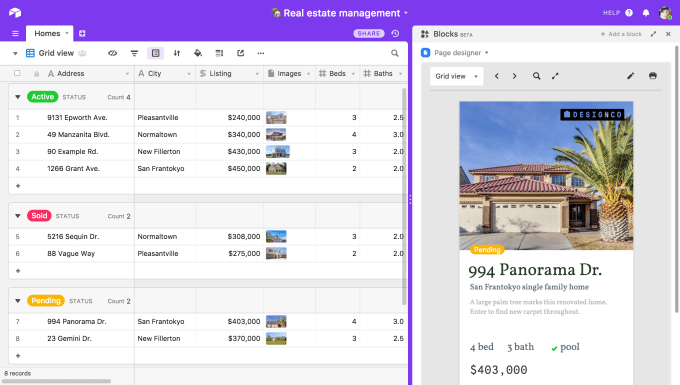
That’s what convinced Howie Liu to create Airtable, a startup that looks to turn what seems like just a normal spreadsheet into a robust database tool, hiding the complexity of what’s happening in the background while those without any programming experience create intricate systems to get their work done. Today, they’re trying to take that one step further with a new tool called Blocks, a set of mix-and-match operations like SMS and integrating maps that users can just drop into their systems. Think of it as a way to give a small business owner with a non-technical background to meticulously track all the performance activity across, say, a network of food trucks by just entering a bunch of dollar values and dropping in one of these tools.

“We really want to take this power you have in software creation and ‘consumerize’ that into a form anyone can use,” Liu said. “At the same time, from a business standpoint, we saw this bigger opportunity underneath the low-code app platforms in general. Those platforms solve the needs of heavyweight expensive use cases where you have a budget and have a lot of time. I would position Airtable making a leap toward a graphical user interface, versus a lot of products that are admin driven.”

Liu said the company has raised an additional $52 million in financing in a round led by CRV and Caffeinated Capital, with participation from Freestyle Ventures and Slow Ventures. All this is going toward a way to build a system that is trying to abstract out even the process of programming itself, though there’s always going to be some limited scope as to how custom of a system you can actually make with what amounts to a set of logic operation legos. That being said, the goal here is to boil down all of the most common sets of operations with the long tail left to the average programmers (and larger enterprises often have these kinds of highly-customized needs).

All this is coming at a time when businesses are increasingly chasing the long tail of small- to medium-sized businesses, the ones that aren’t really on the grid but represent a massive market opportunity. Those businesses also probably don’t have the kinds of resources to hire engineers while companies like Google or Facebook are camping out on college campuses looking to snap up students graduating with technical majors. That’s part of the reason why Excel had become so popular trying to abstract out a lot of complex operations necessary to run a business, but at the same time, Liu said that kind of philosophy should be able to be taken a step further.

“If you look at cloud, you have Amazon’s [cloud infrastructure] EC2, which abstracted the hardware level and you can build on existing machine intelligence,” Liu said. “Then, you get the OS level and up. Containers, Heroku, and other tools have extracted away the operation level complexity. But you have to write the app and modal logic. Our goal is to go a big leap forward on top of that and abstract out the app code layer. You should be able to directly use our interface, and blocks, all these plug and play lego pieces that give you more dynamic functionality — whether a map view or an integration with Twilio.”

And, really, all these platforms like Twilio have tried to make themselves pretty friendly to coding beginners as-is. Twilio has a lot of really good documentation for first-time developers to learn to use their platforms. But Airtable hopes to serve as a way to interconnect all these things in a complex web, creating a relational database behind the scenes that users can operate on in a more simplistic matter that’s still accurate, fast, and reliable.

“Obviously MySQL is great if you want to use code or custom SQL queries to interface with the data,” Liu said. “But, ultimately, you’d never as a business end user consider using literally a terminal-based SQL prompt as the primary interface to and from your data. Certainly you wouldn’t put that on your designs. Clearly you would want some interface on top of the SQL level database. We basically expose the full value of a relational database like Postgres to the end user, but we also give them something equally but more important: the interface on the top that makes the data immediately visible.”

There’s been a lot of activity trying to rethink these sort of fundamental formats that the average user is used to, but are ripe for more flexibility. Coda, a startup trying to rethink the notion behind a word document, raised $60 million, and all this points towards moves to try to create a more robust toolkit for non-technical users. That also means that it’s going to be an increasingly hot space, and especially look like an opportunity for companies that are already looking to host these kinds of services online like Amazon or Microsoft and have the buy-in from those businesses.

Liu, too, said that the goal of the company was to go after all potential business cases right away by creating a what-you-see-is-what-you-get one size fits all platform — which is usually called a horizontal approach. That’s often a very risky move, and it’s probably the biggest question mark for the company as there’s an opportunity for some other startups or companies to come in and grab niches of that whole pie in specific areas (like, say, a custom GUI programming interface for healthcare). But Liu said the opportunity for Airtable was to go horizontal from day one.

“There’s this assumption that software has to involve literally writing code,” Liu said. “It’s sort of a difficult thing to extricate ourselves from because we have built so much with writing code. But when you think about what goes into a useful application, especially in the business-to-business internal tools in a company use case which forms the bulk of software that’s consumed in terms of lines of code written, most of them are primarily a relational database model, and the relational database aspect of it is not an arbitrary format.

15 Mar 2018

Five Seasons Ventures is a new €60M European early-stage fund investing in food and agriculture tech

More VC money sloshing around Europe, this time with the launch of a new early-stage fund targeting food and agriculture technology. Backed by the likes of European Investment Fund, Nestlé, Fondo Italiano d’Investimento, and Bpifrance, Five Seasons Ventures is announcing the first closing of its fund with commitments “in excess of €60 million” to invest in food/agtech in the region.

The France-headquartered VC says it plans to focus on early-stage companies developing tech innovations aimed at solving key challenges in the sector. These span healthier food, to shorter supply chains, to quantified and personalised nutrition, to alternative proteins.

Five Seasons Ventures is founded and managed by Ivan Farneti and Niccolò Manzon. Farneti is a seasoned VC and was previously a founding partner of Doughty Hanson Technology Ventures and a board member of Seedcamp. Niccolò meanwhile is said to bring quite a lot food and agtech investing experience. In his previous role leading a European family office, he’s previously backed 10 companies in the food tech sector, such as Impossible Foods, Perfect Day, Beyond Meat, Clear Labs and Memphis Meats.

In an email Q&A with the Five Seasons Ventures pair we delved a little into why Europe is crying out for a new early-stage fund dedicated to food and agtech, the new VC firm’s investment thesis, and how it hopes to find the next generation of entrepreneurs innovating in the food and agriculture industries. Full text below.

Why does Europe need a new “Food and Agri Tech” fund, and why now?

NM: The timing of our new fund is perfect, across the EU we are seeing a huge surge in innovation across the food and agri tech sector, due to numerous factors. The consumer mindset has shifted, people are becoming increasingly more conscious of what they eat and the wider impact that food has on their health and wellbeing. The cost of technology is lowering and there is a wider misalignment between the global demand and supply of food. Increasingly, we’re seeing larger incumbents acquiring early-stage companies.

We see many clear reasons for why it’s time to have an independent new European fund that can invest in these high-growth companies. There is a lot of innovation, entrepreneurs and startups growing in this space, and while we’re seeing incumbents are open to innovating outside of their own R&D labs by partnering with startups, there is a limited supply of specialised capital from experts in this area. We believe that Five Seasons Ventures can be the expert partner providing capital and value-add to help these companies scale.

In the area of “Food and Agri Tech”, does Europe have any particular strengths or weaknesses compared to other parts of the world, including Silicon Valley?

NM: Among its strengths, Europe is home to many of the most innovative food corporates, the biggest of which, Nestlé, has joined as one of the investors in our fund. There is less competition for capital, therefore lower valuations and more ‘frugal’ startups. European Universities are playing a key role in incubating food innovation, as an example the top agri tech University in the world is Wageningen University in the Netherlands. In addition to academic institutions, there has been a growing number of food and ag tech focused incubators and accelerator, with over 30 based across the continent. Europe has a culture and heritage in food and nutrition and non-dilutive funding is available from Horizon 2020 and Innovate UK, among others, to support companies at the earlier stages of development.

The areas where Europe is currently lacking are on the regulation side, but we are already seeing improvement in the EU with a simplified, quicker and cheaper Novel Food approval process . While it’s also been lacking in specialised funding, our fund is aiming to fill this gap, but we recognise that given the deal flow within the space, we could easily see further food tech funds develop in the future to further plug this gap. It’s an exciting time to work in food tech in Europe!

What stage companies are you planning to invest in, and what is your average size cheque?

NM: We’re investing at the Series A level into companies with high growth potential, a largely proven technology and early commercial traction. We will invest an initial €2-4m in exchange for a significant minority, ideally as part of a syndicate with other value-add investors. We will retain up to twice the amount invested in the entry round for follow-on investment and can fund up to €12m in each portfolio company.

Can you talk a little bit more about your investment thesis, what specific areas of food or agriculture pose the biggest investment opportunities?

IF: Over the past four years we have defined four initial investment themes, based on our analysis of the most pressing needs in the industry and the most promising startups and entrepreneurs. .

The first theme is “Shifting Diets”, where new technology is applied to changes in the consumer diet, this could be preferences for healthier, natural, and more sustainable food. Think of alternative sources of proteins, or solutions that lower the amount of sugar, salt or saturated fat in our diet or personalised nutrition aimed at making our lives better and healthier.

Secondly, we’re looking at “Trust and Transparency”.  Consumers are more interested than ever in where their food comes from, but big food companies and retailers are concerned about recalls, counterfeits and brand damage. Several digital technologies can be applied to shorten supply chains and make them more transparent.

“Food Waste Reduction” is another key theme. The amount of food that we are wasting, in supermarkets, restaurants, and on the production line, is huge and it’s a disgrace! More than a third of food made for human consumption never gets eaten. We’re already seeing several technology companies addressing this global issue throughout the supply chain, from the fields and distribution stages, to restaurants and at home.

Finally, a key theme is the “Increase of Food Production Yield” without an impact on environmental resources, where a lot of digital and biotechnologies are being applied to solve the growing misaligment between the demand and supply of food. We are very excited by the application of gene editing in agriculture as well as big data analytics and robotics, to name just a few.

What do you look for in founders and how important is domain expertise not just tech?

IF: We discovered that there is no shortage of technical and scientific talent in food and agri tech in Europe. But ambitious founders with a big vision for their business are harder to find. When we find the combination of both, maybe in Co-Founders, we normally get hooked and engage in deeper conversations. We expect more managerial talent to come out of big food and big agtech companies to join startups in the coming years, when current big mergers will lead the inevitable reorganisations.

How will you generate deal-flow, and what is the best way to pitch you?

IF: We have logged about 500 new food and agri tech deals in the last 18 months. We find many companies by attending specific industry events as speakers, panelists, mentors and judges, where we have the opportunity to explain what we are interested in and how we work as venture investors. Quality deal flow comes from our network of contacts in the industry and from generalist investors looking for the specialist’s point of view and our role as possible co-investors. Finally, we take a proactive view on specific themes and we scout the sector far and wide looking for the right company. We aim to respond to an entrepreneur’s email within a week, so a short mail with an exec summary is very efficient. We love to sample the products, wherever possible!


15 Mar 2018

Blue Vision Labs, which builds ‘collaborative’ AR, emerges from stealth with $14.5M led by GV

Blue Vision Labs, a London-based augmented reality startup co-founded by computer vision experts from Oxford and Imperial College, is emerging from stealth today with a new platform that it claims will be the first to bring ‘collaboration’ to the AR experience: with an app built on Blue Vision’s technology (via its API and SDK), multiple users will be able to see the same virtual objects, and interact with each other in that virtual space with spatial accuracy that hasn’t been seen in widely-available AR services before.

Scenarios where this kind of feature could come in useful could include multi-player games, on-street navigation apps, social media applications and education. Peter Ondruska, the startup’s co-founder and CEO, tells me that Blue Vision’s tech can pinpoint people and other moving objects in a space to within centimeters of their actual location — far more accurate than typical GPS — meaning that it could give far better results in apps that require two parties to find each other, such as in a ride-hailing app. (Hands up if you and your Uber driver have ever lost each other before you’ve even stepped foot in the vehicle.)

Blue Vision has been in stealth mode for the past two years building its product — and its founding team, which also includes Lukas Platinsky, Hugo Grimmett, and repeat entrepreneurs Andrej Pancik and Bryan Baum, have been working on the idea since 2011 — but now it is finally hitting the ground running.

Along with the launch of its SDK for developers, Blue Vision announcing that it has raised $17 million in funding — $14.5 million in a new Series A led by Alphabet’s GV, plus another $2.5 million in Seed funding that it raised earlier from Accel, Horizons Ventures, SV Angel and others — all of whom also participated in this latest round, too.

The SDK will initially be free to use, Ondruska said.

There’s been a surge of interest in augmented and virtual reality technology in the last couple of years, fuelled by some interesting moves from larger tech companies like Google and Apple — launching developer kits to build applications, and working on more hardware to consume it — investments by larger media companies in building content for these platforms, and the hundreds of millions of dollars that investors are pouring into the army of startups that are building both software and hardware to usher in this new age of how we will, apparently, soon be seeing the world.

Some of these investments have so far felt like audacious moonshots. (Magic Leap’s hundreds of millions of dollars in funding, for example, have yet to materialise into anything we can use, virtually or otherwise.) But some are making their way to people today, and causing a stir, if not a massive wave of usage. (Think here of Apple’s ARKit and Google’s ARCore.)

And VR development has even already started to tackle the collaboration challenge too: recall Facebook’s Oculus division work on Rooms, where you can interact with multiple people.

Blue Vision’s approach is a little different, in that it requires no more hardware than what many people already have — a smartphone and a basic smartphone camera — both to interact with the experience and to ingest the environment to create it. The fact that it provides that relatively low barrier to entry, while also doing an enormous amount of heavy lifting at the back end to solve a persistent challenge in AR, is what potentially makes the company unique and noteworthy.

“They have reduced the need for specific, tailored hardware,” said GV’s Tom Hulme, who is joining the board. “Where we might have needed multiple lenses before, they have achieved same thing with a basic smartphone lens.”

Some of that heavy lifting has also involved building highly detailed maps that developers can now use to build collaborative AR experiences: the idea here is that the map of a space becomes the canvas onto which all of the other objects get placed for their interactions.

Ondruska said that initially the company has built maps covering the city centers of London, San Francisco and New York, with plans to add more locations. Users, he said, can also essentially “build” locations on the fly while using apps powered by Blue Vision, although these would work less well in fast-moving environments, where you might need to reference locations more accurately and pick up more detail.

Some have projected that AR-based applications could generate $83 billion by 2021. That seems like a big leap, considering we’re now already at 2018 and so far our biggest “hit” in AR has been Pokemon Go. Ondruska believes that this is because there have been missing pieces in making AR a truly seamless and smooth experience, and that his team has built the parts that will complete the picture.

“One of the reasons why AR hasn’t really reached mass market adoption is because of the tech that is on the market,” he said. “Single-user experiences are limiting. We are allowing the next step, letting people see the right place, for example. None of that was possible before in AR because the backend didn’t exist. But by filling this piece, we are creating new AR use cases, ones that are important and will be used on a daily basis.”


15 Mar 2018

Startup Battlefield Europe deadline extended one week

Procrastinateurs se réjouissent! If you haven’t applied yet to compete in TechCrunch Startup Battlefield Europe at VivaTech in Paris on May 24-25, then rejoice indeed, because we have great news for you. We’re extending the application deadline by one full week to March 22, at 9 a.m. PST. Startup Battlefield is the premier startup pitch competition and the best way to launch your early-stage startup to the world. Don’t miss out, apply today.

TechCrunch editors will select roughly 15-30 early-stage startups to compete and will provide the founder of each chosen company with expert pitch coaching. You and your team will be ready and at your best when you step on the Startup Battlefield stage to deliver your six-minute pitch to a panel of judges — and ready to answer any questions they may throw at you.

The judges narrow the field to just five competitors who go on to a second round of pitching to a fresh panel of judges. And from that five comes one top startup that takes home major bragging rights along with €25,000 in no-equity cash and an all-expense paid trip for two to San Francisco, where they will compete in the Startup Battlefield at Disrupt SF 2018, TechCrunch’s flagship event (as long as they still meet eligibility requirements).

Even if you don’t take the top prize, you still reap phenomenal benefits by competing in Startup Battlefield. They’re almost too numerous to mention, but heck, we’ll do it anyway. Let’s start with that invaluable pitch coaching, and remember: when you’re pitching, you’re placing your company in front of the very investors you seek. It’s prime exposure time.

Of course, there’s media attention — and lots of it. Startup Battlefield takes place in front of a large, live audience, and we also stream the entire event — start to finish — around the world on TechCrunch.com, YouTube, Facebook and Twitter (and available later, on demand).

Don’t forget about the incredible networking connections. Every company that competes joins the Startup Battlefield alumni community, which includes the likes of Mint, Dropbox, Yammer, TripIt, Getaround and Cloudflare. The alumni companies number almost 750, and have collectively raised more than $8 billion in funding and produced more than 100 exits.

Here’s the kicker: TechCrunch does not take an equity cut and won’t charge you anything to apply or to participate in Startup Battlefield. Yup, it’s absolutely free.

If you’re the doyenne of details or a fan of fine print, be sure to read our Startup Battlefield Europe FAQ to learn everything you need to know about applying and competing in the Battlefield.

TechCrunch Startup Battlefield Europe — at VivaTech in Paris on May 24-25 — offers so many benefits and absolutely no risk. And now you get an extra week to apply. Do it today.

15 Mar 2018

Revolut adds direct debits in Europe

Fintech startup Revolut is slowly making traditional bank accounts irrelevant. The company is adding direct debits in EUR to make it easier to pay for utilities and subscription services.

While Revolut is currently applying for a banking license, the company has already been adding everything you need to replace your bank account with a Revolut account.

The company started with an e-wallet in multiple currencies combined with a MasterCard . This way, you can upload money to your Revolut account in your local currency and then send and spend money in multiple currencies.

But when it comes to spending money, Revolut users have been limited to card payments so far. And yet, many countries ask you to pay your electricity or phone bill using direct debits.

Back in July 2017, Revolut gave you a personal IBAN in EUR and GBP. And now, you can hand your banking details to any subscription service in EUR so that they can debit your Revolut account directly.

And that’s about all you need to know. Revolut now has 1.5 million customers and many different services. You can buy travel insurance, phone insurance and cryptocurrencies through the Revolut app. Eventually, Revolut wants to become the financial hub on your phone.

15 Mar 2018

Drake and Ninja are playing Fortnite live on Twitch

What do Drake, Ninja the professional esports player, Kim Dotcom, Travis Scott and NFL player JuJu Smith-Schuster have in common?

They’re all playing Fortnite together right now and live-streaming it on Twitch . Yes, seriously.

You can tune in to Ninja’s channel here to check out the action.

Right now the amount of live viewers is hovering around 600,000 which smashes Twitch’s previous record of 388,000 live concurrent viewers.

Drake and Ninja started playing together a few hours ago on Ninja’s channel, and were soon joined by the other members as word spread of the livestream. Ninja is playing on a PC while Drake is on a PS4, but the two can play together thanks to Fortnite’s cross-platform support for those two systems.

The group had their fair share of technical difficulties – especially when it came to adding new players to their party, mainly because everyone’s friend requests were maxed out. That’s definitely something Epic will to work on if Fortnite continues to be the preferred game of celebrities and athletes.

In all seriousness, it’s a big moment for esports and livestreaming in general. The fact that mainstream celebrities are not only spending their time playing (and talking about) massively popular video games, but doing it live so hundreds of thousands of others can watch is a huge validator for the future of the two industries and companies like Twitch and Epic Games .

As you can imagine, Twitter is going insane and we’re already getting some amazing memes.

Oh, and one more thing. Epic Games (the company that created Fortnite) is supposed to take down the game’s servers at 2am PT / 5am ET. Anyone want to bet that they’re going to reschedule?