15 Mar 2018

Drake and Ninja are playing Fortnite live on Twitch

What do Drake, Ninja the professional esports player, Kim Dotcom, Travis Scott and NFL player JuJu Smith-Schuster have in common?

They’re all playing Fortnite together right now and live-streaming it on Twitch . Yes, seriously.

You can tune in to Ninja’s channel here to check out the action.

Right now the amount of live viewers is hovering around 600,000 which smashes Twitch’s previous record of 388,000 live concurrent viewers.

Drake and Ninja started playing together a few hours ago on Ninja’s channel, and were soon joined by the other members as word spread of the livestream. Ninja is playing on a PC while Drake is on a PS4, but the two can play together thanks to Fortnite’s cross-platform support for those two systems.

The group had their fair share of technical difficulties – especially when it came to adding new players to their party, mainly because everyone’s friend requests were maxed out. That’s definitely something Epic will to work on if Fortnite continues to be the preferred game of celebrities and athletes.

In all seriousness, it’s a big moment for esports and livestreaming in general. The fact that mainstream celebrities are not only spending their time playing (and talking about) massively popular video games, but doing it live so hundreds of thousands of others can watch is a huge validator for the future of the two industries and companies like Twitch and Epic Games .

As you can imagine, Twitter is going insane and we’re already getting some amazing memes.

Oh, and one more thing. Epic Games (the company that created Fortnite) is supposed to take down the game’s servers at 2am PT / 5am ET. Anyone want to bet that they’re going to reschedule?


15 Mar 2018

Nest’s video doorbell is now shipping

Back in September of last year, Nest announced its first smart doorbell. When it would actually ship, however, was left sort of up in the air; all the company said at the time was to expect it sometime in Q1 of 2018.

Turns out, that means today. The Nest doorbell — or the Nest Hello, as it’s known — is now shipping for $229.

Nest also mentioned a few other bits of news:

  • The front door lock/touchpad they built in partnership with Yale, also announced back in September of last year, is now shipping
  • They’re now making external, wireless, battery-powered temperature sensors for the Nest Thermostat (previously, the thermostat only really cared about the temperature of whichever room it was in). You can add up to six sensors. One sensor will cost $39, or a three pack goes for $99. The sensor (pictured at the bottom of this post) is a simple white puck, just a bit over an inch wide.

Not unlike the now Amazon-owned Ring, the Hello’s primary purpose is to let you know when someone rings the doorbell, and to let you see and communicate with them by way of the built-in camera/microphone/speaker rig. Out of the box, sans subscriptions, Nest will store the video of who rang your doorbell for 3 hours; if you want to access it beyond that, you’ll need a monthly Nest Aware subscription.

In most cases, hooking up the Hello should be a matter of popping out your old doorbell and wiring up the new one; it pulls its power from the same wiring setup that most doorbells use, and it should play friendly with any in-door chimes you probably already have in place.

Its got a 3-megapixel camera (with infrared night vision) for 1600×1200 video at 30 frames per second, a 160º field of view, and 802.11 a/b/g/n WiFi. Unlike some competitors, it doesn’t have a battery — so you’ll need that aforementioned power line.

With that said, it’s got a few tricks I haven’t seen with others in the space, like a “Quiet time” mode for when you (or, say, your baby) are sleeping. It’ll still buzz your phone, but in-door chimes won’t go ringin’ away. Pre-recorded messages, meanwhile, let you communicate with delivery people and anyone else who might be hanging around your porch during those times when shouting “PLEASE LEAVE THE PACKAGE ON THE PORCH I’LL GRAB IT SHORTLY” might feel a bit weird.

We should have one to check out before too long, so expect a review as soon as we’ve put it through the paces.

15 Mar 2018

Sierra Leone just ran the first blockchain-based election

The citizens of Sierra Leone went to the polls on March 7 but this time something was different: the country recorded votes at 70% of the polling to the blockchain using a technology that is the first of its kind in actual practice.

The tech, created by Leonardo Gammar of Agora, anonymously stored votes in an immutable ledger, thereby offering instant access to the election results.

“Anonymized votes/ballots are being recorded on Agora’s blockchain, which will be publicly available for any interested party to review, count and validate,” said Gammar. “This is the first time a government election is using blockchain technology.”

“Sierra Leone wishes to create an environment of trust with the voters in a contentious election, especially looking at how the election will be publicly viewed post-election. By using blockchain as a means to immutably record ballots and results, the country hopes to create legitimacy around the election and reduce fall-out from opposition parties,” he said.

Why is this interesting? While this is little more than a proof of concept – it is not a complete voting record but instead captured a seemingly acceptable plurality of votes – it’s fascinating to see the technology be implemented in Sierra Leone, a country of about 7.4 million people. The goal ultimately is to reduce voting costs by cutting out paper ballots as well as reducing corruption in the voting process.

Gammar, for his part, sees the value of a decentralizes system.

“We’re the only company in the world that has built a fully-functional blockchain voting platform. Other electronic voting machines are ‘block boxes’ that have been increasingly shown to be vulnerable to security attacks. For that reason, many US states and foreign nations have been moving back to paper,” he said. “If you believe that most countries will use some form of digital voting 50 years from now, then blockchain is the only technology that has been created which can provide an end-to-end verifiable and fully-transparent voting solution for this future.”

One election in one country isn’t a movement – yet. However, Gammar and his team plan on expanding their product to other African countries and, eventually, to the rest of the world.

As for the election it is still unclear who won and there will be a run-off election on March 27. The winner will succeed President Ernest Bai Koroma who has run the country for a full decade.

14 Mar 2018

Alas, Digg Reader is shutting down at the end of March

After the death — no, let’s not mince words — murder of Google Reader, I tried out a dozen or so other RSS readers to see if I could get a similar experience. Of all the ones I tested, I was very surprised to find that Digg Reader was the best of them all, for my purposes anyway.

It was simple, clean, compact, kept up to date, had no weird fluff, no “recommendations” or “trending articles” unless you accidentally visited Digg itself by accident, and since I started using it it has never had any downtime that I’ve noticed.

I’ve come to rely on it as much as I did Google Reader in the past few years, so I am sad to see that the service is shutting down in two weeks. You’ll still be able to export your feeds for a while afterwards, though.

Digg itself will live on, but the Reader portion is being retired. I understand why — RSS readers aren’t exactly glitzy or profitable, they’re more a public service than anything. At some point a company has to reckon with that and decide whether they want to continue subsidizing a tool used by relics like me instead of whatever most people use, probably Twitter or something.

Well, Digg Reader, you were a great tool and I’m sad to leave you. Guess it’s time for me to test out another dozen RSS readers, or maybe bite the bullet and host my own.

14 Mar 2018

MIT gadget puts multiple artificial organs into a paperback-sized connected system

If you want to see how a proposed drug affects human physiology, your options are limited — and usually you end up using mice, which are in many ways poor analogues. What’s a pharmacologist to do? MIT researchers have a solution: a “body on a chip” that simulates up to 10 interconnected human organs at once using millions of living cells.

Anyone can understand the problem, which is simply that mice aren’t humans, and tests on them are necessarily limited. There exist quite a few “organ on a chip” platforms (more properly “microphysiological systems), and while they’re useful, organs don’t exist in isolation — they’re part of complex systems that vary from person to person.

What if you only tested a drug on a bunch of liver cells, but failed to account for the effect of certain byproducts produced by the kidneys? Or what if a byproduct of the drug interferes with some critical process two organs down the line? In case you can’t tell, I am not a medical doctor, but the idea is there: without accounting for these complexities, the testing is incomplete. Say what you will about mice — at least they’re complete organisms.

To better simulate the body, MIT researchers created a much more complex platform where researchers can put up to 10 organ tissues in separate compartments, regulating the flow of substances and medications between them in real time.
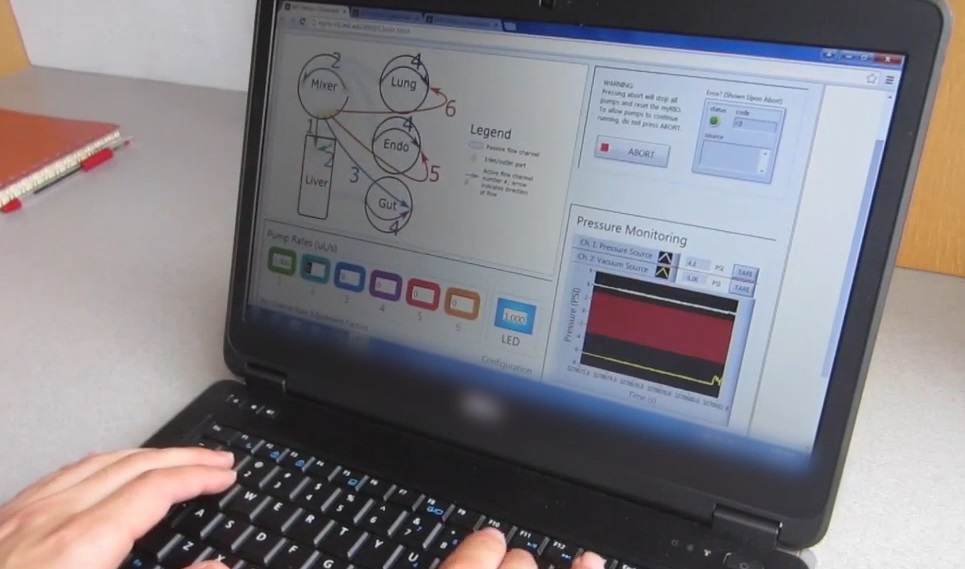
Although MIT’s news release calls this a “body on a chip,” but in the paper, published today in Science Advances, the researchers demur — they prefer the term microphysiological system, “to avoid the implication that an entire organ system is recapitulated in vitro.” You can call it whatever you want, guys. It’s your thing. (“Physiome on a chip” is another popular option.)

It’s nothing new to do this with and handful of tissues, but to have 10 tissues stable for weeks, as the researchers’ paper demonstrates, is unprecedented and represents a huge jump in the capabilities of this kind of system. Not only that, but previous microphysiological systems were difficult to access mid-experiment in case you wanted to sample a tissue or otherwise manipulate it.

In the paper, the researchers tested examples from many of the most commonly tested organs: liver, lung, gut, endometrium, brain, heart, pancreas, kidney, skin, and skeletal muscle. So you could introduce your drug to the gut, and let it be processed normally before being passed to the other organs, which may then perform their own processes and pass the substance on again.
Something that might have taken multiple experiments and systems can be done more quickly and with a method closer to how it actually works in the body — no rodents required.

“An advantage of our platform is that we can scale it up or down and accommodate a lot of different configurations,” explained senior author of the paper Linda Griffith. “I think the field is going to go through a transition where we start to get more information out of a three-organ or four-organ system, and it will start to become cost-competitive because the information you’re getting is so much more valuable.”

That’s good because ultimately it’s cost that drives everything — if this works well but costs as much as 20 simpler experiments done by a bunch of interns, big pharma will probably go for the interns.

14 Mar 2018

TypingDNA launches Chrome extension that verifies your identity based on typing

TypingDNA has a new approach to verifying your identity based on how you type.

The startup, which is part of the current class at Techstars NYC, is pitching this as an alternative to two-factor authentication — namely, the security feature that sends unique codes to a separate device (usually your phone) to make sure someone else isn’t logging in with your password.

The problem with two factor? TypingDNA Raul Popa put it simply: “It’s a bad user experience … Nobody wants to use a different device.” (I know that TechCrunch writers have had two-factor issues of their own, like when they’re trying to log in on an airplane and can’t connect their phone.)

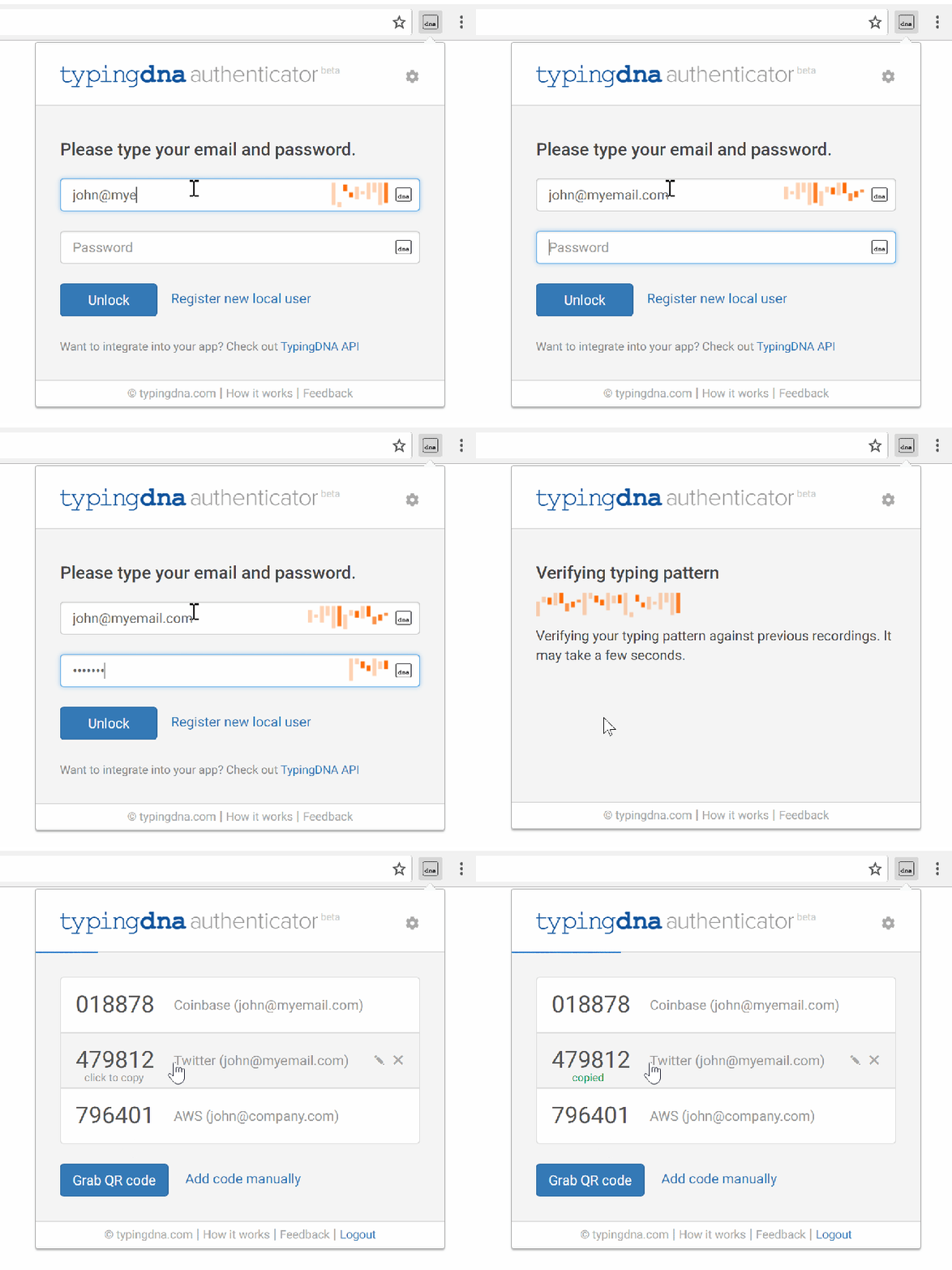
So TypingDNA allows users to verify their identity without having to whip out their phone. Instead, they just enter their name and password into a window, then TypingDNA will analyze their typing and confirm that it’s really them.

TypingDNA Authenticator - Animation

The startup’s business model revolves around working with partners to incorporate the technology, but it’s also launching a free Chrome extension that works as an alternative to two-factor authentication on a wide range of services, including Amazon Web Services, Coinbase and Gmail.

Popa said TypingDNA measures two key aspects of your typing: How long it takes you to reach a key and how long you keep the key pressed down. Apparently these patterns are unique; Popa showed me that the system could tell the difference between his typing and mine, and you can test it out for yourself on the TypingDNA website.

He also said that the company can adjust the strictness of the system, getting the rate of false positives as low as 0.1 percent. In the case of the Chrome authenticator, Popa said, “We minimize the false acceptance rate” — so you might get rejected if you’re typing in an unusual position, or if there’s some other reason you’re typing slower or faster than usual. But in that case, the authenticator will just ask you to try again.

And again, you can use the Chrome extension on a variety of sites. Most two-factor options include confirming a device using a QR code, which TypingDNA can grab. The two-factor codes are then sent to the TypingDNA extension (the codes are stored locally on your computer, not the company’s servers), and they’re revealed once you’ve verified your identity with the aforementioned typing.

You can visit TypingDNA to learn more and download the extension.

14 Mar 2018

Spotify tests native voice search, groundwork for smart speakers

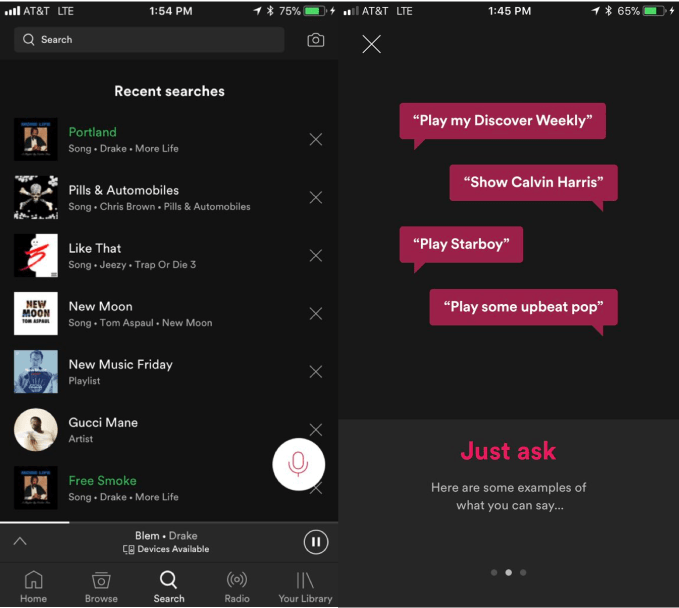
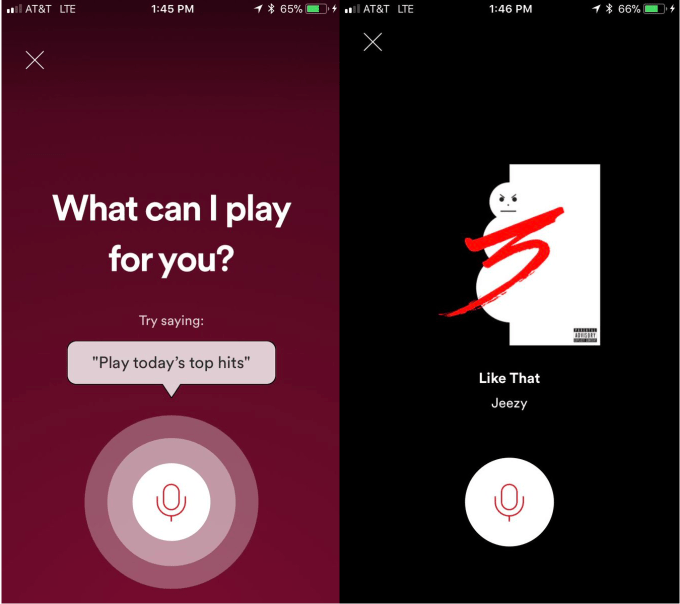
Now Spotify listens to you instead of the other way around. Spotify has a new voice search interface that lets you say “Play my Discover Weekly,” “Show Calvin Harris” or “Play some upbeat pop” to pull up music.

A Spotify spokesperson confirmed to TechCrunch that this is “Just a test for now,” as only a small subset of users have access currently, but the company noted there would be more details to share later. The test was first spotted by Hunter Owens.

Voice control could make Spotify easier to use while on the go using microphone headphones or in the house if you’re not holding your phone. It might also help users paralyzed by the infinite choices posed by the Spotify search box by letting them simply call out a genre or some other category of songs. Spotify briefly tested but never rolled out a very rough design of voice controls a year ago.

Down the line, Spotify could perhaps develop its own voice interface for smart speakers from other companies or that it potentially builds itself. That would relieve it from depending on Apple’s Siri for HomePod, Google’s Assistant for Home or Amazon’s Alexa for Echo — all of which have accompanying music streaming services that compete with Spotify.

Spotify is preparing for a direct listing that will make the company public without a traditional IPO. That means forgoing some of the marketing circus that usually surrounds a company’s debut. That means Spotify may be even more eager to experiment with features or strategies that could be future money-makers so that public investors see growth potential. Breaking into voice directly instead of via its competitors could provide that ‘x-factor.’

For more on Spotify’s not-an-IPO, check out our feature story:

14 Mar 2018

Lyft is building a self-driving platform with auto supplier Magna

Lyft is partnering with Magna, one of the largest tier one automotive industry suppliers in the world, on autonomous vehicle technology. Lyft CEO and co-founder Logan Green explained that this will help them get their self-driving tech into various automaker vehicles around the world. Lyft will be working directly with Magna on “co-developing” an autonomous driving system, with collaborative teams from both companies working on the project.

Magna is also investing $200 million in Lyft in exchange for an equity stake. The goal is to build not only autonomy into production vehicles, but also to put direct access to Lyft’s hailing platform into future autonomous vehicles using the platform.

Green explained that the company’s goal has been to “improve how transportation works” from the very beginning, citing a childhood growing up in traffic, trying to figure out how to avoid traffic, as a motivating factor. He also noted that it’s “wildly expensive” for individuals to own and operate their vehicles.

All ride-sharing makes up just 0.5 percent of all miles travelled, and Lyft’s goal is to move that to over 80 percent, Green said. He cited examples like Netflix as showing what he wants to achieve in the transportation industry, in terms of moving from ownership to subscriptions.

Developing..

14 Mar 2018

Delphia helps publishers create complex, AI-driven surveys

You’re probably familiar with quizzes from online publishers like BuzzFeed. But what if a quiz could actually help you sort through tough decisions and complex topics, not just which Sex and the City character or Disney princess you most closely resemble?

That’s basically what Y Combinator -backed startup called Delphia is promising. CEO Clifton van der Linden said the company works with publishers to create applications that help their readers make decisions.

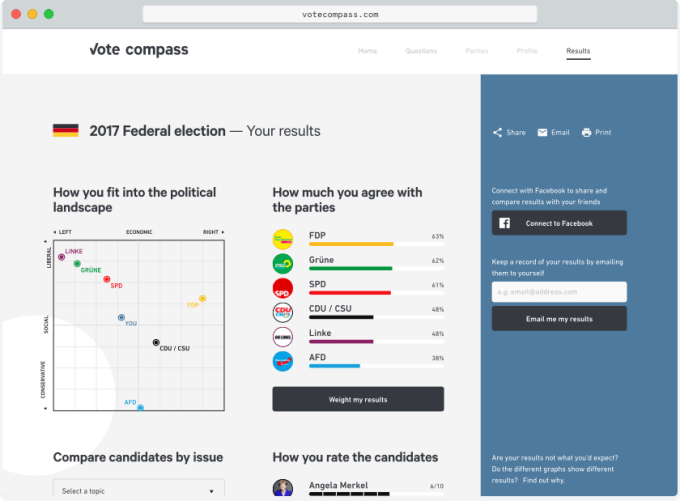
Van der Linden is a Ph.D. candidate in the political science department at the University of Toronto, and he first built an application called Vote Compass, which helps users understand how their political views line up with election candidates. (In the United States, Vote Compass was released in partnership Vox.)

Now, however, Delphia is working to bring a similar approach to non-political questions, like helping kids decide which college to attend, or helping adults figure out the workplace culture that would best fit them.

When I brought up the comparison to BuzzFeed quizzes, van der Linden didn’t exactly reject it. In fact, he admitted that they were one of his inspirations, but he added, “Let me qualify that heavily” — because he said Delphia’s applications use artificial intelligence and data science. Instead of just creating a basic decision tree (this set of answers leads to this quiz result), it’s actually trying to build out models that show how each question and answer is related to overall satisfaction.

Vote Compass

For example, in the case of the university-choosing application, van der Linden said, “We’ve gone out and surveyed tens of thousands of recent graduates of universities with a very long survey to train a model that will predict the right fit for people.” And the applications improve as more people participate: “Everyone who uses those tools, when they’re finished, they’re actually contributing to that learning model and making it smarter and smarter.”

That might seem like a lot of work to put into what amounts to a feature on a website, but van der Linden said it usually pays off for publishers (who either pay Delphia a licensing fee or split the advertising revenue): “It’s a great new form of personalized, innovative content for users.”

Vote Compass, for example, resulted in an average of eight to 10 minutes of engagement time for each participant. And the data from the applications can provide fuel for more content, like this Vox article showing that Trump’s supporters in the 2016 election were more liberal than he was on most issues.

So van der Linden also compared Delphia to survey companies like Gallup, but he said, “None of them ever paired it with machine learning.”

Beyond helping publishers create engaging content, van der Linden is hoping to answer “a really fundamental question in the information age: When we’re faced with so much data and information, how do people make rational decisions?”

“We want to help people navigate decisions in as many decision spaces as we can get into,” he added.

In addition to Y Combinator, Delphia has raised funding from Creative Destruction Lab and Golden Venture Partners.

14 Mar 2018

CFO Naeem Ishaq is leaving Boxed

Naeem Ishaq is leaving his role as chief financial officer of bulk e-commerce company Boxed.

Ishaq joined Boxed in 2016, following a stint as head of finance, strategy and risk at Square. A Boxed spokesperson confirmed Ishaq’s departure, and sent the following statement from CEO Chieh Huang:

Naeem is a world-class financial talent. Over the last two years, he has been indispensable in helping build and grow Boxed to what it is today. We will miss his energy, focus and enthusiasm for our company. Perhaps his greatest legacy is building a well-versed finance team that will continue to focus on evolving the Boxed platform.

I want to thank Naeem for his contribution to Boxed and wish him well on his future endeavors.

Boxed says it’s currently looking for another CFO.

“The last two years I’ve spent at Boxed have been some of the most thrilling of my career,” Ishaq said in a statement (also provided by Boxed). “We achieved much of what I set out to accomplish when I joined. Boxed … has tremendous opportunities ahead and I look forward to rooting [for] them as they continue to grow.”

The news comes less than a week after Bloomberg reported that Boxed had rejected a $400 million acquisition offer from Kroger. Other retailers, including Amazon, Target and Costco, were also rumored to be interested.

When I called Ishaq, he said he’s joining a company in the financial technology industry, but declined get more specific (I guess that’ll be announced separately).  He also said his departure is unconnected to those acquisition stories.

“This is more about an opportunity that came up that frankly, I’m super excited about,” he said. “Boxed is extremely well-positioned … I don’t think [my departure] diminishes that at all. It’s a personal choice for me.”