Month: July 2018

18 Jul 2018

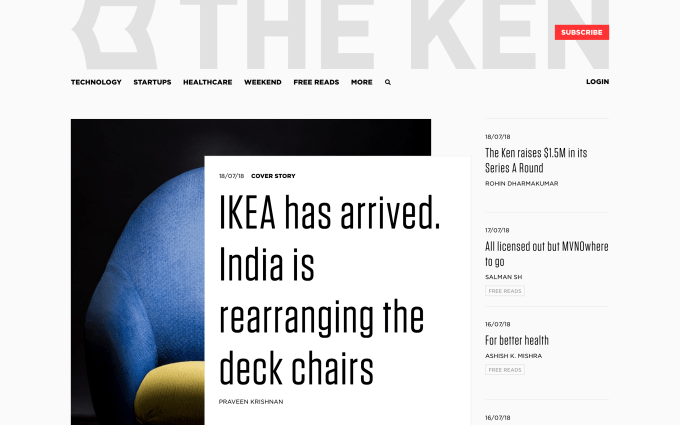
The Ken raises $1.5M to grow its subscription journalism business in India

The Ken, a subscription news startup from India, is moving through the gears after it raised $1.5 million in fresh funding to build out its media business.

We first profiled the company in March 2017 and now, nearly 18 months later, the startup has raised its Series A round led by Omidyar Networks, which has invested in new media companies such as Rappler in the Philippines. Other investors included Yuj Kutumb, the Family Foundation headed by Xander Group founder Sid Yog, and existing and new angel investors.

Rohin Dharmakumar, co-founder and CEO of The Ken, told TechCrunch that the company still has more than half of its $400,000 seed round in the bank, but it has raised this additional cash to go after new opportunities.

The Ken has made its mark by publishing one thoughtfully-reported long-form story each day. An annual subscription is priced at Rs 2750 (around $43) in India or $108 overseas, there are also options for quarterly and single-story access. Thus far it has covered technology startups, healthcare and business verticals but now it is aiming to expand that focus.

“We were a single product experience,” Dharmakumar said. “But this funding allows us to slowly transition The Ken to a media brand with a portfolio of products that gives our readers different things to connect to on different days.”

“We don’t want to replace newspapers, we want to complement them [and] be the deep read that you take alongside the newspaper,” Dharmakumar added, explaining that The Ken will never churn out “dozens” of stories each day.

“We do one story [per day] right now and we might go to two or three, but we’ll organize it so people can read different slices. Increasingly it’s our belief that we don’t want to bombard readers with too much stuff to read each day [because] we can’t do justice to our stories and readers can’t process the information,” he said.

Beyond expanding the scope of reporting, The Ken is looking to cover international topics for its India-based audience and it is also dabbling with different types of storytelling.

That’s already manifested in a weekend edition — which Dharmakumar said has a very different tone — but the startup is looking into audio storytelling, podcasts and other mediums that allow it to “stay true to our brand of journalism.” Video is, at this point, off the table although it could be used in conjunction with stories but not standalone.

Dharmakumar noted that The Ken may also experiment with events over the next twelve months, but he was quick to point out that the focus should be on bringing value to subscribers and not simply pulling in cash. Events are, of course, can be hugely lucrative for media companies — its a key revenue driver for TechCrunch among others, for example — but his concern is that it takes the company down a road it doesn’t want to be on.

“It’s easy to get sidetracked by events,” Dharmakumar said. “We didn’t start this business to do events.”

On the subject of revenue, however, The Ken appears to be doing well even though it isn’t divulging specific numbers at this point.

The company proudly announced it was cash flow positive in April 2018 and Dharmakumar revealed that revenue for its most recent quarter was doubled the previous quarter, and up 3X on the period one year previous. A key part of that seems to be group subscriptions. The Ken has developed a self-serve option that allows corporates to sign-up staff on their dime, while the launch of a discounted student price has also led major educational institutions, including Havard Business School India, to signing up students en masse.

“We’ve proved [the naysers] wrong and with a team of 15 people — we pay market salaries to all our journalists— we became cash flow positive,” Dharmakumar said. “We’re on the cusp of a significant uptick in subscribers. More and more people are discovering us and realizing ‘Hey this price isn’t so bad and the journalism they commit to delivering is good.’”

That team is spread across three offices and the headcount looks set to jump to 30 over the next few months with The Ken in full on hiring mode right now, its CEO said.

You can read more about The Ken’s new funding round on its website here — that post is free to view, of course.

18 Jul 2018

Google confirms it will appeal $5 billion EU antitrust fine

Google has confirmed the expected, that it will indeed appeal the record $5 billion fine that it was handed today by European antitrust regulators for abusing the dominance of its Android operating system.

The European Commission announced that it is fining the U.S. firm for “three types of restrictions that [it] has imposed on Android device manufacturers and network operators to ensure that traffic on Android devices goes to the Google search engine.”

The press conference announcing the investigation, which has been eight years in the making, remains ongoing as of writing, but Google has already issued a short statement that confirms its intention to appeal.

“Android has created more choice for everyone, not less. A vibrant ecosystem, rapid innovation and lower prices are classic hallmarks of robust competition. We will appeal the Commission’s decision,” it said in a tweet.

We’re breaking out the specific details as we learn them in this post, but here’s the core gist.

Competition commissioner Margrethe Vestager tweeted details of the penalty and explained more in an initial statement:

Today, mobile internet makes up more than half of global internet traffic. It has changed the lives of millions of Europeans. Our case is about three types of restrictions that Google has imposed on Android device manufacturers and network operators to ensure that traffic on Android devices goes to the Google search engine. In this way, Google has used Android as a vehicle to cement the dominance of its search engine. These practices have denied rivals the chance to innovate and compete on the merits. They have denied European consumers the benefits of effective competition in the important mobile sphere. This is illegal under EU antitrust rules.

In particular, the EC has decided that Google:

  • Has required manufacturers to pre-install the Google Search app and browser app (Chrome), as a condition for licensing Google’s app store (the Play Store);
  • Made payments to certain large manufacturers and mobile network operators on condition that they exclusively pre-installed the Google Search app on their devices
  • And has prevented manufacturers wishing to pre-install Google apps from selling even a single smart mobile device running on alternative versions of Android that were not approved by Google (so-called “Android forks”).

The decision also concludes that Google is dominant in the markets for general internet search service, licensable smart mobile operating systems, and app stores for the Android mobile operating system.

18 Jul 2018

Announcing TechCrunch meetups in Buenos Aires and Santiago next week

TechCrunch is heading to Latin America for the first time and staging its first ever Startup Battlefield Latin America on Nov. 8 in São Paulo to find the next wave of early stage startups tackling big ideas!

To spread the word, TechCrunch’s Jon Shieber and Anna Escher will visit Buenos Aires and Santiago next week to meet with the startup community and hold meetups for anyone interested in learning more about the Startup Battlefield. They’ll also spend time explaining how to apply. Tickets to the meetups are free, but they will go fast so sign up now.

Here are the details:

Buenos Aires

Tuesday, July 24th, 7:00pm – 9:00pm

Innovation Lab Buenos Aires from Facebook @ Av. Cnel. Niceto Vega 4866, C1414BEF C1414BEF, Buenos Aires, Argentina

Register here.

Santiago

Thursday, July 27th, 5:00pm – 7:00pm

Startup Chile @ Monjitas 565, Santiago, Región Metropolitana, Chile

Register Here.

At the meetup, Founders will learn how to apply for Battlefield and investors will learn how to refer companies in their portfolio. TechCrunch will provide a brief presentation on Startup Battlefield and answer questions. Application close next month, and when they do, our editors will choose 15 companies to compete, and one will win $25,000 and a free trip to the next Disrupt SF.  All the companies, however, will receive global exposure, winners or not, because video from their pitches on stage in front of top tier judges will be posted on TechCrunch.

(And in case you missed it, TechCrunch COO Ned Desmond is in São Paulo and Mexico City this week hosting meetups and briefings for TechCrunch Startup Battlefield Latin America.)

Startup Battlefield is the world’s premier startup launch competition. To date, the Startup Battlefield alumni community comprises almost 750 companies that have raised over $8 billion USD, and produced over 100 successful exits and IPOs.

18 Jul 2018

Google gets slapped $5BN by EU for Android antitrust abuse

Google has been fined a record breaking €4.34 billion (~$5BN) by European antitrust regulators for abusing the dominance of its Android mobile operating system.

Competition commissioner Margrethe Vestager has tweeted to confirm the penalty ahead of a press conference about to take place. Stay tuned for more details as we get them.

In a longer statement about the decision, Vestager said: “Today, mobile internet makes up more than half of global internet traffic. It has changed the lives of millions of Europeans. Our case is about three types of restrictions that Google has imposed on Android device manufacturers and network operators to ensure that traffic on Android devices goes to the Google search engine. In this way, Google has used Android as a vehicle to cement the dominance of its search engine. These practices have denied rivals the chance to innovate and compete on the merits. They have denied European consumers the benefits of effective competition in the important mobile sphere. This is illegal under EU antitrust rules.”

In particular, the EC has decided that Google:

  • has required manufacturers to pre-install the Google Search app and browser app (Chrome), as a condition for licensing Google’s app store (the Play Store);
  • made payments to certain large manufacturers and mobile network operators on condition that they exclusively pre-installed the Google Search app on their devices; and
  • has prevented manufacturers wishing to pre-install Google apps from selling even a single smart mobile device running on alternative versions of Android that were not approved by Google (so-called “Android forks”).

The decision also concludes that Google is dominant in the markets for general internet search services; licensable smart mobile operating systems; and app stores for the Android mobile operating system.

This story is developing… refresh for updates… 

The fine is the second major penalty for the ad tech giant for breaching EU competition rules in just over a year — and the highest ever issued by the Commission for abuse of a dominant market position.

In June 2017 Google was hit with a then-record €2.4BN (~$2.7BN) antitrust penalty related to another of its products, search comparison service, Google Shopping. The company has since made changes to how it displays search results for products in Europe.

According to the bloc’s rules, companies can be fined 10 per cent of their global revenue if they are deemed to have breached European competition law.

Google’s parent entity Alphabet reported full year revenue of $110.9 billion in 2017. So the $5BN fine is around half of what the company could have been on the hook for if EU regulators had levied the maximum penalty possible.

The Commission said the size of the fine takes into account “the duration and gravity of the infringement”. It also specified it had been calculated on the basis of the value of Google’s revenue from search advertising services on Android devices in the European Economic Area (per its own guidelines on fines).

Google will have three months to pay the fine but is likely to appeal — and legal wrangling could drag the process out for many years. Although if it does not pay the fine within that timeframe penalty payments of up to 5% of the average daily worldwide turnover of the company can be applied.

We’ve reached out to Google for its reaction.

Prior to the Commission’s record pair of fines for Google products, its next highest antitrust penalty is a €1.06BN antitrust fine for chipmaker Intel all the way back in 2009.

Yet only last year Europe’s top court ruled that the case against Intel — which focused on it offering rebates to high-volume buyers — should be sent back to a lower court to be re-examined, nearly a decade after the original antitrust decision. So Google’s lawyers are likely to have a spring in their step going into this next European antitrust battle.

The latest EU fine for Android has been on the cards for more than two years, given the Commission’s preliminary findings and consistently prescriptive remarks from Vestager during the course of what has been a multi-year investigation process.

And, indeed, given multiple EU antitrust investigations into Google businesses and business practices (the EU has also been probing Google’s AdSense advertising service).

The Commission’s prior finding that Google is a dominant company in Internet search — a judgement reached at the culmination of its Google Shopping investigation last year — is also important, making the final judgement in the Android case more likely because the status places the onus on Google not to abuse its dominant position in other markets, adjacent or otherwise.

Announcing the Google Shopping penality last summer, Vestager made a point of emphasizing that dominant companies “need to be more vigilant” — saying they have a “special responsibility” to ensure they are not in breach of antitrust rules, and also specifying this applies “in the market where it’s dominant” and “in any other market”. So that means — as here in the Android case — in mobile services too.

While a one-off financial penalty — even one that runs to so many billions of dollars — cannot cause lasting damage to a company as wealthy as Alphabet, of greater risk to its business are changes the regulators can require to how it operates Android which could have a sustained impact on Google if they end up reshaping the competitive landscape for mobile services.

At least that’s the Commission’s intention: To reset what has been judged an unfair competitive advantage for Google via Android, and foster competitive innovation because rival products get a fairer chance to impress consumers.

However the popularity and profile of Google services suggests that even if Android users are offered a choice as a result of an EU antirust remedy — such as of which search engine, maps service, mobile browser or even app store to use — most will likely pick the Google-branded offering they’re most familiar with.

That said, an antitrust remedy could have the chance to shift consumers’ habits over time — if, for instance, OEMs start offering Android devices that come preloaded with alternative mobile services, thereby raising the visibility of non-Google apps and services.

Interestingly, Google has been striking deals with Chinese OEMs in recent months — to brings its ARCore technology to markets where its core services are censored and its Play Store is restricted. And its strategy to workaround regional restrictions in China by working more closely with device makers may also be part of a plan to hedge against fresh regulatory restrictions being placed on Android elsewhere. 

Although complainants in the EU’s earlier Google Shopping antitrust case continue to express displeasure with the outcome on that front. And in a statement responding to news that another EU antitrust penalty was incoming for Android, Shivaun Raff, CEO of Foundem, the lead complainant in Google Shopping case, said: “Fines make headlines. Effective remedies make a difference.”

So the devil will be in the detail of the remedies.


Android as an antitrust ‘Trojan horse’

The European Commission announced its formal in-depth probe of Android in April 2015, saying then that it was investigating complaints Google was “requiring and incentivizing” OEMs to exclusively install its own services on devices on Android devices, and also examining whether Google was hindering the ability of smartphone and tablet makers to use and develop other OS versions of Android (i.e. by forking the open source platform).

Rivals — banding together under the banner ‘FairSearch‘ — complained Google was essentially using the platform as a ‘Trojan horse’ to unfairly dominate the mobile web. The lobby group’s listing on the EU’s transparency register describes its intent as promoting “innovation and choice across the Internet ecosystem by fostering and defending competition in online and mobile search within the European Union”, and names its member organizations as: Buscapé, Cepic, Foundem, Naspers, Nokia, Oracle, TripAdvisor and Yroo.

On average, Android has around a 70-75% smartphone marketshare across Europe. But in some European countries the OS accounts for an even higher proportion of usage. In Spain, for example, Android took an 86.1% marketshare as of March, according to market data collected by Kantar Worldpanel.

In recent years Android has carved an even greater market share in some European countries, while Google’s Internet search product also has around a 90% share of the European market, and competition concerns about its mobile OS have been sounded for years.

Last year Google reached a $7.8M settlement with Russian antitrust authorities over Android — which required the company to no longer demand exclusivity of its applications on Android devices in Russia; could not restrict the pre-installation of any competing search engines and apps, including on the home screen; could no longer require Google Search to be the only general search engine pre-installed.

Google also agreed with Russian antitrust authorities that it would no longer enforce its prior agreements where handset makers had agreed to any of these terms. Additionally, as part of the settlement, Google was required to allow third parties to include their own search engines into a choice window, and to allowing users to pick their preferred default search engine from a choice window displayed in Google’s Chrome browser. The company was also required to develop a new Chrome widget for Android devices already being used in Russia, to replace the standard Google search widget on the home screen so they would be offered a choice when it launched.

A year after Vestager’s public announcement of the EU’s antitrust probe of Android, she issued a formal Statement of Objections, saying the Commission believed Google has “implemented a strategy on mobile devices to preserve and strengthen its dominance in general Internet search”; and flagging as problematic the difficulty for Android users whose devices come pre-loaded with the Google Play store to use other app stores (which cannot be downloaded from Google Play).

She also raised concerns over Google providing financial incentives to manufacturers and mobile carriers on condition that Google search be pre-installed as the exclusive search provider. “In our opinion, as we see it right now, it is preventing competition from happening because of the strength of the financial incentive,” Vestager said in April 2016.

Google was given several months to respond officially to the antitrust charges against Android — which it finally did in November 2016, having been granted an extension to the Commission’s original deadline.

In its rebuttal then, Google argued that, contrary to antitrust complaints, Android had created a thriving and competitive mobile app ecosystem. It further claimed the EU was ignoring relevant competition in the form of Apple’s rival iOS platform — although iOS does not hold a dominant marketshare in Europe, nor Apple have a status as a dominant company in any EU markets.

Google also argued that its “voluntary compatibility agreements” for Android OEMs are a necessary mechanism for avoiding platform fragmentation — which it said would make life harder for app developers — as well as saying its requirement for Android OEMs to use Google search by default is effectively its payment for providing the suite for free to device makers (given there is no formal licensing fee for Android).

It also couched “free distribution is an efficient solution for everyone” — arguing it lowers prices for phone makers and consumers, while “still letting us sustain our substantial investment in Android and Play”.

In addition, Google sought to characterize open source platforms as “fragile” — arguing the Commission’s approach risked upsetting the “balance of needs” between users and developers, and suggesting their action could signal they favor “closed over open platforms”.


18 Jul 2018

Swim.ai raises $11M to bring real-time analytics to the edge

Once upon a time, it looked like cloud-based serviced would become the central hub for analyzing all IoT data. But it didn’t quite turn out that way because most IoT solutions simply generate too much data to do this effectively and the round-trip to the data center doesn’t work for applications that have to react in real time. Hence the advent of edge computing, which is spawing its own ecosystem of startups.

Among those is Swim.ai, which today announced that it has raised an $11 million Series B funding round let by Cambridge Innovation Capital, with participation from Silver Creek Ventures and Harris Barton Asset Management. The round also included a strategic investment from Arm, the chip design firm you may still remember as ARM (but don’t write it like that or their PR department will promptly email you). This brings the company’s total funding to about $18 million.

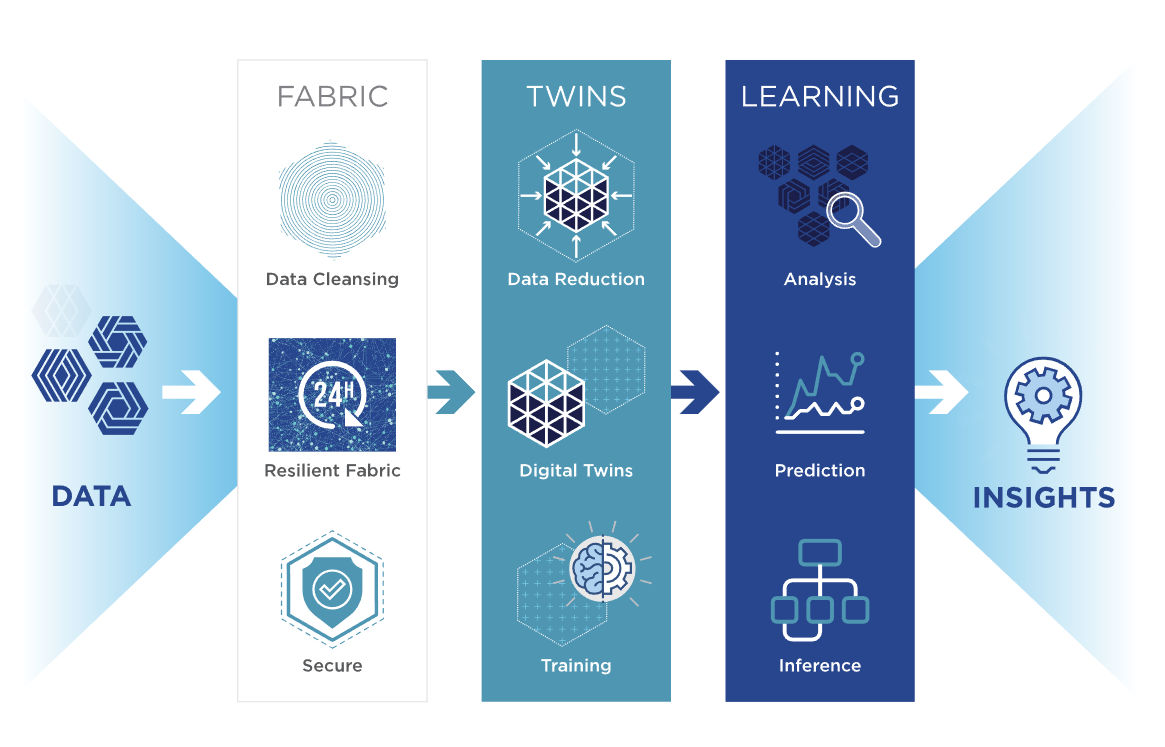
Swim.ai has an interesting take on edge computing. The company’s SWIM EDX product combines both local data processing and analytics with local machine learning. In a traditional approach, the edge devices collect the data, maybe perform some basic operations against the data to bring down the bandwidth cost and then ship it to the cloud where the hard work is done and where, if you are doing machine learning, the models are trained. Swim.ai argues that this doesn’t work for applications that need to respond in real time. Swim.ai, however, performs the model training on the edge device itself by pulling in data from all connected devices. It then builds a digital twin for each one of these devices and uses that to self-train its models based on this data.

“Demand for the EDX software is rapidly increasing, driven by our software’s unique ability to analyze and reduce data, share new insights instantly peer-to-peer – locally at the ‘edge’ on existing equipment. Efficiently processing edge data and enabling insights to be easily created and delivered with the lowest latency are critical needs for any organization,” said Rusty Cumpston, co-founder and CEO of Swim.ai. “We are thrilled to partner with our new and existing investors who share our vision and look forward to shaping the future of real-time analytics at the edge.”

The company doesn’t disclose any current customers, but it is focusing its efforts on manufacturers, service providers and smart city solutions.

Swim.ai plans to use its new funding to launch a new R&D center in Cambridge, UK, expand its product development team and tackle new verticals and geographies with an expanded sales and marketing team.

18 Jul 2018

BuzzFeed launches a new website for its real journalism

It’s not news at this point that BuzzFeed has a serious news organization — one whose reporting on Russia made it a finalist for a Pulitzer Prize this year.

But it’s also a news organization whose stories are published alongside the social media friendly quizzes and lists that BuzzFeed remains known for — which can be confusing, or even provide easy ammunition to those who want to criticize the reporting.

Yes, the company already taken steps to give the more serious reporting its own home and identity, with a BuzzFeed News app, a section on the main BuzzFeed site and a “BuzzFeed News” label on every story.

Still, Senior Product Manager Kate Zasada said the company’s own research has found that some readers “don’t completely understand” that while BuzzFeed is famous for GIF-filled lists, it also produces “deeply researched and fact-checked” journalism. (The snarky comments I seem to get whenever I write about BuzzFeed seem to back this up.)

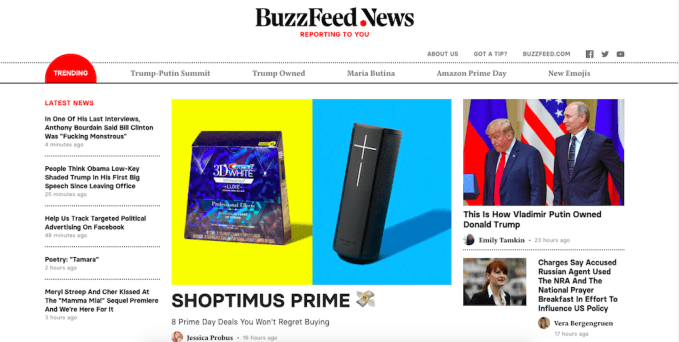
So the company is making that distinction a clearer with the launch of a new BuzzFeed News website.

News stories will still run on the main BuzzFeed homepage, and the BuzzFeed News site will include links to other BuzzFeed content. But it looks and feels more like a standalone site, giving the team what Zasada said is “a new domain and a new brand.”

BuzzFeed News

The site won’t be divided into traditional topics like politics, sports and so on — Product Manager Sam Kirkland argued that these divisions “didn’t make much sense with how we work internally or how we consume news.” Instead, there’s a Trending News Bar at the top of the page, highlighting the most important topics of the day, as chosen by BuzzFeed News editors.

And while the new site will include advertising, such as links to sponsored BuzzFeed posts, Zasada said there won’t be any sponsored posts hosted on BuzzFeed News itself.

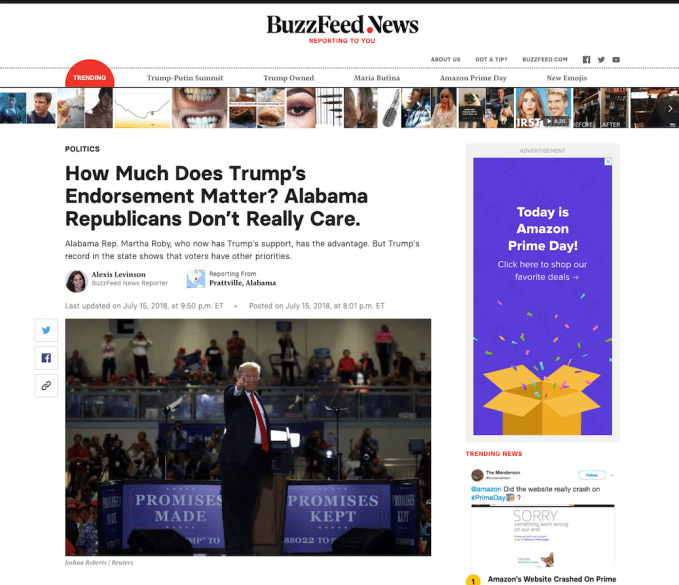
Of course, not every reader will actually find these stories by typing buzzfeednews.com into their web browser. But Zasada said that even if you click over from social media or elsewhere on the web, you’ll see each news article is accompanied by not just the BuzzFeed News logo, but also the Trending News Bar.

And it won’t just be photos and text dominating the page. Zasada said the site will also support YouTube videos and GIFs, and Editor in Chief Ben Smith added that the site will provide “a very seamless way” to promote BuzzFeed’s broadcast-style video programming like its Twitter series AM to DM and Follow This, a Netflix series about BuzzFeed reporters.

BuzzFeed News article

Smith also noted that while the company is creating a new home for its journalism, that doesn’t mean the site will be unrelentingly serious and highbrow. As we spoke yesterday afternoon, he said that some of the most popular BuzzFeed News stories included multiple articles about Trump, a long essay about Gwen Stefani and a story on the sadly neglected aerial tram emoji.

In other words, he said, it’s a “general interest news organization” that covers the “full range” of relevant topics.

And even as it’s competing with all that other BuzzFeed content, it’s still drawing an audience. The company says BuzzFeed News stories receive 200 million pageviews each month, and that one third of BuzzFeed’s total audience reads news stories each month.

In Smith’s view, the new website reflects “an organizational change that’s already happened.”

“I don’t think anybody finds it confusing that ABC does news programming and scripted shows on prime time,” he said. “On the web, the conventions are less clear. I think we’re trying to be very clear. We feel our audience wants that.”

18 Jul 2018

Elon Musk kinda apologizes for calling Thai cave rescuer a ‘pedo’

On Monday, Tesla CEO Elon Musk called Vern Unsworth, one of the rescuers who helped save the young Thai football team trapped in caves, a “pedo.” Today, Wednesday, Musk issued what could be construed as an apology to Unsworth on Twiter.

The apology wasn’t a public one sent to all of Musk’s Twitter followers, and therefore many might have missed it. Instead, it came in response to a Twitter user who highlighted “a thorough piece of reporting” on Quora that defends his well-intentioned but ultimately controversial efforts to help save the Thai children.

Musk replied to the tweet explaining that he was angered by Unsworth’s comments in the media which played down the importance of a mini-sub constructed by Tesla to aid the operation — Unsworth said it “had absolutely no chance of working” — and suggested Musk should “stick his submarine where it hurts.” Ultimately, Musk admitted, he should not have accused Unsworth of being a pedophile.

Musk’s apology comes a day after Tesla’s share price dipped on the news that Unsworth was considering a lawsuit against Musk, who deleted the “pedo” tweet and another that doubled down on the accusation hours after they went viral.

Despite the apology, it would be remiss of me not to point out some facts (sus): it took Musk two days to apologize; he didn’t do it directly; he took action only after the Tesla stock price fluctuated; and — finally — he continues to be scathing of media by endorsing the Quora “reporting.”

Nonetheless, hopefully, this brings closure to this sorry affair because ultimately it is a near-miracle that these kids were able to leave the caves alive as they did. All this bickering after the event leaves a bitter taste in the mouth.

18 Jul 2018

Glovo gets $134M to beef up its on-demand delivery business

Spanish startup Glovo, whose platform lets app users summon a gig economy worker to shop on their behalf, be it for a takeaway burger or a multi-bag supermarket shop, has bagged a €115 million (~$134M) Series C round of funding. Spanish press are reporting the round values Glovo’s business at more than €300M.

The lead investors in the Series C are Rakuten, Seaya and Cathay, which had also invested in its Series B.

Also investing is AmRest — a publicly listed restaurant operator in Central Europe — as well as European funds Idinvest Partners and GR Capital, plus some other minor investments.

AmRest controls more than 1,650 restaurants in more than 16 countries — with brands such as KFC, La Tagliatella, Pizza Hut, Starbucks and Burger King, Blue Frog and KABB under its belt. So the strategic opportunities it’s spying to ply fast food fans with on-demand food at the tap of an app button are clear.

Glovo raised a €30M Series B last October. The startup was founded in Barcelona in 2015, and its delivery riders — with the distinctive yellow box bags strapped to their backs — are a common sight around the city, often to be spotted clustering in expectant groups at the entrance to McDonald’s and other fast food outlets.

The startup says the new funding will be put towards optimizing its platform and tech resources to improve the service to riders, users and associated stores.

Specifically, it’s planning to increase its tech team by adding more than 100 engineers in the coming months — saying it wants to become what it dubs “the most relevant technology hub in Southern Europe”.

It also plans to use the funds to fuel its momentum, noting it’s opened up six countries and 20 cities around the world in just three months. Its regions of focus are Latin America and EMEA areas (Europe, the Middle East and Africa), and its app is available in 61 cities in 17 countries in all at this stage.

While Europe is a core region, and Spain alone accounts for a major chunk of its business — where it’s now operating in 21 cities — the legal risk for gig economy companies operating there is rising as political pressure grows to reform employment law to bolster workers’ rights against erosions by app platforms that are in turn reliant on huge armies of so-called ‘self-employed’ workers to power their businesses.  

In the UK, for example, the government is consulting on a package of labor market reforms, saying in February that it wanted to be “accountable for good quality work as well as quantity of jobs” — and putting gig economy platforms on watch for changes.

Glovo’s other regional focus — of Latin America — suggests the startup is hedging its bets where this type of employment law legal risk is concerned.

And indeed where competitive risk is concerned, given the space it’s playing it is a very crowded one on the food delivery front (with the likes of Deliveroo, UberEats and JustEast competing to conveniently serve consumers’ stomaches in Europe), and the likes of Postmates having established a shop-on-your-behalf business in the US.

Also today Glovo announced the nomination of Niall Wass as chairman. It said that Wass, a former Uber SVP for the EMEA & APAC region, has been working for it as advisor for the past year and helping with its expansion strategy.

18 Jul 2018

The Great British Hack-Off hackathon against Brexit is on this weekend

Prizes of up to £1,000 are up for grabs at Great British Hack-Off summer festival hackathon, an event designed to supercharge the campaign to lobby for a ‘people’s vote’ on Brexit with the option to remain in the EU.

The event is aimed at engineers, designers, UX experts, data scientists, social media influencers and experts. Anyone interested can apply to attend the event via this form.

In a 2-day intensive, overnight “hackathon” on the weekend of July 21-22, the aim will be to connect people with their decision makers and MPs about their concerns for jobs, services and the economy, and put pressure on MPs to back
‘people’s vote’ using democratic tech tools.

The event is being held by Tech For UK (Twitter, Hashtag:#GBhackoff, Instagram,
Facebook) the tech industry body and anti-Brexit group Best For Britain.

There will be a £1,000 first prize for the best product produced by a team, and a £500 second prize for the second-placed team. Participants will also get exclusive merchandise like T-shirts. All products will need to be open source and may be progressed later with other vendors by Best For Britain.

Tech For UK says the ultimate goal will be to engage the tech community to help Best for Britain connect people in local communities to the information they need on Brexit and, in turn, connect them to their decision makers and MPs. Attendees to the Hackathon will also be able to work on their own projects and ideas related to Brexit.

Tech For UK says this will be the first event in a series, to be continued at other cities around the UK, not just in London.

Structured like a “Hackathon” it will be held at a central London venue, bringing together engineers, designers, storytellers, marketers, data scientists, designers, artists, journalists / PR / media people, analytics experts and social media influencers to work on these problems.

Participants will be selected from applications and given full instructions about the event.

There will be capacity for 100 people and the opportunity to stay over-night at the hackathon. Food and beverages will be provided. The event will be an ’18s and over’ event.

18 Jul 2018

EU’s Google Android antitrust decision incoming…

A decision in a long running EU antitrust probe of Google’s Android OS is due to land shortly.

The case focuses on whether Google has abused its market dominance and crowded out rivals by taking steps to ensure its own-brand apps and services are pre-loaded on Android devices.

European Commission officials are trailing a press conference with competition commissioner Margrethe Vestager — to announce an “antitrust decision” at 1pm CET, with a link to watch the event streamed live.

Bloomberg is reporting the EU’s fine for Android will be in the region of $5BN — which would be the largest ever antitrust penalty handed down by the Commission.

In April, Reuters reported on a 2016 document it had reviewed which said the Commission planned to levy a large fine against Google and would also order the company to stop giving revenue-sharing payments to smartphone makers to pre-install only Google Search. Reuters also reported then that Google would be ordered to stop requiring its own Chrome browser and other apps to be installed alongside Google’s Play store.

The Commission will confirm the full details of its Android decision in the next few hours.

Stay tuned for more as we get it…