Month: July 2018

06 Jul 2018

Crypto visa card company Monaco just spent millions to buy Crypto.com

Highly-prized domain name Crypto.com has been sold!

Registered in 1993 by Matt Blaze, a professor of computer and information science at the University of Pennsylvania who sits on the board of directors of the Tor Project, the domain has attracted a vast amount of interest as you’d expect given the explosion of crypto in recent years. However, Blaze has turned down all offers.

In January, Blaze repeated that the domain was “not for sale” and that people shouldn’t both to contact him — as The Verge noted —  however fast forward to July and he has parted with it after Monaco, a crypto project best-known for developing a crypto debit card, bought the domain in an undisclosed deal.

Experts told The Verge that Crypto.com could have attracted as much as $10 million, however Monaco CEO Kris Marszalek declined to go into the specifics.

“If it was only about money he’d have sold it a long time ago,” he told TechCrunch in an interview.

Hong Kong-based Monaco’s ICO finished in June 2017 with the company raising what was then worth $25 million in crypto. Fast forward today and Marszalek said the firm has close to $200 million on its balance sheet thanks to a surge in the valuation of cryptocurrencies like Ether, but he suggested that, more than money, the sale was about finding the right home for the domain.

“This is a very powerful identity that we are taking on. It’s representative of the entire category so it comes with a huge responsibility on us to carry the torch. We don’t take it lightly and this is one of the things that I think we conveyed successfully, that, as a company, we do have a higher purpose,” he said.

“Fundamentally, blockchain and crypto will enable [the next generation] to control their money, to control their data and to control their identity, these are the three fundamental things that weave the fabric of society. For us this is the purpose, we want to acceleration the world’s adoption of cryptocurrency,” he added.

The splashy purchase of the domain is part of a rebrand for Monaco that will see the parent company become Crypto.com and its Monaco services — which the upcoming Visa card, peer-to-peer transfer and a wallet app — become MCO, the same name as the company’s cryptocurrency.

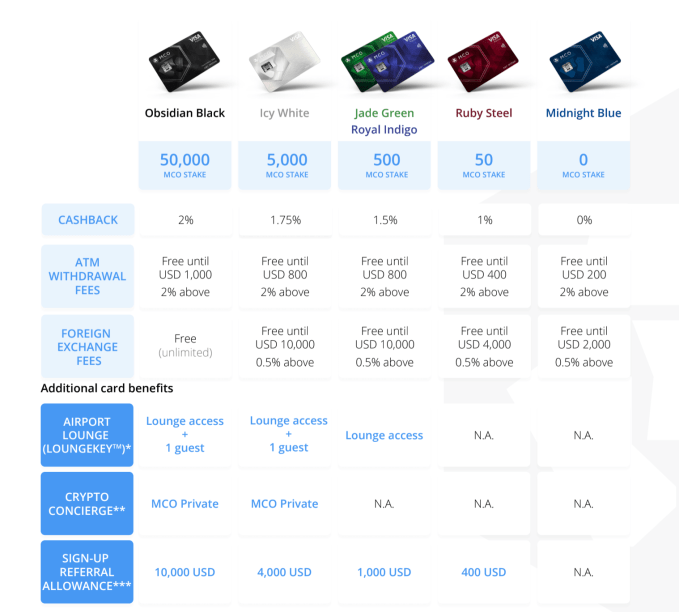
The Monaco card itself just entered testing for a small group of users, primarily the MCO team, and Marszalek said it will be available for all customers in Singapore and Europe this summer, with a rollout for those in the U.S. likely in Q4. That’s covering a backlog of over 70,000 waiting users, but the company has sweetened the appeal of a card for new people by adding a number of perks, most notably cashback on transactions and a concierge, which vary based on the level.

At around $7 per MCO token, the commitment for a card isn’t cheap. The top of the range ‘Obsidian Black,’ which has the highest rate of cashback and perks, requires a customer to hold around $350,000 in MCO tokens. However, there’s a selection to cater to different budgets.

MCO is well-known for its card project, which has been two years in the making and it captured the attention of early crypto enthusiasts, but Marszalek said the company is cooking up other services in a bid to offer a more rounded product line. (That also explains the rebrand.) Among things to expect, he said MCO is opening to introduce lending that uses crypto as collateral, a low-rate credit service, and a robo trading investment feature.

Note: The author owns a small amount of cryptocurrency. Enough to gain an understanding, not enough to change a life.

05 Jul 2018

Belkin’s new Lightning-enabled power bank comes with Apple certification

Sure, there are plenty of power banks out there that can charge your iPhone. The ability to charge up via Lightning cable, on the other hand, is a pretty rare thing — and from the looks of it, the Boost Charge Power Bank is the first to do so with Apple’s blessing.

Belkin’s new portable charger sports a Lightning port in between two standard USBs, so it can be charged up with the same cable you use for your iPhone/iPad. As someone who’s had some issues with Apple’s proprietary cables in the past, it’s something of mixed bag — though as someone who also just came back from a weeklong trip with a carryon bag full of cables, there’s something to be said for only having to pack one.

(I also recently discovered the hard way that Chinese airports will throw out battery packs exceeding a certain size, but that’s a different discussion.)

The battery pack sports a 10,000mAh battery — which is nearly four times the size of what you get on the iPhone X/8 Plus. At $60, however, it ain’t cheap. As a quick pop over to Amazon demonstrates, you can get a lot more battery for a lot less. If Apple MFI certification and cable consolidation mean something to you, however, this is probably your best bet.

It’s up for pre-order now from Belkin’s site.

05 Jul 2018

Skedaddle has had acquisition talks with Uber and Lyft

Uber and Lyft appear to be pursuing a crowdsourced bus startup called Skedaddle, the latest indication that the ride-hailing companies want to build businesses that cover every mode of transit from last-mile solutions like scooters and bikes to inter-city travel in cars and high-capacity vehicles for longer distances.

Uber has been in discussions to acquire Skedaddle for more than a month, an unnamed source familiar with the talks told TechCrunch. Skedaddle was also in talks with Lyft more recently, another source confirmed.

Skedaddle declined to comment. Uber declined comment.

Lyft is not in discussions to acquire Skedaddle, a company spokesperson told TechCrunch.

Skedaddle launched in 2015 to help people find a low-cost and easy way to travel to out-of-town events like music festivals. Think of it as rideshare, but to another town, not to the bar down the street.  Skedaddle developed an app that lets individuals crowdsource private bus rides. Once there’s demand for a ride to a destination — a music festival or say, to a trailhead at a popular hiking spot — the bus is booked. The bus then picks up the confirmed riders within the origin city.

The company, which is based in Boston and New York, has largely stuck to the East Coast. But it’s recently expanded thanks in part to the Women’s March on Washington held in March 2017.

Skedaddle received media attention earlier this year when the company said it transported more than 11,000 individuals to the Women’s March in Washington, D.C., from places as far away as Kansas.

Uber and Lyft have both been making moves in recent months toward a multi-modal ecosystem, a jargon term that basically means having a market share in various forms of transportation. A long-distance rideshare product that could be used as commuter transit or to events is a missing piece for both companies.

In April, Uber acquired JUMP bikes for a sum that came close $200 million. Just days later,  Uber CEO Dara Khosrowshahi announced a deal with instant car-booking service Getaround to launch a product called UberRENT and a partnership with Masabi, a mobile ticketing platform for public transit that works with 30 transportation agencies worldwide, including Los Angeles’ Metrolink. Uber also has applied for a permit to deploy electric scooters in San Francisco.

Khosrowshahi recently appointed Rachel Holt as head of New Modalities, a position that will put her in charge of bringing on additional mobility services such as scooters, car rentals and bikes.

Meanwhile, Lyft closed its own big deal. Last week, the company closed on $600 million in fresh funding and acquired Motivate, the oldest and largest electric bike-share company in North America, for undisclosed terms.

05 Jul 2018

Skedaddle has had acquisition talks with Uber and Lyft

Uber and Lyft appear to be pursuing a crowdsourced bus startup called Skedaddle, the latest indication that the ride-hailing companies want to build businesses that cover every mode of transit from last-mile solutions like scooters and bikes to inter-city travel in cars and high-capacity vehicles for longer distances.

Uber has been in discussions to acquire Skedaddle for more than a month, an unnamed source familiar with the talks told TechCrunch. Skedaddle was also in talks with Lyft more recently, another source confirmed.

Skedaddle declined to comment. Uber declined comment.

Lyft is not in discussions to acquire Skedaddle, a company spokesperson told TechCrunch.

Skedaddle launched in 2015 to help people find a low-cost and easy way to travel to out-of-town events like music festivals. Think of it as rideshare, but to another town, not to the bar down the street.  Skedaddle developed an app that lets individuals crowdsource private bus rides. Once there’s demand for a ride to a destination — a music festival or say, to a trailhead at a popular hiking spot — the bus is booked. The bus then picks up the confirmed riders within the origin city.

The company, which is based in Boston and New York, has largely stuck to the East Coast. But it’s recently expanded thanks in part to the Women’s March on Washington held in March 2017.

Skedaddle received media attention earlier this year when the company said it transported more than 11,000 individuals to the Women’s March in Washington, D.C., from places as far away as Kansas.

Uber and Lyft have both been making moves in recent months toward a multi-modal ecosystem, a jargon term that basically means having a market share in various forms of transportation. A long-distance rideshare product that could be used as commuter transit or to events is a missing piece for both companies.

In April, Uber acquired JUMP bikes for a sum that came close $200 million. Just days later,  Uber CEO Dara Khosrowshahi announced a deal with instant car-booking service Getaround to launch a product called UberRENT and a partnership with Masabi, a mobile ticketing platform for public transit that works with 30 transportation agencies worldwide, including Los Angeles’ Metrolink. Uber also has applied for a permit to deploy electric scooters in San Francisco.

Khosrowshahi recently appointed Rachel Holt as head of New Modalities, a position that will put her in charge of bringing on additional mobility services such as scooters, car rentals and bikes.

Meanwhile, Lyft closed its own big deal. Last week, the company closed on $600 million in fresh funding and acquired Motivate, the oldest and largest electric bike-share company in North America, for undisclosed terms.

05 Jul 2018

Bioproducts are seeing major tailwinds in renewable tech

Although Silicon Valley seems to have largely forgotten about cleantech after failures in solar, wind and batteries, there are still major strides being made across new and exciting renewable technologies. However, because these companies can take a decade or more to come to market — a timeline that is anathema to Sand Hill venture capital — media coverage has died down significantly over the last few years. So what’s going on?

It turns out… a lot.

In particular, there are significant developments across the waste-to-fuel and waste-to-product industries, in the form of thermal (pyrolysis, hydrothermal, gasification) and non-thermal technologies.

The driver for this is somewhat simple: The human population is creating more waste every year and there are fewer options for disposal. Incentives around building a “circular economy,” where renewable products are created from that waste, are growing and making more financial sense.

Basically, companies are learning how to turn trash into cash.

Today, entrepreneurs are approaching the space head-on, and there are dozens of cutting-edge companies coming to market and breaking through with major projects and customers. Companies in the space can be divided between the developers like Fulcrum BioEnergy, Red Rock Biofuels, RES Polyflow and Envia, and the technology providers, such as TCG, TRI, Velocys and many others.

These companies are targeting a variety of waste types, including household garbage (plastics and organics), as well as agricultural waste (like wood) and livestock waste (like manure). Waste is then converted into various products, including synthetic crude oil, natural gas, electricity, refined products (from diesel to high-value waxes) and specialty chemicals.

In short, we’re seeing some major tailwinds for bioproduct companies as we near 2020. Here’s why.

The value of waste removal and disposal has increased

As population and urban density grow and environmental concerns mount, there are fewer places to store waste. Just recently, China — which recycles nearly half of the globe’s waste — banned the import of certain plastics, as well as 23 other waste products, leading to overflowing landfills in many countries, including Australia and Great Britain. Landfill permitting is becoming more stringent, while countries can no longer just ship their trash somewhere else to be dealt with. Gate or tipping fees (the cost of disposing waste at a landfill) are also increasing.

So, with more pressure on these systems around the world, waste disposal has increased in value, making waste-to-product facilities and technologies more economically attractive to developers.

The human population is creating more waste every year and there are fewer options for disposal.

These projects have become even more financially sound when paired with government incentives for cleaner fuels and lower emissions. These often come in the form of renewable credits and fuel standards, such as the EPA’s Renewable Identification Numbers (RINs) and the California Low Carbon Fuel Standard Program (LCFS). In many cases, these credits are a significant portion of revenues, and similar government-market support can be seen in Europe and Asia.

RINs, in particular, were enacted about 10 years ago, initially for corn ethanol projects. In the last few years, however, the advanced biofuels RINs requirements have started to come in to force and generate a new market. For companies that can sell their product in California and take advantage of the LCFS, these policies, in tandem, can support more than 50 percent of the revenues of some plants, making them economically possible. The effects of these mechanisms are hard to overstate.

Old science, new goals

What’s most surprising, though, is that the science behind many of these companies and technologies is not actually new. In fact, some of the science was developed in the early 20th century in Germany, primarily used to convert coal into oil during World War II to overcome small domestic oil reserves. Later, in the 1970s, the idea of peak oil and price shocks around OPEC’s formation pushed major oil producers, like Exxon, to look for alternatives, refining and advancing these processes and creating fuels and products (once again primarily from coal).

However, oil producers focused on massive-scale projects because the goal was to supplant a portion of oil production. So they were looking at $5-10 billion facilities, which were not feasible for waste-to-fuel and waste-to-product processes. Trying to feed such huge facilities with sufficient waste day in, day out would be a logistical impossibility. Moreover, once cheap oil returned, there was no longer an economic rationale for alternative fuels, and much of the technology was shelved.

Today, rather than building $10 billion refineries, developers like Fulcrum BioEnergy or Red Rock Biofuels are looking at $100 million to $500 million in capital expenditure projects — still large sums for a startup. They are taking these systems initially developed for coal processing and using them for all kinds of waste, from household trash to wood to manure. These are smaller-scale systems that fit more specific needs for specific customers and geographies. However, this shift toward smaller scale has presented a new set of engineering challenges that many companies are just now beginning to overcome.

Luckily, developers today are using their experience building and financing similar facilities in the ethanol market and applying it to these new waste-to-fuel projects. High oil prices and ethanol subsidies in the late 2000s led to a resurgence of interest in renewable energies, and the last decade has seen engineering techniques applied to waste-to-fuel for the first time, such as small-scale, temperature-regulated Fischer-Tropsch, small-scale gasification and supercritical water pyrolysis. These big investments into engineering, as well as logistics, have been instrumental in bringing together technologists, developers and customers.

Corporate interest has improved both logistics and market opportunity

For these new projects and technologies to be successful, developers need to secure a reliable source of waste to feed the facility, as well as “offtake partners” — customers who commit to purchase the fuel or product before they can finance and build a large facility. Increasingly, companies are stepping up to the plate. The necessity and value of environmental and carbon credits, as well as growing concerns around sustainability, are pushing corporations to become more involved.

Partnerships have made securing sufficient feedstock possible. This includes waste disposal companies like Waste Management that want to preserve landfill space and reduce methane emissions, forestry companies looking for new forms of lumber byproducts and livestock companies looking to dispose of manure.

Companies are learning how to turn trash into cash.

In addition, some companies are becoming investors or buyers of the end product. For example, airlines (United, Cathay, JetBlue, Southwest, Qantas, British Airlines, Canada Air) are investing in and buying biofuels because of international policy requirements. Grocers (Whole Foods, Tyson) and food and beverage companies (Coca-Cola) are also looking for sustainable waste disposal, packaging and reduction of their environmental footprint.

These projects are highly susceptible to market changes, so company commitments to longer-term agreements for purchasing products like fuel — particularly ones that include price-floors in exchange for decreased upfront cost — can help bridge price gaps and mitigate project risk for lenders. Luckily, we’re seeing more of this happen.

Still, major challenges remain

It’s not all rosy, though. The most challenging aspect of scaling up these bioproduct operations are the significant capital requirements and funding. The process toward economic feasibility has not been an easy one, and unfortunately is littered with stories of failure — but these are high-risk ventures, and failures, are how the market navigates new technologies and learns from mistakes.

Indeed, we’ve seen a few green shoots over the last few years that have served as a boon for companies looking to hit scale.

Tax-exempt bonds and government funding have served as an alternative to traditional loans from risk-averse banks. Solid-waste processing facilities are allowed under the IRS rules for tax-exempt private activity bonds that can be issued by states. This financial mechanism isn’t new, but the use of it by renewable energy developers has helped project financials by lowering the interest rate on the debt that the project has to pay. However, the pot for tax-exempt bonds is also limited by state and federal governments, so developers have to fight to be given an allocation with other projects, which has limited availability of this kind of financing.

In addition, guaranteed performance of these facilities has been a significant weakness in the field. One response to this has been the creation of insurance and warranty products that guarantee reliability of new facilities, thereby reducing the risk for lenders, leading to better financing terms from banks and bond investors, and increasing customer adoption.

Lastly, nearly all of waste-to-product companies today rely on credits to make their projects financially sound. In many cases these are a significant portion of revenue. As mentioned above, RINs and LCFS have been key drivers for domestic projects.

However, not all sectors are treated the same way by these support systems. One of the major drivers in wind, solar and fuel cells has been investment tax credits, which do not apply to waste facilities. Moreover, oversupply of RINs is possible, which could lead to a market price collapse. Of course, the market is also susceptible to political squabbles. So far, the RINs market has survived the EPA transition under Scott Pruitt — they are prized by the farm lobby after all — and it seems increasingly likely the market will remain in place. In fact, the EPA just released its proposed 2019 biofuel requirements and continues to increase the number of available RINs beyond prior levels.

Support and demand for these technologies and processes are accelerating as stakeholders from across the marketplace align to bring these projects to life. Moreover, because of the local and regional nature of these projects, it is unlikely for global forces to derail progress, like China aggressively entering the market and undercutting prices as they did with solar a decade ago.

However, a number of factors still pose a threat, including volatility within the market for renewable credits, as well as government support structures, or risks around commercial and technological viability that scare financiers away from backing these new projects. Only the most robust projects that address a variety of risks and shore up their commercial and technological viability will succeed over the long-term.

Overall, though, given renewed corporate interest in biofuels, new sources of financing and new feedstock and regional focuses, we may soon see a quiet boom in renewable biofuels and products.


05 Jul 2018

Bioproducts are seeing major tailwinds in renewable tech

Although Silicon Valley seems to have largely forgotten about cleantech after failures in solar, wind and batteries, there are still major strides being made across new and exciting renewable technologies. However, because these companies can take a decade or more to come to market — a timeline that is anathema to Sand Hill venture capital — media coverage has died down significantly over the last few years. So what’s going on?

It turns out… a lot.

In particular, there are significant developments across the waste-to-fuel and waste-to-product industries, in the form of thermal (pyrolysis, hydrothermal, gasification) and non-thermal technologies.

The driver for this is somewhat simple: The human population is creating more waste every year and there are fewer options for disposal. Incentives around building a “circular economy,” where renewable products are created from that waste, are growing and making more financial sense.

Basically, companies are learning how to turn trash into cash.

Today, entrepreneurs are approaching the space head-on, and there are dozens of cutting-edge companies coming to market and breaking through with major projects and customers. Companies in the space can be divided between the developers like Fulcrum BioEnergy, Red Rock Biofuels, RES Polyflow and Envia, and the technology providers, such as TCG, TRI, Velocys and many others.

These companies are targeting a variety of waste types, including household garbage (plastics and organics), as well as agricultural waste (like wood) and livestock waste (like manure). Waste is then converted into various products, including synthetic crude oil, natural gas, electricity, refined products (from diesel to high-value waxes) and specialty chemicals.

In short, we’re seeing some major tailwinds for bioproduct companies as we near 2020. Here’s why.

The value of waste removal and disposal has increased

As population and urban density grow and environmental concerns mount, there are fewer places to store waste. Just recently, China — which recycles nearly half of the globe’s waste — banned the import of certain plastics, as well as 23 other waste products, leading to overflowing landfills in many countries, including Australia and Great Britain. Landfill permitting is becoming more stringent, while countries can no longer just ship their trash somewhere else to be dealt with. Gate or tipping fees (the cost of disposing waste at a landfill) are also increasing.

So, with more pressure on these systems around the world, waste disposal has increased in value, making waste-to-product facilities and technologies more economically attractive to developers.

The human population is creating more waste every year and there are fewer options for disposal.

These projects have become even more financially sound when paired with government incentives for cleaner fuels and lower emissions. These often come in the form of renewable credits and fuel standards, such as the EPA’s Renewable Identification Numbers (RINs) and the California Low Carbon Fuel Standard Program (LCFS). In many cases, these credits are a significant portion of revenues, and similar government-market support can be seen in Europe and Asia.

RINs, in particular, were enacted about 10 years ago, initially for corn ethanol projects. In the last few years, however, the advanced biofuels RINs requirements have started to come in to force and generate a new market. For companies that can sell their product in California and take advantage of the LCFS, these policies, in tandem, can support more than 50 percent of the revenues of some plants, making them economically possible. The effects of these mechanisms are hard to overstate.

Old science, new goals

What’s most surprising, though, is that the science behind many of these companies and technologies is not actually new. In fact, some of the science was developed in the early 20th century in Germany, primarily used to convert coal into oil during World War II to overcome small domestic oil reserves. Later, in the 1970s, the idea of peak oil and price shocks around OPEC’s formation pushed major oil producers, like Exxon, to look for alternatives, refining and advancing these processes and creating fuels and products (once again primarily from coal).

However, oil producers focused on massive-scale projects because the goal was to supplant a portion of oil production. So they were looking at $5-10 billion facilities, which were not feasible for waste-to-fuel and waste-to-product processes. Trying to feed such huge facilities with sufficient waste day in, day out would be a logistical impossibility. Moreover, once cheap oil returned, there was no longer an economic rationale for alternative fuels, and much of the technology was shelved.

Today, rather than building $10 billion refineries, developers like Fulcrum BioEnergy or Red Rock Biofuels are looking at $100 million to $500 million in capital expenditure projects — still large sums for a startup. They are taking these systems initially developed for coal processing and using them for all kinds of waste, from household trash to wood to manure. These are smaller-scale systems that fit more specific needs for specific customers and geographies. However, this shift toward smaller scale has presented a new set of engineering challenges that many companies are just now beginning to overcome.

Luckily, developers today are using their experience building and financing similar facilities in the ethanol market and applying it to these new waste-to-fuel projects. High oil prices and ethanol subsidies in the late 2000s led to a resurgence of interest in renewable energies, and the last decade has seen engineering techniques applied to waste-to-fuel for the first time, such as small-scale, temperature-regulated Fischer-Tropsch, small-scale gasification and supercritical water pyrolysis. These big investments into engineering, as well as logistics, have been instrumental in bringing together technologists, developers and customers.

Corporate interest has improved both logistics and market opportunity

For these new projects and technologies to be successful, developers need to secure a reliable source of waste to feed the facility, as well as “offtake partners” — customers who commit to purchase the fuel or product before they can finance and build a large facility. Increasingly, companies are stepping up to the plate. The necessity and value of environmental and carbon credits, as well as growing concerns around sustainability, are pushing corporations to become more involved.

Partnerships have made securing sufficient feedstock possible. This includes waste disposal companies like Waste Management that want to preserve landfill space and reduce methane emissions, forestry companies looking for new forms of lumber byproducts and livestock companies looking to dispose of manure.

Companies are learning how to turn trash into cash.

In addition, some companies are becoming investors or buyers of the end product. For example, airlines (United, Cathay, JetBlue, Southwest, Qantas, British Airlines, Canada Air) are investing in and buying biofuels because of international policy requirements. Grocers (Whole Foods, Tyson) and food and beverage companies (Coca-Cola) are also looking for sustainable waste disposal, packaging and reduction of their environmental footprint.

These projects are highly susceptible to market changes, so company commitments to longer-term agreements for purchasing products like fuel — particularly ones that include price-floors in exchange for decreased upfront cost — can help bridge price gaps and mitigate project risk for lenders. Luckily, we’re seeing more of this happen.

Still, major challenges remain

It’s not all rosy, though. The most challenging aspect of scaling up these bioproduct operations are the significant capital requirements and funding. The process toward economic feasibility has not been an easy one, and unfortunately is littered with stories of failure — but these are high-risk ventures, and failures, are how the market navigates new technologies and learns from mistakes.

Indeed, we’ve seen a few green shoots over the last few years that have served as a boon for companies looking to hit scale.

Tax-exempt bonds and government funding have served as an alternative to traditional loans from risk-averse banks. Solid-waste processing facilities are allowed under the IRS rules for tax-exempt private activity bonds that can be issued by states. This financial mechanism isn’t new, but the use of it by renewable energy developers has helped project financials by lowering the interest rate on the debt that the project has to pay. However, the pot for tax-exempt bonds is also limited by state and federal governments, so developers have to fight to be given an allocation with other projects, which has limited availability of this kind of financing.

In addition, guaranteed performance of these facilities has been a significant weakness in the field. One response to this has been the creation of insurance and warranty products that guarantee reliability of new facilities, thereby reducing the risk for lenders, leading to better financing terms from banks and bond investors, and increasing customer adoption.

Lastly, nearly all of waste-to-product companies today rely on credits to make their projects financially sound. In many cases these are a significant portion of revenue. As mentioned above, RINs and LCFS have been key drivers for domestic projects.

However, not all sectors are treated the same way by these support systems. One of the major drivers in wind, solar and fuel cells has been investment tax credits, which do not apply to waste facilities. Moreover, oversupply of RINs is possible, which could lead to a market price collapse. Of course, the market is also susceptible to political squabbles. So far, the RINs market has survived the EPA transition under Scott Pruitt — they are prized by the farm lobby after all — and it seems increasingly likely the market will remain in place. In fact, the EPA just released its proposed 2019 biofuel requirements and continues to increase the number of available RINs beyond prior levels.

Support and demand for these technologies and processes are accelerating as stakeholders from across the marketplace align to bring these projects to life. Moreover, because of the local and regional nature of these projects, it is unlikely for global forces to derail progress, like China aggressively entering the market and undercutting prices as they did with solar a decade ago.

However, a number of factors still pose a threat, including volatility within the market for renewable credits, as well as government support structures, or risks around commercial and technological viability that scare financiers away from backing these new projects. Only the most robust projects that address a variety of risks and shore up their commercial and technological viability will succeed over the long-term.

Overall, though, given renewed corporate interest in biofuels, new sources of financing and new feedstock and regional focuses, we may soon see a quiet boom in renewable biofuels and products.
05 Jul 2018

Bixby creeps toward usefulness with sports news from TheScore

It’s certainly understandable that Samsung wanted to follow Apple, Amazon and Google into the smart assistant game. But Bixby has been anything but a rousing success. The AI has added voice functionality and a smattering features in subsequent releases, including the S9’s Google Lens-style capabilities, but it’s yet to live up to its full potential. 

Today, TheScore announced that it’s bringing live sports scores news from the gamut of top sports leagues, including the NBA, MLB, NFL, NHL and EPL soccer, starting next month. In August, the feature will arrive in Bixby Home, bringing with it customizable notifications based on sports or specific teams.

It’s a small addition in the larger scope of what these assistants have to offer, but I know that regular sports scores are one of my most frequently used features on Google Assistant and Alexa — especially as someone who lives outside all of my teams’ broadcast range.

Third-party functionality was one of Samsung’s primary Bixby selling points since launch, leaving the heavy lifting up to third parties who specialized in such things. Of course, Bixby’s failed to catch fire, even as the company has gone out of its way to make it front and center through things like a devoted button on the Galaxy S9 and Note 8.

With the Note 9’s arrival just around the corner, perhaps Samsung will have more to show on that front next month.

05 Jul 2018

Joseph Lubin, Amanda Gutterman and Sam Cassatt from Consensys to speak at Disrupt SF

There is perhaps no firm that has done as much to promote the adoption of Ethereum as the dominant cryptocurrency platform for actual product development as Consensys.

Founded by Ethereum Foundation co-founder Joe Lubin, Consensys has emerged as an investor, accelerator, educator and product developer in its own right in little more than three years that it has been in existence.

A Princeton-educated roboticist and autonomous vehicle researcher, Lubin has become a billionaire through his bet on Ethereum as the cryptocurrency that would win the hearts and minds of developers.

And with Consensys he’s built an empire that spans the globe. From its headquarters in Brooklyn, Consensys now has operations, offices and partnerships in Ireland, Israel, and Singapore, and the global expansion shows no sign of slowing down.

That’s why we’re absolutely thrilled to have Joe Lubin, Chief Marketing Officer Amanda Gutterman, and Chief Strategy Officer Sam Cassatt join us on the Disrupt SF stage.

Nothing summarizes Lubin’s ambitions for Ethereum better than this comment on the transformative power that he sees in the cryptocurrency.

Lubin, Gutterman and Cassatt join a world-class agenda, with speakers like Brian Armstrong, Kirsten Green, Reid Hoffman, and Marty Chavez. Tickets to the show, which runs September 5-7, are available here.

05 Jul 2018

MoviePass subscribers will now pay surcharges for popular showtimes

MoviePass subscribers were just greeted with a special Fourth of July surprise from the company, but it’s not good news. Surprise!

The company’s plan to introduce summer surge pricing goes into effect today. In an email to subscribers introducing “peak pricing,” MoviePass tried to spin this like a new feature introduction rather than a notification that its monthly service had again worsened.

In an FAQ on its site, MoviePass explains its new dynamic pricing plan and the accompanying surcharges in more detail, but not a lot of detail. The company fails to really explain what exactly will determine price fluctuations beyond stating that “movies that are high in demand for title, date, or time of day will be impacted.” It doesn’t provide guidelines for what those surcharges will look like, though a screenshot it provides suggests we might pay $3.43 more to see Avengers: Infinity War at 7:00 PM.

Now, movies in the app will display a red lightning icon when they are in peak pricing and a gray icon when they are approaching peak pricing status. Subscribers will be able to waive one peak pricing fee per month, which is some relief for the thing you paid for now providing less value and convenience but also just makes the whole system more complicated.

Peak pricing will gradually roll out across geographic areas starting on July 5. If it hasn’t hit your local screen yet, rest assured that no one MoviePass subscribers will escape the company’s latest effort to bend its unsustainable business model toward realism.

05 Jul 2018

Zebra Technologies is buying rugged tablet maker Xplore for around $90M in cash

Some more consolidation is afoot in the world of enterprise mobility. Today, Zebra Technologies — a company that makes handheld scanners, printers and other portable hardware, and develops the technology to tag things to be read by them — is acquiring Xplore Technologies, one of the older and bigger makers of ruggedised tablets and other hard-wearing hardware. Both companies are publicly listed and Zebra says it will be paying $6 per share in cash for Xplore, which works out to about $90 million — a premium on the company’s current market cap of about $65 million.

Zebra’s market cap is just under $8 billion.

The deal will give Zebra deeper inroads into the retail, manufacturing, transportation, logistics and healthcare verticals and also give the company avenues to sell into further markets where Xplore already has customers such as the energy sector, government and public safety, Zebra said. Xplore booked $87 million in revenue in the 12 months that ended March 31.

Xplore generated revenue of $87 million in the 12-month period ended March 31, 2018, but it’s never been massively profitable. In the fourth quarter, which the company reported earlier today, Xplore scraped out a net profit of $300,000 (compared to a loss of $2.6 million a year ago).

As with a lot of enterprise consolidation, which sees smaller companies coming together or bigger fish gobbling up smaller but promising fish, the idea will be to bring together its hardware business into a wider operation to create more manufacturing efficiencies and to sell more services to Xplore customers to improve margins on those deals, which Zebra says is in line with how businesses are looking to operate today anyway.

“In today’s on-demand economy, investments to digitize operations are central to our customers’ strategies. The acquisition of Xplore enhances our product lineup and gives Zebra a complete rugged tablet portfolio that enables our customers to gain a performance edge,” said Anders Gustafsson, chief executive officer of Zebra Technologies, in a statement. “We’d previously outlined potential areas of expansion that are a natural fit for Zebra and its Enterprise Asset Intelligence vision, and this acquisition is aligned with that strategy. The addition of Xplore provides access to a great team and great products in an attractive market and should enable us to grow the category double digits going forward.”

Zebra has carved out a place for itself as a buyer of operations that need more scale to see their potential realised, making around 14 since 1998. Perhaps most notably, it acquired the enterprise business of Motorola Solutions for $3.5 billion in a big Internet of Things play. Xplore’s emphasis on devices complements that with a set of hardware for when machine-to-machine communications may not be enough.

“We are excited to join Zebra, the worldwide leader in enterprise mobility and visibility. This acquisition validates the incredible work our team does every day to develop innovative solutions and serve our customers,” said Tom Wilkinson, chief executive officer of Xplore Technologies, in his statement. “Our products are a natural fit for Zebra, creating a comprehensive rugged mobility portfolio that stands against any competitor.”

The companies say the deal is expected to close in Q3 2018.