Month: October 2018

29 Oct 2018

Google Discover begins to replace the iconic search box on mobile

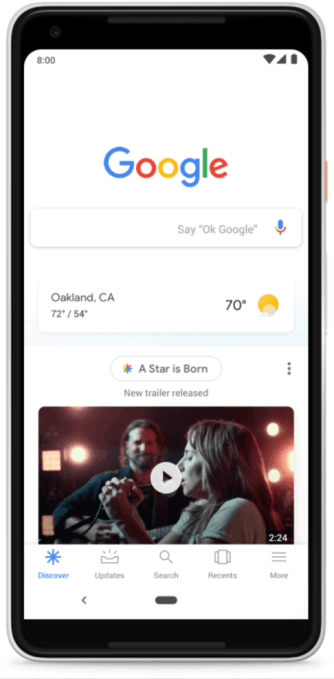
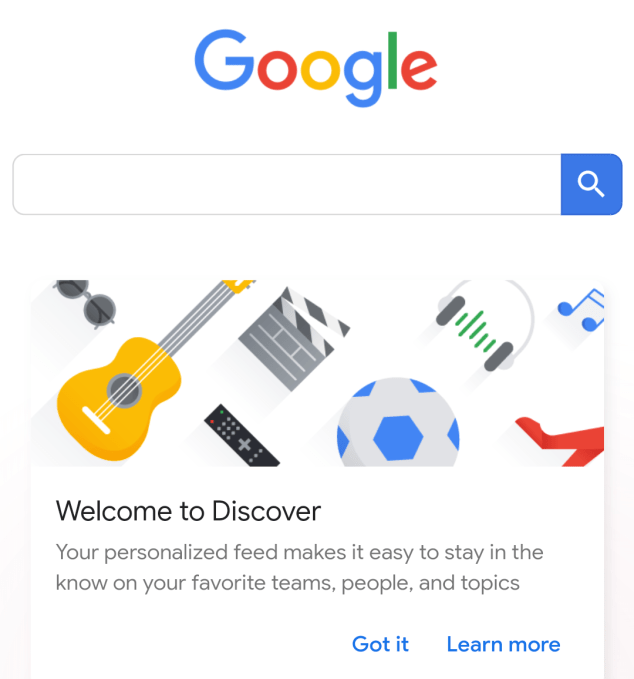
It’s not broke, but Google is fixing it. As it announced last month, Google is rebranding Google Feed, its news landing page on Android and in the Google app, to be called Google Discover. Throwing minimalism out the window, Google Discover will replace the iconically spartan Google.com homepage on mobile.

Discover is rolling out now on Google.com across both iOS and Android devices. For Android users, Discover is already baked into the interface, accessible by swiping right from the home screen. Anyone using the Google app on iOS or Android will also be met with the Discover homepage, which should be familiar at this point. We’ve reached out to Google for more details on who will see Discover when.

For a company that at times struggles with filtering disinformation out of its search results, making Discover so prominent might not be a well timed choice. The Discover results generally resurface stuff that a user has already expressed interest in, but those results are culled from a broad enough pool of sources that they don’t always feel relevant. Hopefully Google has enough sentient humans on its teams to avert future algorithmic catastrophy, though we’re not holding our breath for Google or any social platform on that count.

If you’re using Discover through the Google app, you can customize your feed further, adding topics to subscribe to, weather, commute info and more. If you’re a sports fan, the “teams” feature is genuinely useful. If Google’s vast collective knowledge of your predilections creeps you out (and it should) but you still like the Google app, you can disable “Web & App Activity” for a bit more peace of mind by following these instructions — just do them backward.

29 Oct 2018

Google Discover begins to replace the iconic search box on mobile

It’s not broke, but Google is fixing it. As it announced last month, Google is rebranding Google Feed, its news landing page on Android and in the Google app, to be called Google Discover. Throwing minimalism out the window, Google Discover will replace the iconically spartan Google.com homepage on mobile.

Discover is rolling out now on Google.com across both iOS and Android devices. For Android users, Discover is already baked into the interface, accessible by swiping right from the home screen. Anyone using the Google app on iOS or Android will also be met with the Discover homepage, which should be familiar at this point. We’ve reached out to Google for more details on who will see Discover when.

For a company that at times struggles with filtering disinformation out of its search results, making Discover so prominent might not be a well timed choice. The Discover results generally resurface stuff that a user has already expressed interest in, but those results are culled from a broad enough pool of sources that they don’t always feel relevant. Hopefully Google has enough sentient humans on its teams to avert future algorithmic catastrophy, though we’re not holding our breath for Google or any social platform on that count.

If you’re using Discover through the Google app, you can customize your feed further, adding topics to subscribe to, weather, commute info and more. If you’re a sports fan, the “teams” feature is genuinely useful. If Google’s vast collective knowledge of your predilections creeps you out (and it should) but you still like the Google app, you can disable “Web & App Activity” for a bit more peace of mind by following these instructions — just do them backward.

29 Oct 2018

Assessing IBM’s $34 billion Red Hat acquisition

As you look at the $34 billion IBM-Red Hat deal announced yesterday, if you follow the enterprise closely, it seems like a good move, at least on its face. It could be years before we understand the true value of it for IBM (or lack thereof, depending on how it ultimately goes). The questions stands then, is this a savvy move, a desperate one or perhaps a bit of both. It turns out, it depends on whom you ask.

For starters, there is the sheer amount of money involved, a 63 percent premium on Friday’s closing price of just under $117 a share. IBM spent $190 a share, but as Ray Wang, founder and chief analyst at Constellation Research said, Red Hat didn’t necessarily want to be sold, so IBM had to overpay to get their company.

Wang sees cloud, Linux and security as the big drivers on IBM’s part. “IBM is doubling down on the cloud, but they also are going for a grab in Linux for their largest and most important open source communities and some of the newer tech on Red Hat security,” he told TechCrunch. He acknowledges that it’s a huge premium for the stock, but he believes IBM needs the M&A action to drive down customer acquisition costs and drive up cross sell.
Photo: Ron Miller

IBM is placing a big bet here says Dharmesh Thakker, general partner at Battery Ventures, believing it to be worth 30x its current earnings in the next 12 months. “Needless to say, the hybrid cloud opportunity that we have been working on the last few years, is real and IBM/Cisco/HP/Dell all want a piece of this action going forward as the $300B in datacenter spend gets dislocated by public and hybrid cloud vendors,” Thakker explained in a statement.

He believes this deal could actually trigger a new set of mega mergers between the traditional tech vendors and cloud native, container and DevOps companies over the next few months.

IBM CEO Ginni Rometty was positively giddy at the prospects of a combined IBM-Red Hat in a call with analysts and press this morning, pointing out that only 20 percent of enterprise workloads have been moved to the cloud. She sees a big opportunity, one she projects to be worth $1 trillion by 2020. Keeping in mind you should take market projections with a grain of salt, this is undoubtedly a big market and one that Oracle and Microsoft have also targeted.

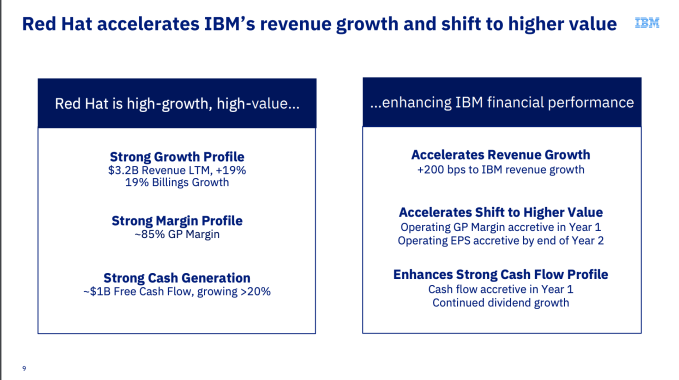
She said that Red Hat was a rare company indeed. “Red Hat on its own has been a high value company and has done a great job with strong growth, is highly profitable and generates cash. There are not many companies out there that look like that in this area,” Rometty said.
Slide: IBM

Dan Scholnick, general partner at Trinity Ventures, whose investments have included New Relic and Docker, was not terribly impressed with the deal, believing it smacked of desperation on IBM’s part.

“IBM is a declining business that somehow needs to become relevant in the cloud era. Red Hat is not the answer. Red Hat’s business centers around an operating system, which is a layer of the technology stack that has been completely commoditized by cloud. (If you use AWS, you can get Amazon’s OS for free, so why would you pay Red Hat?) Red Hat has NO story for cloud,” he claimed in a statement.

That might not be an entirely fair assessment. While Red Hat Enterprise Linux is a big part of the company’s revenue, it’s not the only piece. Over the last couple of years it has moved into Kubernetes and containerization and has grown the cloud native side of the business alongside RHEL.

In fact, Forrester analyst Dave Bartoletti sees the cloud native piece as being key here. “The combined company has a leading Kubernetes and container-based cloud-native development platform, and a much broader open source middleware and developer tools portfolio than either company separately. While any acquisition of this size will take time to play out, the combined company will be sure to reshape the open source and cloud platforms market for years to come,” he said.
Photo: IBM

Wang believes the deal could hinge on how long Red Hat CEO Jim Whitehurst, who had led the company for over a decade, stays with the unit. According to IBM, they will maintain the Red Hat brand and operate it as an independent entity inside Big Blue. “If Whitehurst doesn’t stick around for awhile, the deal could go south,” he said. But the company could dangle the CEO job when Rometty decides to leave as incentive to stay.

Regardless, Wall Street was not entirely happy with IBM’s move with their stock down all day. Needless to say the 63 percent premium IBM paid for the stock has driven Red Hat higher today.

The deal must pass shareholder muster, but given the premium IBM has offered, it’s hard to believe they would turn it down. In addition, since these companies operate across the world, they are subject to the global regulatory approval process. They won’t officially come together until at least the second half of next year at the soonest. That’s when we might begin to learn whether this was a brilliant or desperate move by IBM.


29 Oct 2018

Assessing IBM’s $34 billion Red Hat acquisition

As you look at the $34 billion IBM-Red Hat deal announced yesterday, if you follow the enterprise closely, it seems like a good move, at least on its face. It could be years before we understand the true value of it for IBM (or lack thereof, depending on how it ultimately goes). The questions stands then, is this a savvy move, a desperate one or perhaps a bit of both. It turns out, it depends on whom you ask.

For starters, there is the sheer amount of money involved, a 63 percent premium on Friday’s closing price of just under $117 a share. IBM spent $190 a share, but as Ray Wang, founder and chief analyst at Constellation Research said, Red Hat didn’t necessarily want to be sold, so IBM had to overpay to get their company.

Wang sees cloud, Linux and security as the big drivers on IBM’s part. “IBM is doubling down on the cloud, but they also are going for a grab in Linux for their largest and most important open source communities and some of the newer tech on Red Hat security,” he told TechCrunch. He acknowledges that it’s a huge premium for the stock, but he believes IBM needs the M&A action to drive down customer acquisition costs and drive up cross sell.

Photo: Ron Miller

IBM is placing a big bet here says Dharmesh Thakker, general partner at Battery Ventures, believing it to be worth 30x its current earnings in the next 12 months. “Needless to say, the hybrid cloud opportunity that we have been working on the last few years, is real and IBM/Cisco/HP/Dell all want a piece of this action going forward as the $300B in datacenter spend gets dislocated by public and hybrid cloud vendors,” Thakker explained in a statement.

He believes this deal could actually trigger a new set of mega mergers between the traditional tech vendors and cloud native, container and DevOps companies over the next few months.

IBM CEO Ginni Rometty was positively giddy at the prospects of a combined IBM-Red Hat in a call with analysts and press this morning, pointing out that only 20 percent of enterprise workloads have been moved to the cloud. She sees a big opportunity, one she projects to be worth $1 trillion by 2020. Keeping in mind you should take market projections with a grain of salt, this is undoubtedly a big market and one that Oracle and Microsoft have also targeted.

She said that Red Hat was a rare company indeed. “Red Hat on its own has been a high value company and has done a great job with strong growth, is highly profitable and generates cash. There are not many companies out there that look like that in this area,” Rometty said.

Slide: IBM

Dan Scholnick, general partner at Trinity Ventures, whose investments have included New Relic and Docker, was not terribly impressed with the deal, believing it smacked of desperation on IBM’s part.

“IBM is a declining business that somehow needs to become relevant in the cloud era. Red Hat is not the answer. Red Hat’s business centers around an operating system, which is a layer of the technology stack that has been completely commoditized by cloud. (If you use AWS, you can get Amazon’s OS for free, so why would you pay Red Hat?) Red Hat has NO story for cloud,” he claimed in a statement.

That might not be an entirely fair assessment. While Red Hat Enterprise Linux is a big part of the company’s revenue, it’s not the only piece. Over the last couple of years it has moved into Kubernetes and containerization and has grown the cloud native side of the business alongside RHEL.

In fact, Forrester analyst Dave Bartoletti sees the cloud native piece as being key here. “The combined company has a leading Kubernetes and container-based cloud-native development platform, and a much broader open source middleware and developer tools portfolio than either company separately. While any acquisition of this size will take time to play out, the combined company will be sure to reshape the open source and cloud platforms market for years to come,” he said.

Photo: IBM

Wang believes the deal could hinge on how long Red Hat CEO Jim Whitehurst, who had led the company for over a decade, stays with the unit. According to IBM, they will maintain the Red Hat brand and operate it as an independent entity inside Big Blue. “If Whitehurst doesn’t stick around for awhile, the deal could go south,” he said. But the company could dangle the CEO job when Rometty decides to leave as incentive to stay.

Regardless, Wall Street was not entirely happy with IBM’s move with their stock down all day. Needless to say the 63 percent premium IBM paid for the stock has driven Red Hat higher today.

The deal must pass shareholder muster, but given the premium IBM has offered, it’s hard to believe they would turn it down. In addition, since these companies operate across the world, they are subject to the global regulatory approval process. They won’t officially come together until at least the second half of next year at the soonest. That’s when we might begin to learn whether this was a brilliant or desperate move by IBM.
29 Oct 2018

Google looks to AI interactions and cats to power its latest AR feature

Of all the features and hardware that dropped at Google’s event earlier this month, one that felt particularly glossed over was Playground, the new augmented reality mode that’s arrived on the Pixel 3 camera. For a company that has been investing in phone-based AR for quite a while, it launched rather quietly and in a fairly hidden spot amongst other photo modes in the Pixel 3 camera app.

I got to venture over to the company’s offices to take a closer look at the cute little stickers and 3D character “Playmojis” and hear how Google is aiming to ensure that the AR world has a deeper understanding of your environment than just its geometry.

Google has long flirted with letting users capture moments that bring virtual characters into their daily life. Since the days of Project Tango, Google has been working to create characters that can live in the virtual space at appropriate scale, responding to boundaries of the room and different lighting conditions. With this release, the company challenged themselves on interactivity, trying to get the 3D characters to not only react to what was happening with other Playground objects in the space, but with elements of the real world, as well, so when you smile, the virtual character posed behind you can toss up a grin as well.

“We thought, let’s think deeper into it and start making these stickers smarter and see if we can actually use AR and machine learning to help users be more creative,” Joe Bose, a product manager at Google working on AR, told TechCrunch.

Interactivity is ultimately what makes Playground different from the one-off AR sticker packs Google has dropped with past partnerships with Star Wars or Stranger Things. Playground also showcases a wider swath of Google’s AR efforts than just placing objects into environments. There’s some clear work being done by the live image recognition engine that powers Google Lens, bringing about a cool feature that suggests stickers and playmojis for you to drop into the world. If your camera is focused on a sunny meadow, Playground suggests some more nature-centric AR stickers; when a dog jumped into view while I was demoing, some pooch recommendations popped up.

For now there’s a hefty amount of stickers and some Marvel superheroes and dogs. As part of National Cat Day today, Google is bringing some AR kitties into the action, I’m told, which by all accounts should more than ensure the feature’s success — or at least boost sharability — among lovers of cats real and virtual.

For now Playground is just available on the Pixel 3, but the team is looking to bring the feature to past Pixel phones in the near future.

In the end, Playground is a hilarious amount of sophisticated tech just to add some added pizzazz to your photos, but that’s augmented reality tech in a snapshot. The bullish folks may say it represents a new computing platform, but in 2018 it’s ensuring that your cat has a virtual pal in your photos and videos.

29 Oct 2018

Google looks to AI interactions and cats to power its latest AR feature

Of all the features and hardware that dropped at Google’s event earlier this month, one that felt particularly glossed over was Playground, the new augmented reality mode that’s arrived on the Pixel 3 camera. For a company that has been investing in phone-based AR for quite a while, it launched rather quietly and in a fairly hidden spot amongst other photo modes in the Pixel 3 camera app.

I got to venture over to the company’s offices to take a closer look at the cute little stickers and 3D character “Playmojis” and hear how Google is aiming to ensure that the AR world has a deeper understanding of your environment than just its geometry.

Google has long flirted with letting users capture moments that bring virtual characters into their daily life. Since the days of Project Tango, Google has been working to create characters that can live in the virtual space at appropriate scale, responding to boundaries of the room and different lighting conditions. With this release, the company challenged themselves on interactivity, trying to get the 3D characters to not only react to what was happening with other Playground objects in the space, but with elements of the real world, as well, so when you smile, the virtual character posed behind you can toss up a grin as well.

“We thought, let’s think deeper into it and start making these stickers smarter and see if we can actually use AR and machine learning to help users be more creative,” Joe Bose, a product manager at Google working on AR, told TechCrunch.

Interactivity is ultimately what makes Playground different from the one-off AR sticker packs Google has dropped with past partnerships with Star Wars or Stranger Things. Playground also showcases a wider swath of Google’s AR efforts than just placing objects into environments. There’s some clear work being done by the live image recognition engine that powers Google Lens, bringing about a cool feature that suggests stickers and playmojis for you to drop into the world. If your camera is focused on a sunny meadow, Playground suggests some more nature-centric AR stickers; when a dog jumped into view while I was demoing, some pooch recommendations popped up.

For now there’s a hefty amount of stickers and some Marvel superheroes and dogs. As part of National Cat Day today, Google is bringing some AR kitties into the action, I’m told, which by all accounts should more than ensure the feature’s success — or at least boost sharability — among lovers of cats real and virtual.

For now Playground is just available on the Pixel 3, but the team is looking to bring the feature to past Pixel phones in the near future.

In the end, Playground is a hilarious amount of sophisticated tech just to add some added pizzazz to your photos, but that’s augmented reality tech in a snapshot. The bullish folks may say it represents a new computing platform, but in 2018 it’s ensuring that your cat has a virtual pal in your photos and videos.

29 Oct 2018

Say ‘Hi’ to Nybble, an open-source robotic kitten

If you’ve ever wanted to own your own open-source cat, this cute Indiegogo project might be for you. The project, based on something called the Open Cat, is a laser-cut cat that walks and “learns” and can even connect to a Raspberry Pi. Out of the box a complex motion controller allows the kitten to perform lifelike behaviors like balancing, walking and nuzzling.

“Nybble’s motion is driven by an Arduino compatible micro-controller. It stores instinctive ‘muscle memory’ to move around,” wrote its creator, Rongzhong Li. “An optional AI chip, such as Raspberry Pi can be mounted on top of Nybble’s back, to help Nybble with perception and decision. You can program in your favorite language, and direct Nybble walk around simply by sending short commands, such as ‘walk’ or ‘turn left.'”

The cat is surprisingly cute and the life-like movements make it look far more sophisticated than your average toy. You can get a single Nybble for $200 and the team aims to ship in April 2019. You also can just build your own cat for free if you have access to a laser cutter and a few other tools, but the kit itself includes a motion board and complete instructions, which makes the case for paying for a new Nybble pretty compelling. I, for one, welcome our robotic feline overlords.

29 Oct 2018

Say ‘Hi’ to Nybble, an open-source robotic kitten

If you’ve ever wanted to own your own open-source cat, this cute Indiegogo project might be for you. The project, based on something called the Open Cat, is a laser-cut cat that walks and “learns” and can even connect to a Raspberry Pi. Out of the box a complex motion controller allows the kitten to perform lifelike behaviors like balancing, walking and nuzzling.

“Nybble’s motion is driven by an Arduino compatible micro-controller. It stores instinctive ‘muscle memory’ to move around,” wrote its creator, Rongzhong Li. “An optional AI chip, such as Raspberry Pi can be mounted on top of Nybble’s back, to help Nybble with perception and decision. You can program in your favorite language, and direct Nybble walk around simply by sending short commands, such as ‘walk’ or ‘turn left.'”

The cat is surprisingly cute and the life-like movements make it look far more sophisticated than your average toy. You can get a single Nybble for $200 and the team aims to ship in April 2019. You also can just build your own cat for free if you have access to a laser cutter and a few other tools, but the kit itself includes a motion board and complete instructions, which makes the case for paying for a new Nybble pretty compelling. I, for one, welcome our robotic feline overlords.

29 Oct 2018

What the newly revised copyright law lets (and doesn’t let) you do with your gadgets

You think you own your phone, but you don’t. Copyright law prohibits you from modifying its software in certain ways, opening you up to a voided warranty, cancelled service or even a lawsuit — but that’s slowly changing as the government acknowledges the need (and arguably right) to repair our own devices. A favorable decision from the Copyright Office gives you considerably more freedom with your gadgets, but it’s far from an ideal solution.

As a brief bit of background, the law that prevents you from, say, installing third-party software on your car or sideloading apps onto your Amazon Echo is Section 1201 of the Digital Millennium Copyright Act. It’s meant to make it illegal to circumvent digital copyright protections on software and media, but it’s been used for much more than that.

Companies started stashing all kinds of things behind digital locks and therefore controlling the only means that consumers had to repair or modify them. Digital rights advocates such as Kyle Wiens at iFixit have been pushing back against this practice for years — and recently have made some headway.

Every three years a board of Copyright Office wonks convenes and codifies exemptions to Section 1201: devices or situations that the board is convinced justifiably shouldn’t be covered by the law. What if, for instance, hospitals couldn’t reboot or patch critical medical hardware because the company was unresponsive? Exemptions are added based on merit, but aren’t permanent and must be renewed (and likely re-argued) regularly.

2015’s exemptions were nice, but 2018’s are choice. Here are some things you can do now that you couldn’t last week:

  • Unlock new phones. Believe it or not this was not allowed. Used phones, sure. But new-in-box phones could still sport software locking it to, say, Verizon (our parent company’s parent company, which likely is not happy with this decision) even though its hardware would let it work on AT&T. Now you should be able to unlock at will.
  • Jailbreak Amazon Echoes, Google Homes and Apple HomePods. This class of “voice assistant devices” wasn’t really a thing in 2015, but sure is now. Doubtless there are plenty of people who would love to poke around inside an old Echo and load it up with open-source software — and now they can do so in compliance with the law.
  • Repair smart home components and devices. Ever wonder what happens to a smart home device when its maker goes out of business or you stop paying for their subscription service? It turns into a smart paperweight. But now you should be able to get root access and fix or reactivate devices (like smart bulbs or security cameras) that have been abandoned or bricked.
  • Access and modify land vehicle software. Previously cars (and infamously, tractors) were protected by a thick moat of DRM that prevented users and even repair shops from getting at their digital guts. Not a good thing when cars are basically rolling computers. The law now exempts reading and modifying this software for the purposes of repair — you just can’t tweak it in any way that impairs its roadworthiness.
  • Hire someone to do those repairs for you. Many of these exemptions are restricted to the owner of the device or vehicle, reasonably enough. But not everyone is clued in on this stuff, so it’s important to make sure it’s also legal for consumers to delegate that right to a third party.

These new freedoms will hopefully result in a more flourishing used-device market and allow phones, cars and smart home devices to live longer and happier lives. But don’t forget that these exemptions must be refreshed in three years. Fortunately that gives advocates an opportunity to expand the list as well, as they did here.

That’s good, because there are still plenty of things to add; for instance game consoles, which didn’t make the list. Perhaps the board thought the risk of piracy was too high. Boats and planes are still protected the way cars once were, which is perhaps understandable.

Strangely, the tools you would require to do most of these things — bootloaders, jailbreaking kits and so on — are still illegal to distribute. It’s weird, but not the first time for this sort of paradox — marijuana, for instance, is still in many places legal to own and use but illegal to sell or grow.

This all goes to show that there is much room for improvement, and not just in a series of temporary exemptions. The law itself must be modified permanently to ensure that we actually own the things we own. That’s going to take a lot of time and work, but from this and previous victories it’s clear that the stars are aligning.

29 Oct 2018

What the newly revised copyright law lets (and doesn’t let) you do with your gadgets

You think you own your phone, but you don’t. Copyright law prohibits you from modifying its software in certain ways, opening you up to a voided warranty, cancelled service or even a lawsuit — but that’s slowly changing as the government acknowledges the need (and arguably right) to repair our own devices. A favorable decision from the Copyright Office gives you considerably more freedom with your gadgets, but it’s far from an ideal solution.

As a brief bit of background, the law that prevents you from, say, installing third-party software on your car or sideloading apps onto your Amazon Echo is Section 1201 of the Digital Millennium Copyright Act. It’s meant to make it illegal to circumvent digital copyright protections on software and media, but it’s been used for much more than that.

Companies started stashing all kinds of things behind digital locks and therefore controlling the only means that consumers had to repair or modify them. Digital rights advocates such as Kyle Wiens at iFixit have been pushing back against this practice for years — and recently have made some headway.

Every three years a board of Copyright Office wonks convenes and codifies exemptions to Section 1201: devices or situations that the board is convinced justifiably shouldn’t be covered by the law. What if, for instance, hospitals couldn’t reboot or patch critical medical hardware because the company was unresponsive? Exemptions are added based on merit, but aren’t permanent and must be renewed (and likely re-argued) regularly.

2015’s exemptions were nice, but 2018’s are choice. Here are some things you can do now that you couldn’t last week:

  • Unlock new phones. Believe it or not this was not allowed. Used phones, sure. But new-in-box phones could still sport software locking it to, say, Verizon (our parent company’s parent company, which likely is not happy with this decision) even though its hardware would let it work on AT&T. Now you should be able to unlock at will.
  • Jailbreak Amazon Echoes, Google Homes and Apple HomePods. This class of “voice assistant devices” wasn’t really a thing in 2015, but sure is now. Doubtless there are plenty of people who would love to poke around inside an old Echo and load it up with open-source software — and now they can do so in compliance with the law.
  • Repair smart home components and devices. Ever wonder what happens to a smart home device when its maker goes out of business or you stop paying for their subscription service? It turns into a smart paperweight. But now you should be able to get root access and fix or reactivate devices (like smart bulbs or security cameras) that have been abandoned or bricked.
  • Access and modify land vehicle software. Previously cars (and infamously, tractors) were protected by a thick moat of DRM that prevented users and even repair shops from getting at their digital guts. Not a good thing when cars are basically rolling computers. The law now exempts reading and modifying this software for the purposes of repair — you just can’t tweak it in any way that impairs its roadworthiness.
  • Hire someone to do those repairs for you. Many of these exemptions are restricted to the owner of the device or vehicle, reasonably enough. But not everyone is clued in on this stuff, so it’s important to make sure it’s also legal for consumers to delegate that right to a third party.

These new freedoms will hopefully result in a more flourishing used-device market and allow phones, cars and smart home devices to live longer and happier lives. But don’t forget that these exemptions must be refreshed in three years. Fortunately that gives advocates an opportunity to expand the list as well, as they did here.

That’s good, because there are still plenty of things to add; for instance game consoles, which didn’t make the list. Perhaps the board thought the risk of piracy was too high. Boats and planes are still protected the way cars once were, which is perhaps understandable.

Strangely, the tools you would require to do most of these things — bootloaders, jailbreaking kits and so on — are still illegal to distribute. It’s weird, but not the first time for this sort of paradox — marijuana, for instance, is still in many places legal to own and use but illegal to sell or grow.

This all goes to show that there is much room for improvement, and not just in a series of temporary exemptions. The law itself must be modified permanently to ensure that we actually own the things we own. That’s going to take a lot of time and work, but from this and previous victories it’s clear that the stars are aligning.