Month: October 2018

29 Oct 2018

OnePlus edges toward mainstream with the 6T

This could be OnePlus’s moment. Back in June, the Oppo-backed Chinese smartphone maker announced that it had sold one million units of its latest handset in 22 days.

These aren’t Apple or Samsung numbers we’re talking about here, of course. But they’re impressive for a less than five-year-old company odds are pretty good you’ve never even heard of. And in a sense, it’s precisely Apple and Samsung that have indirectly driven that growth.

Over the past few generations, the leading handset manufacturers have made $1,000+ flagships routine. OnePlus, meanwhile, has remained steadfast, clinging to a “Never Settle” slogan that’s less about grasping for the latest innovation than it is embracing the whole picture. It’s a motto that, ironically, sometimes means settling for slightly behind the curve.

But it’s the same smartphone war that’s pushing innovation that is also driving up price tags and incentivizing companies to adopt technologies that aren’t quite ready for prime time. OnePlus’s approach, meanwhile, has allowed the company to offer remarkable consistency since pretty much day one — and to do so at a price that’s near half that of high-end competitors.

That holds for the new 6T, which starts at $549. That’s $20 more than where the OnePlus 6 started, mind, but that’s largely due to the decision to drop the low-end 64GB model and start things at 128GB. Likely there will be some who balk at that small choice. And $20 is $20, certainly, but as far as growing pains go, it’s a pretty small one.

That said, the company does find itself making some uncharacteristic decisions as it edges toward its fifth birthday. The first seemed like an inevitability, with the company finally settling down with a carrier partner here in the States. The Magenta carrier seems like a strange partner, perhaps, at first glance. “We found a kindred spirit with T-Mobile,” the company writes in the attached press release.

The simple fact of the matter, however, is that you still need carriers to grow here in the States. OnePlus is, naturally, looking to do that here — but it’s trying to do so at a measured pace. It’s an admirable approach in an industry where the majority of companies are more interested in growing as quickly as possible, often sacrificing things like quality and customer service in the process.

It’s been a part of OnePlus’s approach from the beginning, through things like its invite-only releases dating back to the early days. Assuming the company’s backers continue to be on-board with the approach, good on it.

There’s another key flank to the company’s new approach. If you’ve heard anything about the OnePlus 6T up to this point, it’s probably this about this. The handset is one of the first to hit the U.S. market sporting an in-screen fingerprint reader, beating the Samsung Galaxy S10 by several months.

We’ve seen some international handsets sport some version of the technology, but this is a win for OnePlus and a change of pace for the company. Among other things, it’s a way to stand out from the crowd. In a perfect world, building a solid product for a good price would be more than enough, but perfect this world isn’t. Turn on your TV for like 10 seconds (I’ll wait).

It’s a novelty, for sure, but it’s one that makes sense in the broader context of the phone. OnePlus has had face unlock for a while, but it’s a less secure version than the one found on the iPhone, which means you’ll want a second layer of security on the device.

Adding a module beneath the screen brings the authentication back to the front of the device without having to increase the footprint or sacrificing precious screen space. It also comes with the added bonus of being able to check your phone without having to lift it up to your face — one of the main annoyances of Apple’s Face ID feature.

The feature works fairly well. When the screen is locked, a fingerprint icon pops up, showing you where to press. When the finger is in the right spot, the AMOLED display flashes a bright light to capture a scan of the surface from the reflected light. The company says it takes around a third of a second, though in my own testing, that number was closer to one second or sometimes longer as I negotiated my thumb into the right spot.

Perhaps, unsurprisingly, the addition comes with a compromise. In order to fit the scanner beneath the screen, the company had to ditch the headphone jack, bringing it kicking and screaming into 2018. OnePlus was one of the remaining few companies to take the leap.

This time back in 2016, co-founder Carl Pei asked Twitter whether they supported keeping the headphone jack. The answer was overwhelmingly yes. So the company kept it. Two years later, however, a new innovation has forced the company’s hand. And OnePlus isn’t stopping there. Last week, we noted that the company has fully committed itself to bringing out a 5G phone in 2019, making it one of the first in the U.S. to do so.

The next couple of years will find the company making a lot of difficult changes as it looks to expand while maintaining the core audience that helped it grow in the first place. As a kind of small consolation, the package includes a note from Pei.

It’s a nice little nod to OnePlus’s roots, though it tellingly opens, “Friend, Let me be the first to welcome you to the OnePlus community.” It’s an acknowledgement that the company is growing and also a promise not to betray its roots. We’ll see, I suppose.

At 6.41 inches, the 6T has the largest display offered on a OnePlus device. That’s helped along by the hidden fingerprint sensor, of course, along with a tiny notch up top. In spite of the excessively large screen, the phone itself doesn’t feel huge — especially after carrying the downright massive Google Pixel 3 XL around for a while.

The design language is pretty standard OnePlus — and that’s a good thing. The company’s phones are solidly built and nice to look at, without focusing too much on the kind of flash that defines products like the Galaxy line.

Inside, you’ve got a Snapdragon 845, 6 or 8GB of RAM and 128 or 256GB or RAM. Solid enough specs, particularly given the price point. The company has also beefed up the battery by 20 percent, up to a healthy 3,700 mAh. That will give you well over a day of use.

The phone arrives November 1, starting at $549 — still the best deal in smartphones.

29 Oct 2018

You can now control the Nvidia Shield TV with Alexa

Shield TV, Nvidia’s streaming media set-top box introduced last year, is going hands-free by way of Alexa. The company announced this morning the launch of a new Amazon Alexa skill which will enable Shield TV owners in the U.S. to navigate their device with voice commands, including those to turn on or off the Shield, adjust the volume, play, pause, fast-forward, or rewind content, or even move around to various sections, like the Home screen or Settings.

With the addition, Shield TV owners can now choose between Alexa or Google Home Assistant devices, in terms of hands-free voice control.

To use Alexa voice commands, you’ll first have to pair an Echo with the Shield from within the Alexa app. Then, you’ll need to enable the new “Nvidia Shield TV” skill from Amazon’s skill store. After accepting the terms, you’ll link the skill to your Nvidia account. The last step is to select the Shield and the Echo devices you’d like to connect to work together.

Once set up, you can say things like “Alexa, turn on Shield,” “Alexa, play (on Shield),” “Alexa, fast-forward 10 minutes (on Shield),” “Alexa go to control settings (on Shield),” and more.

(Following the first command, Alexa will assume subsequent relevant commands are for Shield. Where “on Shield” is noted in parentheses, you can continue controlling the device with just the command.)

The company says the Alexa support will come to other non-U.S. regions over time, and the list of supported commands will grow, as well.

Alongside the launch, Nvidia also announced Dolby Atmos passthrough support for Prime Video, and a promotion that will give customers buying a Shield TV from Amazon or Best Buy a free Echo Dot (3rd Gen). Current owners can buy a discounted Echo Dot.

Alexa already interoperates with a number of set-top boxes, including Amazon’s own Fire TV line (where the Cube recently added in-app navigation, too); plus TiVo’s devices, Dish’s Hopper, Xbox, DirecTV’s set-top box, and others.

29 Oct 2018

No, Twitter is not removing its like button ‘soon’, but it is considering it

Twitter’s like button — the heart at the bottom of a Tweet — is one of the most enduring and popular parts of the Twitter experience. So it took some by surprise to see a story published earlier today claiming that Twitter would “soon” be removing the feature.

Not so soon, it seems. Twitter today said that while it’s been “considering” a move to remove the “Like” button for a while now, there is no timeline for the move, and it is not happening in the near future.

“As we’ve been saying for a while, we are rethinking everything about the service to ensure we are incentivizing healthy conversation, that includes the like button,” the Twitter Comms account noted. “We are in the early stages of the work and have no plans to share right now.”

What’s the backstory here? Twitter’s heart button — which controversially replaced a star back in 2015 — gets used by millions as a quick way of sending an acknowledgement of what someone else has written, without the full force of a re-tweet. It also can be a way to help you track things you found interesting but are otherwise likely to forget.

But nothing is sacred on social media, and so it seems that even the simple heart has become subject to abuse. As with any Tweet, one that is harassing or harmful, or that might contain incendiary content, will go viral when it gets Re-Tweeted. But a large amount of people — or, perhaps just as likely on Twitter, bots — liking it can also help push it along in Twitter’s algorithms, where it gets surfaced in lists and in people’s timelines because of its popularity. When a Tweet might have a nefarious intention, hearts can lead to heartbreak.

In the meantime, the company has been expanding options it gives users to save Tweets that are less ‘social’, such as the creation of Bookmarks, which are private to the user creating them.

Removing ways of responding to Tweets seems anathema to the idea of a conversational platform, although there are many options for what Twitter might consider before removing the heart (or whatever shape its fave/like takes) altogether: they could include a variety of responses similar to Facebook’s, or changing how a like affects a Tweet’s position in Twitter’s wider algorithms.

Twitter’s move to reconsider the like button and what it does isn’t ridiculous in that context, although abandoning it abruptly would be odd, and potentially controversial in itself. Or perhaps not: the company’s stock is up nearly four percent in trading this morning.

29 Oct 2018

Vimeo subscribers can now publish videos directly to LinkedIn

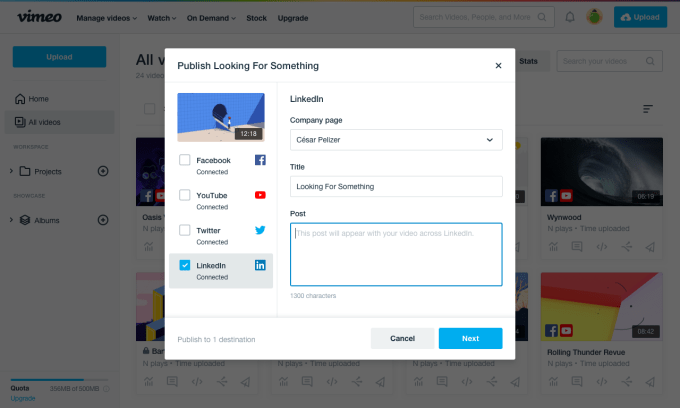
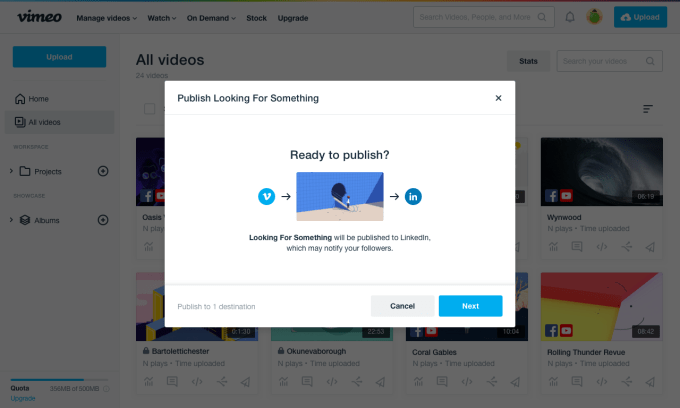
Vimeo announced today a new feature that will allow videos to be published directly to LinkedIn. The added support is a part of the company’s “Publish to Social” feature, which already offers publishing to Facebook, Twitter, and YouTube, and is available to paid subscribers. The expansion to LinkedIn is another example of the company’s shift in focus from being a video destination site to one that sells tools and services to professional and semi-professional video creators.

The company last year scrapped its plans for a subscription video-on-demand service, promoted its creator business lead Anjali Sud to CEO, and acquired live video streaming platform Livestream, as a part of its broader plan to serve the video creator community through services.

Earlier this year, it announced “Publish to Social,” a tool that support uploading videos to multiple sites at once, as a part of all Plus, PRO, Business, and live plans.

Now it’s adding LinkedIn to its list of supported sites, which makes it the first video platform to integrate with LinkedIn, the company says.

The move also follows Microsoft’s earlier announcement that LinkedIn would open to video uploads as part of a larger video push on its part. Last summer, LinkedIn launched a new feature that allowed users to upload videos to the site from its iOS or Android mobile app – the idea being that users could highlight their work  projects or demonstration products, for example.

With Vimeo’s integration, however, the focus is on uploading to Company Pages, where businesses may be using video in a variety of ways to connect with their customers, prospective employees, and others.

Video has become one of the key drivers for member engagement on LinkedIn, and businesses who want to start a conversation with their audiences are increasingly turning to Company Page videos,” said Peter Roybal, principal product manager at LinkedIn, in a statement about the partnership with Vimeo. “Our new integration with Vimeo is an exciting step for anyone who wants to gain more exposure, and understand their reach to LinkedIn’s highly-engaged professional audiences,” he added.

In addition to the ability to publish to LinkedIn, Vimeo will also provide creators with analytics on the videos, including things like video viewership, engagement, and performance stats. These are available on the Vimeo dashboard, alongside the metrics for other social platforms, as well as other websites and blogs, allowing creators to compare their campaigns’ performance across various destinations.

Creators can also take advantage of Vimeo’s other marketing tools from this dashboard to further customize and monetize their content, the company says.

Using video on LinkedIn can be a big boost for businesses. According to LinkedIn’s own data, LinkedIn Company Page videos see 5x the engagement than any other type of post. And because today’s social platforms favor native uploads, the ability to push a video from Vimeo to sites like LinkedIn, Facebook, Twitter and YouTube in that same manner means creators are likely also expanding their reach, rather than using embeds or links.


29 Oct 2018

AmazonSmile has raised $100 million for charity

A little good press goes a long way for a company like Amazon. The company routinely gets knocked for things like warehouse conditions, tax breaks and impact on smaller retail outlets. AmazonSmile’s helped to counteract that a bit, raising money for legitimately good causes, skimmed off purchases from the site.

The online retail giant announced this morning that it’s made $100 million in charitable donations through the program, since launching almost exactly five years ago.

Amazon hasn’t broken down how much each participating charity has raised through the campaign, only that “hundreds of thousands of charities have been able to expand their meaningful work thanks to the donations they’ve received through AmazonSmile,” according to Amazon CEO Worldwide Consumer, Jeff Wilke.

Amazon’s also pumping up the incentives for this week. Purchases between now and November 2 will quality for a donation of five-percent of eligible products. That’s apparently around 10 times the normal donation rate, according to the company.

The are currently north of one million charities to chose from.

29 Oct 2018

Atlassian sells Jitsi, an open-source videoconferencing tool it acquired in 2015, to 8×8

After announcing earlier this year that it planned to shut down HipChat and Stride and sell the IP of both to Slack, today enterprise software company Atlassian made another move related to its retreat from enterprise chat. It is selling Jitsi, a popular open-source chat and videoconferencing tool, to 8X8, a provider of cloud-based business phone and internal communications services. 8X8 says it plans to integrate Jitsi with its current conferencing solutions, specifically a product called 8X8 Meetings, and to keep it open source.

Terms of this latest sale to 8×8 have not been disclosed. Both the tech and the engineering team working on Jitsi, led by Emil Ivov, are coming with the acquisition.

Atlassian originally acquired Jitsi and its owner BlueJimp for an undisclosed sum in 2015 with the intention of adding video communications to HipChat, and later Stride (which launched in 2017).

But now those two products are headed for the graveyard — they are both being discontinued on February 15, 2019 — and that made Jitsi less core to Atlassian’s new direction, where it is focusing less on enterprise chat, and more on tools for developers and customer care, including Jira, Trello, and Bitbucket (a competitor to GitHub).

The deal is one of the final moves for Atlassian as it focuses more on its business building and operating productivity tools that are not direct competitors in the crowded field of enterprise chat applications. It seems that in any case, Jitsi is hoping for more investment under its new owner.

“This is a great thing and will only help to keep Jitsi’s momentum with renewed investment,” writes Ivov in a blog post announcing the news. “The Jitsi team will remain 100 percent intact and will continue to be an independent group. Operationally things will work much the same way as they did under Atlassian. Jitsi users and developers won’t see any impact, though we do expect with continued funding and support you will see even more new features and capabilities from the project!”

Technology in the acquisition includes Jitsi’s modular open-source projects for businesses to build and deploy secure video communication solutions based around WebRTC; the Jitsi Videobridge conferencing server; and the Jitsi Meet conferencing and collaboration application.

“The best video communications solutions are so intuitive and reliable that they help employees conduct shorter, more productive meetings. 8×8 has already developed a world-class meetings solution for enterprises, and we’re focused on maintaining leadership in delivering reliable, crystal-clear video and audio conferencing quality across mobile and desktop applications,” said Dejan Deklich, Chief Product Officer at 8×8, in a statement. “Incorporating Jitsi’s open-source technology into our video communications technology platform, and having Jitsi’s talented engineering team play a role in leading our development of dedicated conferencing applications and WebRTC, will open new paths for our customers and further enhance our meetings solution.”

Jitsi’s tools are used by a variety of platforms and businesses that want to include videoconferencing but would rather use an independent third-party service rather than incorporate one from a would-be competitor or build it themselves. Customers include Comcast and Symphony, the chat app used by the financial services industry.

“Some of the most innovative WebRTC products and companies use Jitsi to support millions of minutes of daily usage as part of their meetings, messaging and collaboration product ecosystems. The open source community has played a critical role in advancing Jitsi’s projects by validating its use in a diverse set of environments and complementing the core team’s development. As part of this acquisition, 8×8 is committed to continuing to support the growing developer community, and we are excited to engage even more,” commented Bryan Martin, Chairman and Chief Technology Officer at 8×8.

This past weekend’s big news of IBM acquiring Red Hat for $34 million has emphasised just how central open source and cloud-based software are in today’s enterprise IT market. This purchase is far smaller, but is also part of that bigger trend.

“8×8 sees tremendous value in the open source community and is committed to helping grow the community even larger,” Ivov notes. “With a major, high-motivated backer like 8×8 behind the project, we are confident about our ability to continue building great open source products.”

29 Oct 2018

Here are the 20 games shipping with the PlayStation Classic

The PlayStation Classic already has a release date (December 3) and price ($100), but before today, Sony’s neglected to announce one key bit of information: games. The electronics giant has finally seen fit to reveal the full list of 20 titles for its answer to the wildly popular NES Classic edition.

It’s a pretty solid list, all told, including some of the console’s truly classic titles and representing a wide range of genres, from fighting to racing to RPG to, well, carjacking. The miniature console is available for preorder now, hitting the U.S. and Canada on December 3. The system also ships with two controllers.

Here’s the full list of titles.

  • Battle Arena Toshinden
  • Cool Boarders 2
  • Destruction Derby
  • Final Fantasy VII
  • Grand Theft Auto
  • Intelligent Qube
  • Jumping Flash
  • Metal Gear Solid
  • Mr Driller
  • Oddworld: Abe’s Oddysee
  • Rayman
  • Resident Evil Director’s Cut
  • Revelations: Persona
  • Ridge Racer Type 4
  • Super Puzzle Fighter II Turbo
  • Syphon Filter
  • Tekken 3
  • Tom Clancy’s Rainbow Six
  • Twisted Metal
  • Wild Arms
29 Oct 2018

Here are the 20 games shipping with the PlayStation Classic

The PlayStation Classic already has a release date (December 3) and price ($100), but before today, Sony’s neglected to announce one key bit of information: games. The electronics giant has finally seen fit to reveal the full list of 20 titles for its answer to the wildly popular NES Classic edition.

It’s a pretty solid list, all told, including some of the console’s truly classic titles and representing a wide range of genres, from fighting to racing to RPG to, well, carjacking. The miniature console is available for preorder now, hitting the U.S. and Canada on December 3. The system also ships with two controllers.

Here’s the full list of titles.

  • Battle Arena Toshinden
  • Cool Boarders 2
  • Destruction Derby
  • Final Fantasy VII
  • Grand Theft Auto
  • Intelligent Qube
  • Jumping Flash
  • Metal Gear Solid
  • Mr Driller
  • Oddworld: Abe’s Oddysee
  • Rayman
  • Resident Evil Director’s Cut
  • Revelations: Persona
  • Ridge Racer Type 4
  • Super Puzzle Fighter II Turbo
  • Syphon Filter
  • Tekken 3
  • Tom Clancy’s Rainbow Six
  • Twisted Metal
  • Wild Arms
29 Oct 2018

DJI releases a modified Mavic 2 drone aimed at enterprise

DJI announced today at an event in Texas a modified version of its well-received Mavic 2 aimed squarely at business ranging from government to education. The base of the folding drone is the same as the commercial one that launched a few months back, but there are a few updates on-board aimed specifically at enterprise customers.

The most interesting of the bunch of a new modular mount for adding-on a handful of new accessories controllable through the DJI app. The group includes a dual spotlight for night flights, a speaker for transmitting information and a beacon with a flashing strobe, so the device can be spotted in emergency conditions.

The drone sports 24GB of on-board, password protected storage, and all images captured on the drone are labeled with a GPS timestamp featuring the date, time and location the shots were taken. DJI’s also added a self-heating battery to product, making it possible to fly it in temperatures as low as 14 degrees.

The enterprise version of the drone runs $2,000 — a price that includes the Mavic 2, remote, battery, the above mount accessories and a case. It’s available starting today.

29 Oct 2018

DJI releases a modified Mavic 2 drone aimed at enterprise

DJI announced today at an event in Texas a modified version of its well-received Mavic 2 aimed squarely at business ranging from government to education. The base of the folding drone is the same as the commercial one that launched a few months back, but there are a few updates on-board aimed specifically at enterprise customers.

The most interesting of the bunch of a new modular mount for adding-on a handful of new accessories controllable through the DJI app. The group includes a dual spotlight for night flights, a speaker for transmitting information and a beacon with a flashing strobe, so the device can be spotted in emergency conditions.

The drone sports 24GB of on-board, password protected storage, and all images captured on the drone are labeled with a GPS timestamp featuring the date, time and location the shots were taken. DJI’s also added a self-heating battery to product, making it possible to fly it in temperatures as low as 14 degrees.

The enterprise version of the drone runs $2,000 — a price that includes the Mavic 2, remote, battery, the above mount accessories and a case. It’s available starting today.