Month: October 2018

26 Oct 2018

Snapchat’s new Camera desktop camera app brings AR masks to Twitch, Skype…

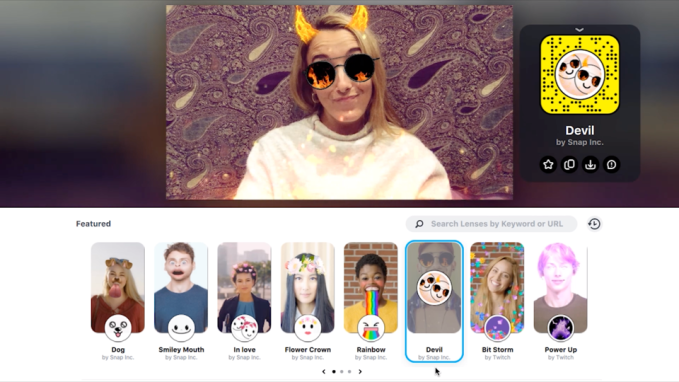
Snapchat is launching its first Mac and Windows software that takes over your webcam and brings its augmented reality effects to other video streaming and calling services. Snap Camera can be selected as a camera output in OBS Skype, YouTube, Google Hangouts, Skype, Zoom, and more plus browser-based apps like Facebook Live so you can browse through Snapchat’s Lens Explorer to try on AR face filters. And through its easily-equipped new Twitch extension, streamers can trigger different masks with hotkeys.

You can download the Mac and Windows versions of Snap Camera now. Users can us Lens Explorer to preview effects and see who made them, Star their favorites for easy access, and access a tab of your recently used Lenses.

Despite Snap Inc’s troubles following yesterday’s Q3 earnings announcement that revealed it’d lost 2 million users causing its share price to hit a new low, Snapchat Camera isn’t about stoking growth. You won’t even have to login to Snapchat to use it. Instead the goal is to drive more attention to its community AR Lens platform so more developers and creators will make their own effects. “We’re going down the path of providing more distribution channels [for Community Lens creators] and surfacing their work” Snap’s head of AR Eitan Pilipski tells me. The desktop camera could win Lens creators more attention, and Snapchat connects top the most talented ones to brands for sponsorship deals.

Snapchat first came to the desktop in January with its first embeddable content, designed for newsrooms that wanted to show off citizen journalism on their sites. But now Snapchat content creation is escaping the mobile medium.
Strangely, Snap Camera has no interface of its own. Really, it should have a Photo Booth-style app so you can record photos and videos of yourself with your webcam and share them wherever. “We don’t want to compete in that space. We just want to bring Community Lenses to whatever apps people are using” Pilipski explains. One major app that won’t support Snap Camera is Apple’s FaceTime. Why? “I don’t know. Apple didn’t comment on that. Believe me we tried” says Pilipski.

Since there’s “not even a facility to collect the impressions” and users don’t have to login, Snap won’t be able to add Camera users to its daily active user count. With that number falling from 191 million in Q1 to 188 million in Q2 to 186 million in Q3 as it announced yesterday, Snap really does need more ways to keep people straying to Instagram Stories. It will have to hope that when video chat users see their friends or family using Snap Camera’s lenses, it will remind them to fire up Snapchat more often. And Lenses could go viral if they show in a Twitch celebrity’s stream.

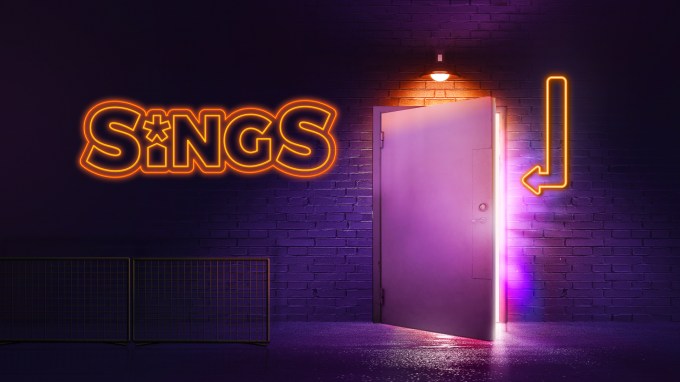
The Twitch extension comes amidst more announcements at today’s TwitchCon event including the reveal of Squad Streaming and a karaoke Twitch Sings game for the service’s average of 1 million concurrent viewers and half-million daily streamers.

The Snap camera equips Twitch broadcasters with extra features. They’ll have access to game-themed lenses for League of Legends, PlayerUnknown’s Battlegrounds, World of Warcraft, and Overwatch. Viewers will see the QR Snapcode for the Lens on the screen which they can scan with Snapchat to try the mask on themselves for virality. Streamers get a button that lets viewers subscribe to them, and can set up a “bonus” lens that shows up as a thank you when someone follows them. And with hotkeys, streamers can trigger different lenses, like an angry one for when they lose a game or victory lenses for if they manage to beat all the other Fortnite addicts.

Over 250,000 Community Lenses have been submitted through Snapchat’s Lens Studio since it launched in December, and they’ve been viewed over 1 billion times. Snapchat realized it couldn’t dream up every crazy way people could use AR just in-house. Out-Lensing Instagram is critical to Snapchat’s business strategy. The more people that use Snapchat’s AR features, the more the company can charge businesses to promote Sponsored Lenses. With the user count shrinking, Snap needs to show its business is growing to salvage its share price and pull in the outside investment or acquisition it will likely need to make it to profitability. A desktop presence could not only make Snapchat more ubiquitious, but get it in front of older users and advertisers who might be a little scared of its mobile app.
26 Oct 2018

Twitch announces group streaming and a karaoke game for its 1M concurrent viewers

The teens were out in force today in San Jose for the annual TwitchCon game streaming conference. There, Twitch announced that at any given time, 1 million people are watching it (up from 746,000 last year), and it seemed like that many game lovers were at TwitchCon in person to meet some of the nearly half-million web celebs that broadcast each day on the service. Considering Twitch said just 2 million were broadcasting per month in December, the service’s growth is still explosive under Amazon’s ownership.

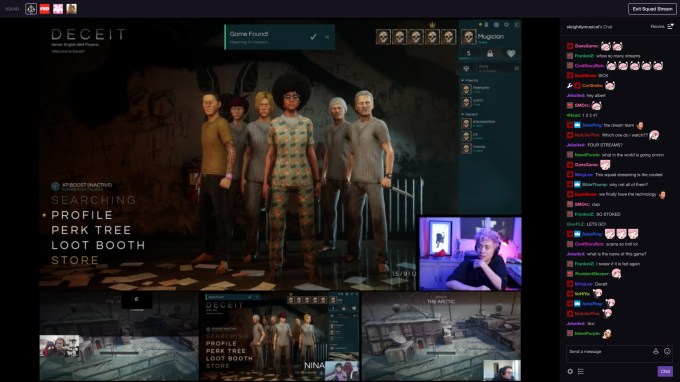
Amongst the major reveals at TwitchCon were a new Squad Streaming feature that lets up to four people broadcast at once in split-screen that will test with select streamers later this year.

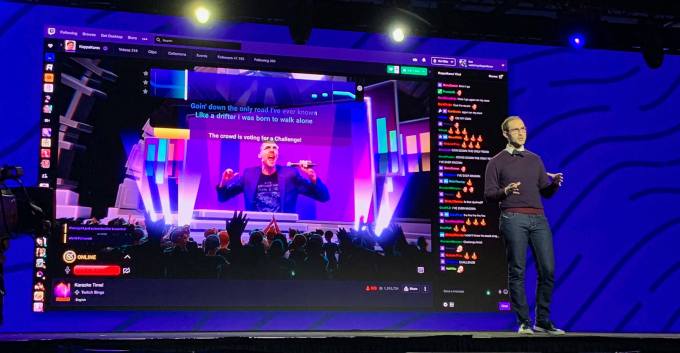
There’s also a new Twitch Sings game built in partnership with Rock Band-creator Harmonix. Broadcasters can play to perform karaoke (though only with fake versions of songs since Twitch lacks major label music licenses). Viewers can use the chat to request the next song, control the lights on the virtual karaoke stage,  Broadcasters can sign up here for the Twitch Sings closed beta that starts later in 2018.

Twitch Squad Streaming

And Twitch broadcasters can now use Snapchat’s augmented reality lenses thanks to the new Snap Camera desktop app and accompanying Twitch extension launching today. Streamers can use hotkeys to trigger different Snapchat Lenses, let viewers try those masks by scanning an onscreen Snapchat QR code, and reward subscribers with a bonus thank you effect. Read our full story on Snap Camera here:

There were plenty of other minor announcements during the conference’s keynote:

  • Over 235,00 streamers now have Affiliate status and are earning money on their channels while 6,800 have joined its Partnership program so they can earn even more through channel subscriptions and ads.
  • Twitch’s Highlight editor can now stitch together multiple clips from across a broadcasting session
  • New homepage sections will feature up-and-coming streamers, new Partners and Affiliates, or streamers local to viewers
  • VIP Badges will let creators recognize their favorite subscribers and moderators
  • Moderators can now see how long someone has been on Twitch, view chat messages that person has sent in the channel, and see how many timeouts or bans that account has received in that channel to better understand who to boot
  • 18 billion messages have been sent in Twitch chat and its Whispers feature in 2018, and fans have given creators 85 million Cheers and Subscriptions
  • 150 million Twitch Clips have been created in 2018 to bring the best game stream and other weird content to the rest of the web.
  • Twitch users have gifted $9 million worth of subscriptions to fellow users in just 9 weeks.
  • Twitch will open its Bounty Board of sponsorship opportunities to 30 more brands, and more Partners and Affiliates in the US and Canada in November
  • The Twitch Rivals in-person gaming tournaments will double to 128 events in 2019. Some will have million-dollar prizes, and it already gave out $5 million in winners’ jackpots last year


As CEO Emmett Shear made the announcements, audience members hooted and hollered with delight. They out-yelled even Apple’s keynote attendees. Shear shouted out early users who’ve been with it since Twitch was a Y Combinator lifevlogging startup called Justin.tv. “When people have your back and support you for a long time, we think they should be recognized for it” he said, revealing the new VIP badges and a counter that shows how many months a fan has been a channel’s paying subscriber.

“You spoke and we listened” Shear said. That truly seemed to be the message of this conference. Facebook’s F8 conferences held in the same San Jose Convention Center often seem to produce updates that are designed to help the company as much as the users. But Twitch has realized it can’t just be useful. It must remain beloved if people are going keep spending 760 million hours per month watching others game, joke, and express themselves. Shear concluded “I think we’re just scratching the surface when it comes to everyone playing together.”

Twitch Sings

26 Oct 2018

We’re addressing gender disparity in engineering way too late

STEM innovations, especially those in engineering, are an essential part of our modern-day lives. These innovations impact us all, and cut across social, economic and geographical boundaries. Yet, at a time when engineers must meet the needs of a vast population of users with diverse opinions and backgrounds, the engineering workforce continues to suffer from gender disparity.

The U.S. Department of Commerce reported that women accounted for 47 percent of all U.S. jobs in 2015. However, women only account for 24 percent of STEM jobs. And the percentage of women in STEM fields continues to be the lowest in engineering, with women representing just 15 percent of the workforce (NSF, 2018).

These are startling numbers — made even more striking given the range of STEM advocacy groups that making concerted efforts to increase female representation in engineering through programs that encourage women to enroll in engineering courses in high school, major in engineering in college and then go into the profession.

The problem, it seems, is that girls self-select out of engineering before these efforts even have a chance to be effective.

At a young age, girls internalize long-lasting stereotypes that tell them that boys are better at engineering and computer science, and that girls simply aren’t engineers. And during these formative years, they never have an opportunity to imagine themselves as engineers.

By the time we try to get young women involved in high school, their minds are already made up that engineering is not for them. Young women do not enroll in engineering-related secondary school courses at the same rates as young men, according to the 2018 National Science Foundation Science and Engineering Indicators Report: About two and a half times (21 percent) as many male students earned engineering and technology credits in high school as compared to female (eight percent). This gender disparity is also apparent in AP courses. In computer science, 77 percent of exam-takers are male.

Then, when women go on to college, they do not select STEM majors at the rate of men: 44 percent of men elect a STEM major compared to 24 percent of women, and only 19.3 percent of engineering degrees are awarded to women.

If we are going to bring more women into engineering, we must start to reach out to them when they’re still young girls.

We know from our work in creating the Museum of Science’s Engineering Is Elementary curriculum, which has been used by more than 15 million elementary students and 190,000 educators across the country, that when given the opportunity and when exposed to engineering concepts, girls are just as successful as boys at understanding the engineering design process. Additionally, a five-year of study of those curricula funded by the National Science Foundation found that girls perform just as well as boys on engineering outcome measures. (Exploring the Efficacy of Engineering is Elementary (E4) NSF No. 1220305)

This data is reinforced by what we see everyday within the halls of the Museum of Science: Girls like engineering if they get a chance to learn it.

More than one million kids have participated in Engineering Design Challenges at the Museum. Our research has shown that when girls immerse themselves in our exhibits, they demonstrate confidence and sustained interest in solving engineering problems and express an interest in future engineering activities (Auster & Lindgren-Streicher, 2013).

If young girls have the aptitude for and interest in engineering when they are able to experience it, and yet they are still not pursuing it as they get into high school and beyond, it means we are simply missing them.

It’s incumbent upon all of us to introduce girls to engineering, in both informal and formal educational settings, during the very earliest years of schooling. We can’t wait until high school and hope to sway them. Rather, it is time we expand engineering education to all children, starting as early as preschool — and then support educators in doing so — so we can build a learning environment in which engineering is part of girls’ daily conversations. When we start young, we never allow the stereotypes to take root in girls. They learn that all students are natural problem solvers and that all students are engineers — especially girls.

26 Oct 2018

Facebook takes down more disinformation activity linked to Iran

Facebook has removed 82 pages, groups and accounts for “coordinated inauthentic behavior” that originated out of Iran.

The social networking giant discovered the “inauthentic behavior” late last week, according to a blog post by the company’s cybersecurity policy chief Nathaniel Gleicher. He said the operation relied on posing as U.S. and U.K. citizens, and “posted about politically charged topics such as race relations, opposition to the President, and immigration.” The company said that although its investigation is in its early stages, it traced the activity back to Iran but does not yet know who is responsible.

Facebook said that a little over one million accounts followed at least one of the pages run by the Iranian actors. The takedown also included 16 accounts on Instagram.

The actors spent “less than $100” on two ads on Facebook and Instagram using both U.S. and Canadian currency, which helped the actors gain a greater reach to Facebook users.

The company shared its findings with the FBI prior to the takedowns, Gleicher added on a call.

It’s the latest batch of account and content takedowns in recent months. Facebook took down hundreds of accounts and pages in August with help from security firm FireEye, which found a widespread Iranian influencing operation on the social media platform. Although previous efforts by Facebook to take down accounts linked with spreading disinformation aimed at elections, the Iranian-backed campaign was targeting a scattering of issues. FireEye said in its analysis that the various narratives employed by the Iranians include “anti-Saudi, anti-Israeli, and pro-Palestinian themes, as well as support for specific U.S. policies favorable to Iran, such as the U.S.-Iran nuclear deal.”

Tech titans like Facebook have faced increasing pressure from lawmakers to better police their platforms from disinformation and the spread of false news from state-backed actors in the wake of the 2016 presidential election.

Although much of the focus has been on activity linked to trolls working for the Russian government, which used disinformation spreading tactics to try to influence the outcome of the election, Iran has emerged as a separate powerhouse in its use of spreading disinformation on the platform.

26 Oct 2018

R.I.P. FilmStruck, the best streaming service for classic films

Sad news for movie fans: FilmStruck, the streaming service developed by Turner Classic Movies, is shutting down.

A message on the FilmStruck website says it’s no longer accepting new subscribers, with plans to shut down on November 29. Meanwhile, The Hollywood Reporter suggests that this was an expected move — now that it’s part of AT&T, WarnerMedia (which owns Turner) is planning to a launch a comprehensive streaming service next year.

“While FilmStruck has a very loyal fanbase, it remains largely a niche service,” WarnerMedia said in a statement. “We plan to take key learnings from FilmStruck to help shape future business decisions in the direct-to-consumer space and redirect this investment back into our collective portfolios.”

In addition to classic Hollywood films, FilmStruck was also known for being the online home of the Criterion Collection, with its library of restored art-house and international films.

“Like many of you, we are disappointed by this decision,” Criterion says in a blog post. However, Criterion has worked with Hulu in the past, so it seems like could find another digital partner.

And indeed, the post says Criterion is “still committed to restoring and preserving the best of world cinema and bringing it to you in any medium we can,” and it continues, “We’ll be trying to find ways we can bring our library and original content back to the digital space as soon as possible.”

So it’s possible that much of this content will eventually find its way back online. Still, the transition from DVDs to digital, and now to subscription streaming, has made many classic film titles unavailable. FilmStruck was one of the few streaming services to fight that trend.

It will be missed.

26 Oct 2018

Reelgood acquires Guidebox to bring streaming TV data to more places

Reelgood, a startup aimed at helping cord cutters find shows and movies to watch on the services they subscribe to, has made an acquisition in the hopes of bringing Reelgood’s data to more places. The company has bought Guidebox, a streaming availability data provider which powers Roku, TVGuide, Metacritic and others.

Deal terms weren’t disclosed, but we understand the price was in the “multi millions.”

Guidebox began its life in 2012 as a consumer-facing website that brought together full show and episode data in one place, then pointed you where you could watch – very much like today’s Reelgood, in fact. But over the years, it shifted its focus to working with publishers and device manufacturers. For example, it’s been well known to be the service that powers Roku’s universal search feature.

It was most recently reported that Guidebox was sold to video data and recommendation startup ColorTV. However, Reelgood says that deal never actually happened – the announcement of the acquisition was premature. (ColorTV now appears to be shut down, as it turns out. We’ve attempted to reach them for confirmation.)

Reelgood says it decided to buy Guidebox because it aims to be more than just a guide for streaming TV.

“Imagine asking your Alexa, ‘Which of my shows has a new episode?’ or reading about a show online and, embedded within the article, seeing where you can watch it,” the company explains in its announcement about the deal. “For TV to ‘just work,’ we need to make it easier to get Reelgood’s data onto other products, too.”

The need for better organization of streaming services’ content is more critical than ever in today’s cord cutting era, as consumers increasingly ditch their cable and satellite TV subscriptions to build their own bundles of video services. The average U.S. household now uses four different streaming apps, says Reelgood, and this acquisition will allow it to expand its reach to over 50 million of those households.

The company says it will build on the existing Guidebox technology to make it even easier for companies to help their own users find streaming content. This data will be made available through an API.

That also means that Reelgood isn’t shutting down Guidebox or ending its existing business relationships – it aims to expand them, as well as pursue new business opportunities. It’s currently in the process of renegotiating some of Guidebox’s deals with larger TV and cable media-centric companies which provide service to some of the bigger networks, we understand.

Guidebox had been working with content providers like Lionsgate, the WWE and Fandor, Variety reported last year.

In terms of the Guidebox team, not all are joining long-term. The executive team is on an earn-out plan, and will help to integrate the technology with Reelgood and transition the client relationships. A few employees working on data  integrity and quality assurance have been hired by Reelgood to help as it expands the product and service.

“No one wants to spend time hunting through apps for the right show,” says David Sanderson, Reelgood founder and CEO, in a statement about the deal. “People expect their devices to help them decide what to watch and where to watch it. Whether it’s a search engine, website, streaming media player, or voice assistant, this is an opportunity for companies to get the experience right.”

26 Oct 2018

China’s ByteDance leapfrogs Uber to becomes world’s most valuable startup

Move aside Uber, China’s ByteDance is now the world’s highest-valued tech startup.

That’s according to reports from Forbes and Bloomberg both of which claim that the company has completed a $3 billion investment that values the company at $75 billion. A source with knowledge of the deal confirmed the round to TechCrunch and suggested that the value is pre-money, which, adding the round, would put ByteDance’s valuation at $78 billion. That’s ahead of Uber’s most recent $72 billion valuation, although the ride-hailing giant is being tipped to go public next year at a valuation of up to $120 billion.

ByteDance did not respond to a request for comment.

We previously reported that ByteDance was in talks with KKR and General Atlantic, and they were joined by SoftBank in the round — with Bloomberg reporting SoftBank plans to put in a total of around $1.8 billion which will include buying out some existing investors via secondary sales. On that note, the publication also claims that the round remains open to additional investors so the amount raised could increase.

ByteDance operates a range of digital media platforms, but it is best known for Toutiao, its AI-based news aggregator that has become one of China’s most-used apps with over 120 million users, and short video platform TikTok, which recently gobbled up Music.ly which ByteDance acquired via a $1 billion acquisition last year.

But it isn’t just popular in China. That TikTok-Music.ly merger is aimed at growing the platform globally, while ByteDance operates a number of Toutiao-like global services too. It has carefully fenced its Chinese and international versions, though. TikTok (500 million monthly users) and Chinese equivalent Douyin (300 million MAUs) are restricted to their respective markets, principally due to censorship concerns.

ByteDance has done the impossible and become an internet giant in China, breaking the dominance of Baidu, Alibaba and Tencent — the so-called BAT big three — but U.S. giants are also paying attention. Because imitation is the sincerest form of flattery, Google is said to be (controversially) developing a Toutiao-like news app for China, while TechCrunch reportedly this week that Facebook is hatching a TikTok clone.

It hasn’t been plain sailing, though. ByteDance has been reprimanded by the Chinese government which has seen its services given app store bans, and the company’s content moderation team grown from 6,000 to 10,000. That’s part of the growing pains and in many ways, interest from Beijing is definitely a compliment that shows just how influential the company has become.

26 Oct 2018

Chat fiction startup Hooked unveils ‘Dark Matter,’ its first feature-length thriller

Chat fiction startups have been exploring the types of stories that you can tell in the form text message conversations, and now Hooked is taking that exploration one step further with the launch of “Dark Matter.” The company describes this as its first feature-length story.

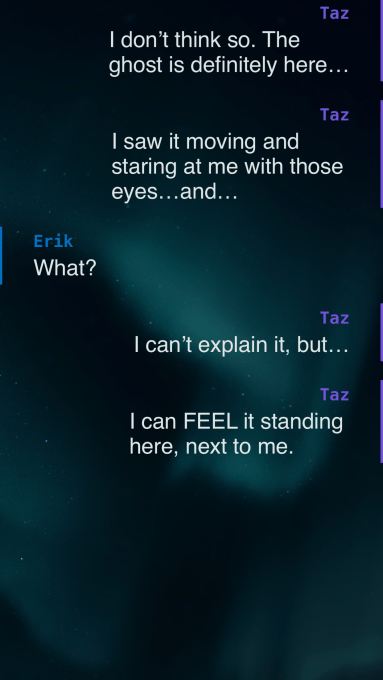
“Dark Matter” tells the story of Tasneem (Taz) Singh, a South Asian American student at Stanford who, after the mysterious death of her twin sister, discovers that she has the ability to interact with the paranormal.

The story debuts today on Snapchat, with a new chapter coming out every day until Tuesdsay, October 30. According to CEO Prerna Gupta, the full script totals 32,000 words — in other words, it’s the length of a feature film script or short novel: “I think it’s fair to say this is the longest chat fiction story. It’s certainly the longest on we’ve ever produced for Hooked .”

If you’re you’re not already a chat fiction fan, you may be skeptical about reading something that long in text message format. Gupta admitted that she and her husband Parag Chordia had similar doubts when they started the company together.

“I would be lying if I didn’t say if we also didn’t have that question ourselves,” she told me. “When a new kind of format or really new medium comes up, you start with the basics first. You tell the simplest stories, then as you become more adept at communicating with that format, you can start to go deeper.”

That’s meant going beyond text — “Dark Matter,” for example, will include a voice track and custom illustrations.

Dark Matter excerpt

“The length makes a big difference,” Gupta added. “You can take your time, slow it down and spend more time with world, developing deeper relationships between the characters.”

“Dark Matter” was written by Hooked staff writer Elyse Endick, but Gupta said the writing process was “almost more like a writers room — it was very collaborative, she did a show bible, then at each step she and I and our head of content would sit in a Google Hangout and just kind of flesh it out.”

Although the story is premiering on Snapchat, it will also make its way to the main Hooked app. Gupta said that she’s less focused on owning the distribution channel than on reaching big, global audiences — and distributing via Snapchat can help with that.

“I’m not trying to be the next Instagram,” she said. “It’s not about the app or any given app. For me, it’s really about our stories.”

And while Snapchat has recently lost some of its luster (daily active user count fell by another 1 percent in its most recent quarter), Gupta said, “I think people are underestimating their whole strategy around entertainment, around being TV for the next generation.”

She added that engagement around Hooked content on Snapchat has been “insane.”

“Why are we investing our resources with Snap? Because of what we’re seeing,” she said. “Our audience and how engaged they are, that’s real.”

26 Oct 2018

Tap, a new startup from Sam Rosen, wants to be the Google of drinking water

MakeSpace founder and former CEO Samuel Rosen is ready to launch his next venture, and it has little or nothing to do with the on-demand economy. This time, Rosen is setting his sights on the world of water.

Tap aims to be the world’s first public index and global search engine for drinking water.

Plastic water bottles are, in many ways, the scourge of the planet. More than 90 percent of the environmental impact of plastic water bottles happens during manufacture, and the Guardian reported that more than 1 million plastic water bottles were sold a minute across the globe in 2016.

Some people have switched over to reusable water bottles and canteens, but once they do, there is no way to search for water fountains or sources of drinking water. That’s where Tap comes in.

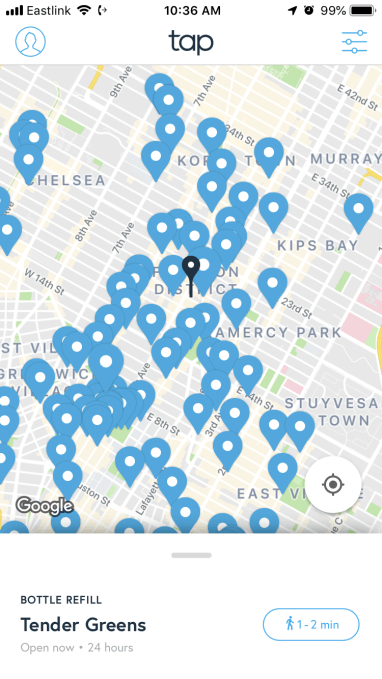
In its first iteration, Tap is a bit like the Waze for water. Using a combination of user-generated content and data from water fountain manufacturers, Tap aims to be a public search engine for where to find water. As it stands now, Tap has more than 34,000 Refill Stations across 30 countries indexed on the app.

But Tap also has ambitions to offer a backend system for water fountain companies. Normally, these companies sell a number of units to airports or other commercial or government properties. Those customers then install the fountains wherever they see fit, and the water fountain company is more or less uninvolved.

However, those companies then need to maintain the fountains, installing new filters and repairing broken parts, etc. But one fountain may be far more trafficked than another, and thus need higher frequency maintenance.

Tap wants to offer an SDK to these companies so that when users report bad filters or a broken water fountain, that information shows up on their dashboard.

Rosen sees an opportunity to generate revenue in a manner similar to Google, offering an advertising product for companies down the line.

26 Oct 2018

Epic Games, the creator of Fortnite, raises $1.25 billion

It pays to have the most popular game in the world.

Epic Games, the creators of the runaway gaming smash hit Fortnite, have raised $1.25 billion in a new round of financing.

via GIPHY

It’s been 20 years since Epic Games first released its Unreal game development engine in concert with its first person shooter, Unreal. Since then, the company has been releasing free-to-play games as a loss leader to show off what its powerful development toolkit can do.

Now, with the insane success of Fortnite, the company has flipped the script.

Since Fortnite became the thing that nearly every gamer in the world plays, the company has slashed prices on the Unreal game engine even as it keeps upgrading the technology.

And the company has been plowing that cash back into the community to support esports tournaments with a $100 million prize pool to support competitive Fortnite gamers.

The company’s game has become the kind of old-school cultural phenomenon that one rarely sees in the fractured age of internet silos. It’s inspired dance crazes, Halloween costumes, and even a Monopoly game and a Nerf gun.

And now it appears that the game has also inspired some of the biggest names in Silicon Valley’s venture capital investment scene to commit huge sums to continue its success.

Investors in the latest round include KKR, Iconiq Capital, Smash Ventures,Vulcan Capital, Kleiner Perkins and Lightspeed Venture Partners, as well as gaming companies like aXiomatic, which announced a significant investment from the NBA legend Michael Jordan earlier in October.

The new investors are joining Tencent, Disney, and Endeavor as minority shareholders in the company — which amazingly still is controlled by its chief executive and founder, Tim Sweeney.

Epic Games has fundamentally changed the model for interactive entertainment under the company’s visionary leadership,” said Ted Oberwager of KKR, in a statement.