Month: October 2018

25 Oct 2018

LG retains confidence in its mobile business despite continued losses

LG remains confident that it can turn the corner for its serially unprofitable mobile business despite the division racking up a loss of over $400 million this year so far.

The Korean company as a whole is having a good year. Following a record six months of profit and revenue in the first half of 2018, the group saw Q3 revenue jump 2.7 percent sequentially to reach 15.43 trillion KRW, or $13.76 billion. Operating profit rose by 45 percent year-on-year to reach 748.8 billion KRW, that’s $667.7 million.

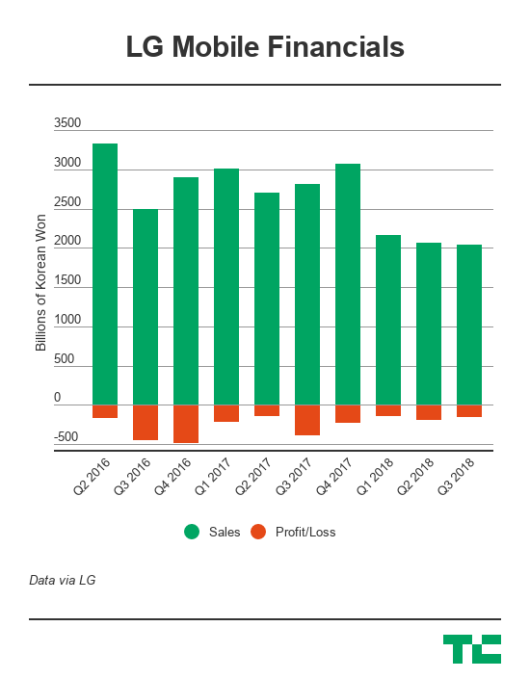
The company’s home entertainment business is the standout performer generating total sales of 3.71 trillion RKW ($3.31 billion) and a 325.1 billion KRW ($289.9 million) profit, with LG Mobile second in terms of revenue. But, the mobile division continues to bleed cash. This time around in Q3, its losses were 146.3 billion RKW, that’s $130.5 million.

That betters large losses for Q3 2016 and 2017 — 436.4 billion KRW and 436.4 billion KRW, respectively — but it means that LG’s mobile division has lost the company $410 million in 2018 so far. But, as the chart below shows, LG has a long way to go before its mobile business stops hurting the group’s overall bottom line and restricting its otherwise impressive growth as a company.
The company played up its performance with a claim that it had weathered challenging global markets — where Chinese brands are competing hard and mobile saturation is weakening consumer demand — by “significantly reduced its operating deficit as a direct result of its business plan and its stronger focus on mid-range products.”

LG recently outed its new V40 ThinQ, a flagship smartphone that packs no fewer than five cameras, and it is optimistic that its launch will boost sales in the final quarter of the year. More widely, it said that the cost-cutting strategy implemented with the appointment of new LG Mobile CEO Hwang Jeong-hwan last November will see it continue to “consolidate and implement a more profitable foundation.”

That strategy has focused around mid-range devices and emerging markets, where LG believes it can offer strong value for money that’ll appeal to consumers in the market for a deal. That explains why mobile division sales are down this year but, crucially, the division is bleeding less capital. Whilst that strategy has helped stem losses, it remains to be seen whether it is the right one to turn the unit profitable.
25 Oct 2018

Tesla to bring portion of Model 3 production to China next year

Tesla, which reported its first quarterly profits in two years Wednesday, is looking to extend its earnings streak by bringing its new Model 3 to customers beyond North America. And part of that plan involves accelerating its manufacturing plans in China.

Tesla saw its revenue skyrocket to $6.8 billion in the third quarter (and a $312 million profit) thanks to sales of its new Model 3 vehicle, despite production bottlenecks and more recent issues with delivery logistics. The company was able to achieve that profitability milestone just through sales in the U.S. and Canada. That leaves two other massive markets on the table. Cue Europe and China.

Tesla said Wednesday it will start to take orders for the Model 3 in Europe and China before the end of 2018. Tesla said it will begin deliveries of the Model 3 to Europe early next year.

“The mid-sized premium sedan market in Europe is more than twice as big as the same segment in the U.S.,” Tesla said in its shareholder letter released Wednesday. “This is why we are excited to bring Model 3 to Europe early next year.”

Notably, the company is further accelerating its timeline for China and said it will bring portions of Model 3 production to the country next year.

“We are aiming to bring portions of Model 3 production to China during 2019 and to progressively increase the level of localization through local sourcing and manufacturing,” Tesla said in its earnings report. “Production in China will be designated only for local customers.”

Tesla said earlier this month it plans for as rapid build out of a factory in China. But there’s something new here. The term “portions of Model 3 production” is the important phrase. This could be referring to a term used in the manufacturing world known as a complete knock down. CKD is basically a kit of non-assembled parts of a product, like say a Model 3. It’s a strategy used to avoid tariffs when shipping to foreign countries.

Tesla has plans to build a factory in Shanghai, but construction hasn’t even begun yet.

The company secured in October rights to about 210 acres of land in Lingang, Shanghai, the site of the electric automaker’s planned factory and its first outside of the U.S.

Tesla warned in its production and delivery report in early October that tariffs, combined with the cost of shipping its vehicles via ocean carrier and the lack of access to cash incentives available to locally produced electric vehicles, has put the company at a disadvantage in China. Tesla reiterated those cost constraints in its third-quarter earnings report.

Tesla reached a deal in July with the Shanghai government to build a factory that it says will be capable of producing 500,000 electric vehicles a year. Once construction begins, it will take about two years until Tesla can produce vehicles. It will be another “two to three years before the factory is fully ramped up to produce around 500,000 vehicles per year for Chinese customers,” a Tesla spokesman said at the time.

25 Oct 2018

Facebook says it removed 8.7M child exploitation posts with new machine learning tech

Facebook announced today that it has removed 8.7 million pieces of content last quarter that violated its rules against child exploitation, thanks to new technology. The new AI and machine learning tech, which was developed and implemented over the past year by the company, removed 99 percent of those posts before anyone reported them, said Antigone Davis, Facebook’s global head of safety, in a blog post.

The new technology examines posts for child nudity and other exploitative content when they are uploaded and, if necessary, photos and accounts are reported to the National Center for Missing and Exploited Children. Facebook had already been using photo-matching technology to compare newly uploaded photos with known images of child exploitation and revenge porn, but the new tools are meant to prevent previously unidentified content from being disseminated through its platform.

The technology isn’t perfect, with many parents complaining that innocuous photos of their kids have been removed. Davis addressed this in her post, writing that in order to “avoid even the potential for abuse, we take action on nonsexual content as well, like seemingly benign photos of children in the bath” and that this “comprehensive approach” is one reason Facebook removed as much content as it did last quarter.

But Facebook’s moderation technology is by no means perfect and many people believe it is not comprehensive or accurate enough. In addition to family snapshots, it’s also been criticized for removing content like the iconic 1972 photo of Phan Thi Kim Phuc, known as the “Napalm Girl,” fleeing naked after suffering third-degree burns in a South Vietnamese napalm attack on her village, a decision COO Sheryl Sandberg apologized for.

Last year, the company’s moderation policies were also criticized by the United Kingdom’s National Society for the Prevention of Cruelty to Children, which called for social media companies to be subject to independent moderation and fines for non-compliance. The launch of Facebook Live has also at times overwhelmed the platform and its moderators (software and human), with videos of sexual assaults, suicides, and murder—including that of an 11-month-old baby by her father—being broadcast.

Moderating social media content, however, is one noteworthy example of how AI-based automation can benefit human workers. Last month, Selena Scola, a former Facebook content moderator, sued the company claiming that screening thousands of violent images had caused her to develop post-traumatic stress disorder. Other moderators, many of whom are contractors, have also spoken of the job’s psychological toll and said Facebook does not offer enough training, support, or financial compensation.

25 Oct 2018

Facebook is building a video music app to steal TikTok’s teens

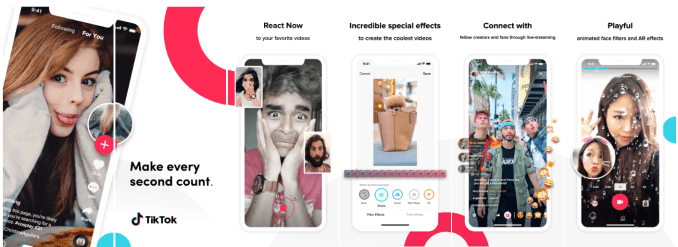
Facebook is working on a new app that it hopes could win back the attention of teens while capitalizing on its recently-attained major label music licenses. Facebook is building a standalone product where users can record and share videos of themselves lip syncing or dancing to popular songs, according to information from current and former Facebook employees.

The app is designed to be a standalone competitor to Musically, which was a hit with teens and even pre-teens before the 60 million monthly user product was acquired by Chinese tech giant ByteDance for around $1 billion and rolled into the company’s TikTok app.

“It’s basically TikTok/Musical .ly. It’s full-screen, built for teens, fun and funny, and focused on creation” one source told me. “A lot of what they’re doing is just trying to be cool and trying to be something that Facebook isn’t.”

Two sources said the music app was codenamed Lasso. However it could be launched under a different name or scrapped, as Facebook does not always release the projects it builds. The app has been in development since at least the middle of the is year. As of August, the app was still in mock-up form. Facebook declined to comment for this report.

The product is being built by members of Facebook’s video and Watch team under leadership from Facebook’s principal lead product designer Brady Voss, a source says.

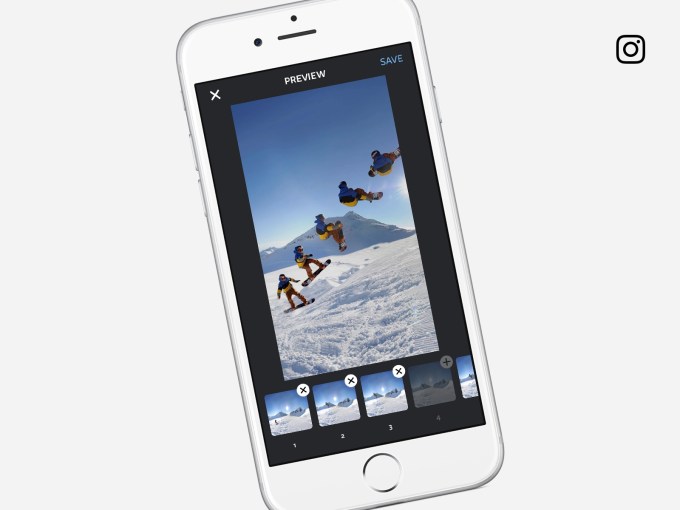
One of the leaders of the Facebook video music app team is Brady Voss, who built this feature Montage as part of a Facebook hackathon in 2016

Voss previously worked on Facebook’s TV app as well as the recently shut down Hello standalone app. For a 2016 hackathon project he presented to Mark Zuckerberg, Voss made a technology called Montage that would stitch together photos of say a snowboarder doing a trick into a single image like a still timelapse. Now he’s back at making creative expression simpler with Lasso. “Brady is great with fun new camera and video things” a source said.

Facebook has been investigating the teen music app space since 2016, when a source says the company spun up a research project to look into Musically. There were suspicions that Musically might not be as popular as it touted, and Facebook eased off.

Then earlier this year, Facebook’s music efforts were reinvigorated when it secured licensing deals with all the major record labels. At first, this just kept users’ videos, including Musically-style lip syncing clips, from being taken down for copyright infringement.

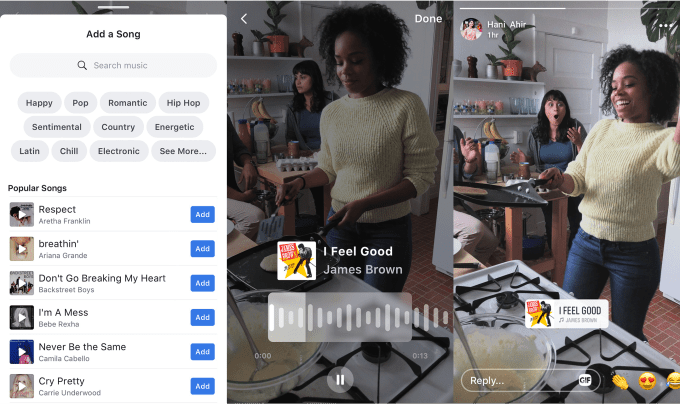
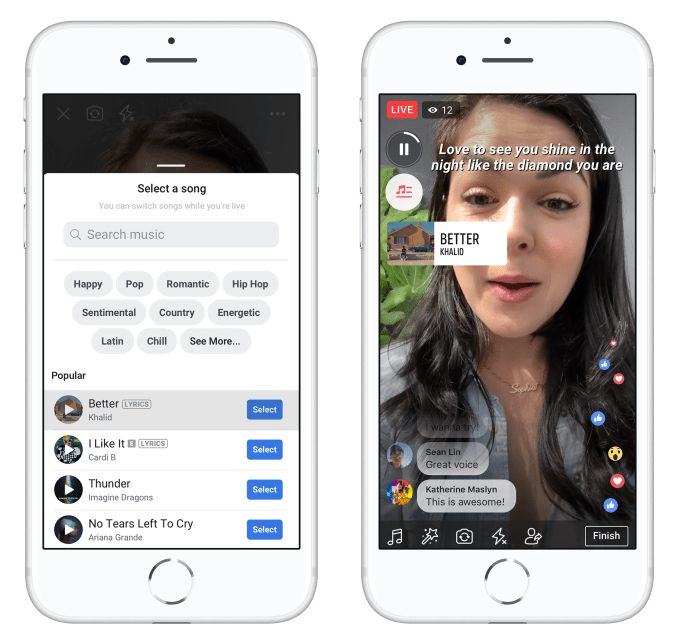
But soon it launched music stickers on Instagram that let you add soundtracks to your Stories, and that feature rolled out on Facebook today. The company also began experimenting with a Lip Sync Live feature for livestreaming karaoke, and today Facebook opened it for Pages and began showing some songs’ lyrics on screen. It plans to soon allow users to pin their favorite songs to their profile so friends can listen to a segment in what feels like a throwback to MySpace Music.

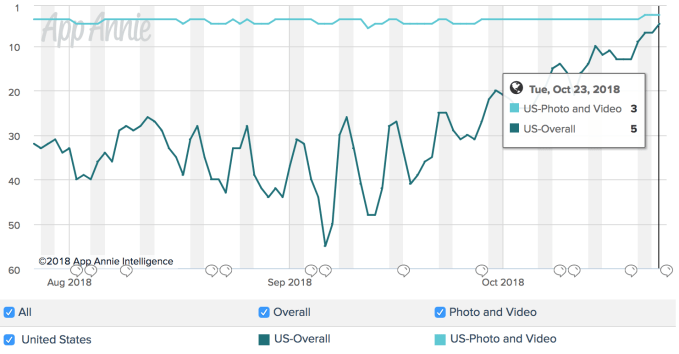
Meanwhile, TikTok is on the rise. The app has climbed from the #32 overall iPhone app in the US three months ago to reach #5 today, according to App Annie.

Now just 5 percent of US teens cite Facebook as their favorite social platform, according to a Piper Jaffray survey. The percentage who use it monthly has dropped from 60 percent to 36 percent since Spring 2016. Facebook needs new ways to engage teens beyond Instagram and WhatsApp, and a standalone music app potentially devoid of its own branding could be a better approach than cramming teen features like Lip Sync Live into its uncool main app.

Facebook already tried and failed to win back the youth with standalone apps like Poke, Slingshot, Bolt, Flash, and other variations on Snapchat. But with US giants like Snap and YouTube neglecting to build proper tools for video music creation, Facebook has a shot to challenge China’s ByteDance . Most people aren’t interesting on camera, especially awkward teens. But with the right soundtrack,  a stupid selfie video can become epic, or at least silly enough to watch.

25 Oct 2018

Facebook is building a video music app to steal TikTok’s teens

Facebook is working on a new app that it hopes could win back the attention of teens while capitalizing on its recently-attained major label music licenses. Facebook is building a standalone product where users can record and share videos of themselves lip syncing or dancing to popular songs, according to information from current and former Facebook employees.

The app is designed to be a standalone competitor to Musically, which was a hit with teens and even pre-teens before the 60 million monthly user product was acquired by Chinese tech giant ByteDance for around $1 billion and rolled into the company’s TikTok app.

“It’s basically TikTok/Musical .ly. It’s full-screen, built for teens, fun and funny, and focused on creation” one source told me. “A lot of what they’re doing is just trying to be cool and trying to be something that Facebook isn’t.”

Two sources said the music app was codenamed Lasso. However it could be launched under a different name or scrapped, as Facebook does not always release the projects it builds. The app has been in development since at least the middle of the is year. As of August, the app was still in mock-up form. Facebook declined to comment for this report.

The product is being built by members of Facebook’s video and Watch team under leadership from Facebook’s principal lead product designer Brady Voss, a source says.

One of the leaders of the Facebook video music app team is Brady Voss, who built this feature Montage as part of a Facebook hackathon in 2016

Voss previously worked on Facebook’s TV app as well as the recently shut down Hello standalone app. For a 2016 hackathon project he presented to Mark Zuckerberg, Voss made a technology called Montage that would stitch together photos of say a snowboarder doing a trick into a single image like a still timelapse. Now he’s back at making creative expression simpler with Lasso. “Brady is great with fun new camera and video things” a source said.

Facebook has been investigating the teen music app space since 2016, when a source says the company spun up a research project to look into Musically. There were suspicions that Musically might not be as popular as it touted, and Facebook eased off.

Then earlier this year, Facebook’s music efforts were reinvigorated when it secured licensing deals with all the major record labels. At first, this just kept users’ videos, including Musically-style lip syncing clips, from being taken down for copyright infringement.

But soon it launched music stickers on Instagram that let you add soundtracks to your Stories, and that feature rolled out on Facebook today. The company also began experimenting with a Lip Sync Live feature for livestreaming karaoke, and today Facebook opened it for Pages and began showing some songs’ lyrics on screen. It plans to soon allow users to pin their favorite songs to their profile so friends can listen to a segment in what feels like a throwback to MySpace Music.

Meanwhile, TikTok is on the rise. The app has climbed from the #32 overall iPhone app in the US three months ago to reach #5 today, according to App Annie.

Now just 5 percent of US teens cite Facebook as their favorite social platform, according to a Piper Jaffray survey. The percentage who use it monthly has dropped from 60 percent to 36 percent since Spring 2016. Facebook needs new ways to engage teens beyond Instagram and WhatsApp, and a standalone music app potentially devoid of its own branding could be a better approach than cramming teen features like Lip Sync Live into its uncool main app.

Facebook already tried and failed to win back the youth with standalone apps like Poke, Slingshot, Bolt, Flash, and other variations on Snapchat. But with US giants like Snap and YouTube neglecting to build proper tools for video music creation, Facebook has a shot to challenge China’s ByteDance . Most people aren’t interesting on camera, especially awkward teens. But with the right soundtrack,  a stupid selfie video can become epic, or at least silly enough to watch.

25 Oct 2018

Trump has two ‘secure’ iPhones, but the Chinese are still listening

President Trump has three iPhones — two of them are “secure” and his third is a regular personal device. But whenever the commander-in-chief takes a call, his adversaries are said to be listening.

That’s according to a new report by The New York Times, which put a spotlight on the president’s array of devices — and how he uses them.

Trump reluctantly gave up his old and outdated Android-powered Samsung Galaxy phone when he took office in 2016 and was transitioned to Apple devices. iPhones have historically been seen as more secure than their Android counterparts. Although one of his devices is a regular iPhone that he can use to store his contacts, the two other iPhones for official business have been modified and locked down by the National Security Agency to prevent eavesdropping.

Except — even when you’re in the White House, you can’t escape the aging, ailing and insecure cell network that blankets the capital and the vast majority of the U.S.

A crucial cell network system that helps broker and pass information between networks — known as Signaling System No. 7 (or just SS7) — have made it easier in recent years for hackers to intercept phone calls and text messages. SS7 is the protocol that cell networks use to establish and route calls and texts, but SS7 so broken that codes used for two-factor authentication have been intercepted and used to break into and drain bank accounts.

Those largely unfixed flaws make it far easier for governments — and anyone else — to tap into calls as they’re being made. That includes China, Russia — and any reasonably knowledgable attacker with the resources to pull off a successful intercept.

Trump’s reliance on three iPhones may seem cumbersome, but it’s a step up from what his predecessor got.

President Obama once likened his government-issued iPhone — given to him during his second term — to a “play phone [that] your 3-year-old has.” It was modified so that it could receive email but couldn’t make calls, and didn’t have a camera or microphone that foreign adversaries could use to glean any knowledge that the president was working on. He wasn’t even allowed to text — not necessarily for technical reasons, but to comply with the Presidential Records Act, which requires high-ranking government officials to store their official communications.

As much as Trump has been given more leniency than Obama, the president is still supposed to receive new, clean devices every month to cut off any hidden persistent malware that could be lurking within. But that policy isn’t enforced as closely as it should be, the report says, because of the inconvenience of having to manually port over the old data to the new phone without accidentally transferring any lingering malware — if any.

Although flaws in SS7 remain an issue for the average person, they’re apparently no match for the president’s own terrible “opsec” — or operational security, an awareness of the threats that he faces and the effort to mitigate them. Even if the Chinese or the Russians aren’t listening to his calls, they could always try their luck by hanging around one of his golf courses — where the president sent staff into a scramble after losing one of his phones in a golf cart.

And this is someone we trust with the nuclear codes.

24 Oct 2018

Original Content podcast: Netflix’s ‘Hold the Dark’ is beautiful, but utterly mystifying

“Hold the Dark” tells the story of Russell Core (played by Jeffrey Wright), a wolf expert who arrives in the Alaskan village of Keelut to investigate the disappearance of a young boy.

At least, that’s how the Netflix Original movie begins. On this week’s episode of the Original Content podcast, your regular hosts are joined by Devin Coldewey to try to untangle what actually happens in the movie.

Without spoiling anything, it’s probably safe to say that “Hold the Dark” goes in some surprising directions — it starts weird and gets weirder (and much more violent), as you can see from our iMessage correspondence below.

anthony jordan texting

There’s a talented team at work here — the movie was directed by Jeremy Saulnier (“Green Room”), and in addition to Wright, it stars Alexander Skarsgard, James Badge Dale and Riley Keogh. There’s no denying that it’s a gorgeous film, filled with stunning images of the Alaskan wilderness. In the end, though, we weren’t convinced that the wolf-y symbolism and copious bloodshed added up to much of a story.

Also, instead of recapping the latest streaming headlines like the usual, Jordan takes a few minutes at the start of the episode to express her admiration for “I Love You, America,” the Sarah Silverman-hosted talk show that recently began its second season on Hulu.

You can listen in the player below, subscribe using Apple Podcasts or find us in your podcast player of choice. If you like the show, please let us know by leaving a review on Apple. You also can send us feedback directly. (Or suggest shows and movies for us to review!)

24 Oct 2018

Red Dead Redemption 2 will let you use your tablet as a map, no pausing required

The bigger these massive GTA-style sandbox games get, the harder it becomes to remember where the hell everything is. Even with Spider-Man, a game set in a loose recreation of a city I’ve been to a bunch of times, I found myself pausing to see the map and reorient myself every other mission.

Rockstar doesn’t want you having to pause Red Dead Redemption 2, its massively awaited title that’ll finally land later this week. Hell, they’re happy to let you turn the on-screen map and HUD off entirely, if you think it’s killing the immersion.

That’s why the company just announced the aptly named “Red Dead Redemption 2 Companion App”. Download the app to your iOS or Android device, link up your PS4/Xbox, and your smartphone/tablet becomes your map. It’ll let you view your current in-game position, swipe/zoom around to see what’s nearby, and set waypoints that’ll show up back in the game to lead the way.

Now, RDR2 isn’t the first game to chart out the companion app territory. EA released companion apps for a few recent titles (Mirrors Edge, FIFA, etc), and Bethesda built a super in-depth Pip-Boy companion app back in 2015 for Fallout 4. Rockstar itself was tinkering with companion apps with Grand Theft Auto 5 way back in 2013. But as an obsessive map checker, I’m loving this one all the same.

In addition to the map, the RDR companion app will also show you your character’s running stats and vitals, and let you view his in-game journal to recap the story so far. The app will ship on October 26th, the same day the game itself goes live.

24 Oct 2018

Facebook launches Candidate Info where politicians pitch on camera

Facebook wants to make YouTube-style monologue videos the new way for politicians to talk straight with their constituency. Today, Facebook launches Candidate Info, featuring thousands of direct-to-camera vertical videos where federal, state, and local candidates introduce themselves and explain their top policy priority, qualifications, and biggest goal if they win office. Congress members including Elizabeth Warren (D – MA Senate), Scott Walker (R – WI Governor), and Beto O’Rourke (D – TX Senate) have already posted, and Facebook expects more candidates to jump in shortly.

These videos will soon be available as part of an Election 2018 bookmark in the Facebook mobile app’s navigation drawer. And starting next week, the clips will begin appearing to potential constituents in the News Feed.

Facebook tells me these videos will make it easier for people to learn about and compare different candidates. The effort extends the Town Hall feature Facebook launched in 2017 that offers a personalized directory of candidates they could vote for. Candidate Info will similarly only show videos from politicians running in elections relevant to a given user, so if you’re in California you won’t see videos from the Texas senate race between O’Rourke and Ted Cruz. But you can still find their videos on their Facebook Pages.

With the mid-terms fast approaching, Facebook is trying to do everything it can to protect against election interference by foreign and domestic attackers, offer transparency about who bought campaign adsconnect users to candidates, and encourage people to register and vote. With fake news that spread through the social network thought to have influenced the 2016 election, and illgotten Facebook user data from Cambridge Analytica applied to Donald Trump’s campaign ad targeting, Facebook is hoping to avoid similar problematic narratives this time around.

You can see some examples of Candidate Info videos below from O’Rourke and Wisconsin Governor Scott Walker.

24 Oct 2018

Disrupt Berlin 2018 early-bird prices extended

It’s possible that St. Expeditus, the patron saint of procrastinators, has taken a shine to time-stressed startuppers. Call it whatever you like — divine intervention, planetary alignment or darned good luck — we’re extending the deadline for early-bird tickets to Disrupt Berlin 2018. That means you have 10 days until the 2 November deadline to save up to €500. Expedite your decision-making and buy your ticket today.

Why wouldn’t you join thousands of your peers and colleagues for two full days devoted to all things startup? Disrupt Berlin draws an international audience — literally thousands of attendees from more than 50 countries, including all the European Union members, Turkey, Russia, Egypt, India, China, South Korea and the list goes on. It’s an opportunity to see some of the best technology the world has to offer — and connect with the people behind it.

Take Startup Alley for example. More than 400 pre-Series A startups will populate our expo floor and showcase some pretty spectacular tech products, platforms, services and talent. It’s where innovation, collaboration and opportunity meet.

And you won’t want to miss our curated cohort of startups that earned the coveted TC Top Pick designation. More than 40 exceptional startups span these tech categories: AI/Machine Learning, Blockchain, CRM/Enterprise, E-commerce, Education, Fintech, Healthtech/Biotech, Hardware, Robotics, IoT, Mobility and Gaming. Here are just a few:

  • Gravete: The world’s first AI-enabled classified ads aggregator.
  • Brickblock: A platform to seamlessly and transparently connect cryptocurrencies with real-world assets.
  • Communiti: LinkedIn for Slack teams. Search users with certain skills such as iOS Developer or UX Designer. Post a job listing to collaborate.

Here’s the complete list of TC Top Picks at Disrupt Berlin 2018.

Disrupt Berlin 2018 offers an opportunity at every turn. Learn from our roster of outstanding speakers — leading founders, investors and technologists sharing their knowledge, perspective and advice. Take advantage of our Q&A Sessions to go deep on crucial tech topics with experts in a smaller, more intimate setting. Experience the thrill of Startup Battlefield, our epic pitch competition, as founders from 15 startups compete for the heralded Disrupt Cup, $50,000 cash and potentially life-changing media and investor love. Oh, and do not miss our kick-ass After Party. Want more specifics? Read the agenda.

Disrupt Berlin 2018 takes place on 29-30 November. You have a little over an extra week to save up to €500. Don’t disappoint St. Expeditus — buy your pass before the 2 November deadline.