Month: October 2018

24 Oct 2018

Facebook confirms it’s building augmented reality glasses

“Yeah! Well of course we’re working on it” Facebook’s head of augmented reality Ficus Kirkpatrick told me when I asked him if Facebook was building an AR glasses at TechCrunch’s AR/VR event in LA. “We are building hardware products. We’re going forward on this . . . We want to see those glasses come into reality, and I think we want to play our part in helping to bring them there.”

This is the clearest confirmation we’ve received yet from Facebook about its plans for AR glasses. The product could be Facebook’s opportunity to own a mainstream computing device on which its software could run after a decade of being beholden to smartphones built, controlled, and taxed by Apple and Google.

This month Facebook launched its first self-branded gadget out of its Building 8 lab, the Portal smart display, and now it’s revving up hardware efforts. For AR, Kirkpatrick told me “We have no product to announce right now. But we have a lot of very talented people doing really, really compelling cutting-edge research that we hope plays a part in the future of headsets.”

There’s a war brewing here. AR startups like Magic Leap and Thalmic Labs are starting to release their first headsets and glasses. Microsoft is considered a leader thanks to its early Hololens product, while Google Glass is still being developed for the enterprise. And Apple has acquired AR hardware developers like Akonia Holographics and Vrvana to accelerate development of its own headsets.
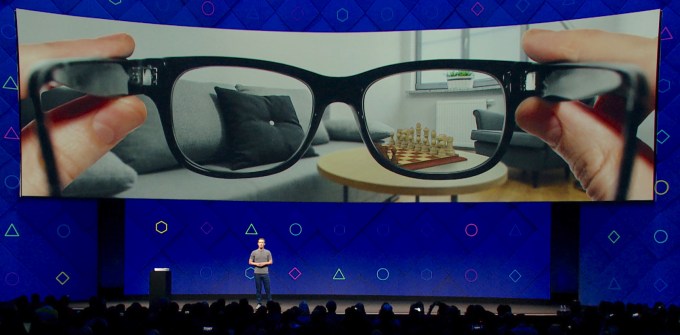
Mark Zuckerberg said AR glasses were 5 to 7 years away at F8 2017

Technological progress and competition seems to have sped up Facebook’s timetable. Back in April 2017, CEO Mark Zuckerberg said “We all know where we want this to get eventually, we want glasses”, but explained that “we do not have the science or technology today to build the AR glasses that we want. We may in five years, or seven years”. He explained that “We can’t build the AR product that we want today, so building VR is the path to getting to those AR glasses.” The company’s Oculus division had talked extensively about the potential of AR glasses, yet similarly characterized them as far off.

But a few months later, a Facebook patent application for AR glasses was spotted by Business Insider that detailed using “waveguide display with two-dimensional scanner” to project media onto the lenses. Cheddar’s Alex Heath reports that Facebook is working on Project Sequoia that uses projectors to display AR experiences on top of physical objects like a chess board on a table or a person’s likeness on something for teleconferencing. These indicate Facebook was moving past AR research.
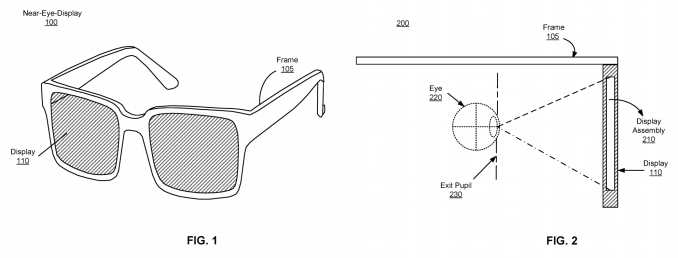
Facebook AR glasses patent application

Last month, The Information spotted four Facebook job listings seeking engineers with experience building custom AR computer chips to join the Facebook Reality Lab (formerly known as Oculus research). And a week later, Oculus’ Chief Scientist Michael Abrash briefly mentioned amidst a half hour technical keynote at company’s VR conference that “No off the shelf display technology is good enough for AR, so we had no choice but to develop a new display system. And that system also has the potential to bring VR to a different level.”

But Kirkpatrick clarified that he sees Facebook’s AR efforts not just as a mixed reality feature of VR headsets. “I don’t think we converge to one single device . . . I don’t think we’re going to end up in a Ready Player One future where everyone is just hanging out in VR all the time” he tells me. “I think we’re still going to have the lives that we have today where you stay at home and you have maybe an escapist, immersive experience or you use VR to transport yourself somewhere else. But I think those things like the people you connect with, the things you’re doing, the state of your apps and everything needs to be carried and portable on-the-go with you as well, and I think that’s going to look more like how we think about AR.”
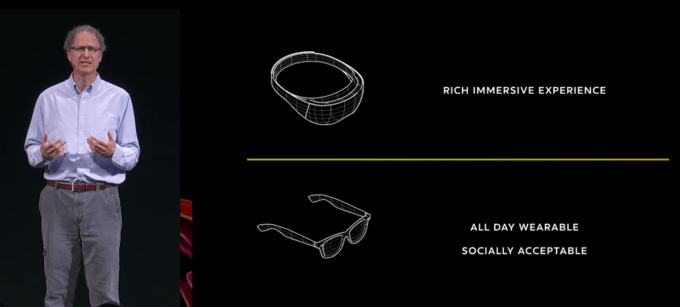
Oculus Chief Scientist Michael Abrash makes predictions about the future of AR and VR at the Oculus Connect 5 conference

Oculus virtual reality headsets and Facebook augmented reality glasses could share an underlying software layer, though, which might speed up engineering efforts while making the interface more familiar for users. “I think that all this stuff will converge in some way maybe at the software level” Kirkpatrick said.

The problem for Facebook AR is that it may run into the same privacy concerns that people had about putting a Portal camera inside their homes. While VR headsets generate a fictional world, AR must collect data about your real-world surroundings. That could raise fears about Facebook surveiling not just our homes but everything we do, and using that data to power ad targeting and content recommendations. This brand tax haunts Facebook’s every move.

Startups with a cleaner slate like Magic Leap and giants with a better track record on privacy like Apple could have an easier time getting users to put a camera on their heads. Facebook would likely need a best-in-class gadget that does much that others can’t in order to convince people it deserves to augment their reality.

You can watch our full interview with Facebook’s director of camera and head of augmented reality engineering Ficus Kirkpatrick from our TechCrunch Sessions — AR/VR event in LA:
24 Oct 2018

Tesla earns its first profit in two years

Tesla reported a profit in the third quarter, reversing seven consecutive quarters of losses and only the third time in its history that it has achieved this milestone. The third quarter earnings, which were reported after the market closed Wednesday, rocketed shares up nearly 12% to above $320.

Tesla reported a profit of $312 million attributed to common shareholders in the three months that ended on Sept. 30, compared with a $619 million loss in the same period last year.

Tesla has had just two profitable quarters in its history, the last of which was reported in 2016. The turnaround at the company were driven by sales of the Model 3, the electric vehicle that the company and its CEO Elon Musk has placed a considerable bet on.

When adjusted for one-time items, Tesla earned $516 million, or $2.90 per share, compared with a loss of $488 million, or $2.92 a share (loss), in the same period last year.

Tesla’s third-quarter earnings showed the company has a free cash flow of about $881 million compared with a negative free cash flow of $1.416 billion in the same period last year. Free cash flow is the amount of cash a company makes after accounting for capital expenditures.

The company total cash increased by $731 million to end the third quarter with $3 billion.

Tesla reported sales of $6.8 billion in the third quarter, more than doubling its revenues of $2.98 billion in the same quarter last year, driven by Model 3 deliveries. Tesla reported sales of $4 billion in the second quarter of this year.

Tesla’s automotive gross margin increased to 25.8% under generally accepted accounting principles. The company’s GAAP automotive gross margin was 18.3% in the same period last year.

Tesla reported October 2 that it delivered 83,500 electric vehicles in the third quarter, more than double from the previous period as the company steered by Elon Musk  pulled out all the stops to get its newest sedan, the Model 3, to customers.

The company delivered 55,840 Model 3 sedans, up from 18,440 in the previous quarter, which was within its own guidance. The company’s delivery numbers fell just short of the 56,000 deliveries expected by a consensus of analysts surveyed by FactSet.

24 Oct 2018

Voting is a social experience

If your Instagram followers aren’t aware that you’ve voted, did you really even vote?

In 2018, the act of voting is great social media fodder. People want their friends to know they’ve registered to vote, or that they’ve just mailed in their absentee ballot or even that they’ve bought some sort of “look, I voted” t-shirt. These announcements are being shared across social platforms like it’s a required part of the voting process.

Whether or not those people only voted for the likes doesn’t really matter, the important thing is that they voted. Social media, because of the unprecedented access it grants people to the lives of their peers and influencers, is an effective strategy of pushing eligible voters to the polls. Why? Because people care about their friends and often even more about what their friends think of them. No one wants to be that friend that didn’t vote.

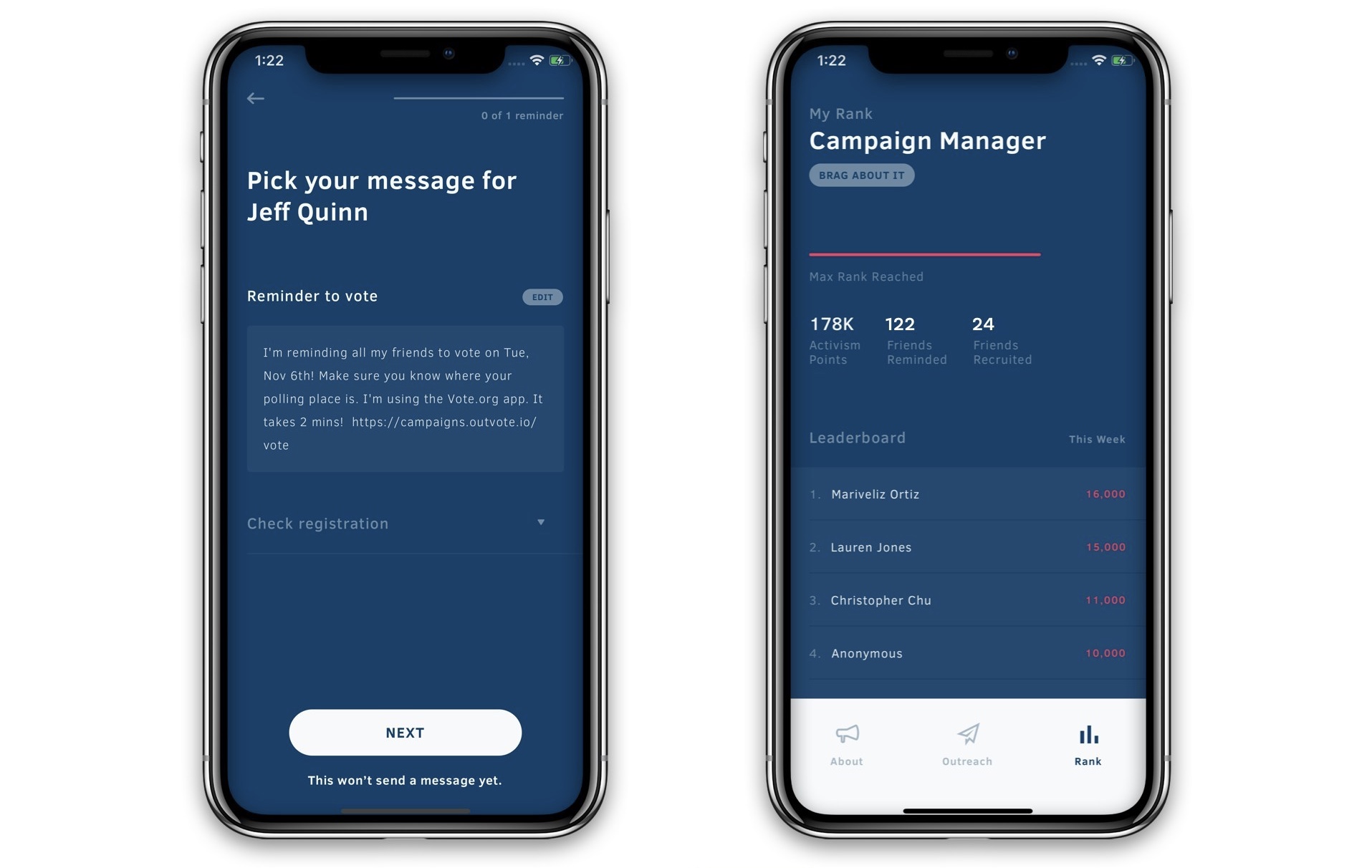
Vote.org and Outvote, a texting app for political campaigns, have taken note. The nonprofit platform for voter registration, information and advocacy has teamed up with the Y Combinator graduate to launch a new nonpartisan social media app that syncs with a user’s address book to help them quickly and efficiently remind their friends to check their registration status, find their polling place location and vote.

According to Outvote’s research, one text message from a known contact made people 10 percent more likely to vote versus 8 percent from a typical conversation with a political canvasser. Using the app, you can essentially perform 2 hours of canvassing in 5 minutes, from the comfort of your own bed.

“This November, reminding your friends is your new civic duty,” Outvote co-founder Naseem Makiya said in a statement. 

Outvote’s flagship app is tailored for Democrats and is meant to inspire and personalize grassroots-style campaigning. Using that app, you can send messages to your friends using Facebook Messenger, too, though the app doesn’t sync with any contacts outside of your phone’s address book.

In addition to YC backing, Outvote has raised $300,000 in seed funding. The startup was founded by Makiya, formerly of startups Moovweb and DataCamp, as well as Nadeem Mazen, the former chief executive officer of a creative agency called Nimblebot.

Axios reported earlier today that while TV and email campaigns are still used by political campaigns, text messaging has proven to be a whole lot more successful. Per Opn Sesame, 90 percent of text messages are read within 5 minutes: “That intimate delivery, and the ability to target and personalize messages, is what makes them so effective for campaigns — but also annoying for many voters who didn’t sign up for them,” Axios’ Kim Hart wrote.

Social media companies, other avenues for targeted and personalized messaging, have stepped up their voter education efforts ahead of the midterm elections.

Snap announced yesterday that after adding a vote button to its app, more than 400,000 of its users registered to vote via TurboVote. Meanwhile, Facebook and Twitter have added small reminders to their feeds, as have Reddit, Tinder, Bumble, Lyft and several other big tech companies.

Instagram, for its part, has Taylor Swift. Her recent social media campaign, beginning with a post earlier this month prodding her fans to vote, caused a big spike in voter registrations. According to Vote.org, 65,000 people registered to vote in the 24-hour period that followed her first-ever politically fueled gram.

Since then, Swift has been sharing on her Instagram story images of her fans who voted. It’s her reward to those who followed her advice to express their political opinions.

So vote, and you may be featured on a pop star’s Instagram. That’s 2018 for you.

24 Oct 2018

Alexa for Business opens up to third-party device makers

Last year, Amazon announced a new initiative, Alexa for Business, designed to introduce its voice assistant technology and Echo devices into a corporate setting. Today, it’s giving the platform a big upgrade by opening it up to device makers who are building their own solutions that have Alexa built-in.

The change came about based on feedback from the existing organizations where Alexa for Business is today being used, Amazon says. The company claims thousands of businesses have added an Amazon Echo alongside their existing office equipment since the program’s debut last year, including companies like Express Trucking, Fender and Propel Insurance, for example.

But it heard from businesses that they want to have Alexa built in to existing devices, to minimize the amount of technology they need to manage and monitor.

The update will allow device makers building with the Alexa Voice Service (AVS) SDK can now create products that can be registered with Alexa for Business, and managed as shared devices across the organization.

The device management capabilities include the ability to configure things like the room designation, location and monitor the device’s health, as well as manage which public and private skills are assigned to the shared devices.

A part of Alexa for Business is the ability for organizations to create their own internal – and practical – skills for a business setting, like voice search for employee directories, Salesforce data, or company calendar information.

Amazon also recently launched its own feature for Alexa for Business users that offers the ability for staff to book conference rooms.

Amazon says it’s already working with several brands on integrating Alexa into their own devices including Plantronics, iHome, and BlackBerry. And it’s working with solution providers like Linkplay and Extron, it says. (Citrix has also begun to integrate with the ‘for Business’ platform.)

“We’ve been using Alexa for Business since its launch by pairing Echo devices with existing Polycom equipment,” noted Laura Marx, VP of Alliance Marketing at Plantronics, in a statement about its plans to make equipment that works with Alexa. “Integrating those experiences directly into products like Polycom Trio will take our customer experience to the next level of convenience and ease of use,” she said.

Plantronics provided an early look at the Alexa experience earlier this year, and iHome has an existing device with Alexa built-in – the iAVS16. However, it has not yet announced which product will be offered through Alexa for Business.

It’s still too soon to see how well any of Amazon’s business initiatives with Alexa pay off – after all, Echo devices today are often used for consumer-orientated purposes like playing music, getting news and information, setting kitchen timers, and making shopping lists. But if Amazon is able to penetrate businesses with Echo speakers and other Alexa-powered business equipment, it could make inroads into a profitable voice market, beyond the smart home.

But not everyone believes Alexa in the workplace is a good idea. Hackers envision how the devices could be used for corporate espionage and hacks, and warn that companies with trade secrets shouldn’t have listening devices set around their offices.

Amazon, however, is plodding ahead. It has even integrated with Microsoft’s Cortana so Alexa can gain access to Cortana’s knowledge of productivity features like calendar management, day at a glance, and customer email.

The Alexa for Business capabilities are provided as an extension to the AVS Device SDK, starting with version 1.10, available to download from Github.


24 Oct 2018

Mobvoi launches new $200 smartwatch and $130 AirPods alternative

Chinese AI company Mobvoi has consistently been one of the best also-rans in the smartwatch game, which remains dominated by Apple. Today, it launched a sequel to its 2016 TicWatch, which was a viral hit raising over $2 million on Kickstarter, and it unveiled a cheaper take on Apple’s AirPods.

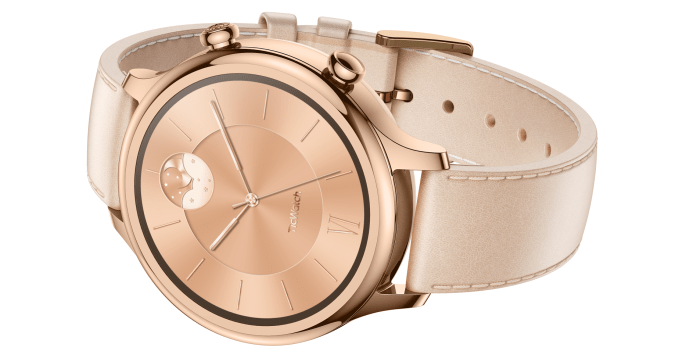
The new TicWatch C2 was outed at a London event and is priced at $199.99. Unlike its predecessor, it has shifted from Mobvoi’s own OS to Google’s Wear OS. That isn’t a huge surprise, though, since Mobvoi’s newer budget watches and ‘pro’ watch have both already made that jump.

The C2 — which stands for classic 2 — packs NFC, Bluetooth, NFC and a voice assistant. It comes in black, platinum and rose gold. The latter color option — shown below — is thinner so presumably it is designed for female wrists.

However, there’s a compromise since the watch isn’t shipping with Qualcomm’s newest Snapdragon Wear 3100 chip. Mobvoi has instead picked the older 2100 processor. That might explain the price, but it will mean that newer Android Wear watches shipping in the company months have better performance, particularly around battery life. As it stands, the TicWatch C2 claims a day-two life but the processor should be a consideration for would-be buyers.

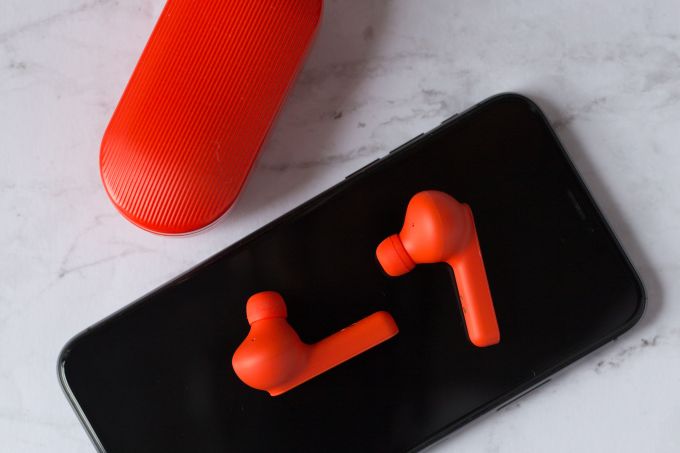
Mobvoi also outed TicPods Free, its take on Apple’s wireless AirPods. They are priced at $129.99 and available in red, white and blue.

The earbuds already raised over $2.8 million from Indiegogo — Mobvoi typically uses crowdfunding to gather feedback and assess customer interest — and early reviews have been positive.

They work on Android and iOS and include support for Alex and Google Assistant. They also include gesture-based controls beyond the Apple-style taps for skipping music, etc. Battery life without the case, which doubles as a charger, is estimated at 18 hours, or four hours of listening time.

The TicPods are available to buy online now. The TicWatch C2 is up for pre-sale ahead of a “wide” launch that’s planned for December 6.

Mobvoi specializes in AI and it includes Google among its investors. It also has a joint venture with VW that is focused on bringing Ai into the automotive industry. In China it is best known for AI services but globally, in the consumer space, it also offers a Google Assistant speaker called TicHome Mini.

24 Oct 2018

Cathay Pacific says 9.4M passenger records affected by data breach

Cathay Pacific, one of the main airlines in Hong Kong, says records on as many as 9.4 million passengers may have been stolen in a data breach.

The airline said in a statement Wednesday that there was “no evidence” that passenger data had been misused, but warned that passenger names, dates of birth, nationalities, phone numbers, email and postal addresses, and passport and identity card numbers may have been taken. Historical travel information and remarks made by customer service was also accessed.

A little over 400 expired credit card numbers were accessed, including 27 credit card numbers without verification numbers.

No passwords were taken in the breach, the company said.

The company said that it first identified unauthorized access to its systems in March, but didn’t say why it took more than six months to reveal the breach publicly. The company didn’t immediately respond to a request for comment outside business hours. That might be a problem for the company in Europe, where the recently introduced General Data Protection Regulation (GDPR) now requires organizations to notify the authorities and customers of a breach within three days. Companies flouting the law can face fines of up to four percent of their global annual revenue.

The company didn’t say if European authorities were notified, but Hong Kong police are investigating the breach.

Chief executive Rupert Hogg apologized for the breach. “We acted immediately to contain the event, commence a thorough investigation with the assistance of a leading cybersecurity firm, and to further strengthen our IT security measures,” he said.

The airline is one of the largest and oldest airlines around, jetting more than 30 million passengers around the world each year.

It’s the second airline security incident this year. British Airways admitted a website and app breach earlier this year, which security researchers later found was caused by credit card skimming malware injected on its site.

24 Oct 2018

The team behind XOXO is taking over Kickstarter’s Drip crowdfunding community

Two years ago, Kickstarter acquired Drip, an indie musician crowdfunding platform, on the eve of the service’s untimely demise. After relaunching Drip last year, Kickstarter is again reinventing the Patreon-like artist platform. This time, by placing it under the stewardship of two guys who love indie creators so much they dreamed up a whole festival about it.

The idea grew out of conversations between Kickstarter principal founder Perry Chen and Andy Baio, Kickstarter’s former (and first) Chief Technology Officer and one half of XOXO Fest, a sometimes annual, very beloved celebration of independent artists and creators. XOXO co-founder Andy McMillan will join Baio on the project, with an undisclosed round of seed funding provided by Kickstarter.

“Andy [McMillan] and I had been thinking about this for some time,” Baio said in an interview with TechCrunch. “The whole thing being about celebrating independent artists, bringing them together to talk about difficult things… So much of what we’ve focused on was that: helping independent artists who use the internet to make a living.”

The two Andys (as they’re known at XOXO) maintain a very active year-round Slack comprised of former XOXO attendees, a responsibility that’s seen them grow into their role as stewards of a community that’s taken on a life of its own, both online and off.

For their new project — the evolution of Drip into a yet-to-be-named community and crowdfunding hub — Baio and McMillan have formed a public-benefit corporation to reflect their values and those of Kickstarter, also a public-benefit corporation. Chen clarifies that the new site is separate from Kickstarter and will “not be a subsidiary in any way, wholly its own thing [with] its own leadership.”

It’s too early to say if Baio and McMillan plan to weave the new platform into XOXO Fest, but the two projects are “really closely aligned in mission,” Baio said. Some of Drip’s existing creators are XOXO Fest regulars and the event itself grew out of a successful Kickstarter that raised $175,511 back in 2012. 

“I think we’re all used to seeing at this point how the platforms that we use have failed,” Baio said. “The challenges that independent artists face are so profound already — to then have the tools and the platforms that you’re using work against you has been a painful thing.”

That pain was a central theme at XOXO Fest this year, which I attended. (Full disclosure: I was also an early member of the XOXO Outpost, a year-round creative space that grew out of the festival.) Across genres, writers, musicians and developers alike expressed concerns that unaddressed harassment, racism and misogyny had turned once well-loved social platforms against some of the users who need them most.

“We really hope that we can show people that this platform reflects the values and care we have for the artists that we care about,” Baio said. “We want it to be sustainable and independent for a long time.”

24 Oct 2018

NBC to launch a new streaming network, NBC News Signal

NBC is looking to reach a younger audience with today’s announcement of a new streaming news network, NBC News Signal. Instead of airing on traditional pay TV platforms, Signal will be available through NBC’s news mobile and over-the-top apps, as well as on other services including PlutoTV, YouTube, and Twitter. The focus will be on the “political and social issues in America,” the company says.

The service will include an evening show hosted by Simone Boyce at 7 PM ET on weekdays. At launch, this program is available on Thursdays at 7 PM ET only. Other programming consists of a morning and afternoon show and hourly news updates called “Brieflies,” which launches later this quarter and in early 2019.

There will also be a Steve Kornacki-hosted digital show “218: Race for the House” which will air daily at 12pm ET and on Election Day, November 6th; as well as a Katy Tur-hosted pre-show on the network from 7-9pm ET.

The channel will have 24/7 news coverage starting in mid-2019, NBC says.

“There is a growing segment of people who have never had a cable subscription, but who are just as hungry for smart news as the prior generations of news watchers who have consumed NBC News for decades,” said Nick Ascheim, SVP of digital at NBC News Group, about the launch. “These consumers – who are up-to-date on the headlines but are seeking a deeper understanding of the news of the moment – are increasingly turning to OTT devices for ‘lean back’ news consumption or an on-the-go informative experience and that’s exactly what NBC News Signal will deliver,” he added.

The streaming network isn’t NBC’s only attempt at wooing millennial viewers. The company also operates a Snapchat show called “Stay Tuned.”

However, it is now one of many digital-first initiatives in the news industry, aimed to reach the younger, cord cutter crowd.

CBS last year added streaming news from CBSN to its offering for cord cutters, CBS All Access, which it plans on augmenting with local news from CBS stations.

Fox News will soon launch its own over-the-top streaming service, Fox Nation. ABC’s new streaming network ABC News Live partnered with Roku to be featured on its devices’ free channel.

Meanwhile, Cheddar has been doing deals left-and-right with various streaming TV services for inclusion in their lineups.

There’s also VICE News Tonight on HBO, and others, like Plex’s news service, based on its Watchup acquisition.

Plus, today’s youngest users – like many of us – get a lot of their news from social media sites, like Facebook and Twitter. That means NBC’s Signal will have a lot of competition fresh out of the gate.

Erica Fink and Christine Cataldi are the executive producers for the network. Rashida Jones, SVP of specials for NBC News and MSNBC, is the executive in charge of programming for NBC News Signal.

The service is available here, and across the above-mentioned platforms.

24 Oct 2018

Southeast Asia’s Grab partners with MasterCard to offer virtual debit cards

Ride-hailing firm Grab branched out into payments last year and now the $11 billion-valued company, which acquired Uber’s Southeast Asia business earlier this year, has given its fintech division a major boost after it announced plans to introduce virtual pre-paid debit in partnership with Mastercard.

The move is the largest digital payment push in Southeast Asia to date. The deal will see its Grab Pay business offer Grab’s 110 million registered users the option to use a virtual Mastercard to make payments both online and in-person.

Users will be able to use physical Grab Pay cards or virtual ones — the latter being a card number, expiry date, and other details that are held within the Grab app. Interestingly, TechCrunch understands that Grab had been in contact with Visa over a similar deal but it ultimately chose MasterCard . Grab declined to comment on that when asked.

Regardless of the issuer, the deal instantly gives Grab Pay the potential for serious legs.

Last November, Grab launched its first payment integration by allowing users in Singapore to pay for food at selected restaurants using its app. While it has expanded that support in Singapore and other parts of Southeast Asia, it has needed to onboard merchants to do so. Now, with MasterCard, it is tapping into a vast network of three million retailers across Southeast Asia, with support for worldwide and also via online merchants.

That turns Grab Pay into a serious payment network on paper, but it will also give a large chunk of Southeast Asia’s 650 million population a chance to own a debit card for the first time.

While the region’s middle-class is growing quickly as internet access continues to increase — Southeast Asia’s internet population is larger than the total U.S. population, and growing — few people own credit or debit cards.

Many, in fact, remain unbanked. The World Bank claims 71 percent of the region is paid their salary in cash while just 30 percent own a debit card and only nine percent have a credit card. Many simply don’t qualify to own one. Grab’s effort, which is the largest pre-paid push in the region, could make a difference.

‘Could’ is very much the operative word here. While Grab has made progress with Grab Pay — which also runs an offline merchant network that enables those with limited internet knowledge to take advantage of e-commerce and other online services — the service is intrinsically linked to Grab.

Grab Pay can now exist as a standalone service. The question is whether Grab can market the virtual card service effectively and tap the undoubted potential that it has for its business and consumers in Southeast Asia. To date, no fintech firm has managed to build a regional network that covers over 100 million consumers, although there are plenty of promising challengers that have started out in a single market right.

Grab though is confident that its raft of non-transportation — which includes food deliveries, grocery deliveries and third-party services on its platform — can make the Mastercard venture work.

“We see Grab Pay as a glue that goes across all the products we offer, and rewards our users for using them,” Reuben Lai, senior managing director at Grab Financial, told TechCrunch in an interview. “Grab Pay users spend two times more than regular users and they stay twice longer on our platform.”

Lai added that those who use Grab Pay are 30 percent more likely to use other Grab services — they, it seems, are the power users — but he added that Grab’s mission, beyond increasing engagement, is to digitize payments in Southeast Asia.

“What we want to do next is democratize payments and access to financial services,” he said. “Many consumers don’t have access to the things we take for granted, we want to make these available to our users, drivers and partners.”

Just as Grab founders Hooi Ling Tan and Anthony Tan have said that street hailing is Grab’s biggest competitor, so Lai suggested that cash is the biggest rival to Grab Pay right now.

That’s certainly true since the deal with Uber removed Grab’s main competitor from the eight markets that it serves in Southeast Asia, but regulators are keen to see increased competition. Singapore fined Uber and Grab a collective $9.5 million from what it deemed to be an “anti-competitive” merger deal while the Philippines followed suit with a far smaller $300,000 wrap on the knuckles.

That shock to the system, coupled with a consumer backlashed around more limited choice and a bodged effort to revamp Grab’s loyalty program, has seen Grab admit for the first time that it needs to rebuild ties. The MasterCard deal has the potential to be useful if executed right, but many Grab users will be looking for it to shore up on the basics, with complaints centered around issues like driver reliability and fair pricing.

That’s right, in the absence of Uber, Grab is learning that it isn’t easy being the top dog. But that status does give it the potential to work on major new products and with huge partners like MasterCard. A deal like this was unthinkable when Grab was the scrappy underdog, but now it’s a company that raises billions on a regular basis and is category leader.

24 Oct 2018

Italian consumer watchdog hands down €15M in fines to Apple and Samsung for slowing devices

Italy’s Autorità garante della concorrenza e del mercato, roughly equivalent to this America’s FTC, has fined Apple and Samsung a total of $15 million for the companies’ practice of forcing updates on consumers that may slow or break their devices. The amount may be a drop in the bucket, but it’s a signal that governments won’t always let this type of behavior fly.

The “unfair commercial practices” are described by the AGCM as follows:

The two companies have induced consumers – by insistently proposing to proceed with the download and also because of the significant information asymmetry of consumers vis-a-vis the producers – to install software updates that are not adequately supported by their devices, without adequately informing them, nor providing them an effective way to recover the full functionality of their devices.

Sounds about right!

In case you don’t remember, essentially Apple was pushing updates to iPhones last year that caused performance issues with older phones. Everyone took this as part of the usual conspiracy theory that Apple slows phones to get you to upgrade, but it turns out to have been more like a lack of testing before they shipped.

Samsung, for its part, was pushing Android Mashmallow updates to a number of its devices, but failed to consider that it would cause serious issues in Galaxy Note 4s — issues it then would charge to repair.

The issue here wasn’t the bad updates exactly, but the fact that consumers were pressured into accepting them, at cost to themselves. It would be one thing if the updates were simply made available and these issues addressed as they came up, but both companies “insistently suggested” that the updates be installed despite the problems.

In addition to this, Apple was found to have “not adequately informed consumers about some essential characteristics of lithium batteries, such as their average duration and deterioration factors, nor about the correct procedures to maintain, verify and replace batteries in order to preserve full functionality of devices.” That would be when Apple revealed to iPhone 6 owners that their batteries were not functioning correctly and that they’d have to pay for a replacement if they wanted full functionality. This information, the AGCM, suggests, ought to have been made plain from the beginning.

Samsung gets €5 million in fines and Apple gets €10 million. Those may not affect either company’s bottom line, but they are the maximum possible fines, so it’s symbolic as well. If a dozen other countries were to come to the same conclusion, the fines would really start to add up. Apple has already made some amends, but if it fell afoul of the law it still has to pay the price.