Month: October 2018

24 Oct 2018

Early-bird pricing ends today for Disrupt Berlin 2018 tickets

Heiliger Strohsack — holy smokes! Today’s the last day you can score early-bird pricing on tickets to Disrupt Berlin 2018. If you want to save up to €500 to attend the best tech startup conference in Europe — and why wouldn’t you — you’d better grab your wallet and buy your pass right now.

The benefits of attending a Disrupt event are undeniable and doing it at the best possible price just makes sound business sense. Here are just a few reasons why early-stage startup founders jump at the chance to attend Disrupt:

  • “Attending Disrupt and exhibiting in Startup Alley is the best training ground for early-stage startup founders. You’re in the thick of the action and learning as you go. It’s a tremendous opportunity to grow.” — David Hall, co-founder and president of Park & Diamond.
  • “We got fantastic coverage in Engadget, which was really valuable. Coverage is the lifeblood of a startup. Cash at the beginning of the startup journey is difficult to come by, and an article from a credible organization can help push things in the right direction.” — Luke Heron, co-founder and CEO and of TestCard.
  • “It was a great networking opportunity. Everyone was there to help and support each other and look for mutually beneficial ways to collaborate. It was refreshing, and you just don’t experience that every day.” — Vlad Larin, co-founder of Zeroqode.
  • “Disrupt helps you connect more with the startup community in very tangible ways. You can meet investors and bigger players in your industry to see if there’s an opportunity to work together. TechCrunch Disrupt is unique in how it brings everyone — all the industry touch points — together under one roof. It’s incredibly valuable.” — Sage Wohns, co-founder of Agolo.

Disrupt Berlin 2018 drives opportunity at every turn — from networking in Startup Alley and learning from Main Stage speakers to competing in Startup Battlefield to having deep conversations on crucial topics at the Q&A Sessions. The possibilities for collaboration, inspiration, growth and innovation are limitless.

You know what does have a limit? Our early-bird pricing. TechCrunch Disrupt Berlin 2018 takes place on 29-30 November, and today’s your last chance to go at the lowest possible price. Heiliger Strohsack! Don’t wait another minute — buy your tickets right now and save up to €500.

24 Oct 2018

Marieme Diop and Shikoh Gitau to speak at Startup Battlefield Africa

Startup Battlefield Africa is set for December 11 in Lagos and investor Marieme Diop and ICT expert Shikoh Gitau will be there to lend their perspective and expertise. The Lagos TechCrunch event is a return to Africa for the Startup Battlefield series after its debut on the continent in Nairobi, Kenya.

Shikoh Gitau

Diop — who is a VC investor in early-stage African startups at Orange Digital Ventures — will speak on venture capital in Africa. And Gitau, who is head of product at Safaricom’s Alpha incubator, joins TechCrunch to discuss talent, innovation, and repatriate entrepreneurs in Africa’s expanding startup landscape.

Alpha opened in 2017 and Gitau led a Pan-African and global search for candidates to form its team. The incubator was established to innovate new products and apps for Safaricom: Kenya’s largest telecom, globally recognized for its M-Pesa mobile money product with 27 million customers.

In April this year, Gitau and her colleagues rolled out Alpha’s first product, called Bonga, to leverage M-Pesa’s extensive financial web as a social and e-commerce network.

Marieme Diop will share insights with the Startup Battlefield crowd on Africa’s VC market. Under her tutelage, Orange Digital Ventures (ODV) participated in a $16 million round for South African fintech startup Yoco and the $8.6 million round to Africa’s Talking—a Pan-African business enterprise software startup.

Marieme Diop

Formed in 2017 as the venture arm of French telco Orange, ODV is a €150 fund with €50 allocated for Africa, according to Diop. It has made 17 investments globally, with 2 in Africa. These follow pre-fund Orange investments in startups Jumia (Africa’s first unicorn), Afrimarket, and Afrostream.

Orange has €40 left for African startup investments, according to Diop. “Our target is to make 4 African investments each year,” she told TechCrunch.

Diop will join Startup Battlefield Africa to discuss investment at a time when VC rounds and funds on the continent are surging. A recent Crunchbase survey found 51 viable Africa-focused VC funds globally, with 22 (or 43 percent) located on the continent. Of those 22, nearly half (41 percent) were formed since 2016, with 9 in Nigeria.

TechCrunch’s Startup Battlefield Africa in Lagos will be a day-long affair and include a competition with pitches from Africa’s top early-stage startups. TechCrunch will also offer panel discussions to explore the continent’s rapidly growing tech ecosystem, including venture capital. You don’t want to miss out. Buy your tickets here.

24 Oct 2018

Hong Kong’s Neat raises $3M to offer easy banking for startups and SMEs

Neat, a Hong Kong-based startup that gives startups and SMEs access to credit cards and banking services has pulled in $3 million in fresh funding.

The new round is led by China-based VC Linear Capital with participation from Hong Kong’s Sagamore investments and existing backers Dymon Asia Ventures and Portag3 Ventures . Neat previously landed a $2 million seed round earlier this year.

In a nutshell, the company offers quick access to prepaid Mastercard-based cards and basic banking services. Cards are charged at around $7.50 per month, with varying prices on incoming, outgoing and international payments. There is also a consumer option, which is much like European startups Monzo, Starling and Revolut, but Neat is more focused on business users.

We profiled the company in August and since then U.S-based Brex — a two-year-old startup that offers similar services — has gone on to reach a billion-dollar valuation. That shows that there’s plenty of validity in the model… at least in the eyes of the investors who write those all-important checks.

Neat is in a much earlier stage of development and it is serving a more fragmented market in Asia via Hong Kong. When we talked to CEO David Rosa earlier this year, he said that “a large portion” of its customers were either based in Hong Kong or associated with the market, but Neat does offer services globally with a focus on Asia. In particular, the company has introduced international payments — which allow users to pay out overseas without incurring exorbitant fees — while Rosa said it is working on other multi-currency solutions and integrations with third-party services such as accountancy and more.

Neat already claims to have customers in 100 countries, but with Linear Capital’s backing, it is aiming to zone in on Chinese businesses that are looking for banking options in Hong Kong. Given the considerable control on moving capital out of Mainland China, Neat may be an easy option for Chinese startups that are looking to go global but don’t want the hassle of dealing with traditional banks to set up their Hong Kong entity. But of course, there is plenty of incumbent competition.

24 Oct 2018

Yahoo agrees $50M settlement package for users hit by massive security breach

One of the largest consumer internet hacks has bred one of the largest class action settlements after Yahoo agreed to pay $50 million to victims of a security breach that’s said to have affected up to 200 million U.S. consumers and some three billion email accounts worldwide.

In what appears to be the closing move to the two-year-old lawsuit, Yahoo — which is now part of Verizon’s Oath business [which is the parent company of TechCrunch] — has proposed to pay $50 million in compensation to an estimated 200 million users in the U.S. and Israel, according to a court filing.

In addition, the company will cover up to $35 million on lawyer fees related to the case and provide affected users in the U.S. with credit monitoring services for two years via AllClear, a package that would retail for around $350. There are also compensation options for small business and individuals to claim back costs for losses associated with the hacks. That could include identity theft, delayed tax refunds and any other issues related to data lost at the hands of the breaches. Finally, those who paid for premium Yahoo email services are eligible for a 25 percent refund.

The deal is subject to final approval from U.S. District Judge Lucy Koh of the Northern District of California at a hearing slated for November 29.

Since Yahoo is now part of Oath, the costs will be split 50-50 between Oath and Altaba, the holding company that owns what is left of Yahoo following the acquisition. Altaba last month revealed it had agreed to pay $47 million to settle three legal cases related to the landmark security breach.

Yahoo estimates that three billion accounts were impacted by a series of breaches that began in 2013. The intrusion is believed to have been state-sponsored attack by Russia, although no strong evidence has been provided to support that claim.

The incident wasn’t reported publicly until 2016, just months after Verizon announced that it would acquire Yahoo’s core business in a $4.8 billion deal.

At the time, Yahoo estimated that the incident had affected “at least” 500 million users but it later emerged that data on all of Yahoo’s three billion users had been swiped. A second attack a year later stole information that included email and passwords belonging to 500 million Yahoo account holders. Unsurprisingly, the huge attacks saw Verizon negotiate a $350 million discount on the deal.

24 Oct 2018

Naya Health, once a promising breast pump startup, now leaving customers in the dark

With their loud noises and hard plastic flanges, breast pumps are the bane of many a new mother’s existence. Founded in 2013, Naya Health is one of the most notable tech startups working on a better pump. But the company’s support site is now shutdown and it’s stopped updating its social media accounts. In a report today, CNBC spoke to several customers who said their pumps, which cost $1,000 and aren’t covered by insurance, had stopped working, and Naya Health had not provided them with adequate support or replacement parts.

Several users have also complained on Naya Health’s Facebook page about non-delivery of pumps they ordered months ago. A Kickstarter campaign created for Naya Health’s smart baby bottle, which raised more than $100,000, is also filled with complaints about orders not being fulfilled (the last response from co-founder and CEO Janica Alvarez was posted six months ago).

Naya Health’s Facebook and Instagram accounts haven’t been updated since summer, even though users are still posting complaints, while its Twitter account has been set to protected mode. An email sent to Alvarez, who co-founded the company with her husband Jeffery Alvarez, Naya Health’s CTO, received an auto-reply. TechCrunch has also contacted Naya Health investors Tandem Capital and Bojiang Capital, the co-leads of its seed round, for comment. The company has raised $4.6 million in angel and seed funding, according to Crunchbase.

While the Naya Health breast pump’s price tag is significantly more than most competing devices, customers were willing to give it a chance because of its unique flange design, which used silicone and water instead of plastic cups to recreate a nursing baby’s mouth.

24 Oct 2018

Cloudflare reportedly gearing up for a $3.5 billion IPO next year

Cloudflare is reportedly preparing for an initial public offering with a potential valuation of more than $3.5 billion. According to Reuters, the IPO would take place in the first half of 2019 and be led by Goldman Sachs.

This year is expected to be a strong one for cybersecurity stock debuts, thanks in part to increasing awareness of, and demand for, security and privacy services. Another cybersecurity startup said to be prepping for an IPO is CrowdStrike, which raised $200 million earlier this year on a valuation of $3 billion. According to Reuters, CrowdStrike’s would also be led by Goldman Sachs.

Founded by Lee Holloway, Matthew Prince, and Michelle Zatlyn, Cloudflare launched in 2010 at TechCrunch Disrupt. Since then, it has raised a total of $182.1 million from investors including NEA, Union Square Capital, Baidu, Microsoft, Qualcomm and capitalG (Alphabet’s investment fund formerly known as Google Capital), according to Crunchbase. Its last funding, a $110 million Series D, was announced in September 2015 and led by Fidelity Investments.

Cloudflare’s services help websites load faster and prevent security breaches. According to the company’s website, it now has more than 154 data centers and serves more than 10 million domains. The company claims that “the average Internet users touches us more than 500 times” each week.

24 Oct 2018

Amazon Alexa goes AWOL for many users

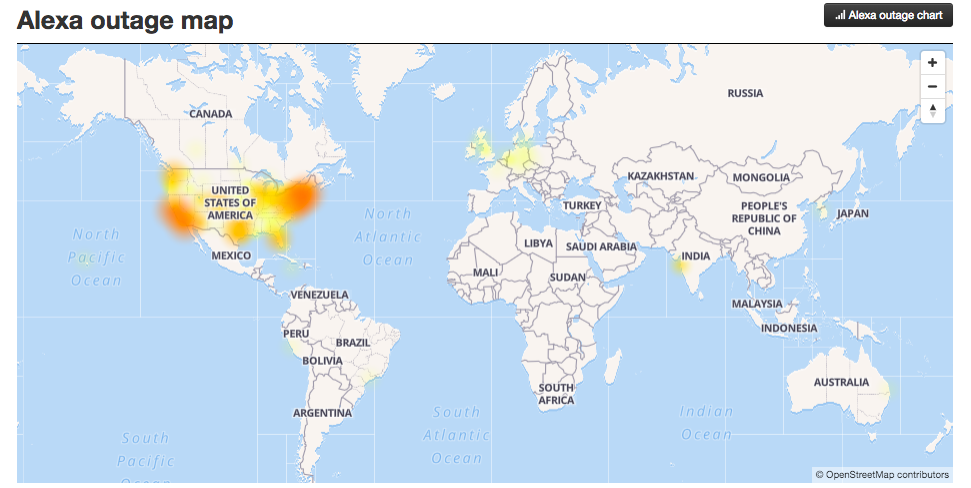
Some Amazon Alexa users are currently having problems reaching the voice assistant. Instead of reacting to commands, Alexa simply says “sorry, something went wrong.” Amazon hasn’t commented publicly yet on the issue.

Based on tweets and Down Detector, users began having trouble reaching Alexa around 7AM PST. While some had their connection issues resolved quickly, many others are still waiting.

This follows an outage last month that mainly affected Echo devices in parts of the United Kingdom, Spain, Germany, and Australia. According to Down Detector’s outage map, however, most of the users who currently can’t reach Alexa are in the United States.

Alexa also suffered an outage in March after an Amazon Web Services networking issue.

TechCrunch has contacted Amazon for comment.

23 Oct 2018

FCC puts gigabit Wi-Fi on the roadmap by opening up new wireless spectrum

More and more, the internet is delivered wirelessly, but as bandwidth demand grows in each home  — multiple TVs, smart devices, tablets and phones — current Wi-Fi standards are starting to fall short. Fortunately the FCC and wireless industry are prepared for this, and the former has just officially proposed opening up a wide swathe of spectrum to bring our Wi-Fi systems up to gigabit level.

Many of the devices we use now operate on what’s called “unlicensed” bands of spectrum, so called because they’re not set aside specifically and tightly regulated, like military or official broadcast bands. Instead the industry was allowed to make what they could out of a set of frequencies as long as they did so within reason, and it’s been a roaring success, promoting both competition and cooperation.

Still, there’s not a lot of room to move right now and as you may have noticed there’s quite a bit of interference because of the dozens of networks that are soaking you and your phone right now — we could use more spectrum to fit more channels and higher-speed networks, among other things.

That’s the purpose of the FCC proposing opening up what’s generally called the 6 gigahertz band — 5,925 to 7,125 MHz — for similar purposes.

The agency’s official proposal isn’t public yet, but the commissioners all seem optimistic about it, and the wireless industry has already been meeting with them regarding how it should look. Everyone has a few pony requests in, like making sure small wireless wireless providers aren’t inconvenienced by a complicated approval process, or making sure it’s open to consumer purposes, not just commercial ones. They’ve all got blog posts or statements, which are all pretty much the same thing: Wi-Fi is important, we applaud the decision, etc.

6 GHz isn’t completely untenanted; there are existing applications that new devices and standards will have to work around, but that’s par for the course.

“It’s an ideal place to explore Wi-Fi expansion because it’s close to our existing Wi-Fi bands,” commented Commissioner Jessica Rosenworcel in a statement issued today. “It also offers an opportunity to introduce wider channels—channels that will be able to take advantage of the new 802.11ax or Wi-Fi 6 standard and deliver speeds even faster than 1 gigabit per second. In other words, this is how we develop next-generation Gigabit Wi-Fi.”

She pointed out, however, that there are lots of other opportunities in other bands — 3.5 and 5.9 GHz — that the FCC is not pursuing with adequate vigor. It’s not just laptops and phones that need wireless connections now, after all; new classes of devices like security cameras, smart appliances, and all that rigmarole need to be on the network, but it’s a bit silly to put them on the same bands you use for gigabit downloads and 4K streaming.

It’s not clear yet when the actual proposal will be made public but I’ll update this post or write a new one when that happens.

23 Oct 2018

Smart marketplaces bridge the implicit and complex

Marketplace businesses are intrinsically linked to the technologies that enable them. There would be no Craigslist without email/SMTP, no eBay without the graphical browser and no Uber without location services and ubiquitous smartphones. As enabling technologies have evolved, marketplaces have grown to facilitate increasingly complex exchanges in new environments and industries. The next level? They will get smart: goodbye marketplace 1.0, hello smarketplace.

The theory is that dense edge computing and machine learning will enable marketplaces to understand more complex demands, and thereby facilitate transactions currently impossible using the present models. Before moving into a discussion on the “next era” of the marketplace, though, let’s review the history, to plot the course of marketplace evolution to date.

In the beginning, there was Craigslist. The progenitor of all digital marketplaces led the way, and its enabling technology was dial-up internet and email! It was the digital reproduction of the printed classified ads that early internet users were used to IRL. Craigslist grew rapidly and organically, but was hard to trust. There was no payments mechanism baked in, meaning users had to set up deals and payments “off marketplace.”

Things evolved. “Web 1.5” brought online payment technologies and better user interaction thanks to glossier programming frameworks such as CSS and HTML+. There were also simply many more users, increasingly ready to pay for goods online. Hence the rise of eBay, which later acquired PayPal (and later still, Amazon).

Alongside eBay rose the generation of the “vertical marketplace.” These had clear limitations: marketplaces were commonly restricted to a niche product, and (outside of eBay motors) users were generally unwilling to pay for high-value items online.

The co-emergence of social media and the camera-phone dramatically altered marketplace models. Social media removed trust barriers between users, and the ease of taking high-quality photographs made selling goods easier, and increased trust on the part of the buyer. This movement saw the emergence of marketplaces such as Etsy,* where users purchased specialist items from a vast range of sellers able to showcase both craft and personal stories.

As transacting became easier, users were further encouraged to sell and buy, and the marketplace platform became the (often vertically focused) clearinghouse that sat between them. Instances include, on the consumer side, Airbnb for travel and Habito for mortgages and Convoy, for trucking, on the b2b side.*

The latest species is the mobile, on-demand marketplace. Uber is the archetype — enabled by location technologies, increased mobile user density, flexible labor and behind-the-scenes supply-facing tools that bridge atoms to bits: scheduling, direct deposits and earnings dashboards.

The next evolution in marketplace businesses will be substantial. Enabled by sensor technologies and AI, marketplaces will be able to understand and satisfy complex multivariate needs.

The next generation is intelligent

Until this point, marketplaces relied on small numbers of variables to inform matches and transactions. For example: I tell Airbnb I would like to rent an apartment in Paris for a week in July and let it know my budget, and it shows me the options. While the pricing in the background may be extremely sophisticated, the customer’s explicit “expression of need” is a fairly straightforward equation.

Now, a new set of technologies will enable a next generation of marketplaces. AI will allow marketplaces to process richer data, and to therefore understand complex multivariate needs. So in the Airbnb example, combining previous trips to infer taste + available flights to balance costs + local events of interest to surface a packaged journey that is more likely to convert.

Smart marketplaces directly link complex demand to supply by understanding multiple needs.

Or take a common manufacturing process such as laser cutting — we have been meeting several online entrants into the space this year. Historically, this has been a non-trivial quoting process which can require expert CAD engineers, and a lot of back and forth between customer and machinist. To determine the right price, these experts consider the (available) laser-cutting machine, the desired material and specifics of the work. This is understandable for an offline over-the-counter transaction.

This is where machine learning could enter the conversation. With a rich history of orders and their resulting price, you could train a neural net that would ingest the 3D file and spit back out an accurate cost, without the customer explicitly defining the parameters. This would leave the factory to set a target margin, and by extension, bring the supply-side online to a manufacturing platform where the Boschs of the world could source parts.

In this way, smart marketplaces directly link complex demand to supply by understanding multiple needs.

The double cold start problem

Building a marketplace is not without challenges, notably achieving liquidity. Starting a (non-smart) marketplace business is difficult if you need to begin the supply and/or demand from a “cold start.” For example, consider the problem of starting a Deliveroo competitor with no customers and no restaurants on the platform.

Smart marketplaces are even more complex to set up. In addition to needing demand and supply-side engagement; the matching algorithm needs to be trained. To use a real example, Uber Pool could not exist without Uber providing the training data: It needed the pickup and routes data from the solo rides to optimize the communal rides.

Therefore, smart marketplaces face a “double cold start.” Not only do they have to populate supply and demand, but they also have to train their matching algos before they can be effective.

Alternatively, as platforms scale, concomitantly increasing the volume of training data, does the platform choose to eat the prediction errors (and consequently their profit margin), the better to train the model? If so, when does “break even” happen? It is worth it?

In the short term, this all prompts the question: Are horizontal smart marketplaces feasible, given the quantity and quality of training data required? If so, which categories could currently support it? The model may be tested in hyper-specific and data-rich markets such as manufacturing before it becomes more widespread.

These are not the only considerations for and limitations to the model. Builders of smart marketplaces need to ask themselves: Is AI a core competency “baked into” the platform, or is AI a “partner” technology that is brought in? If the latter, what does this imply for defensibility?

What next?

Smart marketplaces are coming: They will first emerge in analogue industries producing complex, high-dimensional data that humans are not good at describing: industry (customer part orders), content (stock footage exchanges), healthcare (MRI/CT related) and finance (commodities trading).

The current crop of marketplaces are likely to layer AI on top of their current offerings to reduce friction and increase efficiencies, but the truly smart marketplaces will be those reliant on AI to broker previously impossible transactions.

*Full disclosure: Mosaic Ventures is currently invested in Convoy and Habito. One of my partners, Simon Levene, was previously an early investor in Etsy.


23 Oct 2018

Teamable, the Tinder for hiring, raises $5M and acquires Simppler

Teamable, a provider of hiring software that leverages employees’ social networks, has brought in $5 million from new investor Foundation Capital and existing backers True Ventures and SaaStr Fund.

The startup also announced its acquisition of Simppler‘s referral recommendation engine and matchmaking recruiting software. Teamable’s co-founder and chief executive officer Laura Bilazarian declined to disclose the terms of the deal but said none of the $5 million investment was used to finance the transaction.

According to Crunchbase, Simppler had raised $3.2 million in equity funding from Foundation Capital, Greylock and others. The company, which is akin to Teamable, creates a referral platform using existing employee networks; it was founded by Vipul Sharma in 2013. Sharma previously ran machine learning at Eventbrite and, according to his LinkedIn profile, he’s been an engineering director at Indeed for the past year.

Sharma and the Simppler team will not be joining Teamable .

Using Gmail, Facebook, GitHub and other social media platforms, Teamable aggregates its employees’ contacts to connect recruiters with a more focused set of potential candidates. Companies using Teamable, including Spotify and Lyft, then facilitate a warm introduction between a candidate and the employee in their network. The startup says its social recruiting algorithms lead to more efficient and diverse hiring practices.

“I don’t think candidates love the way recruiting is done,” Bilazarian told TechCrunch. “They are throwing applications over a wall and not hearing back. And I don’t think companies love the way recruiting is done because people are just making guesses based off a job description and they aren’t getting the right applicants.”

“Instead of few people at a company spamming the entire world, you have people who really understand the company reaching out to you,” she added. “Teamable is very precise. It’s reach out to five people to get a hire versus reach out to 200 just to get one response.”

The Foundation-led investment brings Teamable’s total equity funding to date to $10 million, including last year’s $5 million Series A. Bilazarian says the 50-person company is cash flow positive with 200 customers. With offices in San Francisco and Yerevan, Armenia, Teamable will use the capital to expand its team and recruiting platform.