Month: October 2018

23 Oct 2018

Vocal Tesla short seller has reversed course, driving shares higher

Citron Research, an influential short-seller that has been an staunch critic of Tesla, reversed its position on the electric automaker.  The about-face, which Citron Research outlined in a research note Tuesday, helped pushed Tesla shares up 12.7% to close at $294.14.

The research note, entitled, “Citron reverses opinion on Tesla. The story has become too compelling to ignore,” explains that it has taken a long position in Tesla because “the Model 3 is a proven hit and many of the TSLA warning signs have proven not to be significant.”

Investors who take short positions on a stock are betting the asset will fall in value. Citron Research, which was founded by Andrew Left, has been a reliable and often vocal Tesla “short,” a position it has stuck to for years now. Nearly five years ago, Left argued that multiple 200-mile range plus electric vehicles would be on the market before the Model 3. In March 2016, Citron said in a tweet it expected Tesla’s stock price to hit $100 a share by the end of that year due to supply and demand problems.

Citron (aka Left) now says that Model 3 sales as well as continued demand for the Model S, has changed its thinking.

“Tesla appears to be the only company that can actually produce and sell electric cars,” according to note. “If you would have shown us the below chart five years ago there is no way we would have ever believed it. It looks like it is the competition that is taking the Ambien.” (CEO Elon Musk has tweeted about taking Ambien)

A tweet from Citron Research early Tuesday also warned that Tesla’s decision to report earnings Wednesday “might be a bad sign for shorts.”

Even with this sudden shift to a long position, Left said in the note that the company is “still suing Musk and Tesla and this recent report has no bearing on the current lawsuit.” Left is suing Tesla for alleged securities law violations stemming from Musk’s infamous going-private tweets in August.

Tesla has faced notable headwinds, including a volatile stock price, “production hell” and later, logistics/delivery hell with the Model 3 as well as a securities fraud complaint and subsequent settlement agreement between CEO Elon Musk and the U.S. Securities and Exchange Commission. There has been a steady stream of high-level executive departures and questions about worker safety in its factory.

At the same time, Tesla still has very few competitors, if you look at comparable price and battery range. And sales continue to rise, indicating that all the drama around Tesla hasn’t impacted demand.

The Chevy Bolt, an all-electric hatchback that gets an EPA estimated 238 miles to a single charge, went on sale in late 2016. And while it was the first all-electric EV priced under $50,000 capable of delivering an EPA-rated range over 200 miles, sales plateaued and are down 17% since the beginning of 2018, GM reported in early October.

Jaguar is the newest all-electric luxury category competitor with the introduction of the I-Pace, which has a base price of $69,500 and an EPA estimated range of 234 miles. The first I-Pace deliveries are just trickling in now. The wait continues for other expected entrants to hit the marketplace, including the Audi e-tron, an electric SUV that seats five and starts at $74,800.

Meanwhile, the Model 3, which has a base price of $45,000 for a new rear-wheel mid range variant that has a 260-mile range, sits alone.

And Citron Research has been won over — at least for now.

23 Oct 2018

PlusOneCoin made a cryptocurrency for upvotes

A team of developers have made something called PlusOneCoin, a clever cryptocurrency that essentially allows owners to upvote content on two financial sites, ADVFN and Investorshub. The idea – to reward people for accessing content and, more importantly, interacting with it – is something many services like Steemit have tried and failed to pull off.

Created by ADVFN founder Clem Chambers along with blockchain experts Michael Hodges and Jon Mullins, the coin is now listed on many major exchanges and lets you “reward other users and empower a community.”

“This bitcoin-like currency enables content providers and platform owners to monetize their social media sites while giving their audience more power to affect the social media content they consume,” said Chambers. “PlusOneCoins can be bought, swapped, given or mined by users just like Bitcoin or other cryptocurrencies.”

The thought that a media site needs a cryptocurrency to “prove” that an upvote took place is at once goofy and important. Publishers need a way to monetize content and encourage audiences to visit. A system for “proof of view” is vitally important for the ecosystem although it might be hard for a financial media company in London to get the groundswell needed to grow general acceptance of the concept.

“PlusOneCoin (PLUS1) is a social media validation coin based on a proof of work, ASIC-resistant blockchain,” said Chambers. “In the future, PlusOneCoin could be integrated into more mainstream social media websites and applications.

Chambers said that is company, a decades old publicly traded media organization, is ready to manage the currency. It is currently trading at 0.077 cents with minimal trading volume.

“PlusOneCoin has a use case beyond the Hodl and transactions application all coins have,” he said. “Coins with more use cases are the ones to watch especially if that use case can grow. PlusOneCoin is also managed by a long established company, which is regulated by a stock exchange not a bunch of mystery folk from who knows where.”

23 Oct 2018

DLab is a new East Coast accelerator for crypto

SOSV, a twenty-year-old fund with $500M in assets under management, has been running accelerators for years. Their oldest one, HAX, is the premier hardware accelerator in San Francisco and Shenzhen and they’ve recently launched a food accelerator in New York and a pair of biology accelerators. Now, however, they’ve just announced dLab, a crypto accelerator that is paired with Cardano to build out distributed apps and solutions.

It is led by Nick Plante, a programmer integral in drafting the JOBS Act and who co-founded Wefunder, a successful crowdfunding platform.

“We can only make this sort of commitment to ecosystems we feel are incredibly compelling; it takes a substantial amount of dedication, education, staffing, and of course the long term financial commitment to support the space and the companies,” said Plante. “We invest in ecosystems that we identify as ‘macro trends’ like disruptive food, life sciences and synthetic biology, Chinese market entry, IoT and robotics… things that will fundamentally alter the way that we live in the next 100 years.”

“Decentralization is clearly a macro trend, in the macro sense. What’s happening with blockchain and digital ledger technologies has the potential to upend some of the most basic economic incentives that lie beneath the things we do every day; to affect the ways that humans collaborate, identify, trust, govern, and bring new ideas to life… it underlies all of it,” he said.

Dlab supplies up to $200,000 in pre-seed funding as well as perks from the SOSV global network of accelerators. They are also offering fellowships in partnership with Cardano to work with projects that would further blockchain research.

“Through last year and the start of this year we kept watching the blockchain ecosystem do some amazing things – along with some criminal things. The surveys and reports about the fraud rates of ICOs and other unpleasantness kept underlining our concerns report after report. The potential for the big economic shifts I mentioned earlier were clearly here but there were so, so many problems; there was a real need for education, for curation, and for proper governance and incentive structures to be put in place,” said Plante.

The group is accepting applications now for a January cohort. The group invests in 150 startups per year, a heady number in these cash-poor times.

23 Oct 2018

Google just upgraded a bunch of movies to 4K for free

If you’ve ever bought a movie on Google Play and decided to save a few bucks by buying it in standard definition, you might’ve just lucked out.

Google has just announced that it’s upgrading all previously purchased movies to 4K (if a 4K version is available) free of charge. Even if you bought SD instead of HD when the latter was available, they’re bumping it all the way up to 4K.

(Before you go trying to be sneaky-sneaks: no, you can’t go and buy an SD version of something now and immediately get the 4K version free instead. Google says only movies “bought or redeemed before October 23, 2018 will be upgraded.”)

Meanwhile, they’re also dropping prices on 4K content almost across the board. Most 4K movies on Google Play will now cost less than $20 (down from ~$30, in many cases). We first noticed them starting to test out this change back in September of last year.

Worth noting: not all movies are available in 4K. Hell, most movies aren’t in 4K. While the list of 4K titles is steadily growing, it’s still an itty bitty chunk of what’s out there. If any of your previously purchased movies got the upgrade treatment, though, you should see a notification (like the one above) pop up the next time you open the Play app.

23 Oct 2018

Apple’s morning show drama adds Steve Carell to the cast

Apple’s still-untitled morning show drama already has some serious star power, with Jennifer Aniston and Reese Witherspoon as its leads. Now it’s adding Steve Carell to the cast.

This will be Carell’s first regular role on a TV show since his seven seasons starring in the U.S. version of “The Office.” He’ll be playing Mitch Kessler, a morning show anchor who’s struggling to stay relevant. And no, it’s not the first time he’s playing a news anchor.

The series will focus on the world of morning TV, drawing material from reporter Brian Stelter’s book “Top of the Morning.” (Stelter serves as a consultant.) It was one of the first shows that Apple announced as part of its push into original streaming content, with two seasons of 10 episodes each already ordered. The company plans to start production in Los Angeles next week.

Aniston and Witherspoon (who’s working on more than one show with Apple) are both serving as executive producers, as is director Mimi Leder (who directed many of the best episodes of “The Leftovers”) and showrunner Kerry Ehrin (who previously co-created “Bates Motel”).

In other Apple streaming news, regular TechCrunch readers may be aware that I am extremely excited about the upcoming adaptation of Isaac Asimov’s “Foundation” novels. Well I’m even more excited with today’s announcement from comics writer and fantasy novelist Saladin Ahmed that he’s joining the show.

Still unclear: What Apple’s streaming service will be called, and what, if anything, it will cost viewers.

23 Oct 2018

Coinbase lets you buy and sell USDC stablecoin

A few weeks after Circle announced the launch of USD Coin (or USDC for short), Coinbase also announced that customers can now buy, sell, send and receive USDC on Coinbase. A USDC is a token that is worth exactly 1 USD. Its value is going to stay stable against USD — hence the name stablecoin for this type of coins.

Unlike traditional cryptocurrencies, you can be sure that the value of your USDC wallet isn’t going to fluctuate like crazy. It opens up new possibilities and use cases.

While Coinbase lets you hold USD in your Coinbase account, this isn’t safe. If somebody hacks into your account, you could end up with an empty wallet. That’s why you should always try to control the keys of your wallet and transfer your coins to a safer wallet, such as a Ledger wallet or at least a software solution like MyEtherWallet.

But if you want to short cryptocurrencies without sending your USD back to your bank account, you can now convert your tokens to USDC. This way, it’ll be easier to buy cryptocurrencies again in the future. And maybe you can avoid paying taxes by hiding your tokens from taxation authorities…

USDC also works just like a regular token. You just need a wallet address to send some USDC. USDC is an ERC-20 token, which means that it leverages the Ethereum blockchain and ecosystem.

But stablecoins need to be regulated more tightly. Circle, Coinbase and a bunch of other companies have created the CENTRE consortium to define the policies around stablecoins. For instance, if you want to handle stablecoins on your exchange, you need to send regular audited reports that prove that you have as many USD sitting on a bank account as issued tokens.

With both Coinbase and Circle on board, it’s clear that USDC is off to a good start. Now let’s see if there’s enough interest to create other stablecoins based on EUR, CNY and other fiat currencies.

23 Oct 2018

Sources: Balderton Capital gearing up to invest in Swedish e-scooter startup VOI

We already knew that the electronic scooter space in Europe was heating up, with Berlin’s Tier announcing today it has raised €25 million in a round led by Northzone, and rumours circulating that Delivery Hero founder Lukasz Gadowski has ventured into the space — all within the context of U.S. companies Bird and Lime recently expanding to Europe. However, now it seems that Balderton Capital could be about to make its move by investing in Sweden’s VOI Technology, another e-scooter rental play with pan-European ambitions.

According to multiple sources, the London-based venture capital firm is gearing up to lead a round in Stockholm-based VOI. Two sources say the amount being invested is $15 million at a pre-money valuation of between $35-40 million, while another source said it could be as much as $25 million. Separately, I’m hearing that with multiple term sheets on the table and the pace at which the company is growing, VOI is actually considering increasing the round to $50 million.

Other VC firms thought to be participating are Berlin’s Project A, and Netherland-based Prime Ventures.

To date, VOI has raised around just shy of $3 million in seed funding from Vostok New Ventures.

I contacted Balderton Capital earlier today, but haven’t heard back. A spokesperson for Project also declined to comment. Neither Prime Ventures or VOI could be reached at the time of publication.

What is particularly noteworthy about Balderton’s entrance into the e-scooter market is that three of the other “big four” London VC firms have already made U.S. investments in the space. Index and Accel have backed Bird, and Atomico has backed Lime.

As I noted in my earlier Tier funding story — which marked the biggest financial backing for a European company in the space to date — this isn’t stopping a number of European investors getting busy trying to create the “Bird or Lime of Europe,” even if it is far from clear that Bird or Lime won’t take that title for themselves (which is obviously the bet being made by Index, Accel and Atomico). The general sentiment of European VCs steadfastly trying to nurture a European born competitor is that they don’t want to see the e-scooter rental market be rolled over by the U.S. in the same way that Uber rode in and knocked out many local players.

With that said, the worse case scenario in the eyes of many of those same VCs (and those VCs standing on the sidelines not participating) is that Bird or Lime will eventually acquire the most promising European e-scooter company or companies. In other words, the downside is mitigated somewhat, failing an outright home run.

Meanwhile, Tier, VOI and Gadowski’s Go Flash aren’t the only European born e-scooter startups with pan-European ambitions. There’s also Coup, an e-scooter subsidiary owned by Bosch and backed by BCG Digital Ventures that operates in Berlin, Paris and Madrid. And just two month’s ago Taxify announced its intention to do e-scooter rentals under the brand Bolt, first launched in Paris but also planning to be pan-European, including Germany.

Not that everyone is convinced. Two early-stage European VCs I spoke to today said they hated the space. “I just don’t understand, isn’t it going to be a massive bloodbath?” said one of the VCs, before questioning the total number of rides we could see in Europe annually. “I just don’t see how Europe is going to produce multiple multibillion dollar businesses in this space. I think the market size caps it”.

23 Oct 2018

YouTube’s beta program will test stability, not new features

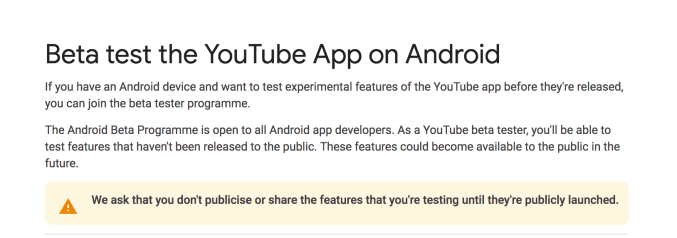
Google sometimes experiments with new features in beta versions of its various Android applications on Google Play. However, the recently spotted YouTube beta program will not, unfortunately, be a testbed for upcoming additions to the video-sharing service. Instead, Google says it only plans to test the stability of the YouTube app at this time, not features.

The company quietly rolled out a YouTube beta program last week on Google Play, where it was soon spotted by the folks at Android Police.

Originally, the belief was that Google would use this new beta to try out features it was planning to bring to the YouTube app – in fact, that’s what Google’s own help documentation about the beta said!

Not only that, but the documentation urged testers not to share information about the features they see in the app until they’re publicly launched.

That all sounds pretty exciting, right? (At least for us early adopters who love to get mess around with the latest new thing before anyone else.)

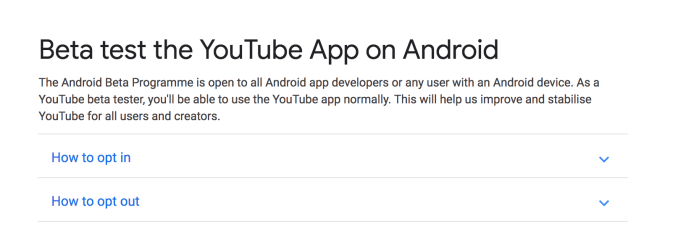
But after asking Google for more information on the program, the company updated its help documentation to remove the wording about “experimental features.” It now says testers will only help YouTube to stabilize its app.

We also understand, too, that YouTube has always run a beta program, the only change is that, as of last week, it become more broadly accessible.

Users can now join the program to help YouTube test stability of the app and can then opt out at any time they choose. At this point, however, Google doesn’t plan on trying out new features in the beta build. That could, of course, change at any time in the future. So if you really want to be the first to know, you may want to join the beta program just in case.

But YouTube for a long time now has been testing its new additions by way of server-side testing. It even decided this year to be more public about those tests – disclosing its experiments by way of its @TeamYouTube handle and the Creator Insider channel.

For example, this is where the company first announced its test of a new Explore tab on iPhone a few months ago, and more recently said it would try different ways of inserting ads into videos, to see if users prefer fewer interruptions even if it meant multiple ads per interruption.

YouTube beta program members may or may not be opted into those same experiments, as they roll out. It will depend on if they’re in the testing bucket that’s targeted at that time.

23 Oct 2018

Motorola is partnering with iFixit to sell official DIY phone repair kits

Repairing a phone is harder than it needs to be. With phone manufacturers spending the last decade chasing device slimness and building devices meant to last however long a phone contract lasts, user repairability just doesn’t seem to be something they care much about. Need a repair part? Good luck on eBay, friendo!

In what might, maybe, hopefully be a sign of that tide changing, Motorola is now selling official repair kits in a partnership with iFixit .

You probably know iFixit as the folks that somehow manage to rip apart nearly every new popular device within hours of its release. Their deep gadget teardowns show you how the clocks tick and the silicon hamster wheels turn, allowing a peek inside while your own hard-earned gear stays in one happily functioning piece.

But they also sell a bunch of bits and bobs for when things stop working. They source tons of individual parts for repairing all sorts of devices, from aging iPods to console controllers. And now, for a handful of Motorola phones, they’re doing it with Motorola’s blessing.

They’ve just started shipping a handful of pre-assembled repair kits with replacement parts sourced straight from Motorola. At this point they’ve got kits for eight different phones (Moto Z, Moto X, Droid Turbo 2, Moto Z Play, Moto G5, Z Force, X Pure and G4 Plus). They’re focusing on the two biggest, most frequently replaced components — the battery and the screen — and each kit contains everything you need to get the phone apart, patched up and put back together. The battery replacement kits cost around $40, while the screen kits cost around $100-$200.

Will other manufacturers follow suit? It’s hard to say. But I’d sure hope so. With each subsequent generation of smartphone getting less and less enticing (“The camera is slightly better! The screen is… brighter? Harder? Faster? Stronger?”), it’d be great to see more of them embrace repair.

(Image source: iFixit’s Moto Z repair guide)

23 Oct 2018

Messenger redesigns to clean up Facebook’s mess

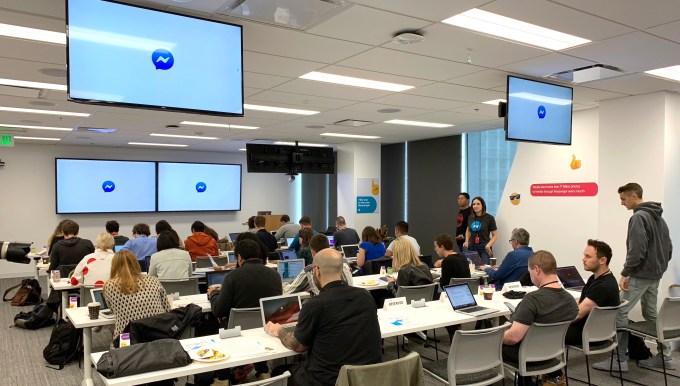
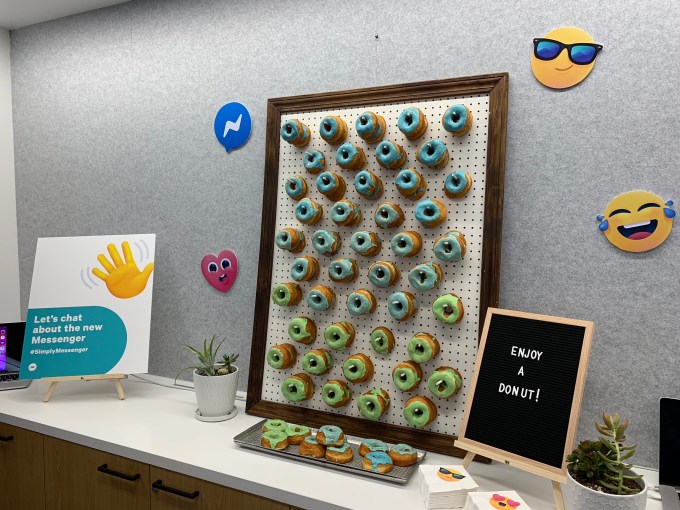
If Facebook Messenger’s redesign succeeds, you won’t really notice it even happened. I hardly did over the past week of testing. There’s just a subtle sense that the claustrophobia has lifted. Perhaps that’s why Facebook decided to throw a big breakfast press event with 30 reporters today at its new downtown San Francisco office, complete with an Instagram-worthy donut wall. Even though the changes are minimal — fewer tabs, color gradients thread backgrounds, and a rounder logo — Facebook was eager to trigger an unequivocally positive news cycle.

Old Messenger vs New Messenger

In the seven years since Facebook acquired group chat app Beluga and turned it into Messenger, it’s done nothing but cram in more features. With five navigation bar options, nine total tabs, Stories, games, and businesses, Messenger’s real purpose — chatting with your friends — started to feel buried. “You build a feature, and then you build another feature, and they are piling up” says Facebook’s head of Messenger Stan Chudnovsky. “We either continue to pile on, or we build a foundation that will allow us to build simplicity and powerful features on top of something new that goes back to its roots.”

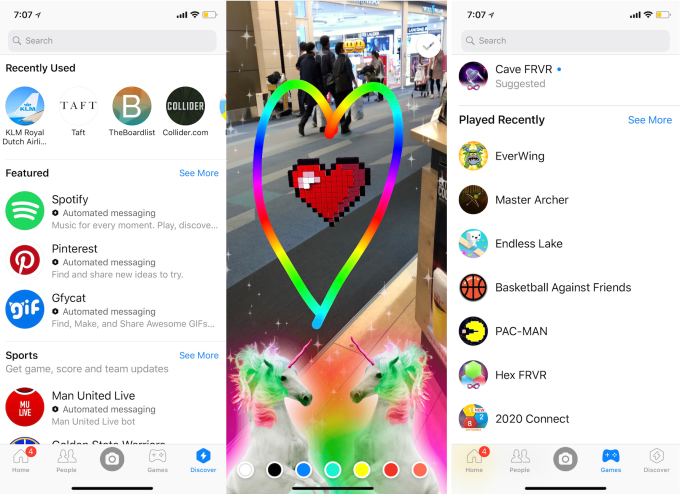
The old, overloaded Messenger

But suddenly uprooting the old design with a massive overhaul wasn’t an option. “It’s impossible to launch something for 1.3 billion people that will not piss people off” Chudnovsky told me. “It takes so much time to test things out and make sure you’re not doing something that will prevent people from doing things that are really, really important to them. At the end of the day, no one really likes change. People generally want things the way they are.”

So starting today, Messenger is globally rolling out an understated redesign globally over the next few weeks. It’s got a simpler interface with a lot more white space, a little less redundancy, and a casual vibe. Here’s a comparison of the app before and after.

Old Messenger: 

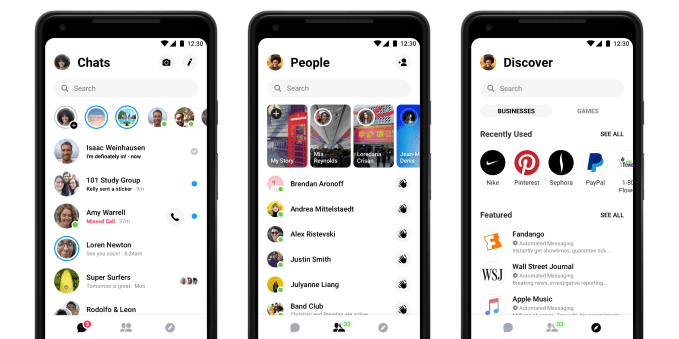
Previously, there were five main navigation buttons along the bottom of the app. Between the actually useful Chats section that’d been invaded by Stories and the chaotic People section, there were tabs for calls, group chats, active friends, . Between then  a camera button that aggressively beckoned you to post Stories, a dedicated Games tab, and a Discover tab for finding businesses and utility app.

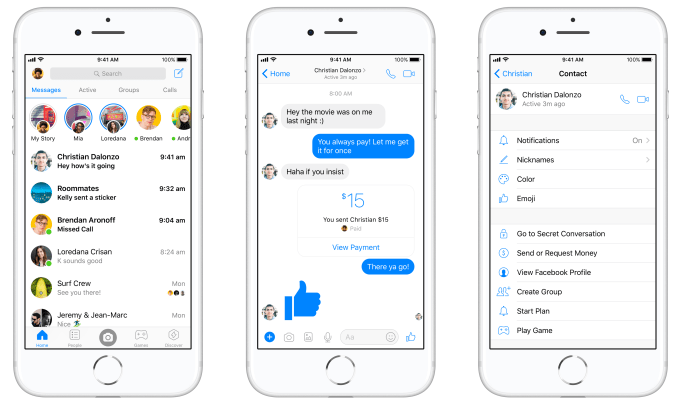
New Messenger:

In Messenger v4, now there are just three navigation buttons. The camera button has been moved up next to the chat composer inside the Chat section above Stories, People now contains the Active list as well as all Stories by friends, and Discover combines games and businesses. The fact that Stories is in both the Chats and People section make it seem that the company wants a lot more than the existing 300 million users across Facebook and Messenger opening its Snapchat copycat.

While there 10 billion conversations with businesses and 1.7 billion games sessions happen on Messenger each month, and both hold opportunities for monetization, they’re not the app’s purpose so they got merged. And though 400 million people — nearly a third of all Messenger users — make a video or audio call each month, those typically start from a button inside chat threads so Facebook nixed the Calls tab entirely.

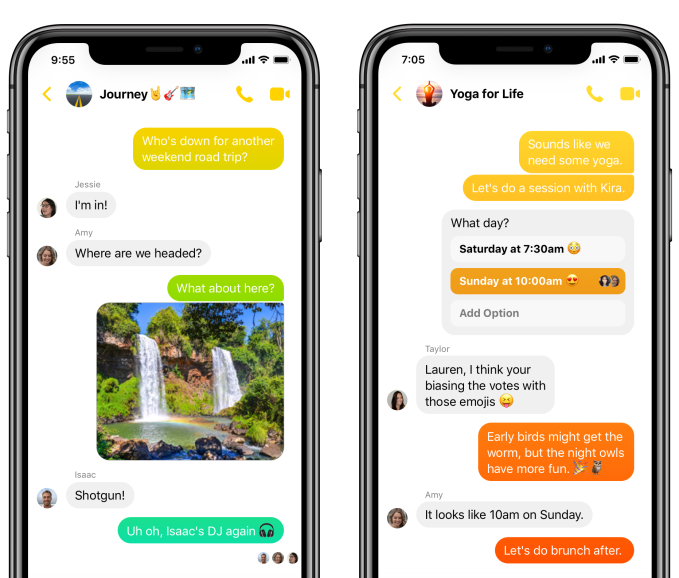
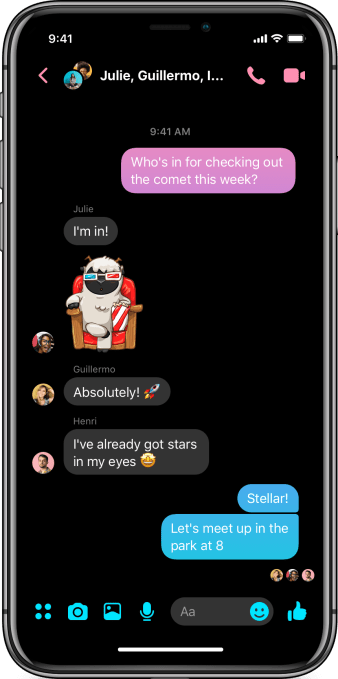
All the old features are still available, just not quite as prominent as before. The one new feature is several color gradients you can use to customize specific chat threads. If you rapidly scroll through the messages, you’ll see the bubble background colors fade through the gradient.  And one much-requested feature still on the way is Dark Mode, which Facebook says will launch in the next several weeks to reduce glare and make night-time usage easier on the eyes.

Finally, Messenger has a softer new logo. The sharp edges have been rounded off the quote bubble and lightning insignia. It seems designed to better compete with Snapchat and remind users that Messenger is fun and friendly as well as fast.

Inside The Messenger War Room

With the company’s downward scandal spiral of breaches, election interference, and fake news-inspired violence, it’s not just Messenger that’s a mess. It’s all of Facebook, both literally and metaphorically. Cleaning up, fighting back —  those are the messages the company wants to drive home.

Facebook scored a win on this front last week by getting dozens of journalists (myself included) to breathlessly cover its election “war room”, until everyone realized they’d played themselves for page views. Today’s Messenger event felt a little like deja-vu as Facebook drilled the word “simple” into our heads. Chudnovsky even acknowledged that Facebook had already milked the redesign for a press hit back in May. “We previewed this at F8 but that was when the work was just beginning.”
Hopefully, this will be the start of a company wide interface cleanup. Facebook’s main app is full of cruft, especially with products like Facebook Watched stuffed in the nav bar despite lukewarm user interest. Messenger did a good job of ceasing to shoehorn the camera and games into our chat behavior, though Stories still appear twice in the app even if some wish they disappeared permanently. The world would benefit from a Facebook more concerned with what users want than what it wants to show them.

With the news going live just an hour after the event ended, many reporters stayed, writing their posts about Facebook while still inside Facebook. Chudnovsky admitted that beyond educating users via the press, the event was designed to celebrate the team that had labored over each pixel. “You can imagine at a company like ours, how many conversations you have to have about changing the logo.”