It’s a good week to be Josh Kushner, venture capitalist, founder of the health insurance unicorn Oscar, brother to President Donald Trump’s senior advisor Jared Kushner and son of real estate tycoon Charles Kushner.
Days after marrying supermodel Karlie Kloss, Kushner’s VC firm Thrive Capital has announced the close of $1 billion in new capital for its sixth flagship venture fund. The firm has raised $600 million for late-stage deals and an additional $400 million for earlier bets.
Thrive is stage and industry agnostic with investments in Oscar, Cadre, a real estate software company co-founded by the Kushner brothers, Glossier, Warby Parker, Slack, Robinhood and Stripe. Its exits include Spotify, Twitch and GitHub, of which it owned a 9 percent stake at the time of its $7.5 billion sale to Microsoft earlier this year.
Kushner, a close friend to Instagram’s former chief executive officer Kevin Systrom, famously doubled his money in 72 hours after investing in the photo-sharing app days before Facebook’s acquisition. He launched Thrive in 2009 and has quickly risen to prominence as both a founder and successful venture investor.
The New York-based firm’s funds have grown successively larger. Its fifth fund closed on $700 million in 2016. Before that, Thrive brought in $400 million in October 2014 for its fourth effort, $150 million in 2012 for its third, $40 million in 2011 for its second and $10 million for its 2009 debut fund.
The $1 billion vehicle is its largest to date.
Kushner, who at just 33 years old is one of the youngest billion-dollar fund managers, has been on a fundraising spree as of late. Oscar secured a $165 million investment in March at a reported valuation of $3.2 billion, bringing its total raised to date to some $1.2 billion.
Thrive’s latest infusion brings its total assets under management to date to $2.5 billion.
Back in MayPower Ledger, the Australian-born startup which allows consumers to buy and sell renewable energy directly between one another using a blockchain platform, launched its first commercial deployment in the US. It’s now extending its mission to allow individuals and communities to share in the profits of renewable energy assets by trading in a crypto token it will launch. To achieve this Power Ledger is literally acquiring energy assets to make the token asset-backed.
This Asset Germination Event (AGE) token has, says the company, the potential to disrupt the traditionally centralized energy market and thus grow the renewable energy industry, because of course, ownership of the token will incentivize people to invest in renewable energy.
This might be of some relief to observers who have seen some nation states lately captured by populist politicians withdraw or reduce funding for renewable energy, as has happened in the UK.
The token will be attached to energy from assets like solar and wind farms and community-owned batteries.
Dr. Jemma Green, co-founder and chairman of Power Ledger, said: “We’ve developed a model that we believe will define the world’s best practice when it comes to fully regulated blockchain token offerings, while allowing people to actively help the environment by supporting renewable energy all over the world.” She believes it will also empower more small-scale investment in renewable energy resources.
Power Ledger’s AGE token aims to increase the amount of capital flowing towards renewable energy by allowing an investor class previously denied the opportunity to participate in many projects of this nature as they were not ‘sophisticated investors’. Most of these products are currently only available to ‘sophisticated investors’ who are able to invest in large-scale energy projects, not retail investors. For example, in Australia, which has plenty of sun, you need at an annual income of at least AUD250,000.
Power Ledger says the asset-backed token will pay out distributions from renewable energy generation, unlike a utility token whose value corresponds to its future use.
To ensure their token is asset-backed, Power Ledger says it is acquiring its first assets; a grid-connected battery and a commercial solar system, and will then issue tokens that pay distributions from the energy generated by those assets as part of an investment fund structure.
As Green says: “When everyday people can invest in and co-own commercial renewable energy assets, we will be closer to our goal of a decentralized and democratized energy ecosystem.”
Power Ledger also provides several other blockchain-based energy trading platforms, including xGrid, which enables Peer-to-Peer electricity trading across the grid, and μGrid, designed for microgrid energy management, electricity metering and secure blockchain transactions.
Energy has increasingly become attractive to the Blockchain world which sees the ability to create a transparent, auditable and automated record of energy generation and consumption.
Last year UK startup DOVU launched to become “the global marketplace for transport data” powered by the “DOV” token, and received seed funding from InMotion Ventures, Jaguar Land Rover’s investment arm.
There’s a war brewing to become the cloud pharmacy for men’s health. Roman, which launched last year offering erectile dysfunctional medication and recently added a ‘quit smoking’ kit, is taking on $97 million-funded Hims for the hair loss market. Today, Roman launched four new products it hopes to cross-sell to users through a unified telemedicine subscription and pill delivery app. It now sells meds for premature ejaculation, oral herpes, genital herpes, and hair loss at what’s often a deep discount versus your local drug store. And for those who are too far gone, it’s launching a “Bald Is Beautiful, Too” microsite for finding the best razors, lotions, and head shaving tips.
Roman CEO Zachariah Reitano
“It’s unlikely that you’ll buy razors from Bonobos or pants from Dollar Shave Club. But with a doctor, it’s actually the exact opposite” Roman CEO Zachariah Reitano tells me. “As a customer you’re frustrated if they send you somewhere else.” And so what started as a single product startup is blossoming into a powerful product mix that can keep users loyal.
Roman starts with a telemedicine doctor’s visit where patients can talk about their health troubles without the embarrassment of going to their general practitioner. When appropriate, the doc can then prescribe medications customers can then instantly buy through Roman.
“If you have something that’s truly consuming your day-to-day, it makes it really hard or nearly impossible to think about the long-term. If you’re 30 pounds overweight and experiencing erectile dysfunction, [it’s the latter symptom] that’s dominating your head space” Reitano explains. The doctor might focus on the underlying health issue, but most humans aren’t so logical, and want the urgent issue fixed first. Reitano’s theory is that if it can treat someone’s erectile dysfunction or hair loss first, they’ll have the resolve to tackle bigger lifelong health challenges. “We’re hoping to work on this so you can take a deep breath and get the monkey off your back” the CEO tells me.
But one thing Roman won’t do is prescribe homeopathic remedies or spurious remedies. “We will only ever offer products that are backed by science and proven to work” Reitano declares. Taking a shot at Roman’s competitor, he says “Hims sells gummies. Roman does not.No doctor would say Biotin would help you regrow hair”, plus the vitamin can distort blood pressure readings that make it tough to tell if someone is having a heart attack.
“Roman will never slap sugar on vitamins, sell them on Snapchat, and say they’ll regrow your hair” Reitano jabs. Roman also benefits from the fact that Reitano’s father and one of the company’s advisors Dr. Michael Reitano was a lead author on a groundbreaking study about how Valacyclovir could be used to suppress transmission of genital herpes.
With Roman, Hims, Amazon acquisition PillPack, and more, there’s a powerful trend in direct-to-consumer medication emerging. Reitano sees it as the outcome of five intersecting facts.
The evolution of telemedicine regulation allowing physicians to have a national presence by seeing patients online
Physicians are being reimbursed less by Medicare, Medicaid, and private insurers for the same activity, pushing them towards telemedicine
A patent cliff is making many medications suddenly affordable under generic names.
Insurance deductibles are increasing, turning patients into consumers
Technology is making it easier and cheaper to start medical startups
Roman’s $88 million Series A it announced last month is proof of this growing trend. Investors see the traditional pharmacy structure as highly vulnerable to disruption.
Roman will have to defeat not just security threats and competitors, but also the status quo of keeping a stiff upper lip. A lot of men silently suffer these conditions rather than speak up. By speaking candidly about his own erectile dysfunction as a side-effect of heart medication, Reitano is trying to break the stigma and get more patients seeking help wherever feels right to them.
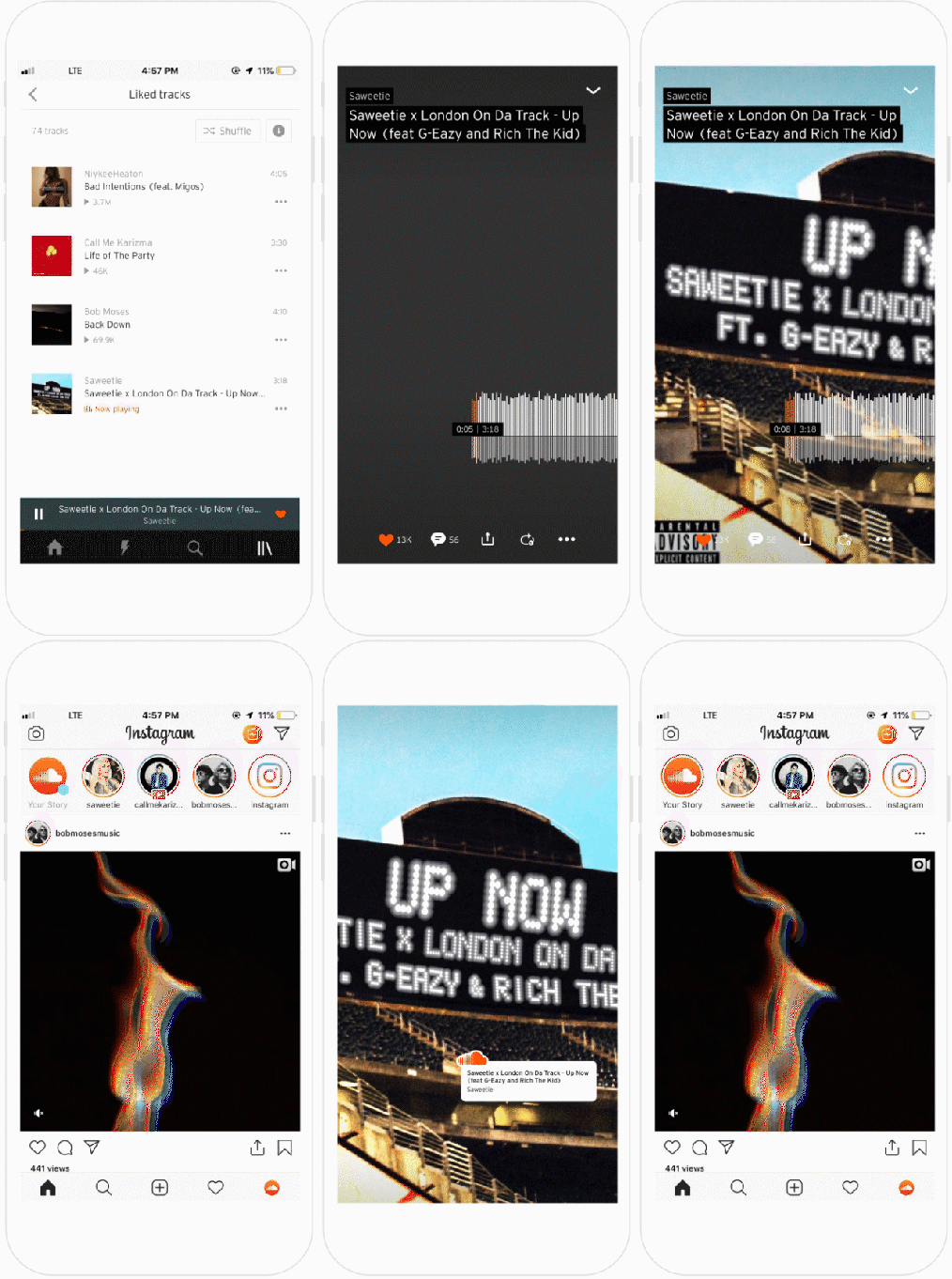
Streaming service SoundCloud is making it easier for its users to share music from its service directly to Instagram . The company announced this morning a new feature that allows users to share tracks to Instagram Stories. However, there’s a big caveat here – the tracks are shared as a link that appears within Stories . To actually listen to the track, users have to click the “Play on SoundCloud” link, which then redirects them to the SoundCloud app to begin listening.
This offers a way for fans and artists to promote their music through Instagram’s hugely popular Stories platform, but it’s not quite the same as being able to actually share music via Instagram, as the listening takes place elsewhere.
Prior to this, people shared their SoundCloud discoveries via workarounds – like taking screenshots, for example.
To use the new feature, you first find the track you want to share, and tap the “Share” icon at the bottom of the screen. You then tap the Instagram icon or select “Share to Instagram Stories,” depending on whether you’re on an iOS or Android smartphone. The link to the track is then shared right in your Instagram Story. There’s a sticker label you can drag around to place on the screen. To listen, viewers click the “Play on SoundCloud” link at the top of the Instagram Story.
However, SoundCloud confirms that it simply hadn’t been implemented until now.
The sharing feature follows the recent launch of SoundCloud’s monetization program for artists, and serves as another means for musicians to reach their fans outside of the platform itself. However, because users have to click a link to listen, it’s not necessarily a way to expose friends to new music the way that Instagram’s own soundtracks feature can.
SoundCloud says sharing feature is live in the latest version of the SoundCloud iOS and Android app.
Artificial intelligence touches just about every aspect of the tech world these days, aiming to provide new ways of making old processes work better. Now, a startup that has built an AI platform that tackles the ever-present, but never-perfect, business of customer service has quietly raised a large round of funding as it gears up for its next act, an IPO. Afiniti, which uses machine learning and behavioral science to better match customers with customer service agents — “behavioral pairing” is how it describes the process — has closed a $130 million round of funding ($75 million cash, $60 million debt) — a Series D that Afiniti CEO Zia Chishti says values his company at $1.6 billion.
If you are not familiar with the name Afiniti, you might not be alone. The company has been relatively under the radar, in part because it has never made much of an effort to publicise itself, and in part because the funding that it has raised up to now has largely been from outside the hive of VCs that swarm around many other startup deals that push those startups into the limelight.
The previous Series C round of $26.5 million, also has an interesting list of backers and also was not widely reported. They included McKinsey & Company, Elisabeth Murdoch, former Thomson Reuters CEO Tom Glocer, and former BP CEO John Browne, alongside Global Asset Management, The Resource Group, Seidenberg and Ryan.
That Series C was at a $100 million valuation, meaning that Afiniti’s valuation has increased more than 10 times in the last year on the back of 100 percent revenue growth each year over the last five.
That momentum led the company also to file confidentially for an IPO — although ultimately Chishti told TechCrunch that the company decided to raise privately at the potential IPO valuation since the money was easy to come by. (It’s also been one of the reasons he said he’s also rebuffed acquisitions, although at least one of the companies that’s approached him, McKinsey, now an investor.)
Now, Chishti — who is a repeat entrepreneur, with his previous company, Align Technology (which makes teeth alignment alternatives to braces), now at a $24 billion market cap — said that Afiniti has started to tip into profitability, so it seems the prospect of an IPO might be back on the table. That is possibly one reason that the company has started to speak to the press more and to make itself more visible.
Chishti and Afiniti are based out of the US, but it has roots into a range of local businesses globally in part by way of its well-connected team of advisors and local leaders. Among them, Princess Beatrice (or Beatrice York), currently 8th in line to the throne to succeed Queen Elizabeth, is the company’s vice president of partnerships. Alonso Aznar, the son of the former prime minister of Spain, runs Afiniti’s operations in Madrid.
The company itself sits in the general area of CRM, and specifically among that wave of startups that are trying to build tools using AI and other new technology to improve on the old ways of getting things done (it’s not alone: just today we noted that People.ai raised $30 million for its own AI-based CRM tools).
Afiniti on one hand calls itself a traditional AI company, but on the other, its CEO laments how overused and hackneyed the term has become. “AI is just a bubble,” he said in an interview. “The intensity of interest in AI is unwarranted because nothing has changed. It’s the same algorithms and software, and we just have faster hardware now.”
In actual fact, what Afiniti does is supply an AI layer to a process that is otherwise “ninety-nine percent human”, in the words of Chishti. The company uses AI to analyse sales people’s performance with specific types of calls and situations, and also to analyse customers in terms of their previous interactions with a company. It then matches up customer service reps who it believes will be most compatible with specific customers.
Afiniti’s pricing model has been an important lever for getting its foot in the door with companies. The company does not price its service per-seat or even per-month, but on a calculation between how well the company does when its call routing and running through Afiniti, versus how much is sold when it does not.
“We run systems on for 15 minutes, off for 5 minutes, and we do that perpetually,” Chishti said. It integrates with a company’s CRM, sales and telephony systems at the back end, in order both to route calls but also to track when those calls result in a sale. “We count the revenues, calculate the delta, and we get a share of that delta.”
If that sounds like a tricky measure, it doesn’t to customers, it seems. The zero-cost-to-try-it model is how it has surmounted the hurdle of getting used by a number of large, often slow-moving carriers and other large incumbents. “It means we have to continuously prove our value,” Chishti added.
As one example of how this works out, he used the example of Verizon (which is the owner of TechCrunch, by way of Oath). “Say Verizon makes $120 billion in revenues in a year,” he said, “and $30 billion of that is in phone-based sales. Afiniti would make $600 million on that.” Times that by dozens of customers in 22 countries, and that may point to how the company has quietly reached the valuation that it has.
Beyond its core product, the company has dozens of patents and more in the application phase in the US and other jurisdictions.
Oracle is a traditional tech company that has been struggling to gain traction in the cloud, but it could see blockchain as a way to differentiate itself. At Oracle OpenWorld today it announced the Oracle Blockchain Applications Cloud, a series of four applications designed for transactions-based processing scenarios using Internet of Things as a data source.
“Customers struggle with how exactly to go from concepts like smart contracts, distributed ledger and cryptography to solving specific business problems,” Atul Mahamuni, VP of IoT and Blockchain at Oracle told TechCrunch.
The company actually introduced a more generalized blockchain as a service offering at OpenWorld last year, but this year they have decided to focus more on specific use cases, announcing four new applications. The blockchain comes into account because of its nature as an irrefutable and immutable record.
In cases where there is a dispute over the accuracy of a particular piece of data, the blockchain can provide incontrovertible proof. As for the Internet of Things, that provides data points you can use to provide that proof. Your sensor feeds the data and it (or some reference to it) gets added to the blockchain, leaving no room for doubt.
The four applications involve supply chain-transaction data including a track and trace capability to follow a product through its delivery from inception to market, proof of provenance for valuables like drugs, intelligent temperature tracking (what they are calling Intelligent Cold Chain) and warranty and usage tracking. Intelligent Cold chain ensures that a product that is supposed to be kept cold didn’t get exposed to higher than recommended temperatures, while warranty tracking ensures that a product was being used in a proscribed fashion and should be subject to warranty claims.
Each of these plays to the some of Oracle’s strengths as a company that builds databases and ERP software. It can draw on the information it tends to collect any way as part of the nature of its business processes and add it to a blockchain and other applications when it makes sense.
“So what we do is we we get events and insights from IoT systems, as well as from supply chain ERP data, and we get those insights and translation from all of this and then put them into the blockchain and then do the correlations and artificial intelligence machine learning algorithms on top of those transactions,” Mahamuni explained.
This year perhaps even more so than the last couple, Oracle is trying to differentiate itself from the rest of the cloud pack, as it tries to right its cloud business. By building applications on top of base technologies like blockchain, IoT and artificial intelligence, while taking advantage of their domain knowledge around databases and ERP, they are hoping to show customers they can offer something their cloud competitors can’t.
New platforms are all about the content, and Resolution Games is one of the rare game studios going all in on AR/VR gaming.
The Stockholm-based startup has swept up $7.5 million in Series B funding at an $87.5 million valuation. The round was led by MizMaa Ventures with participation from GV, GP Bullhound, Fly Forever, David Helgason, Partech, Bonnier Ventures, Creandum and Sisu Game Ventures. The company has raised $13.5 million to date.
The studio has been primarily building for headset based experiences and has been among the first adopters for a lot of the emerging platforms. Resolution Games has titles for Magic, Leap, Oculus Rift, Gear VR, Daydream and HTC Vive though most of their work has been focused on mobile VR systems.
The company is also working on a follow-up to their Bait! fishing title which brings the gameplay to mobile via ARKit.
We took a deep dive look at Angry Birds: First Person Slingshot a few weeks ago, a title Resolution Games partnered with Rovio to make happen. It’s one of Magic Leap’s first titles and it’s really a great example of how certain types of 2D gameplay on mobile can effectively migrate to 3D platforms like AR and VR headsets.
We chatted with Resolution Games CEO Tommy Palm during our demo who gave some of his thoughts on the immersive platforms his team of 35 is building for. “I’ve always been very fascinated at being able to do things at the forefront of technology, I definitely think that games are going to be trailblazing on these platforms when it comes to user interface and just coming up with what you can use it for.”
Chances are good you’ve seen one of Simone Giertz’s ridiculous creations, be it on the Colbert show or GIF’d into your newsfeed. As the “Queen of Shitty Robots” (her words!), she’s mastered the art of taking an idea for a “useless” machine and transforming it into hilarious, bite-sized, oh-so-shareable Internet gold.
Now she’s branching out. Dozens upon dozens of creations later, she’s building something that she hopes is less “useless”, and more “life improving”.
Called the Every Day Calendar, it encourages you to do one thing each and every day by pushing you to maintain a running streak. What that “thing” is, of course, is up to you. Maybe it’s playing guitar. Maybe it’s reading, or jogging, or calling your mom. It doesn’t matter, as long as it’s something you want to do more often than not.
In Simone’s case, the inspiration was practicing yoga — or, more accurately, a bunch of false starts in trying to practice yoga.
“Most of us have a hunch of what we could do to make our lives better, or to make ourselves happier,” she told me earlier this week. “But how do you find the motivation to keep up with it, and to keep yourself accountable? I wanted a physical thing I could see every day. Sometimes when you put so much effort into self-care, it’s like it goes out into a void. But having this progress bar that shows the days you’ve put in, it really helps.”
Could the same thing be done with an app on your phone? Sure. Apps like that exist. But by making it big, and physical, and glowy, it becomes something harder to ignore — something you can’t just swipe away.
Simone’s calendar is sort of like one massive PCB. It’s an array of 365 capacitive touch sensors, each tied to an LED and wired back to a board that keeps track of everything that needs to stay lit. The gold tracing accents of the conductive sensors are pushed forward rather than hidden away, with the whole board then encased in a bamboo frame. It comes together into something that looks homebrew and bespoke, yet modern and pretty enough to fit right into in a lot of rooms.
Want the calendar to do something else? There’s a USB programming port on the back. And if you’re feeling super hacky (and don’t mind wiring up a few hundred LEDs on your own), they’re planning on open sourcing the schematics for all to tear into.
Simone started working on this project about a year ago, originally intending to build a one-off board for herself. After a non-malignant brain tumor led her to need brain surgery (and, as she notes with a laugh, caused her to miss a day on her yoga calendar), she focused on making the calendar something that others could have, too.
On building a product for others for the first time, Simone tells us:
“It’s.. crazy. The difference between making one prototype, for something that needs to work once on camera, vs doing something for manufacturing and building at scale. They’re not even related. Or they’re like distant cousins that don’t talk to each other. Fortunately, we have a team that has a ton of experience that helped flesh out the process.”
The calendar goes live on Kickstarter this morning, with a fundraising goal of $35,000. The early bird first batch will go for $250 each, after which the price bumps up to $300. They expect the calendar to ship by December of next year (or May, for early birds.)
And don’t worry: she’s not done making silly things for the Internet.
Lyft, the transportation on demand company that is heading to a $15 billion IPO in 2019, is racing ahead with its autonomous vehicle plans. TechCrunch has learned that it is acquiring the London-based augmented reality startup Blue Vision Labs and unveiling its first test vehicle with Ford to advance its vision for self-driving cars.
While the integration of Lyft’s autonomous technologies and Ford’s hardware is impressive, perhaps more meaningful is the company’s acquisition of Blue Vision Labs, a startup out of London that has developed a way of ingesting street-level imagery and is using it to build collaborative, interactive augmented reality layers — all by way of basic smartphone cameras.
Blue Vision will sit within Lyft’s Level 5 autonomous car division headed up by Luc Vincent (who joined the company last year as VP of engineering after creating and running Google Street View).
The startup and its staff of 39 (everyone is joining Lyft) will also become the anchor for a new R&D operation in London or the San Francisco-based company, focused on that autonomous driving effort. Level 5 is stepping up a gear in another way today, too: Lyft is unveiling a new vehicle that it will be using for testing.
Blue Vision has developed technology that provides both street level mapping and interactive augmented reality that lets two people see the same virtual objects. The company has already built highly detailed maps that developers can now use to develop collaborative AR experiences — it’s like the maps of these spaces become canvasses for virtual objects to be painted on. Over time, we may see various uses of it throughout the Lyft platform, but for now the main focus is Level 5.
“We are looking forward to focusing Blue Vision’s technology on building the best maps at scale to support our autonomous vehicles, and then localization to support our stacks,” Vincent said in an interview. “This is fundamental to our business. We need good maps and to understand where every passenger and vehicle is. To make our services more efficient and remove friction, we want their tech to drive improvements.”
People familiar with the acquisition tell us Blue Vision is being acquired for around $72 million with $30 million on top of that based on hitting certain milestones. Lyft has declined to comment on the valuation. Blue Vision had raised $17 million and had only come out of stealth last March, after working quietly on the product for two years. Investors included GV, Accel, Horizons Ventures, SV Angel and more.
This deal is notable in part because this is the first acquisition that Lyft has made to expand its autonomous car operation, which now has 300 people working on it. At a time when many larger companies are snapping up startups that have developed interesting applications or technologies around areas like AR, mapping, and autonomous driving, there may be more to come. “We are always evaluating build versus buy,” Vincent said when asked about more acquisitions. But he also acknowledged that it is a very crowded field today, even when considering just the most promising companies.
“I don’t have a crystal ball but arguably there are quite a few players today, including big tech, startups, OEMs and car makers. There are well over 100 [strong] companies in the space and there is bound to be some consolidation.” Lyft earlier this year also inked an investment and partnership with Magna to integrate its self-driving car system into components it supplies to car makers.
But it also might face other pressures. The company counts Didi and GM among its investors, and both of these companies are making their own big strides in self-driving technology and each has inked deals to have more partners using that tech, in part to justify some of their own hefty investment.
Lyft, of course, will hope that acquisitions like Blue Vision will give it more leverage, and make it one of the consolidators, rather than the consolidated.
Blue Vision’s use of smartphones to ingest data to create its street-level imagery and mapping is crucial to Lyft’s quest for scale. In effect, every Lyft vehicle in operation today, with a smartphone on the dashboard, could be commandeered to become a “camera” watching, surveying and mapping the roads that those cars drive on, and how humans behave on them, using that to help Lyft’s autonomous vehicle (AV) platform learn more about driving overall.
In the race for data to “teach” these AI systems, having that wide network of cameras deployed and picking up data so quickly is “game changing,” said Peter Ondruska, the co-founder and CEO of Blue Vision.
“The amount of data you have affects how much you can rely on your system,” Ondruska said in an interview. “What our tech allows us to do is to utilise Lyft’s fleet to train the cars. That is really game changing. I was working on this for eight years and you have to have a lot of data to get to the right level of safety. That is hard and we can get there faster using our technology.”
Lyft up to now has really concentrated its business presence in North America, and so this marks at least one kind of way that it is expanding on the other side of the pond. It opened its first European office in Munich earlier this year, a sign that it’s looking to this part of the world at least for R&D, if not to expand its business footprint to consumers, just yet. Vincent declined to comment on whether Lyft would get involved in autonomous trials in London, nor whether it would expand its transportation service there.
Another key area that is worth noting is that Blue Vision’s “collaborative” VR, which lets people look at the same spot in space and both see and create interactive, virtual figures in it, could be used by Lyft either to help drivers and would-be passengers better communicate, or even help passengers discover more services during a journey or at their destination.
When Ondruska first spoke to TechCrunch earlier this year as the company emerged from stealth, ride hailing applications, in fact, were one of the use cases that we pointed out could be helped by its tech.
Peter Ondruska, the startup’s co-founder and CEO, [said] that Blue Vision’s tech can pinpoint people and other moving objects in a space to within centimeters of their actual location — far more accurate than typical GPS — meaning that it could give better results in apps that require two parties to find each other, such as in a ride-hailing app. (Hands up if you and your Uber driver have ever lost each other before you’ve even stepped foot in the vehicle.)
Blue Vision isn’t the only company working to develop these virtual maps for the world. Startups like 6d.ai, Blippar and the incredibly well capitalized and wildly successful AR technology developer Niantic Labs are also building out these virtual maps on which developers can create applications. Indeed, Niantic’s Pokemon Go game is the most successful augmented reality application to date.
Large media companies have also been investing building content for these platforms, and investors have poured hundreds of millions of dollars into startups like 6d, Niantic, Blue Vision, and others that are building both software and hardware to usher in this new age of how we will, apparently, all soon be seeing the world.
The development of these new platforms will go a long way toward ensuring that more useful applications are just around the corner, waiting for users to pick them up.
“One of the reasons why AR hasn’t really reached mass market adoption is because of the tech that is on the market,” Ondruska told us earlier this year. “Single-user experiences are limiting. We are allowing the next step, letting people see the right place, for example. None of that was possible before in AR because the backend didn’t exist. But by filling in this piece, we are creating new AR use cases, ones that are important and will be used on a daily basis.”
The deal marks Lyft’s tenth acquisition, according to CrunchBase. In 2015, Lyft acquired the disappearing messaging company, Leo, to bring the company’s messaging expertise in house. Two years later, the ride-hailing company went on an acquisition tear, hoovering up FinitePaths, YesGraph, DataScore, and Kamcord. The first three seem like strategic acquisitions to bulk up mapping and marketing efforts internally; but Kamcord, a social media network for video sharing, seemed a little farther afield.
For more on Lyft’s bigger plans for AV, watch the video below of Vincent talking about the company’s roadmap (so to speak).
Nintendo’s Labo Kits are surprisingly fun — and complex. I say this as someone who spent the better part of a workday piecing together a small piano. Now the gaming giant is looking to bring its cardboard building sets into the classroom, as part of a broader STEAM curriculum.
The company says it plans to bring the kits to ~2,000 students between eight and 11 within the next school year. It will be assisted in the task by Institute of Play, a New York City-based non-profit whose mission statement involves education through play.
The program will begin in Institute of Play’s backyard, targeted schools in the New York region. Along with the kits, the organization will be handing out the Nintendo Labo Teacher Guide, featuring sample lesson plans that integrate the product into various STEAM courses.
After the NYC-based pilot, the program is set to extend to 100 schools all around the U.S. running through March of next year. Nintendo will provide kits and Switches to participating schools. The Teacher guide, meanwhile, is free to anyone (though the kits and Switches are decidedly less so).
There’s a sign up site for those interested in participating.