Month: October 2018

23 Oct 2018

Local venture capital fund formation is on the rise in Africa, led by Nigeria

Africa’s VC landscape is becoming more African with an increasing number of investment funds headquartered on the continent and run by locals, according to data from Crunchbase.

The study also tracked the emergence of homegrown corporate venture arms and more Africans in top positions at outside funds. These results derived from a year-long project to boost Crunchbase’s Africa data capture and increase awareness of its platform across the continent’s tech ecosystem.

Drawing on its database and primary source research, Crunchbase identified 51 “viable” Africa-focused VC funds globally—defining viable as formally established entities with 7-10 investments or more in African startups, from seed to series stage.

Those who made the list with 7 investments indicated they would reach 10 by early 2019.  

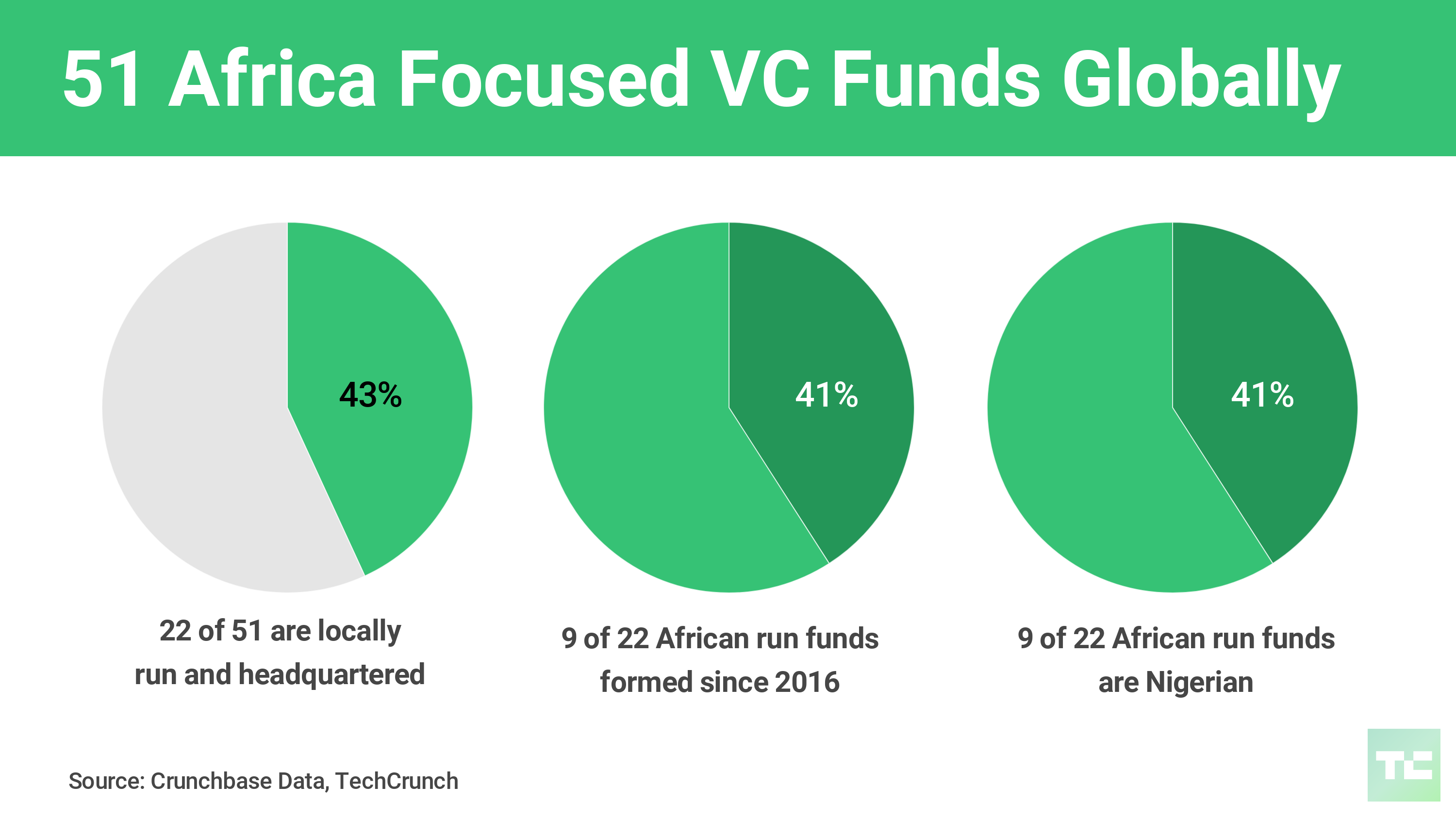
Of the 51 funds investing in African startups, 22 (or 43 percent) were headquartered in Africa and managed by Africans.

Of the 22 African managed and located funds, 9 (or 41 percent) were formed since 2016 and 9 are Nigerian.

Four of the 9 Nigeria located funds were formed within the last year: Microtraction, Neon Ventures, Beta Ventures, and CcHub’s Growth Capital fund.

The research prioritized organizational viability and number of investments over fund and round size. Therefore, the range in typical investment values across the group was wide, with some offering $25K seed investments, and others doing $1 to $10 million rounds at the series A and B stage.

In the group of 51 total funds, TPG’s Growth Fund led the largest round on the continent in 2018 (so far):  $47.5 million to Kenyan fintech startup Cellulant.

This has only been topped by the $52 million round to South Africa’s Jumo, but that was led by Goldman Sachs—which (by the information we have) hasn’t invested significantly in African startups, aside from Jumia.   

The Nigerian funds with the most investments were EchoVC (20) and Ventures Platform (23).

Notably active funds in the group of 51 included Singularity Investments (18 African startup investments) Ghana’s Golden Palm Investments (17) and Musha Ventures (36).

At least one corporate venture arm—Safaricom’s Spark Venture Fund—made Crunchbase’s list of 51. The research also tracked a rise in corporate venture funding and acquisition activity. MTN has invested in African startups and Standard Bank added $1 million to Founders Factory’s new African accelerator. Fintech firm Interswitch has been in the acquisition market and established its E-growth Fund to invest in startups.

Cellulant CEO Ken Njoroge indicated recently his company will likely go acquisition shopping for local startups in the near future.

During the course of Crunchbase’s research sources speaking on background flagged the pending launch of three new African corporate venture arms within the next 12 to 16 months.

In addition to tracking more funds on the continent, another emerging trend point was Africans in senior positions at those located elsewhere—including the three that raised the most capital over the last 24 months.

Former Nigerian ICT minister Omobola Johnson is a senior partner at TLcom Capital’s $40 million fund. Yemi Lalude is Managing Partner of TPG Growth’s Africa fund, which announced $2 billion in its coffers last year. And at French firm Partech—which raised $70 million for its Africa fund—Tidjane Deme is General Partner.

Crunchbase’s overall findings come as a several recent articles (and a heap of Twitter debate) have expressed concern about possible outsized influence of external actors in Africa’s tech ecosystem — primarily East Africa — and bias among VC investors toward non-African founders.

More accurate data on Sub-Saharan Africa’s VC could help better inform these discussions.

Pinning down solid stats on the region’s nascent startup scene is a budding exercise. The core growth in Sub-Saharan Africa’s tech sector has occurred over the last 5-7 years so there’s less accompanying infrastructure—i.e., analyst reporting, long-term databases, and robust media coverage—than other markets

Some VC firms have taken stabs at quantifying the value of VC investment over select timeframes. In 2017, Village Capital did a report tracking fintech funding in East Africa.

The last two years, Partech and media firm Disrupt Africa have done reports on Africa’s annual VC values. Their diverging numbers demonstrate the continued challenges to producing confident stats. Partech’s study tallied 2017 funding to African startups at $560 million, while Disrupt Africa came up with $195 million for the same year.

For its part, Crunchbase aims to create as accurate a VC representation for Africa as it does for other global markets. In addition to tracking stats on African funds, the platform has extended its  Venture Program—which allows partners to directly update their Crunchbase data and investments.

To date, Crunchbase has added 33 African focused Venture Program partners including Greenhouse Capital, TLcom Capital, Draper Darkflow, Silvertree Internet Holdings, Naspers, Orange Digital Ventures, and Accion Venture Lab.

23 Oct 2018

Berlin’s Emil launches pay-per-mile car insurance

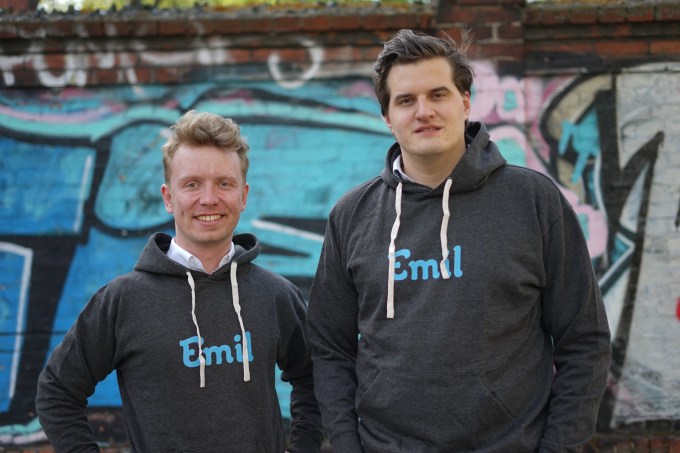
Emil, a new startup from the founders of Movinga, has launched what it claims is Germany’s first pay-per-mile car insurance that measures miles in real-time. Aimed at drivers who do less than 6,200 miles per year on average (or roughly 120 miles per week) — which we’re told accounts for 49 percent of German drivers — mileage is tracked via the Emil app and the supplied dongle that plugs into your car’s diagnostics port.

“With Emil we are building a 21st century mobility insurer,” co-founder Bastian Knutzen tells me. “We believe that insurance products that are offered today can be improved on different dimensions and want to change that by offering flexible and fair products tailored around customer needs. We have started with the German car insurance market where traditionally low mileage drivers have subsidised the higher accident risk of high-mileage drivers which has led to an unfair insurance premium distribution”.

Digging a little more into the technology and model behind Emil, Knutzen explained that the Emil stick is an IoT device with an integrated SIM card that plugs into a vehicle’s OBD-II diagnostics port, from where mileage data is sent to the startup’s servers.

“Customers only pay a low monthly base fee and cents per mile when they actually drive,” he says, meaning that low-mileage drivers can make significant savings on their insurance premiums.

In addition, the Emil mobile app gives your car other ‘smart’ features, such as tracking the vehicle’s location, an overview of all trips (“driver’s logbook”), and remote diagnostics.

The insurance policy itself was developed in cooperation with General Reinsurance AG (a Berkshire Hathaway Company) and the German insurer Gothaer Allgemeine Versicherung.

“In general, we target consumers who want an intuitive, convenient and transparent insurance,” adds Knutzen. “Our customers use their smartphones and other gadgets for payment, banking, shopping, etc., but can’t for insurance. We try to meet that type of expectation for insurance products as well.

More broadly, Emil is tapping into current trends such as growing environmental awareness, urbanisation and car-sharing. “We have decided to offer an insurance which rewards people for not using their cars as our first product. There is a significant price advantage for customers driving less than 6,200 miles annually, which covers around half of German car drivers,” Knutzen says.

Meanwhile, I’m told that Emil’s only funding to date is a “seven-digit” seed round from multiple family offices and business angels with ties to the technology, automotive and insurance industry. They include Johannes Reck (co-founder of GetYourGuide), Lucas von Cranach (co-founder of Onefootball), Roland Grenke (co-founder of Dubsmash), Philip Petrescu (co-founder of Lendico), Verena Pausder (co-founder of Fox & Sheep), Arndt Ellinghorst (German automotive expert), and Oliver Mickler (co-founder Tillhub, co-founder MyDriver and the first angel backer of Movinga).

23 Oct 2018

Fake news ‘threat to democracy’ report gets back-burner response from UK gov’t

The UK government has rejected a parliamentary committee’s call for a levy on social media firms to fund digital literacy lessons to combat the impact of disinformation online.

The recommendation of a levy on social media platforms was made by the Digital, Culture, Media and Sport committee three months ago, in a preliminary report following a multi-month investigation into the impact of so-called ‘fake news’ on democratic processes.

Though it has suggested the terms ‘misinformation’ and ‘disinformation’ be used instead, to better pin down exact types of problematic inauthentic content — and on that at least the government agrees. But just not on very much else. At least not yet.

Among around 50 policy suggestions in the interim report — which the committee put out quickly exactly to call for “urgent action” to ‘defend democracy’ — it urged the government to put forward proposals for an education levy on social media.

But in its response, released by the committee today, the government writes that it is “continuing to build the evidence base on a social media levy to inform our approach in this area”.

“We are aware that companies and charities are undertaking a wide range of work to tackle online harms and would want to ensure we do not negatively impact existing work,” it adds, suggesting it’s most keen not to be accused of making a tricky problem worse.

Earlier this year the government did announce plans to set up a dedicated national security unit to combat state-led disinformation campaigns, with the unit expected to monitor social media platforms to support faster debunking of online fakes — by being able to react more quickly to co-ordinated interference efforts by foreign states.

But going a step further and requiring social media platforms themselves to pay a levy to fund domestic education programs — to arm citizens with critical thinking capabilities so people can more intelligently parse content being algorithmically pushed at them — is not, apparently, forming part of government’s current thinking.

Though it is not taking the idea of some form of future social media tax off the table entirely, as it continues seeking ways to make big tech pay a fairer share of earnings into the public purse, also noting in its response: “We will be considering any levy in the context of existing work being led by HM Treasury in relation to corporate tax and the digital economy.”

As a whole, the government’s response to the DCMS committee’s laundry list of policy recommendations around the democratic risks of online disinformation can be summed up in a word as ‘cautious’ — with only three of the report’s forty-two recommendations being accepted outright, as the committee tells it, and four fully rejected.

Most of the rest are being filed under ‘come back later — we’re still looking into it’.

So if you take the view that ‘fake news’ online has already had a tangible and worrying impact on democratic debate the government’s response will come across as underwhelming and lacking in critical urgency. (Though it’s hardly alone on that front.)

The committee has reacted with disappointment — with chair Damian Collins dubbing the government response “disappointing and a missed opportunity”, and also accusing ministers of hiding behind ‘ongoing investigations’ to avoid commenting on the committee’s call that the UK’s National Crime Agency urgently carry out its own investigation into “allegations involving a number of companies”.

Earlier this month Collins also called for the Met Police to explain why they had not opened an investigation into Brexit-related campaign spending breaches.

It has also this month emerged that the force will not examine claims of Russian meddling in the referendum.

Meanwhile the political circus and business uncertainty triggered by the Brexit vote goes on.

Holding pattern

The bulk of the government’s response to the DCMS interim report entails flagging a number of existing and/or ongoing consultations and reviews — such as the ‘Protecting the Debate: Intimidating, Influence and Information‘ consultation, which it launched this summer.

But by saying it’s continuing to gather evidence on a number of fronts the government is also saying it does not feel it’s necessary to rush through any regulatory responses to technology-accelerated, socially divisive/politically sensitive viral nonsense — claiming also that it hasn’t seen any evidence that malicious misinformation has been able to skew genuine democratic debate on the domestic front.

It’ll be music to Facebook’s ears given the awkward scrutiny the company has faced from lawmakers at home and, indeed, elsewhere in Europe — in the wake of a major data misuse scandal with a deeply political angle.

The government also points multiple times to a forthcoming oversight body which is in the process of being established — aka the Centre for Data Ethics and Innovation — saying it expects this to grapple with a number of the issues of concern raised by the committee, such as ad transparency and targeting; and to work towards agreeing best practices in areas such as “targeting, fairness, transparency and liability around the use of algorithms and data-driven technologies”.

Identifying “potential new regulations” is another stated role for the future body. Though given it’s not yet actively grappling with any of these issues the UK’s democratically concerned citizens are simply being told to wait.

“The government recognises that as technological advancements are made, and the use of data and AI becomes more complex, our existing governance frameworks may need to be strengthened and updated. That is why we are setting up the Centre,” the government writes, still apparently questioning whether legislative updates are needed — this in a response to the committee’s call, informed by its close questioning of tech firms and data experts, for an oversight body to be able to audit “non-financial” aspects of technology companies (including security mechanism and algorithms) to “ensure they are operating responsibly”.

“As set out in the recent consultation on the Centre, we expect it to look closely at issues around the use of algorithms, such as fairness, transparency, and targeting,” the government continues, noting that details of the body’s initial work program will be published in the fall — when it says it will also put out its response to the aforementioned consultation.

It does not specify when the ethics body will be in any kind of position to hit this shifty ground running. So again there’s zero sense the government intends to act at a pace commensurate with the fast-changing technologies in question.

Then, where the committee’s recommendations touch on the work of existing UK oversight bodies, such as Competition and Markets Authority, the ICO data watchdog, the Electoral Commission and the National Crime Agency, the government dodges specific concerns by suggesting it’s not appropriate for it to comment “on independent bodies or ongoing investigations”.

Also notable: It continues to reject entirely the idea that Russian-backed disinformation campaigns have had any impact on domestic democratic processes at all — despite public remarks by prime minister Theresa May  last year generally attacking Putin for weaponizing disinformation for election interference purposes.

Instead it writes:

We want to reiterate, however, that the Government has not seen evidence of successful use of disinformation by foreign actors, including Russia, to influence UK democratic processes. But we are not being complacent and the Government is actively engaging with partners to develop robust policies to tackle this issue.

Its response on this point also makes no reference of the extensive use of social media platforms to run political ads targeting the 2016 Brexit referendum.

Nor does it make any note of the historic lack of transparency of such ad platforms. Which means that it’s simply not possible to determine where all the ad money came from to fund digital campaigning on domestic issues — with Facebook only just launching a public repository of who is paying for political ads and badging them as such in the UK, for example.

The elephant in the room is of course that ‘lack of evidence’ is not necessarily evidence of a lack of success, especially when it’s so hard to extract data from opaque adtech platforms in the first place.

Moreover, just this week fresh concerns have been raised about how platforms like Facebook are still enabling dark ads to target political messages at citizens — without it being transparently clear who is actually behind and paying for such campaigns…

In turn triggering calls from opposition MPs for updates to UK election law…

Yet the government, busily embroiled as it still is with trying to deliver some kind of Brexit outcome, is seemingly unconcerned by all this unregulated, background ongoing political advertising.

It also directly brushes off the committee’s call for it to state how many investigations are currently being carried out into Russian interference in UK politics, saying only that it has taken steps to ensure there is a “coordinated structure across all relevant UK authorities to defend against hostile foreign interference in British politics, whether from Russia or any other State”, before reiterating: “There has, however, been no evidence to date of any successful foreign interference.”

This summer the Electoral Commission found that the official Vote Leave campaign in the UK’s in/out EU referendum had broken campaign spending rules — with social media platforms being repurposed as the unregulated playing field where election law could be diddled at such scale. That much is clear.

The DCMS committee had backed the Commission’s call for digital imprint requirements for electronic campaigns to level the playing field between digital and print ads.

However the government has failed to back even that pretty uncontroversial call, merely pointing again to a public consultation (which ends today) on proposed changes to electoral law. So it’s yet more wait and see.

The committee is also disappointed about the lack of government response to its call for the Commission to establish a code for advertising through social media during election periods; and its recommendation that “Facebook and other platforms take responsibility for the way their platforms are used” — noting also the government made “no response to Facebook’s failure to respond adequately to the Committee’s inquiry and Mark Zuckerberg’s reluctance to appear as a witness“. (A reluctance that really enraged the committee.)

In a statement on the government’s response, committee chair Damian Collins writes: “The government’s response to our interim report on disinformation and ‘fake news’ is disappointing and a missed opportunity. It uses other ongoing investigations to further delay desperately needed announcements on the ongoing issues of harmful and misleading content being spread through social media.

“We need to see a more coordinated approach across government to combat campaigns of disinformation being organised by Russian agencies seeking to disrupt and undermine our democracy. The government’s response gives us no real indication of what action is being taken on this important issue.”

Collins finds one slender crumb of comfort, though, that the government might have some appetite to rule big tech.

After the committee had called for government to “demonstrate how seriously it takes Facebook’s apparent collusion in spreading disinformation in Burma, at the earliest opportunity”, the government writes that it: “has made it clear to Facebook, and other social media companies, that they must do more to remove illegal and harmful content”; and noting also that its forthcoming Online Harms White Paper will include “a range of policies to tackle harmful content”.

“We welcome though the strong words from the Government in its demand for action by Facebook to tackle the hate speech that has contributed to the ethnic cleansing of the Rohingya in Burma,” notes Collins, adding: “We will be looking for the government to make progress on these and other areas in response to our final report which will be published in December.

“We will also be raising these issues with the Secretary of State for DCMS, Jeremy Wright, when he gives evidence to the Committee on Wednesday this week.”

(Wright being the new minister in charge of the UK’s digital brief, after Matt Hancock moved over to health.)

We’ve reached out to Facebook for comment on the government’s call for a more robust approach to illegal hate speech.

Last week the company announced it had hired former UK deputy prime minister, Nick Clegg, to be its new head of global policy and comms — apparently signalling a willingness to pay a bit more attention to European regulators.


23 Oct 2018

Walmart’s marketplace items get free 2-day shipping, in-store returns

With Fulfillment by Amazon, marketplace sellers can make their products eligible for Amazon Prime’s 2-day shipping. Today, Walmart is catching up on this front. The retailer today announced it’s expanding its 2-day shipping to the millions of products offered by its own marketplace sellers. This expansion will roll out in the months ahead, alongside a process for simpler returns on marketplace purchases.

Walmart first launched free, 2-day shipping across millions of products back in January 2017, for orders that were over $35. The move was meant to challenge Amazon Prime, as all it required was a minimum purchase – not an annual membership fee.

Now, that same shipping option will be made available across Walmart’s marketplace, too.

The company says it will initially work with its hundreds of “high-performing” sellers to introduce free, two-day shipping across their eligible items in the U.S. This is being announced today, but will roll out more broadly in the coming months, Walmart notes.

The company tells us it’s implementing 2-day shipping in a number of ways.

It’s enabling it for sellers with their own internal capabilities and it’s introducing the ability to implement geographical settings so two-day shipping is available for specific areas based on the location of an individual seller’s fulfillment network, it says.

Plus, Walmart is working with third-party providers to help fulfill the items, such as Deliverr.

In addition to two-day shipping, Walmart is simplifying returns for items bought through its online marketplace by offering an easier way to manage online returns. Customers will now be able to log into their Walmart.com account and print out a return label to ship items directly back to sellers.

But shipping isn’t always the easiest way to manage returns. That’s where the retailer’s brick-and-mortar stores will come in. Starting in mid-November, customers will be able to return their eligible marketplace purchases in Walmart stores at the Services desk.

Previously, Walmart’s own items could be returned in store, but not those bought from third-party sellers.

Walmart says that 140 million customers shop its stores weekly, and 90% of Americans today live within 10 miles of one of its locations.

With this change, Walmart will facilitate the return of marketplace items by shipping items back to sellers on the customer’s behalf. The customer will then receive a refund from the seller.

This service will be available at all of Walmart’s 4,700 stores, the retailer notes.


23 Oct 2018

Oracle acquires DataFox, a developer of ‘predictive intelligence as a service’ across millions of company records

Oracle today announced that it has made another acquisition, this time to enhance both the kind of data that it can provide to its business customers, and its artificial intelligence capabilities: it is buying DataFox, a startup that has amassed a huge company database — currently covering 2.8 million public and private businesses, adding 1.2 million each year — and uses AI to analyse that to make larger business predictions. The business intelligence resulting from that service can in turn be used for a range of CRM-related services: prioritising sales accounts, finding leads, and so on.

“The combination of Oracle and DataFox will enhance Oracle Cloud Applications with an extensive set of AI-derived company-level data and signals, enabling customers to reach even better decisions and business outcomes,” noted Steve Miranda, EVP of applications development at Oracle, in a note to DataFox customers announcing the deal. He said that DataFox will sit among Oracle’s existing portfolio of business planning services like ERP, CX, HCM and SCM. “Together, Oracle and DataFox will enrich cloud applications with AI-driven company-level data, powering recommendations to elevate business performance across the enterprise.”

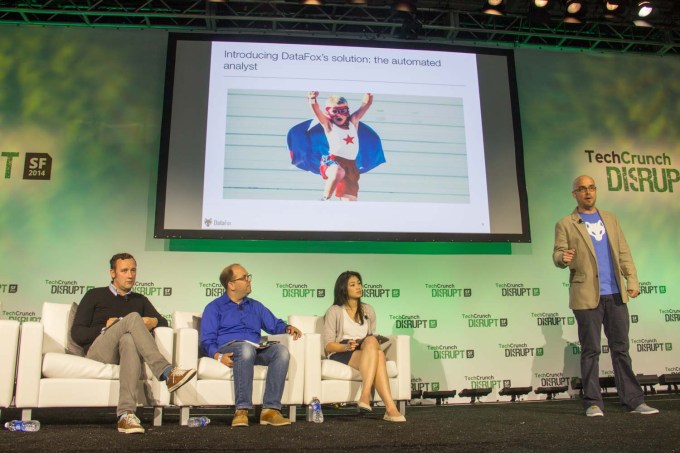
Terms of the deal do not appear to have been disclosed but we are trying to find out. DataFox — which launched in 2014 as a contender in the TC Battlefield at Disrupt — had raised just under $19 million and was last valued at $33 million back in January 2017, according to PitchBook. Investors in the company included Slack, GV, Howard Linzon, and strategic investor Goldman Sachs among others.

Oracle said that it is not committing to a specific product roadmap for DataFox longer term, but for now it will be keeping the product going as is for those who are already customers. The startup counted Goldman Sachs, Bain & Company and Twilio among those using its services. 

The deal is interesting for a couple of reasons. First, it shows that larger platform providers are on the hunt for more AI-driven tools to provide an increasingly sophisticated level of service to customers. Second, in this case, it’s a sign of how content remains a compelling proposition, when it is presented and able to be manipulated for specific ends. Many customer databases can get old and out of date, so the idea of constantly trawling information sources in order to create the most accurate record of businesses possible is a very compelling idea to anyone who has faced the alternative, and that goes even more so in sales environments when people are trying to look their sharpest.

It also shows that, although both companies have evolved quite a lot, and there are many other alternatives on the market, Oracle remains in hot competition with Salesforce for customers and are hoping to woo and keep more of them with the better, integrated innovations. That also points to Oracle potentially cross and up-selling people who come to them by way of DataFox, which is an SaaS that pitches itself very much as something anyone can subscribe to online.

23 Oct 2018

Twitter says it has removed several accounts affiliated with Infowars and Alex Jones

Twitter has cleared more Infowars related accounts off its platform. The company told CNN today that it permanently suspended 18 accounts affiliated with the far-right website, known for spreading misinformation and conspiracy theories, on Monday after “numerous violations and warnings.” It added the removals were in addition to five Infowars affiliated accounts that had been already been banned.

Alex Jones and Infowars, which he launched in 1999, had their accounts permanently suspended by Twitter last month, one of the last major social media platforms to do so. Infowars, however, had been using affiliated accounts to get around the ban and promote its content, according to a Daily Beast report last week. These included the accounts of Infowars’ “Real News” show, the Infowars store (which sells Jones’ line of dietary supplements) and “News Wars,” which promoted videos by Infowars. All of these accounts, and several others, were mentioned in the Daily Beast article and included in Twitter’s purge on Monday.

Alex Jones and Infowars are notorious for spreading some of the most pernicious conspiracy theories to emerge recently, including ones claiming the Sandy Hook and Parkland school shootings were faked. Their articles and videos have also frequently included racist and homophobic content and frequent calls for violence.

A wave of social media and tech companies began suspending accounts maintained by Alex Jones and Infowars in August for violating their policies on hate speech and violence. After weeks of prevarication and half-measures, including a brief temporary ban, Twitter permanently removed both @realalexjones and @infowars at the beginning of September. The list of platforms Infowars and Alex Jones are now barred from include Twitter, YouTube, Spotify, and the App Store.

TechCrunch has contacted Twitter and Infowars for comment.

22 Oct 2018

Water Abundance Xprize’s $1.5M winner shows how to source fresh water from the air

You may remember that back in May, the Water Abundance Xprize named the five finalists in its contest to demonstrate the sustainable and scalable collection of water from the air. Interestingly, none of those finalists were the winner — after one dropped out, an eliminated team stepped in and took the prize.

The goal of the program was to  collect “a minimum of 2,000 liters of water per day from the atmosphere using 100 percent renewable energy, at a cost of no more than 2 cents per liter.” No simple task! In fact, I would have guessed it was an impossible one.

But many teams made the attempt anyway and with a variety of approaches at that. The runner up, Hawaii’s JMCC Wing, combined a large, super-efficient wind turbine with a commercial condenser unit.

The winner was Skysource/Skywater Alliance, which has already deployed many of its units abroad (and, apparently, at Miranda Kerr’s house). They can run off the grid or alternative power sources, and use an extremely efficient adiabatic distillation method.

It’s cheaper and more efficient than desalination, and doesn’t require the presence of nearby water sources or rain. Skywater boxes, which range from somewhat smaller to rather larger than a refrigerator, can produce up to 300 gallons per day; that’s about 1135 liters, so two of them would meet the contest’s requirements if the cost was low enough and it was running on renewables.

That was sufficiently demonstrated to the Xprize inspection teams, it seems, and the team was this weekend awarded the $1.5 million top prize despite not making it into the finals.

“It has been pretty intense but its really been exciting for me to see water come out of our system, because this is connected to real lives in the world,” said team member Jay Hasty in an Xprize video.

This doesn’t mean water scarcity is a solved problem by a long shot — but competitions like this are great ways of promoting new development in a space and also creating awareness of it. Hopefully Skywater systems will be installed where they’re needed, but development will almost certainly continue on those created by the other teams competing for the prize.

22 Oct 2018

Los Angeles investors and entrepreneurs launch PledgeLA, a diversity and inclusion program

In an attempt to boost diversity and inclusion efforts and civic engagement between the growing technology industry in Los Angeles and the community that surrounds it, over 80 venture capitalists and entrepreneurs joined the city’s mayor, Eric Garcetti, and the non-profit Annenberg Foundation to announce PledgeLA.

The initiative is one way in which the Los Angeles technology community is attempting to ensure that it does not repeat the same mistakes made by Silicon Valley and San Francisco and alienate fellow citizens who could feel left out of the opportunities created by tech’s rise to prominence in the city.

“L.A.’s tech growth is no accident – it is a tribute to our region’s tradition of creativity, leadership in innovation, and wealth of talent. With PledgeLA, we will promote transparency in a growing sector and open the doors of opportunity to our diverse base of workers, no matter their race, gender, or background,” said Garcetti, in a statement.

As part of the diversity and inclusion effort, the signatories to PledgeLA have agreed to track civic participation and diversity data each year and to make that data publicly available.

The metrics that signatories will track include community engagement statistics like participation in mentorship programs, volunteering, board service, offering internships, using local banks, giving preference to vendors owned by women or minorities, dedicating a portion of annual spending to local impact initiatives, and investing in local Los Angeles startups.

Demographics at funds and startups will also be under the microscope, since signatories have agreed to report on their composition by race, gender, age, sexual orientation, disability status, immigration status, veteran status, educational attainment, socioeconomic origin, tenure at a firm. PledgeLA participants will also need a code of conduct around diversity and inclusion and are required to privilege diversity in corporate hiring practices.

Over the past five years, Los Angeles has emerged as one of the top five destinations in the U.S. for technology investment and corporate development. It’s one of the fastest growing tech hubs in the country with the 100 largest tech companies in L.A. and Orange County reporting a 24 percent increase in employment from the previous year, according to data provided by the Annenberg Foundation.

The local non-profit was instrumental in setting up the PledgeLA initiative, which grew out of discussions that the institute fostered among the Los Angeles venture community.

Nonetheless, diverse talent remains vastly underrepresented in the workforce of the local tech sector. The landmark
PledgeLA initiative grew out of a series of problem-solving sessions within the Los Angeles venture capital community.

“This commitment from L.A.’s venture capitalists and Mayor Garcetti means that change is happening, and this change is good, as long as we can work to make Los Angeles a more diverse, inclusive and community-focused city that benefits everyone,” said Annenberg Foundation Chairman, President and chief executive Wallis Annenberg, in a statement.

For Los Angeles investors like Upfront Ventures partner, Kobie Fuller, diverse hiring practices are just good business sense.

“Investing in a diverse array of founders, looking for talent in all corners of the city, and bringing different voices to the table when making decisions on investments is just smart business,” Fuller said in a statement. “We know companies with a diverse workforce are more successful, which, in turn, increases community engagement and provides opportunities for the community-at-large. PledgeLA will put Los Angeles on the right trajectory.”

Nearly every large investment firm and Los Angeles based company agreed to sign on to the pledge with at least three notable exceptions. Neither Snap, SpaceX, nor Tesla appear on the list of companies willing to participate in the diversity pledge.

22 Oct 2018

Looks like Tiger Global Management just closed the second biggest venture fund this year

As we noted six months ago, Tiger Global Management, the 17-year-old investment group, is starting to see a whole lot of its venture-related startup investments pay off. We also guessed that because of those wins, the outfit was likely lining up commitments for a new mega fund.

It was a safe bet. According to a new report from the Financial Times, the New York-based outfit has just closed its newest venture vehicle with $3.75 billion after actively marketing it for just six weeks.

That makes Tiger’s new vehicle one of the largest venture funds in a world suddenly clotted with ever-bigger pools of capital, including SoftBank’s massive $93 billion Vision Fund, which closed last year, and the newest global fund assembled by Sequoia, which closed with $8 billion in capital commitments in late summer, a record-breaking amount for the storied venture firm.

In fact, Tiger’s new fund may be the second largest venture fund to close so far this year, just beating out YF Capital’s newest pool, which closed with $2.5 billion in July, and numerous other firms to close billion-dollar-plus funds in 2018, including: Tunlan Investment’s Xiong’An Global Blockchain Innovation Fund, which closed in April with $1.6 billion; Lightspeed Venture Partners, which closed on $1.8 billion in capital across two new funds in July; General Catalyst, which gathered up at least $1.375 billion in capital commitments earlier this year; and GGV Capital, which just last week closed on $1.9 billion across three funds that will back both U.S. and China-based companies.

According to the FT,  the Tiger fund closed exactly a week ago and will focus on both enterprise as well as direct-to-consumer companies in the U.S., China and India, where, according to The Economic Times, Tiger is stepping up its investments after hitting the pause button for a few years. Tiger’s apparent inspiration: the reported $3.3 billion it recently made from an early bet on Flipkart, which sold the majority of its e-commerce business to retail giant Walmart in May for $16 billion.

Other recent developments that Tiger’s investors have surely liked seeing include the sale of Glassdoor, the jobs and salary website, acquired by the Japanese human resources company Recruit Holdings for $1.2 billion in cash back in May; Spotify’s direct listing on the U.S. stock market back in April (the company is currently valued at $26 billion); and even more recent exits, including the IPOs of both Eventbrite and SurveyMonkey — though both have handed back some gains since going public last month. Eventbrite opened at $36 per share and is currently trading at $26 per share; SurveyMonkey has lost roughly one-third of its value since its first trading day.

Tiger was founded by Chase Coleman, a protégé of hedge fund pioneer Julian Robertson. According to the FT, the outfit now manages roughly $26 billion and about half of that is being funneled into venture-backed startups, with portfolio manager Lee Fixel largely overseeing its venture bets.

Some of its investments have been contrarian and underscore the extent to which Tiger is not like other investment firms. It took a stake of more than $1 billion in SoftBank Group earlier this year, for example, reportedly on the belief that it was undervalued at the time. Tiger is also an investor in the e-cig company Juul, which has come under intense regulatory scrutiny in recent months but remains among the fastest-growing companies in the Bay Area right now.

Interestingly, even SoftBank’s Vision Fund — which is currently in an uncomfortable public position, having raised nearly half its money from Saudi Arabia’s Crown Prince Mohammed bin Salman — couldn’t invest in Juul if it wanted to. According to Jeff Housenbold, a managing director with SoftBank’s Vision Fund, like many other venture investors, SoftBank has prohibitive clauses in its agreement with its own backers that include pornography, alcohol, drugs, weapons and tobacco.

Whether Tiger has also raised money from sovereign wealth funds, we don’t know. The firm has never publicly disclosed who, beyond its employees, owns shares in the firm.

22 Oct 2018

Guillermo del Toro is making a stop-motion Pinocchio movie for Netflix

Guillermo del Toro, the Academy Award-winning director of “The Shape of Water” (not to mention “Hellboy,” “Pan’s Labyrinth” and “Pacific Rim”) is making a new version of “Pinocchio” for Netflix.

I’d thought that after del Toro’s awards victory earlier this year he might finally make his long-thwarted adaptation “At the Mountains of Madness.” And while I’m not giving up hope that I’ll see a del Toro-helmed version of the classic H.P. Lovecraft horror story one day, it seems that he’s going in a different direction for now.

The official announcement from Netflix describes this as del Toro’s “lifelong passion project,” and says that it will be both a stop-motion animated film and a musical.

“No art form has influenced my life and my work more than animation and no single character in history has had as deep of a personal connection to me as Pinocchio,” del Toro said in a statement. “In our story, Pinocchio is an innocent soul with an uncaring father who gets lost in a world he cannot comprehend. He embarks on an extraordinary journey that leaves him with a deep understanding of his father and the real world. I’ve wanted to make this movie for as long as I can remember.”

This isn’t the director’s first project for Netflix — he previously created the animated series “Trollhunters,” and he has another series in the works for the streaming service, “Guillermo del Toro Presents 10 After Midnight.” Netflix says that in addition to directing the film with Mark Gustafson (“The Fantastic Mr. Fox”), he will co-write and co-produce it. The Jim Henson Company (which is also making a “Dark Crystal” prequel series for Netflix) and ShadowMachine are producing as well.

Netflix also announced today that it’s raising an additional $2 billion in debt to fund its original content plans. It says production on “Pinocchio” will begin this fall.