Month: October 2018

22 Oct 2018

Uber’s head of corporate development resigns

Less than one month after The Wall Street Journal reported allegations of sexual misconduct by Cameron Poetzscher, Uber’s head of corporate development, Poetzscher has resigned, according to the WSJ.

Uber has confirmed Poetzscher’s resignation to TechCrunch. While Uber searches for a new corporate development lead, Uber CFO Nelson Chai will oversee Poetzscher’s duties.

“We thank Cam for his four and a half years of service to Uber,” an Uber spokesperson told TechCrunch.

Uber had previously hired an outside firm to look into allegations against Poetzscher. That firm reportedly found Poetzscher did indeed have a history of making sexual remarks about female Uber employees. Uber reportedly proceeded to give him a formal warning, reduced his annual bonus and required that Poetzscher take sensitivity training.

However, Uber later promoted him to acting head of finance. At the time of the WSJ’s article last month, Poetzscher said he was “rightfully disciplined” and that he had “learned from this error in judgment.”

22 Oct 2018

The future of photography is code

What’s in a camera? A lens, a shutter, a light-sensitive surface and, increasingly, a set of highly sophisticated algorithms. While the physical components are still improving bit by bit, Google, Samsung and Apple are increasingly investing in (and showcasing) improvements wrought entirely from code. Computational photography is the only real battleground now.

The reason for this shift is pretty simple: Cameras can’t get too much better than they are right now, or at least not without some rather extreme shifts in how they work. Here’s how smartphone makers hit the wall on photography, and how they were forced to jump over it.

Not enough buckets
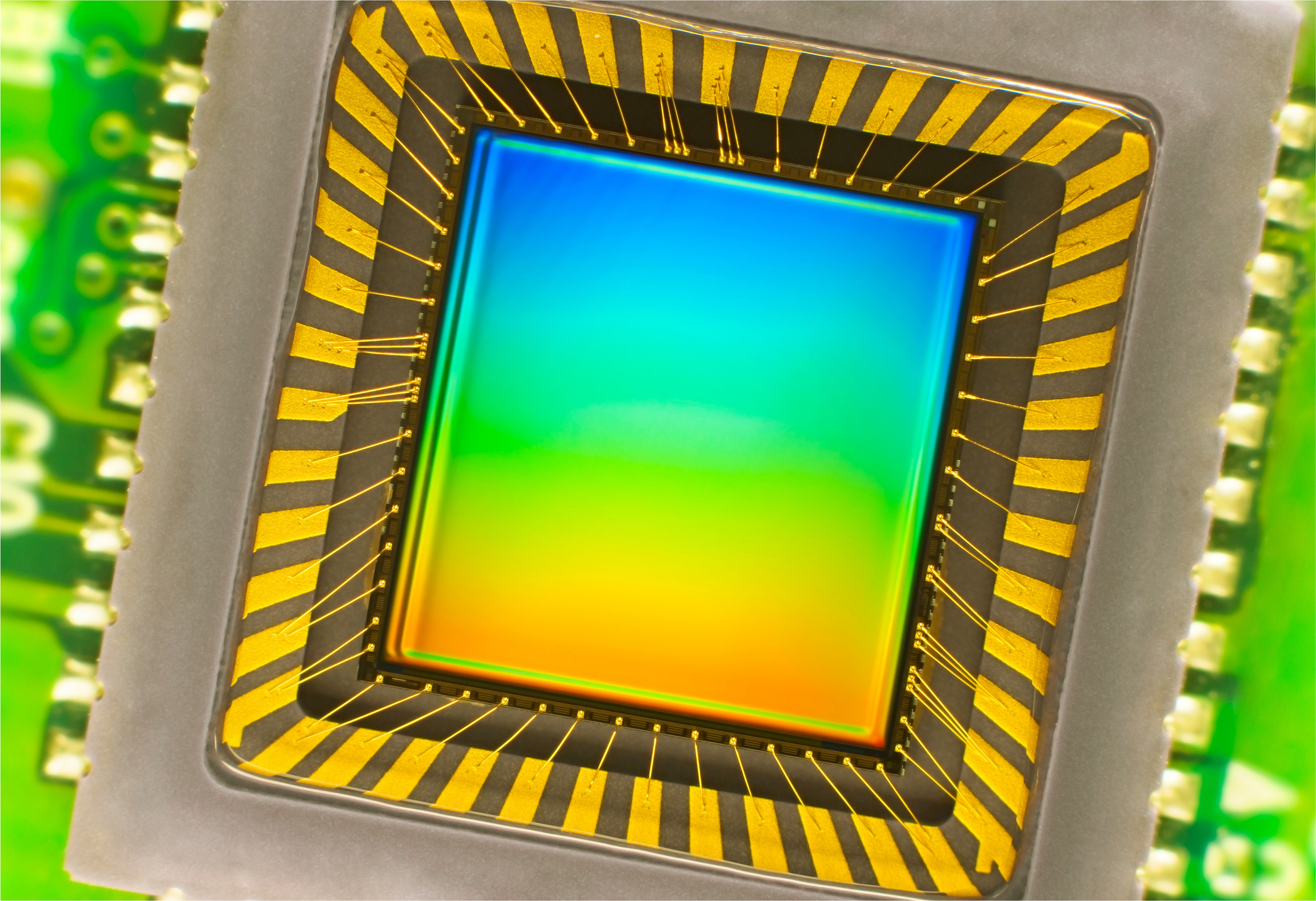
An image sensor one might find in a digital camera

The sensors in our smartphone cameras are truly amazing things. The work that’s been done by the likes of Sony, OmniVision, Samsung and others to design and fabricate tiny yet sensitive and versatile chips is really pretty mind-blowing. For a photographer who’s watched the evolution of digital photography from the early days, the level of quality these microscopic sensors deliver is nothing short of astonishing.

But there’s no Moore’s Law for those sensors. Or rather, just as Moore’s Law is now running into quantum limits at sub-10-nanometer levels, camera sensors hit physical limits much earlier. Think about light hitting the sensor as rain falling on a bunch of buckets; you can place bigger buckets, but there are fewer of them; you can put smaller ones, but they can’t catch as much each; you can make them square or stagger them or do all kinds of other tricks, but ultimately there are only so many raindrops and no amount of bucket-rearranging can change that.

Sensors are getting better, yes, but not only is this pace too slow to keep consumers buying new phones year after year (imagine trying to sell a camera that’s 3 percent better), but phone manufacturers often use the same or similar camera stacks, so the improvements (like the recent switch to backside illumination) are shared amongst them. So no one is getting ahead on sensors alone.

Perhaps they could improve the lens? Not really. Lenses have arrived at a level of sophistication and perfection that is hard to improve on, especially at small scale. To say space is limited inside a smartphone’s camera stack is a major understatement — there’s hardly a square micron to spare. You might be able to improve them slightly as far as how much light passes through and how little distortion there is, but these are old problems that have been mostly optimized.

The only way to gather more light would be to increase the size of the lens, either by having it A: project outwards from the body; B: displace critical components within the body; or C: increase the thickness of the phone. Which of those options does Apple seem likely to find acceptable?

In retrospect it was inevitable that Apple (and Samsung, and Huawei, and others) would have to choose D: none of the above. If you can’t get more light, you just have to do more with the light you’ve got.

Isn’t all photography computational?

The broadest definition of computational photography includes just about any digital imaging at all. Unlike film, even the most basic digital camera requires computation to turn the light hitting the sensor into a usable image. And camera makers differ widely in the way they do this, producing different JPEG processing methods, RAW formats and color science.

For a long time there wasn’t much of interest on top of this basic layer, partly from a lack of processing power. Sure, there have been filters, and quick in-camera tweaks to improve contrast and color. But ultimately these just amount to automated dial-twiddling.

The first real computational photography features were arguably object identification and tracking for the purposes of autofocus. Face and eye tracking made it easier to capture people in complex lighting or poses, and object tracking made sports and action photography easier as the system adjusted its AF point to a target moving across the frame.

These were early examples of deriving metadata from the image and using it proactively, to improve that image or feeding forward to the next.

In DSLRs, autofocus accuracy and flexibility are marquee features, so this early use case made sense; but outside a few gimmicks, these “serious” cameras generally deployed computation in a fairly vanilla way. Faster image sensors meant faster sensor offloading and burst speeds, some extra cycles dedicated to color and detail preservation and so on. DSLRs weren’t being used for live video or augmented reality. And until fairly recently, the same was true of smartphone cameras, which were more like point and shoots than the all-purpose media tools we know them as today.

The limits of traditional imaging
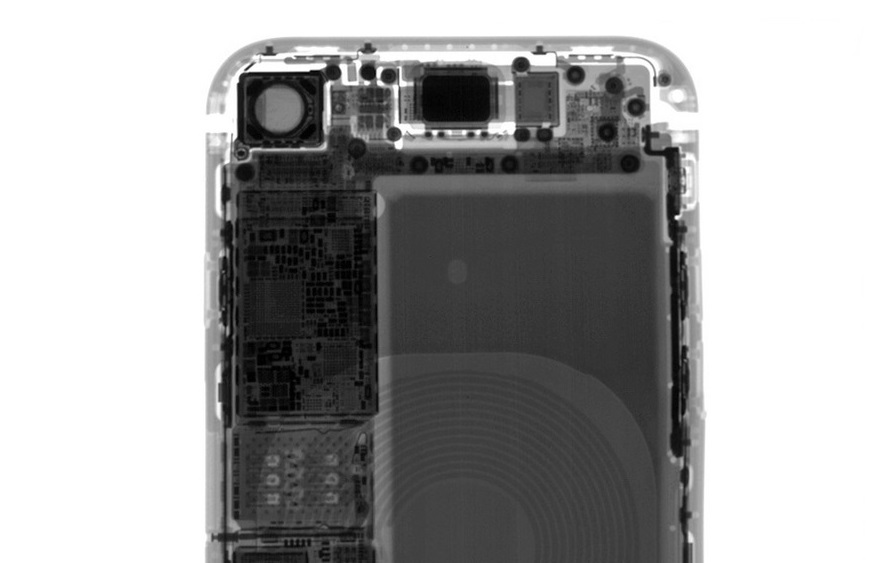
Despite experimentation here and there and the occasional outlier, smartphone cameras are pretty much the same. They have to fit within a few millimeters of depth, which limits their optics to a few configurations. The size of the sensor is likewise limited — a DSLR might use an APS-C sensor 23 by 15 millimeters across, making an area of 345 mm2; the sensor in the iPhone XS, probably the largest and most advanced on the market right now, is 7 by 5.8 mm or so, for a total of 40.6 mm2.

Roughly speaking, it’s collecting an order of magnitude less light than a “normal” camera, but is expected to reconstruct a scene with roughly the same fidelity, colors and such — around the same number of megapixels, too. On its face this is sort of an impossible problem.

Improvements in the traditional sense help out — optical and electronic stabilization, for instance, make it possible to expose for longer without blurring, collecting more light. But these devices are still being asked to spin straw into gold.

Luckily, as I mentioned, everyone is pretty much in the same boat. Because of the fundamental limitations in play, there’s no way Apple or Samsung can reinvent the camera or come up with some crazy lens structure that puts them leagues ahead of the competition. They’ve all been given the same basic foundation.

All competition therefore comprises what these companies build on top of that foundation.

Image as stream
The key insight in computational photography is that an image coming from a digital camera’s sensor isn’t a snapshot, the way it is generally thought of. In traditional cameras the shutter opens and closes, exposing the light-sensitive medium for a fraction of a second. That’s not what digital cameras do, or at least not what they can do.

A camera’s sensor is constantly bombarded with light; rain is constantly falling on the field of buckets, to return to our metaphor, but when you’re not taking a picture, these buckets are bottomless and no one is checking their contents. But the rain is falling nevertheless.

To capture an image the camera system picks a point at which to start counting the raindrops, measuring the light that hits the sensor. Then it picks a point to stop. For the purposes of traditional photography, this enables nearly arbitrarily short shutter speeds, which isn’t much use to tiny sensors.

Why not just always be recording? Theoretically you could, but it would drain the battery and produce a lot of heat. Fortunately, in the last few years image processing chips have gotten efficient enough that they can, when the camera app is open, keep a certain duration of that stream — limited resolution captures of the last 60 frames, for instance. Sure, it costs a little battery, but it’s worth it.

Access to the stream allows the camera to do all kinds of things. It adds context.

Context can mean a lot of things. It can be photographic elements like the lighting and distance to subject. But it can also be motion, objects, intention.

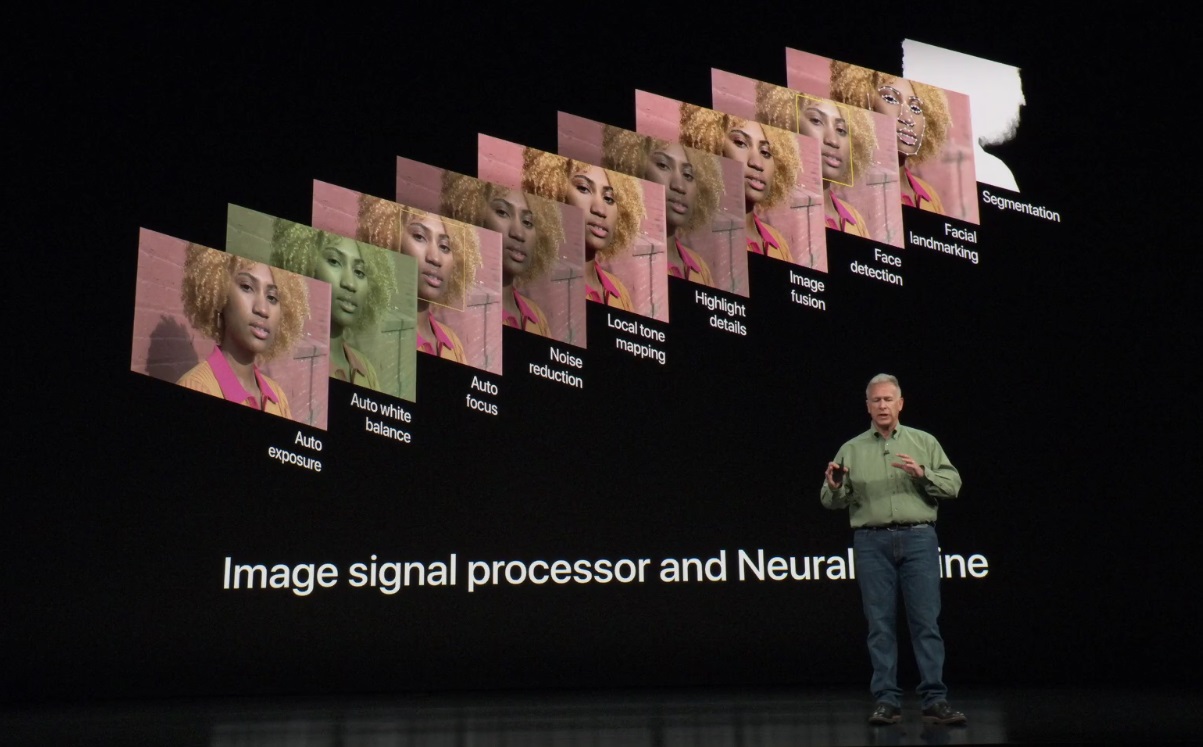
A simple example of context is what is commonly referred to as HDR, or high dynamic range imagery. This technique uses multiple images taken in a row with different exposures to more accurately capture areas of the image that might have been underexposed or overexposed in a single exposure. The context in this case is understanding which areas those are and how to intelligently combine the images together.

This can be accomplished with exposure bracketing, a very old photographic technique, but it can be accomplished instantly and without warning if the image stream is being manipulated to produce multiple exposure ranges all the time. That’s exactly what Google and Apple now do.

Something more complex is of course the “portrait mode” and artificial background blur or bokeh that is becoming more and more common. Context here is not simply the distance of a face, but an understanding of what parts of the image constitute a particular physical object, and the exact contours of that object. This can be derived from motion in the stream, from stereo separation in multiple cameras, and from machine learning models that have been trained to identify and delineate human shapes.

These techniques are only possible, first, because the requisite imagery has been captured from the stream in the first place (an advance in image sensor and RAM speed), and second, because companies developed highly efficient algorithms to perform these calculations, trained on enormous data sets and immense amounts of computation time.

What’s important about these techniques, however, is not simply that they can be done, but that one company may do them better than the other. And this quality is entirely a function of the software engineering work and artistic oversight that goes into them.

DxOMark did a comparison of some early artificial bokeh systems; the results, however, were somewhat unsatisfying. It was less a question of which looked better, and more of whether they failed or succeeded in applying the effect. Computational photography is in such early days that it is enough for the feature to simply work to impress people. Like a dog walking on its hind legs, we are amazed that it occurs at all.

But Apple has pulled ahead with what some would say is an almost absurdly over-engineered solution to the bokeh problem. It didn’t just learn how to replicate the effect — it used the computing power it has at its disposal to create virtual physical models of the optical phenomenon that produces it. It’s like the difference between animating a bouncing ball and simulating realistic gravity and elastic material physics.

Why go to such lengths? Because Apple knows what is becoming clear to others: that it is absurd to worry about the limits of computational capability at all. There are limits to how well an optical phenomenon can be replicated if you are taking shortcuts like Gaussian blurring. There are no limits to how well it can be replicated if you simulate it at the level of the photon.

Similarly the idea of combining five, 10, or 100 images into a single HDR image seems absurd, but the truth is that in photography, more information is almost always better. If the cost of these computational acrobatics is negligible and the results measurable, why shouldn’t our devices be performing these calculations? In a few years they too will seem ordinary.

If the result is a better product, the computational power and engineering ability has been deployed with success; just as Leica or Canon might spend millions to eke fractional performance improvements out of a stable optical system like a $2,000 zoom lens, Apple and others are spending money where they can create value: not in glass, but in silicon.

Double vision

One trend that may appear to conflict with the computational photography narrative I’ve described is the advent of systems comprising multiple cameras.

This technique doesn’t add more light to the sensor — that would be prohibitively complex and expensive optically, and probably wouldn’t work anyway. But if you can free up a little space lengthwise (rather than depthwise, which we found impractical) you can put a whole separate camera right by the first that captures photos extremely similar to those taken by the first.

A mock-up of what a line of color iPhones could look like

Now, if all you want to do is re-enact Wayne’s World at an imperceptible scale (camera one, camera two… camera one, camera two…) that’s all you need. But no one actually wants to take two images simultaneously, a fraction of an inch apart.

These two cameras operate either independently (as wide-angle and zoom) or one is used to augment the other, forming a single system with multiple inputs.

The thing is that taking the data from one camera and using it to enhance the data from another is — you guessed it — extremely computationally intensive. It’s like the HDR problem of multiple exposures, except far more complex as the images aren’t taken with the same lens and sensor. It can be optimized, but that doesn’t make it easy.

So although adding a second camera is indeed a way to improve the imaging system by physical means, the possibility only exists because of the state of computational photography. And it is the quality of that computational imagery that results in a better photograph — or doesn’t. The Light camera with its 16 sensors and lenses is an example of an ambitious effort that simply didn’t produce better images, though it was using established computational photography techniques to harvest and winnow an even larger collection of images.

Light and code

The future of photography is computational, not optical. This is a massive shift in paradigm and one that every company that makes or uses cameras is currently grappling with. There will be repercussions in traditional cameras like SLRs (rapidly giving way to mirrorless systems), in phones, in embedded devices and everywhere that light is captured and turned into images.

Sometimes this means that the cameras we hear about will be much the same as last year’s, as far as megapixel counts, ISO ranges, f-numbers and so on. That’s okay. With some exceptions these have gotten as good as we can reasonably expect them to be: Glass isn’t getting any clearer, and our vision isn’t getting any more acute. The way light moves through our devices and eyeballs isn’t likely to change much.

What those devices do with that light, however, is changing at an incredible rate. This will produce features that sound ridiculous, or pseudoscience babble on stage, or drained batteries. That’s okay, too. Just as we have experimented with other parts of the camera for the last century and brought them to varying levels of perfection, we have moved onto a new, non-physical “part” which nonetheless has a very important effect on the quality and even possibility of the images we take.


22 Oct 2018

Richard Branson steps down as chairman of Virgin Hyperloop One

Richard Branson has reportedly stepped down from the chairman role of Virgin Hyperloop One.

In a statement, cited by Reuters, Branson said that the company would require a more time than he could devote to the company.

“At this stage in the company’s evolution, I feel it needs a more hands-on Chair, who can focus on the business and these opportunities. It will be difficult for me to fulfill that commitment as I already devote significant time to my philanthropic ventures and the many business within the Virgin Group.”

What wasn’t mentioned was the cancellation of a planned project with Saudi Arabia after Branson criticized the kingdom and suspended negotiations around an intended $1 billion investment from the nation’s Public Investment Fund into Virgin’s space operations.

Branson is one of several business leaders who have cut ties with the Kingdom of Saudi Arabia following the alleged assassination and dismemberment of dissident journalist Jamal Khashoggi.

Virgin Hyperloop’s largest investor is the United Arab Emirates shipping and logistics company DP World. Earlier this year, the two companies launched a logistics joint venture that would bring hyperloop technologies to the industry. DP World first invested in what is now Virgin Hyperloop back in 2016.

Earlier this month, Virgin Hyperloop released the results of a feasibility study conducted with Black & Veatch of the company’s planned route through Missouri to link St. Louis and Kansas City.

The independent report, authored by global infrastructure solutions company Black & Veatch, analyzes a proposed route through the I-70 corridor, the major highway traversing Missouri, and verifies the favorable safety and sustainability opportunities this new mode of transportation offers.

“A feasibility study of this depth represents the first phase of actualization of a full-scale commercial hyperloop system, both for passengers and cargo in the United States,” said chief executive Rob Lloyd, at the time. “We are especially proud that Missouri, with its iconic status in the history of U.S. transportation as the birthplace of the highway system, could be the keystone of a nation-wide network. The resulting socio-economic benefits will have enormous regional and national impact.”

In the U.S. Colorado and Ohio are also examining feasibility studies for Virgin Hyperloop technologies, while other projects are underway in India and the United Arab Emirates.

Hyperloop technology developers like Virgin Hyperloop One, Hyperloop Transportation Technologies, all get their inspiration from early plans drawn up by Elon Musk.

As we wrote at the time:

The Hyperloop features tubes with a low level of pressurization that would contain pods with skis made of the SpaceX alloy inconel, which is designed to withstand high pressure and heat. Air exiting those skis through tiny holes would create an air cushion on which the pods would ride, and they’d be propelled by air jet inlets. And all of that would cost only around $6 billion, according to Musk.

We’ve reached out to a spokesperson from Virgin Hyperloop One for comment and will update when we hear back.

22 Oct 2018

Richard Branson steps down as chairman of Virgin Hyperloop One

Richard Branson has reportedly stepped down from the chairman role of Virgin Hyperloop One.

In a statement, cited by Reuters, Branson said that the company would require a more time than he could devote to the company.

“At this stage in the company’s evolution, I feel it needs a more hands-on Chair, who can focus on the business and these opportunities. It will be difficult for me to fulfill that commitment as I already devote significant time to my philanthropic ventures and the many business within the Virgin Group.”

What wasn’t mentioned was the cancellation of a planned project with Saudi Arabia after Branson criticized the kingdom and suspended negotiations around an intended $1 billion investment from the nation’s Public Investment Fund into Virgin’s space operations.

Branson is one of several business leaders who have cut ties with the Kingdom of Saudi Arabia following the alleged assassination and dismemberment of dissident journalist Jamal Khashoggi.

Virgin Hyperloop’s largest investor is the United Arab Emirates shipping and logistics company DP World. Earlier this year, the two companies launched a logistics joint venture that would bring hyperloop technologies to the industry. DP World first invested in what is now Virgin Hyperloop back in 2016.

Earlier this month, Virgin Hyperloop released the results of a feasibility study conducted with Black & Veatch of the company’s planned route through Missouri to link St. Louis and Kansas City.

The independent report, authored by global infrastructure solutions company Black & Veatch, analyzes a proposed route through the I-70 corridor, the major highway traversing Missouri, and verifies the favorable safety and sustainability opportunities this new mode of transportation offers.

“A feasibility study of this depth represents the first phase of actualization of a full-scale commercial hyperloop system, both for passengers and cargo in the United States,” said chief executive Rob Lloyd, at the time. “We are especially proud that Missouri, with its iconic status in the history of U.S. transportation as the birthplace of the highway system, could be the keystone of a nation-wide network. The resulting socio-economic benefits will have enormous regional and national impact.”

In the U.S. Colorado and Ohio are also examining feasibility studies for Virgin Hyperloop technologies, while other projects are underway in India and the United Arab Emirates.

Hyperloop technology developers like Virgin Hyperloop One, Hyperloop Transportation Technologies, all get their inspiration from early plans drawn up by Elon Musk.

As we wrote at the time:

The Hyperloop features tubes with a low level of pressurization that would contain pods with skis made of the SpaceX alloy inconel, which is designed to withstand high pressure and heat. Air exiting those skis through tiny holes would create an air cushion on which the pods would ride, and they’d be propelled by air jet inlets. And all of that would cost only around $6 billion, according to Musk.

We’ve reached out to a spokesperson from Virgin Hyperloop One for comment and will update when we hear back.

22 Oct 2018

Ford expands self-driving vehicle program to Washington, D.C.

Ford is bringing its autonomous vehicles to Washington, D.C., the fourth city to join the automaker’s testing program as it prepares to launch a self-driving taxi and delivery service in 2021.

Ford will begin testing its self-driving vehicles in the district in the first quarter of 2019. The company is already is testing in Detroit, Pittsburgh and Miami. 

Ford is a bit different from other companies that have launched autonomous vehicle pilots in the U.S. Ford is pursuing two parallels tracks — testing the business model and autonomous technology — that will eventually combine ahead of its commercial launch in 2021.

Argo AI, the Pittsburgh-based company into which Ford invested $1 billion in 2017, is developing the virtual driver system and high-definition maps designed for Ford’s self-driving vehicles. Meanwhile, Ford is testing its go-to-market strategy through pilot programs with partners like Domino’s and Postmates, and even some local businesses.

The testing program in DC will follow that same thinking, with an emphasis on job creation and equitable deployment. Ford says its autonomous vehicles will be in all eight of the district’s wards. Eventually, it will operate business pilot programs in all eight wards, as well . Ford has already established an autonomous vehicle operations terminal in Ward 5, where it will house, manage and conduct routine maintenance on the fleet and continue developing its vehicle management process.

Argo AI already has vehicles on DC’s streets, mapping roads in the first step toward testing in autonomous mode, the company said.

“Both Ford and district officials are committed to exploring how self-driving vehicles can be deployed in an equitable way across the various neighborhoods that make up Washington, D.C., and in a way that promotes job creation,” Sherif Marakby, CEO, Ford Autonomous Vehicles LLC wrote in a Medium post Monday.

Marakby underscored a recent report by Securing America’s Future Energy that found autonomous technology could improve people’s access to jobs as well as retail markets.

Ford announced in July 2018 plans to spend $4 billion through 2023 in a newly created LLC dedicated to building out an autonomous vehicles business. The new entity, Ford Autonomous Vehicles LLC, houses the company’s self-driving systems integration, autonomous-vehicle research and advanced engineering, AV transportation-as-a-service network development, user experience, business strategy and business development teams. The spending plan includes a $1 billion investment in startup Argo AI.

22 Oct 2018

Ford expands self-driving vehicle program to Washington, D.C.

Ford is bringing its autonomous vehicles to Washington, D.C., the fourth city to join the automaker’s testing program as it prepares to launch a self-driving taxi and delivery service in 2021.

Ford will begin testing its self-driving vehicles in the district in the first quarter of 2019. The company is already is testing in Detroit, Pittsburgh and Miami. 

Ford is a bit different from other companies that have launched autonomous vehicle pilots in the U.S. Ford is pursuing two parallels tracks — testing the business model and autonomous technology — that will eventually combine ahead of its commercial launch in 2021.

Argo AI, the Pittsburgh-based company into which Ford invested $1 billion in 2017, is developing the virtual driver system and high-definition maps designed for Ford’s self-driving vehicles. Meanwhile, Ford is testing its go-to-market strategy through pilot programs with partners like Domino’s and Postmates, and even some local businesses.

The testing program in DC will follow that same thinking, with an emphasis on job creation and equitable deployment. Ford says its autonomous vehicles will be in all eight of the district’s wards. Eventually, it will operate business pilot programs in all eight wards, as well . Ford has already established an autonomous vehicle operations terminal in Ward 5, where it will house, manage and conduct routine maintenance on the fleet and continue developing its vehicle management process.

Argo AI already has vehicles on DC’s streets, mapping roads in the first step toward testing in autonomous mode, the company said.

“Both Ford and district officials are committed to exploring how self-driving vehicles can be deployed in an equitable way across the various neighborhoods that make up Washington, D.C., and in a way that promotes job creation,” Sherif Marakby, CEO, Ford Autonomous Vehicles LLC wrote in a Medium post Monday.

Marakby underscored a recent report by Securing America’s Future Energy that found autonomous technology could improve people’s access to jobs as well as retail markets.

Ford announced in July 2018 plans to spend $4 billion through 2023 in a newly created LLC dedicated to building out an autonomous vehicles business. The new entity, Ford Autonomous Vehicles LLC, houses the company’s self-driving systems integration, autonomous-vehicle research and advanced engineering, AV transportation-as-a-service network development, user experience, business strategy and business development teams. The spending plan includes a $1 billion investment in startup Argo AI.

22 Oct 2018

A look at the Android Market (aka Google Play) on its 10th Anniversary

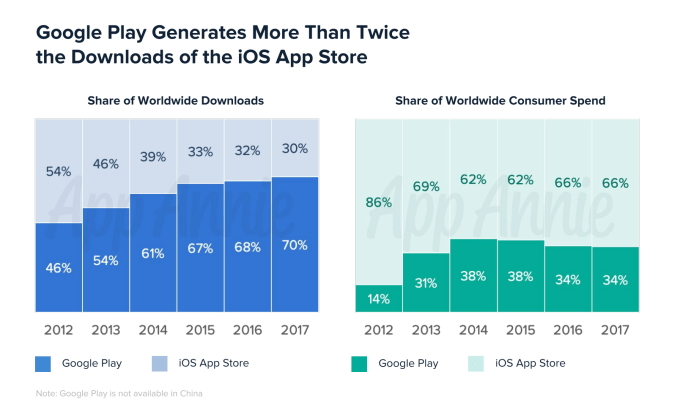
Google Play has generated more than twice the downloads of the iOS App Store, reaching a 70% share of worldwide downloads in 2017, according to a new report from App Annie, released in conjunction with the 10th anniversary of the Android Market, now called Google Play. The report also examined the state of Google Play’s marketplace and the habits of Android users.

It found that, despite the large share of downloads, Google Play only accounted for 34% of worldwide consumer spend on apps, compared with 66% on the iOS App Store in 2017 – a figure that’s stayed relatively consistent for years.

Those numbers are consistent with the narrative that’s been told about the two app marketplaces for some time as well. That is, Google has the sheer download numbers, thanks to the wide distribution of its devices – including its reach into emerging markets, thanks to low-cost smartphones. But Apple’s ecosystem is the one making more money from apps.

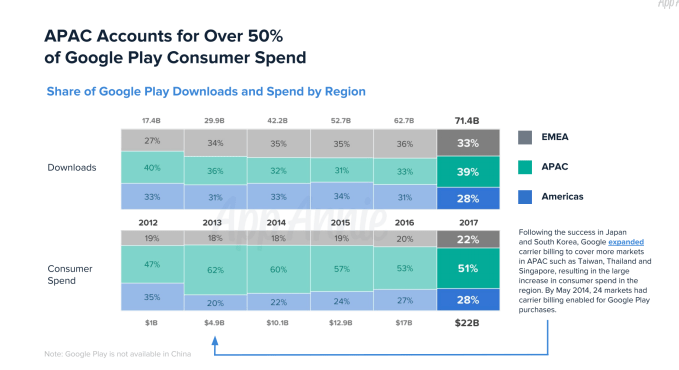
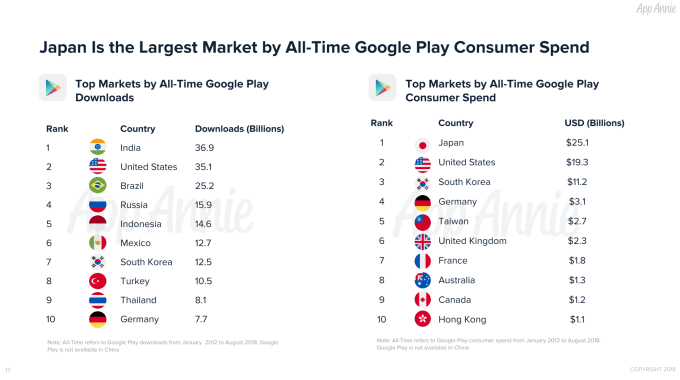
App Annie also found that the APAC (Asia-Pacific) region accounts for more than half of Google Play consumer spending. Japan was the largest market of all-time on this front, topping the charts with $25.1 billion dollars spend on apps and in-app purchases. It was followed by the U.S. ($19.3B) and South Korea ($11.2B).

The firm attributed some of Google Play’s success in Japan to carrier billing. This has allowed consumer spending to increase in markets like South Korea, Taiwan, Thailand and Singapore, as well, it said.

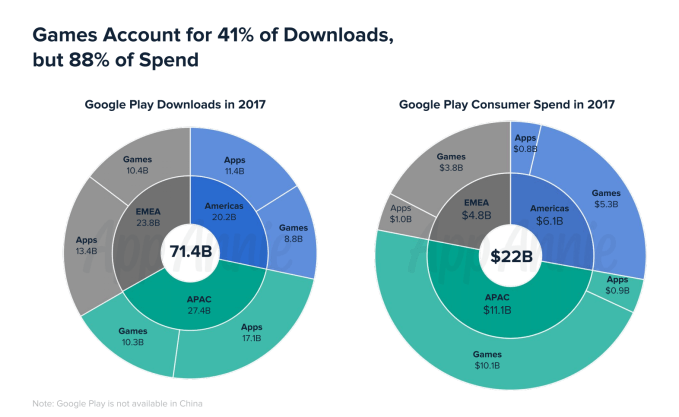
As to what consumers are spending their money on? Games, of course.

The report found that games accounted for 41% of downloads, but 88% of spend.

Outside of games, in-app subscriptions have contributed to revenue growth.

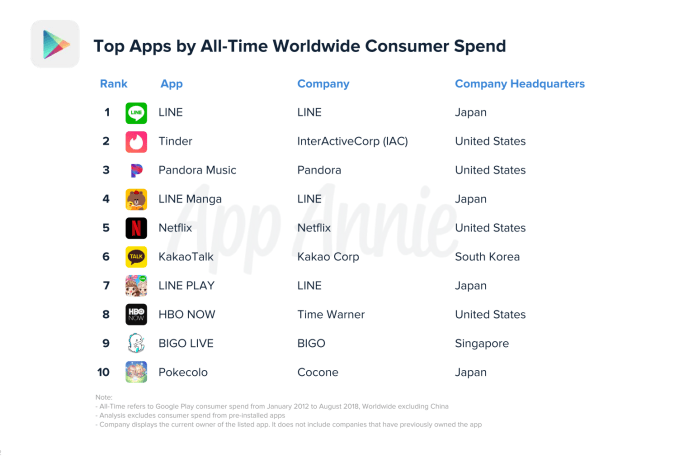
Non-game apps reached $2.7 billion in consumer spend last year, with 4 out of the top 5 apps offering a subscription model. The number one app, LINE, was the exception. It was followed by subscription apps Tinder, Pandora, Netflix, and HBO NOW.

In addition, App Annie examined the app usage patterns of Android users, and found they tend to have a lot of apps installed. In several markets, including the U.S. and Japan, Android users had over 60 apps installed on their phones and they used over 30 apps every month.

Australia, the U.S. and South Korea led the way here, with users’ phones holding 100 or more apps.

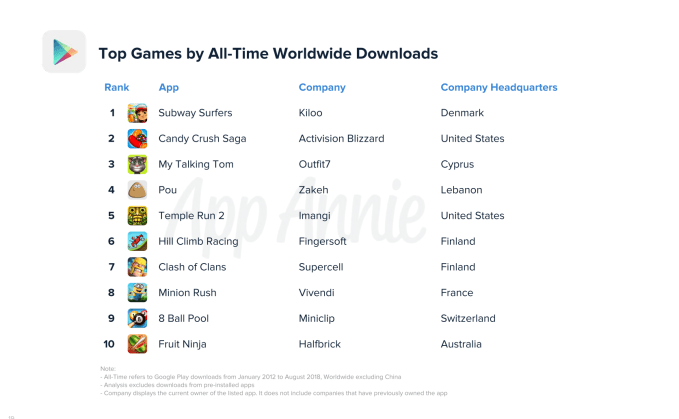
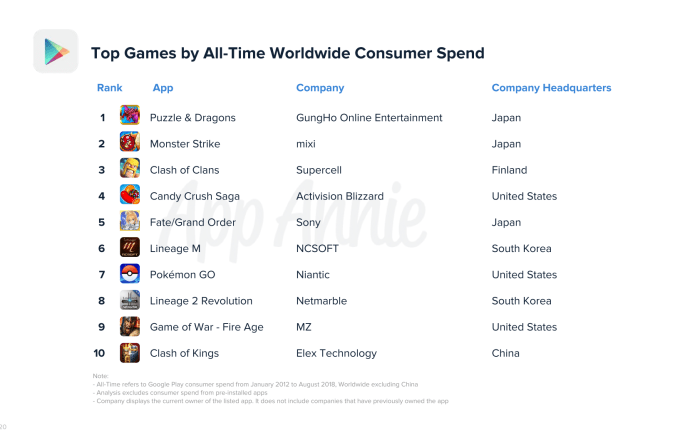
The report also looked at the most popular games and app of all time by both downloads and consumer spend. There weren’t many surprises on these lists, with apps like those made by Facebook dominating the top apps by downloads list, and subscription services dominating top apps by spend.

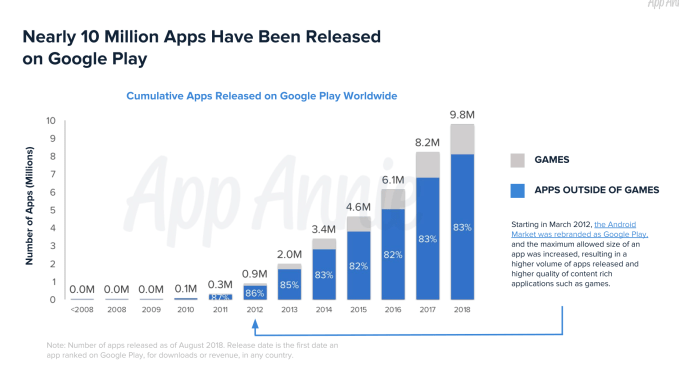
App Annie also noted Google Play has seen the release of nearly 10 million apps since its launch in 2008. Not all these remain, of course – by today’s count, there are just over 2.8 million apps live on Google Play.


22 Oct 2018

Cowboy, the Belgian e-bike startup, raises €10M Series A

Cowboy, the Belgium startup that’s designed and sells a smarter electronic bicycle, has raised €10 million in Series A funding.

Leading the round is Tiger Global Management, with participation from previous backers Index Ventures, and Hardware Club. The new capital will be used to scale operations, and expand beyond Belgum into Germany, U.K., Netherlands, and France.

Founded in January 2017 by Adrien Roose and Karim Slaoui, who both previously co-founded Take Eat Easy (an early Deliveroo competitor), and Tanguy Goretti, who was previously co-founded ridesharing startup Djump, Cowboy set out to build and sell direct a better designed and e-bike.

This included making the Cowboy lighter in weight and more stylish than models from incumbents, and adding automatic motor assistance. The latter utilises built-in sensor technology that measures speed and torque, and adjusts to pedaling style and force to deliver an added boost of motor-assisted speed at key moments e.g. when you start pedaling, accelerate or go uphill.

In addition, Cowboy’s “smart” features powered by the Cowboy app enables the device to be switched on and off, track location, provide “ride stats,” and support remote troubleshooting and software updates. A theft detection feature is also promised soon.

“We designed the Cowboy bike to appeal specifically to people who are yet to be convinced that electric bikes are a practical and mainstream mode of transport,” says Adrien Roose, Cowboy’s CEO, in a statement.

“We focused our attention on the three main reasons people are reluctant to purchase electric bikes: high cost, poor design and redundant technology – or a combination of the above – and we set about fixing them all”.

22 Oct 2018

Lime is building its first scooter “lifestyle brand store” in LA

How can Lime differentiate its scooters and bikes from the piles of Birds and Spins filling Los Angeles sidewalks? Apparently with a physical storefront where it can convince customers of the wonders of on-demand mobility. According to a job listing from Lime seeking a “Retail Store Manager”, the startup plans to open a “lifestyle brand store in Santa Monica” that “will place heavy importance on brand experience and customer engagement.”

It seems Lime will rent vehicles directly from the store given the full-time manager’s role includes “monitoring inventory levels” as well as daily operations, and employee recruiting. They’ll also be throwing live events to build Lime’s hype. Given the company is calling this a lifestyle store, the focus will likely be on showing how Lime’s scooters and bikes can become part of people’s lives and enhance their happiness, rather than on maximizing rental volume.

A rendering of Lime’s new office it’s buidling in San Francisco. The design could hint at what Lime wants to do with its retail store branding.

The listing was first spotted by Nathan Pope, a transportation researcher for consultancy Steer, and later by Cheddar’s Alex Heath. We’ve reached out to Lime and will update if we hear back from the company. Glassdoor shows that the store manager job was posted over 30 days ago, and the site estimates the potential salary at $41,000 to $74,000.

The sheer number of Lime scooters in Santa Monica where the store will arise is already staggering. Supply doesn’t seem to be bottleneck as it is in some other cities. Instead, it’s the fierce competition from hometown startups like local favorite Bird that Lime wants to overcome through brick-and-mortar marketing. Often times you’ll see scooters from Lime and Bird lined up right next to each other. And with similarly cheap pricing, the decision of which to use comes down to brand affinity. According to Apptopia, Bird’s monthly U.S. downloads surpassed Lime’s in July for the first time ever, despite Lime offering bikes as well as scooters.

There are plenty of people who still have never tried an on-demand electric scooter, and going through the process of renting, unlocking, and riding them might be daunting to some. If employees at a physical store can teach people that it’s not too difficult to jump aboard, Lime could become their default scooter. This of course comes with risks too, as electric scooters can be dangerous to the novice or uncoordinated. More aggressive in-person marketing might pull in users who were apprehensive about scooting for the right reason — concerns about safety.

As cities figure out how to best regulate scooters, I hope we see a focus on uptime aka how often the scooters actually function properly. It’s common in LA to rent a scooter, then discover the handlebar is loose or the acceleration is sluggish, end the ride, and rent another scooter from the same brand or a competitor in hopes of getting one that works right. I ditched several Lime scooters like this while in LA last week.

Regulators should inquire about what percentage of scooter company fleets are broken and what percentage of rides end within 90 seconds of starting, which is typically due to a malfunctioning vehicle. Cities could then award permits to companies that keep their fleets running, rather than that litter the streets with massive paper weights, or worse, vehicles that could crash and hurt people. Scooters are fun, cheap and therefore accessible to more people than Ubers, and reduce traffic. But unless startups like Lime put a bigger focus on helments and safe riding behavior, we could trade congestion on the roads for congestion in the emergency room.

22 Oct 2018

Oculus co-founder is leaving Facebook after cancellation of ‘Rift 2’ headset

Brendan Iribe, the co-founder and former CEO of Oculus, announced today that he is leaving Facebook, TechCrunch has learned.

Iribe is leaving Facebook following some internal shake-ups at the company’s virtual reality arm last week that saw the cancellation of the company’s next generation “Rift 2” PC-powered virtual reality headset which he had been leading development of, a source close to the matter tell TechCrunch. Iribe and the Facebook executive team had “fundamentally different views on the future of Oculus that grew deeper over time” and Iribe wasn’t interested in a “race to the bottom” in terms of performance, we are told.

So much has happened since the day we founded Oculus in July 2012. I never could have imagined how much we would…

Posted by Brendan Trexler Iribe on Monday, October 22, 2018

The cancellation of the company’s next-gen PC-based “Rift 2” virtual reality product showcases how the interests of Facebook’s executive leadership have centered on all-in-one headsets that don’t require a connection to an external PC or phone. In May, Oculus released the $199 Oculus Go headset and plans to release the $399 Oculus Quest headset sometime next spring. A Facebook spokesperson tells TechCrunch that the PC VR is part of the company’s future product roadmap and that much of what Iribe’s team has been working on will be manifested in future products.

Facebook CEO Mark Zuckerberg and then-Oculus CEO Brendan Iribe at Oculus Connect 3 in late 2016

Iribe’s exit comes at a time when a number of the founders of Facebook’s high-profile startup acquisitions are leaving the company. Less than a month ago, Instagram co-founders Kevin Systrom and Mike Krieger announced their plans to leave the company in a decision that TechCrunch was told was partially the result of mounting tensions. WhatsApp co-founder Jan Koum left Facebook earlier this year. Iribe’s fellow co-founder Palmer Luckey left Facebook in early 2017, a decision he recently recounted was not a choice that he made.

Iribe came onto Facebook after the $2 billion acquisition of Oculus VR in 2014 where he had been the company’s founding CEO. After a substantial company reorganization in late 2016, Iribe was moved from the CEO position to the head of the company’s PC VR division.

Before co-founding Oculus VR, Iribe was the chief product officer of Gaikai, a cloud-gaming startup that Sony bought in 2012 for $380 million, before that, he co-founded and led Scaleform, a gaming user interface tools startup that Autodesk bought in 2011 for $36 million.

We’ve reached out to Iribe for comment.