Month: October 2018

22 Oct 2018

Saudi Arabia’s ‘Davos in the Desert’ website was hacked and defaced

The website of the Saudi government’s upcoming Future Investment Initiative conference was hacked and defaced with images of the murdered Saudi journalist Jamal Khashoggi.

Several reporters tweeted screenshots of the site after its defacement, purporting to show Saudi crown prince Mohammed bin Salman — the kingdom’s de facto ruler — brandishing a sword. A portion of text on the site was replaced with an accusation the kingdom of “barbaric and inhuman action,” referring not only to the death of Khashoggi but also the government’s involvement in the ongoing offensive in Yemen.

Names and phone numbers of several Saudi individuals were also uploaded to the site’s homepage, including government employees and senior staff in state-backed companies.

The site was pulled offline shortly after the defacement on Monday.

Nobody has yet publicly declared responsibility for the defacement. It comes days after the Saudi regime admitted that Khashoggi was “murdered” in its consulate in Istanbul, more than two weeks after The Washington Post columnist walked in to obtain marriage license papers. Saudi officials claimed he died following a “fist fight,” which Western nations decried as nonsensical. Leaked audio, believed to have been leaked by the Turkish government, claims the journalist was beaten, killed and dismembered.

Britain, France and Germany issued a statement demanding clarity and an explanation for his still missing body. Turkey is expected to reveal more about the killing Tuesday.

The Future Investment Initiative — also known as “Davos in the Desert” after the original Switzerland-based investment conference — is set for later this week.Saudi Arabia invests billions in U.S. tech companies, but the conference has seen dozens of well-known investors, tech companies and business leaders pull out of the conference after the journalist’s murder.

22 Oct 2018

YouTube CEO says EU’s new copyright legislation threatens jobs, smaller creators

YouTube CEO Susan Wojcicki published her quarterly letter to creators today, which included very strong language regarding the EU’s controversial copyright reform directive. Specifically, her letter focused on Article 13, the so-called “meme ban” that states that any site with a large amount of user-generated content – like Facebook or YouTube, for example – will be responsible for taking down content that infringes on copyright. Wojcicki says the way this legislation is written could “shut down the ability” of millions of people to upload to YouTube.

The legislation she’s referring to is Article 13 of the European Union Directive on Copyright in the Digital Single Market, which the EU Parliament just recently voted to back. The Directive contains several parts, including another concerning “link tax,” which gives publishers the right to ask for paid licenses when online platforms share their articles and stories.

But YouTube is most concerned with Article 13, which impacts sites with user-generated content. In order to comply with the law, sites like YouTube would have to automatically scan and filter user uploads to ensure they aren’t in violation of copyright.

But today, users often express themselves by sampling, remixing, and creating content using music, pictures and videos that would otherwise be considered copyrighted material. However, even though memes and parodies are protected by previous laws (in some countries), these upload filters wouldn’t be able to tell the difference between a copyright violation and a meme – and they’d block content that should be allowed. This is how Article 13 became to be known as the “meme ban.”

However, the language in legislation isn’t clear on how enforcement should take place – it doesn’t say, for example, that sites have to use upload filters. Others believe that YouTube’s existing Content ID system, which scans videos after upload, would be sufficient.

YouTube, for its part, seems to be believe that Article 13 will require more than the existing Content ID system to be compliant.

Writes Wojcicki, “Article 13 as written threatens to shut down the ability of millions of people — from creators like you to everyday users — to upload content to platforms like YouTube. It threatens to block users in the EU from viewing content that is already live on the channels of creators everywhere. This includes YouTube’s incredible video library of educational content, such as language classes, physics tutorials and other how-to’s,” she says.

The CEO also says Article 13 will threaten “thousands of jobs” – meaning those of EU-based content creators, businesses, and artists.

And she warns that YouTube may have to take down content from smaller, original video creators, as it would be liable for that content, saying:

The proposal could force platforms, like YouTube, to allow only content from a small number of large companies. It would be too risky for platforms to host content from smaller original content creators, because the platforms would now be directly liable for that content. We realize the importance of all rights holders being fairly compensated, which is why we built Content ID, and a platform to pay out all types of content owners. But the unintended consequences of article 13 will put this ecosystem at risk.

The company wants to weigh in on how the legislation is worded to protect its interests, and those of the larger creator community. Wojcicki said YouTube is committed to working with the industry to find a better way respect the rights of copyright holders, before the language in the EU legislation is finalized by year-end.


Other changes include expansion of memberships, premieres

While YouTube’s comments on Article 13 were the key part of today’s letter, Wojcicki also updated the community on its priorities for 2018.

This included an update on its plans to better communicate with creators, which it says it accomplished by increasing the number of product updates and “heads up” messages regarding changes to YouTube, including smaller tests or experiments, on its @TeamYouTube handle and the Creator Insider channel, in addition to its launch of YouTube Studio, where creators can read all the news and product updates.

The company also said that its new “self certification” video upload flow, where creators self-describe the content in their videos for advertisers, will roll out more broadly in 2019.

Newly launched channel memberships are also expanding their rollout, with the threshold now being lowered from 100,000 to 50,000 subscribers. Meanwhile, the new Premieres feature is now publicly available to all creators.

Other updates focused on what YouTube is doing across education, news and journalism, YouTube Giving charity work, gaming, and more. The full letter is on YouTube’s blog here.


22 Oct 2018

Square details compensation and promotion practices

When tech companies explore diversity and inclusion initiatives, there’s a risk that marginalized groups may feel “othered” and reduced to a number. That’s what Square has found, the company revealed in the first of a series of posts on Square’s diversity and inclusion efforts. So instead of emphasizing demographic data, Square is taking a new approach — one that entails deep dives into its inclusion efforts.

Regarding promotions and compensation — two key places where unconscious bias can often show up — Square has begun to implement three specific initiatives. One is pushing managers to consider promotion readiness for everyone on their team, explicitly highlighting the people who have been at their current job level longer than the median time for people in similar roles who were promoted in the past two promotion cycles.

“Although time in job level is just one metric in a multi-dimensional promotion consideration process, these primers help ensure that every team member is considered, not just those who are more vocal or in more visible roles,” Square describes on its blog.

And before someone gets a raise, Square’s people analytics team conducts a full audit of pay fairness by gender, race and age. The goal is to mitigate bias by checking for any statistical evidence of it before the decision becomes final.

“We check for potential disparities both overall and within specific jobs, and review any outliers we find,” Square says. “While this lengthens the overall promotion process, it gives us the opportunity to make any necessary adjustments before finalizing employees’ new compensation.”

Square is not at the point where diverse people are evenly distributed across high-paying roles, but says addressing that is part of the plan.

Square’s series on these topics comes almost 18 months after the company released its first diversity report. Last year, Square was 36.7 percent female globally, and 57.3 percent white, 6.4 percent black and 5.8 percent Latinx in the U.S.

“Reporting is important, but it doesn’t appear to be driving meaningful change or increasing our public accountability,” Square explains on its site. “Even worse, what these reports do seem to accomplish is the commoditization of the communities the practice was intended to support. Many employees tell us these reports make them feel like they’re reduced to numbers. And that sucks.”

While Square still has plans to share demographic data, the company is looking to be more transparent and communicative around all of its efforts. The purpose of these posts is to shed some light into Square’s approach to D&I, speaking candidly about what has worked and what hasn’t worked. The ideal outcome is that other companies will open up and share their best and inadvertently worst practices.

22 Oct 2018

Netflix to raise $2 billion in debt to fund more original content

Netflix’s commitment to growing its original content collection will see the company again returning to debt markets to raise more financing, the company announced today. According a release published to its investors site, Netflix says it plans to raise $2 billion to help fund new content, including “content acquisitions, production and development, capital expenditures, investments, working capital and potential acquisitions and strategic transactions.”

The funds will be raised in the form of senior unsecured notes, denominated in U.S. dollars and euros, it said.

This debt offering is the sixth time in under four years that Netflix is raising $1 billion or more through bonds, noted Variety, which was among the first to report the news. As of September 30, Netflix’s long-term debt had reached $8.34 billion, up 71% from $4.89 billion in the year ago quarter, it said during its last earnings, Variety’s report also noted.

Netflix recently explained during its Q3 2018 earnings that it needs to continue to invest in original programming in order to remain competitive.

“We recognize we are making huge cash investments in content, and we want to assure our investors
that we have the same high confidence in the underlying economics as our cash investments in the past.
These investments we see as very likely to help us to keep our revenue and operating profits growing for
a very long time ahead,” the letter to shareholders read.

Netflix also pointed to the increasing competition in the industry as one of the reasons why original content investment was so critical, adding that it didn’t only compete with linear TV, YouTube, gaming, social media, DVDs and pay-per-view, but with a number of new and upcoming streaming services, as well.

“Content companies such as WarnerMedia and Disney/Fox are moving to self-distribute their own content; tech firms like Apple, Amazon and others are investing in premium content to enhance their distribution platforms,” the letter also stated. “Amid these massive competitors on both sides, plus traditional media firms, our job is to make Netflix stand out so that when consumers have free time, they choose to spend it with our service,” it had said.


22 Oct 2018

The White House hopes tech employees will drive government innovation

The Trump administration has a major ask to make of big tech companies. In a meeting at the White House today, officials will ask Amazon, Microsoft, Google and IBM, among others, to make it easier for employees to do stints in the government.

It’s a heavy lift, of course, asking well-compensated workers to take time out from demanding gigs for the betterment of federal and state governments. A number of companies, including Facebook and Google, already allow employees to take time off for this exact reason. However, the particularly polarizing nature of politics in 2018 and all of the ill-will surrounding the current administration, have further complicated the ask.

The Washington Post quotes an anonymous official, who stressed the importance of “put[ting] politics aside” for the greater good. “This event on Monday is not just about our efforts, it’s about our successor, and their successor after that,” the person told the paper. “It’s good for the country in the long term for technology professionals to have civil service in their career at some point.”

The notoriously slow pace of government innovation was something the Obama administration looked to address during its eight years in power, and Trump’s White House appears to be interested in continuing that trend. Ahead of his inauguration, Trump met with tech leaders, including Tim Cook, Jeff Bezos and Satya Nadella, though the administration’s policies have been an on-going source of friction with Silicon Valley

22 Oct 2018

Pair Eyewear, the customizable glasses brand for kids, raises $1 million

Pair Eyewear, the customizable glasses brand for kids, has today announced the close of a $1 million Series A, with investors including Corigin Ventures, Outbound Ventures, Precursor Ventures, and Bolt Ventures.

The company has a simple premise: Pair sells affordable glasses to children. But beyond simple frames, Pair sells both base frames (regular glasses) and top frames (snap-on fronts for base frames that let you change the color and style of glasses).

Base frames, which include hand-polished acetate frames and anti-reflective, shatterproof polycarbonate lenses, cost $95 and top frames can be purchased for $25.

While the product is glasses, the mission is to change the way that kids and parents think about glasses, changing that perception from one of a medical device to a fun accessory.

Much of the inspiration for Pair came from Warby Parker, so it makes sense that Pair also has a give-back program. For every pair of Pair glasses sold, another pair goes to a child in need through and partnership with EYElliance, a non-profit founded by the Vision Spring founder Dr. Jordan Kassalow.

Pair took yet another page out of the Warby Parker book by also offering at-home try-on. However, unlike Warby which sends a handful of real glasses to your home, Pair sends out cardboard replicas of their designs for kids to try on. That way, parents don’t have to worry about sending back the try-on pairs of glasses.

The company says that since launch, 15 percent of customers have come back to purchase additional top frames. It’s worth noting that, between Pair’s launch and now, Warby Parker has entered the field of competition, launching a pilot program for kids glasses in January of this year.

“What sets us apart and what we’re focused on is designing for kids and by kids,” said co-founder and co-CEO Nathan Kondamuri. “We want to change the narrative around what glasses can be for kids, and that mission and focus will set us apart and drive us on a different path [from competitors].”

Pair launched in October of 2017, and this latest round brings total funding to $1.5 million.

The company says it will use a big chunk of the funding on national marketing initiatives to spread the word about the brand.

22 Oct 2018

Gjemeni puts your couch in a box

Gjemeni, pronounced Gemini, is a new furniture-on-demand service from founder Sean Pathiratne. The company offers decidedly tech-forward furniture that comes in a single box and can be assembled by anyone in a few minutes.

Pathiratne sees his company as a fashionable and agile furniture company that brings stylish stuff to your living room in the vein of Zara or H&M.

“We can create and deliver on trends through our technology-led global supply chain with the agility and speed of ‘fast fashion.’ We are ‘fast furniture,'” said Pathiratne.

[gallery ids="1735487,1735486"]

“I live and work in Silicon Valley. I spend a lot of time in WeWork and other co-working places, in the offices of start-ups, and with tech friends,” said Pathiratne . “I observed how millennials live and work. They are a restless bunch physically – which mirrors their restlessness overall. They don’t like the status quo in business or with the objects in their lives. They are constantly shifting and fidgeting on their sofas. They just couldn’t find the right positions. After all, today we are checking our smart phones one minute, leaning back and contemplating the world another minute.”

The result? A plugged-in couch for the plugged-in generation.

“So the implications were obvious: create a multi-position couch for our multi-tasking world. A couch that meets people where they are, rather than the other way around. And also make sure that the next- gen couch had connectivity for the generation that is always plugged in,” he said.

The Gjemeni flagship is a convertible couch that turns from stark seating system into a lie-flat futon. Both sides of the couch have power and USB ports and it has three resting positions.

The company also sells a chair and an ottoman. Each product, from the $999 couch to the $299 leg rest, comes in a massive box that opens to reveal the furniture and a set of legs. To build the stuff you simply snap the legs into the holes on the bottom and flip the couch upright.

I tested one of the couches and can report that it would make a great startup-office seat. The styling, the firmness, and the clever charging ports mean that you can easily make your visitors feel powered-up and comfortable. As a home couch, however, I would recommend trying before you buy. First, at 6.5 feet long, there isn’t much room on the couch for more than two people let alone a small family. Further, the two reclining options are not conducive to many traditional couch activities except, perhaps, for the aftermath of Netflix and chill. The two sides of the back of the couch move from upright to reclined. When upright it is set at almost at 90 degrees – a TV lounging nightmare – and when slightly reclined you fall into a napping position. There is no “just right” with this couch for the home user.

That said this is furniture and your experience may differ. The company offers a 60-day money back guarantee as long as you keep the massive box and at $999 it makes perfect sense to take a flyer on this one. In fact, that’s the point. Like other furniture services, Gjemeni plans to disrupt the visit to Ikea or the furniture store. Because setup is so simple there is little harm in giving it a go and sending it back if you don’t like the size, the firmness, or the fit.

After all, said Pathiratne, the company is all about self-awareness.

“We are built to harness technology in pursuit of wellness. Gjemeni meets our ergonomic needs to relieve pressure on the back and spine, and to adjust so that we can take a power nap (we all know how important sleep is to wellness) or simply meditate and ground ourselves,” said Pathiratne.

22 Oct 2018

eBay launches Instant Selling, a new trade-in service for smartphones

eBay today launched a new service to help users unload their old smartphones on its online marketplace. With eBay Instant Selling, as the service is called, consumers can list their device info, add images, then receive an instant voucher that can be used towards the purchase of a new device from eBay. They’ll also receive an eBay shipping label to send their old phone to eBay.

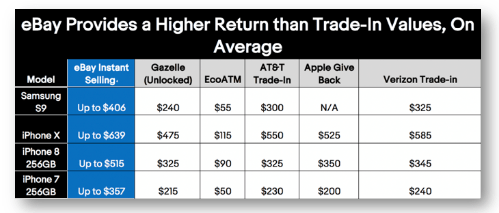
The company claims it will offer a higher return than competitors’ sites, like Gazelle or EcoATM as well as carriers’ trade-in programs like those from AT&T and Verizon, plus Apple’s own Give Back program. It says that standard programs tend to offer 40 to 50 percent off the average market selling price, but eBay will provide up to 40% higher than trade-in values, on average.

Currently, eligible smartphones include Unlocked, Verizon and AT&T, Samsung Galaxy S7 to S9 + and Apple iPhone 6S 16GB through iPhone X 256GB. In November, eBay will add T-Mobile, Sprint and Google Pixel and select LG products to that list, it says.

If this all sounds familiar, that’s because eBay has tried its hand at similar services in the past – repeatedly. In 2013, it shut down an older “Instant Sale” service that focused on reselling consumer electronics, then returned in 2016 with a trade-in site called “Quick Sale.” However, Quick Sale relied on another shuttered eBay service, eBay Valet, which involved having eBay top sellers handle the device sales.

To use the new Instant Selling service, consumers can visit ebay.com/s/phone, then enter their device info and upload photos. After accepting the terms, they’ll receive their instant quote and can opt to print the shipping label to turn in their device to eBay.

The company was unable to provide more information about the revenue sharing portion of the program, as it’s in the quiet period in advance of earnings.

It did, however, provide a comparison chart of top devices and how they would sell on competitors’ sites.

“Millions of Americans have unused phones in their homes and simply don’t realize how much their devices are worth, probably because trade-in values are typically so low,” said Alyssa Steele, Vice President of Hard Goods, eBay, in a statement about the launch. “With Instant Selling, people can find out exactly how much their phone is worth, and sell their phone within a matter of minutes to immediately help fund the holidays, or maybe something off their personal wish list,” she said.

22 Oct 2018

Minds, the blockchain-based social network, grabs a $6M Series A

Minds, a decentralized social network, has raised $6 million in Series A funding from Medici Ventures, Overstock.com’s venture arm. Overstock CEO Patrick Byrne will join the Minds Board of Directors.

What is a decentralized social network? The creators, who originally crowdfunded their product, see it as an anti-surveillance, anti-censorship, and anti-“big tech” platform that ensures that no one party controls your online presence. And Minds is already seeing solid movement.

“In June 2018, Minds saw an enormous uptick in new Vietnamese of hundreds of thousands users as a direct response to new laws in the country implementing an invasive ‘cybersecurity’ law which included uninhibited access to user data on social networks like Facebook and Google (who are complying so far) and the ability to censor user content,” said Minds founder Bill Ottman.

“There has been increasing excitement in recent years over the power of blockchain technology to liberate individuals and organizations,” said Byrne. “Minds’ work employing blockchain technology as a social media application is the next great innovation toward the mainstream use of this world-changing technology.”

Interestingly, Minds is a model for the future of hybrid investing, a process of raising some cash via token and raising further cash via VC. This model ensures a level of independence from investors but also allows expertise and experience to presumably flow into the company.

Ottman, for his part, just wants to build something revolutionary.

“The rise of an open source, encrypted and decentralized social network is crucial to combat the big-tech monopolies that have abused and ignored users for years. With systemic data breaches, shadow-banning and censorship, people over the world are demanding a digital revolution. User-safety, fair economies, and global freedom of expression depend on it – we are all in this battle together,” said Ottman.

22 Oct 2018

Pulumi raises $15M for its infrastructure as code platform

Pulumi, a Seattle-based startup that lets developers specify and manage their cloud infrastructure using the programming language they already know, today announced that it has raised a $15 million Series A funding round led by Madrona Venture Group. Tola Capital also participated in this round and Tola managing director Sheila Gulati will get a seat on the Pulumi board, where she’ll join former Microsoft exec and Madrona managing director S. Somasegar.

In addition to announcing its raise, the company also today launched its commercial platform, which builds upon Pulumi’s open-source work.

“Since launch, we’ve had a lot of inbound interest, both on the community side — so you’re seeing a lot of open source contributions, and they’re really impactful contributions, including, for example, community-led support for VMware and OpenStack,” Pulumi co-founder and CEO Eric Rudder told me. “So we’re actually seeing a lot of vibrancy in the open-source community. And at the same time, we have a lot of inbound interest on the commercial side of things. That is, teams wanting to operationalize Pulumi and put it into production and wanting to purchase the product.”

So to meet that opportunity, the team decided to raise a new round to scale out both its team and product. And now, that product includes a commercial offering of Pulumi with the company’s new ‘team edition.’ This new enterprise version includes support for unlimited users, integrations with third-party tools like GitHub and Slack, as well as role-based access controls and onboarding and 12×5 support. Like the free, single-user community edition, the team edition is delivered as a SaaS product and supports deployments to all of the major public and private cloud platforms.

“We’re all seeing the same things — the cloud is a foregone conclusion,” Tola’s Gulati told me when I asked her why she was investing in Pulumi. “Enterprises have a lot of complexity as they come over the cloud. And so dealing with VMs, containers and serverless is a reality for these enterprises. And the ability to do that in a way that there’s a single toolset, letting developers use real programming languages, letting them exist where they have skills today, but then allows them to bring the best of cloud into their organization. Frankly, Pulumi really has thought through the existing complexity, the developer reality, the IT and develop a relationship from both a runtime and deployment perspective. And they are the best that we’ve seen.”

Pulumi will, of course, continue to develop its open source tools, too. Indeed, the company noted that it would invest heavily in building out the community around its tools. The team told me that it is already seeing a lot of momentum but with the new funding, it’ll re-double its efforts.

With the new funding, the company will also work on making the onboarding process much easier, up to the point where it will become a full self-serve experience. But that doesn’t work for most large organizations, so Pulumi will also invest heavily in its pre- and post-sales organization. Right now, like most companies at this stage, the team is mostly comprised of engineers.