Month: October 2018

19 Oct 2018

Funderbeam CEO to talk about disrupting startup funding at Disrupt Berlin

Startup funding hasn’t changed much in the past decade. Funderbeam is an interesting company trying to turn everything upside down using a marketplace approach, a modern syndication system and a blockchain-based platform. I’m excited to announce that Funderbeam founder and CEO Kaidi Ruusalepp will come to TechCrunch Disrupt Berlin.

The first boom of venture capital of the 1980s changed everything in the tech industry. Countless of tech startups managed to get funding, grow and make money down the road. Without venture capital firms, some of the biggest tech firms out there just wouldn’t be around.

Arguably, convertible notes and accelerators turned startups into a mainstream phenomenon. It became much easier to get seed funding and some sort of mentorship.

But it hasn’t changed much since then. Funderbeam has some ambitious goals as the company wants to change everything by adding more transparency and liquidity into private funding.

Funderbeam combines multiple products into one. As a startup, you can use Funderbeam to raise your next funding round. Funderbeam acts as a marketplace so that angel investors can invest in your startup. As a business angel, you can invest in a syndicate.

The startup is also building a secondary market so that early investors in a company can sell shares to newer investors. And Funderbeam also compiles all its data on startups to create a database of financial information on startups.

Buy your ticket to Disrupt Berlin to listen to this discussion and many others. The conference will take place on November 29-30.

In addition to fireside chats and panels, like this one, new startups will participate in the Startup Battlefield Europe to win the highly coveted Battlefield cup.

Kaidi Ruusalepp

Founder & CEO, Funderbeam

Founder and CEO of Funderbeam, the global funding and trading platform of private companies built on blockchain. Funderbeam combines three stages of investor journey into one: startup analytics, investing, and trading on the secondary market. Powered by blockchain technology, the marketplace delivers capital to growth companies and on-demand liquidity to investors worldwide.

Member of Startup Europe Advisory Board at European Commission. Kaidi is a former CEO of Nasdaq Tallinn Stock Exchange and of the Central Securities Depository. Co-Founder of Estonian Service Industry Association. The first IT lawyer in Estonia, she co-author of the Estonian Digital Signatures Act of 2000 — landmark legislation that enables secure digital identities and, in turn, the country’s booming electronic economy.

Kaidi was named as an Entrepreneur of a Year in 2018 by the Playmakers Technology Award and as a Person of a Year in 2016 by the Estonian IT and Telecommunication Association. Co-author of #Foundership Playbook and mentor of various girls and women in tech initiatives.

19 Oct 2018

Jane.VC, a new fund for female entrepreneurs, wants founders to cold email them

Want to pitch a venture capitalist? You’ll need a “warm introduction” first. At least that’s what most in the business will advise.

Find a person, typically a man, who made the VC you’re interested in pitching a whole bunch of money at some point and have them introduce you. Why? Because VCs love people who’ve made them money; naturally, they’ll be willing to hear you out if you’ve got at least one money maker on your side.

There’s a big problem with that cycle. Not all entrepreneurs are friendly with millionaires and not all entrepreneurs, especially those based outside Silicon Valley or from underrepresented backgrounds, have anyone in their network to provide them that coveted intro.

Jane.VC, a new venture fund based out of Cleveland and London wants entrepreneurs to cold email them. Send them your pitch, no wealthy or successful intermediary necessary. The fund, which has so far raised $2 million to invest between $25,000 and $150,000 in early-stage female-founded companies across industries, is scrapping the opaque, inaccessible model of VC that’s been less than favorable toward women.

“We like to say that Jane.VC is venture for every woman,” the firm’s co-founder Jennifer Neundorfer told TechCrunch.

Neundorfer, who previously founded and led an accelerator for Midwest startups called Flashstarts after stints at 21st Century Fox and YouTube, partnered with her former Stanford business school classmate Maren Bannon, the former chief executive officer and co-founder of LittleLane. So far, they’ve backed insurtech company Proformex and Hatch Apps, an enterprise software startup that makes it easier for companies to create and distribute mobile and web apps.

“We are going to shoot them straight”

Jane.VC, like many members of the next generation of venture capital funds, is bucking the idea that the best founders can only be found in Silicon Valley. Instead, the firm is going global and operating under the philosophy that a system of radical transparency and honesty will pay off.

“Let’s be efficient with an entrepreneur’s time and say no if it’s not a hit,” Neundorfer said. “I’ve been on the opposite end of that coaching. So many entrepreneurs think a VC is interested and they aren’t. An entrepreneur’s time is so valuable and we want to protect that. We are going to shoot them straight.”

Though Jane.VC plans to invest across the globe, the firm isn’t turning its back on Bay Area founders. Neundorfer and Bannon will leverage their Silicon Valley network and work with an investment committee of nine women based throughout the U.S. to source deals. 

“We are women that have raised money and have been through the ups and downs of raising money in what is a very male-dominated world,” Neundorfer added. “We believe that investing in women is not only the right thing to do but that you can make a lot of money doing it.”

19 Oct 2018

E-moto startup Alta Motors reportedly powers down

Brisbane, California based e-motorcycle startup Alta Motors has ceased operations, TechCrunch has confirmed. 

Earlier today Asphalt and Rubber — and several subsequent outlets — reported the company stopped operating this morning, fired its staff, and may be looking for a buyer. Alta has yet to comment on the situation.

“As of this morning I no longer represent Alta Motors so I’m not in a position to speak on it,” a former Alta Motors spokesperson told TechCrunch on background when asked about the shutdown. “I forwarded your request for more info to the board, and they’ll have to comment,” said the former comms rep. Alta’s head office has not respond to requests for comment.

The EV company specializes in producing dual-sport and high performance electric powered off-road motorcycles. The startup had raised $45 million and counts Tesla co-founders Marc Tarpenning and Martin Eberhard among its investors.

Alta made news in March when it entered a co-development partnership with Harley Davidson. This aligned with Harley’s EV push, including the debut of a production e-moto by 2019, an expanded electric line-up to follow, and the opening of a Silicon Valley research facility.

Harley Davidson wouldn’t give a solid “no” to reports its partnership with Alta had concluded but their statement TechCrunch seems a pretty strong indication they’re business with the startup is in the past.

“Our collaborative efforts with Alta Motors were productive and we were pleased with the development work we partnered on,” Harley Davidson Communications Director Patricia Sweeney told TechCrunch.  

TechCrunch visited Alta’s facilities, tested its motorcycles, and interviewed co-founder Marc Fenigstein earlier this year. The startup has 70 dealerships nationwide  and our reporting flagged it is a potential acquisition target in a motorcycle industry that could be shifting electric.

On the competition level, Alta has been attempting compete with gas bikes by seeking entrance in American Motorcycle Association sanctioned motocross events. In September, the company became the first e-moto to earn a podium spot in AMA competition in another race class, endurocross.

With Harley Davidson’s EV commitment potentially pushing the motorcycle industry to voltage, Alta could be a discounted acquisition and R&D buy for Indian Motorcycle or  other major gas companies — Honda, Yamaha, BMW — who have been slow to develop production e-motos.

18 Oct 2018

The space pen became the space pen 50 years ago

Everyone knows about the space pen. NASA spent millions on R&D to create the ultimate pen that would work in zero gravity and the result was this incredible machine. Well, no. In fact it was made by a pen manufacturer in 1966 — but it wasn’t until October of 1968 that it went into orbit and fulfilled its space pen destiny.

The pen was created by pen maker (naturally) Paul Fisher, who used $1 million of his own money to create the AG-7 anti-gravity pen. As you may or may not know, the innovation was a pressurized ink cartridge and gel ink that would deploy reliably regardless of orientation, temperature or indeed the presence of gravity.

He sent it to NASA, which was of course the only organization reliably worried about making things work in microgravity, and they loved it. In fact, the Russians started using it shortly afterwards, as well.

Walt Cunningham, Wally Schirra and Donn Eisele took the pens aboard with them for the Apollo 7 mission, which launched on October 11, 1968, and they served them well over the next 11 days in orbit.

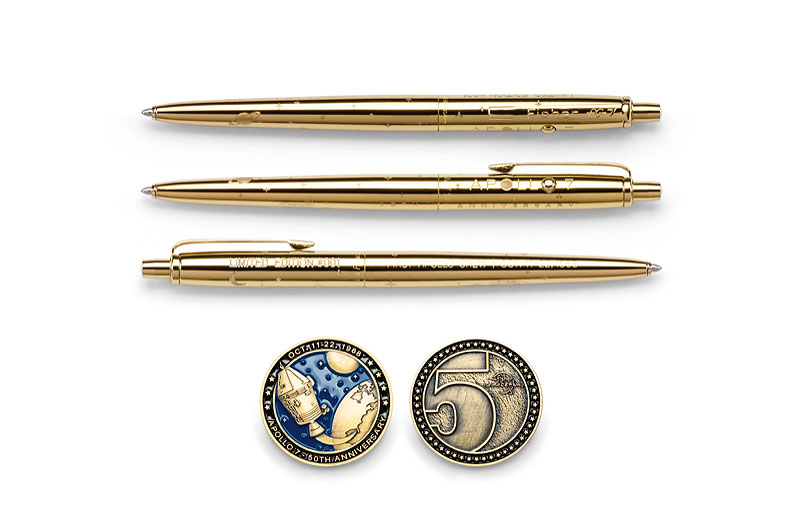
A 50th anniversary edition of the pen is now available to people who have a lot of money and love gold stuff. It’s $500, a limited edition of 500, and made of “gold titanium nitride plated brass,” and it comes with a case and commemorative plaque with a quote from Cunningham:

“Fifty years ago, I flew with the first flown Space Pen on Apollo 7. I relied on it then, and it’s still the only pen I rely on here on Earth.”

Okay, that’s pretty cool. Presumably astronauts get a lifetime supply of these things, though.

Here’s to the Fisher space pen, an example of American ingenuity and simple, reliable good design that’s persisted in use and pop culture for half a century.

18 Oct 2018

Knotch launches Blueprint to help marketers find the best publishers of sponsored content

When I last wrote about Knotch, the company had just patented its color-based feedback system that helps advertisers measure the effectiveness of their sponsored content.

Since then, it’s added a competitive intelligence product and now Blueprint, a tool for marketers who want to find the best topics, formats and partners to reach their desired audience.

Lara Vandenberg, Knotch’s senior vice president of marketing and communications, told me that agencies had been asking the company to recommend of which publishers to work with, so Blueprint is meant to meet that need. She described it as both “this ultimate content planning product” and as “a predictive matchmaker for brands as content becomes so much more of a focus.”

To accomplish this, she said Knotch is scouring the web for sponsored content, then automatically identifying elements like content, themes and trends.

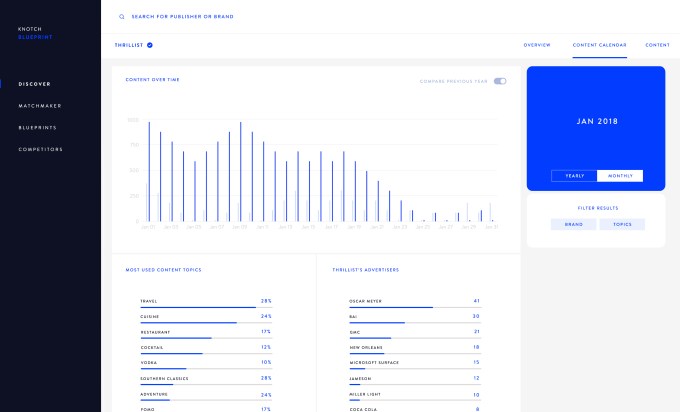
Knotch Blueprint

Marketers can then access this data by browsing through different themes and publishers. They can also search based on the audience and metrics that they’re looking for, and Blueprint will recommend publishers who seem like a good fit.  Blueprint offers detailed about publishers, like how often they’re publishing sponsored content, who their advertisers are and what kind of response they’re getting.

In some cases, marketers can even click a button to send a message directly to the publisher’s sales team.

The initial brands using Blueprint include JP Morgan Chase and Ford. Vandenberg said the product will only be monetized on the brand side, but publishers can also claim their profiles, turning them into “verified” accounts where Knotch measures their sponsored content directly.

“The idea is for Knotch to be with a brand at every phase of the content cycle, except for the creating,” Vandenberg said. That means the company wants to be involved in “the measurement, the optimization, the distribution, the planning.”

18 Oct 2018

Amazon says it will add 1,000 more employees in the UK, bringing the total to 28,500, bucking the Brexit chill

A lot of uncertainty hangs over the UK as continues its slow march out of the European Union, but today one of the world’s biggest companies announced plans to expand its presence in the country. Amazon today said it would add another 1,000 workers in the UK, including establishing its first corporate and R&D office in Manchester.

Amazon said it also plans to add more people to its R&D bases in Edinburgh and Cambridge — respectively known for developing search technology as well as the AI technology that powers Alexa, among other things. The company says it currently has 27,500 “roles” in the UK.

The government is positioning Amazon’s news as a win at a time when many have been criticising how it has been handling Brexit negotiations. “Ensuring that the world’s best and brightest companies continue to invest and innovate in the UK is at the heart of our Global Britain agenda,” said Secretary of State for International Trade, Liam Fox, in a statement. “Amazon’s decision to create hundreds of highly-skilled jobs in Manchester, Edinburgh and Cambridge is an enormous vote of confidence in the UK and a signal to the world that the UK is very much open for business.”

The news was announced today as the company presented an “Innovation Day” to journalists, showcasing some of the different areas that are the focus of its R&D hubs in Austria, France, Germany, Ireland, Italy, Luxembourg, Netherlands, Poland, Romania, Spain and the UK. I was at the event, and while I wouldn’t say that the day was strong on news announcements around that work, it’s instructive to consider what Amazon chose to show (and perhaps not show, too).

For example, in one demo the company showed off today, a new computer vision-based system Amazon is building in Berlin will allow robots to identify what produce is ripe or rotten, so that automatic pickers can select more robust fruit and vegetables to pack off to consumers; and identify what needs to be discarded. This underscores the company’s ambitions in the business of fresh food sales and delivery. Earlier this summer there were reports that Amazon was interested in bidding for a number of large retail locations that were due to be shut down by Homebase, a DIY chain, so that it could set up more delivery (or perhaps even retail) spots across key UK cities. However, so far nothing has materialised.

A walk through some of the company’s transportation work, meanwhile, focused more incremental developments rather than fundamental shifts for the company. The focus in the presentation was not on drones (which Amazon has also been building in Europe), nor on autonomous cars (which Amazon is also working on) but on its real-time street navigation services, and other tools to help delivery people make more accurate parcel drops.

While Amazon is continuing to add employees in the UK, it has also had its share of employment controversies. Warehouse workers regularly strike during the company’s busiest sales periods, to protest working conditions. And earlier this month, Reuters reported that the company had built an AI prototype to assist with finding and screening suitable candidates to help make its hiring spree more efficient. But the project had to be scrapped after it was found to be biased against women (highlighting some of the problems with “training” in machine learning). 

The company is also among the tech giants that might finally be held to task over taxes, although the issue has become very long in the tooth over the years that it has not been resolved. In the latest development, the EU commissioner who oversees taxes said that he was working to a deal that could be finalised before the end of this year, which could bring in about €5 billion in tax revenues from companies like Amazon, Google and Facebook, based on their “digital” presence rather than physical presence — the loophole that has kept American internet companies from paying large taxes on their profits up to now. However, if a deal isn’t reached soon, it could be pushed back by a year, since Brexit is expected to sidetrack everything in 2019.


18 Oct 2018

Disruptive technology and organized religion

More or less since Nietzsche declared God “dead” nearly 140 years ago, popular wisdom has held that science and religion are irreparably misaligned. However, at a recent conference hosted by the Vatican, I learned that even in the era of artificial intelligence and gene splicing, religious institutions and leaders still have much to contribute to society as both moral compass and source of meaning.

In April this year, the Vatican launched Unite to Cure: A Global Health Care Initiative at the Fourth International Vatican Conference. This international event gathered some of the world’s leading scientists, physicians and ethicists — along with leaders of faith, government officials, businesspeople and philanthropists. The goal was to engage about the cultural, religious and societal implications of breakthrough technologies that improve human health, prevent disease and protect the environment. I had the privilege of participating as a board member of the XPRIZE Foundation.

We are living at a phenomenal point in human history. It’s a moment when our machines are flirting with godlike powers. AI and ever-accelerating innovations in medical technology are enabling humans to live longer than ever. Yet with increased machine capabilities and human longevity come heavy questions of morality and spirituality.

When bodies live longer, so do the souls inside of them. What are the spiritual implications for people who are given an additional 30 or even 50 years of life? Is enhanced longevity meddling with creation, or a complement to it?

As technology disrupts the way we relate to the few remaining physical and spiritual mysteries of humanity, it also disrupts the way we embrace religion.

It is here, at this nexus of technology and spirituality, that the Vatican wisely decided to bring together thinkers from both science and faith.

It was humbling to sit inside the tiny and unconventional country that we call Vatican City, surrounded by the world’s leading scientists, ethicists, venture capitalists and faith leaders. We talked about regenerative medicine, aging reversal, gene editing and cell therapy. We discussed how humanity is shifting from medicine that repairs and remediates toward a system that overtly changes our physical composition. We discussed the incredible augmentations available to the disabled — for example 3D-printed prosthetic limbs. How long before the able-bodied begin to exploit these enhancements to augment their own competitive advantage in an increasingly crowded world? To what extent, if any, should society attempt to control this paradigm shift?

One of the more interesting discussions surrounded how to ensure that humans don’t just live longer, but also better.

What exactly does “living better” entail? Does it imply physical comfort, spiritual well-being, financial security? At this moment in history, we have more instant and unlimited information than the kings and queens of ancient Greece or the Middle Ages could have ever imagined. That technological power is allowing more and more people to become enormously wealthy, at a speed and magnitude that would have been unthinkable for anyone other than a monarch just a century ago.

But are these people living “better”?

In as much as longer-living humans use their accrued wealth to support and encourage the creation of projects as audacious and ambitious as — for example — the Coliseum, I believe the answer is yes. If longevity and riches encourage the average human being to create change on a scale that matches the enormous potential of our exponential times — all the more so.

Yet, others in the room had a different take. For many religious leaders, “better” meant a more sharply defined relationship with God. For some scientists, “better” meant a life that creates fewer emissions and embraces better and smarter technology.

It was astounding, really. In one of the most hallowed spots on earth for the Catholic Church, sharing oxygen and ideas with cardinals and future saints, stood the world’s leading researchers, scientists and corporate leaders, who hold in their hands the technology to extend human life. Together with the clergy of the world’s great monotheistic religions, we held an open dialogue about how to improve the heart and soul of human life while the technology we create continues to advance beyond our ancestors’ wildest imaginations.

As technology disrupts the way we relate to the few remaining physical and spiritual mysteries of humanity, it also disrupts the way we embrace religion. In this conference, the Vatican very correctly leveraged the opportunity for organized religions to disrupt themselves by thinking about how they can be meaningful contributors to the conversation on spiritual, physical and mental well-being in the future.

18 Oct 2018

6D.ai opens up its beta

After wrestling for more than a decade with the development of a technology that would create a three-dimensional map of the physical world, the team at 6D.ai is finally ready to open up to developers its toolkit that the company says has done exactly that.

When company chief executive Matt Miesnieks announced the launch of 6D in March, he laid out a vision for its growth that had three goals: The company would build APIs to capture the three-dimensional geometry of the world; it would apply that three-dimensional data to build semantic APIs so applications can understand the world; and it would partner and extend those APIs to create an operating system for reality.

Having achieved the first goal, the company is now working on the second.

“The whole purpose of this company wasn’t ‘Hey there’s this new technology!’ It’s what can AR do in its fully realized form and what is a native experience for AR that hadn’t worked in prior mediums and what’s stopping that stuff from being effective and how do you solve those problems,” says Miesnieks.

For Miesnieks the problems confronting augmented reality come down to creating believable visual objects that integrate seamlessly into the world. That act of creation depends on persistence, occlusion and interaction, according to Miesnieks.

Interactivity, to Miesnieks should happen seamlessly rather than requiring a multi-step process that the 6D chief executive calls “just a bridge too far.”

“What needs to happen is you say, ‘Hey join my game.’ And it just works.”

Miesnieks argues that the kind of precision that synchronization requires demands a kind of on-device localization, which is exactly what 6D has claimed it enables.

“Once you have that 3D model then the virtual content can bounce off the 3D model. You can do shadows correctly. Extend that over large areas so that it doesn’t just work in a corner of my living room, but that it can work everywhere,” Miesnieks said. “We need these models and the only way to get there is to use a depth camera or offline photogrammetry.”

6D has already done some work with bands like Massive Attack and Aphex Twin that put its technology through some early paces. And the Victoria and Albert Museum have also used the technology. Soon it will launch a game with an undisclosed Japanese game developer (which has intellectual property similar to Pokémon) and a virtual YouTube-like application with the Japanese social network, Gree.

For Miesnieks perhaps the most interesting application is with a big, undisclosed transportation company that is interested in navigation for terrestrial and other mobility.

“When we set the company up, we are pretty convicted that we want to say to the developers that this is reality. We will give you shared coordinates for multi-player,” said Miesnieks.

Underlying all of this are concerns about security related to who can see what in the space that users map. But Miesnieks said that the company had solved that problem as well.

“You can only get the data for a space if you’re physically in that space,” said Miesnieks. “I hold my phone up, it looks at your living room, based on what it sees it queries the server and if there’s a match it will serve that data up to that location.”

Based on research, the point cloud that 6D generates isn’t directly connected to the geographic structure. It’s slightly randomized so a user can’t look at the point cloud and see what is what.

“It’s unable to be reverse engineered by any known science into a human readable image,” said Miesnieks. “All the image would look like is a whole bunch of dots and blobs. That’s kind of what we’re doing so far.”

As the company builds out its three-dimensional map of the world, it’s encouraging developers to think of it as a new kind of augmented reality platform.

“Our business is web services meet Waze,” said Miesnieks.

18 Oct 2018

MoviePass is under investigation for securities fraud in New York state

More bad news for MoviePass .

At the direction of New York Attorney General Barbara Underwood, MoviePass parent company Helios and Matheson is now the subject of a fraud probe in New York state.

“We’ve launched a securities fraud investigation into ⁦@MoviePass⁩’ parent company,” Underwood confirmed in a tweet. “My office is committed to protecting New York investors and the integrity of our financial markets.”

The probe will examine whether the company misrepresented its financial situation to investors. The probe will leverage the Martin Act, a powerful New York statute that allows the Attorney General to aggressively pursue suspected instances of fraud in the state.

“We are aware of the New York Attorney General’s inquiry and are fully cooperating,” Helios and Matheson said in a statement provided to TechCrunch. “We believe our public disclosures have been complete, timely and truthful and we have not misled investors. We look forward to the opportunity to demonstrate that to the New York Attorney General.”

Underwood’s office declined to provide further details to TechCrunch, pointing us toward the CNBC report that originally reported the probe.

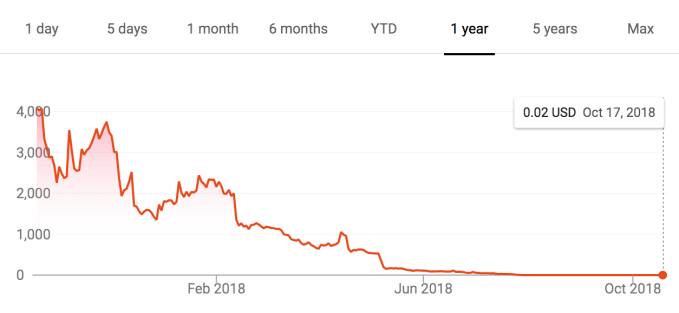
MoviePass and parent company Helios and Matheson (HMNY) has flailed wildly throughout 2018, abruptly making major changes to the movie subscription service, watching its stock prices walk off a cliff and seeking emergency infusions of cash in the process.

In Q2, Helios and Matheson posted losses of $126.6 million compared to a net loss of roughly $150 million in all of 2017. Its 2017 losses were attributed to its acquisition of a majority stake in MoviePass, but the 2018 losses are obviously a different story. Shares of Helios and Matheson were down 8.5% at the time of writing.

18 Oct 2018

Uber is developing an on-demand staffing business

Uber is reportedly developing a short-term staffing business to offer 1099 independent contractors for events and corporate functions, the Financial Times first reported. Dubbed Uber Works, the service would provide waiters, security guards and other temporary staffers to business partners, a source close to Uber told TechCrunch.

Uber has been working on the project for several months in Chicago, after first trialing the project in Los Angeles. Uber already has a vast network of drivers — all of whom have become familiarized with the process of filing taxes as an independent contractor — who may be looking for additional work. However, Uber’s current pilot program does not include active Uber drivers.

Uber Works falls under the purview of Rachel Holt, who stepped into the role of head of new modalities in June. Holt, who has been with Uber since 2011, is tasked with ramping up and onboarding new mobility services like bikes, scooters, car rentals and public transit integration.

In a job posting for a general manager to lead special projects in Chicago, Uber says, “our business is based around providing a flexible, on-demand supply for our business partners – it’s imperative that we have intuitive and responsive account management to support for our business partners in addressing their needs promptly.”

Uber declined to comment for this story. But as the company gears up for its initial public offering next year, Uber is clearly trying to diversify its business. In the last year, Uber double-downed on multi-modal transportation with the acquisition and deployment of JUMP bike-share. And in the last month, Uber deployed electric scooters in Santa Monica, Calif.

Whether this effort launches remains to be seen, but it’s certainly something Uber is exploring and positioning as a business-to-business service. In a similar vein, Uber is also working to create a pipeline to hire some of its driver partners.