Month: October 2018

18 Oct 2018

Square unveils the Square Terminal, designed to replace old keypad credit card machines

Square is launching a new piece of hardware today — the Square Terminal.

As explained to me by the company’s Head of Hardware Jesse Dorogusker, the Terminal fills a gap the company’s product lineup — unlike the basic card reader, it provides an all-in-one hardware experience (no phone or tablet required), but more affordable than the Square Register.

Dorogusker suggested that it’s really designed to replace the “outdated” credit card terminals that you’ll encounter in all kinds of stores (like the gray block that sits on the counter of my local bodega). He argued that these terminals often come with onerous contracts for the business owner, and they’re not a great experience for consumers, either.

The new Terminal, on the other hand, provides a more Square -like experience. For one thing, it works with WiFi and is powered by an all-day battery, so it can be carried around the store and handed over to customers.

“One of the really fun things we realized about this product is that in addition to having Square Payments built-in, it unlocks people to use it in new ways,” Dorogusker said.

For example, he said the beta testers included a restaurant that can now process payments at the customer’s table, a salon that allows customers to pay while they’re still in their chair and a plastic surgeon whose patients can go through the bill while in the privacy of the treatment room.

Dorogusker acknowledged that restaurants in some countries are already bringing wireless card terminals to customers’ tables, but he said that they don’t have the other advantages of a Square Terminal, like a display that allows you to see the price of every item you’re buying. Plus, there’s the ability to accept payments from smartphones and other devices through Apple Pay and Google Pay, and there’s Square’s two-second processing time for chip cards.

Square Terminal costs $399. Businesses that are new to Square and that order now will also receive a $300 processing credit. With or without the credit, Square will process those payments on the same simple terms it offers to everyone else — 2.6 percent, plus 10 cents for each transaction.

18 Oct 2018

Embracing multimodality, Uber pioneers ride recommendations

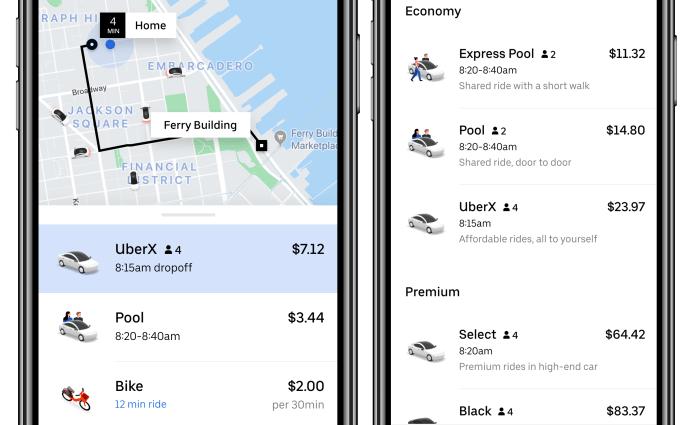
For the first time, Uber will make contextual, personalized suggestions about the best way to get from point A to point B. The startup offers more than just cars now, and it’s starting to understand the tradeoffs between price, speed, convenience, and comfort amidst its multi-modal fleet. Most noticeably, you’ll now see JUMP bikes get premier billing right alongside Uber’s other vehicles. Going a short distance and there’s a charged up bike nearby? Uber will suggest you pedal. Might need extra room for luggage on your way to the airport? UberXL and SUV will appear. Always take cheap Pools? It won’t show you a pricier Black car.

Uber is finally getting smart. It has to if it’s going to make sense of its growing patchwork of ride types without overwhelming passengers with too many options. Uber’s algorithm can help them choose. “We think there’s a lot to be gained by being a one-stop shop to get somewhere” says Uber director of product Nundu Janakiram.

Uber now dynamically recommends different ride types

In particular, Uber could block disruption by scooter-specific startups like Spin, Bird, or Skip. If those apps have no vehicles nearby or you’re going to far, they’ve got nothing to offer. But Uber can provide a competitively priced Express Pool when there’s no open-air ride available, while convincing its existing UberX riders to try a bike or scooter for quick trips when congestion is thick thanks to its new in-house traffic estimates.

Uber Director Of Product Nundu Janakiram

Previously, you’d get a static set of three ride options from the price class you booked from last, regardless of your destination. Meanwhile, bikes and scooters were buried in Uber’s hamburger menu sidebar or an awkward toggle at the top of the screen. The company hans’t done a good job of communicating the definition of Select (nicer normal-sized cars) or Express Pool (walk and wait for a discount) either.

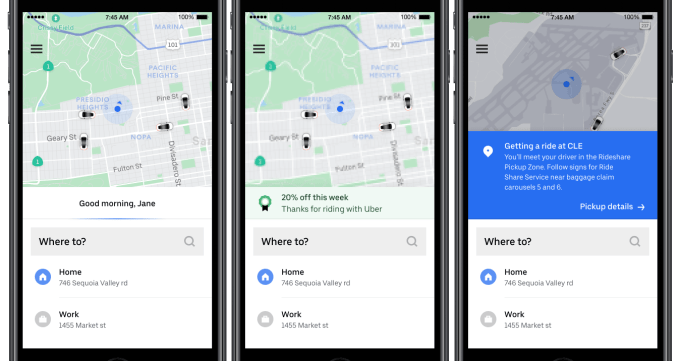
Now Uber’s homescreen can cherry pick the most relevant ride suggestions from across all price classes and vehicle types based on your trip length, destination type, and your personal ride history. Along with better explanations of the different options, this could get users experimenting with modes they’d never tried before.

To make room for more recommendations, the Uber Pool option will unfold to offer both Pools and Express Pools. Uber will even point you to nicer vehicles like Black cars or XLs if UberX is surging to the point that their prices are similar. If you want to compare all the options manually, you can tap to see a list with all the specs and prices lined up.

Beyond ride recommendations, Uber is moving the address bar to the bottom of the screen so its closer to your thumbs (which is great as phones keep getting bigger). Finally, in the coming weeks Uber will add a dynamic message bar to the center of the homescreen. Here depending on your pickup and drop off, it could show instructions for hailing from an airport, a discount offer, a birthday message, or just a friendly “Good Morning”. 

Eventually, Uber hopes to integrate public transportation ticketing like through its partner Masabi, car rentals, and even multi-leg trips into its recommendations. Maybe a JUMP bike to the train, then an UberPool that’s waiting to take you to your final destination is quicker and cheaper than any one mode alone. If you’re looking at an hour-plus Uber, it might cost less to just rent a car through its partner GetAround and drive yourself. And if a scooter is by far the best ride for you but all of Ubers are rented out, it could recommend one from its partner Lime.

A new communication box is coming to the center of Uber’s homescreen

Uber’s data shows users are rapidly embracing the multi-modal future. A study found the introduction of JUMP bikes to one city led to a 15 percent increase in total Uber + JUMP trips, even though Uber use dropped 10 to 15 percent.

Even if Uber sometimes cannibalizes itself by recommending cheaper options, it’s a smart long-term strategy. Janakiram laughs that “If we wanted to optimize for revenue, we wouldn’t have shown UberX, Pool, and Express Pool first for every user for the last few years.” The lifetime value of ridesharing users is so high that’s worth losing a couple of bucks here or there to keep users from straying to multi-modal competitors like Lyft. Retention will be a key metric under scrutiny as it eyes a 2019 IPO at a potential $120 billion valuation.

“The big picture is that we want your phone to replace your personal car” Janakiram concludes. “If we want to be a true transportation platform, we need to be everywhere our riders need to be as well. The right ride for the right context, and what’s the right ride for you.”

[Disclosure: Uber’s Janakiram and I briefly lived in the same three-bedroom apartment 5 years ago, though I’d already agreed to write about the redesign when I found out he was involved.]

18 Oct 2018

Embracing multimodality, Uber pioneers ride recommendations

For the first time, Uber will make contextual, personalized suggestions about the best way to get from point A to point B. The startup offers more than just cars now, and it’s starting to understand the tradeoffs between price, speed, convenience, and comfort amidst its multi-modal fleet. Most noticeably, you’ll now see JUMP bikes get premier billing right alongside Uber’s other vehicles. Going a short distance and there’s a charged up bike nearby? Uber will suggest you pedal. Might need extra room for luggage on your way to the airport? UberXL and SUV will appear. Always take cheap Pools? It won’t show you a pricier Black car.

Uber is finally getting smart. It has to if it’s going to make sense of its growing patchwork of ride types without overwhelming passengers with too many options. Uber’s algorithm can help them choose. “We think there’s a lot to be gained by being a one-stop shop to get somewhere” says Uber director of product Nundu Janakiram.

Uber now dynamically recommends different ride types

In particular, Uber could block disruption by scooter-specific startups like Spin, Bird, or Skip. If those apps have no vehicles nearby or you’re going to far, they’ve got nothing to offer. But Uber can provide a competitively priced Express Pool when there’s no open-air ride available, while convincing its existing UberX riders to try a bike or scooter for quick trips when congestion is thick thanks to its new in-house traffic estimates.

Uber Director Of Product Nundu Janakiram

Previously, you’d get a static set of three ride options from the price class you booked from last, regardless of your destination. Meanwhile, bikes and scooters were buried in Uber’s hamburger menu sidebar or an awkward toggle at the top of the screen. The company hans’t done a good job of communicating the definition of Select (nicer normal-sized cars) or Express Pool (walk and wait for a discount) either.

Now Uber’s homescreen can cherry pick the most relevant ride suggestions from across all price classes and vehicle types based on your trip length, destination type, and your personal ride history. Along with better explanations of the different options, this could get users experimenting with modes they’d never tried before.

To make room for more recommendations, the Uber Pool option will unfold to offer both Pools and Express Pools. Uber will even point you to nicer vehicles like Black cars or XLs if UberX is surging to the point that their prices are similar. If you want to compare all the options manually, you can tap to see a list with all the specs and prices lined up.

Beyond ride recommendations, Uber is moving the address bar to the bottom of the screen so its closer to your thumbs (which is great as phones keep getting bigger). Finally, in the coming weeks Uber will add a dynamic message bar to the center of the homescreen. Here depending on your pickup and drop off, it could show instructions for hailing from an airport, a discount offer, a birthday message, or just a friendly “Good Morning”. 

Eventually, Uber hopes to integrate public transportation ticketing like through its partner Masabi, car rentals, and even multi-leg trips into its recommendations. Maybe a JUMP bike to the train, then an UberPool that’s waiting to take you to your final destination is quicker and cheaper than any one mode alone. If you’re looking at an hour-plus Uber, it might cost less to just rent a car through its partner GetAround and drive yourself. And if a scooter is by far the best ride for you but all of Ubers are rented out, it could recommend one from its partner Lime.

A new communication box is coming to the center of Uber’s homescreen

Uber’s data shows users are rapidly embracing the multi-modal future. A study found the introduction of JUMP bikes to one city led to a 15 percent increase in total Uber + JUMP trips, even though Uber use dropped 10 to 15 percent.

Even if Uber sometimes cannibalizes itself by recommending cheaper options, it’s a smart long-term strategy. Janakiram laughs that “If we wanted to optimize for revenue, we wouldn’t have shown UberX, Pool, and Express Pool first for every user for the last few years.” The lifetime value of ridesharing users is so high that’s worth losing a couple of bucks here or there to keep users from straying to multi-modal competitors like Lyft. Retention will be a key metric under scrutiny as it eyes a 2019 IPO at a potential $120 billion valuation.

“The big picture is that we want your phone to replace your personal car” Janakiram concludes. “If we want to be a true transportation platform, we need to be everywhere our riders need to be as well. The right ride for the right context, and what’s the right ride for you.”

[Disclosure: Uber’s Janakiram and I briefly lived in the same three-bedroom apartment 5 years ago, though I’d already agreed to write about the redesign when I found out he was involved.]

18 Oct 2018

Google launches compose actions to streamline access to SaaS apps in Gmail

Lately, Google has been all about shaving time off your everyday activities when sending emails. First they came out with smart responses that let you choose among several (sometimes) logical responses to the email. Next was type ahead, which guesses what you might want to type with remarkable accuracy. Today the company announced the general availability of compose actions, another way to save you a little time.

These connectors, which are part of the company’s G Suite business offering, link to your favorite SaaS applications like Box, Dropbox, Egnyte and Atlassian Jira and let you work on these service in the context of the email. Software companies have been stressing ways to keep you in the flow of your work without switching focus and that’s precisely what compose actions have been designed to do.

“Compose actions make it easy for you to add attachments, reference records, or liven up your messages with content from your favorite third-party apps right as you draft your message in Gmail,” Aakash Sahney, Google’s product manager for Gmail and Chat wrote in a blog post announcing the new feature.

You start by connecting your service of choice in G Suite using the Gmail Add-on tool. Google created Gmail Add-ons to make it simpler to integrate these third-party tools into the Gmail workflow. Once you authorize the tool, it will now appear as an option in your compose window, giving you direct access to the content without leaving Gmail. G Suite admins can create a list of authorized apps if they wish to limit the integrations to sanctioned services.

If you want to incorporate a file or folder from Box, Dropbox or Egnyte, authorize the app and then you can click the compose action that appears in the email compose window to access the service and pull in a file.

Gif: Google

With the Atlassian integration, you can insert a project file directly in the email.

Gif: Google

This may not seem like much, but it’s all in the service of reducing keystrokes and actions that tend to add up in terms of time spent over the course of a day. Instead of opening your content provider’s service, navigating or searching to the content, copying it and then pasting into the email, you can simply click the compose action and access the service directly from Gmail.

Compose actions were first announced at the Google Cloud Next conference in July. They are available for G Suite subscribers starting today.

18 Oct 2018

Google launches compose actions to streamline access to SaaS apps in Gmail

Lately, Google has been all about shaving time off your everyday activities when sending emails. First they came out with smart responses that let you choose among several (sometimes) logical responses to the email. Next was type ahead, which guesses what you might want to type with remarkable accuracy. Today the company announced the general availability of compose actions, another way to save you a little time.

These connectors, which are part of the company’s G Suite business offering, link to your favorite SaaS applications like Box, Dropbox, Egnyte and Atlassian Jira and let you work on these service in the context of the email. Software companies have been stressing ways to keep you in the flow of your work without switching focus and that’s precisely what compose actions have been designed to do.

“Compose actions make it easy for you to add attachments, reference records, or liven up your messages with content from your favorite third-party apps right as you draft your message in Gmail,” Aakash Sahney, Google’s product manager for Gmail and Chat wrote in a blog post announcing the new feature.

You start by connecting your service of choice in G Suite using the Gmail Add-on tool. Google created Gmail Add-ons to make it simpler to integrate these third-party tools into the Gmail workflow. Once you authorize the tool, it will now appear as an option in your compose window, giving you direct access to the content without leaving Gmail. G Suite admins can create a list of authorized apps if they wish to limit the integrations to sanctioned services.

If you want to incorporate a file or folder from Box, Dropbox or Egnyte, authorize the app and then you can click the compose action that appears in the email compose window to access the service and pull in a file.

Gif: Google

With the Atlassian integration, you can insert a project file directly in the email.

Gif: Google

This may not seem like much, but it’s all in the service of reducing keystrokes and actions that tend to add up in terms of time spent over the course of a day. Instead of opening your content provider’s service, navigating or searching to the content, copying it and then pasting into the email, you can simply click the compose action and access the service directly from Gmail.

Compose actions were first announced at the Google Cloud Next conference in July. They are available for G Suite subscribers starting today.

18 Oct 2018

Future Family raises $10M to make fertility treatments more affordable

Future Family, a startup that helps families more easily afford fertility services like IVF and egg freezing, has raised $10 million in a Series A round.

Just weeks back, Future Family switched up its offerings to feel less like a loan, and more like a monthly subscription. The end results might seem pretty similar — with both, customers get the services they need without having to cough up a big pile of cash up front — but the monthly subscription approach has a big advantage: flexibility. If a customer realizes a few months in that additional fertility services are needed, the cost can just be wrapped right into the monthly plan on the fly.

The company’s fertility offerings start at $195 a month (for 60 months) for a plan that pairs you with a clinic and concierge to help you start navigating, while $250 a month (for 60 months) covers the cost of lab work, medication, clinic visits and the IVF procedure.

Future Family CEO Claire Tomkins tells me that this Series A will largely go toward expanding their monthly subscription offerings, as well as expanding the number of fertility clinics they partner with. The company had previously raised around $4.2 million.

Future Family was born out of Claire Tomkins’ own experiences with the complexities and costs of fertility treatments. After spending hundreds of thousands of dollars on treatments involved with having her first child (with much of the cost coming as a surprise only revealed once the process had begun), Claire set out to build a better way. Future Family partners with clinics to work out all the pricing ahead of time and pays the bill upfront, ensuring there are no billing surprises down the road.

This round was led by Aspect Ventures, and backed by iNovia, BBG, Ulu Ventures, LaunchCapital and Portfolia. As part of the deal, Aspect Venture’s Lauren Kolodny will join Future Family’s board of directors.

18 Oct 2018

Future Family raises $10M to make fertility treatments more affordable

Future Family, a startup that helps families more easily afford fertility services like IVF and egg freezing, has raised $10 million in a Series A round.

Just weeks back, Future Family switched up its offerings to feel less like a loan, and more like a monthly subscription. The end results might seem pretty similar — with both, customers get the services they need without having to cough up a big pile of cash up front — but the monthly subscription approach has a big advantage: flexibility. If a customer realizes a few months in that additional fertility services are needed, the cost can just be wrapped right into the monthly plan on the fly.

The company’s fertility offerings start at $195 a month (for 60 months) for a plan that pairs you with a clinic and concierge to help you start navigating, while $250 a month (for 60 months) covers the cost of lab work, medication, clinic visits and the IVF procedure.

Future Family CEO Claire Tomkins tells me that this Series A will largely go toward expanding their monthly subscription offerings, as well as expanding the number of fertility clinics they partner with. The company had previously raised around $4.2 million.

Future Family was born out of Claire Tomkins’ own experiences with the complexities and costs of fertility treatments. After spending hundreds of thousands of dollars on treatments involved with having her first child (with much of the cost coming as a surprise only revealed once the process had begun), Claire set out to build a better way. Future Family partners with clinics to work out all the pricing ahead of time and pays the bill upfront, ensuring there are no billing surprises down the road.

This round was led by Aspect Ventures, and backed by iNovia, BBG, Ulu Ventures, LaunchCapital and Portfolia. As part of the deal, Aspect Venture’s Lauren Kolodny will join Future Family’s board of directors.

18 Oct 2018

Call for social media adtech to be probed by UK competition watchdog

A British Conservative politician, who has called repeatedly for Mark Zuckerberg to come to parliament to answer questions about how Facebook fences fake news — only to be repeatedly rebuffed — has made a public call for the UK’s competition regulator to look into social media giants’ adtech operations.

Damian Collins, the chair of the DCMS committee which has spent months this year asking questions about how disinformation spreads online — culminating in a report, this summer, recommending the government impose a levy on social media to defend democracy — made the suggestion in a tweet that references a news article reporting on a U.S. class action lawsuit against Facebook.

Advertisers in the US lawsuit allege Facebook knowingly inflated video viewing stats and thus mislead them into spending more money on its ad platform than they otherwise would have.

But Facebook disputes the allegations, saying the lawsuit is “without merit”. It has also filed a motion to dismiss the claims of ad fraud.

Although, two years ago, it did ‘fess up to a ‘miscalculation’ around average video viewing times, saying it had mistakenly discounted all the people who dropped out of watching a video in the first 3 seconds in calculating averages — thereby bumping viewing averages up.

At about the same time, it also said it had discovered some other ad-related bugs and errors in its system that had led to the wrong numbers being reported across four products, including Instant Articles, video and Page Insights.

The advertisers in the class action lawsuit — which was filed back in 2016 — had originally claimed Facebook engaged in unfair business practices. After receiving tens of thousands of documents in relation to the case they amended their complaint to accuse the company of fraud, CBS reports.

In its statement denying the suit’s claims, Facebook also said: “Suggestions that we in any way tried to hide this issue from our partners are false. We told our customers about the error when we discovered it — and updated our help center to explain the issue.” 

The company declined to comment on Collins’ remarks about adtech industry practices today.

A spokeswoman for the UK’s Competition and Markets Authority (CMA) also declined to comment when asked whether it has any concerns related to practices in the adtech sector.

Given market sensitivity to regulatory action it’s normal for the CMA to not want to stoke any speculation around a particular company.

For the same reason it would not normally discuss any complaints it’s received until the point of actually launching any investigation.

However this is not the first time the CMA has been urged by concerned politicians to investigate the adtech sector.

This fall another UK committee, the Lords Select Committee on Communications, directly asked the body to investigate digital advertising.

And earlier this month the CMA’s CEO, Andrea Coscelli, told the committee it is indeed considering doing so, if only it can carve out the resources to do so — saying he was worried about “potential gaps” in the regulatory framework around competition and consumer issues.

“A month ago, this Committee asked us to look at digital advertising. That is something we are actively considering, subject to Brexit in the next few weeks, because it has a big resource implication for us,” said Coscelli on October 9. “It is certainly something where we are interested in getting involved. If we did, we would work closely with Ofcom and give serious thought to the regulatory framework in that context.”

The CMA has also generally been ramping up its activity on the digital market front, recently spinning up a new data unit and appointing a chief data and digital insights officer, Stefan Hunt, hired in from the Financial Conduct Authority — to help it “develop and deliver an effective data and digital insight strategy… to better understand the impact that data, machine learning and other algorithms have on markets and people”.

So it sounds like a case of ‘watch this regulatory space’ for more action at the very least.

Elsewhere in Europe competition regulators have also been paying closer attention to the adtech industry in recent years — examining a variety of practices by adtech giants, Facebook and Google, and coming away with a range of antitrust-related concerns.

In preliminary findings at the end of last year, for example, Germany’s Federal Cartel Office accused Facebook of using its size to strong-arm users into handing over data.

While, earlier this year, the French Competition Authority suggested it was planning to investigate Facebook and Google‘s dominance of the adtech market, publishing a report in which it identified a raft of problematic behaviors — and pointed out that the two companies act as both publishers and technical intermediaries for advertisers, thereby gaining a competitive advantage.

Italian regulators have also been probing competition concerns related to big data for more than a year.

As we’ve reported before, the European Commission is also actively eyeing digital platforms’ market power — and looking to reshape competition policy to take account of how tech giants are able to draw on network effects and leverage their position from one market to another.

And when you’re talking about platform power, you are also — in the current era — talking about adtech.

There’s no doubt closer scrutiny of the digital advertising sector is coming. And with a brighter spotlight, tighter accountability screws applied to its practices.

Privacy reviews of adtech platforms have already raised plenty of ethical questions, in addition to flagging actual violations of the law.

This summer the UK’s data protection watchdog also called for an ethical pause of the use of social media ads for political purposes, writing that: “It is important that there is greater and genuine transparency about the use of such techniques to ensure that people have control over their own data and that the law is upheld.”

So while it remains to be seen what any competition investigations of the adtech sector will conclude, political momentum is building to increase transparency and ensure accountability — which makes regulation more likely.


18 Oct 2018

Call for social media adtech to be probed by UK competition watchdog

A British Conservative politician, who has called repeatedly for Mark Zuckerberg to come to parliament to answer questions about how Facebook fences fake news — only to be repeatedly rebuffed — has made a public call for the UK’s competition regulator to look into social media giants’ adtech operations.

Damian Collins, the chair of the DCMS committee which has spent months this year asking questions about how disinformation spreads online — culminating in a report, this summer, recommending the government impose a levy on social media to defend democracy — made the suggestion in a tweet that references a news article reporting on a U.S. class action lawsuit against Facebook.

Advertisers in the US lawsuit allege Facebook knowingly inflated video viewing stats and thus mislead them into spending more money on its ad platform than they otherwise would have.

But Facebook disputes the allegations, saying the lawsuit is “without merit”. It has also filed a motion to dismiss the claims of ad fraud.

Although, two years ago, it did ‘fess up to a ‘miscalculation’ around average video viewing times, saying it had mistakenly discounted all the people who dropped out of watching a video in the first 3 seconds in calculating averages — thereby bumping viewing averages up.

At about the same time, it also said it had discovered some other ad-related bugs and errors in its system that had led to the wrong numbers being reported across four products, including Instant Articles, video and Page Insights.

The advertisers in the class action lawsuit — which was filed back in 2016 — had originally claimed Facebook engaged in unfair business practices. After receiving tens of thousands of documents in relation to the case they amended their complaint to accuse the company of fraud, CBS reports.

In its statement denying the suit’s claims, Facebook also said: “Suggestions that we in any way tried to hide this issue from our partners are false. We told our customers about the error when we discovered it — and updated our help center to explain the issue.” 

The company declined to comment on Collins’ remarks about adtech industry practices today.

A spokeswoman for the UK’s Competition and Markets Authority (CMA) also declined to comment when asked whether it has any concerns related to practices in the adtech sector.

Given market sensitivity to regulatory action it’s normal for the CMA to not want to stoke any speculation around a particular company.

For the same reason it would not normally discuss any complaints it’s received until the point of actually launching any investigation.

However this is not the first time the CMA has been urged by concerned politicians to investigate the adtech sector.

This fall another UK committee, the Lords Select Committee on Communications, directly asked the body to investigate digital advertising.

And earlier this month the CMA’s CEO, Andrea Coscelli, told the committee it is indeed considering doing so, if only it can carve out the resources to do so — saying he was worried about “potential gaps” in the regulatory framework around competition and consumer issues.

“A month ago, this Committee asked us to look at digital advertising. That is something we are actively considering, subject to Brexit in the next few weeks, because it has a big resource implication for us,” said Coscelli on October 9. “It is certainly something where we are interested in getting involved. If we did, we would work closely with Ofcom and give serious thought to the regulatory framework in that context.”

The CMA has also generally been ramping up its activity on the digital market front, recently spinning up a new data unit and appointing a chief data and digital insights officer, Stefan Hunt, hired in from the Financial Conduct Authority — to help it “develop and deliver an effective data and digital insight strategy… to better understand the impact that data, machine learning and other algorithms have on markets and people”.

So it sounds like a case of ‘watch this regulatory space’ for more action at the very least.

Elsewhere in Europe competition regulators have also been paying closer attention to the adtech industry in recent years — examining a variety of practices by adtech giants, Facebook and Google, and coming away with a range of antitrust-related concerns.

In preliminary findings at the end of last year, for example, Germany’s Federal Cartel Office accused Facebook of using its size to strong-arm users into handing over data.

While, earlier this year, the French Competition Authority suggested it was planning to investigate Facebook and Google‘s dominance of the adtech market, publishing a report in which it identified a raft of problematic behaviors — and pointed out that the two companies act as both publishers and technical intermediaries for advertisers, thereby gaining a competitive advantage.

Italian regulators have also been probing competition concerns related to big data for more than a year.

As we’ve reported before, the European Commission is also actively eyeing digital platforms’ market power — and looking to reshape competition policy to take account of how tech giants are able to draw on network effects and leverage their position from one market to another.

And when you’re talking about platform power, you are also — in the current era — talking about adtech.

There’s no doubt closer scrutiny of the digital advertising sector is coming. And with a brighter spotlight, tighter accountability screws applied to its practices.

Privacy reviews of adtech platforms have already raised plenty of ethical questions, in addition to flagging actual violations of the law.

This summer the UK’s data protection watchdog also called for an ethical pause of the use of social media ads for political purposes, writing that: “It is important that there is greater and genuine transparency about the use of such techniques to ensure that people have control over their own data and that the law is upheld.”

So while it remains to be seen what any competition investigations of the adtech sector will conclude, political momentum is building to increase transparency and ensure accountability — which makes regulation more likely.
18 Oct 2018

Alexa’s new Whisper Mode goes live

At Amazon’s Alexa event last month in Seattle, the company teased a new feature soon coming to its voice assistant: the ability to whisper. The company demonstrated how whispering a request – like “play a lullaby” – to Alexa would trigger the voice assistant to respond in kind. Today, Amazon says Whisper Mode is officially going live.

The feature is now rolling out to users in the U.S., the company tells us, and works in U.S. English.

It’s particularly useful around bedtime or nighttime scenarios, where you’re trying to keep the room quiet. And, of course, it’s especially helpful for parents, who don’t want to wake a sleeping child to command Alexa, or who are trying to set a more peaceful “bedtime,” “nap time,” or just generally “quiet time” tone to their interactions.

Whisper Mode is one of several features Amazon has been working on to make Alexa more context aware.
For example, the assistant knows that a command to “play Hunger Games” likely means launch the movie, if asked on a device with a screen, while the same command to an Echo speaker would start the audiobook instead.

Also at Amazon’s September event, the company showed off a forthcoming smart-home feature for Echo devices called “Alexa Guard.” This sound-detection technology will allow Alexa to recognize smoke alarm, carbon monoxide alarms, and the sounds of glass breaking.

Both Alexa Guard and Whisper Mode use a machine-learning network known as a “long short-term memory,” explained Alexa head scientist Rohit Prasad.

The incoming audio signals are broken into ultrashort snippets, and the long short-term memory network processes them in order, the company explained in September. The system also factors in its judgments about preceding snippets when trying to make a judgement as to whether a new snippet is a whisper or alarm. In this way, it can learn systematic relationships between segments of an audio signal that are separated in time, Amazon says. 

The company also showed off last month how Alexa voice interactions were becoming more natural through “context carryover” – meaning you could ask follow-up questions, like “how about tomorrow?” after first asking “will it rain today?”, for example.

And recently, it patented tech that would allow Alexa to tell if you’re sick, then offer to sell you meds – like cough drops. The system could also detect emotion, like joy, anger or sorrow, according to reports.

To check to see if Whisper Mode has reached your Alexa device, you’ll just have to try it out. It’s not a setting you can manually turn on or off.