Month: October 2018

18 Oct 2018

Alexa’s new Whisper Mode goes live

At Amazon’s Alexa event last month in Seattle, the company teased a new feature soon coming to its voice assistant: the ability to whisper. The company demonstrated how whispering a request – like “play a lullaby” – to Alexa would trigger the voice assistant to respond in kind. Today, Amazon says Whisper Mode is officially going live.

The feature is now rolling out to users in the U.S., the company tells us, and works in U.S. English.

It’s particularly useful around bedtime or nighttime scenarios, where you’re trying to keep the room quiet. And, of course, it’s especially helpful for parents, who don’t want to wake a sleeping child to command Alexa, or who are trying to set a more peaceful “bedtime,” “nap time,” or just generally “quiet time” tone to their interactions.

Whisper Mode is one of several features Amazon has been working on to make Alexa more context aware.
For example, the assistant knows that a command to “play Hunger Games” likely means launch the movie, if asked on a device with a screen, while the same command to an Echo speaker would start the audiobook instead.

Also at Amazon’s September event, the company showed off a forthcoming smart-home feature for Echo devices called “Alexa Guard.” This sound-detection technology will allow Alexa to recognize smoke alarm, carbon monoxide alarms, and the sounds of glass breaking.

Both Alexa Guard and Whisper Mode use a machine-learning network known as a “long short-term memory,” explained Alexa head scientist Rohit Prasad.

The incoming audio signals are broken into ultrashort snippets, and the long short-term memory network processes them in order, the company explained in September. The system also factors in its judgments about preceding snippets when trying to make a judgement as to whether a new snippet is a whisper or alarm. In this way, it can learn systematic relationships between segments of an audio signal that are separated in time, Amazon says. 

The company also showed off last month how Alexa voice interactions were becoming more natural through “context carryover” – meaning you could ask follow-up questions, like “how about tomorrow?” after first asking “will it rain today?”, for example.

And recently, it patented tech that would allow Alexa to tell if you’re sick, then offer to sell you meds – like cough drops. The system could also detect emotion, like joy, anger or sorrow, according to reports.

To check to see if Whisper Mode has reached your Alexa device, you’ll just have to try it out. It’s not a setting you can manually turn on or off.


18 Oct 2018

YouTube partners with Eventbrite to sell concert tickets on music videos

YouTube is extending its ticketing initiative, already live with Ticketmaster, with the new addition of Eventbrite. The partnership, which was announced this morning, will see Eventbrite listings for live music performances across the U.S. when watching YouTube Official Artist Channels. Beneath these videos will be show listings and a “Tickets” button which users can click to make purchases, across both YouTube on the desktop and in the YouTube app.

The video streaming site had first entered into the ticketing business late last year with a dealt to sell concert tickets on YouTube video pages, powered by Ticketmaster listings.

The launch had arrived at a time when Spotify and Apple Music were running away with the streaming music business in the U.S., while YouTube was still getting its own music competitor, YouTube Music, off the ground. However, the video site on its own has a massive reach beyond those who pay for its streaming music subscription. It announced in May some 1.8 billion logged-in users monthly – many of whom are watching music videos, of course.

YouTube has also recently ventured into other ways to monetize its videos, including through merchandise sales in partnership with Teespring, for example, as well as through channel memberships and Super Chat for top fans.

With the Eventbrite deal, YouTube says the integration will apply to thousands of artists with YouTube Official Artist Channels around the world, with Eventbrite show listings. However, the listings will focus on concerts in the U.S.

The company declined to say how ticket sale revenue was shared, or discuss other aspects of the deal’s terms.

With the addition, YouTube now covers more than 70% of the U.S. ticketing market, it says. The company plans to expand the feature to include more artists and venues across North America next, then expand the feature globally.

18 Oct 2018

YouTube partners with Eventbrite to sell concert tickets on music videos

YouTube is extending its ticketing initiative, already live with Ticketmaster, with the new addition of Eventbrite. The partnership, which was announced this morning, will see Eventbrite listings for live music performances across the U.S. when watching YouTube Official Artist Channels. Beneath these videos will be show listings and a “Tickets” button which users can click to make purchases, across both YouTube on the desktop and in the YouTube app.

The video streaming site had first entered into the ticketing business late last year with a dealt to sell concert tickets on YouTube video pages, powered by Ticketmaster listings.

The launch had arrived at a time when Spotify and Apple Music were running away with the streaming music business in the U.S., while YouTube was still getting its own music competitor, YouTube Music, off the ground. However, the video site on its own has a massive reach beyond those who pay for its streaming music subscription. It announced in May some 1.8 billion logged-in users monthly – many of whom are watching music videos, of course.

YouTube has also recently ventured into other ways to monetize its videos, including through merchandise sales in partnership with Teespring, for example, as well as through channel memberships and Super Chat for top fans.

With the Eventbrite deal, YouTube says the integration will apply to thousands of artists with YouTube Official Artist Channels around the world, with Eventbrite show listings. However, the listings will focus on concerts in the U.S.

The company declined to say how ticket sale revenue was shared, or discuss other aspects of the deal’s terms.

With the addition, YouTube now covers more than 70% of the U.S. ticketing market, it says. The company plans to expand the feature to include more artists and venues across North America next, then expand the feature globally.

18 Oct 2018

Amplifyher Ventures launches to fund startups led by women

Amplifyher Ventures is a new firm looking to invest in female founders.

Amplifyher was created by Tricia Black, Facebook’s former vice president of advertising sales. Since her time at Facebook (where she was the seventh employee), Black has been angel investing, and she also co-founded Victress Capital.

Black told me that Amplifyher allows her to build on her work as an individual investor and at Victress: “I really wanted … to build a team, to formally build my own brand.”

At Amplifyher, the investment team consists of Black and Meghan Cross Breeden, the former managing partner at Red Bear Angels, who also worked at director of communications at StyleCaster.

“We’re a great match,” Black said. “Meghan has done a ton of work on the operational side, I’m really engaged on the networking side … I think we’re going to find a nice balance between the two of us.”

There are other firms with a similar focus on female founders, including Female Founders Fund and BBG Ventures (which is backed by TechCrunch’s parent company Oath) . However, Cross Breeden said she was “completely enthusiastic about Tricia’s whole thesis — not just about seeding the founders, but arming them with both resources and capital to get from founder to CEO.”

Amplifyher Ventures

Tricia Black, Meghan Cross Breeden

Black and Cross Breeden pointed to stats suggested that there’s plenty more work to be done on this front — the share of female CEOs in the Fortune 500 dropped by 25 percent this year, while in 2017, only 2 percent of VC dollars are going to startups founded solely by women.

“We look at female founders not as necessarily under funded … but just an untapped opportunity,” Black said.

To that end, Amplifyher has raised what Black said is an “evergreen fund” that’s fully-financed to make 10 to 15 investments of $100,000 to $300,000 for the next three years.

Again, these should be startups led by woman — ideally with at least one female founder, but “if there’s a woman in the C-suite, that works for us,” Black said.

And while the firm isn’t focused on any specific industry, she noted, “We are … both marketers by trade, and I’ve invested in many direct-to-consumer brands.” They also expect most of their investments to be on the East Coast, particularly those in Boston and New York City (where Amplifyher is based).

“We’re building an entire ecosystem of women leaders,” Black added. “Through our personal networks, we’re not just making introductions between them, but really encouraging the sharing of ideas and expertise.”

18 Oct 2018

Atlassian launches the new Jira Software Cloud

Atlassian previewed the next generation of its hosted Jira Software project tracking tool earlier this year. Today, it’s available to all Jira users. To build the new Jira, Atlassian redesigned both the back-end stack and rethought the user experience from the ground up. That’s not an easy change, given how important Jira has become for virtually every company that develops software — and given that it is Atlassian’s flagship product. And with this launch, Atlassian is now focusing on its hosted version of Jira (which is hosted on AWS) and prioritizing that over the self-hosted server version.

So the new version of Jira that’s launching to all users today doesn’t just have a new, cleaner look, but more importantly, new functionality that allows for a more flexible workflow that’s less dependent on admins and gives more autonomy to teams (assuming the admins don’t turn those features off).

Because changes to such a popular tool are always going to upset at least some users, it’s worth noting at the outset that the old classic view isn’t going away. “It’s important to note that the next-gen experience will not replace our classic experience, which millions of users are happily using,” Jake Brereton, head of marketing for Jira Software Cloud, told me. “The next-gen experience and the associated project type will be available in addition to the classic projects that users have always had access to. We have no plans to remove or sunset any of the classic functionality in Jira Cloud.”

The core tenet of the redesign is that software development in 2018 is very different from the way developers worked in 2002, when Jira first launched. Interestingly enough, the acquisition of Trello also helped guide the overall design of the new Jira.

“One of the key things that guided our strategy is really bringing the simplicity of Trello and the power of Jira together,” Sean Regan, Atlassian’s head of growth for Software Teams, told me. “One of the reasons for that is that modern software development teams aren’t just developers down the hall taking requirements. In the best companies, they’re embedded with the business, where you have analysts, marketing, designers, product developers, product managers — all working together as a squad or a triad. So JIRA, it has to be simple enough for those teams to function but it has to be powerful enough to run a complex software development process.”

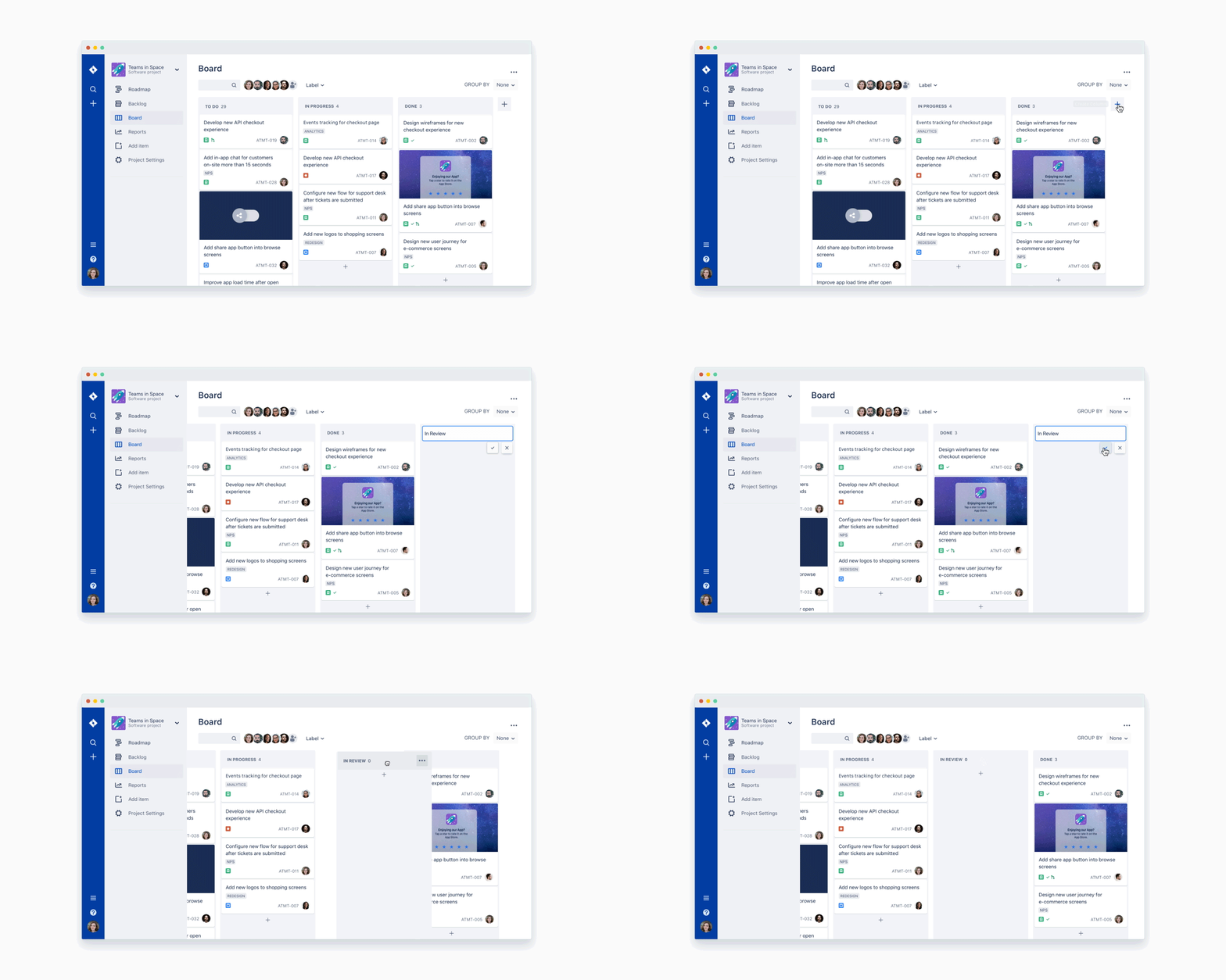
Unsurprisingly, the influence of Trello is most apparent in the Jira boards, where you can now drag and drop cards, add new columns with a few clicks and easily filter cards based on your current needs (without having to learn Jira’s powerful but arcane query language). Gone are the days where you had to dig into the configuration to make even the simplest of changes to a board.

As Regan noted, when Jira was first built, it was built with a single team in mind. Today, there’s a mix of teams from different departments that use it. So while a singular permissions model for all of Jira worked for one team, it doesn’t make sense anymore when the whole company uses the product. In the new Jira then, the permissions model is project-based. “So if we wanted to start a team right now and build a product, we could design our board, customize our own issues, build our own workflows — and we could do it without having to find the IT guy down the hall,” he noted.

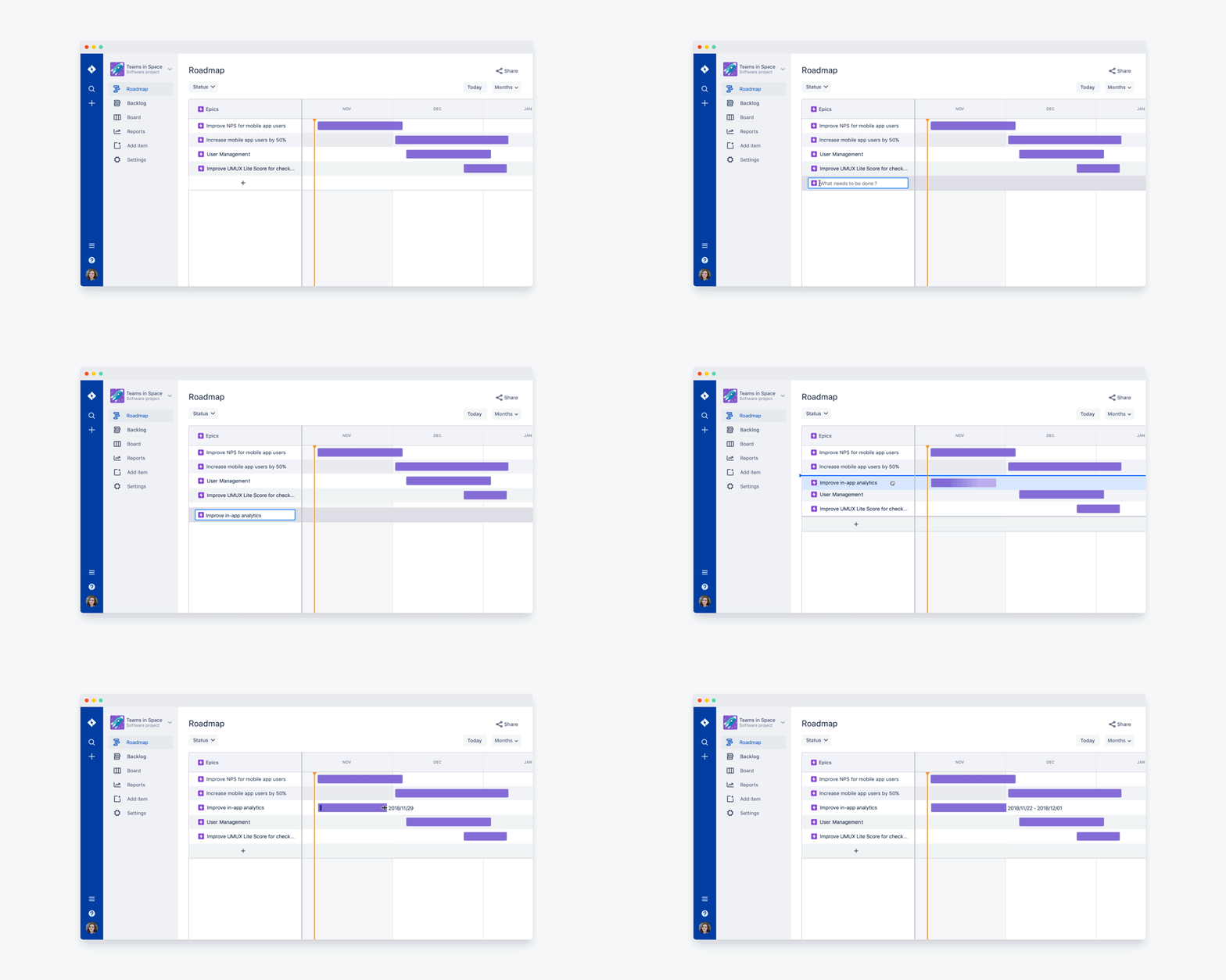
One feature the team seems to be especially proud of is roadmaps. That’s a new feature in Jira that makes it easier for teams to see the big picture. Like with boards, it’s easy enough to change the roadmap by just dragging the different larger chunks of work (or “epics,” in Agile parlance) to a new date.

“It’s a really simple roadmap,” Brereton explained. “It’s that way by design. But the problem we’re really trying to solve here is, is to bring in any stakeholder in the business and give them one view where they can come in at any time and know that what they’re looking at is up to date. Because it’s tied to your real work, you know that what we’re looking at is up to date, which seems like a small thing, but it’s a huge thing in terms of changing the way these teams work for the positive.

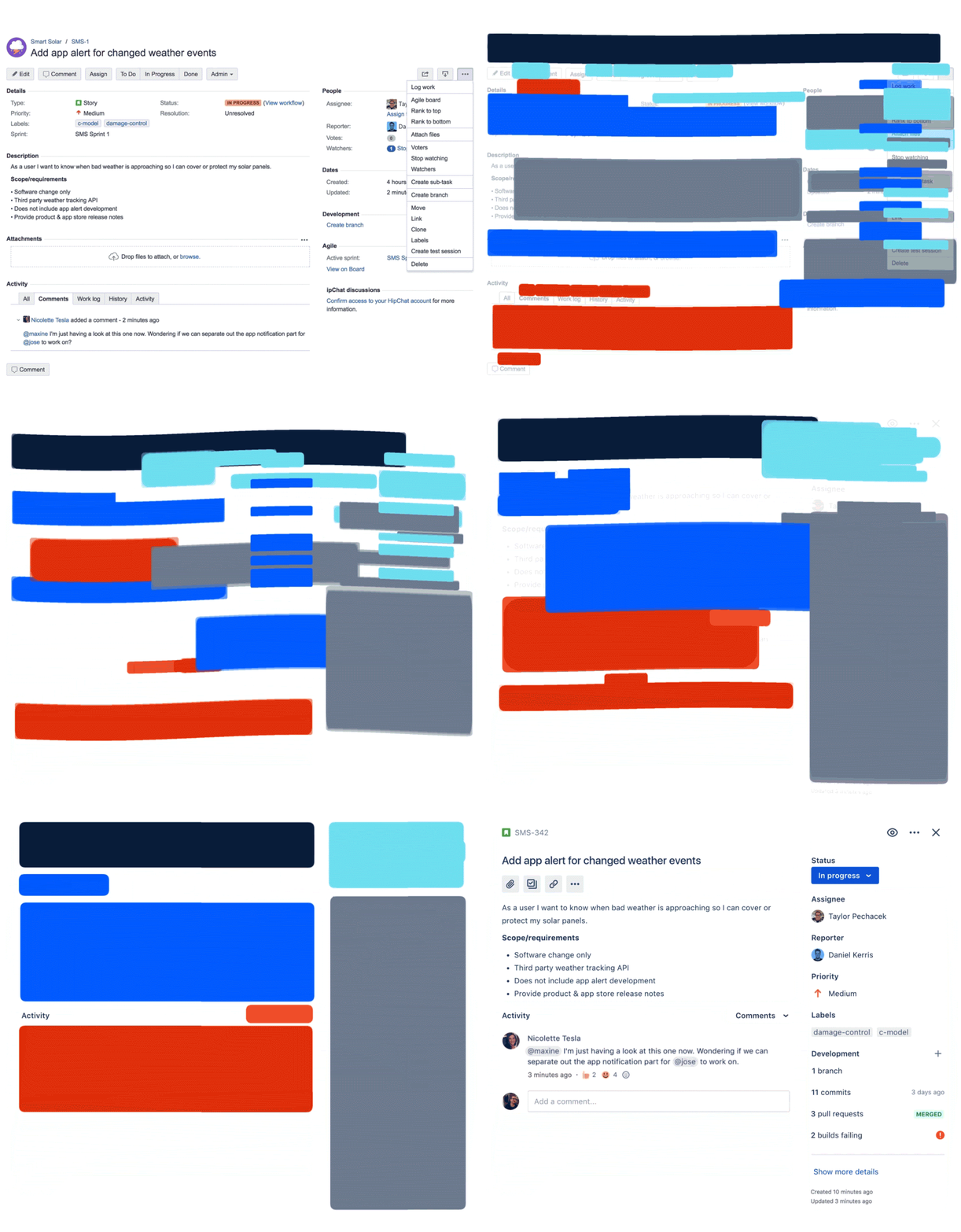
The Atlassian team also redesigned what’s maybe the most-viewed page of the service: the Jira issue. Now, issues can have attachments of any file type, for example, making it easier to work with screenshots or files from designers.

Jira now also features a number of new APIs for integrations with Bitbucket and GitHub (which launched earlier this month), as well as InVision, Slack, Gmail and Facebook for Work.

With this update, Atlassian is also increasing the user limit to 5,000 seats, and Jira now features compliance with three different ISO certifications and SOC 2 Type II.

18 Oct 2018

Spotify’s Premium app gets a big makeover

Spotify has given its app a big makeover, with a focus on making the experience better for its paying subscribers. The company has simplified the app’s navigation by reducing the numbers of buttons and has revamped its Search page, which now incorporates elements previously found in “Browse,” like favorite genres or music to match a mood. And it’s given its Radio service a redesign as well, with the addition of new and easy-to-use Artist Radio Playlists.

The most immediately noticeable change is the app’s navigation.

Spotify has always felt a bit cluttered, with its five navigation buttons – Home, Browse, Search, Radio and My Library. The new app has chopped this down to just three buttons – Home, Search, and My Library.

Recommendations will appear on the Home page, following the update, while discovery is powered by Search.

The Search page lets you seek out artists, albums and podcasts by typing in queries, as before. But the page is also now personalized, showing your own “Top Genres” beneath the search bar – like R&B, Rock, Hip-Hop, Kids & Family – or whatever else you listen to. This is helpful because users’ tastes can change over time, or they may share their individual Spotify account with others (instead of opting for a Family plan), which can garble their recommendations.

The “Browse” section has moved to this Search page in the redesign, and points to things like top charts, Spotify’s programmed playlists, your own personalized playlists, plus music by mood, genre, activity and more.

The Radio section got an overhaul, too.

With the update, you can search for a favorite artist or song, then immediately start listing to one of the brand-new Artist Radio playlists. These are personalized, endless streams based on your own tastes – and they’re updated regularly to stay fresh, Spotify notes.

This latter feature appears to address a recent challenge from Pandora, which tapped into its Music Genome to create dozens of personalized playlists for its users. Spotify, effectively, is turning its radio stations into personalized playlists now, too. Instead of asking users to thumbs up/down its selections, it will just create stations it knows you’ll like, based on the data it already has. These radio playlists also work offline, the company says.

The updated app for Premium users follows a redesign of the app for its free customers, announced back in April. That redesign made it easier for free users to access over a dozen playlists with songs on demand, which also included the option to skip tracks. It also reduced the number of tabs in the bottom navigation.

This week, the company also rolled out a new Android Wear application. Plus, the third-party manufacturer Mighty launched a new version of its Spotify player, which is basically an iPod Shuffle-like device that works with Spotify instead of Apple Music or iTunes.

The changes to the Spotify app comes at a time when the company is losing ground in North America to Apple. Pandora was just snatched up by Sirius XM for $3.5 billion, which could make for increased competition in the U.S., as well.

Spotify’s Premium Subscribers grew to 83 million in Q2 2018, and it has 180 million monthly actives, including free customers, which still puts it ahead of the competition, in terms of user base size.

Spotify says the redesign for Spotify Premium is rolling out to all Premium subscribers on iOS and Android globally starting today.

18 Oct 2018

Document editor Coda adds third-party integrations with G Suite, Slack, Twilio and more

Coda, the smart collaborative document editor that breaks down the barriers between documents, spreadsheets, databases and presentations, is today launching one of its most important updates since its launch in 2017. With this update, users will be able to pull in data from third-party sources and send out messages to their teams on Slack or by SMS and email. With this, the company’s take on building living documents that are essentially small apps is now really taking shape.

“Coda is a new type of documents,” Coda co-founder and CEO Shishir Mehrotra told me. “It combines the best of documents, spreadsheets, presentations, applications into a new surface. The goal is to allow anybody to build a doc as powerful as an app.” That means you can use your inventory spreadsheet to build a small inventory management app, for example, that lives entirely in a tabbed Coda document. Mehrotra noted that many businesses essentially run on documents and spreadsheets, but they don’t have the ability to use that data to its full extent.

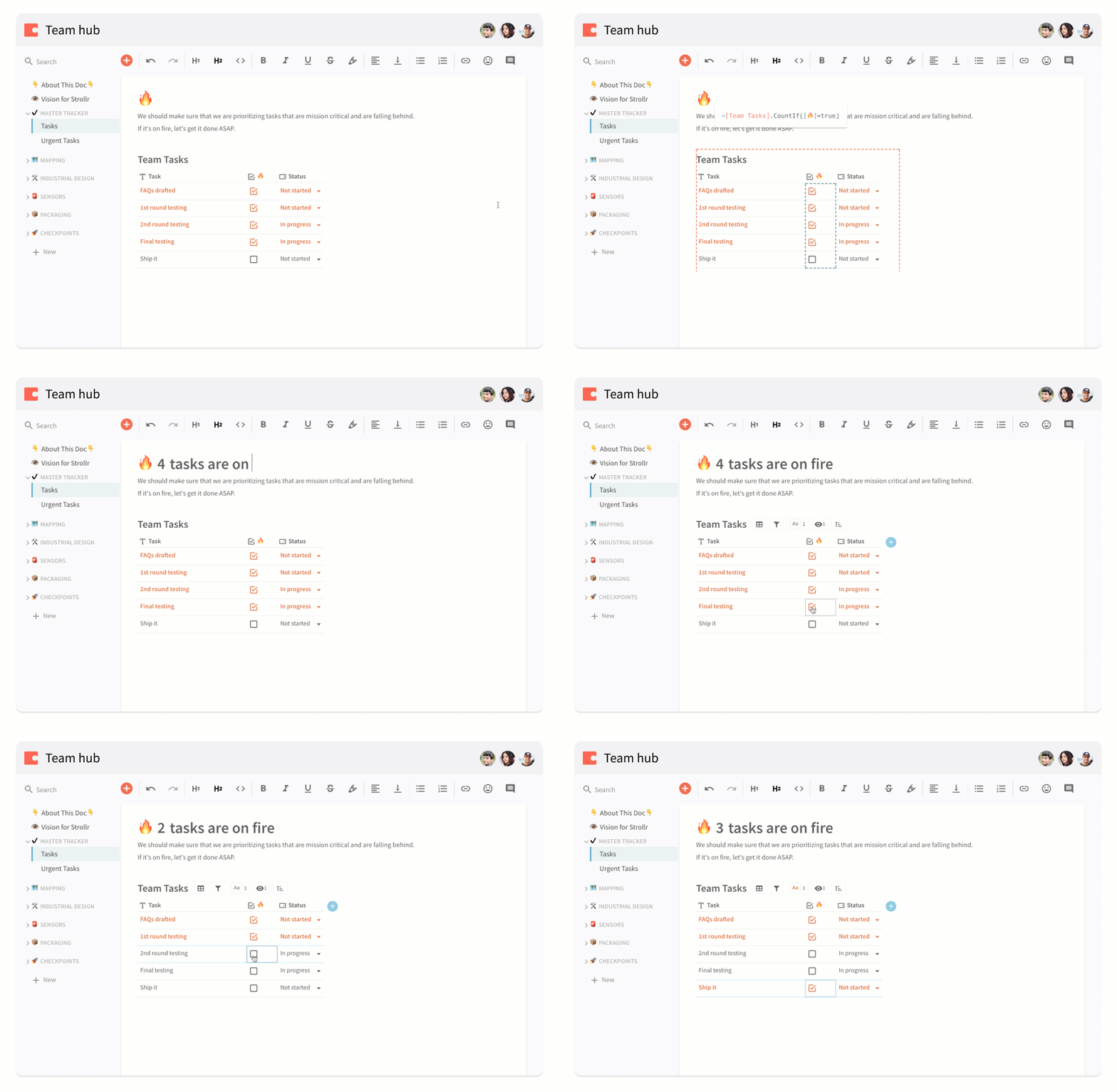
One part of these new integrations, which Coda calls “Coda Packs,” is that you now have the ability to extend your spreadsheets with data that you typically would have had to pull in by hand — something few people are likely to do. That may be stock, sports or weather data, but also open GitHub requests, Intercom tickets and data from your Google Calendar. But there also is a second set of integrations that now let you push out information to Slack and Twilio . In addition to these, Coda supports Figma, Greenhouse, Instagram, YouTube, Walmart Shopping and Wikipedia.

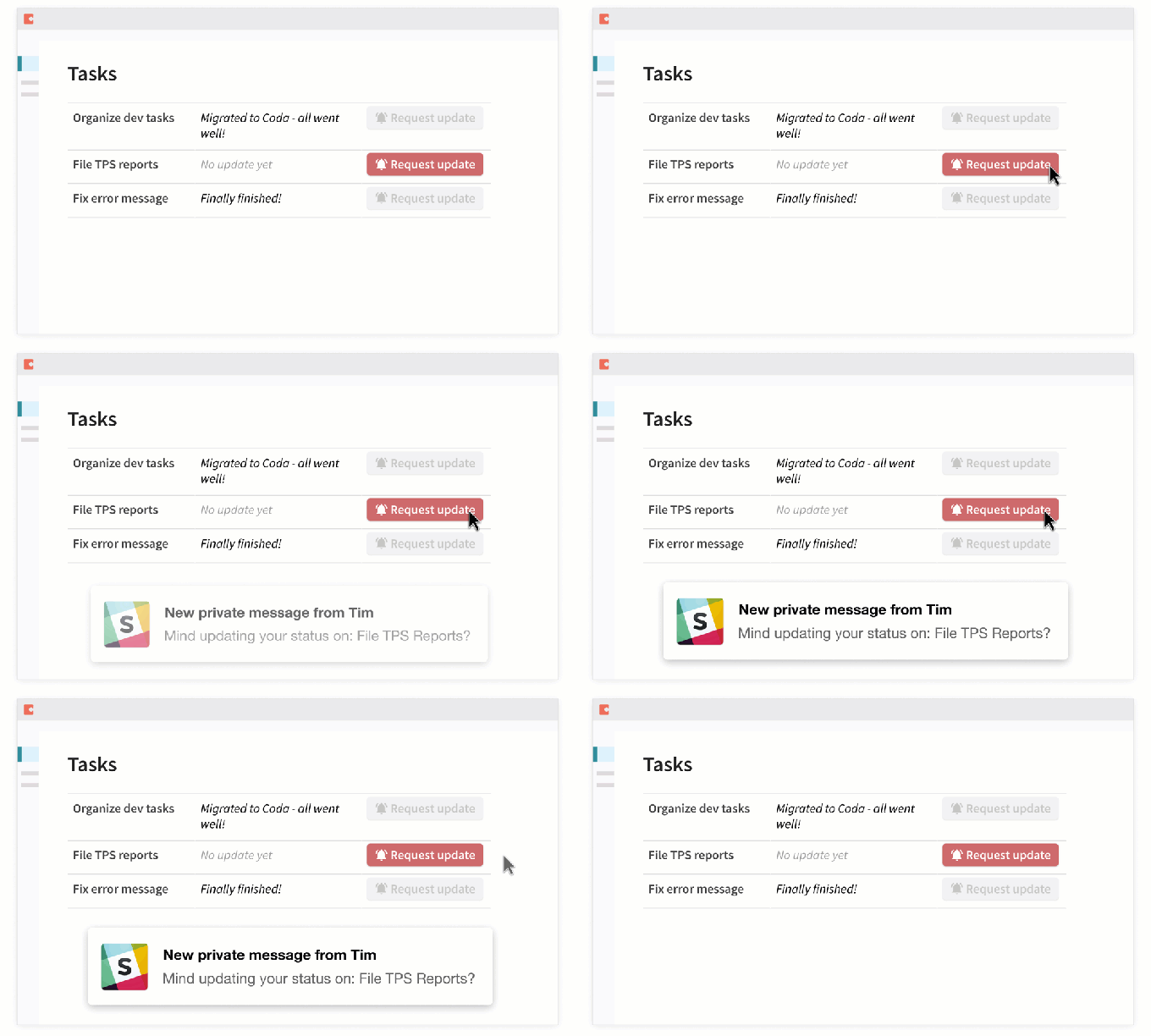
What’s cool here is that Coda lets you build buttons that can combine dozens of different actions. Maybe you have a spreadsheet about an upcoming event with the phone numbers of a dozen friends and want to text them all a reminder? You can now build a button that talks to Twilio and sends an SMS to all of those who haven’t RSVPed yet. And with the weather integrations, you can tell them what the temperature will be.

I’m typically rather skeptical when I see a company that tries to reimagine a well-established concept like a text editor or spreadsheet. And who knows if Coda will be a commercial success. But I can see how the overall concept makes sense (especially thanks to the ability to add a formula anywhere in a document). It’s worth noting, though, that Microsoft is also moving in this direction with the ability to pull third-party data into Excel (though mostly under the guise of artificial intelligence). What Microsoft doesn’t really do as smoothly as Coda is combine all the different document types in one.

18 Oct 2018

Daivergent connects people on the autism spectrum with jobs in data management

Great startups normally come from a personal place. Byran Dai’s new company, Daivergent, is no different.

Founded in December 2017, Daivergent looks to connect enterprise clients with folks on the autism spectrum who will help complete tasks in AI/ML data management.

Dai’s younger brother, Brandon, is on the autism spectrum. Dai realized that his brother and other folks on the spectrum are perfect candidates for certain high-complexity tasks that require extraordinary attention to detail, such as data entry and enrichment, quality assurance and data validation, and content moderation.

In a landscape where just about everyone is working on AI and machine learning algorithms, organizing data is a top priority. Daivergent believes that it can put together the perfect pool of data specialists to complete any task in this space.

Daivergent partners with various agencies including the AHRC and Autism Speaks to source talent. Those folks go through a screening process, which assesses their abilities to complete these sorts of tasks. They then become Daivergent contractors, where they get further training and then start working on projects.

The company says that there are 2.5 million adults with autism in the U.S., and Autism Speaks reports an 85 percent unemployment rate among college-educated adults with autism.

Daivergent not only provides a way for these people to get into the workforce, but it offers a way for corporations and companies to employ American workers for projects they would likely otherwise employ overseas contractors.

When a new task comes in to Daivergent, the company splits that project into smaller tasks and then assigns those tasks to its workers. The company also determines the complexity of the overall project, factoring in the urgency level of the request, to decide pricing.

Daivergent takes a small cut of the earnings and passes the rest on to the workers.

Right now, Daivergent has 25 active workers performing tasks for customers, with 150 workers registered and going through the qualification process and another 400 adults with autism in the candidate pool.

The company recently graduated from the ERA accelerator.

18 Oct 2018

Sam’s Club to offer same-day grocery delivery via Instacart at over half its stores by month end

Fresh off its $600 million round of new funding, grocery delivery service Instacart is expanding its relationship with Walmart, the companies announced this morning. The two first joined up in February to offer same-day grocery delivery at select Sam’s Clubs locations in the U.S. Today, Walmart says it plans to offer Instacart-powered grocery delivery in over half of Sam’s Clubs stores by the end of this month.

That expansion will make Sam’s Club grocery delivery via Instacart available to nearly 1,000 new ZIP codes and more than 100 new stores, including those in markets like New Jersey, Indianapolis, Houston and others, the company says.

In total, customers will be able to order from nearly 350 clubs by the end of October.

The partnership was first piloted in Dallas-Fort Worth, Austin and St. Louis, then reached San Diego and L.A. in more recent weeks.

The deal also allows consumers to shop Sam’s Clubs stores without a membership, including shopping its sales. However, Sam’s Club members will receive lower, membership-only pricing, Walmart says.

Deliveries are offered in as little as an hour, and may include non-grocery items, the retailer also notes.

“To help the holidays run smooth, we’re offering a wide product assortment available on Instacart so shoppers can now get household goods delivered,” said Sachin Padwal, Sam’s Club’s Vice President of Product Management, in a statement. “We’re excited that last-minute gifts, small appliances, extra pillows and towels – just to name a few things – are just a few clicks and minutes away,” he added.

The partnership between Sam’s Club and Instacart is significant in terms of Walmart’s larger battle with Amazon, which offers grocery pickup and delivery through its Whole Foods division, as well as grocery delivery through AmazonFresh and Prime Now.

Sam’s Club parent Walmart also offers an affordable curbside pickup program for groceries – which, unlike with third-party services, sells items at the same price as they are in stores. In select markets, Walmart offers grocery delivery, too.

In Walmart’s recent fiscal year 2020 guidance, it said that it expects to offer grocery pickup at 3,100 Walmart stores by 2020, and delivery at 1,600 locations. Currently, Walmart’s grocery delivery is on track to reach 100 U.S. metros by year-end.

Same-day delivery for Sam’s Club isn’t the only change Walmart’s warehouse membership club has made in recent months. Also in February, the club began to offer free shipping on orders, with no minimum purchase, and simplified memberships to two tiers, Savings ($45/year) and Plus ($100/year). Both of those options are cheaper than Amazon Prime, now $119/year.

Sam’s Club shoppers can visit samsclub.com/Instacart to see if their local store is supported.

18 Oct 2018

Proxxi saves workers from getting electrocuted

There are some gadgets that are nice to have – iPhones, sous vide wands – and some gadgets that you must have. Proxxi fits in the latter camp.

Proxxi is an always-on sensor that buzzes when it gets too close to high voltage electricity. Its worn by mechanics and electricians and warns them when they get too close to something dangerous. The Vancouver-based company just sold out of its initial commercial evaluation units and they’re building a huge business supplying these clever little bracelets to GE, Con Edison, Exelon, Baker Hughes, Schneider Electric and ABB.

The bracelet connects to an app that lets workers silence warnings if they’re working on something that is energized and it also tracks the number of potentially harmful interactions wirelessly. This lets management know exactly where the trouble spots are before they happen. If, for example, it senses many close brushes with highly charged gear it lets management investigate and take care of the problem.

Founded by Richard Sim and Campbell Macdonald, the company has orders for thousands of units, a testament to the must-have nature of their product. They raised $700,000 in angel funding.

“All of this is critical to enterprises looking to mitigate risk from catastrophic injuries: operational disruption, PR nightmare, stock analyst markdowns and insurance premiums,” said Macdonald. “This represents a whole new class of hardware protection for industrial workers who are used to protection being process driven or protective gear like gloves and masks.”

The company began when British Columbia Hydro tasked Sim to research a product that would protect workers from electricity. Macdonald, whose background is in hardware and programming, instead built a prototype and showed it around.

“We initially found that all utilities and electricians wanted this,” he said. “The most exciting thing we have discovered in the last year is that the opportunity is much larger covering manufacturing, oil and gas, and construction.”

“It’s a $40 billion problem,” he said.

The goal is to create something that can be used all day. Unlike other sensors that are used only in dangerous situations, Proxxi is designed to be put on in the morning and taken off at night, after work.

“There are other induction sensors out there, but they are focused on high risk scenarios, ie, people use them when they think they are at risk. The trouble is you can’t tell when you are at risk. You can’t sense that you have made a mistake in the safety process,” said Macdonald. The goal, he said, is to prevent human error and, ultimately, death. Not bad for a wearable.