
Month: October 2018

18 Oct 2018

Seva snares $2.4M seed investment to find info across cloud services

Seva, a New York City startup, that wants to help customers find content wherever it lives across SaaS products, announced a $2.4 million seed round today. Avalon Ventures led the round with participation from Studio VC and Datadog founder and CEO Olivier Pomel.

Company founder and CEO Sanjay Jain says that he started this company because he felt the frustration personally of having to hunt across different cloud services to find the information he was looking for. When he began researching the idea for the company, he found others who also complained about this fragmentation.

“Our fundamental vision is to change the way that knowledge workers acquire the information they need to do their jobs from one where they have to spend a ton of time actually seeking it out to one where the Seva platform can prescribe the right information at the right time when and where the knowledge worker actually needs it, regardless of where it lives.”

Seva, which is currently in Beta, certainly isn’t the first company to try and solve this issue. Jain believes that with a modern application of AI and machine learning and single sign-on, Seva can provide a much more user-centric approach than past solutions simply because the technology wasn’t there yet.

The way they do this is by looking across the different information types. Today they support a range of products including Gmail, Google Calendar, Google Drive,, Box, Dropbox, Slack and JIRA, Confluence. Jain says they will be adding additional services over time.
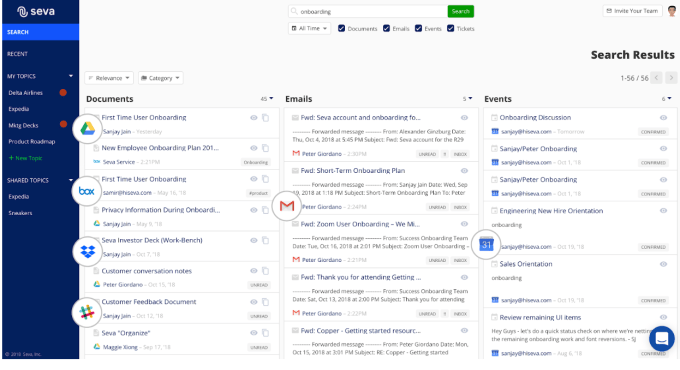
Screenshot: Seva

Customers can link Seva to these products by simply selecting one and entering the user credentials. Seva inherits all of the security and permissioning applied to each of the services, so when it begins pulling information from different sources, it doesn’t violate any internal permissioning in the process.

Jain says once connected to these services, Seva can then start making logical connections between information wherever it lives. A salesperson might have an appointment with a customer in his or her calendar, information about the customer in a CRM and a training video related to the customer visit. It can deliver all of this information as a package, which users can share with one another within the platform, giving it a collaborative element.

Seva currently has 6 employees, but with the new funding is looking to hire a couple of more engineers to add to the team. Jain hopes the money will be a bridge to a Series A round at the end of next year by which time the product will be generally available.


18 Oct 2018

Sick of managing your Airbnb? Vacasa raises $64M to do it for you

Airbnbing can be a ton of work. Between key pickups, tidying, and maintenance emergencies, renting out your place isn’t such a passive revenue source. But Vacasa equips owners with full-service vacation home management, including listings on top rental platforms like Airbnb and HomeAway, as well as local cleaners who come between guests. It now manages 10,000 vacation rental properties in over 16 countries.

With the peer-to-peer housing market maturing and Airbnb looking to go public, private equity firms see an opportunity in who controls the end relationship with home owners like Vacasa does. So today the startup is announcing it’s raised $64 million in a Series B bridge round led by Riverwood, and joined by Level Equity, Assurant, and Newspring. The cash will fuel Vacasa’s expansion into real estate as it seeks to sell property to people who want to own and rent out a vacation home.

Vacasa was impressively bootstrapped from 2009 until 2015. “I’ve always been passionate about vacation rentals. When traveling with friends or family, I love having common spaces to come together in” says CEO Eric Breon. He founded the company after owning a vacation cabin on the Washington Coast. He’d go up in the Spring, spend a weekend fixing up the place, it’d sit idle all summer, and then he’d have to spend another weekend closing it up. He considered a local property manager, but they massively underestimated how much he could earn off renting it out. So Breon built Vacasa to make it easy for home owners to earn the most money without a hassle.

After years growing the business organically, Vacasa raised a $35 million series A from Level Equity in 2015, then $5 million more from Assurant. Then in fall of 2017, it raised an $103.5 million series B. Now it’s topping up that round with $64 million and a new valuation warranted by the startup’s growth this past year. That brings Vacasa to a total of $207.5 million in funding


While that’s just a fraction of the over $4.4 billion Airbnb has raised. But Vacasa caters to a more upscale market that don’t want to manage the properties themselves. With plenty of popular listings sites out there, Vacasa gets easy distribution. But eventually as the other giants in the space become public companies, they’ll be forced to chase bigger margins that could see them compete with Vacasa after years of partnership.

Breon remains confident, though. When I ask him the biggest existential threat to the business, he declares that “We’ve reached a point where failure isn’t a realistic outcome. We have great retention of our homeowners, and strong recurring revenue. The question is more about how quickly we can continue scaling into the huge $32 billion market we’re focused on.” Getting to an exit might not be quite so straightforward, but with life seeming to get more stressful by the year, there’ll be no shortage of people seeking a getaway.

18 Oct 2018

Arianna Huffington’s Thrive Global is teaming up with Zenefits

Many are familiar with Arianna Huffington’s personal journey from media mogul to outspoken sleep advocate.

In April 2007 she collapsed, broke her collarbone and woke up in a pool of blood, a well-publicized accident she attributes to sleep deprivation and exhaustion. In the years that followed, she shifted her focus to wellness, authoring two books on the topic: Thrive and The Sleep Revolutionand later founded a wellness media company called Thrive Global.

Thrive, which bills itself as a “behavior change” startup, helps businesses help their employees develop healthy relationships with technology and manage stress and burnout — issues with which Huffington is personally familiar. The company has raised nearly $43 million in venture capital funding to date, at a $121.5 million valuation as of May.

Today, Thrive is announcing a new partnership with Zenefits, the provider of software that helps small- and medium-sized business (SMBs) manage human resources, though is still often known for a series of regulatory and compliance issues that led to the exit of its founding chief executive, Parker Conrad.

The partnership will make available to employees of the 11,000 businesses that use Zenefits human resources software Thrive content, tips and tools within the Zenefits platform, and managers will be able to use the Thrive app to track and measure employee well-being.

“People are sleep deprived; people are eating the wrong food,” Huffington told TechCrunch. “It’s very basic things we can change through behavior that affect the bottom line of a company.”

“When you give employees science-based micro steps — that’s how change happens,” she added. “You need little nudges to help you change your behavior.”

Thrive educational content focuses on sleep, humans’ relationship with technology, goal setting and other issues that pertain to physical and mental health.

Huffington and Jay Fulcher, Zenefits CEO, told TechCrunch this arrangement was a year in the making.

Zenefits tapped Fulcher, the former CEO of Ooyala and Agile Software, as CEO last year. He was the third CEO in the span of 12 months after Conrad was ousted and Craft Ventures’ David Sacks stepped down after a brief stint as interim CEO. 

“{Stress] is the tipping point for things like retention, which obviously costs businesses billions and billions every year,” Fulcher said. “We have a very sophisticated and broad tech platform and to be able to put all of Thrive’s content on our platform, we think that is a really good proposition and one that customers are excited about.”

Thrive has historically worked with large enterprises, inking deals with Accenture, J.P. Morgan and others since Huffington launched the company in 2016. A partnership with Zenefits marks its first foray into SMBs. 

Thrive is backed by Salesforce CEO Marc Benioff, Sean Parker, Lerer Hippeau, Greycroft Partners and others. Zenefits, founded in 2013, is backed by Andreessen Horowitz, Fidelity, TPG and others. Both companies are backed by IVP.

18 Oct 2018

Take a video tour of Facebook’s election security war room

Beneath an American flag, 20 people packed tight into a beige conference room are Facebook’s, and so too the Internet’s, first line of defence for democracy. This is Facebook election security war room. Screens visualize influxes of foreign political content and voter suppression attempts as high-ranking team members from across divisions at Facebook, Instagram, and WhatsApp coordinate rapid responses. The hope is through face-to-face real-time collaboration in the war room, Facebook can speed up decision-making to minimize how misinformation influences how vote.

In this video, TechCrunch takes you inside the war room at Facebook’s Menlo Park headquarters. Bustling with action beneath the glow of the threat dashboards, you see what should have existed two years ago. During the U.S. presidential election, Russian government trolls and profit-driven fake news outlets polluted the social network with polarizing propaganda. Now Facebook hopes to avoid a repeat in the upcoming US midterms as well as elections across the globe. And to win the hearts, minds, and trust of the public, it’s being more transparent about its strategy.

“It’s not something you can scale to solve with just human.s And it’s not something you can solve with just technology either” says Facebook’s head of cybersecurity Nathaniel Gleicher. “I think artificial intelligence is a critical component of a solution and humans are critical component of a solution.” The two approaches combine in the war room.

Who’s In The War Room And How They Fight Back

Engineers – Facebook’s coders develop the dashboards that monitor political content, hate speech, user reports of potential false news, voter suppression content, and more. They build in alarms that warn the team of anomalies and spikes in the data, triggering investigation by…

  • Data Scientists – Once a threat is detected and visualized on the threat boards, these team members dig into who’s behind an attack, and the web of accounts executing the misinformation campaign.
  • Operations Specialists – They determine if and how the attacks violate Facebook’s community standards. If a violation is confirmed, they take down the appropriate accounts and content wherever they appear on the network.
  • Threat Intelligence Researchers and Investigators – These professional cybersecurity professionals have tons of experience in deciphering the sophisticated tactics used by Facebook’s most powerful adversaries including state actors. They also help Facebook run war games and drills to practice defense against last-minute election day attacks.
  • Instagram and WhatsApp Leaders – Facebook’s acquisitions must also be protected, so representatives from those teams join the war room to coordinate monitoring and takedowns across the company’s family of apps. Together with Facebook’s high-ups, they dispense info about election protection to Facebook’s 20,000 security staffers.
  • Local Experts – Facebook now starts working to defend an election 1.5 to 2 years ahead of time. To provide maximum context for decisions, local experts from countries with the next elections join to bring knowledge of cultural norms and idiosyncracies.
  • Policy Makers – To keep Facebook’s rules about what’s allowed up to date to bar the latest election interference tactics, legal and policy team members join to turn responses into process.

Beyond fellow Facebook employees, the team works external government, security, and tech industry partners. Facebook routinely cooperates with other social networks to pass each other information and synchronize take-downs. Facebook has to get used to this. Following the mid-terms it will evaluate whether it needs to constantly operate a war room. But after it was caught be surprise in 2016, Facebook accepts that it can never turn a blind eye again.

Facebook’s director of our global politics and government outreach team Katie Harbath concludes. “This is our new normal.”

18 Oct 2018

Banksy’s rigged art frame was supposed to shred the whole thing

In the connected future will anyone truly own any thing? Banksy’s artworld shocker performance piece, earlier this month, when a canvas of his went under the hammer at Sothebys in London, suggests not.

Immediately the Girl with Balloon canvas sold — for a cool ~$1.1M (£860,000) — it proceeded to self-destruct, via a shredder built into the frame, leaving a roomful of designer glasses paired with a lot of shock and awe, before facial muscles twisted afresh as new calculations kicked in.

As we reported at the time, the anonymous artist had spent years planning this particular prank. Yet the stunt immediately inflated the value of the canvas — some suggested by as much as 50% — despite the work itself being half shredded, with just a heart-shaped balloon left in clear view.

The damaged canvas even instantly got a new title: Love Is in the Bin.

Thereby undermining what might otherwise be interpreted as a grand Banksy gesture critiquing the acquisitive, money-loving bent of the art world. After all, street art is his big thing.

However it turns out that the shredder malfunctioned. And had in fact been intended to send the whole canvas into the bin the second after it sold.

Or, at least, so the prankster says — via a ‘director’s cut’ video posted to his YouTube channel yesterday (and given the title: ‘Shred the love’, which is presumably what he wanted the resulting frame-sans-canvas to be called).

“In rehearsals it worked every time…” runs a caption towards the end of the video, before footage of a complete shredding is shown…

The video also appears shows how the canvas was triggered to get to work cutting.

After the hammer goes down the video cuts to a close-up shot of a pair of man’s hands pressing a button on a box with a blinking red LED — presumably sending a wireless signal to shreddy to get to work…

The suggestion, also from the video (which appears to show close up shots of some of the reactions of people in the room watching the shredding taking place in real time), is that the man — possibly Banksy himself — attended the auction in person and waited for the exact moment to manually trigger the self-destruct mechanism.

There are certainly lots of low power, short range radio technologies that could have been used for such a trigger scenario. Although the artwork itself was apparently gifted to its previous owner by Banksy all the way back in 2006. So the built-in shredder, batteries and radio seemingly had to sit waiting for their one-time public use for 12 years. Unless, well, Banksy snuck into the friend’s house to swap out batteries periodically.

Whatever the exact workings of the mechanism underpinning the stunt, the act is of course the point.

It’s almost as if Banksy is trying to warn us that technology is eroding ownership, concentrating power and shifting agents of control.

18 Oct 2018

Emma, the money management app, rolls out cryptocurrency support

Emma, the U.K. money management app (or self-described “financial advocate”), is launching a cryptocurrency feature by integrating with a plethora of exchanges so that you can easily track your cryptocurrency balances. The idea is that a modern PFM type app should support cryptocurrency if it wants to provide insights into a user’s whole financial life, not just fiat currency sitting in traditional banks or on credit cards.

At launch, the supported cryptocurrency exchanges are Coinbase, Bittrex, Binance, Bitstamp, Kraken, Bitfinex and individual Bitcoin and Ethereum addresses. However, for now the functionality is “read-only,” meaning you can’t make transactions within Emma or buy more cryptocurrency. For that, you’ll still need to visit the individual exchanges, at least for the time being.

“We see cryptocurrency as the next emerging asset class,” Emma co-founder and CEO Edoardo Moreni tells me. “At this point, there are more than 3 million people who have bought Crypto in the U.K. It’s pretty evident that we need to start accepting this as any other type of financial product, in the same way we treat current accounts and credit cards. If Emma is able to help people control and manage a current account, she should be able to do the same for any type of financial product or service”.

On the issue of read-only access, Moreni explains that Emma’s founding goal has always been to build the best financial tracker in the market, hence why the startup hasn’t yet developed any “write-access” features for any of the bank accounts it connects to (or the newly added cryptocurrency exchanges). However, now that Emma’s read only mission is “solid and almost complete,” this will soon change.

“We are going to release several write features in both spaces, traditional and crypto,” says Moreni. “Open Banking will be extremely useful for the former. In terms of the latter, we are already talking with a few providers to introduce write transactions and also the ability to save in cryptocurrency, based on behavioural rules and risk appetite. We see this as a huge opportunity and if we are those who help people understand and invest in crypto for the first time, it fits with our core mission”.

That mission, says the Emma founder, isn’t just to design a really useful aggregator, but to use the aggregated data to help Emma users better manage their money and in the longer term improve their financial well-being.

“We see aggregation as the internet 25 years ago,” he says, “a massive playground which we can use to build technology that has an impact on people’s lives. Our main focus is financial improvement. There is no technology out there that helps you getting out of an overdraft, teaches where and how to save or makes you invest for the first time. We believe this is what Emma is all about.

“We are not trying to be the default interface for a generation or the mission control centre of our finances. We want to build a technology that helps people improve. At the end of the day, that is where the real value is and this is what we are pursuing. This is not and will never be the job of banks, whose goal is to build great financial products, which Emma can interact with”.

To that end, Emma’s list of current features includes:

  • Manage all your money in one place (current & savings accounts, credit cards and now crypto)
  • Sync budgets to payday (“this is the most requested feature in the U.K.,” says Moreni)
  • Find and track recurring payments – as well as predicting future payments and notifying when prices go up and down
  • Notify you before you go into overdraft
  • Detect hidden bank fees, such as markup on foreign transactions
  • Spending insights broken down by category or vendor
  • Smart alerts for various transactions
  • Real time currency converter

Meanwhile, Emma raised a seed round of £500,000 in July 2018 led by Kima Ventures, one of the first investors in Transferwise, and Aglaé Ventures, the early stage program of Groupe Arnault.

18 Oct 2018

Get your Disrupt Berlin 2018 passes before 24 October and save big

Great news, startup fans. You still have time to save up to €500 on your pass to TechCrunch Disrupt Berlin 2018. Our premier tech conference focusing on the European startup scene takes place on 29-30 November, but the deadline for scoring passes at the best possible price arrives next week on 24 October.

What budget-minded early-startup founder, investor, marketer or job seeker wouldn’t want to reap that kind of savings? Be good to your bottom line. Buy your ticket now, and then pat yourself on the back for kicking procrastination to the curb.

Disrupt Berlin, a truly international event, draws participants — top international tech founders, innovators, influencers and investors — from more than 50 countries, including European Union members, Turkey, Russia, Egypt, India, China and South Korea. Whether you’re looking for global exposure for your startup or you’re scouting the world for your next big investment, Disrupt Berlin is where you need to be.

If you’re wondering about the professional benefits of attending Disrupt, take a gander at what these three attendees said about their experience.

“TechCrunch Disrupt is unique in how it brings everyone — all the industry touch points — together under one roof. You can meet investors and bigger players in your industry to see if there’s an opportunity to work together. It’s incredibly valuable.” — Sage Wohns, co-founder and CEO, Agolo.

“I was very pleasantly surprised at the number of early-stage startups in attendance. I spent probably 75 percent of my time having one-on-one meetings with startup founders.” — Michael Kocan, co-founder and managing partner, Trend Discovery.

“The exposure we received at TechCrunch Disrupt completely changed our trajectory and made it easier to raise funds and jump to the next stage.” — David Hall, co-founder and president, Park & Diamond.

Two action-packed days await you in Berlin. We have an incredible lineup of speakers — tech luminaries, business moguls, headline-making founders and leading investors — ready to share their experiences, expertise and perspectives on a range of hot-button topics.

The adrenaline trip that is Startup Battlefield never fails to disappoint. Be there to cheer on 15 of Europe’s top early-stage startups as they launch their dream to the world and compete for $50,000. You might just witness tech history in the making.

Take a deep dive into Startup Alley, where more than 400 early-stage startups — including companies that earned the coveted TC Top Pick designation — will exhibit their very latest technology. This is prime networking territory and an opportunity to meet your future founder, investor or technologist. A source of innovation and inspiration, Startup Alley is a must-see experience.

Of course, you’ll always find world-class networking going down in casual style at the infamous (OK, it might not be infamous, but it is wicked fun) TechCrunch After Party.

Disrupt Berlin 2018 takes place on 29-30 November. You can save up to €500, but only if you buy your pass before 24 October. Be good to your bottom line.

18 Oct 2018

Announcing the TC Top Picks of Disrupt Berlin 2018

We called on early-stage startup founders to apply for TC Top Pick status at TechCrunch Disrupt Berlin 2018, which takes place on 29-30 November. We knew that many founders would heed the call but — holy smokes — the response was thunderous. Sheer volume combined with sheer brilliance to make our job of selecting up to five outstanding startups in 10 categories difficult to say the least.

Never ones to turn away from a challenge — or from learning about amazing tech startups — we persisted, and the results are at hand. Read on to find the list of winners and what they receive.

We created the TC Top Pick designation as just one way to recognize exceptional pre-Series A startup founders. We carefully reviewed and vetted each application and chose up to five startups from each of these categories:

AI/Machine Learning, Blockchain, CRM/Enterprise, E-commerce, Education, Fintech, Healthtech/Biotech, Hardware, Robotics, IoT, Mobility and Gaming

TC Top Pick founders receive a free Startup Alley Exhibitor Package, which includes a one-day exhibit space in Startup Alley, three Founder passes (good for both days of the show), use of CrunchMatch — our investor-to-startup matching platform — and access to the Disrupt Berlin 2018 press list. They will also receive a three-minute interview on the Showcase Stage with a TechCrunch editor — and we’ll promote that video across our social media platforms.

That’s a pretty sweet deal, and all that’s left is the big reveal. Maestro, may we have a drum roll please? Introducing the TC Top Picks for Disrupt Berlin 2018.

Artificial Intelligence & Machine Learning

  • Gravete: World’s first AI-enabled classified ads aggregator.
  • iRecommend Software: Develops intelligent business solutions utilizing artificial intelligence, machine learning and dynamic data modeling.
  • Retorio: “Your AI-based communication coach.”
  • Seez: Automates the car-searching process by searching all car websites, negotiates price down using AI and estimates fair market value.

Blockchain

  • Brickblock: A platform to seamlessly and transparently connect cryptocurrencies with real-world assets.
  • WorkChain: The blockchain solution to the future of work.

CRM & Enterprise

  • Communiti: LinkedIn for Slack teams. Search users with certain skills such as iOS Developer or UX Designer. Post a job listing to collaborate.
  • fraudDB: A B2B fraud database that helps businesses prevent fraud.
  • Nuzzera: Your Spotify for news — the first two-sided market for professional journalism.
  • Stack: Desktop-app displaying all web-applications on a single screen.

E-commerce

  • Inova Diamonds: Changing the way diamonds and jewelry are sold online.
  • Lonelyfork Standards: An innovative food-tech digital platform business that offers “food standards as a product.”
  • Money Farm Gambia: Gambia’s first crowdfunding platform connecting farmers to investors.

Education

  • ChallengeRocket: AI-powered recruitment. Reach and assess hidden programming talents with programming challenges.
  • i2x: Leverage your data. Coach your team. Make customers happy. i2x is real-time speech analytics powered by AI.
  • Morressier: World’s largest platform for early-stage research.
  • Processim Labs: Transforming smartphones into pocket simulators that college professors can use as powerful and convenient teaching games!

Fintech

  • Evarvest: Invest globally, like a local. A simple way to invest in global stock markets from almost anywhere in the world.
  • Fin.do: Allows instant money transfers in any currency, avoiding banks’ high fees and exchange rates.
  • FinMarie: Germany’s first online financial platform for women.
  • Youcheck Online Services Limited: Identity and address verification services for Sub-Sahara Africa.

Gaming

  • MakerBrane: A digital and physical platform that lets anyone design, build and trade their own playworlds.
  • Moonic Oy: Our company wants to help people who are trying to create music with products that are effortless and quick to use.
  • Smartboard: The world’s first universal board game console.
  • Wolf3d: Creates 3D avatars of people for VR/AR communication and games using a smartphone.

Hardware, Robotics and IoT

  • Arculus: Helps multi-variant manufacturers cope with the market’s bespoke customization demand, being more efficient and cost-effective.
  • GkeyLab: Virtual (VR), Augmented (AR) and Mixed Reality (MR).
  • Moggie: A cat care system that improves cat ownership experience across the globe.
  • Nucleus Technologies: Offers a solution based on augmented reality (AR) to improve workers’ efficiency and safety across industries.

Healthtech & Biotech

  • Cooltec: We aid man with becoming fathers.
  • DiaMonTech: Developing a medical device for non-invasive measurement of blood sugar values.
  • Legacy: The Swiss private bank for men to store their most valuable assets.
  • Testcard Diagnostics: The innovative medtech behind the “urine test-in-a-postcard” concept. Its accompanying mobile app provides an immediate result.
  • Zana: An intelligent assistant that responds to health questions and empowers people to get and stay healthy.

Mobility

  • Dazzle.ai: The AI customer experience platform for travel. Dazzle exists to create conversations that end with a transaction. Every channel. Always on.
  • Fishtripr: Brings together millions of outdoor lovers and professional fishing guides.
  • Load Me FZE: Operates as an online marketplace for shipments and trucks.
  • Trippo: A mobile app that allows users to capture and organize travel ideas they discovered on ANY app or website by simply taking a screenshot.

It may be too late for you to be a TC Top Pick this year, but it’s not too late to buy a Startup Alley Exhibitor Package and exhibit alongside our Top Picks and more than 400 companies in Startup Alley.

Exhibiting at Disrupt makes sense for early-stage founders, but don’t just take our word for it. Vlad Larin, co-founder of ZeroQode, had this to say following his experience:

Startup Alley is the place where technology worlds collide. You shake hands and talk with all kinds of people looking for new ideas, collaboration and inspiration — people who want to learn and exchange ideas about the latest products and industry trends.

TechCrunch Disrupt Berlin 2018 takes place 29-30 November. Come join us and discover a world full of new opportunities. We can’t wait to see you there!

18 Oct 2018

Cryptocurrency wallet startup Cobo raises $13M Series A to enter the U.S. and Southeast Asia

Cobo, a cryptocurrency wallet startup headquartered in Beijing, has raised a $13 million Series A to enter new international markets. The round was led by DHVC and Wu Capital, a family office based in China. Cobo plans to expand in the United States and Southeast Asia, in particular Vietnam and Indonesia. Cobo is also now taking pre-orders for Cobo Vault, a hardware wallet (pictured above) that it claims is military grade. Cobo’s Series A brings its total funding to $20 million so far.

Cobo Wallet allows users to store both proof-of-stake and proof-of-work coins. One incentive for people to pick the app over its competitors is the ability to pool proof-of-stake assets with other users so they can increase their chances of mining and validating new blocks on the blockchain. Since launching earlier this year, Cobo says its digital wallet has gained more than 500,000 users.

The startup was founded last year by CEO Shixing Mao, who is known as Discus Fish in the crypto community, and CTO Changhao Jiang, a former platform engineer at Facebook and Google who co-founded Bihang, a cryptocurrency wallet acquired by OKCoin in 2013. Discus Fish, meanwhile, is known for launching F2Pool, China’s first mining pool.

Cobo Vault, which will retail for $479, meets the MIL-STD-810G U.S. military standard for equipment, Cobo’s head of hardware Lixin Liu said in an email, adding that it was built with proprietary firmware created especially for the device, a bank-grade encryption chip and military-grade aluminum.

Cobo Vault’s creation was prompted by an August 2017 incident in which F2Pool was hacked and more than 8,000 ETH was stolen from Discus Fish’s account. Fish also refunded customers’ lost ETH from his own assets. “As a result, Discus Fish was resolute on the fact that for crypto to gain mass market adoption, products had to be made to be hacker-resistant and truly safe,” said Liu.

18 Oct 2018

Some notable Facebook shareholders file (mostly symbolic) proposal to oust Mark Zuckerberg as chairman

Several major Facebook shareholders have submitted a proposal calling for CEO Mark Zuckerberg to step down as chairman of the company’s board. The filing is mainly symbolic, since Zuckerberg has almost total voting control, an arrangement that has earned the company’s board structure comparisons to a “dictatorship.” The proposal is still noteworthy, however, because of the investors involved.

The pension funds of New York City are joining activist shareholder Trillium Asset Management, which has wanted to remove Zuckerberg as Facebook’s chairman since its disappointing second-quarter earnings report in July, as well as the state treasurers of Rhode Island, Illinois, and Pennsylvania. The proposal will be voted on at Facebook’s shareholder meeting next year.

In an online statement, New York City comptroller Scott Stringer called on Facebook’s board to make its chair an independent position.

“Facebook plays an outsized role in our society and economy. They have a social and financial responsibility to be transparent—that’s why we’re demanding independence and accountability in the company’s boardroom. We need Facebook’s insular boardroom to make a serious commitment to addressing real risks—reputational, regulatory, and the risk to our democracy—that impact the country, its shareholders, and ultimately the hard-earned pensions of thousands of New York City workers,” Stringer said. “An independent board chair is essential to moving Facebook forward from this mess, and to reestablish trust with Americans and investors alike.”

The shareholder proposal was filed by the New York City Pension Funds, Illinois state treasurer Michael Frerichs, Rhode Island state treasurer Seth Magaziner, Pennsylvania treasurer Joe Torsella, and Trillium Asset Management.

Stringer, a Democrat who serves as fiduciary for the city’s five public pension funds, which are worth about $160 billion in total assets, has been a vocal critic of Facebook. In March, he asked Facebook’s lead independent director, Dr. Susan Desmond-Hellmann, to improve the company’s data privacy accountability after the Cambridge Analytica scandal, citing the 4.9 million Class A shares held by the city’s pension funds.

Another proposal to replace Zuckerberg as chairman was filed in April before his Senate testimony about Cambridge Analytica’s misuse of Facebook user data.

TechCrunch has contacted Facebook for comment.