Month: October 2018

18 Oct 2018

Twitter tests out ‘annotations’ in Moments

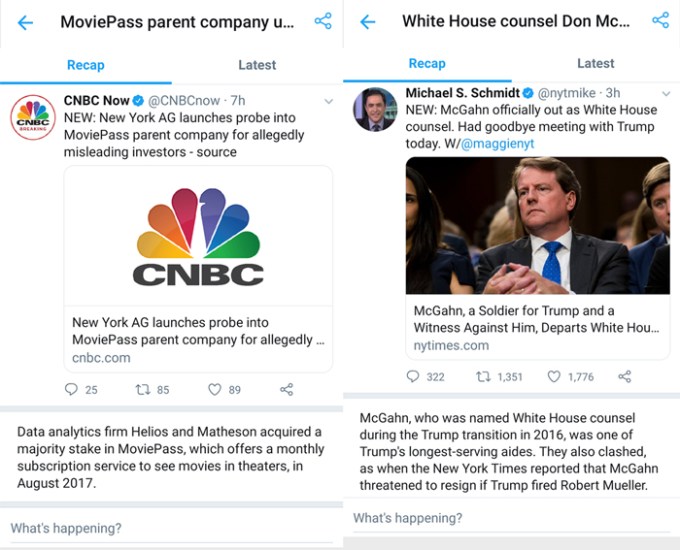
Twitter is trying out a small new change to Moments that would provide contextual information within its curated stories. Spotted by Twitter user @kwatt and confirmed by a number of Twitter product team members, the little snippets appear sandwiched between tweets in a Moment.

Called “annotations” — not to be confused with Twitter’s metadata annotations of yore — the morsels of info aim to clarify and provide context for the tweets that comprise Twitter’s curated trending content. According to the product team, they are authored by Twitter’s curation group.

In our testing, annotations only appear on the mobile app and not on the same Moments on desktop. So far we’ve seen them on a story about the NFL, one about Moviepass and another about staffing changes in the White House.

While it’s a tiny feature tweak, annotations are another sign that Twitter is exploring ways to infuse its platform with value and veracity in the face of what so far appears to be an intractable misinformation crisis.

18 Oct 2018

MIT researchers say memory splitting breakthrough could prevent another Meltdown or Spectre

Virtually every modern computer processor was thrown under the bus earlier this year when researchers found a fundamental design weakness in Intel, AMD and ARM chips, making it possible to steal sensitive data from the computer’s memory.

The Meltdown and Spectre vulnerabilities — which date back to 1995 — punched holes in the walls that keeps apps from accessing other parts of the system’s memory that it doesn’t have permission to read. That meant a skilled attacker could figure out where sensitive data was stored, like passwords and encryption keys. While the companies mitigated some of the flaws, they acknowledged that their long term plan would require a core redesign in how their computer processors work.

Now, a team of MIT’s Computer Science and Artificial Intelligence Laboratory (CSAIL) researchers say they have found a way to prevent a similar range of flaws like Meltdown and Spectre in the future.

When an app needs to store something in memory, it asks the processor where to put it. But searching for that memory is slow, so processors use a trick known as “speculative execution” to run several sets of tasks at the same time while it finds the right memory slot. But attackers can exploit the same technique to allow an app to read parts of the memory that it shouldn’t be allowed to read.

MIT’s CSAIL says their technique would split up memory so that the data not stored in the same place — in what the team calls “secure way partitioning.”

They call it called DAWG — or “Dynamically Allocated Way Guard” — which, admittedly might sound ridiculous, but it’s meant to work as a counterpoint to Intel’s Cache Allocation Technology, or CAT. According to their work, DAWG works similarly to CAT and doesn’t require many changes to the device’s operating system — making it potentially as easy to install on an affected computer as Meltdown’s microcode fix.

According to Vladimir Kiriansky, one of the research paper’s authors, the new technique “establishes clear boundaries for where sharing should and should not happen, so that programs with sensitive information can keep that data reasonably secure.”

Not only could the technology help to protect regular computers, but also also vulnerable cloud infrastructures.

Although DAWG can’t prevent against every speculative attack, the researchers are now working to improve their technology to prevent against more — if not all attacks.

But if their technology is picked up by Intel or any other chip maker, the researchers say techniques like DAWG could “restore our confidence in public cloud infrastructure, and hardware and software co-design will help minimize performance overheads.”

18 Oct 2018

YC grad Oh My Green gets $20M seed investment

In its first institutional funding round, Oh My Green has raised $20 million from Initialized Capital, Powerplant Ventures, Backed VC, ZhenFund, Talis Capital and the Stanford StartX Fund to bring healthier foods to offices around the U.S.

The concierge-style startup, which completed Y Combinator’s startup accelerator in 2016, provides businesses in San Francisco, Los Angeles, Seattle, Chicago, Austin, Denver, Boston, New York City and Nashville nutritional snacks and meals. It stocks office snack pantries — a staple at tech startups — caters events, manages cafes and provides wellness programming. Its goal is to be a one-stop shop for corporate nutritional wellness. 

The San Francisco-based company was founded in 2014 by Michael Heinrich. Based off my conversation with him earlier this week, I’m guessing he wouldn’t approve of the TechCrunch snack cupboard, which includes a year-long supply of Skittles, M&Ms and Fruit by the Foot.

“I wanted to do something more meaningful in my life,” Heinrich told TechCrunch. “I had worked in really challenging environments and I found myself really enjoying the people and the problems but looking at the food we had available, a lot of it was ultra-processed and ultra-sugared.”

“When I was sugar crashing and not being productive at work, I realized I should stop complaining and actually make a difference,” he added.

Oh My Green’s tech-enabled service, which relies on machine learning to give its customers personalized recommendations for meals and snacks, has 200 customers today, including Lyft, Apple and Y Combinator. With the investment, the company will expand throughout the U.S. and eventually launch overseas.

17 Oct 2018

Building a great startup requires more than genius and a great invention

Many entrepreneurs assume that an invention carries intrinsic value, but that assumption is a fallacy.

Here, the examples of the 19th and 20th century inventors Thomas Edison and Nikola Tesla are instructive. Even as aspiring entrepreneurs and inventors lionize Edison for his myriad inventions and business acumen, they conveniently fail to recognize Tesla, despite having far greater contributions to how we generate, move, and harness power. Edison is the exception, with the legendary penniless Tesla as the norm.

Universities are the epicenter of pure innovation research. But the reality is that academic research is supported by tax dollars. The zero-sum game of attracting government funding is mastered by selling two concepts: Technical merit, and and broader impact toward benefiting society as a whole. These concepts are usually at odds with building a company, which succeeds only by generating and maintaining competitive advantage through barriers to entry.

In rare cases, the transition from intellectual merit to barrier to entry is successful. In most cases, the technology, though cool, doesn’t give the a fledgling company the competitive advantage it needs to exist among incumbents, and inevitable copycats. Academics, having emphasized technical merit and broader impact to attract support for their research, often fail to solve for competitive advantage, thereby creating great technology in search for a business application.

Of course there are exceptions: Time and time again, whether it’s driven by hype or perceived existential threat, big incumbents will be quick to buy companies purely for technology.  Cruise/GM (autonomous cars), DeepMind/Google (AI), and Nervana/Intel (AI chips). But as we move from 0-1 to 1-N in a given field, success is determined by winning talent over winning technology. Technology becomes less interesting; the onus on the startup to build a real business.

If a startup chooses to take venture capital, it not only needs to build a real business, but one that will be valued in the billions. the question becomes how a startup can create durable, attractive business, with a transient, short-lived technological advantage.

Most investors understand this stark reality. Unfortunately, while dabbling in technologies which appeared like magic to them during the cleantech boom, many investors were lured back into the innovation fallacy, believing that pure technological advancement would equal value creation. Many of them re-learned this lesson the hard way. As frontier technologies are attracting broader attention, I believe many are falling back into the innovation trap.

So what should aspiring frontier inventors solve for as they seek to invest capital to translate pure discovery to building billion-dollar companies?  How can the technology be cast into an unfair advantage that will yield big margins and growth that underpin billion-dollar businesses?

Talent productivity: In this age of automation, human talent is scarce, and there is incredible value attributed to retaining and maximizing human creativity.  Leading companies seek to gain an advantage by attracting the very best talent. If your technology can help you make more scarce talent more productive, or help your customers become more productive, then you are creating an unfair advantage internally, while establishing yourself as the de facto product for your customers.

Great companies such as Tesla and Google have built tools for their own scarce talent, and build products their customers, in their own ways, can’t do without. Microsoft mastered this with its Office products in the 90s, through innovation and acquisition, Autodesk with its creativity tools, and Amazon with its AWS Suite. Supercharging talent yields one of the most valuable sources of competitive advantage: switchover cost.  When teams are empowered with tools they love, they will loathe the notion of migrating to shiny new objects, and stick to what helps them achieve their maximum potential.

Marketing and Distribution Efficiency: Companies are worth the markets they serve.  They are valued for their audience and reach.  Even if their products in of themselves don’t unlock the entire value of the market they serve, they will be valued for their potential to, at some point in the future, be able to sell to the customers that have been tee’d up with their brands. AOL leveraged cheap CD-ROMs and the postal system to get families online, and on email.

Dollar Shave Club leveraged social media and an otherwise abandoned demographic to lock down a sales channel that was ultimately valued at a billion dollars. The inventions in these examples were in how efficiently these companies built and accessed markets, which ultimately made them incredibly valuable.

Network effects: Its power has ultimately led to its abuse in startup fundraising pitches. LinkedIn, Facebook, Twitter, and Instagram generate their network effects through Internet and Mobile. Most marketplace companies need to undergo the arduous, expensive process of attracting vendors and customers.  Uber identified macro trends (e.g., urban living) and leveraged technology (GPS in cheap smartphones) to yield massive growth in building up supply (drivers) and demand (riders).

Our portfolio company Zoox will benefit from every car benefitting from edge cases every vehicle encounters: akin to the driving population immediately learning from special situations any individual driver encounters. Startups should think about how their inventions can enable network effects where none existed, so that they are able to achieve massive scale and barriers by the time competitors inevitably get access to the same technology.

Offering an end-to-end solution: There isn’t intrinsic value in a piece of technology; it’s offering a complete solution that delivers on an unmet need deep-pocketed customers are begging for. Does your invention, when coupled to a few other products, yield a solution that’s worth far more than the sum of its parts? For example, are you selling a chip, along with design environments, sample neural network frameworks, and datasets, that will empower your customers to deliver magical products? Or, in contrast, does it make more sense to offer standard chips, licensing software, or tag data?

If the answer is to offer components of the solution, then prepare to enter a commodity, margin-eroding, race-to-the-bottom business. The former, “vertical” approach is characteristic of more nascent technologies, such as operating robots-taxis, quantum computing, and launching small payloads into space. As the technology matures and becomes more modular, vendors can sell standard components into standard supply chains, but face the pressure of commoditization.

A simple example is Personal Computers, where Intel and Microsoft attracted outsized margins while other vendors of disk drives, motherboards, printers, and memory faced crushing downward pricing pressure.  As technology matures, the earlier vertical players must differentiate with their brands, reach to customers, and differentiated product, while leveraging what’s likely going to be an endless number of vendors providing technology into their supply chains.

A magical new technology does not go far beyond the resumes of the founding team.

What gets me excited is how the team will leverage the innovation, and attract more amazing people to establish a dominant position in a market that doesn’t yet exist. Is this team and technology the kernel of a virtuous cycle that will punch above its weight to attract more money, more talent, and be recognized for more than it’s product?

17 Oct 2018

Building a great startup requires more than genius and a great invention

Many entrepreneurs assume that an invention carries intrinsic value, but that assumption is a fallacy.

Here, the examples of the 19th and 20th century inventors Thomas Edison and Nikola Tesla are instructive. Even as aspiring entrepreneurs and inventors lionize Edison for his myriad inventions and business acumen, they conveniently fail to recognize Tesla, despite having far greater contributions to how we generate, move, and harness power. Edison is the exception, with the legendary penniless Tesla as the norm.

Universities are the epicenter of pure innovation research. But the reality is that academic research is supported by tax dollars. The zero-sum game of attracting government funding is mastered by selling two concepts: Technical merit, and and broader impact toward benefiting society as a whole. These concepts are usually at odds with building a company, which succeeds only by generating and maintaining competitive advantage through barriers to entry.

In rare cases, the transition from intellectual merit to barrier to entry is successful. In most cases, the technology, though cool, doesn’t give the a fledgling company the competitive advantage it needs to exist among incumbents, and inevitable copycats. Academics, having emphasized technical merit and broader impact to attract support for their research, often fail to solve for competitive advantage, thereby creating great technology in search for a business application.

Of course there are exceptions: Time and time again, whether it’s driven by hype or perceived existential threat, big incumbents will be quick to buy companies purely for technology.  Cruise/GM (autonomous cars), DeepMind/Google (AI), and Nervana/Intel (AI chips). But as we move from 0-1 to 1-N in a given field, success is determined by winning talent over winning technology. Technology becomes less interesting; the onus on the startup to build a real business.

If a startup chooses to take venture capital, it not only needs to build a real business, but one that will be valued in the billions. the question becomes how a startup can create durable, attractive business, with a transient, short-lived technological advantage.

Most investors understand this stark reality. Unfortunately, while dabbling in technologies which appeared like magic to them during the cleantech boom, many investors were lured back into the innovation fallacy, believing that pure technological advancement would equal value creation. Many of them re-learned this lesson the hard way. As frontier technologies are attracting broader attention, I believe many are falling back into the innovation trap.

So what should aspiring frontier inventors solve for as they seek to invest capital to translate pure discovery to building billion-dollar companies?  How can the technology be cast into an unfair advantage that will yield big margins and growth that underpin billion-dollar businesses?

Talent productivity: In this age of automation, human talent is scarce, and there is incredible value attributed to retaining and maximizing human creativity.  Leading companies seek to gain an advantage by attracting the very best talent. If your technology can help you make more scarce talent more productive, or help your customers become more productive, then you are creating an unfair advantage internally, while establishing yourself as the de facto product for your customers.

Great companies such as Tesla and Google have built tools for their own scarce talent, and build products their customers, in their own ways, can’t do without. Microsoft mastered this with its Office products in the 90s, through innovation and acquisition, Autodesk with its creativity tools, and Amazon with its AWS Suite. Supercharging talent yields one of the most valuable sources of competitive advantage: switchover cost.  When teams are empowered with tools they love, they will loathe the notion of migrating to shiny new objects, and stick to what helps them achieve their maximum potential.

Marketing and Distribution Efficiency: Companies are worth the markets they serve.  They are valued for their audience and reach.  Even if their products in of themselves don’t unlock the entire value of the market they serve, they will be valued for their potential to, at some point in the future, be able to sell to the customers that have been tee’d up with their brands. AOL leveraged cheap CD-ROMs and the postal system to get families online, and on email.

Dollar Shave Club leveraged social media and an otherwise abandoned demographic to lock down a sales channel that was ultimately valued at a billion dollars. The inventions in these examples were in how efficiently these companies built and accessed markets, which ultimately made them incredibly valuable.

Network effects: Its power has ultimately led to its abuse in startup fundraising pitches. LinkedIn, Facebook, Twitter, and Instagram generate their network effects through Internet and Mobile. Most marketplace companies need to undergo the arduous, expensive process of attracting vendors and customers.  Uber identified macro trends (e.g., urban living) and leveraged technology (GPS in cheap smartphones) to yield massive growth in building up supply (drivers) and demand (riders).

Our portfolio company Zoox will benefit from every car benefitting from edge cases every vehicle encounters: akin to the driving population immediately learning from special situations any individual driver encounters. Startups should think about how their inventions can enable network effects where none existed, so that they are able to achieve massive scale and barriers by the time competitors inevitably get access to the same technology.

Offering an end-to-end solution: There isn’t intrinsic value in a piece of technology; it’s offering a complete solution that delivers on an unmet need deep-pocketed customers are begging for. Does your invention, when coupled to a few other products, yield a solution that’s worth far more than the sum of its parts? For example, are you selling a chip, along with design environments, sample neural network frameworks, and datasets, that will empower your customers to deliver magical products? Or, in contrast, does it make more sense to offer standard chips, licensing software, or tag data?

If the answer is to offer components of the solution, then prepare to enter a commodity, margin-eroding, race-to-the-bottom business. The former, “vertical” approach is characteristic of more nascent technologies, such as operating robots-taxis, quantum computing, and launching small payloads into space. As the technology matures and becomes more modular, vendors can sell standard components into standard supply chains, but face the pressure of commoditization.

A simple example is Personal Computers, where Intel and Microsoft attracted outsized margins while other vendors of disk drives, motherboards, printers, and memory faced crushing downward pricing pressure.  As technology matures, the earlier vertical players must differentiate with their brands, reach to customers, and differentiated product, while leveraging what’s likely going to be an endless number of vendors providing technology into their supply chains.

A magical new technology does not go far beyond the resumes of the founding team.

What gets me excited is how the team will leverage the innovation, and attract more amazing people to establish a dominant position in a market that doesn’t yet exist. Is this team and technology the kernel of a virtuous cycle that will punch above its weight to attract more money, more talent, and be recognized for more than it’s product?

17 Oct 2018

Silicon Valley hoped the Khashoggi story would go away; instead, it may end an era

It’s amazing how quickly things can change. Exactly a week ago, we wondered if Saudi Arabia’s money might finally become radioactive in light of the disappearance of Saudi journalist and Washington Post columnist Jamal Khashoggi. Almost no one who we reached for comment wanted to participate in the story, though behind the scenes, we heard the same things from different sources who have a vested interest in keeping the peace with the country and its Crown Prince Mohammed bin Salman: There is no proof.  We’re waiting to see what happens. You’re naive if you think this is the only regime that both funds Silicon Valley and tortures its own people. I would rather scale my company using Saudi money then cap my opportunity by trying to ensure that my funding sources are pure.

In fairness, Silicon Valley companies are used to getting away with a lot. Outrage over one perceived calamity often dissipates quickly as it’s replaced by another. No doubt a week ago, there was an expectation that the media would move on from the journalist who vanished inside the Saudi consulate in Turkey one October afternoon.

Yet the Khashoggi story has not faded away. In stark contrast, it just became so graphic that to ignore it is no longer an option. Consider: according to a senior Turkish official who earlier today described details from audio recordings to the New York Times, almost immediately after Khashoggi walked into the consulate, Saudi agents seized him and began to beat him and torture him, cutting off his fingers as he screamed, then cutting off his head and dismembering his body. According to this same Turkish official, it was suggested by a doctor of forensics who’d been brought along for the dissection that the agents put on headphones and listen to music as they worked.

That isn’t enough for President Trump, who has defended the crown prince, known as MBS, as having been unfairly accused. However, Softbank — the Japanese conglomerate that has been shoveling billions of dollars of Saudi dollars into tech and other companies — seems to be having second thoughts. According to the Financial Times, Softbank’s COO Marcelo Claure has said for the first time that there is “no certainty” that SoftBank will launch another Vision Fund, the $93 billion vehicle it is currently investing and that received roughly half of its capital from MBS and company.

SoftBank is “watching developments” to “see where this goes,” Claure added.

If Softbank or other recipients of Saudi Arabia’s capital are hoping for a surprising turn of events, they should watch what they wish for. If there’s a twist at all, it may well be that a journalist who many in Silicon Valley had never heard of until two weeks ago causes its long economic boom to bust.

It may sound farfetched; it isn’t. Consider that a huge percentage of the money flowing into Silicon Valley in recent years has come from the kingdom. That’s been just fine with founders and investors, who’ve grown fat and happy off that flow of capital. Indeed, while some have suggested these sophisticated businesspeople were somehow tricked by the charming price, it’s more likely they had a different rationale: that if and when the market turned, it would be Saudi Arabia left holding the bag.

In the meantime, that money has sustained countless startups with round after round of funding. In tandem, rounds sizes have gone up. The amount of money that VCs manage has gone up. The number of years that it takes venture-backed companies to go public has gone up. In many ways, Saudi Arabia has changed the very nature of the venture industry.

Without those riches — and it’s going to be pretty hard to return to that well anytime soon — startups will have to look elsewhere. Some might try their luck on the public markets. Presumably, others will fail — finally.

It could be well be the end of an era, and how strange to think it started when one man entered a consulate to obtain marriage license papers, never to be seen again.

17 Oct 2018

Silicon Valley hoped the Khashoggi story would go away; instead, it may end an era

It’s amazing how quickly things can change. Exactly a week ago, we wondered if Saudi Arabia’s money might finally become radioactive in light of the disappearance of Saudi journalist and Washington Post columnist Jamal Khashoggi. Almost no one who we reached for comment wanted to participate in the story, though behind the scenes, we heard the same things from different sources who have a vested interest in keeping the peace with the country and its Crown Prince Mohammed bin Salman: There is no proof.  We’re waiting to see what happens. You’re naive if you think this is the only regime that both funds Silicon Valley and tortures its own people. I would rather scale my company using Saudi money then cap my opportunity by trying to ensure that my funding sources are pure.

In fairness, Silicon Valley companies are used to getting away with a lot. Outrage over one perceived calamity often dissipates quickly as it’s replaced by another. No doubt a week ago, there was an expectation that the media would move on from the journalist who vanished inside the Saudi consulate in Turkey one October afternoon.

Yet the Khashoggi story has not faded away. In stark contrast, it just became so graphic that to ignore it is no longer an option. Consider: according to a senior Turkish official who earlier today described details from audio recordings to the New York Times, almost immediately after Khashoggi walked into the consulate, Saudi agents seized him and began to beat him and torture him, cutting off his fingers as he screamed, then cutting off his head and dismembering his body. According to this same Turkish official, it was suggested by a doctor of forensics who’d been brought along for the dissection that the agents put on headphones and listen to music as they worked.

That isn’t enough for President Trump, who has defended the crown prince, known as MBS, as having been unfairly accused. However, Softbank — the Japanese conglomerate that has been shoveling billions of dollars of Saudi dollars into tech and other companies — seems to be having second thoughts. According to the Financial Times, Softbank’s COO Marcelo Claure has said for the first time that there is “no certainty” that SoftBank will launch another Vision Fund, the $93 billion vehicle it is currently investing and that received roughly half of its capital from MBS and company.

SoftBank is “watching developments” to “see where this goes,” Claure added.

If Softbank or other recipients of Saudi Arabia’s capital are hoping for a surprising turn of events, they should watch what they wish for. If there’s a twist at all, it may well be that a journalist who many in Silicon Valley had never heard of until two weeks ago causes its long economic boom to bust.

It may sound farfetched; it isn’t. Consider that a huge percentage of the money flowing into Silicon Valley in recent years has come from the kingdom. That’s been just fine with founders and investors, who’ve grown fat and happy off that flow of capital. Indeed, while some have suggested these sophisticated businesspeople were somehow tricked by the charming price, it’s more likely they had a different rationale: that if and when the market turned, it would be Saudi Arabia left holding the bag.

In the meantime, that money has sustained countless startups with round after round of funding. In tandem, rounds sizes have gone up. The amount of money that VCs manage has gone up. The number of years that it takes venture-backed companies to go public has gone up. In many ways, Saudi Arabia has changed the very nature of the venture industry.

Without those riches — and it’s going to be pretty hard to return to that well anytime soon — startups will have to look elsewhere. Some might try their luck on the public markets. Presumably, others will fail — finally.

It could be well be the end of an era, and how strange to think it started when one man entered a consulate to obtain marriage license papers, never to be seen again.

17 Oct 2018

Gillette partners with Formlabs to 3D print razor handles

3D printing for manufacturing is one of those things that gets talked about a lot, but we’ve yet to see a lot of truly mainstream applications for the technology. A new partnership between Gillette and MIT-born startup Formlabs offers up an interesting potential peak into such a future.

Granted, customized razor handles is probably more of a novelty than anything. It’s not exactly as game changing as, say, Invisalign braces, prosthesis or even sneakers, but if the tech proves scalable it could add an extra level of customization to a product that’s a part of many of our day to day lives.

For now, Gillette’s 3D printed razor handle program is just a pilot the shaving giant is offering up in limited quantities. It starts at $19 and goes up to $45, depending on the materials used. Using the Razor Maker site, users can build their own distinct version. The handles are then printed out on Formlabs machines at Gillette’s Boston headquarters.

17 Oct 2018

Gillette partners with Formlabs to 3D print razor handles

3D printing for manufacturing is one of those things that gets talked about a lot, but we’ve yet to see a lot of truly mainstream applications for the technology. A new partnership between Gillette and MIT-born startup Formlabs offers up an interesting potential peak into such a future.

Granted, customized razor handles is probably more of a novelty than anything. It’s not exactly as game changing as, say, Invisalign braces, prosthesis or even sneakers, but if the tech proves scalable it could add an extra level of customization to a product that’s a part of many of our day to day lives.

For now, Gillette’s 3D printed razor handle program is just a pilot the shaving giant is offering up in limited quantities. It starts at $19 and goes up to $45, depending on the materials used. Using the Razor Maker site, users can build their own distinct version. The handles are then printed out on Formlabs machines at Gillette’s Boston headquarters.

17 Oct 2018

Why IGTV should go premium

It’s been four months since Facebook launched IGTV, with the goal of creating a destination for longer-form Instagram videos. Is it shaping up to be a high-profile flop, or could this be the company’s next multi-billion-dollar business?

IGTV, which features videos up to 60 minutes versus Instagram’s normal 60-second limit, hasn’t made much of a splash yet. Since there are no ads yet, it hasn’t made a dollar, either. But, it offers Facebook the opportunity to dominate a new category of premium video, and to develop a subscription business that better aligns with high-quality content.

Facebook worked with numerous media brands and celebrities to shoot high-quality, vertical videos for IGTV’s launch on June 20, as both a dedicated app and a section within the main Instagram app. But IGTV has been quiet since. I’ve heard repeatedly in conversations with media executives that almost no one is creating content specifically for IGTV and that the audience on IGTV remains small relative to the distribution of videos on Snapchat or Facebook. Most videos on it are repurposed from a brand’s or influencer’s Snapchat account (at best) or YouTube channel (more common). Digiday heard the same feedback.

Instagram announced IGTV on June 20 as a way for users to post videos up to 1 hour long in a dedicated section of the app (and separate app)

Facebook’s goal should be to make IGTV a major property in its own right, distinct from the Instagram feed. To do that, the company should follow the concept embodied in the “IGTV” name and re-envision what television shows native to the format of an Instagram user would look like.

Its team should leverage the playbook of top TV streaming services like Netflix and Hulu in developing original series with top talent in Hollywood to anchor their own subscription service, but in it a new format of shows produced specifically for the vertically oriented, distraction-filled screen of a smartphone.

Mobile video is going premium

Of the 6+ hours per day that Americans spend on digital media, the majority on that is now on their phone (most of it on social and entertainment activities) and video viewing has grown with it. In addition to the decline in linear television viewing and rise of “over-the-top” streaming services like Netflix and Hulu, we’ve seen the creation of a whole new category of video: mobile native video.

Starting at its most basic iteration with everyday users’ recordings for Snapchat Stories, Instagram Stories and YouTube vlogs, mobile video is a very different viewing environment with a lot more competition for attention. Mobile video is watched as people are going about their day. They might commit a few minutes at a time, but not hour-long blocks, and there are distracting text messages and push notifications overlaid on the screen as they watch.
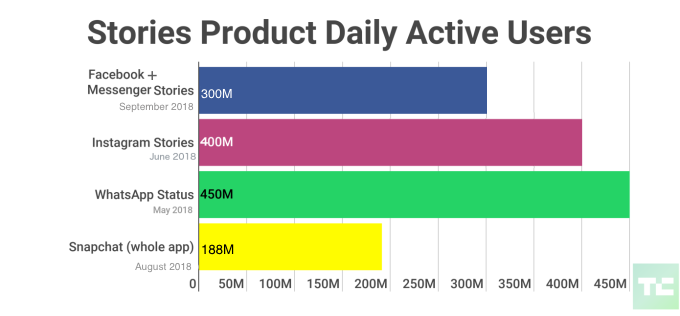
“Stories” on the major social apps have advanced vertically oriented, mobile native videos as their own content format

When I spoke recently with Jesús Chavez, CEO of the mobile-focused production company Vertical Networks in Los Angeles, he emphasized that successful episodic videos on mobile aren’t just normal TV clips with changes to the “packaging” (cropped for vertical, thumbnails selected to get clicks, etc.). The way episodes are written and shot has to be completely different to succeed. Chavez put it in terms of the higher “density” of mobile-native videos: packing more activity into a short time window, with faster dialogue, fewer setup shots, split screens and other tactics.

With the growing amount of time people spend watching videos on their social apps each day — and the flood of subpar videos chasing view counts — it makes sense that they would desire a premium content option. We have seen this scenario before as ad-dependent radio gave rise to subscription satellite radio like Sirius XM and ad-dependent network TV gave rise to pay-TV channels like HBO. What that looks like in this context is a trusted service with the same high bar for riveting storytelling of popular films and TV series — and often featuring famous talent from those — but native to the vertical, smartphone environment.

If IGTV pursues this path, it would compete most directly with Quibi, the new venture that Jeffrey Katzenberg and Meg Whitman are raising $2 billion to launch (and was temporarily called NewTV until their announcement at Vanity Fair’s New Establishment Summit last Wednesday). They are developing a big library of exclusive shows by iconic directors like Guillermo del Toro and Jason Blum crafted specifically for smartphones through their upcoming subscription-based app.

Quibi’s funding is coming from the world’s largest studios (Disney, Fox, Sony, Lionsgate, MGM, NBCU, Viacom, Alibaba, etc.) whose executives see substantial enough opportunity in such a platform — which they could then produce content for — to write nine-figure checks.

TechCrunch’s Josh Constine argued last year Snapchat should go in a similar “HBO of mobile” direction as well, albeit ad-supported rather than a subscription model. The company indeed seems to be stepping further in this direction with last week’s announcement of Snapchat Originals, although it has announced and then canceled original content plans before.

Snapchat announced its Snap Originals last week

Facebook is the best positioned to win

Facebook is the best positioned to seize this opportunity, and IGTV is the vehicle for doing so. Without even considering integrations with the Facebook, Messenger or WhatsApp apps, Facebook is starting with a base of more than 1 billion monthly active users on Instagram alone. That’s an enormous audience to expose these original shows to, and an audience who don’t need to create or sign into a separate account to explore what’s playing on IGTV. Broader distribution is also a selling point for creative talent: They want their shows to be seen by large audiences.

The user data that makes Facebook rivaled only by Google in targeted advertising would give IGTV’s recommendation algorithms a distinct advantage in pushing users to the IGTV shows most relevant to their interests and most popular among their friends.

The social nature of Instagram is an advantage in driving awareness and engagement around IGTV shows: Instagram users could see when someone they follow watches or “likes” a show (pending their privacy settings). An obvious feature would be to allow users to discuss or review a show by sharing it to their main Instagram feed with a comment; their followers would see a clip or trailer, then be able to click-through to the full show in IGTV with one tap.

Developing and acquiring a library of must-see, high-quality original productions is massively capital-intensive — just ask Netflix about the $13 billion it’s spending this year. Targeting premium-quality mobile video will be no different. That’s why Katzenberg and Whitman are raising a $2 billion war chest for Quibi and budgeting production costs of $100,000-150,000 per minute on par with top TV shows. Facebook has $42 billion in cash and equivalents on its balance sheet. It can easily outspend Quibi and Snap in financing and marketing original shows by a mix of newcomers and Hollywood icons.

Snap can’t afford (financially) to compete head-on and doesn’t have the same scale of distribution. It is at 188 million daily active users and no longer growing rapidly (up 8 percent over the last year, but DAUs actually shrunk by 3 million last quarter). Snapchat is also a much more private interface: it doesn’t enable users to see each others’ activity like Facebook, Instagram, LinkedIn, YouTube, Spotify and others do to encourage content discovery. Snap is more likely to create a hub for ad-supported mobile-first shows for teens and early-twentysomethings rather than rival Quibi or IGTV in creating a more broadly popular Netflix or Hulu of mobile-native shows.

It’s time to go freemium

Investing substantial capital upfront is especially necessary for a company launching a subscription tier: consumers must see enough compelling content behind the paywall from the start, and enough new content regularly added, to find an ongoing subscription worthwhile.

There is currently no monetization of IGTV. It is sitting in experimentation mode as Facebook watches how people use it. If any company can drive enough ad revenue solely from short commercials to still profit on high-cost, high-quality episodic shows on mobile, it’s Facebook. But a freemium subscription model makes more sense for IGTV. From a financial standpoint, building IGTV into its own profitable P&L while making substantial content investments likely demands more revenue than ads alone will generate.

Of equal importance is incentive alignment. Subscriptions are defined by “time well spent” rather time spent and clicks made: quality over quantity. This is the environment in which premium content of other formats has thrived too; Sirius XM as the breakout on radio, HBO on linear TV, Netflix in OTT originals. The type of content IGTV will incentivize, and the creative talent they’ll attract, will be much higher quality when the incentives are to create must-see shows that drive new subscribers than when the incentives are to create videos that optimize for views.

Could there be a “Netflix for mobile native video” with shows shot in vertical format specifically for viewing on smartphone?

The optimization for views (to drive ad revenue) have been the model that media companies creating content for Facebook have operated on for the last decade. The toxicity of this has been a top news story over the last year with Facebook acknowledging many of the issues with clickbait and sensationalism and vowing changes.

Over the years, Facebook has dragged media companies up and down with changes to its newsfeed algorithm that forced them to make dramatic changes to their content strategies (often with layoffs and restructuring). It has burned bridges with media companies in the process; especially after last January, how to reduce dependence on Facebook platforms has become a common discussion point among digital content executives. If Facebook wants to get top producers, directors and production companies investing their time and resources in developing a new format of high-quality video series for IGTV, it needs an incentives-aligned business model they can trust to stay consistent.

Imagine a free, ad-supported tier for videos by influencers and media partners (plus select “IGTV Originals”) to draw in Instagram users, then a $3-8/month subscription tier for access to all IGTV Originals and an ad-free viewing experience. (By comparison, Quibi plans to charge a $5/month subscription with ads with the option of $8/month for its ad-free tier.)

Looking at the growth of Netflix in traditional TV streaming, a subscription-based business should be a welcome addition to Facebook’s portfolio of leading content-sharing platforms. This wouldn’t be its first expansion beyond ad revenue: the newest major division of Facebook, Oculus, generates revenue from hardware sales and a 30 percent cut of the revenue to VR apps in the Oculus app store (similar to Apple’s cut of iOS app revenue). Facebook is also testing a dating app which — based on the freemium business model Tinder, Bumble, Hinge, and other leading dating apps have proven to work — would be natural to add a subscription tier to.

Facebook is facing more public scrutiny (and government regulation) on data privacy and its ad targeting than ever before. Incorporating subscriptions and transaction fees as revenue streams benefits the company financially, creates a healthier alignment of incentives with users and eases the public criticism of how Facebook is using people’s data. Facebook is already testing subscriptions to Facebook Groups and has even explored offering a subscription alternative to advertising across its core social platforms. It is quite unlikely to do the latter, but developing revenue streams beyond ads is clearly something the company’s leadership is contemplating.

The path forward

IGTV needs to make product changes if it heads in this direction. Right now videos can’t link together to form a series (i.e. one show with multiple episodes) and discoverability is very weak. Beyond seeing recent videos by those you follow, videos that are trending and a selection of recommendations, you can only search for channels to follow (based on name). There’s no way to search for specific videos or shows, no way to browse channels or videos by topic and no way to see what people you follow are watching.

It would be a missed opportunity not to vie for this. The upside is enormous — owning the Netflix of a new content category — while the downside is fairly minimal for a company with such a large balance sheet.