Month: October 2018

17 Oct 2018

WhiteSource nabs $35M to track open source code for security vulnerabilities

Open source software — a $14 billion market — has become a cornerstone for building apps and other IT services, with some 97 percent of developers today using using open source components of one form or another in their work. That popularity, however, belies a critical challenge: some of the most ubiquitous open source packages around are rife with vulnerabilities, so using them increases the risk of a security breach.

Rather than (unrealistically) expecting organizations to stop using open source components, there is a new wave of startups that are emerging to help them tackle this problem head on, by tracking open source components in their code, identifying when there are vulnerabilities, and providing routes to fix them. And today, one of the pioneers in the space, Israel-based WhiteSource, is announcing that it has raised $35 million to expand the scope of its work — by hiring more engineers, doubling down on its platform and coming to more geographies — it currently has offices in New York, Boston and Tel Aviv — to expand beyond the 500 large enterprises that use its tools today (including 23 percent of Fortune 100 companies).

Led by new investor Susquehanna Growth Equity, others in this round include 83North and M12 (formerly known as Microsoft Ventures), both previous backers.

WhiteSource is not disclosing its valuation, but a source close to the company tells me it’s in the region of $200 million. The company has raised $46 million to date.

WhiteSource has been around since 2011, founded by Rami Sass (CEO), Azi Cohen, Ron Rymon and Roni Einav — four alums from a previous startup, an identity management firm called Eurekify, which was acquired by CA about a decade ago. Sass said in an interview that even though WhiteSource had quietly bootstrapped itself initially and had only raised around $11 million before now, there had been a “big shift” in the marketplace in the last year or so.

“There is now an awareness to the potential risk of security vulnerabilities in open source code that’s being used, and that you want to use more,” he said. “So we decided to make a big jump, and focus on becoming a more substantial firm. That means a lot of plans to increase innovation and invest in the next phase of technology in this space.”

(Indeed, this funding comes on the heels of another startup in the same space, Synk, raising $22 million less than a month ago — a collective sign not just of the widespread use of open source, but the acceptance that there are a lot of vulnerabilities in the packages that need identifying and addressing.)

WhiteSource was one of the early companies to coin the term “software composition analysis” — “It wasn’t even in existence until we started the company,” Sass said — and while Sass didn’t specify what the next phase of tech at WhiteSource might entail, there are some critics of the “waterfall” model of SCA. Future work at WhiteSource might well entail more developer-centric versions of its detection software, on top of those it already offers.

While Black Duck (acquired by Synopsys last December), Snyk and others all offer a way to detect vulnerabilities in open source code, WhiteSource’s belief is that its solution is the most comprehensive on the market by comparison. “Monitoring is a limited description,” Sass said of what WhiteSource does. “We are able to govern security risk mitigation, able to look at every step, able to block out components based on corporate policy.”

These include tools to prevent vulnerabilities from creeping into code in the first place, as well as actions that an organization can take retroactively once a vulnerability has been identified; as well as scanning multiple sources for the newest information on open source code (building on what is considered the main resource, the National Vulnerability Database). On a positive note, nearly 98 percent of all vulnerabilities in open source packages have fixes built for them: the challenge is in identifying the holes and deploying the right code to the rescue.

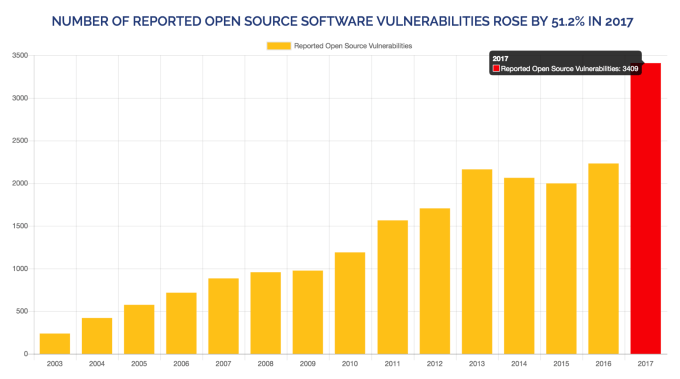
The issue of open source vulnerabilities is a persistent one. Research from WhiteSource found that the number of disclosed open source software vulnerabilities in 2017 rose by over 60 percent over 2016, with 2018 shaping up to be even bigger.

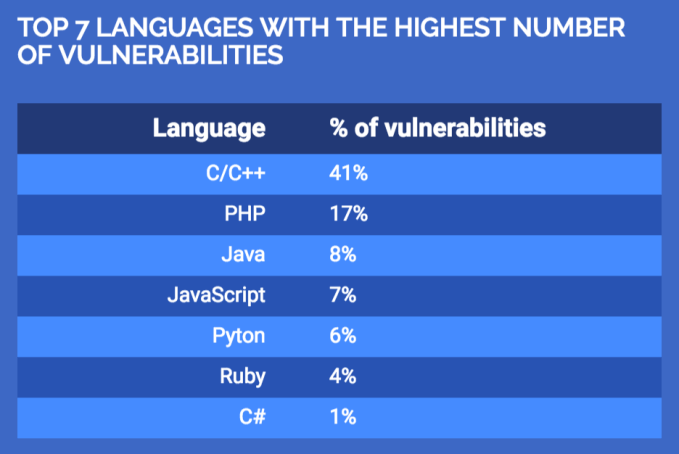
Moreover, the vulnerabilities seem to exist in direction variation to the popularity of the package or computing language being used.

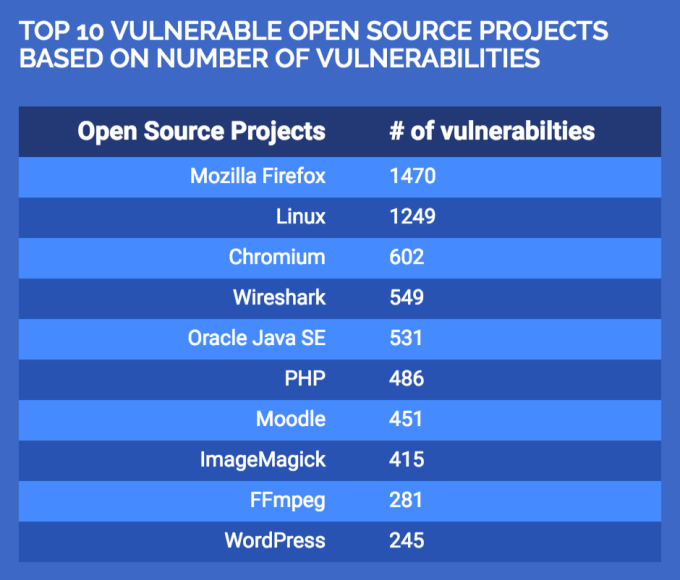
“The more popular an open source project is, the larger its community and the more ‘eyeballs’ it garners from security researchers,” the company noted in a recent report. “With more contributors looking at it, more security and quality issues are discovered and made public every month.” WhiteSource estimates that 7.5 percent of all open source projects are vulnerable because of this, but of the 100 most popular projects, 32% are vulnerable.


“WhiteSource has established the standard for open source security solutions with its strong leadership and breakthrough innovation,” said Martin Angert, Director at Susquehanna Growth Equity, in a statement. “We are excited for join WhiteSource on their journey to help businesses develop better software, faster.”


17 Oct 2018

Applied gets $2M to make hiring fairer — using algorithms, not AI

London-based startup Applied has bagged £1.5M (~$2M) in seed funding for a fresh, diversity-sensitive approach to recruitment that deconstructs and reworks the traditional CV-bound process, drawing on behavioural science to level the playing field and help employers fill vacancies with skilled candidates they might otherwise have overlooked.

Fairer hiring is the pitch. “If you’re hiring for a product lead, for example, it’s true that loads and loads of product leads are straight, white men with beards. How do we get people to see well what is it actually that this job entails?” founder and CEO Kate Glazebrook tells us. “It might actually be the case that if I don’t know any of the demographic background I discover somebody who I would have otherwise overlooked.”

Applied launched its software as a service recruitment platform in 2016, and Glazebrook says so far it’s been used by more than 55 employers to recruit candidates for more than 2,000 jobs. While more than 50,000 candidates have applied via Applied to date.

The employers themselves are also a diverse bunch, not just the usual suspects from the charitable sector, with both public and private sector organizations, small and large, and from a range of industries, from book publishing to construction, signed up to Applied’s approach. “We’ve been pleased to see it’s not just the sort of thing that the kind of employers you would expect to care about care about,” says Glazebrook.

Applied’s own investor Blackbird Ventures, which is leading the seed round, is another customer — and ended up turning one investment associate vacancy, advertised via the platform, into two roles — hiring both an ethnic minority woman and a man with a startup background as a result of “not focusing on did they have the traditional profile we were expecting”, says Glazebrook.

“They discovered these people were fantastic and had the skills — just a really different set of background characteristics than they were expecting,” she adds.

Other investors in the seed include Skip Capital, Angel Academe, Giant Leap and Impact Generation Partners, plus some unnamed angels. Prior investors include the entity Applied was originally spun out of (Behavioural Insights Team, a “social purpose company” jointly owned by the UK government, innovation charity Nesta, and its own employees), as well as gender advocate and businesswoman Carol Schwartz, and Wharton Professor Adam Grant.

Applied’s approach to recruitment employs plenty of algorithms — including for scoring candidates (its process involves chunking up applications and also getting candidates to answer questions that reflect “what a day in the job actually looks like”), and also anonymizing applications to further strip away bias risks, presenting the numbered candidates in a random order too.

But it does not involve any AI-based matching. If you want to make hiring fairer, AI doesn’t look like a great fit. Last week, for example, Reuters reported how in 2014 ecommerce giant Amazon built and then later scrapped a machine learning based recruitment tool, after it failed to rate candidates in a gender-neutral way — apparently reflecting wider industry biases.

“We’re really clear that we don’t do AI,” says Glazebrook. “We don’t fall into the traps that [companies like] Amazon did. Because it’s not that we’re parsing existing data-sets and saying ‘this is what you hired for last time so we’ll match candidates to that’. That’s exactly where you get this problem of replication of bias. So what we’ve done instead is say ‘actually what we should do is change what you see and how you see it so that you’re only focusing on the things that really matter’.

“So that levels the playing field for all candidates. All candidates are assessed on the basis of their skill, not whether or not they fit the historic profile of people you’ve previously hired. We avoid a lot of those pitfalls because we’re not doing AI-based or algorithmic hiring — we’re doing algorithms that reshape the information you see, not the prediction that you have to arrive at.”

In practice this means Applied must and does take over the entire recruitment process, including writing the job spec itself — to remove things like gendered language which could introduce bias into the process — and slicing and dicing the application process to be able to score and compare candidates and fill in any missing bits of data via role-specific skills tests.

Its approach can be thought of as entirely deconstructing the CV — to not just remove extraneous details and bits of information which can bias the process (such as names, education institutions attended, hobbies etc) but also to actively harvest data on the skills being sought, with employers using the platform to set tests to measure capacities and capabilities they’re after.

“We manage the hiring process right from the design of an inclusive job description, right through to the point of making a hiring decision and all of the selection that happens beneath that,” says Glazebrook. “So we use over 30 behavioural science nudges throughout the process to try and improve conversion and inclusivity — so that includes everything from removal of gendered language in jobs descriptions to anonymization of applications to testing candidates on job preview based assessments, rather than based on their CVs.”

“We also help people to run more evidence-based structured interviews and then make the hiring decision,” she adds. “From a behavioral science standpoint I guess our USP is we’ve redesigned the shortlisting process.”

The platform also provides jobseekers with greater visibility into the assessment process by providing them with feedback — “so candidates get to see where their strengths and weaknesses were” — so it’s not simply creating a new recruitment blackbox process that keeps people in the dark about the assessments being made about them. Which is important from an algorithmic accountability point of view, even without any AI involved. Because vanilla algorithms can still sum up to dumb decisions.

From the outside looking in, Applied’s approach might sound highly manual and high maintenance, given how necessarily involved the platform is in each and every hire, but Glazebrook says in fact it’s “all been baked into the tech” — so the platform takes the strain of the restructuring by automating the hand-holding involved in debiasing job ads and judgements, letting employers self-serve to step them through a reconstructed recruitment process.

“From the job description design, for example, there are eight different characteristics that are automatically picked out, so it’s all self-serve stuff,” explains Glazebrook, noting that the platform will do things like automatically flag words to watch out for in job descriptions or the length of the job ad itself.

“All with that totally automated. And client self-serve as well, so they use a library of questions — saying I’m looking for this particular skill-set and we can say well if you look through the library we’ll find you some questions which have worked well for testing that skill set before.”

“They do all of the assessment themselves, through the platform, so it’s basically like saying rather than having your recruiting team sifting through paper forms of CVs, we have them online scoring candidates through this redesigned process,” she adds.

Employers themselves need to commit to a new way of doing things, of course. Though Applied’s claim is that ultimately a fairer approach also saves time, as well as delivering great hires.

“In many ways, one of the things that we’ve discovered through many customers is that it’s actually saved them loads of time because the shortlisting process is devised in a way that it previously hasn’t been and more importantly they have data and reporting that they’ve never previously had,” she says. “So they now know, through the platform, which of the seven places that they placed the job actually found them the highest quality candidates and also found people who were from more diverse backgrounds because we could automatically pull the data.”

Applied ran its own comparative study of its reshaped process vs a traditional sifting of CVs and Glazebrook says it discovered “statistically significant differences” in the resulting candidate choices — claiming that over half of the pool of 700+ candidates “wouldn’t have got the job if we’d been looking at their CVs”.

They also looked at the differences between the choices made in the study and also found statistically significant differences “particularly in educational and economic background” — “so we were diversifying the people we were hiring by those metrics”.

“We also saw directional evidence around improvements in diversity on disability status and ethnicity,” she adds. “And some interesting stuff around gender as well.”

Applied wants to go further on the proof front, and Glazebrook says it is now automatically collecting performance data while candidates are on the job — “so that we can do an even better job of proving here is a person that you hired and you did a really good job of identifying the skill-sets that they are proving they have when they’re on the job”.

She says it will be feeding this intel back into the platform — “to build a better feedback loop the next time you’re looking to hire that particular role”.

“At the moment, what is astonishing, is that most HR departments 1) have terrible data anyway to answer these important questions, and 2) to the extent they have them they don’t pair those data sets in a way that allows them to prove — so they don’t know ‘did we hire them because of X or Y’ and ‘did that help us to actually replicate what was working well and jettison what wasn’t’,” she adds.

The seed funding will go on further developing these sorts of data science predictions, and also on updates to Applied’s gendered language tool and inclusive job description tool — as well as on sales and marketing to generally grow the business.

Commenting on the funding in a statement, Nick Crocker, general partner at Blackbird Ventures said: “Our mission is to find the most ambitious founders, and support them through every stage of their company journey. Kate and the team blew us away with the depth of their insight, the thoughtfulness of their product, and a mission that we’re obsessed with.”

In another supporting statement, Owain Service, CEO of BI Ventures, added: “Applied uses the latest behavioural science research to help companies find the best talent. We ourselves have recruited over 130 people through the platform. This investment represents an exciting next step to supporting more organisations to remove bias from their recruitment processes, in exactly the same way that we do.”


17 Oct 2018

Unifonic, dubbed the Twilio of emerging markets, closes $21M Series A round

Those of you familiar with the incredible rise of Twilio, which came along to utterly disrupt the communications world, will be interested to hear that another player plans to do the same, but this time in the staid and tricky area of emerging markets.

Unifonic, which has been dubbed “the Twilio of emerging markets” has today closed a $21M Series A funding round led by Saudi Technology Ventures (STV), and the emerging market specialist fund Endeavor Catalyst, which is backed by LinkedIn co-founder Reid Hoffman, among others. Other participants include RTF ELM, and Raed Ventures.

At $500M, STV is the largest VC fund in the region, and anchored by the Saudi Telecom Company (STC), the largest telecom company in the Middle East. Former Googler turned VC Abdulrahman Tarabzouni lead this round.

As far as we can tell, the is the largest Series A funding in the history of the Middle East technology sector. Appropriately, it shows the sheer growth in the region and comes on the heels of our recent and highly successful TechCrunch Startup Battlefield MENA in Beirut, as well as the Series C round announced by the “Uber for Doctors” in MENA Vezeeta’s Series C.

The capital will be used by Unifonic to scale the company across the MENA region and globally, and invest in the platform.

Unifonic is similar to Twilio in that it is a B2B cloud communications platform, a space that is sometimes called Communications Platform as a Service (CPaaS).
With 100+ employees spread across nine regional offices, and over 5,000 B2B clients, many of whom are giants in the MENA region, such as Souq.com, Aramex, Al Jazeera, HSBC, Uber, FedEx, Carrefour and others, they are the MENA region’s clear No.1 in this arena.

Started by two brothers – Hassan and Ahmed Hamdan, they were funded 5 years ago by Endeavor since July 2013. They now regularly compete against their European counterpart, MessageBird, which recently raised $60M (led by Accel and Atomico), and their US benchmark, Twilio.

Hassan told me: “Unifonic’s competition in emerging markets are small players that operate in a single country not cross the region like Unifonic. The product suite is designed for both the non-tech-savvy with last-mile tools already built to plug and play, localized to telecom infrastructure, hosted on multiple clouds, geographically in the region, to increase reliability and minimize latency so transactions are processed in milliseconds.”

In a joint statement Reid Hoffman, Linkedin co-founder and chairman of Endeavor Catalyst and Linda Rottenberg, Endeavor’s Co-founder and CEO said: “Endeavor selects and connects the most promising global companies and entrepreneurs with experienced business advisors to help drive growth and economic development around the world. The founders of Unifonic were selected as high-impact Endeavor Entrepreneurs in 2013, and we are thrilled to announce the Endeavor Catalyst fund is now investing in Unifonic alongside STV as the company continues scaling up.”

Why should you care?

Well, this comes on the heels of the first tech wave in the MENA region (culminating in Amazon’s acquisition of e-commerce player Souq.com last year, and large funding rounds for ride-hailing leader, Careem), this funding represents that Middle East investors are now starting to bet on B2B. It’s also STV’s 3rd publicly announced investment, as they previously invested co-led Careem’s Series D in December 2016 and last month led Vezeeta’s Series B.

As I wrote last year, Middle East startups are growing fast, and that’s even before the flying taxis arrive.

17 Oct 2018

Cognata raises $18.5M as race to deploy autonomous vehicles quickens

Cognata has raised $18.5 million in a funding round led by Scale Venture Partners, fresh capital that the Israeli autonomous simulation startup will use to meet demand for technology that will help companies speed up the deployment of self-driving vehicles.

Cognata founder and CEO Danny Atsmon told TechCrunch the company, which has 28 employees, will use the funds to double its staff and expand commercial operations. Cognata wants to increase its international presence, specifically into the U.S., Germany, China and Japan, he added.

Existing investors Emerge, Maniv Mobility, and Airbus Ventures as well as newcomer Global IoT Technology Ventures also participated in the round.

“All of the companies that are working on autonomous vehicles in the world identify simulation as a key technology to bring autonomous vehicles to market,” Atson told TechCrunch.

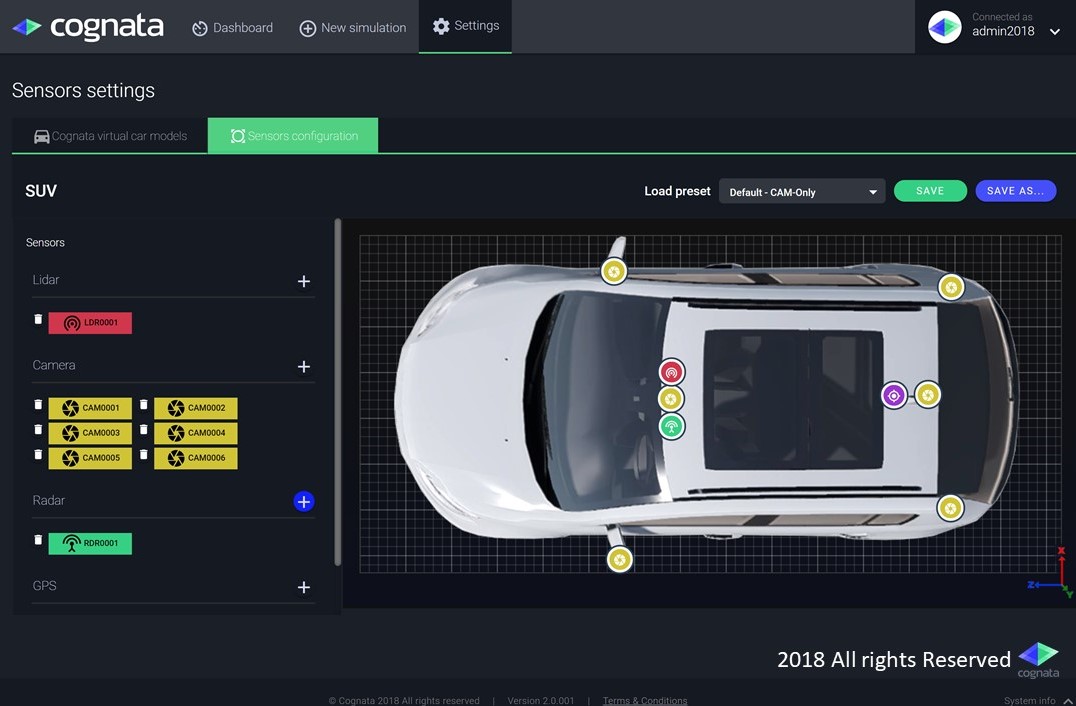
Cognata recreates cities in its 3D simulation platform using a combination of AI, deep learning and computer vision to give customers a variety of testing scenarios that simulates real-world test driving. Many autonomous vehicle companies use simulation because it allows them to test edge cases — those unlikely and unexpected scenarios that pop up while driving —without the risk of an accident. 

The automotive simulation platform pulls in layers of data to help build these virtual environments. It starts with recreating real cities, then adds AI-based traffic models to simulate real-world conditions, as well as data from the vehicle’s sensors.

Audi’s self-driving unit Autonomous Intelligent Driving signed a multi-year partnership earlier this year to use Cognata’s simulation platform to help it bring its self-driving vehicles to market faster. That partnership validates a product Cognata spent 2.5 years to bring to market, Atson said, adding with the additional capital “there will be more of these kinds of announcements” in the future.

As part of this funding round, Rory O’Driscoll, a partner at Scale Venture Partners will join Cognata’s board.

“As autonomous vehicles get closer to market, automakers must have a comprehensive simulation solution in place to meet the stringent training demands,”  O’Driscoll said in a statement.  “Cognata’s simulation platform is a critical component for the development of self-driving vehicles and the future of the industry.”

Cognata raised $5 million in 2017 from Airbus Ventures, Emerge and Maniv Mobility.

17 Oct 2018

Smule raises $20M, with plans to expand India operations

App maker turned music social network Smule has raised another $20 million. The latest round follows a $54 million raise in May of last year, led by Tencent, intent on helping the company expand Asia operations. This time out, funding is arriving via Times Bridge, the VC wing of India media conglomerate The Times Group.

The “strategic investment” comes as Smule pushes to expand its footprint in India, currently the second largest of the app maker’s international markets. Engaging there requires building a platform for an utterly massive and multi-lingual market.

“Building the Smule brand in India is a long term process, but a critical facet of realizing our vision to connect the world through music,” CEO and co-founder Jeffrey Smith told TechCrunch. “We are therefore thrilled to expand our reach in India through this significant partnership with Times Bridge.”

The round marks the first full social media partnership for Times Bridge, which finds the organization leveraging connections with local artists and helping to provide targeted marketing for Smule.

“Times Bridge’s mission is to bring the world’s best ideas to India and share India’s best insights with the world,” Times Bridge CEO Rishi Jaitly says in a statement. “Smule is a deeply original, bold idea with a mission of changing the way the world experiences music. Our investment will advance Smule’s music mission across the Indian subcontinent and unlock the creativity of many millions along the way. We are delighted to be working with a partner who approaches India with the empathy, conviction and optimism that the Indian market warrants.”

17 Oct 2018

Memory raises $5M to bring AI to time tracking

Memory, a startup out of Norway and maker of time tracking app Timely, has raised $5 million in further funding. Leading the round is Concentric, and Investinor, with participation from existing investor SNÖ Ventures. The company had previously raised $1 million in 2016 from 500 Startups, and SNÖ.

Founded by Mathias Mikkelsen, a designer by background and who I understand turned down a job offer at Facebook to try his hand at startup life, Memory is applying what it describes as AI and digital technology to create various tools to help solve “the abuses of time” that workers typically face in the modern workplace. The first of those abuses being tackled is the monotonous and time-consuming task of time tracking and filing time sheets — a meta problem if there ever was one.

“The problem we’re trying to solve is with time tracking, the most common currency of work that exists,” Mikkelsen tells me. “The problem is that people find it extremely painful to do and thus do it incorrectly. For example, what did you do last Friday? How long did it take? Humans are not built to remember that kind of detail and we shouldn’t be doing it. Harvard Business Review estimates that U.S. companies loose billions of dollars per day because of incorrect time tracking, so we think the potential is massive”.

The resulting product, dubbed Timely, is billed as a fully automatic time tracking tool. Powered by “AI”, it automatically records everything employees work on and then claims to create accurate time sheets on their behalf.

“We solve it with tons of data and machine learning,” says Mikkelsen. “We have built an ML model (recurring neural net) that literally tracks, completely privately and securely, everything you do in life. Files you work on, locations, websites, calendar, email, etc. Then we analyse all of that, make sense of it and automatically create a timesheet for you. We round up the time, choose projects, tags, all of it. It matches your individual pattern and the only thing our customers have to do is to hit an Accept button and you’re done with your timesheet”.

Mikkelsen says that Timely is currently used by more than 4,000 paying businesses across 160 countries, and that having created a complete “virtual memory” of time data, the Oslo startup is developing new tools to improve the “quality of time” and help businesses use time more effectively. As part of this effort, Memory will use the new funding to double its current 30-person team. It also plans on refining Timely’s AI model and to accelerate international growth.

17 Oct 2018

European late-stage FinTech startups get a boost with new Corviglia fund

In a boost to late-stage funding for FinTech startups looking to scale-up without having to leave Europe, what claims to be the largest growth equity fund for Fintech in Europe launches today.

The Corviglia Capital Fund will be deployed from Luxembourg and has secured $250M as a first closing for its first three years of operations, with the aim being to raise a total of $500M.

The fund has been started by two former fund managers Petr Šmída and Cezary Smorszczewski, and is a geographically agnostic, long-term investor in late-stage fintech companies. It will make minority investments with tickets ranging from $10M to $50M.

Šmída said banking and financial services are being disrupted by FinTech startups, so they “decided to set up Corviglia Capital Fund to find those very entrepreneurs and invest in their growth.”

Šmída previously co-founded ENERN, an Eastern European/DACH venture capital firm which has invested in 20 tech companies via three different funds since its founding. Prior to that, he worked in banking. Smorszczewski has previously held senior positions at a number of major Polish banks.

17 Oct 2018

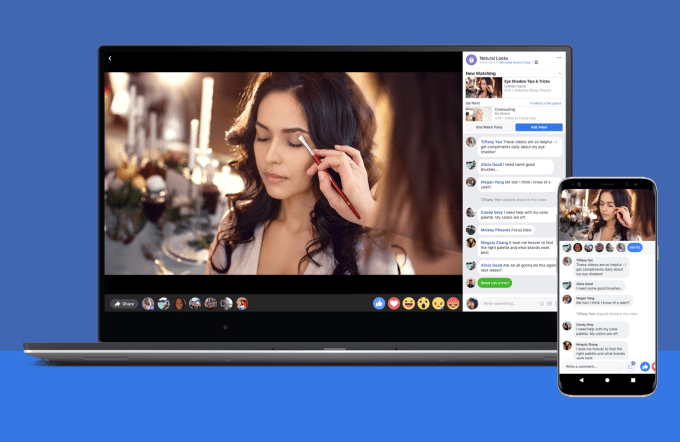
An interactive MTV Real World is coming to Facebook Watch

The world’s first hit reality show “The Real World” is being reimagined for Facebook Watch 26 years after it debuted on cable. Come Spring 2019, fans will get a chance to vote on who’ll join as the final cast member and connect with the housemates through Facebook Watch Party’s synchronized viewing chat rooms as they “stop being polite and start getting real”.

Facebook’s first truly tent-pole show for its Watch video hub could lure in viewers after a lackluster slate of mostly no-name shows launched alongside the feature in August 2017. But it’s starting to gain momentum, as 50 million people now spend at least 1 minute per month on Watch, and total Watch view time is up 14X since the start of 2018. For comparison, over 18 Snapchat Shows have over 10 million viewers per month. Users who do come to Facebook Watch spend 5X longer watching than on spontaneously discovered News Feed videos, which seems to have emboldened it to invest more in Watch content.

Facebook is hoping to outcompete YouTube Originals and Snapchat Discover’s Shows to win the mid-length social video market and the landslide of ad dollars shifting away from TV commercials.

As I wrote recently, there’s already plenty of user generated content to consume on these platforms, so the real opportunity is in super-premium shows that stand firmly apart from what litters feeds and Stories. While it’s unclear how much Facebook paid for the Real World, it likely didn’t come cheap,  but now it has arguably the highest profile show of any of the platforms.

Facebook’s partnership with MTV and Real World-creator Bunim/Murray Productions comes as part of a slew of original video content announcements revealed today at the MIPCOM TV industry trade show.

The [Business] INSIDER original game show on Facebook Watch called Confetti will expand internationally — curiously without INSIDER’s help. Facebook tells TechCrunch it will work with local partners in international markets to create versions of the HQ Trivia-style live video game show where players compete through their phones to win cash prizes. EMEA, APAC and LATAM editions of Confetti will launch by the end of this year.

Facebook Watch will also launch The World’s Most Amazing Dog, an interactive global competition show. In partnership with The Dodo, the show will spotlight top dogs and their owners from around the world.

Now that Facebook’s ad breaks are running in 25 countries, it’s able to get serious about monetizing Watch and recouping its content investments. Facebook has been paying up front for these shows but hopes that ad breaks could wean creators off its cash and create sustainable businesses based on Watch. But with today’s Wall Street Journal report that Facebook underreported the scale of video ad view time metrics bug that inflated measurements years ago, it may face additional skepticism that Watch is worth studios’ investment.

But again, it’s the name brand of The Real World that could change Watch’s trajectory. Facebook has signed on for three different one season runs of 12 episodes of the show localized for the US, Mexico, and Thailand.

“The Real World made history as the world’s first original reality show and trailblazing social experiment — and we’re thrilled to reboot the show for today’s audiences — representing and amplifying the real life, real people, real places and real social tensions of each country” says Matthew Henick, Facebook’s Head of Content Planning & Strategy. It poached Henick from BuzzFeed earlier this year to bring some experienced leadership to its intersection of traditional studio content and the smallest screen.

Last week Snapchat announced 12 original shows including two produced by Bunim/Murray. Yet with the ephemeral social apps losing users as well as over $300 million per quarter, it was only able to secure new and unknown docuseries like Endless Summer and Growing Up Is A Drag.

Despite Facebook jamming the Watch tab into its main app’s navigation bar, many users have ignored it. They already get short-form clips in the News Feed, longer web shows on YouTube, and full-length series on Netflix and Amazon Prime Video. It will require more big bets like The Real World to convince users that Watch is where they want to relax.

17 Oct 2018

Roborace to replace F1 racing drivers with robots at Disrupt

Formula E is so 2017. This year, it's all about Roborace, an upcoming F1-style competition. And the big new thing is that it's all about self-driving cars. I'm excited to announce that Roborace CEO Lucas DiGrassi will come to TechCrunch Disrupt Berlin to talk about this crazy idea.

DiGrassi may sound like a familiar name already as he's also a racing driver. He has competed in Formula One, Formula E and the World Endurance Championship. He’s also the current Formula E Champion. Clearly, DiGrassi is much better at parallel parking than I’ll ever be.

Racing has always been a great way to break new grounds for car manufacturers. Many of the technologies that you can find in your current car were first developed for endurance and Formula One competitions.

And it seems logical that the next radical step involves removing the driver altogether. Roborace will be a competition with self-driving cars that run using electric motors. Cars will compete on the Formula E tracks.

Teams will share the same chassis, powertrain, sensors and Nvidia Drive PX 2 system on a chip. You can find radars, lidars and other sensors on each car. But, of course, each team will be able to customize their AI-powered algorithm to beat competitors.

Right now, Roborace is testing the racing format alongside Formula E events. Sometimes, it involves putting an actual human being in a development car called a “DevBot”.

I’m incredibly excited about meeting DiGrassi and talking about this new competition. And if you want to meet him too, you should buy your ticket to Disrupt Berlin to listen to this discussion and many others. The conference will take place on November 29-30.

In addition to fireside chats and panels, like this one, new startups will participate in the Startup Battlefield Europe to win the highly coveted Battlefield cup.

Lucas DiGrassi

CEO, Roborace

Lucas DiGrassi is the CEO of Roborace, the world's first competition for human and artificial intelligent racing, making autonomous technology exciting and inspirational for a new generation of spectators.

Lucas is also a racing driver who has competed in Formula One, Formula E and the World Endurance Championship and is the current Formula E Champion.

He has been instrumental in building and growing the Formula E series over the past six years having joined as Special Advisor for the FE CEO Alejandro Agag back in 2012.

He is now bringing his business experience and extensive knowledge of racing, to Roborace, helping grow it into an established competition and cooperation of human and AI intelligence.

17 Oct 2018

Samsung acquires network analytics startup Zhilabs to help its transition to 5G

Samsung Electronics is betting that acquiring Zhilabs, a real-time networks analytics startup based in Barcelona, will ease its transition from 4G to 5G technologies. Financial details of the deal, which was announced today, have not been disclosed. Zhilabs will be fully owned by Samsung, but it will continue to operate independently under its own management.

The acquisition of Zhilabs is part of Samsung’s initiative, announced in August, to invest 25 trillion won (about $22 billion) in businesses working on AI, 5G, components for self-driving vehicles, and biopharmaceutical technologies.

In a statement, Youngky Kim, Samsung Electronic’s president and head of networks business, said “5G will enable unprecedented services attributed to the generation of exponential data traffic, for which automated and intelligent network analytics tools are vital. The acquisition of Zhilabs will help Samsung meet these demands to assure each subscriber receives the best possible service.”

Founded in 2008, Zhilabs’ products are used by customers including Hewlett Packard Enterprise, Vodafone, and Telefonica to analyze and test network performance in real-time. Because its solutions allow service issues to be automatically detected and fixed, Zhilabs’ AI-based automation will help Samsung launch new services related to the industrial Internet of Things and smart cars.