Month: October 2018

17 Oct 2018

Scribd and The New York Times announce a joint $12.99 subscription

If you want to subscribe to both Scribd and The New York Times, you can now do it for a combined price of $12.99 per month — particularly impressive when you consider that a standard NYT digital subscription costs $15.99 on its own.

You sign up and pay through Scribd, but once you do, you’ll get separate logins. Those will give you full access to The Times’ website and apps, as well Scribd’s library of ebooks, audiobooks and more. (One caveat: You’ll need to be a new subscriber to both services.)

The two companies have worked together in the past, both on a student subscription and by incorporating selected Times articles into the Scribd service. This, however, looks like their biggest partnership yet.

When asked about the price, The Times’ vice president of customer experience and retention Dork Alahydoian said simply, “We felt the need to be competitive with other major services.”

He added that The Times is hoping use these kinds of bundles to find and retain new subscribers. However, it hasn’t done many of these partnerships in the past — basically, a promotion with Spotify is the only one in the United States.

“We definitely needed to make sure it was the right partner, the right audience, the right model,” Alahydoian said. In his view, Scribd was a good fit because it attracts a similar audience as The Times, namely educated readers who are “willing to pay for content.”

As for whether The Times might do more deals like this in the future, he said, “We’re always looking for the right partnership. It’s about making sure it’s an impactful relationship.”

Scribd, meanwhile, has been experimenting with subscription bundles of its own. In this case, CEO Trip Adler said he’s hoping to provide “everything you could want to read in one subscription.”

“By having such a great offering, we think we can really expand the number of people who pay for news and for books and for written content,” he added.

17 Oct 2018

YouTube has been down for more than an hour

No, it’s not just you. As of Tuesday evening Pacific Time, YouTube was down for many users. The outage appears to have begun some time around 6:15 p.m., making this a pretty long outage for such a major site.

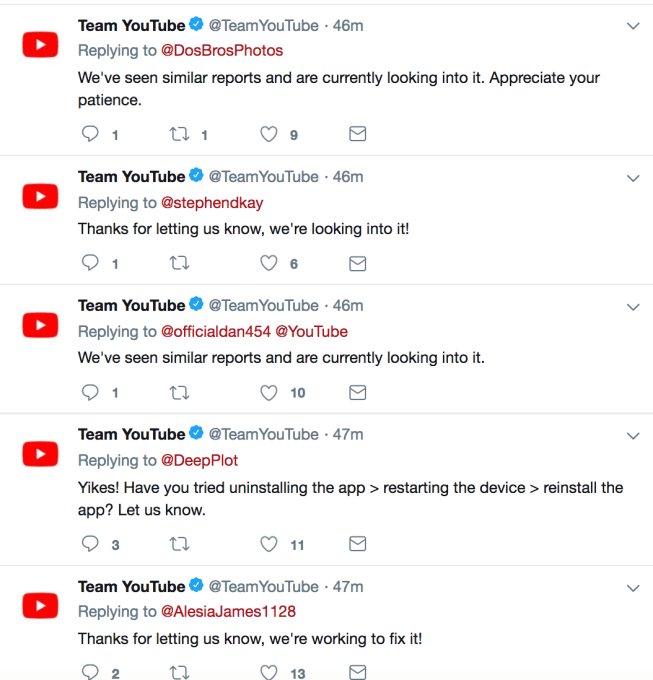
The company is well aware of the issue and tweeting its updates. The account began responding to tweets reporting the outage about an hour ago and has painstakingly replied to many, many reports from users since.

YouTube doesn’t experience downtime very often, making Tuesday’s outage pretty notable. We’ve reached out to YouTube about the cause of the outage and will update this story when we learn more.

16 Oct 2018

Blockchain media startup Civil is issuing full refunds to all buyers of its cryptocurrency

Many doubted The Civil Media Company‘s ambitious plan to sell $8 million worth of its cryptocurrency, called CVL. 

The skeptics, as it turns out, were right. Civil’s initial coin offering, meant to fund the company’s effort to create a new economy for journalism using the blockchain, failed to attract sufficient interest. The company announced today that it would provide refunds to all CVL token buyers by October 29.

Civil’s goal was to sell 34 million CVL tokens for between $8 million and $24 million. The sale began on September 18 and concluded yesterday. Ultimately, 1,012 buyers purchased $1,435,491 worth of CVL tokens. A spokesperson for Civil told TechCrunch an additional 1,738 buyers successfully registered for the sale, but never completed their transaction.

Civil isn’t giving up. The company says “a new, much simpler token sale is in the works,” details of which will be shared soon. Once those new tokens are distributed, Civil will launch three new features: a blockchain-publishing plugin for WordPress, a community governance application called The Civil Registry and a developer tool for non-blockchain developers to build apps on Civil.

ConsenSys, a blockchain venture studio that invested $5 million in Civil last fall, has agreed to purchase $3.5 million worth of those new tokens. The purchase is not an equity; all capital from the token sale is committed to the Civil Foundation, an independent nonprofit initially funded by Civil that funds grants to the newsrooms in Civil’s network.

In a blog post today, Civil chief executive officer Matthew Iles wrote that the token sale failure was a disappointment but not a shock. Days prior, he’d authored a separate post where he admitted things weren’t looking good.

“This isn’t how we saw this going,” Iles wrote. “The numbers will show clearly enough that we are not where we wanted to be at this point in the sale when we started out. But one thing we want to say at the top is that until the clock strikes midnight on Monday, we are still working nonstop on the goal of making our soft cap of $8 million.”

A recent Wall Street Journal report claimed Civil had reached out to The New York Times, The Washington Post, Dow Jones and Axios, among others, but failed to incite interest in its token.

Separate from its token sale, Civil has inked strategic partnerships with media companies like the Associated Press and Forbes, both of which confirmed to TechCrunch today that the failed token sale doesn’t impact their partnerships with Civil. 

Forbes became the first major media brand to test Civil’s technology when it announced earlier this month that it would experiment with publishing content to the Civil platform. As for the AP, it granted the newsrooms in Civil’s network licenses to its content. 

Civil, of course, isn’t the only blockchain startup targeting journalism. Nwzer, Userfeeds, Factmata and Po.et, which was founded by Jarrod Dicker, a former vice president at The Washington Post, are all trying their hand at bringing the new technology to the content industry.

Which, if any, will actually find success in the complicated space, is the question.

16 Oct 2018

Google tweaks Android licensing terms in Europe to allow Google app unbundling — for a fee

Google has announced changes to the licensing model for its Android mobile operating system in Europe,  including introducing a fee for licensing some of its own brand apps, saying it’s doing so to comply with a major European antitrust ruling this summer.

In July the region’s antitrust regulators hit Google with a recordbreaking $5BN fine for violations pertaining to Android, finding the company had abused the dominance of the platform by requiring manufacturers pre-install other Google apps in order to license its popular Play app store. 

Regulators also found Google had made payments to manufacturers and mobile network operators in exchange for exclusively pre-installing Google Search on their devices, and used Play store licensing to prevent manufacturers from selling devices based on Android forks.

Google disputes the Commission’s findings, and last week filed its appeal — a legal process that could take years. But in the meanwhile it’s making changes to how it licenses Android in Europe to avoid the risk of additional penalties heaped on top of the antitrust fine.

Hiroshi Lockheimer, Google’s senior vice president of platforms & ecosystems, revealed the new licensing options in a blog post published today.

Under updated “compatibility agreements”, he writes that mobile device makers will be able to build and sell Android devices intended for the European Economic Area (EEA) both with and without Google mobile apps preloaded — something Google’s same ‘compatibility’ contracts restricted them from doing before, when it was strictly either/or (either you made Android forks, or you made Android devices with Google apps — not both).

“Going forward, Android partners wishing to distribute Google apps may also build non-compatible, or forked, smartphones and tablets for the European Economic Area (EEA),” confirms Lockheimer.

However the company is also changing how it licenses the full Android bundle — which previously required OEMs to load devices with the Google mobile application suite, Google Search and the Chrome browser in order to be able to offer the popular Play Store — by introducing fees for OEMs wanting to pre-load a subset of those same apps under “a new paid licensing agreement for smartphones and tablets shipped into the EEA”.

Though Google stresses there will be no charge for using the Android platform itself. (So a pure fork without any Google services preloaded still wouldn’t require a fee.)

Google also appears to be splitting out Google Search and Chrome from the rest of the Google apps in its mobile suite (which traditionally means stuff like YouTube, the Play Store, Gmail, Google Maps, although Lockheimer’s blog post does not make it clear which exact apps he’s talking about) — letting OEMs selectively unbundle some Google apps, albeit potentially for a fee, depending on the apps in question.

“[D]evice manufacturers will be able to license the Google mobile application suite separately from the Google Search App or the Chrome browser,” is what Lockheimer unilluminatingly writes.

Perhaps Google wants future unbundled Android forks to still be able to have Google Search or Chrome, even if they don’t have the Play store, but it’s really not at all clear which configurations of Google apps will be permitted under the new licensing terms, and which won’t.

“Since the pre-installation of Google Search and Chrome together with our other apps helped us fund the development and free distribution of Android, we will introduce a new paid licensing agreement for smartphones and tablets shipped into the EEA. Android will remain free and open source,” Lockheimer adds, without specifying what the fees will be either. 

“We’ll also offer new commercial agreements to partners for the non-exclusive pre-installation and placement of Google Search and Chrome. As before, competing apps may be pre-installed alongside ours,” he continues to complete his trio of poorly explained licensing changes.

We’ve asked Google to clarify the various permitted and not permitted app configurations, as well as which apps will require a fee (and which won’t), and how much the fees will be, and will update this post with any response.

The devil in all those details should become clear soon though, as Google says the new licensing options will come into effect on October 29 for all new (Android based) smartphones and tablets launched in the EEA.

16 Oct 2018

10 lessons from Marketo’s growth to a multi-billion-dollar exit

With Adobe’s acquisition of Marketo, I have been reflecting on what an amazing and pioneering company Marketo has been since it was founded in 2006. There are very few tech companies that have defined a new category, executed a successful IPO, been acquired by a private equity firm for more than four times the company’s initial IPO market value and now, at a price of $4.75 billion, become the largest acquisition of a world-class company like Adobe.

The credit for this dream-come-true Silicon Valley company goes to the co-founding team of Phil Fernandez, Jon Miller and David Morandi, who together built an amazing customer-first product, defined a breakthrough category and launched a marketing automation company that continues to delight and amaze partners and customers alike.

I had the unique pleasure of meeting the founding team in 2006 when they shared their vision and passion for marketing automation. At the time, all they had was a PowerPoint deck. But it was clear then that they had a special idea and the unique capability to build a breakthrough product to deliver on their vision.

In all honesty, I couldn’t know how truly extraordinary the company would become. Thankfully, I was lucky enough that the team chose me and my former partner Bruce Cleveland as their first investor and also was fortunate to serve on the board for 10 years. Most recently, I was thrilled that Phil joined me at Shasta. One of the qualities I admire most about Phil — which was apparent all those years ago and continues to this day — is that he never stops iterating to do things better or faster or more efficiently or more thoughtfully. Phil always carried a notebook that said “THINK” on the cover, which epitomizes how he approaches his work.

Phil recently shared his “10 Things I’d Do Even Better If I Did It Again” presentation with our team and our founder/CEO community. We believe his insights are “10 Must-Dos” for today’s software entrepreneurs. It’s hard for entrepreneurs to know the trade-offs required when making the tough decisions — especially early on ­– but what follows is what I learned from Phil, and the key takeaways from his talk that I believe can help more founders create iconic companies with lasting value. (Note: Click here to view excerpts of Phil’s talk.)

Have one person own revenue

If your company is like every other company, there are two executives — vice president of Sales and the chief marketing officer — who are regularly locking horns because they are each tasked with taking different approaches to the same goal of increasing revenue. How do you solve this?

Hire a chief revenue officer (CRO) who can see both perspectives, plus give the context that sales and marketing are missing. This seat understands the big picture and doesn’t belong in marketing or sales. The CRO needs to talk strategically about life cycle revenue — across the customer journey. She or he should be a storyteller who can look at the numbers and the models and explain it all in plain English to the executive team so that everyone understands. Like a chief people officer, you’re going to have to spend on a CRO — but it’s worth it in the long run.

Hire a chief people officer (CPO) ASAP

Your company needs a leader of “all things people” who can make sure your workplace is welcoming, diverse and responsive to employee needs. For the staff to have trust, this person needs to be in a role that is empowered by the organization and not just by the CEO. Hire the most senior, overqualified HR executive into your business as early as possible — Series A level — and have him or her report directly to the CEO. By constantly listening to people — which is really hard when you’re working really hard — the CPO will help build your culture and be the eyes and ears for the CEO. Investing early in HR will come back to you tenfold through employee retention, team morale and an enviable culture.

Give back when it makes no sense

The day you think you’ve got to get a product release out the door and there’s no time to do anything else is the day you get out and give back in whatever way makes sense for your company and your community. Give employees time off to volunteer. Pick a cause for your company to support. Or, consider starting a charitable foundation with pre-public stock. It will create a spirit and energy that will give back to your team five or 10 times whatever it is costing you.

Charge your first customer

Phil personally wrote a stupid thing on their website that said, “At Marketo, your success doesn’t have a price.” That copy stayed up for years as a testament to how customer-centric they were. They were proud that they weren’t charging for services. But as Phil said, that was a big mistake; they should have been charging from day one.

When you’re a startup, short-range thinking is seductive, but long-range thinking is powerful.

There really isn’t any friction about asking customers to pay for services. If you say, “Look, this product is great. It’s going to transform your business but it’s not easy and it will cost money,” they will spend it. Feature-level sales is a great way to justify why you are charging what you are charging, and it keeps customers renewing services and adding more features as their business grows and changes. To make this strategy work, gear your sales metrics toward incremental increases over time­ instead of pushing sales reps to sell as much as they can all at once. Customers will pay for quality products that meet their needs.

Build a world-class Rev Ops/Sales Enablement team

You need a VP-level Rev Ops/Sales Enablement executive by the time your company reaches $2-3 million in revenue. That individual must think holistically about how revenue is happening, from the early lead in the door and the sale to renewal and the up-sale; understanding full lifetime value and thinking about it in a modeling sense. She or he needs to be a storyteller — one who can look at the numbers, look at the models and then explain it in plain English to the executive team. That’s gold.

Focus on continuous ARPU expansion

Today, to increase ARPU (average revenue per user), you need to design feature-level packaging every bit as much as how you design product functionally. The same people on product management ought to be thinking together with Rev Ops and Sales about how you dish out the product, how you launch the pieces, how you turn on pieces and how you enable pieces. It becomes a part of the art of product design as much as the art of revenue design — and that’s where these two rules of thought really come together. Basically, you need to design an expansion pass.

Incubate new product initiatives

Marketo failed in defining a multi-product company, from when it was $30 million a year to when it was $300 million a year. If you’re going to bring a second product line into the company — whether it’s organic or inorganic — it needs to be incubated. It needs to have its own dedicated sales team and its own separate quotas. If you’re thinking about becoming a multi-product company, do not pass Go, do not collect $200; go read Geoffrey Moores’ Zone to Win, the only business book Phil has ever recommended.

Pursue constant technology renewal

The pace at which tech is moving and the competitive advantage that new tech is providing over old tech has never been like this during the past 35 years. Today, you need someone that’s charged with thinking not about product but about the future. You need to value technical currency. If you’re three years old on your technology and a new company enters your market — the degree of agility, pace and performance the new entrant has in running circles around your company will win over a five-year cycle. Every time.

Always be seeking more TAM

No matter how good your initial tenure is, no matter how good it feels, no matter how amazing you see your company, as the CEO, as a leader, have a Plan B. Know what’s next, know where you’re going next and make sure you’re always talking about it. Be absolutely zealous about ensuring you know the next piece of TAM you’re going to go after. Think about what’s going to happen if you have more money; what would you do next? Give yourself that opportunity to dream, but make it real, make it defensible.

Watch the clock during scale up

When you’re a startup, short-range thinking is seductive, but long-range thinking is powerful. Always be watching the time. The tension between operating leverage and scale-up investment is really dangerous. At Marketo, they got to it late and their growth slowed a little too much. Live in the real world and focus on cash and on making the investments so you have the capacity when you need it. Have a long-range planning process and understand the day when you’ll need $2 million of ramp capacity. Don’t let the tyranny of a seductive short-range model triumph over what the real world is telling you about the dynamics of growing the business. Understand what it takes to really scale.

16 Oct 2018

Netflix shares are up after the streaming service adds nearly 7M new subscribers in Q3

After a disappointing second quarter, Netflix is back in Wall Street’s good graces. The company just released its third quarter earnings report, and as of 5:30pm East Coast time, the stock is up 12 percent in after hours trading.

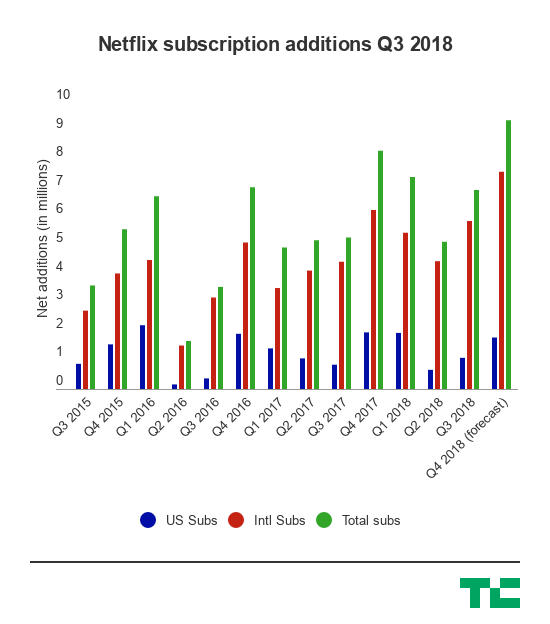
The most important number here is subscriber growth, and that’s where Netflix came in way ahead of expectations, with 6.96 net additions, compared to the 5.07 million that analysts predicted. The service now has a total of 137 million members, and 130 million paying members.

The company also reported earnings of 89 cents per share on revenue of $4 billion — analysts had predicted EPS of 68 cents.

In addition to reporting on the latest financials, Netflix’s letter to shareholders also offers an update on its original content strategy. It distinguishes between two different types of Netflix Originals — the ones like “Orange Is The New Black,” where Netflix gets the first window for distribution, and others like “Stranger Things,” where it actually owns the content.

The company says:

Today, we employ hundreds of people in physical production, working on a wide variety of owned titles spread across scripted and unscripted series, kids, international content, standup, docs and feature films from all over the world. To support our efforts, we’ll need more production capacity; we recently announced the selection of ​Albuquerque, New Mexico​ as the site of a new US production hub, where we anticipate bringing $1 billion dollars in production over the next 10 years and creating up to 1,000 production jobs per year. Our internal studio is already the single largest supplier of content to Netflix (on a cash basis).

Netflix subscription adds Q3

Netflix also says romance has been big recently, thanks to its “Summer of Love” slate of original films, which have been watched by more than 80 million accounts. Apparently “To All The Boys I’ve Loved Before” did particularly well, becoming one of Netflix’s most-watched original films, “with strong repeat viewing.”

The service plans to release “Gravity” director Alfonso Cuarón’s new film “Roma” in December, which has already been getting rave reviews at film festivals. While Netflix’s original movies generally have a minimal presence in theaters, the company says “Roma” (like Paul Greengrass’ “22 July”) will be released in more than 100 screens worldwide — not a blockbuster rollout, but not a perfunctory release, either.

The company is forecasting the addition of 9.4 new members in the fourth quarter.

16 Oct 2018

Passport, a customer service company focused on shipping, has raised $3 million in seed funding from some notable names

Founders building a brand today are largely relying on new infrastructure to do it, though they’re still heavily reliant on legacy carriers like FedEx and DHL when it comes to international shipping. In fact, prohibitively high prices, along with not a lot of support or tools, are a few reasons why more American products aren’t shipped abroad. Many startups especially decide it’s simply not worth it.

Enter Passport, a 1.5-year-old, San Francisco-based startup that sees an opportunity to make it easier for brands to reach far-flung customers and that has raised $3 million in seed funding toward that end. Among its backers is Resolute Ventures; Precursor Ventures; Product Hunt cofounder Ryan Hoover; Girlboss founder Sophia Amoruso; and April Underwood, the chief product officer of Slack.

What piqued investors’ interest? The team, for starters, including cofounder and COO Aaron Schwartz, who previously founded his own e-commerce company (Modify Watches) and CEO Alex Yancher, who, among other things, cofounded a smart fridge kiosk company called Pantry that was acquired. The two have some experience in moving packages from one point to another; they also know the pain of dealing with lost and delayed packages.

The company is also “asset light,” which investors typically like. Indeed, the company is largely a customer service business focused on shipping globally. How it works: one of its customers — let’s take Native Deodorants — will hold its inventory in a third party logistics warehouse. In Native’s case, it’s a Connecticut company called Fulfillment Works, and Fulfillment Works slaps a label on Native’s packages that have been created by Passport, then gets the packages ready for pickup.

After that, Passport arranges for a daily pickup of all of Native’s internationally bound parcels, working through a third-party freight company like Old Dominion or FedEx Freight. That company brings the parcels to a consolidation point, where the parcels are sorted by country and final mile. After that, the Canada parcels, say, are sent on a truck to the border and perhaps injected into the Canadian Postal system, or they’re flown to Australia on a Qantas flight and shipped out to the recipient via the Australian Post. Passport then acts as a reference point so that if a customer has any questions about his or her package, they are fielded by Passport.

It doesn’t sound like rocket science. All the same, in an age where consumer expectations are higher than ever when it comes to at-home delivery, an aggregator that connects all the pieces to provide a better customer experience may well prove worth it to some brands. Indeed, in addition to Native, others of Passport’s early customers include the men’s outfitter Shinesty, the backpack maker ISM, the socks manufacturer Bombas, and the clothing company Betabrand.

We were in touch yesterday with Yancher and Schwartz to learn more.

TC: How did you identify this particular sliver of industry as a problem worth tackling?

AY: I ran a personal shopping service — Lynks.com — that helped people abroad buy products from the U.S., and I saw that demand for American goods is booming abroad. In fact, half of a brand’s Instagram followers are from abroad, but only 10 percent of its sales are. Despite the boom in cross-border, current international shipping options are lacking a lot of what a merchant needs to successfully sell and ship abroad.

This pain doesn’t just exist for individual brands alone but also for third party logistics facilities — the operations companies that partner with brands and that receive, warehouse and fulfill customer orders.  They have incredible buying power for shipping customers, and yet they’re also unsatisfied.

TC: It sounds like your differentiator is customer service, but couldn’t another startup come in and strike relationships with international carriers and do precisely the same thing?

AY: Shipping a package internationally is complicated. Building a consistent experience across hundreds of partners with different transit times expectations, technical backends and terms and conditions requires technological as well as logistical expertise. I’ve spent years stringing together custom shipping routes. This isn’t something you just jump into, there’s a ton of nuance into how you work with global posts and private carriers.

What we do differently is embed customer support via Intercom on the tracking page, which is where consumer anxiety happens. Anyone can offer customer experience, but for international shipping, it’s pretty darn hard. You have to get detailed data from a bunch of carriers. You also have to know what the “exceptions” are. We automate a lot of the support behind the scenes, which has taken a year to get going.

We also offer proactive notifications when door tags are left, so a customer can follow-up directly with their local carrier and packages aren’t set back to the U.S.; we set up direct Slack channels with brands in order to help their own customer experience teams deal with any other questions about international shipping; and we do in-shopping-cart integrations, like a fully landed cost calculator, so consumers know exactly what they are paying for an item and won’t get hit with a “your item is held at customs.”

TC: Which international carriers are you working with, and do you have any kind of exclusive deals with them?

AS: We ship to 195 countries around the world and use a different last mile provider in each country and use a variety of trucks (to Canada and Mexico) and air transport partners to get parcels all over the world. In total we work with over 300 carriers and posts. We don’t have exclusive deals on the carrier side of the business.

TC: How do you price packages? How much more do you mark them up in exchange for the hand-holding you provide?

AS: Our price depends on multiple factors from the origin point to the quantity of shipments. Our markup range is between 5 percent to 50 percent depending on the client, but our pricing is 100 percent transparent. If you ship with DHL, FedEx, etc. you’ll get a rate sheet. But then you’ll also have a bunch of hidden fees like fuel surcharges, or “remote area surcharges” of up to 30 percent that will be sent 30 days later, after you’ve charged your customer.  They’ll charge you extra for certain deliveries. They’ll charge you extra for the fully-landed cost calculator — or tell you to partner with a different party. And if your package is lost, they’ll say, “Fill out this form. We’ll be in touch in 90 days after an investigation.”

Our point of view is that great logistics is necessary but insufficient when it comes to international shipping. You also need to deliver a great digital experience for brands. Everything that goes into delivering that gets bundled into our postage price.


16 Oct 2018

Facebook News Feed now downranks sites with stolen content

Facebook is demoting trashy news publishers and other websites that illicitly scrape and republish content from other sources with little or no modification. Today it exclusively told TechCrunch that it will show links less prominently in the News Feed if they have a combination of this new signal about content authenticity along with either clickbait headlines orlanding pages overflowing with low-quality ads. The move comes after Facebook’s surveys and in-person interviews with discovered that users hate scraped content.

If illgotten intellectual property gets less News Feed distribution, it will receive less referral traffic, earn less ad revenue, and the there’ll be less incentive for crooks to steal articles, photos, and videos in the first place. That could create an umbrella effect that improves content authenticity across the web.

And just in case the scraped profile data stolen from 29 million users in Facebook’s recent massive security breach ended up published online, Facebook would already have a policy in place to make links to it effectively disappear from the feed.

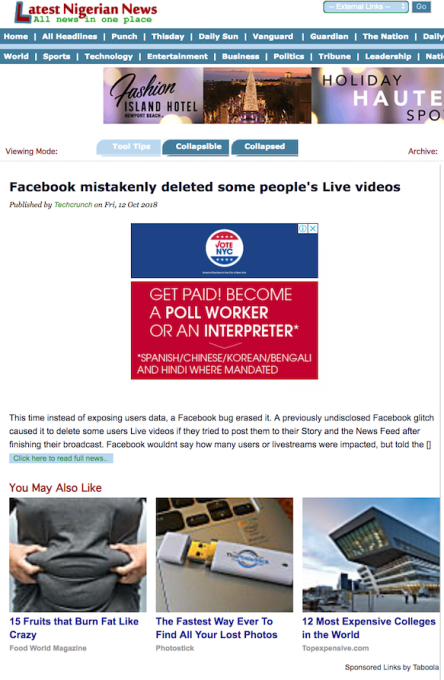
Here’s an example of the type of site that might be demoted by Facebook’s latest News Feed change. “Latet Nigerian News” scraped one of my recent TechCrunch articles, and surrounded it by tons of ads.

An ad-filled site that scraped my recent TechCrunch article. This site might be hit by a News Feed demotion

“Starting today, we’re rolling out an update so people see fewer posts that ink out to low quality sites that predominantly copy and republish content from other sites without providing unique value. We are adjusting our Publish Guidelines accordingly” Facebook wrote in an addendum to its May 2017 post about demoting sites stuffed with crappy ads. Facebook tells me the new publisher guidelines will warn news outlets to add original content or value to reposted content or invoke the social network’s wrath.

Personally, I think the importance of transparency around these topics warrants a new blog post from Facebook as well as an update to the original post linking forward to it.

So how does Facebook determine if content is stolen? It’s systems compare the main text content of a page with all other text content to find potential matches. The degree of matching is used to predict that a site stole its content. It then uses a combined classifier merging this prediction with how clickbaity a site’s headlines are plus the quality and quantity of ads on the site.

16 Oct 2018

Google Maps amplifies its app for electric vehicle owners

Google Maps is beefing up its app to help electric vehicle owners find the most suitable and closest place to charge up.

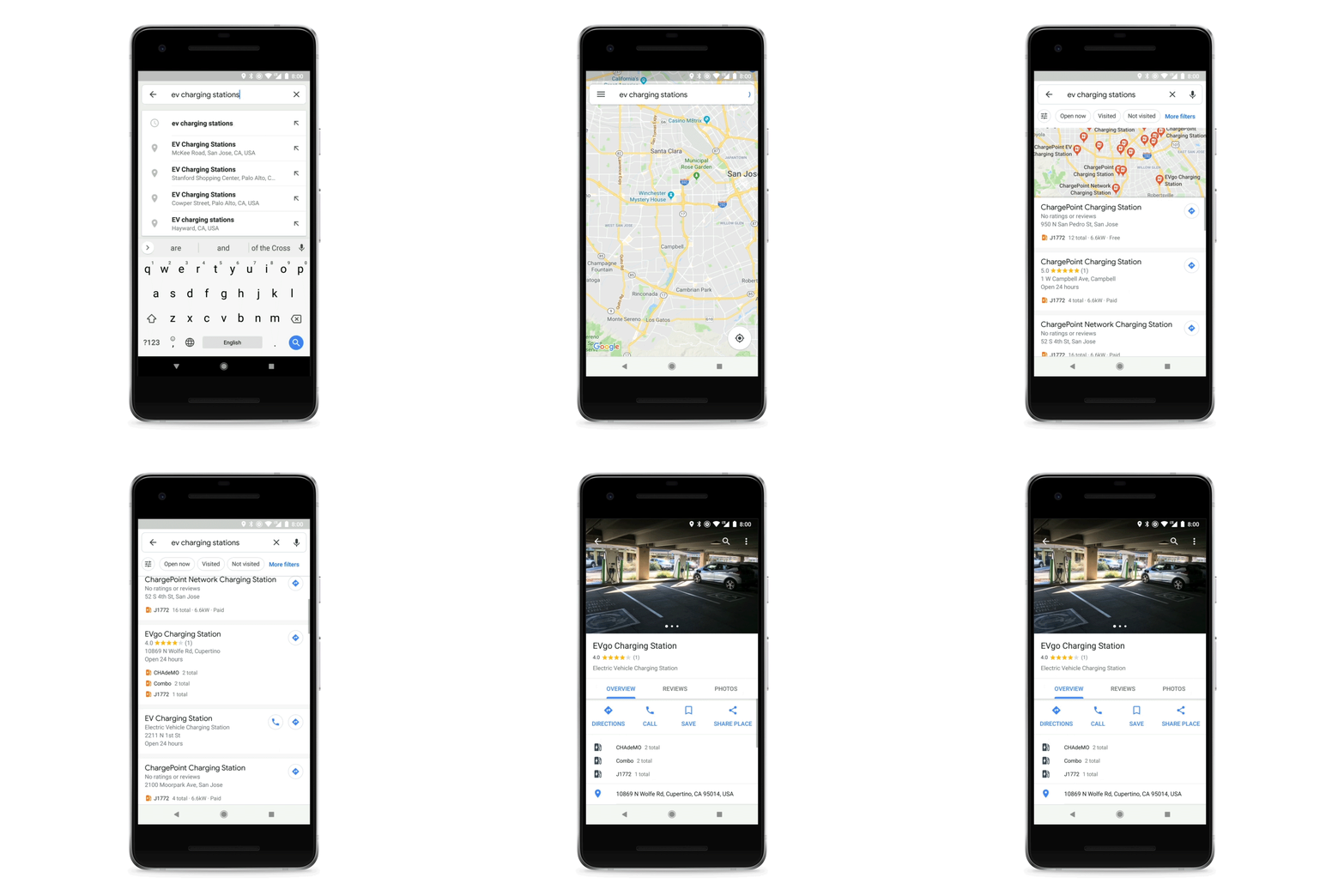
Google Maps said Tuesday it’s adding an EV charging feature to the app that will give users information about charging stations. Google has featured charging stations for a number of years now. But now, Google Maps is displaying more stations from supported networks and providing information about the stations themselves, including how many charging ports are available and how quickly they’ll be able to charge.

Users can type in keywords like “ev charging” or “EV charging stations” to see the nearest supported stations.

The EV charging search feature starts rolling out Tuesday on Android and iOS, with desktop launching in the coming weeks.

Google Maps now supports charging stations around the world, including Tesla and ChargePoint globally. In the U.S., the feature also includes SemaConnect, EVgo and Blink. ChargeMaster and Pod Point are included in Google Maps in the UK and ChargeFox stations will be shown in Australia and New Zealand.

Google Maps will show information about the business where the station is located, the types of ports available, charging speeds, and how many ports there are. Users will also see information about the station from drivers, including photos, ratings, reviews and questions.

There are other third-party apps out there with this kind of information, notably PlugShare, which has been a go-to source for many electric vehicles owners in the past. Innogy recently acquired PlugShare’s parent company Recargo.

16 Oct 2018

Coinbase now lets you buy and sell ZRX

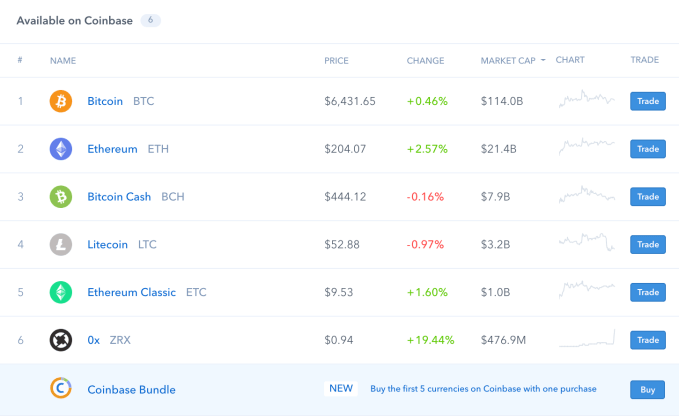
Coinbase’s newest asset is live. On Tuesday the popular U.S.-based cryptocurrency platform added support for ZRX, the token representing the 0x Project. On Coinbase, ZRX joins the rarified ranks of Bitcoin, Bitcoin Cash, Ethereum, Ethereum Classic and Litecoin.

Coinbase ZRX

The addition doesn’t come as a surprise. Last week, Coinbase added ZRX to Coinbase Pro, the so-called “evolution of GDAX,” Coinbase’s more feature-rich trading platform. Coinbase also previously signaled its intentions to “explore” the addition of a number of new cryptocurrencies including 0x (ZRX), Cardano (ADA), Basic Attention Token (BAT), Stellar Lumens (XLM) and Zcash (ZEC).

By showing its hand well in advance and being more transparent about its regulatory hurdles, the platform will hopefully avoid another debacle like the volatile launch of Bitcoin Cash last December, which prompted an insider trading investigation.

“One of the most common requests we hear from customers is to be able to trade more assets on Coinbase,” Coinbase said in a blog post.

ZRX should show up soon for most users across the desktop, iOS and Android versions of Coinbase. At launch time, ZRX won’t be available in the state of New York or the United Kingdom due to unresolved regulatory issues.