Month: October 2018

16 Oct 2018

Periscope broadcasters can now assign their own chat moderators

It’s going to be harder for trolls to disrupt Periscope broadcasts. The Twitter-owned live streaming app has offered chat moderation capabilities for years, but it has so far relied on group moderation. That means when users flagged a comment as abuse, spam or harassment, Periscope would randomly select a few other viewers to take a look and decide if that’s true. Violators would be banned if the users agreed. That worked well in some cases, but it still put control in the hands of the crowd, not the live streamer. Now, Periscope is changing that.

Instead of relying solely on group moderation, the company says broadcasters will instead be allowed to assign chat moderators before they start streaming.

These moderators can then watch the chat during the live broadcast and actively mute commenters in the audience who are disruptive.

After being muted, the person will not be allowed to chat for the remainder of the broadcast. This muting activity will be visible to anyone joining the broadcast from either Periscope or Twitter, but assigning chat moderators can only be done from Periscope, the company says.

When the live stream wraps, the broadcaster can then view a list of all the muted accounts and can choose to block those users from joining in future broadcasts.

The addition, which arrived alongside new replay editing tools, is another step towards improving the health of conversations on Periscope, the company claims. It follows another change announced this past summer, which focused on stricter enforcement of its rules around abuse and harassment.

Before, trolls whose comments were flagged during a broadcast were only temporarily blocked from chatting. They wouldn’t be able to comment on that live broadcast, but they could still join others in the future and continue to disrupt, threaten or abuse the video creator or the community.

The change that rolled out this summer made it so that those people who repeatedly got suspended for violating the guidelines would have their Periscope accounts reviewed and suspended.

Online harassment is not a new problem, to be sure, but the major social platforms have been struggling to get a handle on the issues.

In Twitter’s case, in particular, it’s been called out for being too tolerant of online harassment and hate speech, under the guise of protecting free speech. But Twitter has been trying to better handle abuse complaints, in more recent months, including through the acquisition of anti-abuse technology provider Smyte, which is helping to automate some of the processes here, as well as with the rollout of more stringent policies and anti-abuse features. Periscope hasn’t received as much attention, but is focusing on reducing the abuse that occurs during the real time conversations on live broadcasts.

More info on how the new chat moderation feature works is here.


16 Oct 2018

Google-incubated AdLingo uses chatbot integration to create conversational ads

“Conversational marketing” is a phrase that I hear a lot, but when the team at AdLingo uses it, they mean something specific — namely, bringing chatbots and other conversational assistants into online advertising.

The startup is part of Google’s Area 120, and co-founder and general manager Vic Fatnani said he’s worked on advertising at Google for more than a decade.

“One of the things we saw happening was this paradigm shift with users and consumers going towards more of a conversational medium,” he said. “Everything is becoming more conversational, whether it’s through devices such as your phone, your speaker and eventually your car … We asked ourselves, ‘Hey if this shift is happening, why can’t marketing be more conversational?'”

You may be wondering whether consumers are really clamoring to interact with ads, but Fatnani said he and his co-founder Dario Rapisardi were determined not to build “a solution that needs a problem,” so they spent months talking to marketers and chatbot developers.

Apparently, when they asked about what challenges everyone was facing, the big answer was “discovery.” As Fatnani put it, “Hey, I have this amazing conversational assistant, but it’s really hard for me to bring this in front of audience.”

General Manager Vic Fatnani, Head of Partnerships Stephanie Lyras, Head of Engineering Dario Rapisardi

In his view, advertising provides the perfect medium to solve this problem. Instead of building a chatbot and just letting consumers find it on their own website or app, brands can integrate it into their advertising, allowing people who see the ad to ask questions and provide feedback.

“Imagine you want to launch a new soda drink in Brazil, a market that you’ve never entered before,” he added. “Imagine you can now run a conversational display ad and actually have people vote to say what kind of flavor would you like to drink.”

Or for a real example, there’s the Allstar Kia experience that you can see at the top of this post. Che company’s director of internet marketing Chris Ferrall said in a statement that “AdLingo lets our customers browse inventory, determine car trade-in value and make an appointment with a salesperson — all within an engaging, interactive experience that meets them right where they are.”

To be clear, Adlingo isn’t building the chatbots. Instead, Fatnani said, “The brands and developers bring the conversational experience to us, and we distribute that experience all over the web.”

To do this, the platform integrates with chatbot tools like Dialogue Flow, Microsoftbot Framework, LiveEngage and Blip. It’s also partnered with Valassis Digital and LivePerson (the Kia campaign happened through Valassis).

How does this all fit into Google’s larger plans for advertising? Fatnani said it doesn’t, at least not yet.

“We are completely separate efforts in terms of our product roadmap and what we execute,” he said, later adding, “At this point, we just want to make sure we’re really, really focused on our customer.”

16 Oct 2018

No, your Twitter was not hacked

Twitter users on iOS were hit with a strange bug today. Instead of receiving notifications that included the tweet itself, they received a string of alphanumeric characters. The issue only affected iOS users, we confirmed with the company, and has since been resolved.

Twitter was quick to address the problem, following complaints from Twitter users about the weird notifications.

Twitter CEO Jack Dorsey posted at 12:42 PM ET today that Twitter was aware of the issue and was working on a fix.

Minutes later, he tweeted again that the issue was resolved.

We asked Twitter for more details on what went wrong, as a lot of people were wondering why their phones’ notification screen looked like this.

Some were also concerned it was a security issue of some kind, and didn’t know if a password reset was in order.

Twitter now says the issue was only a bug – nothing to be concerned about.

The company pointed us to a tweet from its Support channel (see below), which explains the issue in layman’s terms. It says the bug was related to the code used for iOS notifications – specifically the “red bubbles” (meaning the app icon’s badges).

Normally, you would not see this in “numbers and code,” Twitter explains.

Or, as @Jack put it in more technical terms: “We send an invisible background notification to the app with badge counts (mainly unread notifications, DMs, etc.). The issue caused these notifications to become visible for a short period of time. We don’t know exactly why, but quickly reverted.”

In any event, the issue is fixed, it’s not a hack, and we can all rest easy.

Whew. 

16 Oct 2018

Report: Lyft picks JPMorgan to lead IPO in 2019

Lyft and Uber’s race to an IPO is heating up.

Lyft has selected JPMorgan Chase & Co. as the lead underwriter of its initial public offering along with Credit Suisse Group and Jefferies Group, the WSJ reported, citing “people familiar with the company’s plans.”

Lyft declined to comment.

Lyft is expected to file an IPO in the first half of 2019. Choosing an underwriter marks the next official step in the process. Meanwhile, Uber is making it’s own preparations.

Uber, which has received proposals from banks that placed its value as much as $120 billion, is also considering an early 2019 listing.

Some people familiar with the plan said Lyft’s valuation will exceed the $15.1 billion it was valued earlier this year. While Lyft’s value is still considerably lower than Uber’s, it’s on the upswing.

Lyft said in June 2018 that it raised an additional $600 million in a Series I financing round led by Fidelity Management & Research Company, pushing its post-money valuation to $15.1 billion. The valuation had more than doubled in a 14-month span.

Lyft has spent the past 18 months aggressively expanding into new U.S. cities, as well as into Canada and pursuing its autonomous vehicle ambitions. Lyft has increased its market share in the U.S. to 35 percent. In January 2017, Lyft had just 22 percent market share in the United States.

Lyft has raised $2.9 billion in primary capital since April 2017. In total, Lyft has raised $5.1 billion since its inception.

16 Oct 2018

Macaw will curate Twitter for you, help expand your network

Twitter today inserts activity-based tweets into your timeline, alerting you to things like the popular tweets liked by people you follow, or those Twitter accounts that a lot of people in your network have just started to follow. These alerts can be useful, but their timing is sporadic and they can be easily missed. Plus, if you turn off Twitter’s algorithmic timeline (as may be possible for some), you’ll lose access to this sort of info. A new Twitter app called Macaw aims to help.

Macaw, which recently launched on Product Hunt, offers a set of similar information as Twitter does, with a few changes.

Macaw works by first pulling in a list of people you follow. It then tracks what tweets they like throughout the day and turns that into a feed of tweets that were most popular. Macaw does the same thing for users, too – that is, it shows you if a number of people have suddenly started following someone, for example.

Beyond this, Macaw will also show you the “Latest” tweets receiving likes from your network in a separate tab, as well as tweets where someone has asked a question.

This “Asks” section will highlight tweets where someone on Twitter has asked something like “Does anyone know…?” or “what are the best…?”, for example. This can help you find new conversations to participate in and help you expand your network.

The end result is a curated version of Twitter, where you can catch up with what’s important, without so much endless scrolling through your timeline.

Even if you’re on Twitter itself a lot, Macaw can still be useful.

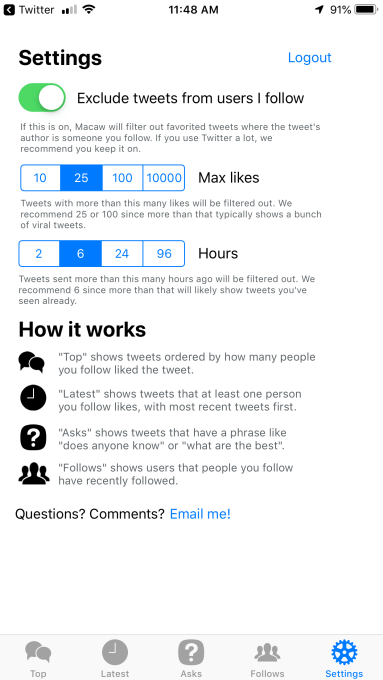
Its default setting will hide top tweets posted by someone in your network – because, chances are, you’ve already read them. With this setting turned on, you’ll only be shown top tweets by users you don’t yet follow.

You can also configure how many likes are required for something to be considered a “top” tweet. By default, this is set to 25, but you can change it to 10, 100, or even 1,000. You can adjust the default setting for the age of the tweet, too, from 6 hours to 2 hours, 24 hours, or 96 hours, based on how often you check in.

The app, however, is not a Twitter client.

That is, it doesn’t take the place of Twitter or other apps like Twitterific or Tweetbot, as you can’t use it to post tweets, access direct messages, update your profile, or follow users. You’ll need a different app, like the main Twitter client, for that. But a tap in Macaw will launch Twitter for you, making the transition feel seamless.

The app was built by Zachary Hamed, who had previously built Daily 140 for tracking a similar set of data, shared via email. He says he started building Macaw as a side project and launched it into private beta in August. It doesn’t currently have a business model, beyond a plan to maybe charge for additional features later on.

In some ways, Macaw is similar to Nuzzel, another Twitter summarization app that provides a list of top links that your network is sharing and discussing. But many of the best things on Twitter aren’t links, they’re individual tweets or tweetstorms. (Like that recent Google+ rant, for example).

Hamed admits Nuzzel was a source of inspiration for Macaw (a bird that screams constantly, by the way. Ha!)

“I was actually inspired by those notifications in the main Twitter app since I’ve always found them fascinating and by Nuzzel, which is one of my most used apps – and whose founder Jonathan I really respect,” Hamed says. “I think there is a lot of hidden insight to be found in posts people have liked and who they start following, especially if there is momentum around certain names or topics. As of now, Twitter only shares one to two of those recommendations, not all of it,” he adds.

*While we do like Macaw, the app, one thing we’re not a fan of are the fake reviews on the Macaw website, which pretend to be from @Jack, Mary Meeker, and Chamath Palihapitiya. It’s obviously meant to be a joke, but it falls flat – Macaw doesn’t need this sort of false promotion, and it’s wrong because it could confuse less savvy users.

Macaw is a free download on the App Store.


16 Oct 2018

Keeps parent company Thirty Madison raises $15 million to fight male pattern baldness

Thirty Madison, the healthcare startup behind the hair loss brand Keeps, has brought in a $15.25 million Series A co-led by Maveron and Northzone.

The company provides a subscription-based online marketplace for men’s hair loss prevention medications Finasteride and Minoxidil. Keeps sells these drugs direct-to-consumer, working with manufacturers to keep the costs low.

On Keeps, a subscription of Minoxidil, an over-the-counter topical treatment often referred to as Rogaine, is $10 monthly. A subscription to Finasteride, a prescription drug taken daily, is $25 per month.

It’s an end-to-end platform that is the single best place for guys who are looking to keep their hair,” Thirty Madison co-founder Steven Gutentag told TechCrunch.

Keeps is tapping into a big market. According to the American Hair Loss Association, two-thirds of American men experience some hair loss by the age of 35.

You may have heard of Hims, a venture-backed men’s healthcare company that similarly sells subscriptions to hair loss treatments, as well as oral care, skin care and treatments for erectile dysfunction. Keeps is its smaller competitor. For now, the company is focused solely on haircare, though with the new funds, Thirty Madison plans to launch Cove, a sister brand to Keeps that will provide treatments to migraine sufferers.

The company was founded last year by Gutentag and Demetri Karagas with a plan to develop several digital healthcare brands under the Thirty Madison umbrella.

“Going through this process myself of starting to experience hair loss, I was not sure where to turn,” Gutentag said. “I went online and looked up ‘why am I losing my hair,’ and if you search on Google, really for any medical condition, you usually walk away thinking you’re going to die … I was so fortunate that I got access to this high-quality specialist who could help me with my problem and I was in the position to afford those treatments but most people don’t get that access.”

Keeps also provide digital access to a network of doctors at a cost of roughly $30 per visit.

TechCrunch’s Connie Loizos wrote last year that “it’s never been a better time to be a man who privately suffers from erectile dysfunction, premature ejaculation or hair loss” because of advances and investments in telemedicine. Since then, even more money has been funneled into the space.

Hims has raised nearly $100 million to date and is rumored to be working on a line of women’s products. Roman, a cloud pharmacy for erectile dysfunction, raised an $88 million Series A last month and is launching a “quit smoking kit.” And Lemonaid Health, which also provides prescriptions to erectile dysfunction medications and more, secured $11 million last year.

Greycroft, Steadfast Venture Capital, First Round, Entrepreneurs Roundtable, HillCour and Two River also participated in Thirty Madison’s fundraise, which brings its total raised to date to $22.75 million.

16 Oct 2018

Pokémon Go update bringing ‘mon from the Sinnoh region is live

If you’ve been laying off the Pokémon Go for a while due to a lack of new monsters, prepare to be glued to your phone again. Niantic is now adding pokémon from the rugged Sinnoh region that first appeared in 2007’s Diamond, Pearl, and Platinum games.

Of course, it’s not so simple as a dump of a hundred new ‘mon into your area. The new guys are arriving in waves, likely meaning the most common sorts will start appearing today, while cooler ones and sets of themed critters will arrive over the coming weeks.

These are part of the Generation 4 set, but it’s not clear yet which will be appearing first or indeed at all. It’s entirely up to Niantic and you can be sure they’re going to mete these little guys out over several months, interspersed with other events — anything to keep you catching.

Everyone will probably have a Chimchar on their shoulder soon, because that sucker is cute, but ultimately everyone is going to want a Dialga. I get the feeling they’re going to be a regular feature at gyms soon. I for one will be working to evolve a Glaceon.

There are also some new evolutions, so don’t trash your mid-tier pokémon just yet. Magmortar, Electivire, Tangrowth, and Rhyperior mean you’ll have a use for all that extra candy.

Update your app and start draining that battery, Trainer! And don’t forget that we’ve got Niantic’s Ross Finman at our AR/VR Session in LA this Thursday. Drop by if you’re in the area.

16 Oct 2018

Arm launches Neoverse, its IP portfolio for internet infrastructure hardware

Arm-based chips are ubiquitous today, but the company isn’t resting on its laurels. After announcing its ambitions for powering more high-end devices like laptops a few months ago, the company today discussed its roadmap for chips that are dedicated to internet infrastructure and that will power everything from high-performance servers to edge computing platforms, storage systems, gateways, 5G base stations and routers. The new brand name for these products is ‘Neoverse’ and the first products based on this IP will ship next year.

Arm-based chips have, of course, long been used in this space. What Neoverse is, is a new focus area where Arm itself will now invest in developing the technologies to tailor these chips to the specific workloads that come with running infrastructure services. “We’ve had a lot of success in this area,” Drew Henry, Arms’ SVP and GM for Infrastructure, told me. “And we decided to build off that and to invest more heavily in our R&D from ourselves and our ecosystem.”

As with all Arm architectures, the actual chip manufacturers can then adapt these to their own needs. That may be a high core-count system for high-end servers, for example, or a system that includes a custom accelerator for networking and security workloads. The Neoverse chips themselves have also been optimized for the ever-changing data patterns and scalability requirements that come with powering a modern internet infrastructure.

The company has already lined up a large number of partners that include large cloud computing providers like Microsoft, silicon partners like Samsung and software partners that range from RedHat, Canonical, Suse and Oracle on the operating system side to container and virtualization players like Docker and the Kubernetes team.

Come 2019, Arm expects that Neoverse systems will feature 7nm CPUs. By 2020, it expects that will shrink to 5nm. What’s more important, though, is that every new generation of these chips, which will arrive at an annual cadence, will be 30 percent faster.

16 Oct 2018

GitHub launches Actions, its workflow automation tool

For the longest time, GitHub was all about storing source code and sharing it either with the rest of the world or your colleagues. Today, the company, which is in the process of being acquired by Microsoft, is taking a step in a different but related direction by launching GitHub Actions. Actions allow developers to not just host code on the platform but also run it. We’re not talking about a new cloud to rival AWS here, but instead about something more akin to a very flexible IFTTT for developers who want to automate their development workflows, whether that is sending notifications or building a full continuous integration and delivery pipeline.

This is a big deal for GitHub. Indeed, Sam Lambert, GitHub’s head of platform, described it to me as “the biggest shift we’ve had in the history of GitHub.” He likened it to shortcuts in iOS — just more flexible. “Imagine an infinitely more flexible version of shortcut, hosted on GitHub and designed to allow anyone to create an action inside a container to augment and connect their workflow.”

GitHub users can use Actions to build their continuous delivery pipelines, and the company expects that many will do so. And that’s pretty much the first thing most people will think about when they hear about this new project. GitHub’s own description of Actions in today’s announcement makes definitely fits that bill, too. “Easily build, package, release, update, and deploy your project in any language—on GitHub or any external system—without having to run code yourself,” the company writes. But it’s about more than that.

“I see CI/CD as one narrow use case of actions. It’s so, so much more,” Lambert stressed. “And I think it’s going to revolutionize DevOps because people are now going to build best in breed deployment workflows for specific applications and frameworks, and those become the de facto standard shared on GitHub. […] It’s going to do everything we did for open source again for the DevOps space and for all those different parts of that workflow ecosystem.”

That means you can use it to send a text message through Twilio every time someone uses the ‘urgent issue’ tag in your repository, for example. Or you can write a one-line command that searches your repository with a basic grep command. Or really run any other code you want to because all you have to do to turn any code in your repository into an Action is to write a Docker file for it so that GitHub can run it. “As long as there is a Docker file, we can build it, run in and connect it to your workflow,” Lambert explained.

As Corey Wilkerson, GitHub’s head of product engineering also noted, many of these Actions already exist in repositories on GitHub today. And there are now over 96 million of those on GitHub, so that makes for a lot of potential actions that will be available from the start.

With Actions, which is now in limited public beta, developers can set up the workflow to build, package, release, update and deploy their code without having to run the code themselves.

Now developers could host those Actions themselves — they are just Docker containers, after all — but GitHub will also host and run the code for them. And that includes developers on the free open source plan.

Over time — and Lambert seemed to be in favor of this — GitHub could also allow developers to sell their workflows and Actions through the GitHub marketplace. For now, that’s not an option, but it it’s definitely that’s something the company has been thinking about. Lambert also noted that this could be a way for open source developers who don’t want to build an enterprise version of their tools (and the sales force that goes with that) to monetize their efforts.

While GitHub will make its own actions available to developers, this is an open platform and others in the GitHub community can contribute their own actions, too.

In addition to Actions, GitHub also announced a number of other new features on its platform. As the company stressed during today’s event, it’s mission is to make the life of developers easier — and most of the new features may be small but do indeed make it easier for developers to do their jobs.

So what else is new? GitHub Connect, which connects the silo of GitHub Enterprise with the open source repositories on its public site, is now generally available, for example. GitHub Connect enables new features like unified search, that can search through both the open source code on the site and internal code, as well as a new Unified Business Identity feature that brings together the multiple GitHub Business accounts that many businesses now manage (thanks, shadow IT) under a single umbrella to improve billing, licensing and permissions.

The company also today launched three new courses in its Learning Lab that make it easier for developers to get started with the service, as well as a business version of Learning Lab for larger organizations.

What’s maybe even more interesting for developers whose companies use GitHub Enterprise, though, is that the company will now allow admins to enable a new feature that will display those developers’ work as part of their public profile. Given that GitHub is now the de facto resume for many developers, that’s a big deal. Much of their work, after all, isn’t in open source or in building side projects, but in the day-to-day work at their companies.

The other new features the company announced today are pretty much all about security. The new GitHub Security Advisory API, for example, makes it easier for developers to find threads in their code through automatic vulnerability scans, while the new security vulnerability alerts for Java and .NET projects now extend GitHub’s existing alerts to these two languages. If your developers are prone to putting their security tokens into public code, then you can now rest easier since GitHub will now also start scanning all public repositories for known token formats. If it finds one, it’ll alert you and you can set off to create a new one.


16 Oct 2018

Medical device maker Medtronic finally fixes its hackable pacemaker

Medtronic, a maker of medical devices and implants, has pulled the plug on its internet-based software update system, which security researchers had found had a dangerous security vulnerability

The company said in a notice this week that it’s switching off the software distribution network after researchers found that a hacker could update the pacemaker’s software with malicious software that could manipulate the impulses that regulate a patient’s heartbeat. The researchers, Jonathan Butts and Billy Rios, revealed the vulnerability at the Black Hat conference in August, more than a year after first reporting the vulnerability to Medtronic.

The bug isn’t within the pacemaker itself but the devices that are used by doctors to connect to the pacemaker to check its battery and status. These “programmer” devices weren’t checking if downloaded software hadn’t been tampered with.

Medtronic issued several updates throughout the year to try to mitigate the vulnerability, but only this month shut down the internet updating feature, per a security advisory issued by the Federal Drug Administration.

Now, patients with one of the 34,000 CareLink affected pacemakers will have to receive the update over USB from their doctor when new software is released, according to Medtronic’s statement.

It’s a turnaround from how the medical device maker reacted when the flaws were first reported. Butts said at the time that the company “spent more time trying to twist the story than fixing it.”

Medtronic said that it’s not received any reports to date of anyone exploiting the vulnerabilities.