Year: 2018

27 Nov 2018

YC alum Make School gains rare accreditation for 2-year applied CS bachelor’s degree

Higher education is a mess. College students spend years learning arcana and quaint academic theories, only to be thrust into the harsh light of the workplace where they are ill-equipped to handle even the most mundane task. A crisis, a moral failure, or perhaps simply an expensive mistake, college is clearly in need of a reboot.

Colleges would perhaps love to innovate on their models, but are stymied by accreditation agencies charged with maintaining the standards and integrity of higher education. Unfortunately for students, those standards are based on inputs like classroom time, years on campus, and major / minor curriculums rather than on measurable outputs like job income. Worse, these agencies are advised by the colleges and universities themselves, who rarely see disruptive and innovative education as a positive.

That’s why the news today that Make School has received accreditation from the Western Association of Schools and Colleges (WASC) is so interesting.

Make School is a project-based, product-focused program based in San Francisco founded by Ashu Desai and Jeremy Rossmann. The two founders centered the program’s curriculum around a bachelor’s in applied computer science, but rather than learning algorithms or data structures theoretically from a textbook, they reimagined the university from the bottom up by teaching skills through a progression of working software applications and products.

As I wrote in a profile of the company three years ago, “At the heart of the school’s approach is the belief that focusing on an actual project helps motivate students in ways that college never does.” Desai and Rossmann started by teaching game programming, but then saw that the enthusiasm of their students could be extended to other areas of software engineering and product design.

Beyond just redesigning a typical college program, they scrapped the notion of a four-year bachelor’s degree and replaced it with a full-time, two-year curriculum. That simultaneously eliminated the “summer melt” that plagues the traditional American academic calendar, and also significantly cut the cost of tuition for the program. Make School generally uses an income-share agreement in lieu of upfront tuition for its students, which means that students pay nothing during the program, but then pay a percentage of their income after they graduate.

Make School had a novel model for teaching a complicated subject, but it was unaccredited. For students, that meant that Make School’s courses most likely couldn’t be transferred to other accredited universities, nor could they receive public student loans, which mandate that a school be accredited for disbursement.

WASC, the accreditation agency in charge of higher education in California, Hawaii, and certain territories, has in recent years revised its “incubation policy” to encourage more non-traditional education providers to pursue accreditation. The model works by linking accredited universities with unaccredited institutions, with the eventual goal of making the startup accredited itself.

In Make School’s case, its accreditation collaborator is Dominican University, located just north of San Francisco. Make School students will be able to minor in computer science by taking classes at the university’s campus.

For Make School, it’s one more milestone on the way to rebuilding higher education.

27 Nov 2018

Amazon’s Cyber Monday was the biggest shopping day in the company’s history

Amazon said on Tuesday it just had its biggest shopping day in the company’s history on Cyber Monday (Monday, November 26), based on the number of products sold worldwide. That means the shopping event topped Black Friday and even Amazon’s own sales event known as Prime Day, which this July had become the biggest sales day in Amazon’s history with over 100 million products sold.

Amazon also said the five shopping days that start with Thanksgiving and continue through Cyber Monday – aka the “Turkey 5” – broke records as U.S. consumers bought millions more products over the five day period compared with the same period last year.

Though the retailer didn’t offer revenue figures for any of these milestones, it did note what sorts of products were selling.

Customers worldwide bought more than 18 million today and more than 13 million fashion items on Black Friday and Cyber Monday combined. More than 4 million toys and electronics were order through the Amazon mobile app on Black Friday alone.

And sales from small to medium-sized businesses grew more than 20 percent on Black Friday, compared with last year.

In total, across the “Turkey 5,” Amazon customers ordered more than 180 million items, the retailer said.

Of course, many of the best-sellers were Amazon’s own devices, thanks to hefty discounts on Alexa-powered smart speakers and Fire TV.

Over the weekend, Amazon sold “millions” of Echo devices worldwide, with the new Echo Dot being the top seller as well as the No. 1 selling product across all of Amazon from any manufacturer.

Other popular devices included the Fire TV Stick 4K and Fire 7 tablet with Alexa. “Millions” of Fire tablets and Kindle devices were sold over the weekend, as well, Amazon said.

Smart home devices also broke sales records, with Ring and Blink products more than doubling their sales this year compared with the same time last year.

While Cyber Monday was the biggest day out of the “Turkey 5,” Amazon said its Black Friday event also outperformed the same day last year, in terms of items ordered.

Black Friday’s best-sellers included the new Echo Dot, Fire TV Stick 4K with all-new Alexa Voice Remote, Fire 7 Tablet, Instant Pot (DUO80 8 Quart and DUO60 6 Quart), and Harry Potter: Complete 8-Film Collection on Blu-Ray.

Amazon’s performance over Black Friday and Cyber Monday is being closely watched, as the retailer during its Q3 earnings issued fourth quarter guidance that fell short of Wall Street’s expectations. The retailer said it was expecting $66.5 billion to $72.5 billion in sales, versus analyst estimates of somewhere around $73.8 billion.

Of course, whether these record-breaking sales will actually boost revenues remains to be seen, especially since millions of the products sold were deeply discounted Amazon devices.

27 Nov 2018

Amazon’s Cyber Monday was the biggest shopping day in the company’s history

Amazon said on Tuesday it just had its biggest shopping day in the company’s history on Cyber Monday (Monday, November 26), based on the number of products sold worldwide. That means the shopping event topped Black Friday and even Amazon’s own sales event known as Prime Day, which this July had become the biggest sales day in Amazon’s history with over 100 million products sold.

Amazon also said the five shopping days that start with Thanksgiving and continue through Cyber Monday – aka the “Turkey 5” – broke records as U.S. consumers bought millions more products over the five day period compared with the same period last year.

Though the retailer didn’t offer revenue figures for any of these milestones, it did note what sorts of products were selling.

Customers worldwide bought more than 18 million today and more than 13 million fashion items on Black Friday and Cyber Monday combined. More than 4 million toys and electronics were order through the Amazon mobile app on Black Friday alone.

And sales from small to medium-sized businesses grew more than 20 percent on Black Friday, compared with last year.

In total, across the “Turkey 5,” Amazon customers ordered more than 180 million items, the retailer said.

Of course, many of the best-sellers were Amazon’s own devices, thanks to hefty discounts on Alexa-powered smart speakers and Fire TV.

Over the weekend, Amazon sold “millions” of Echo devices worldwide, with the new Echo Dot being the top seller as well as the No. 1 selling product across all of Amazon from any manufacturer.

Other popular devices included the Fire TV Stick 4K and Fire 7 tablet with Alexa. “Millions” of Fire tablets and Kindle devices were sold over the weekend, as well, Amazon said.

Smart home devices also broke sales records, with Ring and Blink products more than doubling their sales this year compared with the same time last year.

While Cyber Monday was the biggest day out of the “Turkey 5,” Amazon said its Black Friday event also outperformed the same day last year, in terms of items ordered.

Black Friday’s best-sellers included the new Echo Dot, Fire TV Stick 4K with all-new Alexa Voice Remote, Fire 7 Tablet, Instant Pot (DUO80 8 Quart and DUO60 6 Quart), and Harry Potter: Complete 8-Film Collection on Blu-Ray.

Amazon’s performance over Black Friday and Cyber Monday is being closely watched, as the retailer during its Q3 earnings issued fourth quarter guidance that fell short of Wall Street’s expectations. The retailer said it was expecting $66.5 billion to $72.5 billion in sales, versus analyst estimates of somewhere around $73.8 billion.

Of course, whether these record-breaking sales will actually boost revenues remains to be seen, especially since millions of the products sold were deeply discounted Amazon devices.

27 Nov 2018

Source: Canada’s Corel is acquiring virtualization specialist Parallels in an all-cash deal

Some consolidation is afoot in the world of business software. TechCrunch has learned that Parallels, the virtualization specialist with millions of users, is getting acquired by Corel, the Canadian company behind design apps like CorelDraw and other productivity apps like WordPerfect.

Some employees at Parallels have already been briefed on the acquisition, which is expected to be announced to the whole company today. Terms have not been disclosed but we understand it is an all-cash deal.

Corel has changed ownership and gone in and out of being listed publicly a number of times since being founded in the 1980s in Ottawa. It’s now owned by Vector Capital, which is essentially the one buying Parallels.

From what we understand, Corel will keep Parallels an independent product.

Parallels was originally founded in 1999 with roots in Russia and is currently headquartered in Bellevue, Washington. It has never made much of a fanfare around its financing or valuation. According to PitchBook its last funding round was in 2015, an undisclosed amount from Endeavour Vision, KG Investments, Maxfield Capital, Savano Capital Partners and others. It had raised $300 million from Ingram Micro the year before that.

It’s not fully clear what the rationale was for the sale, except it seems many investors were longstanding and looking to exit, while Corel has slowly been consolidating a number of sodtware businesses, most recently before this, Gravit Designer from Germany earlier this year.

Parallels provides a number of products that help people work seamlessly across multiple platforms, essentially letting people (and IT managers) run a unified workflow regardless of the device or operating system, ranging from Windows, Mac, iOS, Android, Chromebook, Linux, Raspberry Pi and cloud — a particularly compelling offering in the current, fragmented IT climate.

Corel once had designs to take on Microsoft in the world of software — to be the Pepsi to Microsoft’s Coke, as I once saw it described. That didn’t really pan out, with Microsoft at the time having a vice grip on platform and software (this was before the rise of Google, the rebirth of Apple, the rise of apps, and other big shifts in the industry). At one point, Microsoft signed a partnership with Corel that saw it investing in the company: a sell out, as one disappointed Canadian journalist described it at the time.

The two have also sparred over patents.

These days Corel is “highly profitable”, says Vector, selling software that includes CorelDraw, WordPerfect, WinZip, PaintShop Pro, and WinDVD. You could potentially imagine Parallels existing alongside that, or even perhaps helping increase the functionality and usefulness of Corel’s other apps with more cross-platform functionality.

The Parallels deal is expected to close next year, our source said.

We have written both to Corel and Parallels and will update this post as we learn more.

There have been a number of enterprise software acquisitions with a view to legacy businesses raising their game in open source, cloud and other newer developments. The most notable of these has been IBM announcing its intent to acquire Red Hat for $34 billion in October.

27 Nov 2018

Google faces GDPR complaint over “deceptive” location tracking

A group of European consumer watchdogs has filed a privacy complaint against Google — arguing the company uses manipulative tactics in order to keep tracking web users’ location, for ad-targeting purposes.

The consumer organizations are making the complaint under the EU’s new data protection framework, GDPR, which regulators can use to levy major fines for compliance breaches — of up to 4% of a company’s global annual turnover.

Under GDPR a consent-based legal basis for processing personal data (e.g. person’s location) must be specific, informed and freely given.

In their complaint the groups, which include Norway’s Consumer Council, argue that Google does not have proper legal basis to track users through “Location History” and “Web & App Activity” — settings which are integrated into all Google accounts, and which, for users of Android -based smartphones, they assert are particularly difficult to avoid.

The Google mobile OS remains the dominant smartphone platform globally, as well as across Europe.

“Google is processing incredibly detailed and extensive personal data without proper legal grounds, and the data has been acquired through manipulation techniques,” said Gro Mette Moen, acting head of the Norwegian Consumer Council’s digital services unit in a statement.

“When we carry our phones, Google is recording where we go, down to which floor we are on and how we are moving. This can be combined with other information about us, such as what we search for, and what websites we visit. Such information can in turn be used for things such as targeted advertising meant to affect us when we are receptive or vulnerable.”

Responding to the complaint, a Google spokesperson sent TechCrunch the following statement:

Location History is turned off by default, and you can edit, delete, or pause it at any time. If it’s on, it helps improve services like predicted traffic on your commute. If you pause it, we make clear that — depending on your individual phone and app settings — we might still collect and use location data to improve your Google experience. We enable you to control location data in other ways too, including in a different Google setting called Web & App Activity, and on your device. We’re constantly working to improve our controls, and we’ll be reading this report closely to see if there are things we can take on board.

Earlier this year the Norwegian watchdog produced a damning report calling out dark pattern design tricks being deployed by Google and Facebook meant to manipulate users by nudging them towards “privacy intrusive options”. It also examined Microsoft’s consent flows but judged the company to be leaning less heavily on such unfair tactics.

Among the underhand techniques that the Google-targeted GDPR complaint, which draws on the earlier report, calls out are allegations of deceptive click-flow, with the groups noting that a “location history” setting can be enabled during Android set-up without a user being aware of it; key settings being both buried in menus (hidden) and enabled by default; users being presented at the decision point with insufficient and misleading information; repeat nudges to enable location tracking even after a user has previously turned it off; and the bundling of “invasive location tracking” with other unrelated Google services, such as photo sorting by location.

GDPR remains in the early implementation phrase — just six months since the regulation came into force across Europe. But a large chunk of the first wave of complaints have been focused on consent, according to Europe’s data protection supervisor, who also told us in October that more than 42,000 complaints had been lodged in total since the regulation came into force.

Where Google is concerned, the location complaint is by no means the only GDPR — or GDPR consent-related — complaint it’s facing.

Another complaint, filed back in May also by a consumer-focused organization, took aim at what it dubbed the use of “forced consent” by Google and Facebook — pointing out that the companies were offering users no choice but to have their personal data processed to make use of certain services, yet the GDPR requires consent to be freely given.

27 Nov 2018

Google faces GDPR complaint over “deceptive” location tracking

A group of European consumer watchdogs has filed a privacy complaint against Google — arguing the company uses manipulative tactics in order to keep tracking web users’ location, for ad-targeting purposes.

The consumer organizations are making the complaint under the EU’s new data protection framework, GDPR, which regulators can use to levy major fines for compliance breaches — of up to 4% of a company’s global annual turnover.

Under GDPR a consent-based legal basis for processing personal data (e.g. person’s location) must be specific, informed and freely given.

In their complaint the groups, which include Norway’s Consumer Council, argue that Google does not have proper legal basis to track users through “Location History” and “Web & App Activity” — settings which are integrated into all Google accounts, and which, for users of Android -based smartphones, they assert are particularly difficult to avoid.

The Google mobile OS remains the dominant smartphone platform globally, as well as across Europe.

“Google is processing incredibly detailed and extensive personal data without proper legal grounds, and the data has been acquired through manipulation techniques,” said Gro Mette Moen, acting head of the Norwegian Consumer Council’s digital services unit in a statement.

“When we carry our phones, Google is recording where we go, down to which floor we are on and how we are moving. This can be combined with other information about us, such as what we search for, and what websites we visit. Such information can in turn be used for things such as targeted advertising meant to affect us when we are receptive or vulnerable.”

Responding to the complaint, a Google spokesperson sent TechCrunch the following statement:

Location History is turned off by default, and you can edit, delete, or pause it at any time. If it’s on, it helps improve services like predicted traffic on your commute. If you pause it, we make clear that — depending on your individual phone and app settings — we might still collect and use location data to improve your Google experience. We enable you to control location data in other ways too, including in a different Google setting called Web & App Activity, and on your device. We’re constantly working to improve our controls, and we’ll be reading this report closely to see if there are things we can take on board.

Earlier this year the Norwegian watchdog produced a damning report calling out dark pattern design tricks being deployed by Google and Facebook meant to manipulate users by nudging them towards “privacy intrusive options”. It also examined Microsoft’s consent flows but judged the company to be leaning less heavily on such unfair tactics.

Among the underhand techniques that the Google-targeted GDPR complaint, which draws on the earlier report, calls out are allegations of deceptive click-flow, with the groups noting that a “location history” setting can be enabled during Android set-up without a user being aware of it; key settings being both buried in menus (hidden) and enabled by default; users being presented at the decision point with insufficient and misleading information; repeat nudges to enable location tracking even after a user has previously turned it off; and the bundling of “invasive location tracking” with other unrelated Google services, such as photo sorting by location.

GDPR remains in the early implementation phrase — just six months since the regulation came into force across Europe. But a large chunk of the first wave of complaints have been focused on consent, according to Europe’s data protection supervisor, who also told us in October that more than 42,000 complaints had been lodged in total since the regulation came into force.

Where Google is concerned, the location complaint is by no means the only GDPR — or GDPR consent-related — complaint it’s facing.

Another complaint, filed back in May also by a consumer-focused organization, took aim at what it dubbed the use of “forced consent” by Google and Facebook — pointing out that the companies were offering users no choice but to have their personal data processed to make use of certain services, yet the GDPR requires consent to be freely given.

27 Nov 2018

Alexa can now help you donate to Toys for Tots and other charities

Fresh off its biggest shopping day in history, Cyber Monday 2018, Amazon today is making it easy for Alexa owners to participate in Giving Tuesday, the international day of charitable giving that follows the holiday shopping spree kicked off by Thanksgiving Day sales. Starting today, Alexa owners can donate a toy to a child in need just by saying, “Alexa, donate to Toys for Tots.”

After speaking the voice command, Alexa will present you with a reasonably priced item appropriate for kids across a range of ages.

The charitable organization curated a list of toys that includes things like Mickey and Minnie plush toys, Nerf footballs, Monopoly games and more, says Amazon .

When the customer confirms the order, Amazon will ship the toy directly to Toys for Tots. You can request tracking and delivery updates for the item, just like any other order by asking Alexa, “where’s my stuff?” or by signing up for Alexa Shopping Notifications.

Amazon is also matching donations of toys to Toys for Tots, up to $100,000 in matching toy donations through December 31, 2018, it notes.

It’s really one of the simplest ways to give back, and not one that’s been tried before.

Amazon says this is the first time it’s used the Alexa platform for donating items – and, if it succeeds, the company may roll out similar initiatives in the future.

“Alexa provides the easiest way to give back this holiday season enabling customers to donate an item to Toys for Tots in less than 60 seconds,” said Chuck Moore, VP of Alexa Shopping, in a statement. “This time of year is made brighter by the generosity of others. As Alexa Shopping evolves, we want to enable customers to be able to fulfill all kinds of shopping needs, whether that be personal or the needs of the wider community,” he added.

In addition to its work with Toys for Tots, Amazon is also supporting monetary donations through Alexa to the charity of their choice. To do so, Alexa owners just say “Alexa, I want to make a donation” to get started.

Meanwhile, on Amazon.com, the retailer has also this year rolled out a new feature called Charity Lists that provides non-profits a way to create lists of items they need. This is a feature on AmazonSmile, the shopping destination that allows customers to support a charity whenever they shop Amazon.


27 Nov 2018

Alexa can now help you donate to Toys for Tots and other charities

Fresh off its biggest shopping day in history, Cyber Monday 2018, Amazon today is making it easy for Alexa owners to participate in Giving Tuesday, the international day of charitable giving that follows the holiday shopping spree kicked off by Thanksgiving Day sales. Starting today, Alexa owners can donate a toy to a child in need just by saying, “Alexa, donate to Toys for Tots.”

After speaking the voice command, Alexa will present you with a reasonably priced item appropriate for kids across a range of ages.

The charitable organization curated a list of toys that includes things like Mickey and Minnie plush toys, Nerf footballs, Monopoly games and more, says Amazon .

When the customer confirms the order, Amazon will ship the toy directly to Toys for Tots. You can request tracking and delivery updates for the item, just like any other order by asking Alexa, “where’s my stuff?” or by signing up for Alexa Shopping Notifications.

Amazon is also matching donations of toys to Toys for Tots, up to $100,000 in matching toy donations through December 31, 2018, it notes.

It’s really one of the simplest ways to give back, and not one that’s been tried before.

Amazon says this is the first time it’s used the Alexa platform for donating items – and, if it succeeds, the company may roll out similar initiatives in the future.

“Alexa provides the easiest way to give back this holiday season enabling customers to donate an item to Toys for Tots in less than 60 seconds,” said Chuck Moore, VP of Alexa Shopping, in a statement. “This time of year is made brighter by the generosity of others. As Alexa Shopping evolves, we want to enable customers to be able to fulfill all kinds of shopping needs, whether that be personal or the needs of the wider community,” he added.

In addition to its work with Toys for Tots, Amazon is also supporting monetary donations through Alexa to the charity of their choice. To do so, Alexa owners just say “Alexa, I want to make a donation” to get started.

Meanwhile, on Amazon.com, the retailer has also this year rolled out a new feature called Charity Lists that provides non-profits a way to create lists of items they need. This is a feature on AmazonSmile, the shopping destination that allows customers to support a charity whenever they shop Amazon.


27 Nov 2018

Recapping the TechCrunch China Shenzhen 2018 event

This year we returned to Shenzhen, the Chinese city known as the world’s ‘Silicon Valley for hardware,’ for an event that was packed full of future-looking discussions, innovative startups, experienced founders, VCs and more.

We love Shenzhen. Sure, Beijing has Zhongguancun and Shanghai has its international and diverse entrepreneurial community. But Shenzhen has a certain je ne sais quoi, an energy that pervades the entire city. Maybe it’s the great weather or maybe its youth of the place — both the residents and the age of the city itself — but every time we come to this southern city, we’re amazed by the people, projects, and companies thriving here.

This year was no different. From blockchain smartphones to battling robots, from hackathons to VC speed dating, TechCrunch Shenzhen saw over 5,000 registered attendees and 150 startups showing off their stuff. It was a whirlwind of great ideas and a glimpse into the future of technology in China and beyond.

Here are some highlights from the two-day conference and hackathon — you can check out our the Technode Twitter account or #tcshenzhen for more:

Hackathon

Teams of four to six people — some were total strangers before the hackathon — came together to create proofs-of-concept to complete blockchain challenges. Winners included teams who came up with novel ways to record transactions, verifying the history of vaccines, preventing payment fraud, and — perhaps the most unique — a hardware controller for CryptoKitties as well as a Pokemon Go-like game for the crypto pet platform.

Main stage

Spanning two days and covering a wide range of topics, the main stage saw some of China’s leading technologists and businesspeople talk about where the cutting edge is, for both consumers and businesses.

Smartphones and hardware
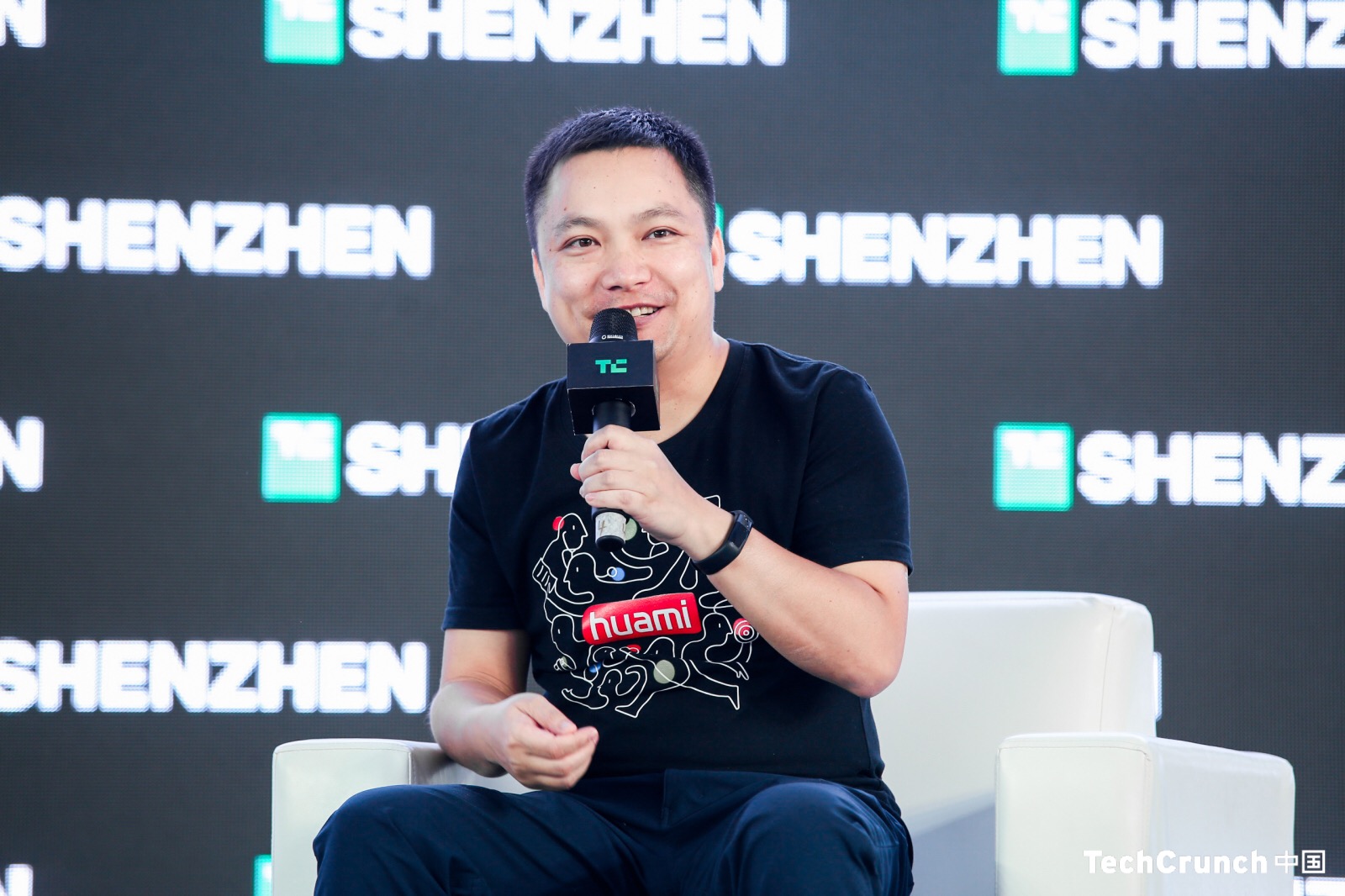
Huang Wang, CEO at Huami. Image Credit: TechNode/TechCrunch

Huami Corporation’s Chairman and CEO Wang Huang spoke about the future of wearable devices. Huami, a company that is backed by Xiaomi, listed on the New York Stock Exchange in February this year. Last year, Huami shipped 18.1 million units of smart wearable devices globally and it claims to have a total registered user base of 56.1 million.

The once low-profile Chinese flexible display company, Royole grabbed headlines over the past two weeks by becoming the first company to launch a foldable smartphone, beating Samsung in the process.

While the smartphone-tablet hybrid stoked much anticipation among ‘flexphone’ aficionados, Royole CEO Bill Liu said that this is just the beginning. For him, the potential of flexible display technology expands far beyond the world of smartphones.

Speaking about projections for the future of mobile. Phil Chen, the decentralized chief officer at HTC, spoke about the company’s much-hyped blockchain phone and its shifting focus to blockchain and crypto.

So, is the blockchain-powered phone a hype or it is something potentially revolutionary?

Chen said with crypto and blockchain he saw, for the first time, tech’s potential to disrupt big centralized companies. Smartphones are the most accessible and ubiquitous devices where most of our data is generated, he argued.
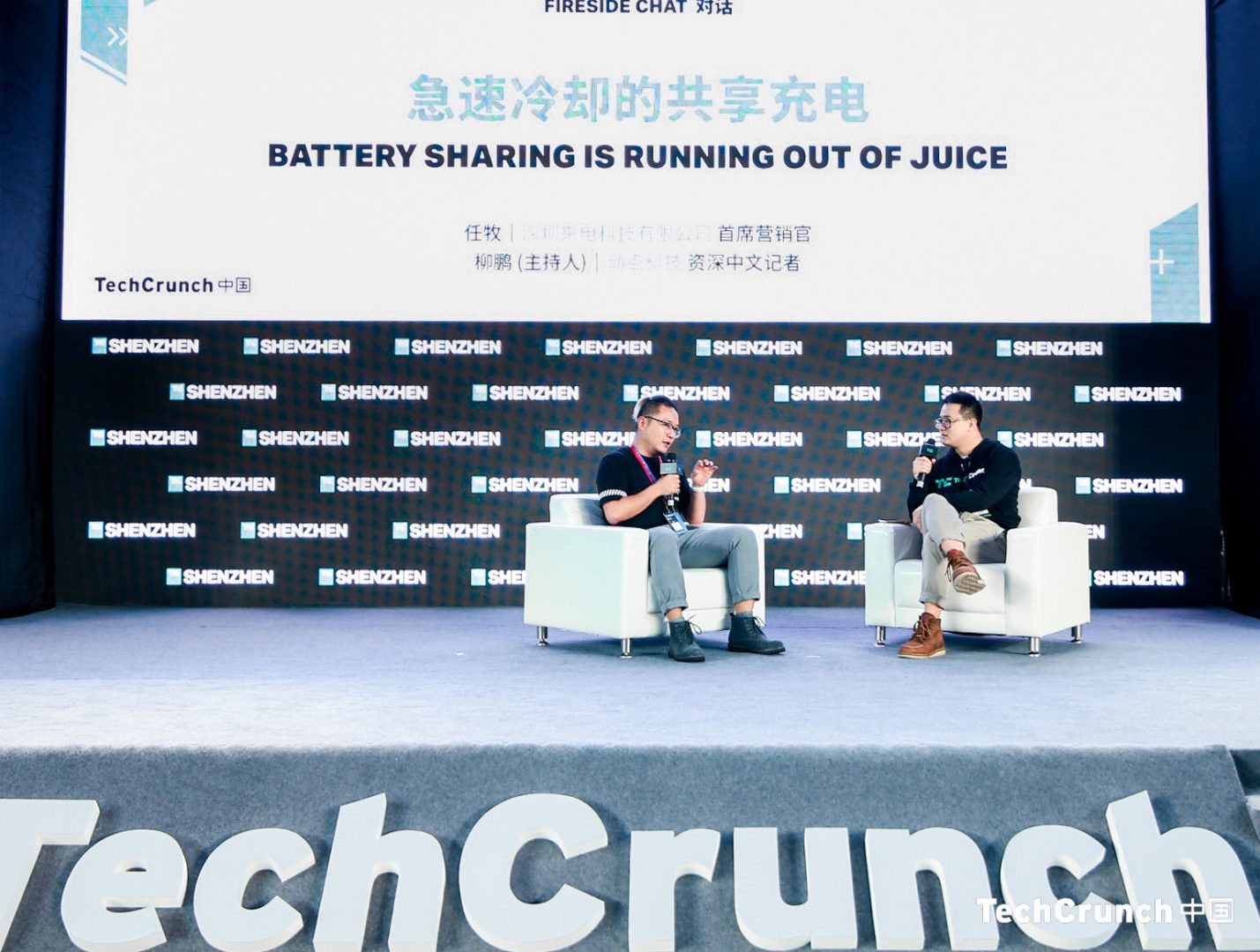
Laidian talks about power bank sharing. Image Credit: TechNode/TechCrunch

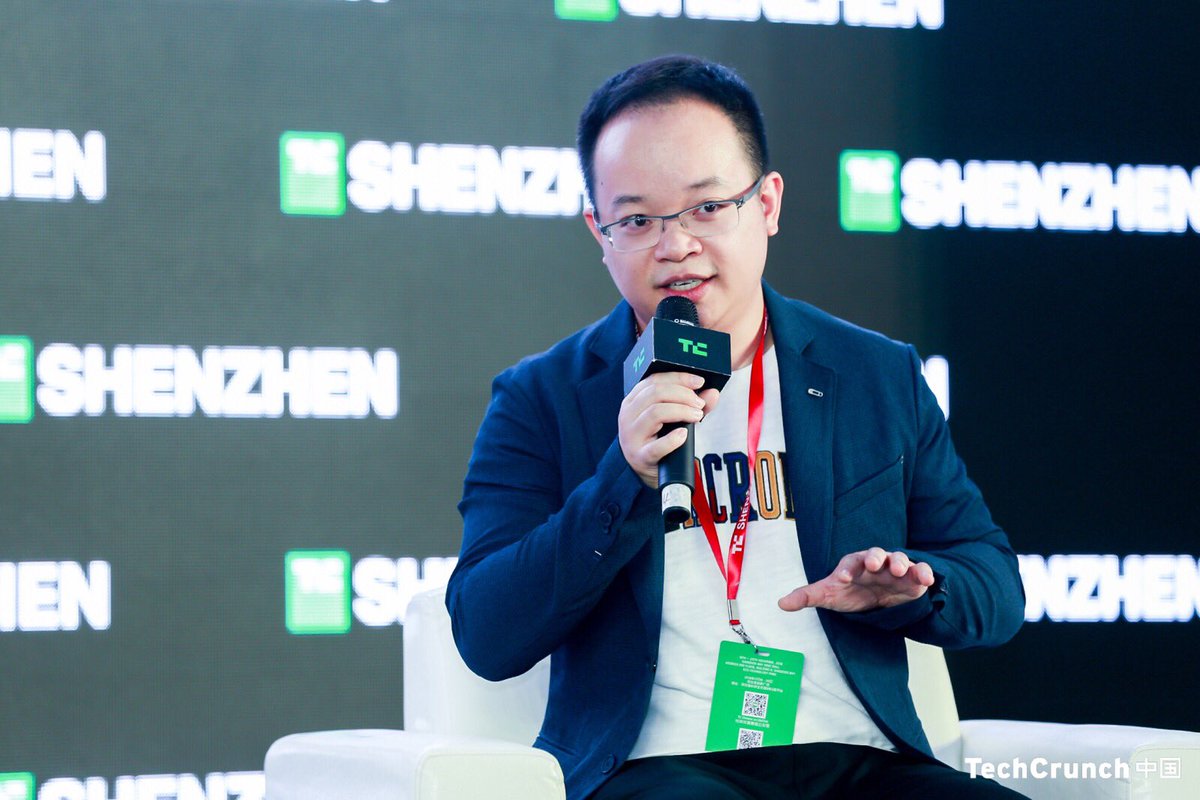
The sharing economy is not dying, it’s just transforming, said Ren Mu, chief marketing officer at smartphone power bank sharing company Laidian Technology.

“The apparent death of the sharing economy is actually the death of the term as a concept—not the business model,” Ren explained. “As the tech ecosystem becomes impatient, and treats the sharing economy as just a novel and innovative noun, real implementations are beginning to penetrate our lives.”
What do fighting robots and hip hop have in common?

Well, it’s not a trick question. According to the CEO of media company The Makers (创客星球), Archie Ru, they’re both niche interests with the potential to gain huge audiences among China’s youth.

Ru is referring, of course, to how hip-hop fever swept the nation after streaming platform iQiyi released its surprise hit show Rap of China last year. The series kickstarted previously unknown artists’ careers while introducing new fashions and phrases to Chinese audiences.

Artificial Intelligence and big data
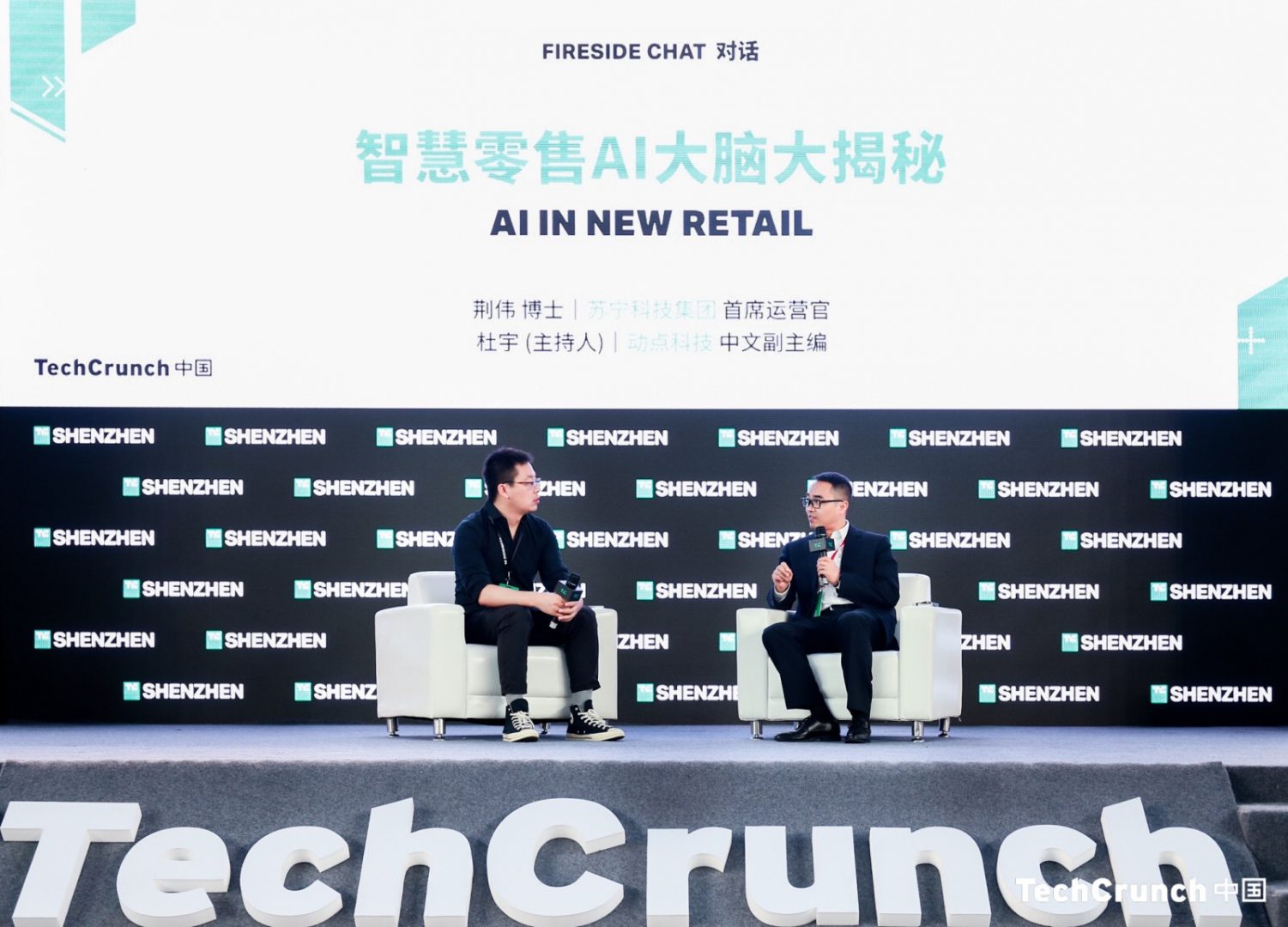
TechCrunch Shenzhen Fireside Chat: AI in New Retail. Image Credit: TechNode/TechCrunch

Suning Technology Group, China’s leading home appliance and digital device retail giant, will focus more on practical applications in use cases, instead of heavily investing in fundamental research, said Jack Jing, the company’s COO.

“Consumer-driven companies, and startups too, could hand over fundamental research work to professional tech teams. Efforts saved shall be paid to implementations,” Liu explained, adding that it is China’s diverse use cases that encourage companies to adopt data supported implementations.
(Image Credit: TechCrunch China)

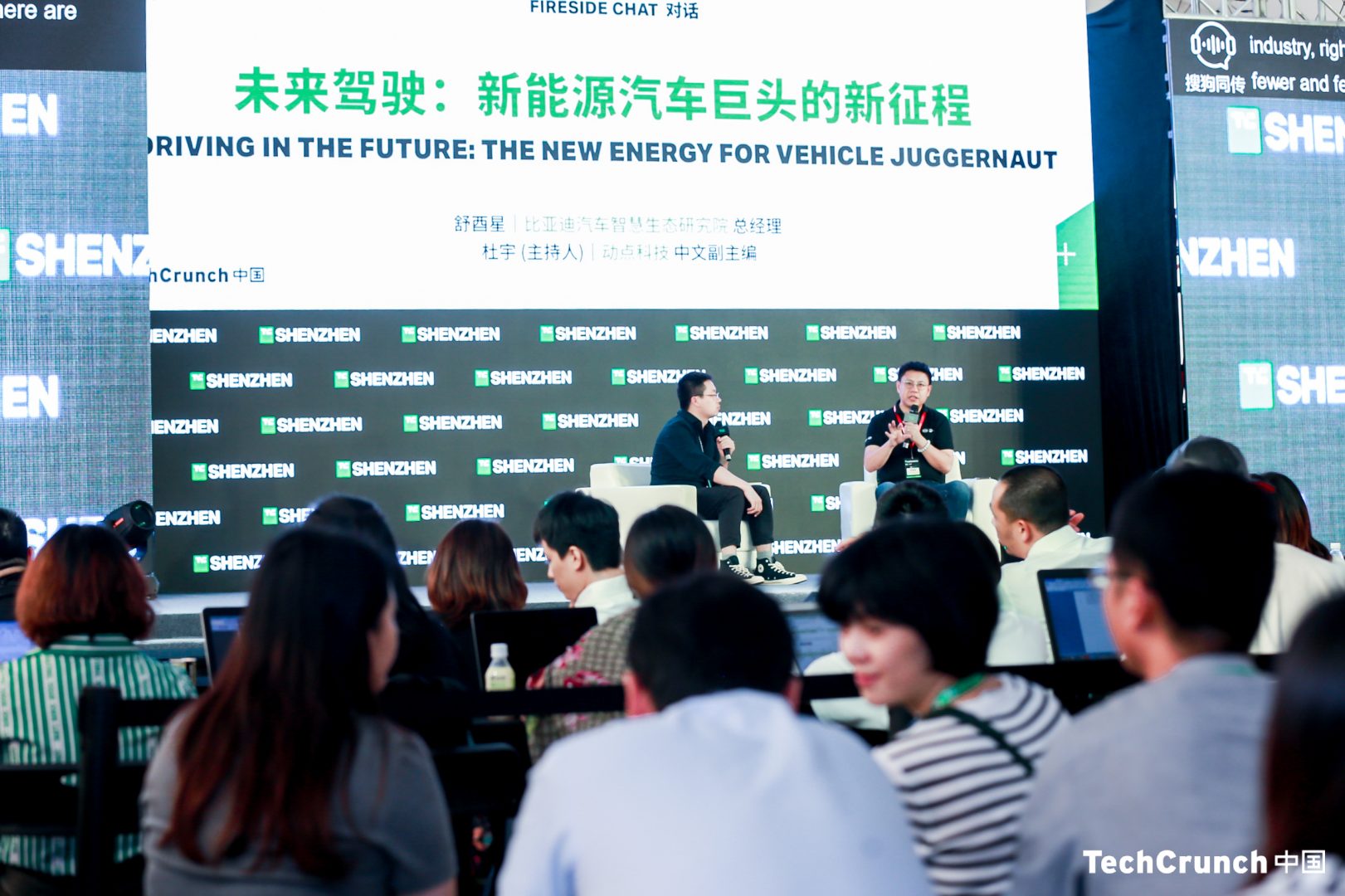
Amid headlines of the impending arrival of autonomous vehicles (AVs) on China’s roads, Michael Shu, general manager of the Auto Intelligent Ecology Institute at Chinese automotive manufacturer BYD, says the technology should be viewed with a level head.

“We need to look at self-driving cars with a calm eye,” he told attendees at our Shenzhen event.”Driverless cars need to become more mature, rules and regulations still need to be formulated, and ethical issues need to be solved.”

Greater Bay Area integration

Hong Kong Cyberport’s chief public mission officer, Toa Charm. (Image credit: Bailey Hu/TechNode)

China’s proposed Greater Bay Area (GBA) — which spans Hong Kong, Macau, and nine cities in southern Guangdong Province — represents a “golden moment” for innovation provided political and regulatory hurdles can be overcome, a senior official of Hong Kong-government backed Cyberport said at the event.

Speaking on the sidelines of the show, Toa Charm, chief public mission officer for the innovation and digital tech hub, said closer collaboration is needed in order to realize the full potential the GBA represents for sectors such as fintech.

Blockchain

For the third event in a row, TechCrunch China hosted a blockchain side stage. Covering a range of topics that spanned the current, bearish market to government application, blockchain security and payments, the side stage gave a comprehensive overview of the current state of the industry and technology.

From left: TechNode editor-in-chief John Artman and panelists Patrick Dai, Jack Liu, and Edith Yeung. Image credit: TechCrunch 中国

“One day in crypto is like a year in any other technology space.”

That statement from 500 Startups partner Edith Yeung’s statement seemed a fitting evaluation of the state of play right now.

This time last year, Bitcoin’s value was close to $10,000. After the value peaked to nearly $20,000, it — and other cryptocurrencies — have seen a rocky slide south. As of the second day of the show, Bitcoin had dropped below $4,500 and set a new low for this year. But panelists at TechCrunch’s blockchain side stage remained largely optimistic.

One of the many promises of blockchain technology is that it allows users to store and exchange valuable information in a secure and tamperproof way. But how secure is blockchain really?

David Lancashire, founder of Saito, and Sarah Zhang, founder of Points discussed blockchain’s vulnerabilities and long-term security issues during a panel on TechCrunch Shenzhen’s blockchain side stage.
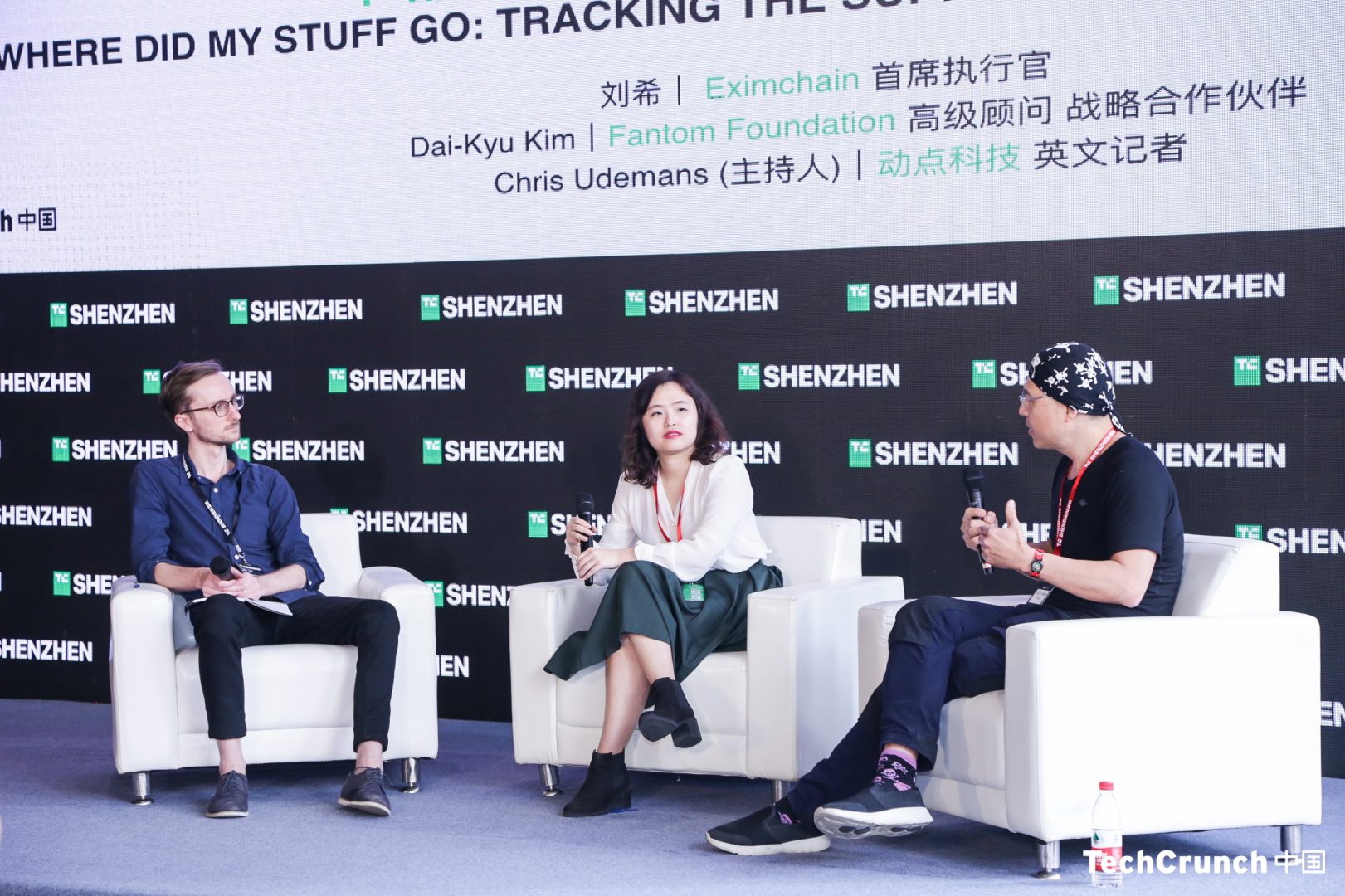
From left: TechNode reporter Christopher Udemans, Eximchain CEO Hope Liu, and senior advisor at Fantom Foundation Dai-Kyu Kim.

Blockchain is the best mechanism currently available to deal with the problems in the supply chain, said senior advisor at Fantom Foundation Dai-Kyu Kim. His comments come at a turbulent time for the global supply chain.

Joined by EximChain CEO Hope Liu, Kim was part of a panel discussion at TechCrunch Shenzhen that was foused on blockchain’s applications in enhancing the global supply chain.

Startup Alley

Startup Alley is perhaps the most exciting part of any TechCrunch conference, and the Shenzhen event was no different. Spread between the two stages, startups showed off a range of products with hints at where technology is moving to. Highlights included:

VC Meetup

Over 20 different VC funds and over 120 entrepreneurs met at TechCrunch Shenzhen for “speed dating” sessions. Each entrepreneur had the chance to pitch their big idea to some of the best VCs in China.

Startup competition

Drawn from 300 contestants, 20 finalists, and 100,000 online votes, 12 teams took the stage to pitch their startup to our panel of expert judges.
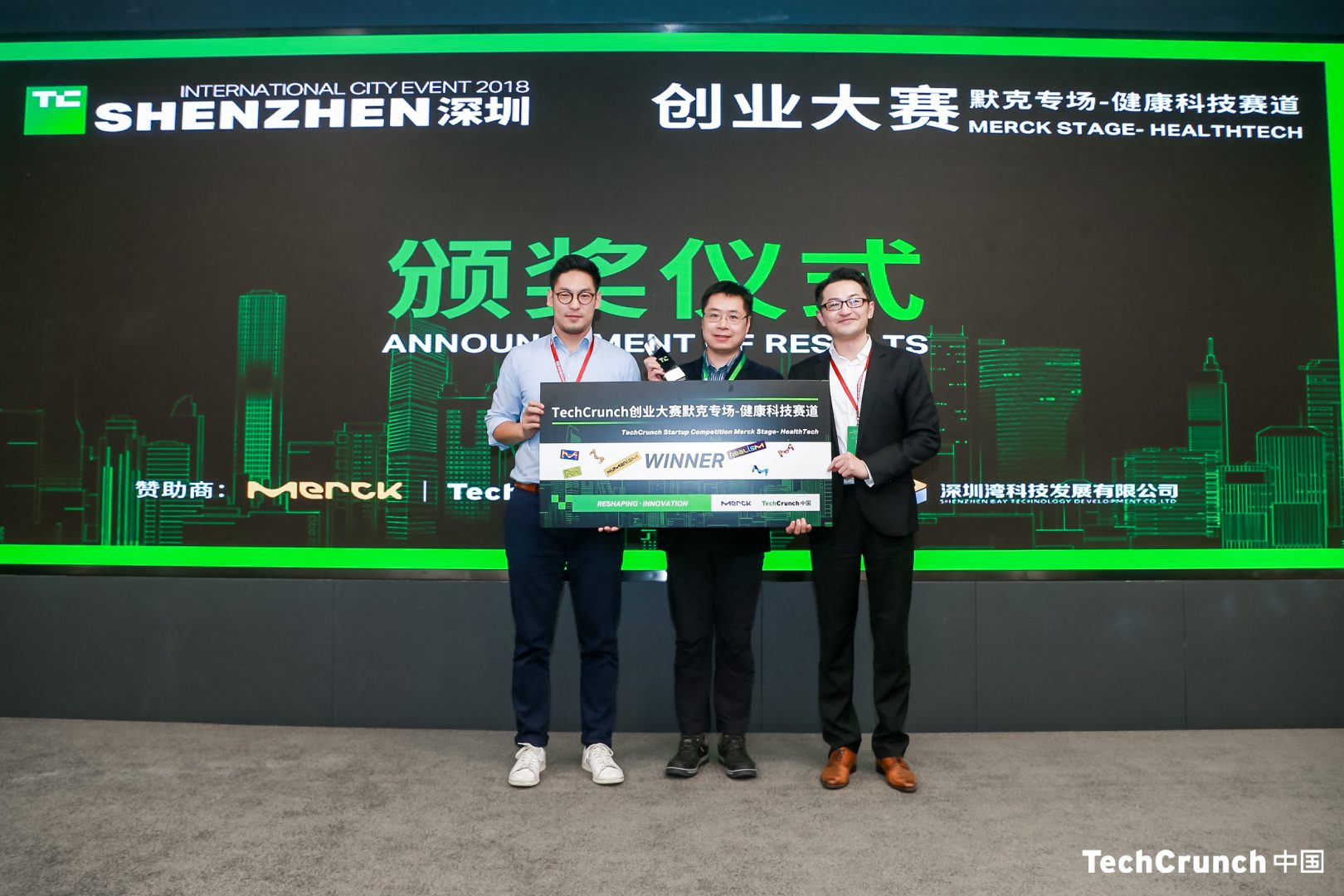
Congrats to the winners, who will be shortlisted as candidates for Merck China Accelerator, a program that focuses on collaboration between startups and Merck’s innovation ecosystem.

Big data track: Yunxing Chuangxin

New retail track: Beika Keji

Blockchain track: Wanwugongsuan

27 Nov 2018

Recapping the TechCrunch China Shenzhen 2018 event

This year we returned to Shenzhen, the Chinese city known as the world’s ‘Silicon Valley for hardware,’ for an event that was packed full of future-looking discussions, innovative startups, experienced founders, VCs and more.

We love Shenzhen. Sure, Beijing has Zhongguancun and Shanghai has its international and diverse entrepreneurial community. But Shenzhen has a certain je ne sais quoi, an energy that pervades the entire city. Maybe it’s the great weather or maybe its youth of the place — both the residents and the age of the city itself — but every time we come to this southern city, we’re amazed by the people, projects, and companies thriving here.

This year was no different. From blockchain smartphones to battling robots, from hackathons to VC speed dating, TechCrunch Shenzhen saw over 5,000 registered attendees and 150 startups showing off their stuff. It was a whirlwind of great ideas and a glimpse into the future of technology in China and beyond.

Here are some highlights from the two-day conference and hackathon — you can check out our the Technode Twitter account or #tcshenzhen for more:

Hackathon

Teams of four to six people — some were total strangers before the hackathon — came together to create proofs-of-concept to complete blockchain challenges. Winners included teams who came up with novel ways to record transactions, verifying the history of vaccines, preventing payment fraud, and — perhaps the most unique — a hardware controller for CryptoKitties as well as a Pokemon Go-like game for the crypto pet platform.

Main stage

Spanning two days and covering a wide range of topics, the main stage saw some of China’s leading technologists and businesspeople talk about where the cutting edge is, for both consumers and businesses.

Smartphones and hardware

Huang Wang, CEO at Huami. Image Credit: TechNode/TechCrunch

Huami Corporation’s Chairman and CEO Wang Huang spoke about the future of wearable devices. Huami, a company that is backed by Xiaomi, listed on the New York Stock Exchange in February this year. Last year, Huami shipped 18.1 million units of smart wearable devices globally and it claims to have a total registered user base of 56.1 million.

The once low-profile Chinese flexible display company, Royole grabbed headlines over the past two weeks by becoming the first company to launch a foldable smartphone, beating Samsung in the process.

While the smartphone-tablet hybrid stoked much anticipation among ‘flexphone’ aficionados, Royole CEO Bill Liu said that this is just the beginning. For him, the potential of flexible display technology expands far beyond the world of smartphones.

Speaking about projections for the future of mobile. Phil Chen, the decentralized chief officer at HTC, spoke about the company’s much-hyped blockchain phone and its shifting focus to blockchain and crypto.

So, is the blockchain-powered phone a hype or it is something potentially revolutionary?

Chen said with crypto and blockchain he saw, for the first time, tech’s potential to disrupt big centralized companies. Smartphones are the most accessible and ubiquitous devices where most of our data is generated, he argued.

Laidian talks about power bank sharing. Image Credit: TechNode/TechCrunch

The sharing economy is not dying, it’s just transforming, said Ren Mu, chief marketing officer at smartphone power bank sharing company Laidian Technology.

“The apparent death of the sharing economy is actually the death of the term as a concept—not the business model,” Ren explained. “As the tech ecosystem becomes impatient, and treats the sharing economy as just a novel and innovative noun, real implementations are beginning to penetrate our lives.”

What do fighting robots and hip hop have in common?

Well, it’s not a trick question. According to the CEO of media company The Makers (创客星球), Archie Ru, they’re both niche interests with the potential to gain huge audiences among China’s youth.

Ru is referring, of course, to how hip-hop fever swept the nation after streaming platform iQiyi released its surprise hit show Rap of China last year. The series kickstarted previously unknown artists’ careers while introducing new fashions and phrases to Chinese audiences.

Artificial Intelligence and big data

TechCrunch Shenzhen Fireside Chat: AI in New Retail. Image Credit: TechNode/TechCrunch

Suning Technology Group, China’s leading home appliance and digital device retail giant, will focus more on practical applications in use cases, instead of heavily investing in fundamental research, said Jack Jing, the company’s COO.

“Consumer-driven companies, and startups too, could hand over fundamental research work to professional tech teams. Efforts saved shall be paid to implementations,” Liu explained, adding that it is China’s diverse use cases that encourage companies to adopt data supported implementations.

(Image Credit: TechCrunch China)

Amid headlines of the impending arrival of autonomous vehicles (AVs) on China’s roads, Michael Shu, general manager of the Auto Intelligent Ecology Institute at Chinese automotive manufacturer BYD, says the technology should be viewed with a level head.

“We need to look at self-driving cars with a calm eye,” he told attendees at our Shenzhen event.”Driverless cars need to become more mature, rules and regulations still need to be formulated, and ethical issues need to be solved.”

Greater Bay Area integration

Hong Kong Cyberport’s chief public mission officer, Toa Charm. (Image credit: Bailey Hu/TechNode)

China’s proposed Greater Bay Area (GBA) — which spans Hong Kong, Macau, and nine cities in southern Guangdong Province — represents a “golden moment” for innovation provided political and regulatory hurdles can be overcome, a senior official of Hong Kong-government backed Cyberport said at the event.

Speaking on the sidelines of the show, Toa Charm, chief public mission officer for the innovation and digital tech hub, said closer collaboration is needed in order to realize the full potential the GBA represents for sectors such as fintech.

Blockchain

For the third event in a row, TechCrunch China hosted a blockchain side stage. Covering a range of topics that spanned the current, bearish market to government application, blockchain security and payments, the side stage gave a comprehensive overview of the current state of the industry and technology.

From left: TechNode editor-in-chief John Artman and panelists Patrick Dai, Jack Liu, and Edith Yeung. Image credit: TechCrunch 中国

“One day in crypto is like a year in any other technology space.”

That statement from 500 Startups partner Edith Yeung’s statement seemed a fitting evaluation of the state of play right now.

This time last year, Bitcoin’s value was close to $10,000. After the value peaked to nearly $20,000, it — and other cryptocurrencies — have seen a rocky slide south. As of the second day of the show, Bitcoin had dropped below $4,500 and set a new low for this year. But panelists at TechCrunch’s blockchain side stage remained largely optimistic.

One of the many promises of blockchain technology is that it allows users to store and exchange valuable information in a secure and tamperproof way. But how secure is blockchain really?

David Lancashire, founder of Saito, and Sarah Zhang, founder of Points discussed blockchain’s vulnerabilities and long-term security issues during a panel on TechCrunch Shenzhen’s blockchain side stage.

From left: TechNode reporter Christopher Udemans, Eximchain CEO Hope Liu, and senior advisor at Fantom Foundation Dai-Kyu Kim.

Blockchain is the best mechanism currently available to deal with the problems in the supply chain, said senior advisor at Fantom Foundation Dai-Kyu Kim. His comments come at a turbulent time for the global supply chain.

Joined by EximChain CEO Hope Liu, Kim was part of a panel discussion at TechCrunch Shenzhen that was foused on blockchain’s applications in enhancing the global supply chain.

Startup Alley

Startup Alley is perhaps the most exciting part of any TechCrunch conference, and the Shenzhen event was no different. Spread between the two stages, startups showed off a range of products with hints at where technology is moving to. Highlights included:

VC Meetup

Over 20 different VC funds and over 120 entrepreneurs met at TechCrunch Shenzhen for “speed dating” sessions. Each entrepreneur had the chance to pitch their big idea to some of the best VCs in China.

Startup competition

Drawn from 300 contestants, 20 finalists, and 100,000 online votes, 12 teams took the stage to pitch their startup to our panel of expert judges.

Congrats to the winners, who will be shortlisted as candidates for Merck China Accelerator, a program that focuses on collaboration between startups and Merck’s innovation ecosystem.

Big data track: Yunxing Chuangxin

New retail track: Beika Keji

Blockchain track: Wanwugongsuan