The Exodus 1 didn’t make its global debut on stage at TechCrunch Shenzhen. That was the plan, but stuff, as the saying goes, happens. It simply didn’t make its way from Hong Kong to China in time.
I won’t lie, I was a bit suspicious of this latest turn of events. After month of teasing its blockchain phone, HTC had mostly relied on wire frames and renders, and now it was MIA, a matter of weeks before it was set to hit the market.
But we did manage to get our hands on the thing, following the event. Here it is, for all the world to see, framed against some hideous hotel carpeting, which appears to be one of the few constants, regardless of where you happen to go in the world.
The device is a pretty bog standard piece of HTC hardware — one that’s tough to distinguish from the U12. HTC’s been pretty upfront about that, and it’s no surprise, really. The company doesn’t seem to be operating under any illusions that the Exodus will be a blockbuster — or, the sort of hit the company needs after a couple of rough years that culminated with 1,500 layoffs in July.
As such, the company is using the device as the conduit for a sort of beta testing among the sort of crypto enthusiastic who might pay the Bitcoin/Ether equivalent of $700-900, sight unseen. For that reason, HTC hasn’t done to much to tweak the hardware, beyond some chip-level adjustments like the addition of a secure enclave on the Snapdragon chip. The single major aesthetic update here is the addition of an Exodus HTC logo etched onto the transparent backing (which is highly reflective, hence the somewhat awkward angles here).
While we did get to hold the device, HTC still wasn’t ready to show off the Zion (keeping with the Genesis block/Exodus biblical theme) interface — the micro OS that sits on top of Android, offering a secure place in which to store one’s keys. Though the does plan to show that off before or around the handset’s December ship date.
In a conversation at this week’s event in Shenzhen, HTC’s Decentralized Chief Officer Phil Chen told TechCrunch that the company is “as committed as they are to the Vive. I don’t think it’s number one of the priority list, but I would say it’s number three or four.”
The category’s growth, however, will be a slow one — even more of an uphill push than the HTC had in its early days of embracing Android. As such, the company is taking baby steps with the Exodus, rather than incorporating these technologies into one of its more mainstream devices. Though that shift is likely to happen soon. I wouldn’t be too surprised to see some sort of blockchain tech incorporated into an upcoming successor to the U12.
The company is open to licensing such technologies out to third-parties — similar to the deals its already struck with the likes of Google to help provide industrial design for Pixel devices. Chen says he can also see a model similar to the ways HTC’s Viveport technologies operate with third-parties, though those companies would have to be willing to give up some access to user data — an essential part of many current business models.
That said, the future of all of this is still very much up in the air. “I see us as the trusted Android,” Chen says, vaguely alluding to a future road map that finds HTC shifting its focus from hardware to software and IP. “We’re not talking about [monetization] right now, but we have some ideas.”
While the devoted blockchain phone is largely a stepping stone toward incorporating that technology into more mainstream devices, there are plans to continue development on the line, as the Exodus 1 name optimistically implies. Chen explains that the company is working on follows that will be further distinguished from other handsets, though he’s not ready to discuss specifics.
Presently HTC has between 20 and 30 engineers working on the blockchain project, bringing in expert in the space to educate them on the intricacies of the technologies. Event among those who are currently devoted to building out the device, this is all clearly very much a learning process.
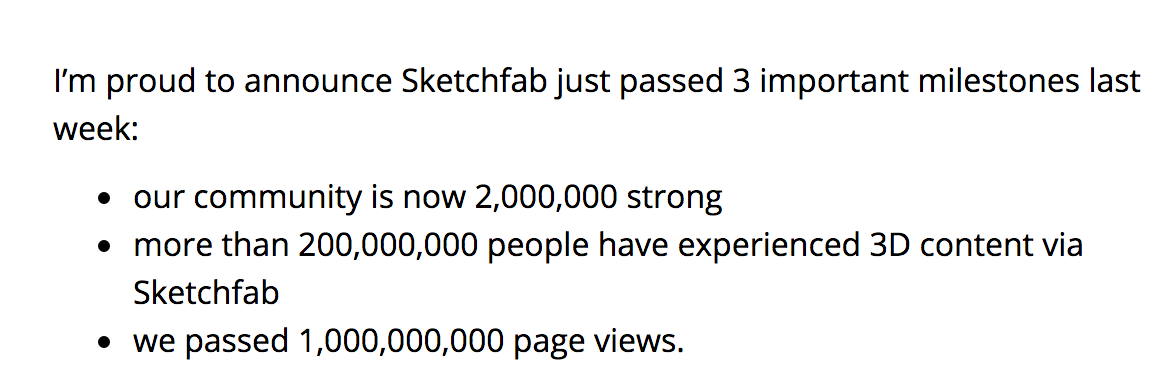
Last week Sketchfab, the 3D content hub, shared an exciting milestone — the company has just crossed 1 billion cumulative pageviews. Taken with the community’s growth — they just surpassed 2 million users, as well as the 200 million people that have experienced content via Sketchfab more broadly, this makes it one of the platforms with the largest reaches for interactive 3D content on the web.
With Google’s Poly turning one and Microsoft’s Remix 3D turning two, it’s an interesting moment to reflect where we are in the trajectory of the 3D web.
Alban Denoyel, the CEO of Sketchfab has watched the industry and community evolve in the six years since he founded the company. In an interview for Flu I sat with Alban and we got into the history of the business and how he’s built a team between Europe and the U.S., what the company has learned from Youtube and why they are pursuing a distributed content strategy. Alban also shared details on how power creators are using the platform to monetize content, the powerful role 3D plays in cultural heritage, and the importance of figuring out standards and formats in 3D. An excerpt of the conversation can be found below and the full transcript is on Medium.
AMLG: Our guest today is Alban Denoyel. He is the founder and CEO of Sketchfab a hub for 3D content on the internet. The company was founded in 2012 and is based between New York and Paris. I haven’t caught up with you for some time, it’s great to see you again. I believe you had a baby girl in the last few months?
AD: Three months ago.
AMLG: Congratulations. Maybe we can start with a bit your history, how you got into graphics, came over from France for Techstars and the origins of the company.
AD: Sure. We started the company back in 2012 in Paris. I actually had a business background so for the first two years of the company I was the only non-developer in the team. I do sculpture as a hobby and was commissioned to make a large piece. I was trying to figure out what was the most efficient way to make it. That’s how I heard about 3D printing. Back in 2011 in France it was very new. I found it fascinating and was telling everybody about it — “3D printing, that’s the future if you haven’t heard about it.”
AMLG: Clay sculptures?
AD: Initially wood sculpture, then for this piece it had to be clay because it was too big for wood and I had to do a mould. A lot of that would have been easier if I had known about 3D scanning and all that stuff. Then in 2012, I left my job because I wanted to start a company. I was trying to meet as many people as possible. I went to a party where I was preaching the 3D printing gospel again. Someone told me, hey you should go talk to this guy back there he’s a 3D guy. So I went to Cedric who is now my co-founder and CTO. He had never heard about 3D printing. But he told me, “I’ve been working on this prototype around 3D. If you are interested I’d be happy to talk more. Let’s have lunch.” So we agreed to have lunch the next day. Then he showed me what was essentially the first web-based 3D player to have ever been built. He had been a 3D programmer in the video game industry for 15 years and was hired by Mozilla to make the first demo of WebGL for the launch of Firefox 4 back in 2011. He built the first WebGL framework — so WebGL is now standard but wasn’t standard back then to display 3D graphics in the browser. He showed me the prototype which was really just an upload button, you uploaded a 3D file and got back a URL and saw the 3D file in your web page. No user interface, no nothing.
AMLG: So he had built the core idea already a bit, tinkered with it.
AD: Yeah. He kind of built it as a tool for himself. He was working with 3D artists in the gaming industry and they were sharing screenshots of their work, which sucked. He said hey maybe I can find something better. So he built it for himself and had told nobody about it.
AMLG: Did you convince him to leave his job?
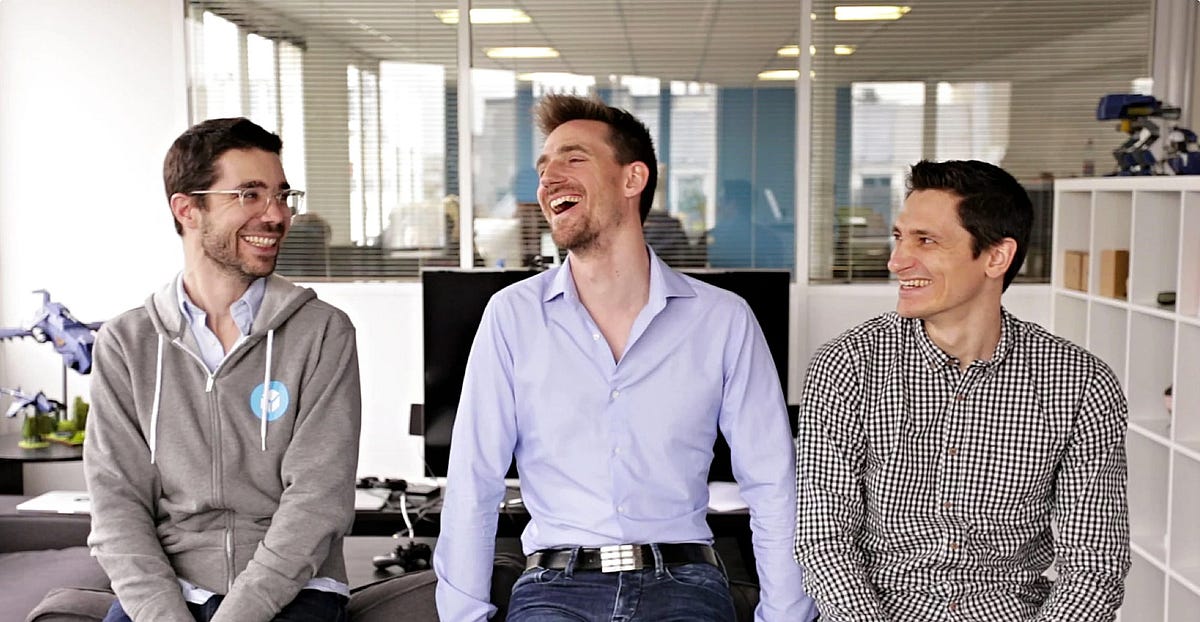
Sketchfab co-founders Alban Denoyel, Cédric Pinson and Pierre-Antoine Passet
AD: He had already moved to full-time freelancing around WebGL. He was super happy as a freelancer, he had no intention to build a business. And I initially had no sense as to whether this would be a sustainable idea. So I just started helping out on the side. It immediately took off because we were the first platform to do that. Then our third co-founder Pierre-Antoine joined us a few months after. We quickly realized we’re the first mover in the space. And that if we wanted to reach our ambitions and find funding and get partnerships with the big tech guys we had to move to the U.S. fast. If you look at other media platforms — we had DailyMotion for video in France, we had Deezer for music. They both got doubled by U.S. companies because it was harder back then to move to the U.S. So very early on I started applying to the U.S. accelerators. We first got into Web Forward which was Mozilla’s accelerator, so we spent Q4 of 2012 in San Francisco and then back to Paris. We knew we had to go back to the U.S. as fast as possible and we applied and got into TechStars New York in spring 2013. So that’s how we came back.
AMLG: Ok. So to get into what is Sketchfab—it’s essentially a platform for creators to publish and users to consume 3D content. There’s an embeddable player that displays 3D content across the web. So much of the 3D landscape has changed in the six years since you started the company. What is the biggest difference now?
AD: There’s been shifts on the two sides of the platform, both creation and consumption. When we started there were only professional people creating 3D content. You needed advanced professional tools like 3ds Max or SolidWorks and AutoCAD. The crowd of people who could become Sketchfab users was limited to 20 million or so 3D professionals. Then on the consumption side, there was no VR or AR. 3D printing was very early and there were fewer ways to consume the content. Six years later — the iPhone 10 has a depth sensor, which means you can do 3D capture on the spot. That means that anyone with a smartphone will become a 3D creator moving our target user base from 20 million to 2 billion people. Then on the consumption side, 3D used to be meant only for background work, back office stuff like manufacturing. A lot of ads are done with 3D assets but the result is 2D and its the same for movies. Whereas today you can consume stuff that is made in 3D in a 3D form which is VR or AR. So the appetite for 3D content is exploding and there are more and more ways to use and leverage that content. So it’s become increasingly important to be able to share and find that content.
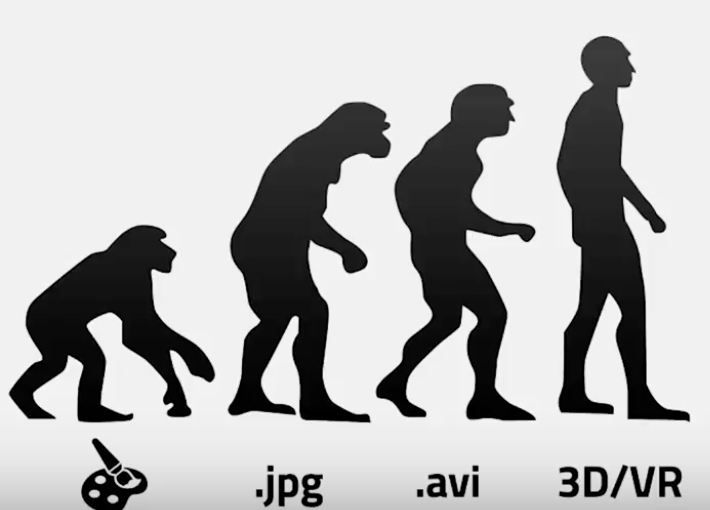
AMLG: When it comes to those two sides of the marketplace it feels like on the consumption side we’re at this turning point with VRAR, that we’re about to have all these different ways to consume. But the creation side still feels like a bottleneck. I mean I’m trying to learn Unity so maybe that’s my own personal struggle. But when we talk about how creation has evolved, we started with cave paintings and then went to regular paintings, then photography, then video, and now we’re going to 3D. We’re starting to learn how to capture in 3D.
You mentioned Intel RealSense. Obviously, there was a lot of excitement with Google Project Tango — RIP. I still have my Lenovo Phab. I was very excited to get it, it took such a long time to come. But I was hoping we’d see more uptick in capture and content growth from that. My understanding is that the Tango team rolled into AR Core anyway so that’s been a positive. That’s capture. There’s also Tiltbrush and other tools for creating. But overall, is there still a bottleneck?
AD: It’s definitely true that for the average person there aren’t a lot of seamless ways to create content. But the thing is you don’t need a crazy depth sensor to make 3D capture. Most of our 3D captures on Sketchfab are coming from photogrammetry. It’s an older technique stitching a ton of images together. The downside is that it’s much less seamless than depth sensors because you have to take a lot of pictures. But the upside is that the result looks nicer because the tech is more evolved. I would say about half of our uploads are coming from 3D capture. More and more is coming from drones. We see new use cases for 3D captures every day, we see new solutions coming to market every day. I guess for the outside world it may seem like a bottleneck. But for us, because we have become the go-to place to publish that content, we see a lot of volume.
AMLG: In various talks you’ve said that 3D is eating the world. I think that’s true it’s just, along what timeframe? Is it nibbling, is it taking a large chomp, where are we in that… What do you think will be different about 3D and where are we in format standardization?
AD: It’s important to make a differentiation between the formats and the platform to host it. There’s been a lot of technical discussions around which 3D format should be the holy grail of 3D formats. It’s an ecosystem that is much more fragmented than sound or video. But even if we do get to an agreement around the best 3D format you still need a platform to host it, publish it, share it, embed it, display it. That’s where we come in and where YouTube comes in for video. Today you can display a video on a web page without Youtube. It’s part of any normal html5 markup. We’re going to get to the same state for the 3D world.
ugh
AMLG: I remember the days of “please make sure you’ve downloaded Adobe Flash plugin” — like, what.
AD: Yeah so Youtube made it easy and then reached critical mass, and at that point there was no reason not to use Youtube because it made it easier. That’s what we want to do.
AMLG: And you’ve done that with the embedded API right? You have that built-in capability now, to view Sketchfab content across the web? Through your partnerships.
AD: Yes. We’ve spent a lot of energy on that. The main difference when it comes to consuming the format is it’s a very different medium. Even if now we’re able to support many volumetric movies which are closer to what a video is, a lot of the content is more like objects or scenes. And while a lot of it makes sense to be consumed as is, there are a number of assets that make more sense combined or reused in a different context. So maybe it’s just because the Web part of the ecosystem is too early to do this efficiently. But what we’ve come to realize is that while YouTube is fully optimized for content being consumed within the Youtube player, we’re just starting to see that there is more value in letting the content go, letting it leave the Sketchfab player to be reused in different contexts.
AMLG: So it’s distributed consumption rather than a destination.
AD: Exactly.
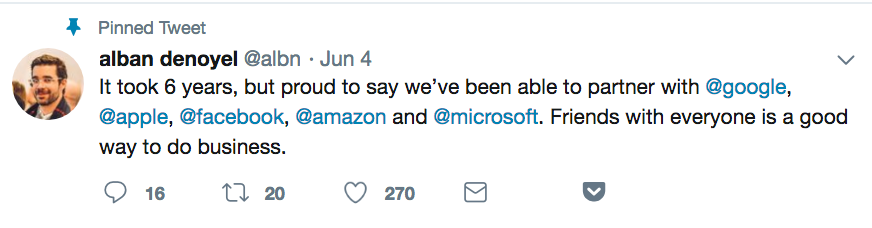
AMLG: Which is why it’s such a feat. I saw pinned to the top of your Twitter that “it took six years but I’m proud to say we’ve been able to partner with Google Apple Facebook Amazon and Microsoft.” Slow but steady. I can’t imagine what kind of work that took. I guess it comes back to what you were saying with WebGL. Curious to get into that — it’s really the first web standard that allows you to display 3D graphics in a browser without a plugin. Mozilla has been driving that and you have DNA from Mozilla in your team. What is it about Mozilla? I mean they’re a free open source browser, but why are they such a critical role in this ecosystem? They seem very forward thinking.
AD: They’ve always been pushing for content openness and distribution. A lot of previous formats were quickly grabbed by large tech companies and then locked into proprietary formats like Flash. So they felt this shouldn’t happen for the 3D world. What’s interesting is that they pioneered WebGL back in 2011 2012 and they did it again with WebVR WebAR webXR. They were actually the first browser — Firefox — to launch with built-in WebVR support out of the box a few months ago, ahead of Google and any other browser which is impressive.
AMLG: So how does this all relate to WebVR?
AD: Well VR is just another screen, another way to consume the content. We are the repository and then you can consume it on mobile on desktop in VR in AR. What I like about WebVR is that instead of having people needing to go to one of the VR destination sites like the Oculus store or the Steam platform — people don’t have the habit to do that. We’ve been betting heavily on the concept of embedding content anywhere on the Web. Our content is traveling across e-commerce websites, news sites and so on. Then you run into the Sketchfab player wherever you are — in your Facebook feed, in a tweet. You can consume it the way you want. If you have your VR headset plugged in you can just jump into it in VR without having to worry about anything else.
AMLG: So it’s hardware agnostic right? And the API works for this. That API essentially gives developers access to your 150,000 3D models?
AD: So WebVR lets you consume our entire library of 3 million plus assets straight from our player. Our player is VR enabled for the web. And then our download API is a pipeline to get the content outside of our player to be used natively inside any other — well it can then re-end into WebVR but in another platform —
AMLG: I may have to draw a diagram for listeners. But what you’re saying is you’ve made it really easy for people to access.
AD: Yeah to search — the concept is a search bar for the 3D world. Just like when you are in Photoshop or even Google Slides, if you want to get content, they have integrations with guys like Shutterstock or Getty or Fotolia . It’s just a library of 2D stuff. We want to do the same thing for the 3D world.
AMLG: To get into the numbers and give listeners a sense, as of July you have a community of over a million and a half users who’ve published close to 3 million 3D models, which I believe makes Sketchfab the largest library of 3D volumetric content online?
AD: We’re close to 2 million users now and we just passed 3 million assets.
AMLG: Can you get into uniques per month — you said a few months ago maybe five million. I’m guessing it’s somewhere near 10 million now?
AD: Yeah we’re in between that.
AMLG: OK. I want to get a bit more concrete around the types of content. Initially you were targeting 3D artists, animation, gaming studios — it seems like over time use cases and content types are much broader than you thought?
AD: We’ve had this kind of tension, in terms of market and even in terms of co-founders. I wanted to get traction and critical mass and volume and go for like Youtube model. My co-founders were more like, we need to serve the artists and make a solution for the best content, and having the best content will reflect positively on our platform. So do we go after less great content? We quickly became the market leader and so we decided we might as well go for every type of 3D content. So today we managed to grab the high end of the market. If you go to Sketchfab, the curated part is really high-end stuff that takes a month or six months to build. Then we have the long tail of things that are drawn by kids in Tiltbrush or 3D capture. Like I make portraits of my son, it’s not great content but it’s great content for me.
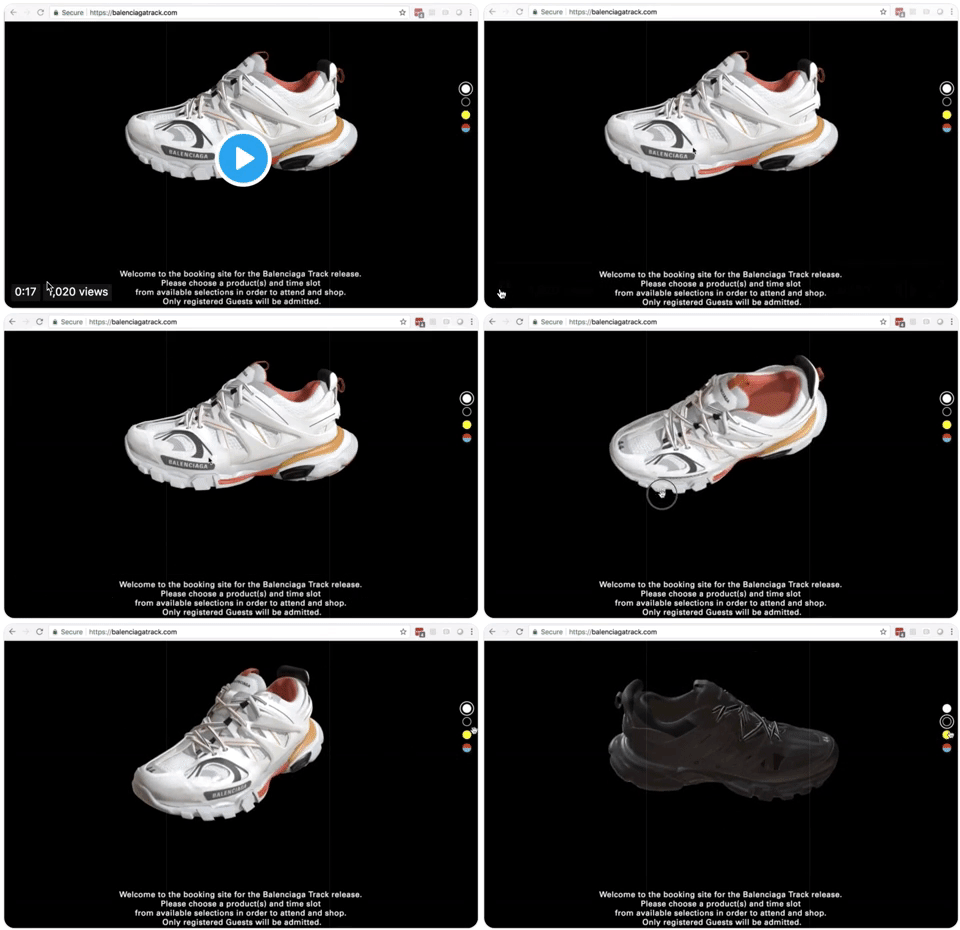
It seems like shoes come up a lot. I saw your Balenciaga partnership for their trainers, it’s high-quality stuff. You’re into shoes and have uploaded shoes. What is it with 3D shoes and e-commerce, and when is e-commerce 3D going to start penetrating for the average person?
Brands Sketchfab has worked with
AD: It always sounded crazy to me that when you buy your product you go to the product page and then you have 10 pictures of 10 angles of the product. We can do better than that. Then, of course, you think about AR and VR and the day that we will have Apple AR glasses on our head. Every brand will need a virtual version of their products. The good news is that most brands manufacture physical products, and they start with a 3D design because they need to manufacture it. So a lot of them already have 3D files of what they sell. But most of this content doesn’t look good and isn’t meant to be consumed that way.
Sketchfab collaboration with Balenciaga
We want to help 3D get into e-commerce and we’re starting with verticals where 3D is the most relevant and already present and accessible. Those categories are typically things like furniture. We work with brands like made.com. Shoes is an area where 3D is very present in innovation, just to design a shoe, and it’s also easy to 3D scan a shoe and has a great result. Often we combine both. I guess I also have a bias because I’m a shoe person —
AMLG: A sneakerhead.
AD: Yeah. I really want to get all the, well we actually already work with Adidas, Nike, New Balance and Crocs — I want to work with the shoe brands. It also seems like the type of product like you care more about seeing in 3D than a T-shirt. It’s more expensive. And then there are so many differences from one shoe to another. So many components and technical features.
AMLG: Do you think any businesses are proving out an ROI with 3D yet when it comes to e-commerce?
AD: Well we’ve started experimenting with free advertising, partnering with Google and programmatic networks to get our player to run 3D ads. We’ve seen a much better ROI than 2D ads. Like for a jewelry brand we did a case study. But to be honest, when I pitch an e-commerce brand I’m not pitching the ROI angle first. It’s a byproduct and I expect it to be ROI positive. But 10 years from now you will need to be ready for when virtual content is seamlessly shared with physical content. So what do you do today to be ready for that?
AMLG: Get ahead of the curve.
AD: Yes and today it starts with a web-based player of your products on an e-commerce site, and then tomorrow, I don’t know what the user interface is going to be for AR VR —
AMLG: Why am I not seeing more 3D on Amazon . Are they going to do it?
AD: That’s a long conversation but yes they’re working on it.
AMLG: I would think so. They’re usually ahead of these things. I guess to get more into a random question for you— if you could go back in history and 3D capture any human or any place, what would it be?
AD: Well my last grandmother just passed away. She is the only one I was able to capture in 3D four years ago because she came to visit me in New York. It sounds silly but I would love to have 3D portraits of all my grandparents. It’s as close to who they were and who they are.
AMLG: Yeah it’s powerful stuff.
AD: I take 3D portraits of my kids. It sounds silly —
AMLG: No not at all. We have a company called 8i and one of the first things they did was capture a mother holding a baby. It’s been one of the most popular assets. She came back a year later and stepped into herself again to hold the baby. She couldn’t believe how much her child had grown, stepping back into her own hologram and holding the baby. It was an interesting moment. That’s what they’ve found in capturing these human moments. I’d be curious to hear what was the first thing you ever uploaded or sold on Sketchfab?
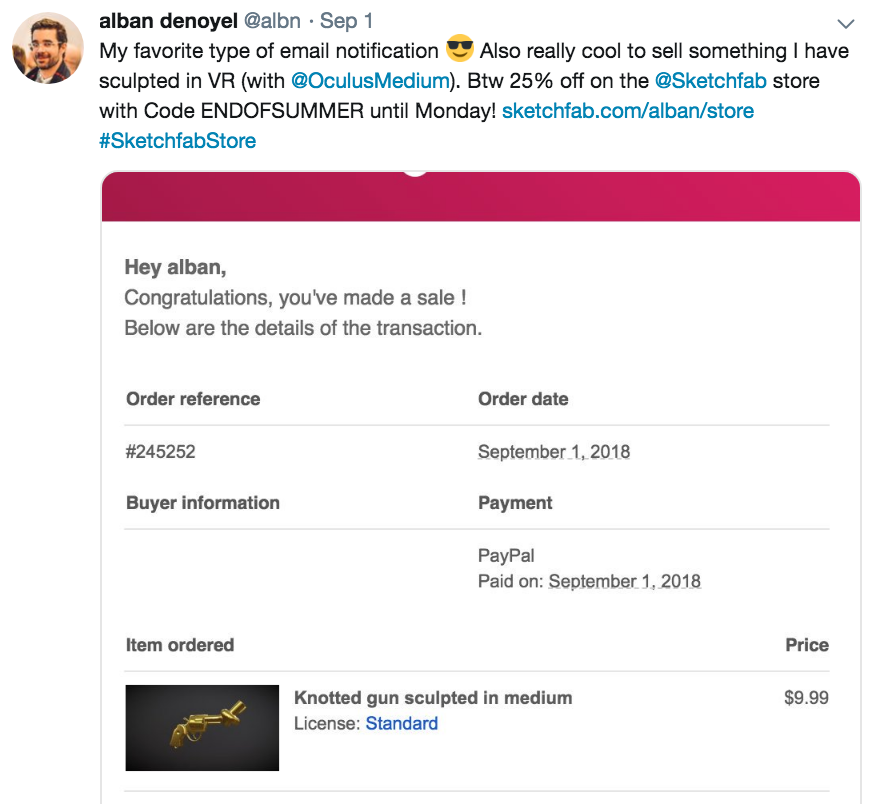
AD: The first asset I sold was a 3D capture of a chocolate croissant. It sold for $4.99. What’s interesting is that first, we had no idea if 3D captures would sell on our store because traditionally it’s an industry driven by high-end computer graphics and 3D captures are usually not optimized, the content doesn’t always look as good. So I was not expecting to sell it. Also, I had no idea who would have use of a virtual version of a croissant that costs more than the actual thing. Then I did a bit of research. It turns out it was an entrepreneur building an AR app to give nutritional advice on food. He’s doing machine learning on virtual versions of foods, so he is able to look at any actual food piece and say, hey —
AMLG: I think I’ve come across this guy. I remember someone doing this.
AD: There are probably several people doing that. But what’s interesting is, don’t assume that things won’t sell. Because you never know how they are going to be used. It was just a great surprise for me and for Sketchfab as a platform.
Drone delivery really only seems practical for two things: take-out and organ transplants. Both are relatively light and also extremely time sensitive. Well, experiments in flying a kidney around Baltimore in a refrigerated box have yielded positive results — which also seems promising for getting your pad thai to you in good kit.
The test flights were conducted by researchers at the University of Maryland there, led by surgeon Joseph Scalea. He has been frustrated in the past with the inflexibility of air delivery systems, and felt that drones represent an obvious solution to the last-mile problem.
Scalea and his colleagues modified a DJI M600 drone to carry a refrigerated box payload, and also designed a wireless biosensor for monitoring the organ while in flight.
After months of waiting, their study was assigned a kidney that was healthy enough for testing but not good enough for transplant. Once it landed in Baltimore, the team loaded it into the container and had it travel 14 separate missions of various distances and profiles. The longest of these was three miles, a realistic distance between hospitals in the area, and the top speed achieved was 67.6 km/h, or about 42 mph.
Biopsies of the kidney were taken before and after the flights, and also after a reference flight on a small aircraft, which is another common way to transport organs medium distances.
Image credit: Joseph Scalea
The results are good: despite the potential threats of wind chill and heat from the motors of the drone (though this was mitigated by choosing a design with a distal motor-rotor setup), the temperature of the box remained at 2.5 degrees Celsius, just above freezing. And no damage appeared to have been done by the drones’ vibrations or maneuvers.
Restrictions on drones and on how organs can be transported make it unlikely that this type of delivery will be taking place any time soon, but it’s studies like this that make it possible to challenge those restrictions. Once the risk has been quantified, then kidneys, livers, blood, and other tissues or important medical supplies may be transported this way — and in many cases, every minute counts.
One can also imagine the usefulness of this type of thing in disaster situations, when not just ordinary aircraft but also land vehicles may have trouble getting around a city. Drones should be able to carry much-needed supplies — but before they do, they should definitely be studied to make sure they aren’t going to curdle the blood or anything.
Radio giant iHeartMedia announced today that it’s reached an agreement to acquire Jelli, a company bringing programmatic ad-buying to radio broadcasters.
As a result of the deal, the Jelli team in Silicon Valley will become iHeartMedia’s main adtech operation, and it will still be led by CEO Michael Dougherty. At the same time, iHeartMedia says Expressway by Katz, the programmatic ad exchange created using Jelli technology, will be run independently by Katz Media Group.
In a statement, iHeartMedia CEO Bob Pittman said:
At iHeart we believe marketing is both math and magic. The math is our rich data and insights about our users and how they relate to our partners’ products and services — and the magic is the incredible creative ideas we bring to our partners, such as our iconic music events, award shows, influencers, podcasts, social reach and our unique on air promotions. Jelli allows us to do something no other company can do — advertisers can now buy and use our broadcast assets, reach and impact just as they use the major digital players. We now offer heavy data and heavy creative innovation all in one place.
The financial terms of the acquisition were not disclosed. Jelli’s other investors include Relay Ventures, Intel Capital, First Round Capital and Universal Music Group, and according to Crunchbase, it raised more than $40 million total.
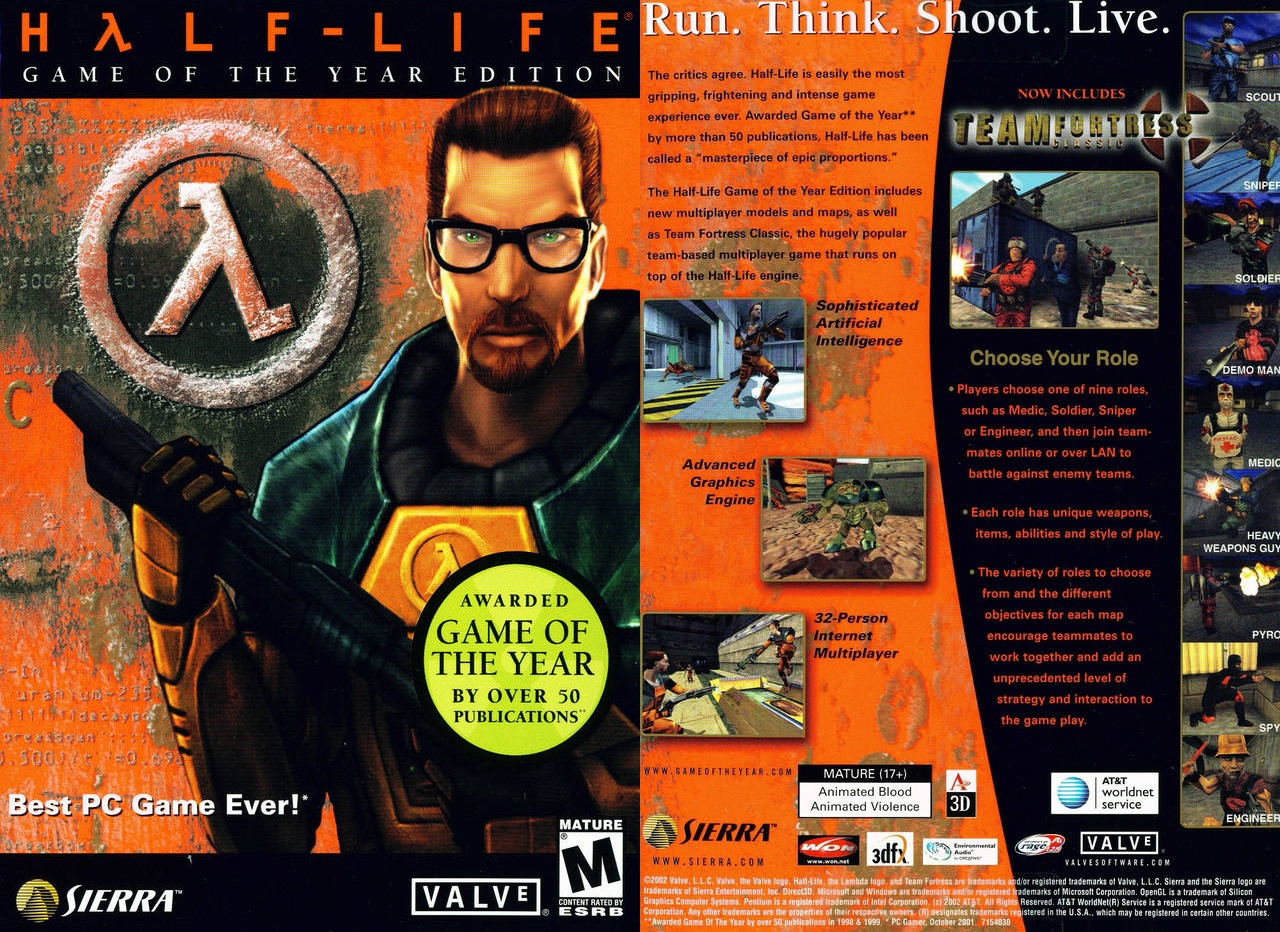
The only thing that’s crazier than the fact that Half-Life was released exactly 20 years ago is that I wrote up its 10th anniversary on this very website… well, 10 years ago. We’ve both aged well, I like to think. But Half-Life has already left a legacy.
Half-Life was Valve’s first game, when they were a young game studio and not the giant gaming conglomerate we know them as today. The game was also a big risk — its narrative-heavy gameplay, including the now famous arrival-at-work intro sequence, was a departure from the generally simple shooters of the late ’90s.
At a time when most games were still level-based, Half-Life set forth a continuous (though still largely episodic) journey punctuated with setpiece encounters and more than a few terrifying moments. This story-centric, wide corridor approach would be immensely influential in game design, as would Half-Life’s scarily smart (for the time) enemy AI, particularly the soldiers sent to shut down the Black Mesa facility and everyone in it.
The tantalizing tastes of a larger story in which you were only one part — orchestrated by the still-mysterious G-Man — kept players on the hook through its expansions and eventually its masterful and sadly unfinished sequel.
The multiplayer, too, was a joy. I remember in particular long matches of robots versus scientists in Gasworks, and brutal close-quarters combat trying to escape the air raid in Crossfire. Then of course Team Fortress Classic and all that came after.
But it wasn’t just Half-Life itself that was influential. Valve’s success with this experiment drove it to make further forays into gaming infrastructure, leading to the creation of Steam — now, of course, the world’s leading PC gaming platform. Although there are arguments to be made now that Steam is stuck in the past in many ways, it’s hard to overestimate its effect on the gaming industry over the years.
I replayed the game a couple of years ago and it mostly holds up. The initial chapters are still compelling and creepy, and the action is still fun and frantic. The pacing isn’t so hot and of course the graphics aren’t so hot these days, and of course Xen is still a pain — but overall it’s easy to put yourself back in your ’90s shoes and remember how amazing this was back then.
If you’re thinking of replaying it, however, you might do yourself a favor and instead play Black Mesa, a full-on remake of the game with more modern graphics and a lot of quality of life changes. It’s still largely the same game, just not quite as 1998.
In a blockbuster deal for Fanatics and Ticketmaster, the two companies have agreed to sell verified tickets and merchandise on each others’ sites.
According to a statement from the two companies, the partnership will give leagues, teams and universities an integrated e-commerce experience from the two companies’ customer databases to create fan rewards programs, as well.
Ticketmaster is the gatekeeper for almost every major sporting event in the U.S., and through the new deal will be the exclusive ticket provider for Fanatics — giving shoppers the ability to buy tickets through embedded links on sites like Fanatics .com, FansEdge.com and individual team sites.
Ticket purchases will also get Fanatics shoppers access to a rewards program where points can be exchanged for merchandise.
“As the go-to destination for event tickets and the official ticketing partner to so many incredible sport clients, we’re always looking for ways to enhance the fan experience while simultaneously adding value to our partners,” Jared Smith, president of Ticketmaster, said in a statement. “Partnering with Fanatics in this way is the definition of a win-win for us, for Fanatics, for our common rights holders and for fans.”
The partnership will also allow Ticketmaster to target Fanatics shoppers with personalized offerings, special offers and identify new customers. Fanatics shoppers can also receive bundles of merchandise as an up-sell on their ticket purchases through Ticketmaster.
“As partner to leagues, teams and schools, Ticketmaster and Fanatics have a shared responsibility to help stakeholders amplify their brands and grow their businesses,” said Cole Gahagan, chief commercial officer of Fanatics. “By teaming up, we’re now in a remarkably unique position to not only boost event awareness, but to also reward fans, and increase the value of buying tickets and attending games. It’s a big win for every member of the sports community.”
It was a stormy Monday for cloud stocks today with the general trend pointing way down. Okta stock took the biggest beating, down over 15 percent to $48.67, and even mighty Salesforce had its worst day since 2016, according to CNBC, down 8.7 percent to $121.01.
Wall Street was apparently disenchanted with just about every cloud company, large and small and in-between. Nobody, it seemed, was spared investor’s wrath:
Box was down 6.93 percent to $16.66
Workday was down 7.57 percent to $124.07
Twilio was down 13.76 percent to $76.90
Amazon (which of course includes AWS) was down 5.09 percent to $1,512.29
That’s just a smattering of the cloud stocks, and it didn’t take any cherry picking to give you the idea. It was a bad day, but there really is no rhyme or reason for this drubbing. The cloud is in high growth mode. Amazon just reported cloud revenue accounted for $6.68 billion, up 46 percent in its most recent earnings report. That’s a run rate of almost $25 billion just for the cloud business.
As for Okta, it’s reporting in a couple of weeks, but in its most recent report, it announced $94.6 million, which accounted for 57 percent year-over-year growth with subscription revenue growing 59 percent year-over-year. None of these sound like companies in trouble, do they?
John Dinsdale, chief analyst and research director at Synergy Research, a firm that tracks cloud market share, said it was a case of today’s short-term snapshot of the market simply not matching the forecasted growth of the cloud in the coming years.
“Well, there is logic and then there is the stock market; and often the two have little in common,” Dinsdale told TechCrunch. “In terms of ongoing market growth and future prospects, absolutely nothing has changed. The market forecasts remain extremely healthy. Indeed, if anything our next forecast update will likely result in us nudging up our forecast growth rates a little,” he said.
In general, the cloud market continues to grow, according to Synergy’s latest reports (which is in line with other market projections). “The Q3 growth rate of 45% compares with a full-year 2017 growth rate of 44% and a 2016 growth rate of 50%. Public IaaS and PaaS services account for the bulk of the market and those grew by 51% in Q3,” Synergy wrote in their October 25th report.
Perhaps this is just a case of one bad day as the stock market continues its overall volatility of the last couple of months, but whatever the reasons, cloud stocks really took it on the chin today.
Shares of technology companies were battered in today’s trading as fears of an increasing trade war between the U.S. and China and rising interest rates convinced worried investors to sell.
The Nasdaq Composite Index, which is where many of the country’s largest technology companies trade their shares, was down 219.4 points, or 3%, to 7,028.48. Meanwhile, the Dow Jones Industrial Average fell 395.8 points, or 1.6%, to 25,017.44.
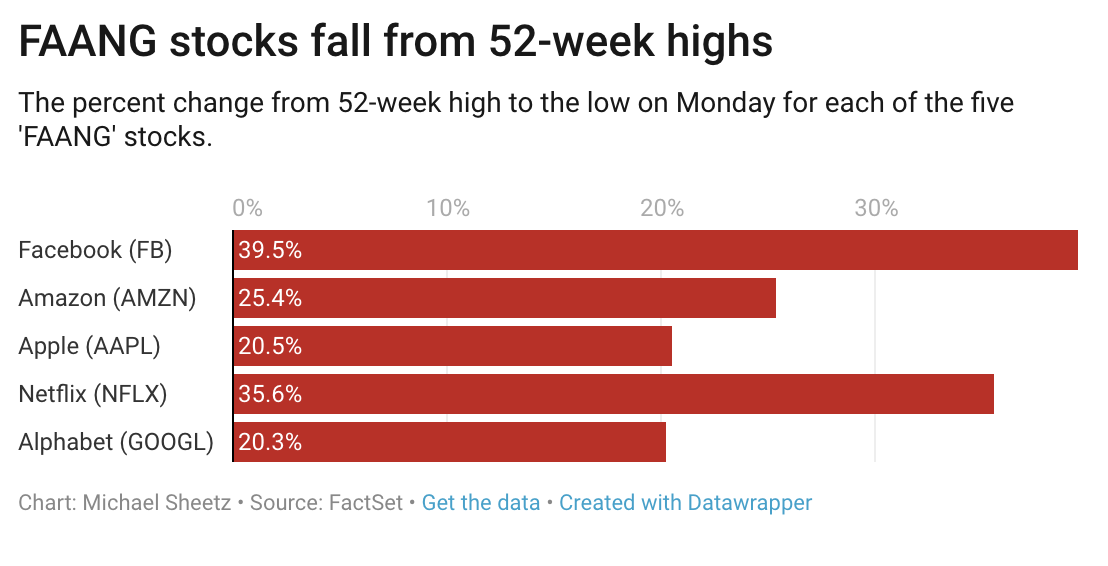
Facebook, Alphabet (the parent company of Google), Apple, Netflix and Amazon all fell into bear trading territory, which means that the value of these stocks have slid more than 20%. CNBC has a handy chart illustrating just how bad things have been for the largest tech companies in the U.S.
Some of the woes from tech stocks aren’t necessarily trade war related. Facebook shares have been hammered on the back of a blockbuster New York Times report detailing the missteps and misdirection involved in the company’s response to Russian interference in the U.S. elections. Investors are likely concerned that the company’s margins will shrink as it spends more on content moderation.
And Apple saw its shares decline on reports that sales of its new iPhones may not be as rosy as the company predicted — although the holiday season should boost those numbers. According to a Wall Street Journal report, Apple has cut the targets for all of its new phones amid uncertainties around sales.
The Journal reported that in recent weeks, Apple had cut its production orders for all of the iPhone models it unveiled in September, which has carried through the supply chain. Specifically, targets for the new iPhone XR were cut by one-third from the 70 million units the company had asked suppliers to produce, according to WSJ sources.
Those sales numbers had a ripple effect throughout Apple’s supply chain, hitting the stock prices for a number of suppliers and competitors.
But the U.S. government’s escalating trade war with China is definitely a concern for most of the technology industry as tariffs are likely to affect supply chains and drive prices higher.
According to a research note from Chris Zaccarelli, the chief investment officer at Independent Advisor Alliance, quoted in MarketWatch, interest rates and slowing global growth are adding to trade war pressures to drive tech stock prices down.
“Tech continues to be caught in the crosshairs of the triple threat of rising interest rates, global growth fears and trade tensions with China,” Zaccarelli wrote. “Trade war concerns with China weigh on the global supply chain for large technology companies while global growth fears worry many that future earnings will be lower,” he said.
Sometimes, it’s hard to imagine a product or industry that a new e-commerce startup hasn’t tried to remake already, from slippers to mattresses, from luggage to lipstick.
Yet two childhood friends in New York have seemingly struck on a fresh idea: taking on the stodgy and often expensive world of cookware, where one’s options out of college are usually limited to a few pieces of Calphalon or Farberware or, in the best-case scenario, some Le Creuset, the premium French cookware manufacturer founded back in 1925 and known for its vibrant colors, including Marseille, Cerise, and Soleil.
In fact, what the pair are building with their 10-month-old startup, Great Jones, appears to be a Le Creuset for the next generation: a handful of cookware items, including a cast-iron Dutch oven, that come in an array of colorful, if comparatively more muted, tones. Think Broccoli and Mustard.
The cookware is also more affordable than Le Crueset, which charges upward of $300 for a similar Dutch oven, compared with $145 for Great Jones’s new product. In fact, Great Jones’s full collection, which also includes a stainless steel stock pot, a stainless sauce pot, a stainless deep saute and a ceramic nonstick skillet, retails for $395.
Cookware is a smart sector to chase. According to the market consultancy IBIS World, the so-called “kitchen and cookware stores” industry has been growing steadily, reaching revenue of $17 billion last year.
One of the big question questions for Great Jones will be whether its offerings hold up, and whether its customers find them compelling enough to recommend to others. After all, the old adage tends to hold up that you get what you pay for. And most new products take off because of favorable word of mouth, not merely because they’re Instagrammable.
Great Jones’s 28-year-old founders — Sierra Tishgart, previously a food editor at New York Magazine, and Maddy Moelis, who worked in customer insights and product management at a variety of e-commerce companies, including Warby Parker and Zola — seem to have thought these things through. Indeed, in a recent Forbes profile, they say they conducted extensive interviews with chefs and cookbook authors in their network in order to establish, for example, how to design a comfortable handle.
They also smartly made certain that their introductory offerings come in a range of metals. As even so-so cooks know, stainless steel is ideal for browning and braising; durable nonstick coatings make preparing delicate foods, including eggs and pancakes, less nightmarish.
In the meantime, Great Jones has easily captured the press’s imagination with what they are cooking up — a sign, perhaps, that the industry is ready for a refresh. In addition to Forbes, Great Jones also received recent coverage in the New York Times and Vogue — valuable real estate that most months-old startups can only dream of landing.
Great Jones has also raised outside funding already, including $2.75 million that it closed on last month led by venture capital firm General Catalyst, with participation from numerous individual investors.
Now, the company just needs to convince its target demographic that it should ditch the older, established brands that may not feel particularly modern but are known to be durable, easy to clean, dishwasher safe, and not insanely heavy (among the other things that keep people from throwing their pots in the garbage).
Great Jones also has plenty of newer competition to elbow out of the way if it’s going to succeed.
As the Times piece about the company notes, just a few of the other startups that are suddenly chasing the same opportunity include Potluck, a five-month-old, New York-based startup that sells a $270 “essentials bundle” that features 22 pieces, including utensils; Misen, a four-year-old, Brooklyn-based startup that sells cookware and chefs knives; and Milo, a year-old, L.A.-based startup that’s solely focused on Dutch ovens, to start.
According to Crunchbase, Misen has raised $2 million, including through a crowdfunding campaign; Milo has raised an undisclosed amount of seed funding.
Sometimes, it’s hard to imagine a product or industry that a new e-commerce startup hasn’t tried to remake already, from slippers to mattresses, from luggage to lipstick.
Yet two childhood friends in New York have seemingly struck on a fresh idea: taking on the stodgy and often expensive world of cookware, where one’s options out of college are usually limited to a few pieces of Calphalon or Farberware or, in the best-case scenario, some Le Creuset, the premium French cookware manufacturer founded back in 1925 and known for its vibrant colors, including Marseille, Cerise, and Soleil.
In fact, what the pair are building with their 10-month-old startup, Great Jones, appears to be a Le Creuset for the next generation: a handful of cookware items, including a cast-iron Dutch oven, that come in an array of colorful, if comparatively more muted, tones. Think Broccoli and Mustard.
The cookware is also more affordable than Le Crueset, which charges upward of $300 for a similar Dutch oven, compared with $145 for Great Jones’s new product. In fact, Great Jones’s full collection, which also includes a stainless steel stock pot, a stainless sauce pot, a stainless deep saute and a ceramic nonstick skillet, retails for $395.
Cookware is a smart sector to chase. According to the market consultancy IBIS World, the so-called “kitchen and cookware stores” industry has been growing steadily, reaching revenue of $17 billion last year.
One of the big question questions for Great Jones will be whether its offerings hold up, and whether its customers find them compelling enough to recommend to others. After all, the old adage tends to hold up that you get what you pay for. And most new products take off because of favorable word of mouth, not merely because they’re Instagrammable.
Great Jones’s 28-year-old founders — Sierra Tishgart, previously a food editor at New York Magazine, and Maddy Moelis, who worked in customer insights and product management at a variety of e-commerce companies, including Warby Parker and Zola — seem to have thought these things through. Indeed, in a recent Forbes profile, they say they conducted extensive interviews with chefs and cookbook authors in their network in order to establish, for example, how to design a comfortable handle.
They also smartly made certain that their introductory offerings come in a range of metals. As even so-so cooks know, stainless steel is ideal for browning and braising; durable nonstick coatings make preparing delicate foods, including eggs and pancakes, less nightmarish.
In the meantime, Great Jones has easily captured the press’s imagination with what they are cooking up — a sign, perhaps, that the industry is ready for a refresh. In addition to Forbes, Great Jones also received recent coverage in the New York Times and Vogue — valuable real estate that most months-old startups can only dream of landing.
Great Jones has also raised outside funding already, including $2.75 million that it closed on last month led by venture capital firm General Catalyst, with participation from numerous individual investors.
Now, the company just needs to convince its target demographic that it should ditch the older, established brands that may not feel particularly modern but are known to be durable, easy to clean, dishwasher safe, and not insanely heavy (among the other things that keep people from throwing their pots in the garbage).
Great Jones also has plenty of newer competition to elbow out of the way if it’s going to succeed.
As the Times piece about the company notes, just a few of the other startups that are suddenly chasing the same opportunity include Potluck, a five-month-old, New York-based startup that sells a $270 “essentials bundle” that features 22 pieces, including utensils; Misen, a four-year-old, Brooklyn-based startup that sells cookware and chefs knives; and Milo, a year-old, L.A.-based startup that’s solely focused on Dutch ovens, to start.
According to Crunchbase, Misen has raised $2 million, including through a crowdfunding campaign; Milo has raised an undisclosed amount of seed funding.