
Year: 2018

19 Nov 2018

Today in brighter crypto news: SEC says tokens are securities

Crypto news got a little boost last week after a dark month of crashes, stablecoins, and birthdays. The SEC ruled that two ICO issuers, CarrierEQ Inc. and Paragon Coin Inc., were in fact selling securities instead of so-called utility tokens.

“Both companies have agreed to return funds to harmed investors, register the tokens as securities, file periodic reports with the Commission, and pay penalties,” wrote Pamela Sawhney of the SEC. “These are the Commission’s first cases imposing civil penalties solely for ICO securities offering registration violations.”

From the release:

Airfox, a Boston-based startup, raised approximately $15 million worth of digital assets to finance its development of a token-denominated “ecosystem” starting with a mobile application that would allow users in emerging markets to earn tokens and exchange them for data by interacting with advertisements. Paragon, an online entity, raised approximately $12 million worth of digital assets to develop and implement its business plan to add blockchain technology to the cannabis industry and work toward legalization of cannabis. Neither Airfox nor Paragon registered their ICOs pursuant to the federal securities laws, nor did they qualify for an exemption to the registration requirements.

This behavior – a sort of “damn the torpedoes” for the Fintech set – was all the rage at the beginning of the year as no clear guidance was available for filing security tokens – essentially pieces of company equity – versus utility tokens which were, in theory, used within the company ecosystem. In fact ICOed companies contorted themselves into all sorts of knots to appear to fit their “utility token” within the torturous confines of securities law.

“We have made it clear that companies that issue securities through ICOs are required to comply with existing statutes and rules governing the registration of securities,” said Stephanie Avakian, Co-Director of the SEC’s Enforcement Division. “These cases tell those who are considering taking similar actions that we continue to be on the lookout for violations of the federal securities laws with respect to digital assets.”

The SEC fined both companies $250,000 each. Future ICOs, at least in the U.S., would do well to keep this in mind.
19 Nov 2018

Today in brighter crypto news: SEC says tokens are securities

Crypto news got a little boost last week after a dark month of crashes, stablecoins, and birthdays. The SEC ruled that two ICO issuers, CarrierEQ Inc. and Paragon Coin Inc., were in fact selling securities instead of so-called utility tokens.

“Both companies have agreed to return funds to harmed investors, register the tokens as securities, file periodic reports with the Commission, and pay penalties,” wrote Pamela Sawhney of the SEC. “These are the Commission’s first cases imposing civil penalties solely for ICO securities offering registration violations.”

From the release:

Airfox, a Boston-based startup, raised approximately $15 million worth of digital assets to finance its development of a token-denominated “ecosystem” starting with a mobile application that would allow users in emerging markets to earn tokens and exchange them for data by interacting with advertisements. Paragon, an online entity, raised approximately $12 million worth of digital assets to develop and implement its business plan to add blockchain technology to the cannabis industry and work toward legalization of cannabis. Neither Airfox nor Paragon registered their ICOs pursuant to the federal securities laws, nor did they qualify for an exemption to the registration requirements.

This behavior – a sort of “damn the torpedoes” for the Fintech set – was all the rage at the beginning of the year as no clear guidance was available for filing security tokens – essentially pieces of company equity – versus utility tokens which were, in theory, used within the company ecosystem. In fact ICOed companies contorted themselves into all sorts of knots to appear to fit their “utility token” within the torturous confines of securities law.

“We have made it clear that companies that issue securities through ICOs are required to comply with existing statutes and rules governing the registration of securities,” said Stephanie Avakian, Co-Director of the SEC’s Enforcement Division. “These cases tell those who are considering taking similar actions that we continue to be on the lookout for violations of the federal securities laws with respect to digital assets.”

The SEC fined both companies $250,000 each. Future ICOs, at least in the U.S., would do well to keep this in mind.

19 Nov 2018

Microsoft acquires FSLogix to enhance Office 365 virtual desktop experience

Back in September, Microsoft announced a virtual desktop solution that lets customers run Office 365 and Windows 10 in the cloud. They mentioned several partners in the announcement who were working on solutions with them. One of those was FSLogix, a Georgia virtual desktop startup. Today, Microsoft announced it has acquired FSLogix. It did not share the purchase price.

“FSLogix is a next-generation app-provisioning platform that reduces the resources, time and labor required to support virtualization,” Brad Anderson, corporate VP for Microsoft Office 365 and Julia White, corporate VP for Microsoft Azure wrote in a joint blog post today.

When Microsoft made the virtual desktop announcement in September they named Citrix, CloudJumper, Lakeside Software, Liquidware, People Tech Group, ThinPrint and FSLogix as partners working on solutions. Apparently, the company decided it wanted to own one of those experiences and acquired FSLogix.

Microsoft believes by incorporating the FSLogix solution, it will provide a better virtual desktop experience for its customer by enabling better performance and faster load times, especially for Office 365 ProPlus customers.

Randy Cook, founder and CTO at FSLogix, said the acquisition made sense given how well the two companies have worked together over the years. “From the beginning, in working closely with several teams at Microsoft, we recognized that our missions were completely aligned. Both FSLogix and Microsoft are dedicated to providing the absolute best experience for companies choosing to deploy virtual desktops,” Cook wrote in a blog post announcing the acquisition.

Lots of companies have what are essentially dumb terminals running just the tools each employee needs, rather than a fully functioning stand-alone PC. Citrix has made a living offering these services. When employees comes in to start the day, they sign in with their credentials and they get a virtual desktop with the tools they need to do their jobs. Microsoft’s version of this involves Office 365 and Windows 10 running on Azure.

FSLogix was founded in 2013 and has raised over $10 million, according to data on Crunchbase. Today’s acquisition, which has already closed according to Microsoft, comes on the heels of last week’s announcement that the company was buying Xoxco, an Austin-based developer shop with experience building conversational bots.

19 Nov 2018

NASA chooses the landing site for its Mars 2020 rover mission

Five years and sixty potential locations later, NASA has chosen the Jezero Crater as the landing site for its Mars 2020 rover mission.

Slated to launch in July the Mars 2020 rover mission will touch down at the Jezero Crater as NASA’s exploration of the Red Planet enters its next phase.

The rover will be looking for signs of habitable conditions — and past microbial life — while also collecting rock and soil samples that will be stored in a cache on the Martian surface.

Alongside the European Space Agency, NASA is already studying future missions that will allow the agencies to retrieve the samples and return them to earth. According to NASA, this new landing is the first step of a planned decade-long exploration of Mars.

“The landing site in Jezero Crater offers geologically rich terrain, with landforms reaching as far back as 3.6 billion years old, that could potentially answer important questions in planetary evolution and astrobiology,” said Thomas Zurbuchen, associate administrator for NASA’s Science Mission Directorate, in a statement. “Getting samples from this unique area will revolutionize how we think about Mars and its ability to harbor life.”

The crater is located on the western edge of Isidis Planitia, a giant impact basin just north of the Martian equator, with some of the oldest and most scientifically interesting landscapes Mars has to offer, according to NASA scientists.

Mission scientists believe the 28-mile-wide crater once held an ancient river delta, and could have collected and preserved organic molecules and other potential signs of microbial life from the water and sediments that flowed into the crater.

NASA thinks it can collect up to five different kinds of Martian rock, including clays and carbonates that may preserve indicators of past life. There’s also the hope that minerals have been swept into the crater over the last billion years which Rover could also collect.

It was the geologic diversity of the Jezero crater that ultimately tipped the scales for NASA scientists, but the site’s contours will make it a bit more tricky for NASA entry, descent and landing engineers, according to a statement from the agency.

“The Mars community has long coveted the scientific value of sites such as Jezero Crater, and a previous mission contemplated going there, but the challenges with safely landing were considered prohibitive,” said Ken Farley, project scientist for Mars 2020 at NASA’s Jet Propulsion Laboratory, in a statement. “But what was once out of reach is now conceivable, thanks to the 2020 engineering team and advances in Mars entry, descent and landing technologies.”

This Mras mission will be the first to feature new Terrain Relative Navigation technologies to allow the rover to avoid hazardous areas during the “sky crane” descent stage — when the rocket-powered system carries the rover down to the surface.

The site selection is dependent upon extensive analyses and verification testing of the TRN capability. A final report will be presented to an independent review board and NASA Headquarters in the fall of 2019.

“Nothing has been more difficult in robotic planetary exploration than landing on Mars,” said Zurbuchen. “The Mars 2020 engineering team has done a tremendous amount of work to prepare us for this decision.  The team will continue their work to truly understand the TRN system and the risks involved, and we will review the findings independently to reassure we have maximized our chances for success.”

Now that the site has been selected, rover drivers and NASA’s science operations team can start planning for the exploration of the crater once the rover is on the ground. Using information from Mars orbiters, they will map the terrain and try to identify regions that could be the most interesting for the rover to explore.

Mars 2020 will launch from Cape Canaveral Air Force Station in Florida.

19 Nov 2018

Inboard opens general availability of its premium electric scooter

Inboard, the startup that sells a range of electric scooters and skateboards, has just opened sales of its first premium scooter — just in time for the holiday season.

The company has already sold 285 of the scooters in a private pre-sale, with 80 percent of the orders coming from the United States and 35 percent coming from inside California.

Best known for its M1 electric skateboard, the “Glider” electric scooter will become the second product in the Inboard suite.

Retailing for $999, the Glider scooter boasts a swappable battery and an integrated app that gives users information about their location while on the go, and provides traffic information and diagnostics and maintenance alerts, according to the company.

“The Glider is the confluence of hardware mastery, software expertise and our team’s relentless ambition to provide safer and smarter urban transportation,” said Inboard co-founder and chief executive, Ryan Evans. “Our goal is not only to release the most advanced e-scooter on the market, but to enter the space responsibly and lead with safety. Our hardware will be the most innovative on the market, but it is our software that truly separates the Glider from the competition – allowing riders a safer and more efficient journey, while providing a fun way to re-imagine your city.”

Inboard pitches itself as a safer scooter, designed for a rider height below the axle centerline and featuring headlights, brake lights, turn signals, bigger tires and a wider deck.

Gliders also come with a three-axis accelerometer to detect board vibrations and inform riders about road obstacles through its app.

Backed with $11.7 million in venture financing from investors, including Upfront Ventures and the battery technology developer LION Smart, European investment firm Sunstone Capital and Sweet Capital, Inboard is betting on the same mobility revolution that has fueled the sky-high funding rounds for companies like Bird and Lime.

The company is betting that the mobility revolution isn’t something that riders will want to rent, but something that they’ll own as the types of people-moving options and services continue to expand.

The Glider’s pre-sale price of $999 is only available via pre-order until 12/31/18, the company said, at which point pricing will be increased to the full price of $1,299.


19 Nov 2018

Instagram kills off fake followers, threatens accounts that keep using apps to get them

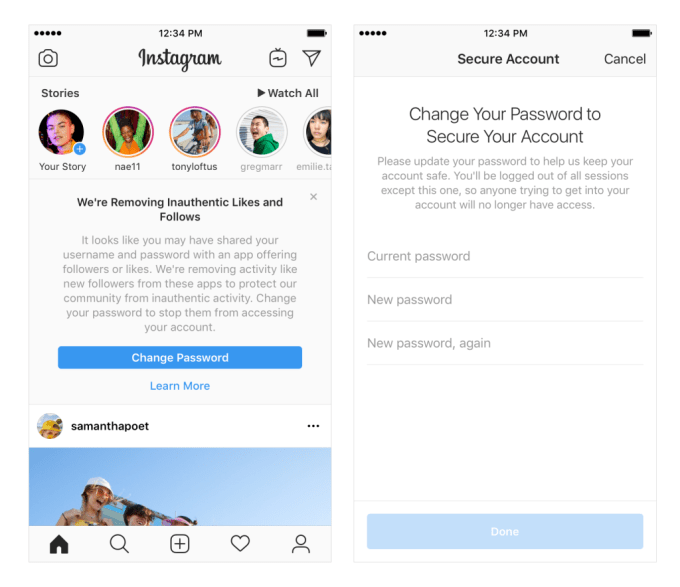
Instagram is fighting back against automated apps people use to leave spammy comments or follow then unfollow others in hopes of growing their audience. Today Instagram is removing inauthentic follows, Likes, and comments that violate its policies from people’s accounts who use these apps; sending them a warning to change their password to cut ties with these apps, and saying people who continue using these apps “may see their Instagram experience impacted”. Instagram tells me it “may limit access to certain features, for example” for those users.

Instagram is also hoping to discourage users from ever giving another company the login details to their accounts as this can lead to them being hacked or having their account used to send spam. So if you see Instagram follower accounts drop, it’s not because that profile offended people, but because to followers were fake.

The renewed vigor for policy enforcement comes amidst the continuing threat of foreign misinformation campaigns on Facebook and Instagram designed to polarize communities and influence elections in the US and abroad. Facebook has said that inauthentic accounts are often the root of these campaigns, and it has removed 754 million fake accounts in the past quarter alone, and stopping these spam apps could prevent them from misusing clients’ accounts. Instagram has been taking down fake accounts since at least 2014, but this is the first time it’s publicly discussed removing fake likes from posts. It now says “We’ve built machine learning tools to help identify accounts that use [third-party apps for boosting followers] and remove the inauthentic activity.”

Some of the most popular bot apps for growing followers like Instagress and Social Growth have been shut down, but others like Archie, InstarocketProX, and Boostio charge $10 to $45 per month. They often claim not to violate Instagram’s policies, though they do. The New York Times this year found many well-known celebrities had stooped to buying fake Twitter followers from a company called Devumi.

Users typically have to provide their username and password to these services which then take control of their accounts and automatically Like, comment on, and follow accounts associated with desired hashtags to dupe them into following the unscrupulous user back. The spam app users will now get scolded by Instagram, which will send “an in-app message alerting them that we have removed the inauthentic likes, follows and comments given by their account to others” and be told to change their passwords.

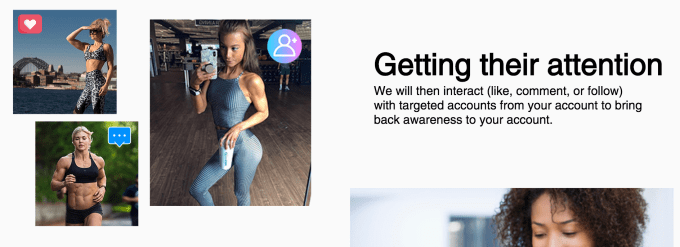
InstarocketProX advertises how it sends fake likes and follows from your account to get you followers

One big question, though, is whether Instagram will crack down harder on ads for services that sell fake followers that appear on its app. I’ve spotted these in the past, and they sometimes masquerade as analytics apps for assisting influencers with tracking the size of their audience. We asked Instagram and a spokesperson told us “Ads are also subject to our Community Standards, which prohibit spammy activity like collecting likes, followers, etc. — so you are correct that ads promoting these services violate our policies. Please feel free to report them if you see them”.

Follower accounts on apps like Instagram have become measures of people’s influence, credibility, and earning potential. This is becoming especially true for social media stars who are paid for brand sponsorships in part based on their audience size. Now that brands are even paying “nanoinfluencers” with as a few as one thousand followers to post sponsored content, the allure to use these services can be high and lead to an immediate return on illicit investment.

If no one can believe those counts are accurate, it throws Instagram’s legitimacy into question. And every time you get a notification about a fake follow or Like, it distracts you from real life, dilutes the quality of conversation on Instagram, and makes people less likely to stick with the app. Anyone willing to pay for fake followers doesn’t deserve your attention, and Instagram should not hold back from terminating their accounts if they don’t stop.

19 Nov 2018

Virgin Orbit successfully takes its 747 flying launchpad out for a spin

In the next step on its path to getting its low earth orbit payload launch system up and running, Virgin Orbit successfully took its LauncherOne system out for a spin with an actual rocket attached under its wing. 

The company’s specially modified 747-400 carried a 70-foot-long rocket as part of a test flight proving that the carbon-fiber, two-stage rocket works with the plane.

It’s a necessary step toward Virgin Orbit’s plans to begin launching rockets early next year.

The launch took place in Victorville, Calif., near Virgin Orbit’s Long Beach factory and the Mojave Air and Space Port, which serves as an operational launch site for Virgin.

“The vehicles flew like a dream today,” said Virgin Orbit Chief Pilot Kelly Latimer (Lt. Col, US Air Force, Ret.), in a statement. “Everyone on the flight crew and all of our colleagues on the ground were extremely happy with the data we saw from the instruments on-board the aircraft, in the pylon, and on the rocket itself. From my perspective in the cockpit, the vehicles handled incredibly well, and perfectly matched what we’ve trained for in the simulators.”

The company said that it expects to conduct several more flights of its 747-400, both with and without the LauncherOne rocket. The critical culmination of all of these tests will be a drop test, when a rocket will be released from the 747 (dubbed “Cosmic Girl”) without igniting. 

That test is designed to provide data about the systems aboard the 747 that control detachment and about the rocket’s performance in an atmospheric free-fall.

Virgin Orbit is one of several new companies racing to get new launch systems in orbit. Already capacity-constrained as companies push to launch new satellites into low earth orbit, companies like Virgin Orbit, RocketLab, Relativity Space, ARCA, AstroSpace, Blue Origin, Generation Orbit, Lockheed Martin, Orbital ATK, and others around the world have raised hundreds of millions to take payloads into space.

[gallery ids="1748677,1748678,1748679,1748680,1748682,1748683,1748684,1748685"]
19 Nov 2018

BuzzFeed News launches a paid membership program (and yes, there’s a tote bag)

BuzzFeed News is giving readers a new way to support its journalism — by paying a monthly or yearly fee.

BuzzFeed might not seem like the most obvious publication to ask readers for financial support, as it doesn’t really have the high-minded appeal of (say) NPR or The New Yorker. However, the company has been working to establish a separate identity for its team focused on real journalism (as opposed to the quizzes and other entertainment for which BuzzFeed is known). In fact, it launched a separate website for BuzzFeed News a few months ago.

In August, BuzzFeed News started giving readers a way to make one-off donations of between $5 and $100. It says the average donation was more than $20, with some readers asking for a way to support the organization on an ongoing basis.

So today, it’s launching a recurring membership program. For $5 a month, readers will receive members-only emails highlighting the latest scoops and taking them behind the scenes of BuzzFeed reporting. For $100 a year, they’ll also receive a BuzzFeed News tote bag.

BuzzFeed memberships

The memberships are available internationally, but you can only get a tote bag if you’re in the United States.

BuzzFeed reportedly missed its revenue target last year by as much as 20 percent, so it’s not surprising that the company is looking beyond advertising for ways to make money. However, in an email to the BuzzFeed team, Global News Director Lisa Tozzi said, “A membership program takes time to build, and we don’t expect it to be a huge portion of BuzzFeed’s revenue in 2019. That’s why we’re investing in it now and hope to see it contribute more to our work over time.”

And if you’re worried that this might be setting the stage for a paywall or meter on BuzzFeed News stories, Tozzi said flatly, “This is not a prelude to any sort of paywall.”

19 Nov 2018

Office 365, Azure users are locked out after a global multi-factor authentication outage

Good morning! Except if you’re a hosted Microsoft customer who’s locked out of your account right now.

Microsoft’s cloud-based multi-factor authentication services went down across the globe early Monday morning, preventing users who are required to sign in using a second layer of authentication to their account, such as a text message, a push notification on their phone, or a hardware key. You hit the password page, and then you’re stuck — no code, no notification, nothing.

“Affected users may be unable to sign in,” said a notice on Office 365’s service health page, confirming the outage.

More than half a day later, the service is still struggling.

At the time of writing, Microsoft said it has deployed a hotfix to get the service up and running again, but will “continue to monitor any updates” for the next couple of hours. “We’ve received reports that users may no longer receive alerts, so we’re analyzing diagnostic logs to understand why,” the company added.

So far, there’s no clear reason for the outage. We’ve reached out to Microsoft for more, and will update when we hear back.

Multi-factor authentication adds a significantly greater layer of protection on an email account than just a password. But, as a crucial mechanism for users to log in, it’s also a single point of failure if the system breaks.

A system so secure that even its users can’t log in. Who knew?

19 Nov 2018

Amazon Comprehend adds customized language lists to machine learning tool

Last year Amazon announced Comprehend, a natural language processing tool to help companies extract common words and phrases from a corpus of information. Today, a week ahead of its Re:invent customer conference, Amazon announced an enhancement to Comprehend that allows developers to build lists of specialized words and phrases without machine learning domain knowledge.

“Today we are excited to bring new customization features to Comprehend, which allow developers to extend Comprehend to identify natural language terms and classify text which is specialized to their team, business or industry,” Matt Wood, GM for deep learning and AI wrote in a blog post announcing the enhancement.

The key aspect of this is that Amazon is handling all of the complexity, allowing developers to add customized lists without having deep machine learning or natural language processing background. “Under the hood, Comprehend will do the heavy lifting to build, train, and host the customized machine learning models, and make those models available through a private API,” Wood wrote.

This involves two pieces. First of all developers define a list of custom entities. This could be something like legal language at a law firm or a list of part numbers at an automobile company. All the developer needs to do is expose a list of these entities. Amazon learns to identify the customized language and builds a private, customized model based on the list.

The second piece involves customized classifying. Once you have the language, you can begin to build logical lists where the terms appear. “Through as few as 50 examples, Comprehend will automatically train a custom classification model that can be used to categorize all your documents. You could group support emails by department, social media posts by product, or analyst reports by business unit,” Wood wrote. You could see how this could be useful to take these items after they have been extracted and categorized, and move them through a workflow to the appropriate personnel or for further use programmatically by an application.

Amazon is providing a way to build customized machine learning models, while it takes care of the details behind the scenes. At their best, cloud companies simplify the complex and provide access to sets of services that might otherwise be too difficult for many developers to achieve on their own. Comprehend is trying to offer a way to build customized models without having any machine learning knowledge whatsoever.

The new Comprehend features are generally available starting today.