Year: 2018

19 Nov 2018

Lightfoot gets $4M to nudge more drivers to go smooth with a ‘Fitbit for cars’

UK car tech startup lightfoot, which sells a telematics system that gives real-time feedback to drivers combined with a rewards platform to further incentivize good driving, has picked up £3.2 million (~$4M) from London-based early-stage venture fund BGF.

Former Dyson CEO, Martin McCourt, also contributed to the investment, and will join lightfoot’s board as a non-executive chairman.

The startup has previously received grant funding from government-backed Innovate UK and later an innovate loan. But this looks to be their first tranche of VC. And a spokesperson confirmed it’s being treated as a Series A.

Lightfoot’s telematics device, which it bills as a sort of ‘Fitbit for cars’, plugs into a vehicle’s onboard computer and rests on the dashboard — where the driver can easily see the visual cues it provides as they drive (using a traffic light color-coded feedback system).

The idea is to offer a more reciprocal alternative to traditional ‘blackbox’ telematics systems which just record driving data and don’t give the driver an opportunity to improve their driving.

Smoother driving is linked to reduced fuel consumption, lower emissions and a lower risk of accidents. So there are plenty of reasons why fleet owners — lightfood’s initial target for the tech — might want to encourage it.

On the driver side lightfood combines real-time feedback with a rewards platform that offers individual incentives, such as lower insurance premiums and deals-related discounts on things like restaurants, holidays, days away and retail.

It uses a gamification approach here, with a so-called ‘Elite Driver’ status being needed to unlock rewards. A driving score of 85% required to reach that status. Lightfoot says 80% of its users hit the mark and are able to remain there, while 97% achieve Elite Driver status “at some point”.

The company was launched in 2013, by entrepreneur Mark Roberts, and now has more than 20,000 drivers using the tech across more than 150 fleet clients — including Virgin Media, Dixons Carphone, Southern Water, Ecotricity, Greencore and Dyno Rod.

It’s opening up to individual motorists with a UK consumer launch today, and plans to expand the proposition globally being slated as “already underway”.

It says the new investment will be used to feed these growth plans, including ramping up hiring across the business.

Commenting in a statement, Ned Dorbin, BGF investor and new lightfoot board member said: “Lightfoot is a vibrant, smart and ambitious business with a first-class management team. After five years of operation, they have established a strong reputation in the market and developed a clear strategy for growth.”

“We’re on a mission to change the way people think about driving. And to make it fun again,” added Lightfoot’s founder and CEO, Mark Roberts, in another supporting statement. “We want everyone to enjoy the amazing benefits that smoother driving can have on their wallets and our planet.

“So far, we’ve created a community of Lightfoot drivers who are earning better deals for better driving – now, we’re excited to grow this with more like-minded motorists who believe good driving deserves rewarding.”

19 Nov 2018

Plastiq raises $27M at 2X+ value to let you pay for anything on credit

“I wasn’t asking to pay in Bitcoin!” Plastiq CEO and co-founder Eliot Buchanan recalls with a laugh. “I went to pay part of my tuition at Harvard and I was told that they didn’t (and never would) accept credit card. It was inconvenient and seemed odd. Credit cards had been around for 50 years.” That set off the a light bulb in his head. “Why couldn’t I use a credit card to pay for this important bill? So, I set out to solve my own problem.”

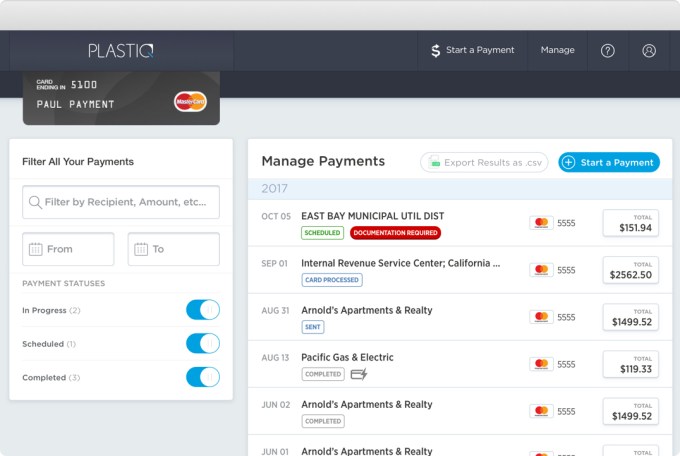
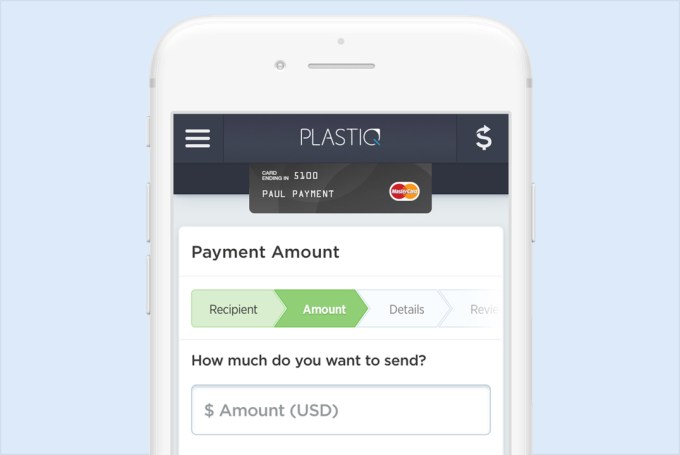
Whether you’re trying to pay your rent or tuition on credit, or you have a business and want to invest in a new opportunity or get a better rate by paying vendors up front, Plastiq can help. For a flat 2.5 percent fee, you pay Plastiq through your credit card, and it issues the proper wire transfer, check, or deposit for up to $500,000 on your behalf to whoever you owe.

Now with over 1 million clients, growth stage VCs are taking notice. Kleiner Perkins has just led a $27 million Series C for Plastiq with partner Ilya Fushman joining the board. A source says the raise that also comes from DST Global between doubles and triples Plastiq’s valuation over its 2017 Series B-1 rounds of $11 million and $16 million. Now with $73 million in total funding, it plans to add 100 more people to its current team of 60 while building out its small business product and bank partnerships.

“As tens of thousands of business owners started using Plastiq actively for billions of dollars in payments, we realized we had this incredible opportunity to serve as the hub/platform on which they (SMBs) could run all their payments. The very fabric of America’s economy — and certainly much of the world — is run by rising or aspiring small business owners” Buchanan tells me. He says that’s “the main reason that seeded this Kleiner financing and our renewed vision to ‘accelerate how small businesses grow’. [Helping people pay with credit cards] is merely the entry point to a much broader play where we are central to how a small business runs.”

For example, if a small business wants to ramp up production of something it’s selling, it’d typically have to pay up front for manufacturing, but wait months until the stuff is shipped and sold to recoup its investment. That can put a major squeeze on the company’s operating capital. With Plastiq, the business can pay with credit up front so they don’t have to worry about being in danger of running out of money in the meantime. Plastiq also lets businesses accept credit card payments, which can win them favor with partners.

Plastiq co-founders (from left): Eliot Buchanan and Dan Choi

Speciality medical clinic chain Metro Vein pays vendors who don’t take credit with Plastiq instead. “I was able to invest in a new line of business that has enabled me to more than double our revenues in the last ten months,” said CEO Dmitri Ivanov. And thanks to tax write-offs, business users of Plastiq can push its realized fee down to 2 percent.

Buchanan claims Plastiq doesn’t have any direct competitors that allow SMBs to pay for all their bills via credit. It does carry platform risk, though. “Like any payments business, we rely heavily on Visa, MasterCard, and American Express. A challenge or risk factor is that you’re relying on very large companies that are very successful. You have to learn to work hand in hand with those partners instead of ‘disrupt them’.” He says Plastiq’s relationships with them are positive right now since it’s driving new revenue for them and helping their customers spend in new areas.

There’s also the risk that people misuse Plastiq to procrastinate on actually paying their personal bills or get in over their head investing in their business. But Plastiq’s new board member Fushman calls the service “this elegant way for businesses to tap into credit they’ve been issued but they haven’t been able to utilize before.” For many who are happy to pay though just need some time and flexibility, Plastiq can pitch in.

19 Nov 2018

SoftBank’s Deepcore and accelerator Zeroth team up to hunt early stage AI opportunities

Two early stage AI programs are joining forces because, even in the world of artificial intelligence, two heads are better than one.

Hong Kong-based accelerator Zerothwhich recently grabbed a majority investment from Animoca Brands — and Deepcore, a Japanese incubator and fund that is part of the SoftBank group, are pairing up to use their resources on deal sourcing and other collaboration around artificial intelligence.

The two seem complementary, with Deepcore focused on starting new ventures and investing in AI companies more generally, while Zeroth operates Asia’s first accelerator program targeted at AI and machine learning startups. It recently bagged $3 million through a deal that sees Animoca Brands take a 67 percent share stake in Deepcore’s operating business and provide a check for its investment arm.

SoftBank launched Deepcore earlier this year to give the organization a foothold in early AI projects. The company operates a co-working/incubation/R&D facility — Kernel Hongo — in addition to an investment arm called Deepcore Tokyo.

Zeroth was founded two years ago and it has graduated 33 companies from three batches to date, taking an average of six percent equity. Some of those graduates have gone on to raise from other investors, including Fano Labs (which is now Accosys) which took money from Horizons Ventures, the VC firm founded by Hong Kong’s richest man Li Ka-Shing, and Japan’s Laboratik. It has also made eight investments in blockchain startups.

“It’s very excited to see the Zeroth ecosystem grow,” founder Tak Lo told TechCrunch in a statement. “Ultimately, this ecosystem is about building more and more opportunities for our founders to build great companies.”

19 Nov 2018

A closer look at Royole’s foldable display

You’d be forgiven if Royole doesn’t ring any bells. Even here China, it’s far from a household name. Still, the Shanghai-based startup recently secured an undisclosed Series E, vaulting its valuation to an apparent $5 billion, up from $3 billion in late 2016.

Founded in 2012, Royole’s best-known release was a wearable cinema display. That changed last month, however, when it surprised the industry by announcing the imminent arrival of the FlexPai, a flexible screen smartphone that appears on track to to beat the Samsung Galaxy X to market.

The FlexPai’s anticipated December release seemingly came out of nowhere. Like competitors, Royole had shown off its proprietary folding technology as part of a standalone demos, but it hadn’t teased the arrival of a smartphone until the device was ready to ship. It’s a far cry, certainly, from the not ready for prime time prototype Samsung marched out on stage last month.

At an event in Shenzhen, CEO Bill Liu told TechCrunch that the company was built around the desire to bring the technology to market. “We started from the flexible displays and flexible sensors,” he explained. “We started the company with a focus on the flexible displays and sensors. And then along the way, we realized this could be a huge application for the technology.”

A foldable smartphone was simply the first product that made sense for the underlying tech. With development dating back a half-dozen year, Royole was the first to achieved the industry’s long standing goal of delivering a foldable screen — beating even the massive Samsung to market.

Being first isn’t always a blessing in this industry, but it’s an impressive feat, nonetheless. The FlexPai is real. I can’t speak to the scalability of the product, until it actually starts shipping out next month, but I can attest to the fact that at least one of the things exists in the world. I held it in my hands. I folded it. It worked.

It’s a difficult problem and Royole solved it with in-house technologies. No one can take that away from the company. I can’t say my initial apprehensions were ultimately dissuaded, however. The FlexPai mostly works as desired, but the execution isn’t what ultimately the kind of premium product one would expect, given the ultra-premium price tag (around $1,300 American).

Liu happily dropped the phone a couple of times on stage, in an attempt to put to rest any durability question. While the display ultimately didn’t crack or scratch, the flexible material looks almost like cellophane and sports crinkles that catch the light — the clarity also leaves something to be desire.

As far as portability, it’s true that you can fold it up and stuff it in your pocket, though it’s pretty chunky when you do so. Ultimately, these are first generation products — and likely a result of a company pushing to be first to market, knowing full well that companies like Samsung were breathing down its neck.

Royole sees potential to license the technology out for other categories. “Right now for the smartphone industry, we haven’t done any licensing,” said Liu. “For industrial applications like automotive or media, we do have customers. We sell the licenses to them, and we’ve already sold a lot of licenses.”

The company will also be working with developers to create content for the new form factor, with a $30 million program it launched last month. The Chinese version is due out in December.


[gallery ids="1748404,1748425,1748424,1748423,1748422,1748421,1748420,1748419,1748418,1748417,1748416,1748415,1748414,1748413,1748412,1748411,1748410,1748409,1748408,1748407,1748406"]
19 Nov 2018

GoEuro is adding ferries to its multi-modal travel planner mix

European multi-modal travel planning platform, GoEuro, is adding another transport option to its ‘compare and book’ proposition by introducing ferries to the existing mix of trains, planes and buses.

The platform is powered by partnerships with more than 800 regional transport operators at this stage.

The initial focus for ferries will be on the Mediterranean, where GoEuro says it has been testing the product for destinations in Italy, including Amalfi-Positano and Naples-Ischia via ferry providers SNAV and Travelmar.

The move will add another string to GoEuro’s multi-modal bow. Albeit it’s a toe-in-the-water for now — with the beta launch only set to cover ferries in Italy and Croatia as its starting point. But GoEuro says it will build on that next year by adding more routes and markets.

Ticket booking for ferry travel can be a confusing and research-intensive process, owing to unfamiliar options and multiple providers of varying sizes plying different routes. Booking options are also not standardized. Add in the vagaries of weather and taking a ferry can feel like a tricky option to consider let alone nail down and book vs more digitally accessible alternatives like buying a plane ticket.

Hence GoEuro reckons there’s “significant opportunity” in the “limited digital booking capabilities” in the ferry market.

Its hope is to become a go-to middleman platform, providing a slicker and less stressful ticket booking experience for consumers, on the one hand, while offering ferry operators a new channel to expand sales and reach travellers who might not otherwise have considered going by ship. 

It also says its longer term aspiration is to connect ferry legs with other parts of a multi-modal journey — to create “true end-to-end booking for consumers”.

Though there’s clearly a way to go before its platform can claim to offer seamless linking between and across all the various transport types its platform is surfacing.

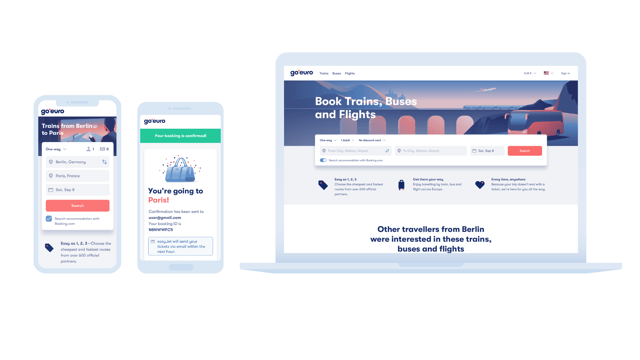
In another business development, also revealed to TechCrunch today, GoEuro has unveiled a new look for its brand, outing a redesigned logo and a color palette chosen to project calm reassurance to combat travel stress.

There’s also a new suite of anchor illustrations that paint a romantic view of the transport modes its platform sells access to…

GoEuro unveils new brand identity

It says this new look will be rolled out across Europe over the next month, with the ferry beta launching at the same time.

Another planned update will add more information and clarity around “often confusing travel elements”, such as add-ons, duration and transfers — also intended to de-stress the trip planning processes by making customers feel better informed and more in control.

Commenting in a statement, Naren Shaam, CEO and Founder, said: “The changes we’re announcing today — from an exciting new brand through to new modes of transportation — represent a big moment for GoEuro and a major step towards a more complete experience for our millions of users. We want to make travel booking seamless and provide reassurance, no matter where customers want to go, or how.

“Bringing more modes into one place, with mobile ticketing as default, and a smooth user experience, is much closer to our vision of the future of travel. Our new brand identity is designed to resonate well with our customers, and reaffirm our commitment to making their travel easier.”

In an additional development, GoEuro says it has integrated a portion of flight bookings directly on the platform, rather than requiring users to go — via redirect — to a third party site to book that leg of their trip. It now has onsite booking for “hundreds” of air carriers, enabling users to compare and buy flights directly too.

The Berlin-based startup recently announced a $150M funding raise — a month ago — led by Kinnevik AB, Temasek and Hillhouse Capital, bringing the total raised since it was founded in 2012 to close to $300M.

19 Nov 2018

Google report: Southeast Asia’s digital economy to triple to $240 billion by 2025

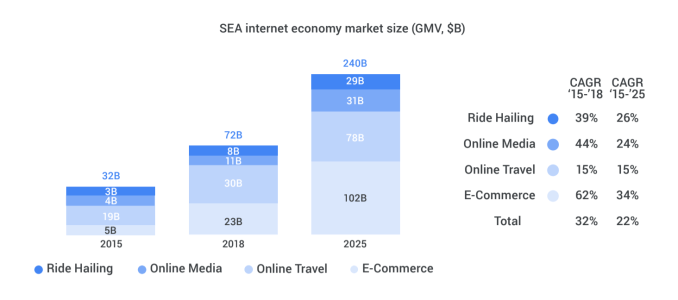
It may sit in the shade of China and India, but tech has real growth potential in Southeast Asia. Home to a cumulative 650 million people, the region’s digital economy is forecast to triple in size and reach $240 billion over the next seven years, according to Google’s third “e-Conomy SEA” report.

The annual study, which is authored by Google and Singapore sovereign fund Temasek and is arguably the most comprehensive research program for tech in Southeast Asia, has raised its estimation for the size of the digital economy in 2025 from an initial $200 billion after seeing the region reach “an inflection point.”

Southeast Asia has 350 million internet users across its six largest countries — that’s more than the entire U.S. population — and the latest data suggests its internet economy will reach $72 billion this year, up from $50 billion last year and $19.1 billion in 2015.

Online travel accounts for the majority of that revenue ($30 billion) ahead of e-commerce ($23 billion), online media ($11 billion) and ride-hailing ($8 billion), and that rough breakdown is likely to be maintained up until 2025, according to the report.

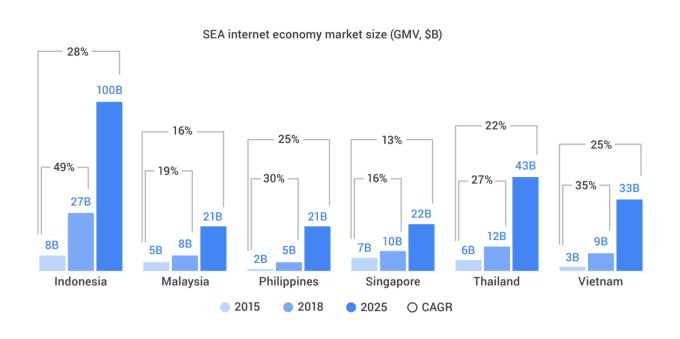
Indonesia, the world’s fourth largest country by population, is forecast to hit $100 billion by 2025, head of Thailand ($43 billion) and Vietnam ($33 billion) with strong growth forecast across the board. Indonesia and Vietnam, in particular, have seen their respective digital economies more than triple since 2015, according to the data.

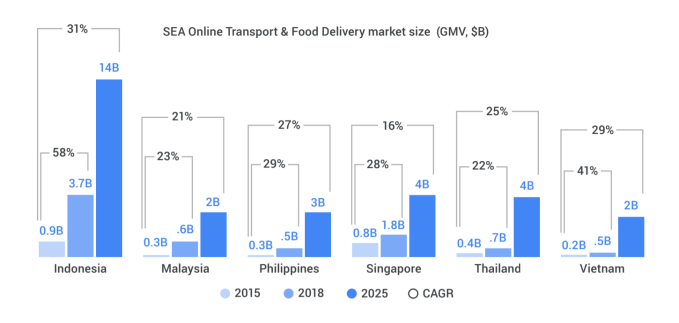
This year’s Google-Temasek report includes more detail on ride-hailing, which has become a particularly fascinating space in Southeast Asia since Grab acquired Uber’s local business earlier this year. Grab and its close rival Go-Jek, which is expanding from its base in Indonesia, have seen the market grow considerably, according to the report. Daily ride-hailing users in 2018 are up to eight million from 1.5 million in 2015, with monthly users growing to 35 million from eight million during the same time period.

Growth in revenue is actually coming faster for food delivery services over core transportation services, which is a good sign for Grab and Go-Jek since the two businesses have aggressively expanded into additional on-demand services. Singapore, while the smallest of Southeast Asia’s six largest economies with a population of 5.5 million, has an outsized share of the region’s ride-hailing market — and that’s forecast to continue to 2025.

Speaking of outsized, the report sheds some light on how the region’s largest companies utterly dominate its funding landscape. Billion-dollar companies in Southeast Asia sucked up $16 billion of the $24 billion invested in the region of the last four years, with Grab alone responsible for $6 billion of that figure.

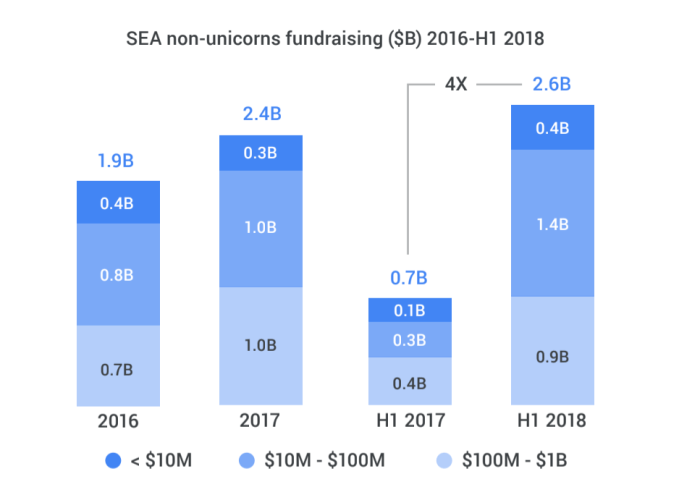
Every edition of the report has stressed that the growth forecasts are contingent on requisite levels of funding boosting the Southeast Asian startup ecosystem as a whole, so the fact that most capital is going to a few very big players is a concern. However, the report does show that there has been progress from the rest of the field, with non-unicorn funding jumping nearly forecast annually during the first half of 2018 — which raised more than the whole of 2017.

“More than 2,000 internet economy companies in the region have secured investments, with companies valued less than $1 billion able to raise collectively almost $7 billion in the last three years. Among them, the most dynamic segment was that of companies valued between $10 million and $100 million. The bedrock of the internet economy, these companies have raised $1.4 billion in the first half of 2018, already eclipsing the $1.0 billion they received in all of 2017,” the report states.

You can read the full findings here.

18 Nov 2018

VOI Technology, the e-scooter startup from Sweden, raises $50M led by Balderton Capital

VOI Technology, an e-scooter startup headquartered in Sweden but with pan-European ambitions, has raised $50 million in Series A funding, confirming our earlier scoop. As I previously reported, London-based venture capital firm Balderton Capital has led the round, alongside LocalGlobe, Raine Ventures, and previous VOI backer Vostok New Ventures.

A number of angel investors also participated. They include Cristina Stenbeck, Jeff Wilkes (Amazon), Justin Mateen (co-founder of Tinder), Nicolas Brusson (CEO and co-founder of BlaBlaCar), Sebastian Knutsson (co-founder of King), Spencer Rascoff (CEO of Zillow), and Keith Richman.

A source with knowledge of VOI’s early fundraising tells me this is in actual fact two rounds effectively being announced at the same time, although both VOI and Balderton say this is not the case. The e-scooter startup had previously raised around $3 million earlier this year.

What I do know, however, is the size of this new round got increased significantly very late on as VOI continues to gain early traction and the round became more competitive with a lot of VC interest. According to my sources, the initial target was $15 million at a pre-money valuation of between $35-40 million. Unfortunately, I haven’t been able to confirm the new valuation based on this much larger fundraise. Both VOI and Balderton declined to comment.

Launched in Sweden’s Stockholm in August 2018 by founders Fredrik Hjelm, Douglas Stark, Adam Jafer and Filip Lindvall, VOI has since expanded to Madrid, Zaragoza and Malaga in Spain. The plan is to use the new funding to continue to expand into new European markets. Belgium, the Netherlands, Luxembourg, France, Germany, Italy, Norway, and Portugal are said to be launching “in the coming months”. The VOI jobs page reveals that VOI is recruiting country managers for Denmark, Switzerland, Greece, Turkey, and Finland, too.

Like other e-scooter startups, VOI pitches itself as a way to ease traffic-clogged city centres and reduce pollution, with VOI’s scooters offering a “clean, efficient, cost-effective and zero emission” first-and-last-mile alternative to cars and taxis. After downloading the VOI app, you simply locate a nearby scooter on the street or via the app’s map, press the ‘ride’ button, scan the VOI QR code, and ride anywhere in the city. The company charges a €1 unlocking fee and a ride costs €0.15 per minute.

In just 12 weeks, VOI claims to have garnered 120,000 users, who have taken 200,000 rides, travelling 350,000 kilometres. It says this makes VOI Europe’s leading e-scooter sharing company.

“We see that we’ve changed user behaviour drastically in a very short time period,” VOI CEO Fredrik Hjelm tells me. “We changed how people commute, people move themselves. We changed how people transport within cities almost instantly after they try the scooters for the first time”.

He says this has resulted in “very strong retention rates, recurring use, and also friend referrals”.

“I’m from up in the North in Sweden, and for me it’s very difficult to understand, and it’s absurd, why we have so many cars and why our cities are built for cars, taxes and trucks, and not for people, animals, scooters, bikes, and light electric vehicles,” explains Hjelm. “That’s more from an ideological perspective. For me, scooters power freedom”.

VOI is also talking up its “distinctive” European approach in the way the company works collaboratively with city authorities. This is very different to the ‘ask for forgiveness not permission’ mentality of Silicon Valley.

“When you are reading the news, you get the feeling that city politicians are against scooters. The reality is the other way around,” Hjelm says. “The only thing is that they want a say in this and how it should be operated, so we don’t end up in a scooter graveyard situation that we see in some U.S. cities… Pretty much every European city has some kind of ambition or vision to become less dependent on fossil fuel driven cars and other vehicles”.

Balderton’s entrance into the e-scooter market comes after three of the other “big four” London VC firms have already made U.S. investments in the space. Index and Accel have backed Bird, and Atomico has backed Lime.

Last month also saw Berlin’s Tier raise €25 million in Series A funding led by Northzone, in another attempt to create the “Bird or Lime of Europe,” even if it is far from clear that Bird or Lime won’t take that title for themselves (which is obviously the bet being made by Index, Accel and Atomico). And two month’s ago Taxify also announced its intention to do e-scooter rentals under the brand Bolt, first launched in Paris but also planning to be pan-European.

This has led some VCs to describe the e-scooter space in Europe as a venture capital “blood bath” waiting to happen. The thinking is that the market has become so competitive so early, a lot of VC dollars are going to be spent (and potentially wasted) before it is far from clear who will be the eventual winner. That feels quite unusual for Europe, where it is more common for competing VCs to back off or co-invest once one or two of the big firms (or Rocket Internet) have made their move or when there is a better-funded U.S. competitor on the horizon — a point I put to Balderton Partner Lars Fjeldsoe-Nielsen.

“Yeah, and I think if we kept doing that as a VC community, we would never see any billion dollar companies coming out of Europe,” he replies. “This is why we’re backing VOI. [But] I get your point: it’s up against large amounts of capital”.

Describing e-scooters as a massive opportunity to change that, Fjeldsoe-Nielsen says that in the last four weeks VOI has doubled it revenues and that Balderton is seeing the same kind of traction and market reaction as Bird and Lime in the U.S.

“We believe an equally big company can come out of Europe,” he adds.

18 Nov 2018

Original Content podcast: The disappointment of ‘House of Cards’ and its final season

It seems like Netflix’s “House of Cards” had a real opportunity for a fresh start with season six.

Granted, the behind-the-scenes turmoil probably made this season particularly challenging: Production was already underway when “Star Trek: Discovery” actor Anthony Rapp came forward with allegations that Kevin Spacey made a sexual advance towards him when Rapp was only 14. In response, Netflix and production company Media Rights Capital halted production and ultimately decided to rewrite the season without Spacey’s character Frank Underwood.

If you’ve watched “House of Cards,” you know that this must have been a big change, since Underwood and his political schemes have been at the center of the show for five years. Still, the previous season ended with Robin Wright’s Claire Underwood taking over the presidency, so it seemed like the right time to rethink this as a show that’s centered on Claire.

What we got, however, was a season that’s still very much about Frank Underwood. Sure, he’s died offscreen before the season starts, and Spacey never appears in these new episodes. But he still casts a long shadow over the show, with all of the characters focused on the mystery of his death and the power vacuum he left behind. On the latest episode of the Original Content podcast, we try to explain why we found this approach so unsatisfying.

In addition, we talk about the death of comics legend Stan Lee and Hulu’s plans to create multiple series based on “Wild Cards,” a set of superhero stories edited by George R.R. Martin. This, in turn, leads us to the question on every “Song of Ice and Fire” fan’s mind: When is he going to finish the next book?

You can listen in the player below, subscribe using Apple Podcasts or find us in your podcast player of choice. If you like the show, please let us know by leaving a review on Apple. You also can send us feedback directly. (Or suggest shows and movies for us to review!)

18 Nov 2018

Google looks to former Oracle exec Thomas Kurian to move cloud business along

Diane Greene announced on Friday that she was stepping down after three years running Google’s cloud business. She will stay on until the first of the year to help her successor, Thomas Kurian in the transition. He left Oracle at the end of September after more than 20 years with the company, and is charged with making Google’s cloud division more enterprise-friendly, a goal that has oddly eluded the company.

Greene was brought on board in 2015 to bring some order and enterprise savvy to the company’s cloud business. While she did help move them along that path, and grew the cloud business, it simply hasn’t been enough. There have been rumblings for months that Greene’s time was coming to an end.

So the torch is being passed to Kurian, a man who spent over two decades at a company that might be the exact opposite of Google. He ran product at Oracle, a traditional enterprise software company. Oracle itself has struggled to make the transition to a cloud company, but Bloomberg reported in September that one of the reasons Kurian was taking a leave of absence at the time was a difference of opinion with Chairman Larry Ellison over cloud strategy. According to the report, Kurian wanted to make Oracle’s software available on public clouds like AWS and Azure (and Google Cloud). Ellison apparently didn’t agree and a couple of weeks later Kurian announced he was moving on.

Even though Kurian’s background might not seem to be perfectly aligned with Google, it’s important to keep in mind that his thinking was evolving. He was also in charge of thousands of products and helped champion Oracle’s move to the cloud. He has experience successfully nurturing products enterprises have wanted, and perhaps that’s the kind of knowledge Google was looking for in its next cloud leader.

Ray Wang, founder and principal analyst at Constellation Research says Google still needs to learn to support the enterprise, and he believes Kurian is the right person to help the company get there. “Kurian knows what’s required to make a cloud company work for enterprise customers,” Wang said.

If he’s right, perhaps an old-school enterprise executive is just what Google requires to turn its Cloud division into an enterprise-friendly powerhouse. Greene has always maintained that it was still early days for the cloud and Google had plenty of time to capture part of the untapped market, a point she reiterated in her blog post on Friday. “The cloud space is early and there is an enormous opportunity ahead,” she wrote.

She may be right about that, but marketshare positions seem to be hardening. AWS, which was first to market, has an enormous marketshare lead with over 30 percent by most accounts. Microsoft is the only company with the market strength at the moment to give them a run for their money and the only other company with double digit market share numbers. In fact, Amazon has a larger marketshare than the next four companies combined, according to data from Synergy Research.

While Google is always mentioned in the Big 3 cloud companies with AWS and Microsoft, with around $4 billion revenue a year, it has a long way to go to get to the level of these other companies. Despite Greene’s assertions, time could be running out to make a run. Perhaps Kurian is the person to push the company to grab some of that untapped market as companies move more workloads to the cloud. At this point, Google is counting on him to do just that.