Year: 2018

16 Nov 2018

Former Oracle Exec Thomas Kurian to replace Diane Greene as head of Google Cloud

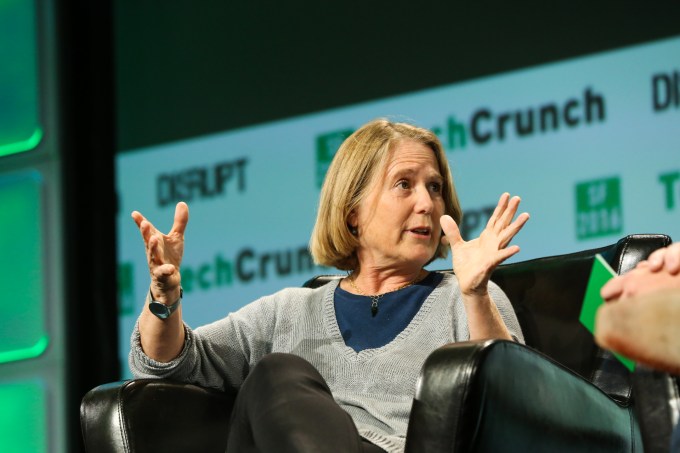
Diane Greene announced in a blog post today that she would be stepping down as CEO of Google Cloud and will be helping transition former Oracle executive Thomas Kurian to take over early next year.

Greene took over the position almost exactly three years ago when Google bought Bebop, the startup she was running. The thinking at the time was that the company needed someone with a strong enterprise background and Greene, who helped launch VMware, certainly had the enterprise credentials they were looking for.

In the blog post announcing the transition, she trumpeted her accomplishments. “The Google Cloud team has accomplished amazing things over the last three years, and I’m proud to have been a part of this transformative work. We have moved Google Cloud from having only two significant customers and a collection of startups to having major Fortune 1000 enterprises betting their future on Google Cloud, something we should accept as a great compliment as well as a huge responsibility,” she wrote.

The company had a disparate set of cloud services when she took over, and one of the first things Greene did was to put them all under a single Google Cloud umbrella. “We’ve built a strong business together — set up by integrating sales, marketing, Google Cloud Platform (GCP), and Google Apps/G Suite into what is now called Google Cloud,” she wrote in the blog post.

As for Kurian, he stepped down as president of product development at Oracle at the end of September. He had announced a leave of absence earlier in the month before making the exit permanent.  Like Greene before him, he brings a level of enterprise street cred, which the company needs as it continues to try and grow its cloud business.

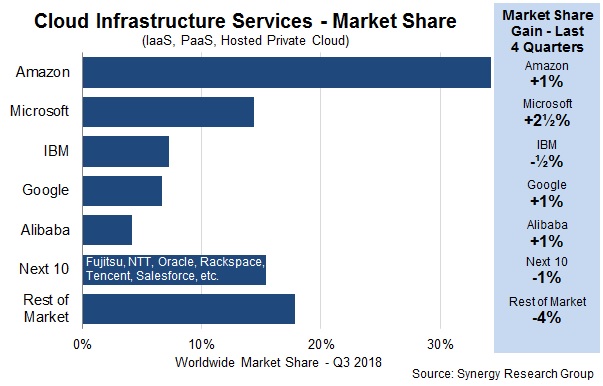
After three years with Greene at the helm, Google, which has tried to position itself as the more open cloud alternative to Microsoft and Amazon, has still struggled to gain market share against its competitors, remaining under 10 percent consistently throughout Greene’s tenure.

As Synergy’s John Dinsdale told TechCrunch in an article on Google Cloud’s strategy in 2017, the company had not been particularly strong in the enterprise to that point. “The issues of course are around it being late to market and the perception that Google isn’t strong in the enterprise. Until recently Google never gave the impression (through words or deeds) that cloud services were really important to it. It is now trying to make up for lost ground, but AWS and Microsoft are streets ahead,” Dinsdale explained at the time. Greene was trying hard to change that perception.

Google has not released many revenue numbers related to the cloud, but in February it indicated they were earning a billion a quarter, a number that Greene felt the $4 billion run rate put Google in elite company. Amazon and Google were reporting numbers like that for a quarter at the time. Google stopped reporting cloud revenue after that report.

Regardless, the company will turn to Kurian to continue growing those numbers now. “I will continue as CEO through January, working with Thomas to ensure a smooth transition. I will remain a Director on the Alphabet board,” Greene wrote in her blog post.

Interesting enough Oracle has struggled with its own transition to the cloud. Kurian gets a company that was born in the cloud, rather than one that has made a transition from on-prem software and hardware to one solely in the cloud. It will be up to him to steer Google Cloud moving forward.

16 Nov 2018

Weather Up’s app can give you forecasts for your calendar events

There are plenty of weather apps to choose from on the App Store, but the newly released Weather Up app is doing something different. Instead of just offering the daily weather, it will now offer Event Forecasts — meaning forecasts that sync with your calendars so you can see what the weather will be for your upcoming appointments and various events.

The feature is customizable, so you don’t have to use it with all your calendars — or even all your events. You can opt to tag specific events in order to show the weather forecast for just those.

Event Forecasts is useful for planning your outdoor activities like the kids’ soccer games, outdoor concerts and more, but also for planning for events you’ll walk to or drive to.

The app itself is not new. It actually began its life last year as Weather Atlas, from LauncherPro developer David Barnard. He admits the first version app struggled with retention, so he’s now overhauled it from a usability perspective, based on user feedback and testing.

The revamped app — basically the 2.0 release of Weather Atlas — is now rebranded as Weather Up, as a result of these and other changes, which also includes a new set of cute app icons.

“Apps that don’t take off are often abandoned, but the weather category is just so interesting to me I’m going to keep pushing until I carve out a decent niche. And I think Weather Up is a great step in the right direction,” says Barnard.

He says a lot of time was spent on making the app feel more intuitive — especially in terms of its gestural interface. The new design makes use of the extra vertical space on X-series iPhones and makes most of its buttons and gestures easily accessible from the lower portion of the screen, he says.

Another interesting thing he’s trying in the new app is an in-app Merch Store, which is certainly a first for a weather application — or productivity apps in general, for the most part.

To help with monetization, the store will sell things like shirts, mugs, bags, hats and more emblazoned with the new icons — which Barnard recently showed off on Twitter.

The store is also available on the developer’s website.

The app’s core feature set, of course, is its weather forecasts. In addition to temperature, it also shows humidity and precipitation accumulation, and warns about weather events like thunderstorms, tornadoes, hurricanes and tropical tracks.

As an indie developer, Barnard hopes people will choose his app over others because he vows not to sell user data or even location data to advertisers — even though that would be more profitable, he says.

Weather Up is a free download on the App Store, with a pro feature set available for $9.99/year or $1.99/month.

16 Nov 2018

Airbnb made more than $1 billion in revenue last quarter

Ahead of Airbnb’s expected initial public offering next year, the home-sharing startup announced more than $1 billion in revenue during Q3 2018.

Airbnb says this was its strongest quarter to date, where it saw “substantially more” than $1 billion in revenue.

Airbnb, however, has been without a permanent chief financial officer since February, when Laurence Tosi left the company amid tension between him and Airbnb CEO Brian Chesky. Since then, Airbnb Head of Financial Planning and Analysis Ellie Mertz has been serving as the interim CFO.

According to CNBC, Airbnb is on track to be profitable for the second year in a row on an EBITDA basis.

“Airbnb’s mission is to create a world where anyone can belong anywhere and we will continue to offer updates regarding our work in the weeks and months to come,” Airbnb wrote in a memo today.

16 Nov 2018

UN warns over human rights impact of a ‘digital welfare state’

The UN special rapporteur on extreme poverty and human rights has raised concerns about the UK’s rush to apply digital technologies and data tools to socially re-engineer the delivery of public services at scale, warning in a statement today that the impact of a digital welfare state on vulnerable people will be “immense”.

He has also called for stronger laws and enforcement of a rights-based legal framework to ensure that the use of technologies like AI for public service provision does not end up harming people.

“There are few places in government where these developments are more tangible than in the benefit system,” writes professor Philip Alston. “We are witnessing the gradual disappearance of the postwar British welfare state behind a webpage and an algorithm. In its place, a digital welfare state is emerging. The impact on the human rights of the most vulnerable in the UK will be immense.”

It’s a timely intervention, with UK ministers also now pushing to accelerate the use of digital technologies to transform the country’s free-at-the-point-of-use healthcare system.

Alston’s statement also warns that the push towards automating public service delivery — including through increasing use of AI technologies — is worryingly opaque.

“A major issue with the development of new technologies by the UK government is a lack of transparency. The existence, purpose and basic functioning of these automated government systems remains a mystery in many cases, fuelling misconceptions and anxiety about them,” he writes, adding: “Evidence shows that the human rights of the poorest and most vulnerable are especially at risk in such contexts.”

So, much like tech giants in their unseemly disruptive rush, UK government departments are presenting shiny new systems as sealed boxes — and that’s also a blocker to accountability.

“Central and local government departments typically claim that revealing more information on automation projects would prejudice its commercial interests or those of the IT consultancies it contracts to, would breach intellectual property protections, or would allow individuals to ‘game the system’,” writes Alston. “But it is clear that more public knowledge about the development and operation of automated systems is necessary.”

Radical social re-engineering

He argues that the “rubric of austerity” framing of domestic policies put in place since 2010 is misleading — saying the government’s intent, using the trigger of the global financial crisis, has rather been to transform society via a digital takeover of state service provision.

Or, at he puts it: “In the area of poverty-related policy, the evidence points to the conclusion that the driving force has not been economic but rather a commitment to achieving radical social re-engineering.”

Alston’s assessment follows a two week visit to the UK during which he spoke to people across British society, touring public service and community provided institutions such as job centers and food banks; meeting with ministers and officials across all levels of government, as well as opposition politicians; and talking to representatives from civil society institutions, including front line workers.

His statement discusses in detail the much criticized overhaul of the UK’s benefits system, in which the government has sought to combine multiple benefits into a single so-called Universal Credit, zooming in on the “highly controversial” use of “digital-by-default” service provision here — and wondering why “some of the most vulnerable and those with poor digital literacy had to go first in what amounts to a nationwide digital experiment”.

“Universal Credit has built a digital barrier that effectively obstructs many individuals’ access to their entitlements,” he warns, pointing to big gaps in digital skills and literacy for those on low incomes and also detailing how civil society has been forced into a lifeline support role — despite its own austerity-enforced budget constraints.

“The reality is that digital assistance has been outsourced to public libraries and civil society organizations,” he writes, suggesting that for the most vulnerable in society, a shiny digital portal is operating more like a firewall.

“Public libraries are on the frontline of helping the digitally excluded and digitally illiterate who wish to claim their right to Universal Credit,” he notes. “While library budgets have been severely cut across the country, they still have to deal with an influx of Universal Credit claimants who arrive at the library, often in a panic, to get help claiming benefits online.”

Alston also suggests that digital-by-default is — in practice — “much closer to digital only”, with alternative contact routes, such as a telephone helpline, being actively discouraged by government — leading to “long waiting times” and frustrating interactions with “often poorly trained” staff.

Human cost of automated errors

His assessment highlights how automation can deliver errors at scale too — saying he was told by various experts and civil society organizations of problems with the Real Time Information (RTI) system that underpins Universal Credit.

The RTI is supposed to takes data on earnings submitted by employers to one government department (HMRC) and share it with DWP to automatically calculate monthly benefits. But if incorrect (or late) earnings data is passed there’s a knock on impact on the payout — with Alston saying government has chosen to give the automated system the “benefit of the doubt” over and above the claimant.

Yet here a ‘computer says no’ response can literally mean a vulnerable person not having enough money to eat or properly heat their house that month.

“According to DWP, a team of 50 civil servants work full-time on dealing with the 2% of the millions of monthly transactions that are incorrect,” he writes. “Because the default position of DWP is to give the automated system the benefit of the doubt, claimants often have to wait for weeks to get paid the proper amount, even when they have written proof that the system was wrong. An old-fashioned pay slip is deemed irrelevant when the information on the computer is different.”

Another automated characteristic of the benefits system he discusses segments claimants into low, medium and high risk — in contexts such as ‘Risk-based verification’.

This is also problematic as Alston points out that people flagged as ‘higher risk’ are being subject to “more intense scrutiny and investigation, often without even being aware of this fact”.

“The presumption of innocence is turned on its head when everyone applying for a benefit is screened for potential wrongdoing in a system of total surveillance,” he warns. “And in the absence of transparency about the existence and workings of automated systems, the rights to contest an adverse decision, and to seek a meaningful remedy, are illusory.”

Summing up his concerns he argues that for automation to have positive political — and democratic — outcomes it must be accompanied by adequate levels of transparency so that systems can be properly assessed.

Rule of law, not ‘ethics-washing’

“There is nothing inherent in Artificial Intelligence and other technologies that enable automation that threatens human rights and the rule of law. The reality is that governments simply seek to operationalize their political preferences through technology; the outcomes may be good or bad. But without more transparency about the development and use of automated systems, it is impossible to make such an assessment. And by excluding citizens from decision-making in this area we may set the stage for a future based on an artificial democracy,” he writes.

“Transparency about the existence, purpose, and use of new technologies in government and participation of the public in these debates will go a long way toward demystifying technology and clarifying distributive impacts. New technologies certainly have great potential to do good. But more knowledge may also lead to more realism about the limits of technology. A machine learning system may be able to beat a human at chess, but it may be less adept at solving complicated social ills such as poverty.”

His statement also raises concerns about new institutions that are currently being set up by the UK government in the area of big data and AI, which are intended to guide and steer developments — but which he notes “focus heavily on ethics”.

“While their establishment is certainly a positive development, we should not lose sight of the limits of an ethics frame,” he warns. “Ethical concepts such as fairness are without agreed upon definitions, unlike human rights which are law. Government use of automation, with its potential to severely restrict the rights of individuals, needs to be bound by the rule of law and not just an ethical code.”

Calling for existing laws to be strengthened to properly regulate the use of digital technologies in the public sector, Alston also raises an additional worry — warning over a rights carve out the government baked into updated privacy laws for public sector data (a concern we flagged at the start of this year).

On this he notes: “While the EU General Data Protection Regulation includes promising provisions related to automated decision-making 37 and Data Protection Impact Assessments, it is worrying that the Data Protection Act 2018 creates a quite significant loophole to the GDPR for government data use and sharing in the context of the Framework for Data Processing by Government.”


16 Nov 2018

CodeStream lets you collaborate and talk directly in VS Code

Adding comments to your code is nothing new. But what if you could @-mention your coworkers and start a thread about a specific part of your code? Meet CodeStream, a Y Combinator-backed startup that wants to do just that.

The best way to discuss some content is right next to the content itself. That’s why Google Docs annotations, PowerPoint comments and Word revisions are so useful. Slack shouldn’t be the home to all discussions.

And yet, collaboration between two developers too often start with a private conversation on Slack. CodeStream doesn’t want to replace git commits or native comments in your code. But it adds a useful conversation layer on top of your code.

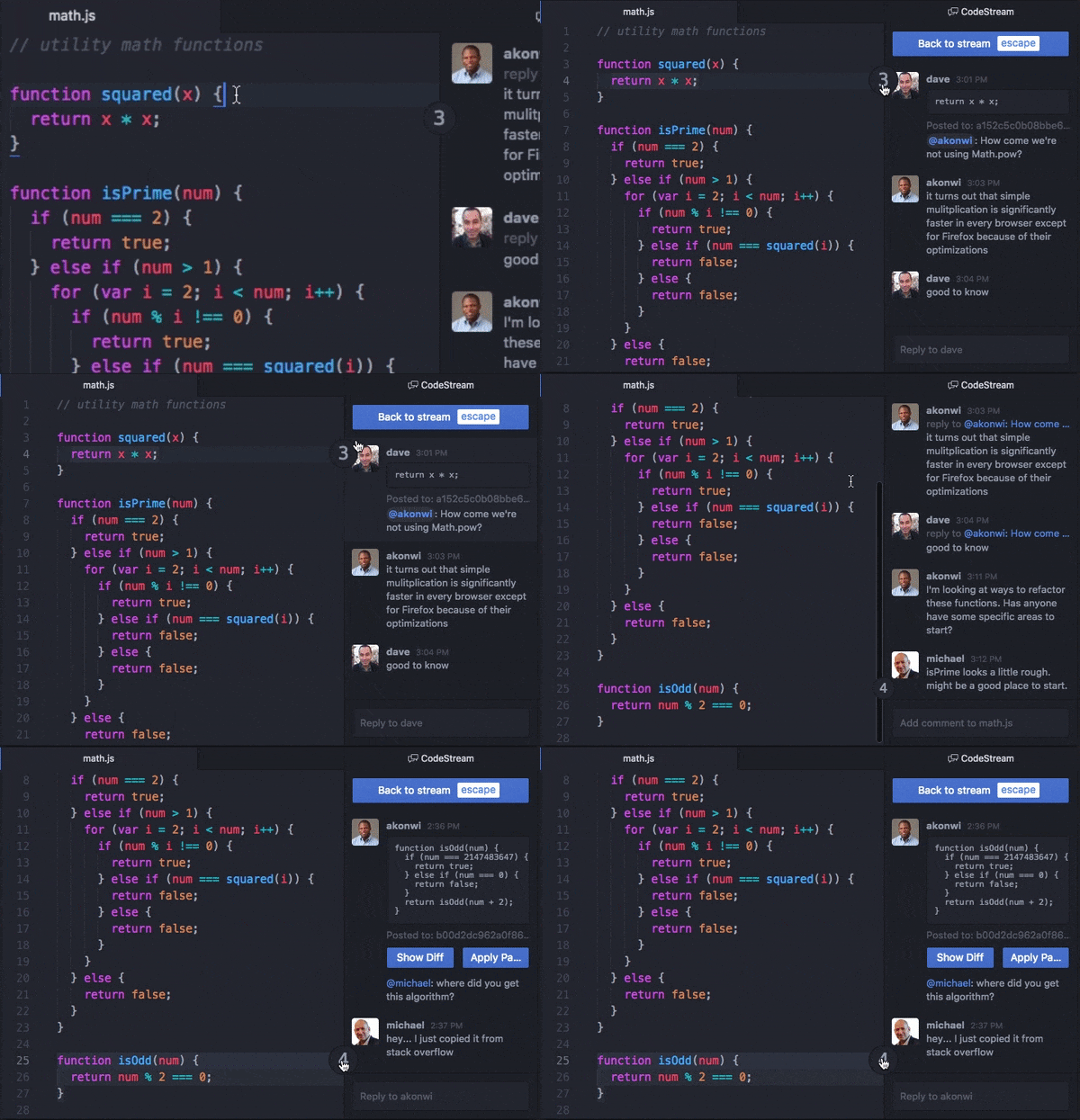
If you want to involve someone else, you first select a text and start a discussion. It creates a thread with your coding block as the original post. If you link CodeStream with your Slack instance, it starts a thread in the right Slack channel. You can @-mention someone, copy and paste a few lines of code and more.

If a developer gets mentioned, they can click on the thread and CodeStream opens up the right file at the right line. Even if two developers aren’t on the same branch, they’ll both be looking at the same line of code — even if there’s some new code in one of the branch.

Months later, if your code base evolved, your conversation threads will still be there. At any time, you can look at past conversations and understand why something has been done this way.

Right now, CodeStream supports VS Code. After installing CodeStream, you can split up your IDE in two columns with your main coding window on the left and CodeStream threads on the right.

In the future, the company plans to add support for more IDEs, such as Visual Studio, JetBrains editors and Atom. CodeStream is still in beta so it’s free for now.

The company recently raised a $3.2 million funding round from S28 Capital with PJC also participating. Additional investors include Y Combinator, Steve Sordello, Mark Stein and David Carlick.

16 Nov 2018

MailChimp teams up with Square to launch shoppable landing pages

MailChimp, the popular email newsletter service and marketing platform, today announced a partnership with Square that will allow its users to create landing pages with built-in e-commerce features. These shoppable landing pages are meant to give businesses a new sales channel to sell things like limited edition good or run targeted promotions.

MailChimp’s landing pages have been around for a few years now. Until now, though, they were mostly meant to capture additional email addresses or link people to a store. Now, with this new partnership, customers will be able to build a full shopping flow with built-in payments right into these pages.

To make this easier, MailChimp is offering a number of pre-designed templates and a drag-and-drop builder. Square will handle all the payments and MailChimp will offer this service for a flat processing rate.

[gallery ids="1747791,1747792,1747810"]

Right now, this only works for a single product per landing page, though. That means there’s no shopping cart functionality but also makes for an easy setup. That’s why the company is currently marketing this as a feature for limited edition items, for example. Over time, though, the company plans to add additional functionality to these pages.

MailChimp tells me that 50 percent of its revenue now comes from e-commerce. In total, its customers sold over $22 billion worth of products in the first half of 2018 alone.

It’s worth noting that went through a rebranding exercise earlier this year that was explicitly meant to highlight its feature set outside of its core email services. Today’s new shoppable landing pages are a good example for the kind of new features the company was surely thinking about when it went through this process.

16 Nov 2018

Facebook Messenger is building a “Watch Videos Together” feature

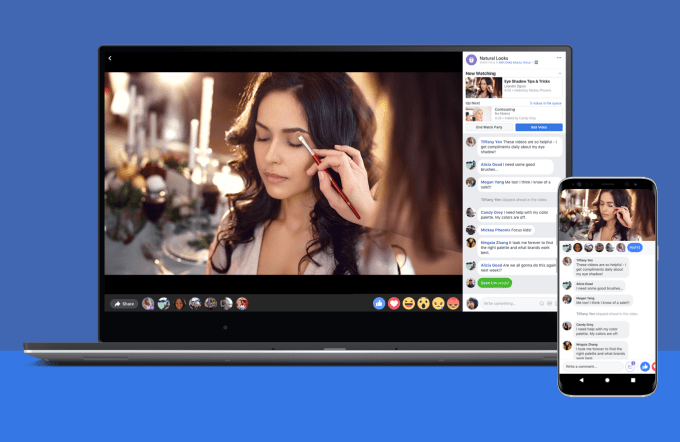
Netflix and chill from afar? Facebook Messenger is now internally testing simultaneous co-viewing of videos. That means you and your favorite people could watch a synchronized video over group chat on your respective devices while discussing or joking about it. This “Watch Videos Together” feature could make you spend more time on Facebook Messenger while creating shared experiences that are more meaningful and positive for well-being than passively zombie-viewing videos solo. This new approach to Facebook’s Watch Party feature might feel more natural as part of messaging than through a feed, Groups, or Events post.

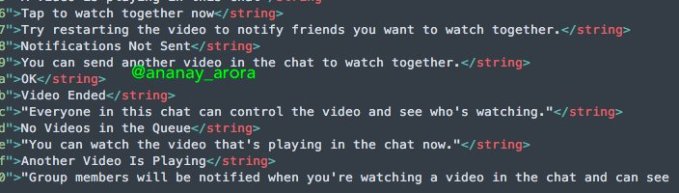
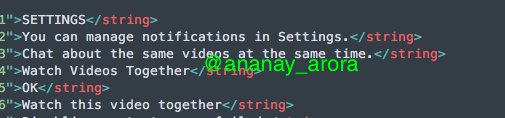
The feature was first spotted in Messenger’s codebase by Ananay Arora, the founder of deadline management app Timebound as well as a mobile investigator in the style of frequent TechCrunch tipster Jane Manchun Wong. The code he discovered describes Messenger allowing you to “tap to watch together now” and “chat about the same videos at the same time” with chat thread members receiving a notification that a co-viewing is starting. “Everyone in this chat can control the video and see who’s watching” the code explains.

A Facebook spokesperson confirmed to TechCrunch that this is an “internal test” and that it doesn’t have any more to share right now. But other features originally discovered in Messenger’s code like contact syncing with Instagram have eventually received official launches.

Watch Party exists on Facebook but could be more popular as a chat feature

A fascinating question this co-viewing feature brings up is where users will find videos to watch. It might just let you punch in a URL from Facebook or share a video from there to Messenger. The app could put a new video browsing option into the message composer or Discover tab.  Or if it really wanted to get serious about chat-based co-viewing, Facebook could allow the feature to work with video partners, ideally YouTube.

Co-viewing of videos could also introduce a new revenue opportunity for Messenger. It might suggest sponsored videos, such as recent movie trailers. Or it could simply serve video ads between a queue of videos lined up for co-viewing. Facebook has recently been putting more pressure on its subsidiaries like Messenger and Instagram to monetize as News Feed ad revenue growth slows down due to plateauing users growth and limited News Feed ad space.

Other apps like YouTube’s Uptime (since shut down), and Facebook’s first president Sean Parker’s Airtime (never took off) have tried and failed to make co-watching a popular habit. The problem is that coordinating these synced-up experiences with friends can be troublesome. By baking simultaneous video viewing directing into Messenger, Facebook could make it as seamless as sharing a link.

16 Nov 2018

Uber’s financials, Qualtric’s $8B exit and what’s going on at WeWork

Hello and welcome back to Equity, TechCrunch’s venture capital-focused podcast, where we unpack the numbers behind the headlines.

This week we had the excellent Connie Loizos on the air, we had Danny Crichton on the horn from New York, I was in the studio mostly hacking up one lung or the other, and we had Matt Howard of Norwest Venture Partners.

And so, with smoke in the Bay and snow in the Big Apple, we dug into what we love. Namely, dollars.

Uber was first in line due to the scale of its results. The firm disclosed its third-quarter results including slowing growth (in percentage terms), steep losses on a GAAP basis (GAAP means that all costs were counted) and adjusted losses that fell in the period.

So, a mixed bag. I found it to be somewhat negative (more of my view here); our guest was more bullish. Feel free to write in and let us know who you think is right.

Next up was the big deal of the week, effectively. The Qualtrics exit to SAP for $8 billion in cash, a portion of which it borrowed, as we point out. The deal meant that the company didn’t actually go public (boo), but it still made a hell of a splash all the same.

I chatted with the CEOs of SAP and Qualtrics, and have the notes here if that’s useful.

Finally, we riffed on the latest WeWork numbers which include a $3 billion warrant, and a massive third-quarter loss. WeWork lost more money in the quarter than it generated in revenue. That is, as they say, not great.

Many companies lose money while growing and work out great! But for every Facebook, there are a few Snaps, and I can’t tell which side of the coin WeWork lands.

Oh, and this Instacart story happened. What’s up with that?

Equity drops every Friday at 6:00 am PT, so subscribe to us on Apple PodcastsOvercast, Pocket Casts, Downcast and all the casts.

16 Nov 2018

Popular Chinese selfie app Meitu now includes 3D editing

You’ve probably had the experience of posing awkwardly for a photo while everyone else looks great. Now China’s top photo-editing firm Meitu has a solution that helps you resist the urge to trash that photo.

Meitu’s namesake app, which claims over 100 million monthly active users as of August, recently launched a feature that lets users virtually rotate their faces up, down, to the left, or to the right. There’s already a plethora of editing apps out there that allows people to polish their shots like a pro, but Meitu wants to take retouching to another level.

“Traditional image processing technology can only perform plane stretching in two dimensions, and the image has no depth information and therefore is unable to truly reflect the changes in the posture of real life,” says a spokesperson for the company.

The feature, called “3D Reshape,” takes hints from a static portrait and applies face recognition and reconstruction technologies to generate 3D information of the user’s face. In other words, it simulates how the user’s head tilts or rotates in real life, yielding results that the firm claims are more “natural” and “realistic”.

meitu

The process is a bit eerie, but the result looks satisfying. / Credit: Meitu

The feature also works for group photos, so users can choose to fix a particular person’s unflattering pose. The Chinese company isn’t the only photo app that’s come up with 3D editing. Google’s Snapseed has a similar offer.

Meitu goes all out to perfect portraits by maintaining an in-house R&D team of 200 staff. For the 3D project, the researchers collected 18 unique facial expressions from 1,200 people who were primarily Chinese and aged between 12 and 60.

Despite being a dominator in its space, Meitu has had to look beyond photo editing for monetization since its early days. For the six months ended June 30, the firm generated 72 percent of its revenues from selling smartphones designed to take outstanding selfies, while internet-related services brought in the rest of the money.

Nonetheless, Meitu has seen its hardware revenues drop as smartphone shipments slow in China and competition heats up. By contrast, internet-based revenues jumped 132 percent year-over-year thanks to growth in advertising and “value-added” services. The latter stands for virtual items sales on Meitu’s video streaming app Meipai.

Meitu’s trove of users may have other practical use. In July, the firm shelled out $30 million for an undisclosed stake in Gengmei, a social media platform that connects customers with plastic surgeons who offer them advice. It’s not hard to imagine a future where Meitu links its beauty-seeking users to not only virtual tools but also long-lasting, real-life means.

16 Nov 2018

BlackBerry is buying Cylance for $1.4 billion to continue its push into cybersecurity

BlackBerry was best known for keyboard-totting smartphones, but their demise in recent years has seen the Canadia firm pivot towards enterprise services and in particular cybersecurity. That strategy takes a big step further forward today after BlackBerry announced the acquisition of AI-based cybersecurity company Cylance for a cool $1.4 billion.

Business Insider reported that a deal was close last week, and that has proven true with BlackBerry paying the full amount in cash up front. The deal is set to close before February 2019 — the end of BlackBerry’s current financial year — and it will see Cylance operate as a separate business unit within BlackBerry’s business.

Business Insider’s report suggested Cylance was preparing to go public until BlackBerry swooped in. That suggests BlackBerry wanted Cylance pretty badly, badly enough to part with a large chunk of the $2.4 billion cash pile that it was sitting on prior to today.

Cylance was founded in 2015 by former McAfee/Intel duo Stuart McClure (CEO) and Ryan Permeh (chief scientist) and it differentiates itself by using artificial intelligence, machine learning and more to proactively analyze and detect threats for its customers, which it said include Fortune 100 organizations and governments.

The company has raised nearly $300 million to date from investors that include Blackstone, DFJ, Khosla Ventures, Dell Technologies and KKR. Cylance is headquartered in Irvine, California, with global offices in Ireland, the Netherlands and Japan.

“Cylance’s leadership in artificial intelligence and cybersecurity will immediately complement our entire portfolio, UEM and QNX in particular. We are very excited to onboard their team and leverage our newly combined expertise. We believe adding Cylance’s capabilities to our trusted advantages in privacy, secure mobility, and embedded systems will make BlackBerry Spark indispensable to realizing the Enterprise of Things,” said BlackBerry CEO John Chen in a statement.

Chen has overseen BlackBerry’s move into enterprise services since his arrival in 2013 as part of a takeover by financial holdings firm Fairfax. Initially, things got off to a rocky start but the strategy has borne fruit. The stock price was $6.51 when Chen joined, it closed Thursday at $8.86 down from a peak of $12.66 in January. While some of the progress has been erased this year, Chen has signed on to retain the top role at BlackBerry until at least 2023, giving him a potential 10-year tenure with the company that was once the world’s number one mobile brand.