Year: 2018

15 Nov 2018

Facebook will pass off content policy appeals to a new independent oversight body

Facebook doesn’t want to be the arbiter of decency when it comes to content policy decisions, similar to how it looked to third-party fact checkers rather than becoming an arbiter of truth. Today on a press call with journalists, Mark Zuckerberg announced that a new external oversight committee would be created in 2019 to handle some of Facebook’s content policy decisions. The body will take appeals and make final decisions. The hope is that beyond the influence of Facebook’s business imperatives or the public’s skepticism about the company’s internal choices, the oversight body can come to the proper conclusions about how to handle false information, calls to violence, hate speech, harassment, and other problems that flow through Facebook’s user generate content network.

“I believe the world is better off when more people have avoice to share their experiences . . . at the same time we have a responsibility to keep people safe” Zuckerberg said. “When you connect 2 billion people, you’re going to see all the good and bad of humanity. Different cultures have different norms, not only about what content is okay, but also about who should be making those decisions in the first place.” He cites how use of a racial slur could be hatespeech or condemning hate speech as the kind of decision Facebook could use help with.

Zuckerberg explained that over the past year he’s come to believe that so much power over free expression should not be concentrated solely in Facebook’s hands. That echoes his sentiment from an interview with Ezra Klein earlier this year when he suggested Facebook may need a “supreme court” to decide on controversial issues. Zuckerberg says he sees Facebook’s role as more akin to how a government is expected to reduce crime but not necessarily eliminate it entirely. “Our goal is to err on the side of giving people a voice while preventing real world harm” he writes. “These are not problems you fix, but issues where you continually improve.”

How The Independent Appeals Body Will Work

Zuckerberg describes that when someone initially reports content, Facebook’s systems will do the first level of review. If a person wants an appeal, Facebook will also handle this second level of review and scale up its systems to handle a lot of cases. Then he says “The basic approach is going to be if you’re not happy after getting your appeal answered, you can trey to appeal to this broader body. It’s probably not going to review every case like some of the higher courts . . . it might be able to choose which cases it thinks are incredibly important to look at. It will certainly need to be transparent about how it’s making those decisions.

Zuckerberg said Facebook will be working to get the oversight body up and running over the next year. For now, there are plenty of unanswered questions about who will be on the committee, which of the many appeals it will review, and what ensures it’s truly independent from Facebook’s power. “One of the biggest questions we need to figure out in the next year is how to do the selection process for this this body so that it’s independent . . . while giving people a voice . . . and keeping people safe. If the group ends up too tightly decided by facebook it won’t feel like it’s independent enough.” Facebook plans to query experts and start running pilots of the next year to determine what approaches to codify.

Facebook launched an internal appeals system this year that let users request a second review when their content is taken now, and Facebook plans to expand that to allow people to appeal responses when they report other people’s content. But the new independent body will serve as the final level of escalation for appeals

[Update: Since we published this report, Zuckerberg has released a 5000-word letter describing his thoughts on Facebook policy, and the oversight body. You can read it below:]

Posted by Mark Zuckerberg on Thursday, November 15, 2018

Here’s the passage about the oversight committee:

In the next year, we’re planning to create a new way for people to appeal content decisions to an independent body, whose decisions would be transparent and binding. The purpose of this body would be to uphold the principle of giving people a voice while also recognizing the reality of keeping people safe.

I believe independence is important for a few reasons. First, it will prevent the concentration of too much decision-making within our teams. Second, it will create accountability and oversight. Third, it will provide assurance that these decisions are made in the best interests of our community and not for commercial reasons. 

This is an incredibly important undertaking — and we’re still in the early stages of defining how this will work in practice. Starting today, we’re beginning a consultation period to address the hardest questions, such as: how are members of the body selected? How do we ensure their independence from Facebook, but also their commitment to the principles they must uphold? How do people petition this body? How does the body pick which cases to hear from potentially millions of requests? As part of this consultation period, we will begin piloting these ideas in different regions of the world in the first half of 2019, with the aim of establishing this independent body by the end of the year.

Over time, I believe this body will play an important role in our overall governance. Just as our board of directors is accountable to our shareholders, this body would be focused only on our community. Both are important, and I believe will help us serve everyone better over the long term.

Avoiding Or Acknowledging The Weight Of Its Decisions?

The past year has seen Facebook criticized for how it handled calls for violence in Myanmar, harassment and fake news by conspiracy theorists like Alex Jones, election interference by Russian, Iranian, and other state actors, and more. Most recently, the New York Times published a scathing report about how Facebook tried to distract from or deflect criticism of its myriad problems, including its failure to prevent election interference ahead of the 2016 Presidential race.

The oversight committee could both help Facebook make smarter decisions that the world can agree with, and give Facebook a stronger defense to this criticism because it’s not the one making the final policy calls. The approach could be seen as Facebook shirking its responsibility, or as it understanding that the gravity of that responsibility exceeds its own capabilities.

[Update: We’ve updated this story with information from Zuckerberg’s Blueprint letter.]

15 Nov 2018

OpenStack regroups

Only a few years ago, OpenStack was the hottest open-source project around, with a bustling startup ecosystem to boot. The project, which gives enterprises the tools to run the equivalent of AWS in their own private data centers, ran into trouble as it tried to tackle too many individual projects at the same time and enterprises took longer than expected to adopt it. That meant many a startup floundered or was acquired before it was able to gain traction while the nonprofit foundation that manages the project started to scale back its big tent approach and refocused on its core services.

The height of the OpenStack hype was around late 2014, where even small startups used their copious venture funding to host lavish parties at the project’s conferences. But by 2016, it was deep in the trough of disillusionment as a number of major backers like HPE, Cisco and IBM started to sell off their OpenStack assets or reduce their involvement in the project, and some of the startups in the ecosystem called it quits. But something interesting happened after that. The OpenStack project moved along, fixed many of its problems and adapted to a changing world where everybody wants to talk about containers and edge computing.

Today, it’s a stable system that’s the de facto standard for running private clouds. There’s very little hype, but now there’s lots of actual usage. Only a few years ago, there was plenty of hype, but you would’ve been hard pressed to find any major company that ran a significant OpenStack deployment in production. People who made an early bet on OpenStack and seemed miserable a year ago now have a bit of bounce in their step again. And lately, I’ve heard from a number of vendors, including the likes of Suse, that tell me they make more money from OpenStack now than at any time during the hype phase. Indeed, according to the Foundation’s latest stats, OpenStack users now use the system to manage well over 10 million cores of compute power.

“There is a perception versus reality thing,” OpenStack Foundation CTO Mark Collier told me. “We’re past the peak of the hype cycle for this particular technology in people’s minds. And so there’s this interesting paradox which is that adoption tends to go up as hype goes down.”

Stable systems are boring, though, and so it’s maybe no surprise that the OpenStack Foundation decided that it’s time to redirect some of its community’s energy to tackle some new problems, all with a focus on open source infrastructure problems, but without the requirement that they are tied directly to the actual OpenStack project. That’s a move that started more than a year ago and that’s now starting to take concrete form.

At the OpenStack Summit in Berlin this week, the OpenStack Foundation announced that this would be the last of its bi-annual conferences under this name. Going forward, it’ll be the Open Infrastructure Summit. For some, that was surely a major surprise — though the Foundation had been laying the groundwork for this for a while now. Don’t expect the Foundation itself to change its name, though. Just like the Linux Foundation is keeping its name even though it now helps manage a plethora of other foundations, the OpenStack Foundation isn’t about to spend a lot of money and energy rebranding.

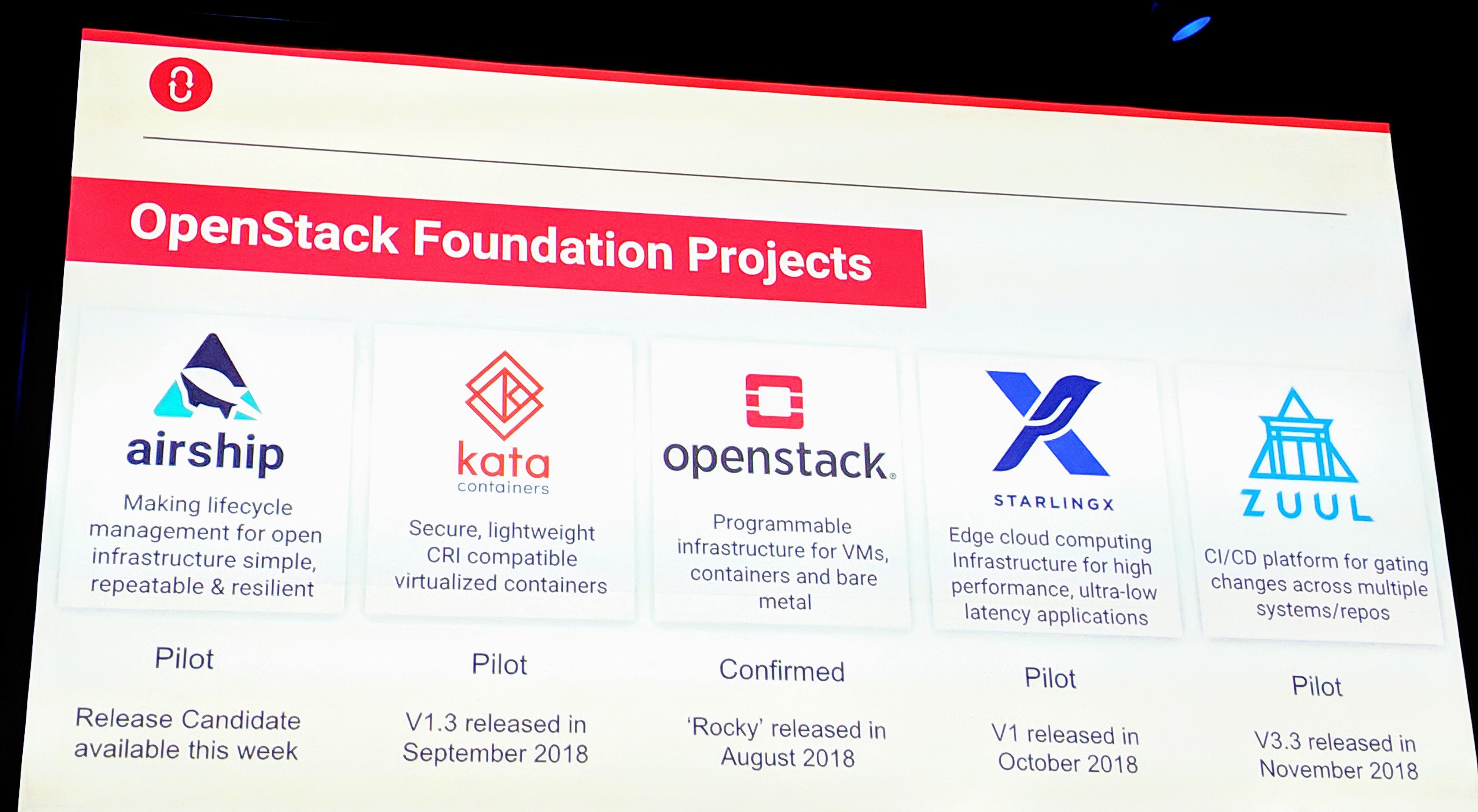
What is changing, though, is the nature of what the Foundation is doing. A board meeting earlier the week made official the Foundation’s process for adopting new projects outside of the core OpenStack project. There’s now a process for adding so-called “pilot projects” and fostering them for a minimum of 18 months. With this, the Foundation is also making it clear that its focus for these projects will be on continuous integration and continuous delivery (CI/CD), container infrastructure, edge computing, data center and artificial intelligence and machine learning. There are currently four of these pilot projects: AirshipKata ContainersStarlingX and Zuul.

None of these projects are new — and all of them are in different stages of development — but it’s a start for OpenStack to spread its wings. The idea here is not to manage dozens of projects, though — or to increase the Foundation’s revenue by setting up new foundations inside the current framework. “We’re not trying to have dozens of projects,” OpenStack’s VP of marketing and community services Lauren Sell explained. “It’s really this tighter, more focused scope around people who run or manage infrastructure.” There’s also no additional bureaucracy — at least for the time being. “We have not created new boards of directors or foundations for each project,” Collier added. “We’re also not trying to house a huge amount of projects. We have a specific form of open collaboration that we feel has really proven it works with OpenStack. And a few people started coming to us going: we’d like to use that same model.”

The Foundation members are the first to acknowledge that there are still details that need to be worked out — and that will take a while.

At the same time, though, OpenStack — the actual technology — isn’t going anywhere, and will remain core to the Foundation’s efforts. “We said very clearly this week that open infrastructure starts with OpenStack, so it’s not separate from it. OpenStack is the anchor tenant of the whole concept,” Collier said. “The core OpenStack community is really thinking about how OpenStack is deployed and it’s always deployed with other technologies and some of these can now be more easily collaborated with and integrated with because they’re happening at the same events.” Sell echoed this. “We’re not moving away from OpenStack,” she told me. “This is not separate from OpenStack. All that we are doing is actually meant to make OpenStack better.”

Canonical founder Mark Shuttleworth has a slightly different opinion about the current direction of the Foundation, though. He seems to be worried that the focus on multiple projects will take away from the core OpenStack project. “OpenStack suffered when there wasn’t clarity about the mission,” he said. “And I hope that in broadening the scope of what they as the Foundation want to worry about won’t confuse people about OpenStack.” Today, he believes, OpenStack is in a good spot because it delivers on a specific set of promises. “I would really like to see the Foundation employ the key contributors to OpenStack so that the heart of OpenStack had long-term stability that wasn’t subject to a popularity contest every six months,” he added.

There can be no doubt that today, a number of companies are back to doubling down on OpenStack as their core focus. Mirantis, for example, was one of the earliest and best-known (and well-funded) backers of the project. A year ago, it looked like the company was going to switch its focus to application delivery and away from infrastructure. Today, it’s still building out that side of its business, but as co-founders Adrian Ionel and Boris Renski told me, the OpenStack side of its business is growing, with both new customers coming on board and existing customers like Adobe and Apple expanding their deployments. “Something changed,” Renski. He attributed that change to the Foundation’s focus on edge computing. “I think as the edge is becoming more relevant and more of a real thing, it’s actually possible to productize OpenStack much better.”

Interestingly, much of the interest in OpenStack today is in China. The U.S. market for OpenStack, on the other hand, is still growing, but at a far slower pace. Collier attributed the success in China to the fact that the country has massive infrastructure need and that it has embraced open source. “If you have those two criteria, you’re going to run OpenStack like crazy,” he said. “What else are you going to run?” He did add, though, that the Chinese government has also gotten involved in evangelizing technology standards and that many a group in the government has identified OpenStack as one of those.

While OpenStack feels like it’s back on track, though, this move to broaden the Foundation’s scope also sets it up for some competition with the Linux Foundation, and especially the Cloud Native Computing Foundation, which it manages. A number of pundits at the event were surprised that Ceph, an open-source storage service that’s at the core of many major OpenStack deployments, as well as container-based platforms, formed its own foundation under the Linux Foundation earlier this week.

Sell and Collier don’t see it that way, though. “I think it’s a strong statement that [the Ceph Foundation] had a really successful event here and made the announcement from here,” Sell said. “I think that shows that some of these foundation lines and where projects live is not as significant as you may think it is.”

“I think that what matters to us is that the people from the Ceph community feel welcome here,” Collier added. “And all we really want to do is have the people collaborate and have the technology work together. Where the actual pieces of software that are put together ultimately live in terms of foundations, it’s not that important.”

He also noted that he never saw a user who cared whether a project lived in the Apache Foundation or the Linux Foundation, for example. What matters instead is the community around a project. He did acknowledge, though, that the foundations that manage projects obviously matter — and that this is important enough that the OpenStack Foundation is changing to accommodate the projects that would be a good fit under its auspices.

No matter how this will eventually play out, though, it’s been interesting to watch the journey of OpenStack over the last few years. When I first really started paying attention to it, it was at the top of the hype cycle. Those parties were fun, but OpenStack hadn’t proven itself. Then, the approach of bringing in lots of projects started to muddle the project’s mission and, at the same, the startup ecosystem began to flounder as enterprise adoption materialized at a glacial pace. Some companies, like Mirantis, had raised enough money to hang in there, though, and those are now finally reaping the rewards. What didn’t go away, though, was the community that built the project, and many of the large corporate backers. In part, that’s because more use cases for private data centers have emerged. Telcos, banks and others are betting on those — and there are simply no real alternatives to OpenStack for them.

Today, OpenStack itself is frankly boring. There are no major new features. Nobody is pumping a lot of money into the OpenStack ecosystem. But the enterprise world is just fine with that, because those companies aren’t betting their business on OpenStack because it’s the cool new thing. At the same time, the OpenStack Foundation is also reinventing itself to react to the needs of its community. And as new projects emerge, maybe the hype cycle will start over again.

15 Nov 2018

Facebook reports a massive spike in government demands for data, including secret orders

Facebook has published the details of 13 historical national security letters it’s received for user data.

The embattled social media giant said that the letters dated between 2014 and 2017 for several Facebook and Instagram accounts.

These demands for data are effectively subpoenas, issued by the FBI without any judicial oversight, compelling companies to turn over limited amounts of data on an individual whose named in a national security investigation. They’re controversial — not least because they come with a gag order that prevents companies from informing the subject of the letter, let alone disclosing its very existence.

Companies are often told to turn over IP addresses of everyone a person has corresponded with, online purchase information, email records, and also cell-site location data.

But since the introduction of the Freedom Act, passed in the aftermath of the Edward Snowden revelations, the FBI has to periodically review the gag orders.

Chris Sonderby, Facebook’s deputy general counsel, said that the government lifted the non-disclosure orders on the letters over the course of this year.

“We always scrutinize each government request we receive for account data to make sure it is legally valid,” said Sonderby.

It’s not the first time Facebook has disclosed a national security letter. Its first letter, revealed in 2016, dated back to 2015. (You can read all of the disclosed national security letters here.)

News of the national security letters dropped a day after a highly critical report by The New York Times that revealed some of the company’s shady tactics over the years designed to deflect attention from its various scandals, including attempts to discredit activists and protesters.

Facebook’s latest transparency report shows that the number of government demands for data rocketed by 26 percent year-over-year, from 82,341 to 103,815 requests.

The U.S. government’s demands for customer data went up by 30 percent to 42,466 total requests, Facebook said, affecting 70,528 accounts. The company said that more than half including a non-disclosure clause that prevented the company from informing the user.

Most of the legal orders were court-authorized search warrants.

For its latest reporting period, Facebook also said that the number of other national security orders more than doubled year-over-year, from between 12,500-12,999 accounts during July-December 2016 to 25,000-25,499 accounts during January-June 2017.

Under current Justice Dept. reporting rules, companies are subject to a six-month reporting delay.

15 Nov 2018

What the FDA’s restriction of e-cig flavors means for Juul

FDA Commissioner Scott Gottlieb has revealed his plans to combat underage use of e-cigs and nicotine, which has grown 78 percent among high school students from 2017 to 2018.

The commissioner today announced a plan that would remove all flavored electronic nicotine delivery system products — with the exception of tobacco, mint, menthol, or non-flavored products — from any store where children under the age of 18 can see them.

So what does this mean for Juul, a company that reached a $10 billion valuation 4x faster than Facebook and currently owns more than 70 percent of the e-cig market?

One result is that Juul Labs is likely now just as desperate for minors to quit vaping as the FDA. The commissioner has made it abundantly clear that if he doesn’t see a significant decrease in underage use, he’s willing to pull the plug on the e-cig industry.

“I could take more aggressive steps,” Gottlieb said in a written statement. “I could propose eliminating any application enforcement discretion to any currently marketed ENDS product, which would result in the removal of ALL such products from the marketplace. At this time, I am not proposing this route, as I don’t want to foreclose opportunities for currently addicted adult smokers. But make no mistake. If the policy changes that we have outlined don’t reverse this epidemic, and if the manufacturers don’t do their part to help advance this cause, I’ll explore additional actions.”

Yes, it seems remarkable that we may live in a world where cigarettes, the country’s leading cause of preventable death, are available at grocery stores but e-cigarettes, which are said to be 95 percent less dangerous, are illegal.

But that’s exactly what might happen if the government, e-cig manufacturers, and consumers don’t work together to end underage use of nicotine.

Though some critics would argue otherwise, Juul has maintained that it never intended to sell to minors. Which doesn’t change the fact that the company’s revenue is largely dependent on the nicotine addicted as a category.

The American economy was essentially created upon the back of Big Tobacco. And 50 years ago, the industry got away with marketing to young people and creating several generations of addicted adults to what may have been the most successful consumer product ever. To say that it was lucrative would be an understatement. It still is.

Fiscally, would Juul enjoy being the next Philip Morris? Undoubtedly. But it would rather be the next Nicoderm CQ or Nicorette than be illegal. Hell yes! Right now, the company is still hanging in there. But the only way to prevent the company from being officially banned in the U.S. is to find a way to get kids to stop vaping.

For this reason, Juul Labs is going a few steps further than the FDA’s new policy. Not only is the company removing non-tobacco flavors from convenience stores or other stores where people under 18 can shop, but it’s also removing all non-tobacco flavors from vape shops and age-restricted specialty stores. From here on out, the only place to buy Cucumber, Creme, Fruit and Mango (the most popular flavor) Juul pods is on the Juul website.

The company will also increase its secret shopper program from 500 visits/month to 2,000 visits/month at the more than 90,000 stores where Juul products are sold.

Juul’s plan, announced Tuesday, also includes removing the company’s Instagram and Facebook channels, and limiting its Twitter account to non-promotional information.

Alongside cracking down on flavored ENDS products, Gottlieb is also looking into banning combustible menthol cigarettes and all flavored cigars from the market. Mint and menthol ENDS products could also be on the chopping block.

“I’m deeply concerned about the availability of menthol-flavored cigarettes,” said Gottlieb in a written statement. “I believe these menthol-flavored products represent one of the most common and pernicious routes by which kids initiate on combustible cigarettes.”

Not only does the masking effect of menthol make combustible menthol cigarettes more attractive to youth, but Gottlieb went on to say that “they exacerbate troubling disparities in health related to race and socioeconomic status” and “disproportionately and adversely affect underserved communities.”

For these reasons, the FDA is taking a hard stance on menthol combustible cigarettes and flavored cigars, a move that will surely mobilize big tobacco in yet another battle in their decades-long war against regulators. Until restrictions can be enforced on these combustible products, however, the FDA is allowing menthol and mint flavored ENDS products to be sold in convenience stores as well as vape shops.

But Gottlieb will be keeping a close watch on it:

“I’m also aware that there are potentially important distinctions even between mint- and menthol-flavored e-cigarette products,” he wrote. “I’m particularly concerned about mint-flavored products, based on evidence showing its relative popularity, compared to menthol, among kids. So, I want to be clear that, in light of these concerns, if evidence shows that kids’ use of mint or menthol e-cigarettes isn’t declining, I’ll revisit this aspect of the current compliance policy.”

In response to the FDA’s announced plan, a Juul Labs spokesperson had this to say:

Commissioner Gottlieb has made it clear that “preventing youth initiation on nicotine is a paramount imperative.” As we said earlier in the week, the numbers tell us underage use of e-cigarette products is a problem that requires immediate action. That is why we implemented our action plan. We are committed to working with FDA, state Attorneys General, local municipalities, and community organizations as a transparent and responsible partner in this effort.

The FDA statement, which is more than 4,000 words, thoroughly explains that the agency is trying to strike a balance between ensuring adult smokers have an alternative through ENDS and protecting a generation of young people from becoming addicted to nicotine.

In light of the FDA’s opposition to menthol, Gottlieb addresses the distinction between allowing menthol/mint and tobacco flavored ENDS into convenience stores opposed to other flavors:

This distinction among flavors seeks to maintain access for adult users of these products, including adults who live in rural areas and may not have access to an age-restricted location, while evidence of their impacts continues to develop. It also recognizes that combustible cigarettes are currently available in menthol in retail locations that are not age-restricted. This approach is informed by the potential public health benefit for adult cigarette smokers who may use these ENDS products as part of a transition away from smoking.

As far as online sales go, the FDA is looking to ensure that all flavored ENDS products sold online go through a rigorous age-verification process.

Gottlieb also addressed the potential for new products to reverse the growth of underage ENDS use, and said that the agency would work to make the application review process more efficient.

“In the coming months, CTP plans to issue additional policies and procedures to further make sure that the process for reviewing these applications is efficient, science-based and transparent,” said Gottlieb. “We’ll also explore how to create a process to accelerate the development and review of products with features that can make it far less likely that kids can access an e-cigarette.”

Juul Labs has briefly discussed its vision for a next-generation e-cig, which the company has been working on for a year. The device would incorporate Bluetooth, letting users monitor and control their nicotine intake. However, Bluetooth might also allow for geofencing to prevent kids from using the product at school, as well as a smartphone-based lock that would only allow the Juul to be used by someone who has verified they’re over 21.

15 Nov 2018

After first commercial launch, Rocket Lab announces $140 million in funding

When it rains, it pours. And when you’re a successful space startup, it pours money. Rocket Lab, the New Zealand-based launch provider, is still on cloud nine from having completed its first fully commercial launch this weekend — and now they get to announce a $140 million funding round that puts their valuation well above a billion.

The Series E, led by current Australian investor Future Fund, was not (as you might guess) contingent on the success of “It’s Business Time,” the Electron rocket that went up without a hitch this weekend. It was closed last month, with participation from Greenspring Associates, Khosla Ventures, Bessemer, DCVC, Promus, K1W1 and ACC.

The success of the mission no doubt comes as a relief to the whole company, not to mention its investors: The launch had been delayed for various technical reasons and, although they had every confidence in their tech, space is tricky. Not to mention expensive.

With the new $140 million in the bank, Rocket Lab is set up to kick its manufacturing facilities into high gear. I talked with CEO Peter Beck at Disrupt SF in September and he proudly discussed the infrastructure the company had built to churn out rockets in huge numbers.

In the press release announcing the raise, Beck elaborated on what the cash would be used for.

This funding also enables the continued aggressive scale-up of Electron production to support our targeted weekly flight rate,” he said. “It will also see us build additional launch pads and begin work on three major new R&D programs.”

The entire goal of Rocket Lab, you see, is to provide cheap, frequent access to space on a completely different time frame from existing launch providers. The launch vehicle itself is “fully dialed in,” he told me. It’s just a matter of making enough of them.

That said, the R&D efforts (which I’ve asked the company about) suggest there is plenty of room for improvement still, however dialed in the rocket itself is. More efficient satellite deployment systems, less space waste (a pet issue of Beck’s) and other things offer options to sweeten the Rocket Lab deal.

Rocket Lab has also been practicing cutting down the time it takes to load up a rocket — after all, you have to have paying customers. Most launch services will have you put on a rocket perhaps a year or two down the line, but “It’s Business Time” went from zero to full payload (admittedly not a particularly large one) in three months. There ended up being delays, but in a best-case scenario they might have had people sign up their satellite for orbit and launch just a matter of weeks later. That’s the kind of quick turnaround Rocket Lab is aiming to enable.

It’s exciting to have another launch provider hitting its marks and raising money. The demand for rides to space is insatiable and driving the cost down only makes more people get into it. Sounds like Rocket Lab is going to be an enduring and unique presence in the industry for good now.

15 Nov 2018

Meet Uber’s newly promoted Chief Product Officer, Manik Gupta

Manik Gupta got his first taste of solving logistics nightmares when fresh out of college, he was delivering Palm Pilots around Singapore. He’d started a precursor to Groupon called BuyItTogether. “We were a full stack marketplace where we were also delivering the goods. That’s what caused us to not have good profit margins. Actually, zero profit margins” he recalls with a laugh.

His new gig isn’t earning profits either. Uber lost nearly $1 billion last quarter. But the company sees Gupta’s experience with delivery and maps as crucial to building an app that caters to people’s every desire so they never stray and keep earning it money. That’s why today Uber announced that it’s promoted its VP of maps and marketplace Manik Gupta to become its new Chief Product Officer.

“We look at ourself at Uber as the starting point of all your transportation needs” Gupta tells me. “Here’s a company that’s causing this interesting change in user behavior. With my own knowledge and capability, I thought I could help the company get to the next level of understanding the real world, which is very different from digital habits.” His first big projects will be augmenting GPS for more accurate pickups and making Uber’s new rider and driver loyalty program work in every market.

From entrepreneurship to the massive supply chain of HP, to the top of Google India and now at Uber, Gupta is one of those technologists who lives to eliminate frustration. He framed nearly every question I asked him in the sense of problems and solutions. In the messy physical realm of clogged streets, that mentality goes a long way.

“I grew up in India and things weren’t always very structured” Gupta says when asked where that philosophy came from. “I learned to manage uncertainty and the importance of having a Plan B at a very early age. I faced a lot of real time micro-problems needing micro-solutions and I guess I’ve honed this skill over time.”

Back in 1999 with BuyItTogether, there were no logistics networks. “We couldn’t get the retailers to do the delivery themselves. So we had to do it” Gupta remembers, seeming like he’s still a bit exhausted by the experience. He eventually sold BuyItTogether to a Norwegian company called CoShopper and spent a few years bringing the service to Europe. “That was my first foray into doing things in the real world and being focused how we can move things from point A to point B as fast as possible.”

Manik Gupta’s first startup, the very 90s “BuyItTogether”

From there he joined Hewlett Packard as it struggled to match Dell’s direct-to-consumer sales model, which he says “required building tons of muscles for HP. ” After getting an MBA, he joined Google India in Bangalore. “My first week, my manager asked me what are the things I’m interested in, and told me ‘There’s something called Maps that no one seems to be owning. Do you want to work on that?'”

That opportunity would set him on the path to Uber. He launched Google Maps in India and managed MapMaker, the crowdsourcing tool that gave Google feet on the ground in tiny towns around the world. Gupta moved to Mountain View in 2011 to oversee Google’s push to make its own maps, which after seven years at the company set him up to join as Uber’s VP of maps and marketplace in 2015.



Now after nearly three years, and spending the last five months filling in since Uber’s VP of Product Daniel Graf left, Gupta is in the top product spot at Uber. He’s humble about the new gig, repeating “I’m here to help” rather than to lead or become some tech luminary. He seems happy leaving that to Uber’s CEO Dara Khosrowshahi

Knowing that Uber is spread across so many culturally distinct places, Gupta wants his teams to build what’s right for the world around them rather than trying to make Uber the same everywhere. “One of the things I learned back at Google is that you really have to empower teams that are locally situated.” For example, the India team was fully responsible for the development of its new Uber Lite app for emerging markets with slow connections and old phones.

One thing I hope he develops a coherent cross-border strategy for is helmets. With Uber’s bikes and scooters proliferating, people around the world are increasingly hopping on and hopping off. But the spontaneous nature of the experience means many riders aren’t wearing helmets. If that practice continues, major injuries will stack up. Not only is it a moral imperative that Uber develop a helmet solution, like something collapsible or that attaches to the vehicle between rides, but its relationship with local governments will depend on keeping citizens safe.

As for Gupta’s personal roadmap, he’s concentrating on rolling out the Uber Rewards rider loyalty and Uber Pro driver loyalty initiatives. “Both of these programs are just getting started, so I’m focused on getting them install the communities we serve.”

Drawing on his Google Maps experience, Gupta is developing a new way to make sure drivers and riders can always find each other.We’re rethinking GPS to solve a major pain point for riders and drivers: pick up location. These locations are particularly tricky for GPS to find when they’re in “urban jungles” or areas with a lot of tall buildings” Gupta explains. “The technology we’re piloting in a handful of cities improves GPS performance in these cities by using maps and satellite signal strengths to help drivers find pick up points more easily.” The means you might not have to run across four lanes of traffic to get to your ride.

But knowing Uber’s history of culture issues, Gupta wants to ensure his team lives by Dara’s new mantra of ‘Do the right thing. Period.’ “This is a super important topic as well. I believe that the way you set culture starts at the top. Dara has been a phenomenal agent of change within the company. Over the course of this year we have attracted excellent talent for the product team — from the Facebook’s and Google’s of the world. We have this melting pot of people from all different backgrounds.” To build for everyone, he knows each of those voices must be heard.

15 Nov 2018

Apple’s Final Cut Pro X just got a big update — here’s what’s new

Apple’s pro-grade video editing tool Final Cut Pro X is getting a big update today.

While much of FCPX is getting polished up in this release, the biggest change is what it allows for moving forward: workflow extensions. These extensions allow third-party apps and services to hook right into FCPX and build on top of the native interface and functionality.

Apple partnered with three companies to build out extensions for launch day:

  • Frame.io: Frame.io lets video producers share in-progress edits, allowing collaborators to view the project as it comes together and drop comments, frame-by-frame annotations and ideas directly into the relevant, time-synced section of your timeline. Frame.io has been building out this functionality within their own app for quite a while now — this new workflow extension just brings all of it right into FCPX to keep you from having to constantly switch back and forth.

  • Shutterstock: Need some b-roll you didn’t think to shoot? The Shutterstock extension lets you drag watermarked photos/videos/music into your project for temporary use, then handles swapping in the licensed/unwatermarked stuff later.
  • CatDV: If your team uses CatDV for handling/tagging its assets, the new extension lets you connect to your content catalog, search for tagged content and pull it right into a project.

While FCPX has had plug-ins for a while, these new workflow extensions are able to more tightly integrate into the app’s built-in interface. Third-party extensions will come straight from the Mac App Store. Apple says that anyone will be able to build an FCPX workflow extension through a newly built SDK, though it’s asking interested parties to reach out to them directly for now.

Meanwhile, some of the other changes coming to FCPX:

  • A Comparison Viewer that lets you pin clips side-by-side (or drag in references from the web) to help with color correction and grading.
  • A batch-sharing tool to help export multiple clips (or export into multiple formats) at once.
  • A newly built video noise reduction effect for helping to cut down on grain while maintaining sharpness.
  • A fancy “Tiny Planet” feature that can convert 360º video into a trippy spherical view

Apple is also pushing updates for Motion and Compressor, two apps it sells separately from FCPX on the App Store. Motion, Apple’s tool for building titles and transitions, is getting deeper color management tools to help get all the grading just right, along with a new comic book-style filter and a tiny planet feature similar to the one now built into Final Cut. Compressor, Apple’s dedicated tool for encoding your videos and prepping them for distribution, is being shifted over to a new 64-bit engine (though it’ll still work with 32-bit file formats). It’s also picking up the ability to burn subtitles directly into a video, and will at long last offer support for handling SRT subtitle files — particularly useful for anyone trying to upload straight from FCPX to Facebook, which will only accept SRTs.

All of the updates are free to existing users. For new users, Final Cut Pro X costs $300, while Motion and Compressor go for $50 each.

15 Nov 2018

Google partners with MotherCoders to bring tech training to moms in New York City

Diversity and inclusion is a topic that all too often starts and ends with white women. MotherCoders, while targeting women, aims to support moms of all backgrounds — whether they be LGBTQ, single and/or people of color.

“If you look at our cohorts, they tend to be really represented,” MotherCoders founder Tina Lee told TechCrunch. “I want to make a cohort that’s truly diverse and inclusive.”

Google, an imperfect company in the realm of diversity and inclusion, has teamed up with nonprofit organization MotherCoders and New York City’s Women.NYC initiative to offer a free, nine-week tech training program for moms. The initiative was born out of the desire to help moms in New York City, Lee said.

“There’s a huge population of very educated people, but moms tend to get pushed out of the workforce,” Lee said. “There’s this ideal worker model where you have to be in all the time, but maybe they need extra time to recover and can’t do all of the things at the same time. In many cases, we end up with a lot of moms who are overeducated and underemployed. There’s no reason why moms shouldn’t be included in the diversity and inclusion initiatives going on.”

MotherCoders is geared toward moms who want to re-enter the workforce, start their own company or change careers. Through the nine-week program, moms learn HTML, CSS and JavaScript, in addition to tech trends and issues in the industry. The program also offers on-site childcare at no additional cost.

“Our vision with women.nyc is to make NYC the nation’s best city for women to succeed across sectors – including tech, where women have historically been underrepresented,” NYC Deputy Mayor Alicia Glen said in a statement to TechCrunch. “MotherCoders offers us a compelling way to address this issue by combining best-in-class training with child care, at once removing two of the major barriers to women in tech. This partnership will help us build a tech ecosystem that is truly representative of NYC.”

Since its launch in 2015 in San Francisco, MotherCoders has graduated five classes of women, who have seen an average salary increase of 68 percent. MotherCoders usually costs about $7,000 per student, but in this case, Google is footing the entire bill.

“Google has been proud to support the amazing work of MotherCoders for the last three years and we’re thrilled to now welcome them to the NYC community,” Google NYC Head of External Affairs Carley Graham Garcia said in a statement. “Creating opportunities for everyone and increasing access to CS Education is something we have in common with MotherCoders and Women.nyc and we can’t wait to see the impact this program has on women across the city.”

In order to apply, you must be at least 21 years old, have a college degree and have at least tried learning how to code. The cohort is accepting applications starting today and begins February 2019.

“Right now, we require a college degree just because they’re the easiest to onramp into tech companies,” Lee said. But as the tech industry becomes more inclusive of people without college degrees, Lee said MotherCoders will follow suit.

While MotherCoders won’t necessarily make everyone who goes through the program tech job-ready, graduates of the program have gone on to work at companies like Google, Airbnb and Code for America.

15 Nov 2018

Lyft launches default tipping, rating protections and more to keep drivers happy

Until autonomous vehicles are here, ride-hailing companies like Lyft and Uber have to attract and retain human drivers if they hope to sustain their businesses.

Lyft announced Thursday a half dozen new driver-friendly features, from default tipping and in-trip tipping to ways to protect their ratings and an events planner. Lyft also committed to rolling out at least one new feature or enhancement from its driver community each month.

All of these new features came out of Lyft’s Driver Advisory Council, which was formed in 2016.

Lyft has allowed tipping through its ride-hailing app for years. It’s a feature that has helped Lyft drivers earn $1 billion in tips, according to Lyft. Now it’s expanding tipping to help boost earnings.

Beginning next month, Lyft will add a default tipping option and in-ride tipping for select riders. There will be a broader roll out after the New Year. If riders select default tipping in the app’s settings, Lyft will automatically apply their pre-set tip percentage to the driver’s earnings when they don’t proactively rate a trip and add a tip themselves.

Meanwhile, the in-ride tipping option allows riders to give a tip during their ride. These days, the ride has to end before a rider can issue a tip. Lyft found that riders open the app during 53 percent of trips, a data point that suggests an in-ride tipping option might boost earnings for drivers.

Lyft is also going to start dropping the single-lowest rating for every driver, exclude low ratings for the stuff like heavy traffic outside their control, and default to a five-star rating if riders don’t rate their drivers.

The single-lowest rating will be dropped every 100 rides the driver completes.

The rating policy will work the same way for passengers and drivers: if a ride is left unrated, the rating will default to five stars, Lyft said.

Finally, Lyft is rolling out an event planner of sorts. This feature is designed to give drivers insight into upcoming local events. It will also display a demand graph that shows the busiest hours of the day.

15 Nov 2018

Facebook’s weapon amid chaos and controversy: misdirection

The New York Times’ bombshell report into the past three years at Facebook paint a grotesque picture of the company’s attempts to navigate a string of high-profile controversies by using unsavory, unethical and dark PR tactics.

The Times’ report, citing more than 50 sources, accuses the company of:

  • employing a Republican opposition research firm to “discredit activist protesters,” in part by linking them to the liberal billionaire George Soros;
  • using its business relationships to lobby a Jewish civil rights group to flag critics and protesters as anti-Semitic;
  • attempted to shift anti-Facebook rhetoric against its rivals to soak up the blame by planting stories with reporters;
  • posting “less specific” carefully crafted posts about Russian election interference amid claims that the company was slow to act;
  • and urging its senior staff to switch to Android (which Facebook denies) after Apple chief executive Tim Cook made critical remarks about Facebook’s data practices

Not a good look at all. The whole report is worth a read. Facebook responded with its own version of events, calling out “a number of inaccuracies” in the Times’ report.

Facebook, to be fair, has had a rough few years. To be unfair, much of it was of its own making. The Cambridge Analytica scandal. A firehose of criticism over its data practices and privacy issues. Election interference. Its involvement in Myanmar’s genocide. And a major data breach.

And then misinformation, misinformation and misinformation.

Facebook has shown that it can’t keep its users safe.

But instead of tackling the fires it had created for itself, the company took to discrediting and deflecting in an effort to distance or absolve itself from the responsibility of the mess that it helped create.

Facebook had an uncanny ability to throw out good headlines amid chaos. A day after a lawsuit accused the company of inflating its video figures that put some newsrooms out of business, a stream of headlines (including from TechCrunch!) from Facebook’s makeshift election war room pushed any lingering headlines to the bottom of the pile. With just weeks to go before the midterms, Facebook wanted to paint some good news that it was working to pilot better election campaign security efforts, even though critics said it was way too late. Every opportunity it got to say it took down some misinformation or “inauthentic behavior,” it took it — a mea culpa for its role in failing to prevent the spread of misinformation during the 2016 presidential election, or a cheap way to get some quick, positive headlines? Even the debut of its camera-enabled Facebook Portal product was tone-deaf, announced the same week as its data breach.

Coincidence? Maybe. Suspect? Definitely.

The health of the company — particularly its leadership — doesn’t look good.

The Times’ report is going to reignite needed conversation about whether the executive duopoly, chief executive Mark Zuckerberg and chief operating officer Sheryl Sandberg, are fit to keep running the company. Zuckerberg, who has about 60 percent of voting power, will make it near impossible to remove him from his leadership position.

This time, an apology tour isn’t going to cut it.