Year: 2018

15 Nov 2018

Facebook under pressure over Soros smear tactics

Facebook is facing calls to conduct an external investigation into its own lobbying and PR activities by an aide to billionaire George Soros.

BuzzFeed reports that Michael Vachon, an advisor to the chairman at Soros Fund Management, made the call in a letter to friends and colleagues.

The call follows an explosive investigation, published yesterday by the New York Times based on interviews with more than 50 sources on the company, which paints an ugly picture of how Facebook’s leadership team responded to growing pressure over election interference, in the wake of the Kremlin ads scandal of 2016, including by engaging an external firm to lobby aggressively on its behalf.

The firm used smear tactics targeted at Soros, according to the NYT report, with the paper writing that: “A research document circulated by Definers [the PR firm engaged by Facebook] to reporters this summer, just a month after the House hearing, cast Mr. Soros as the unacknowledged force behind what appeared to be a broad anti-Facebook movement.”

Wikipedia describes Definers as “an American right leaning opposition research firm… [that] performs media monitoring services, conducts research using the Freedom of Information Act and also creates strategic communication to negatively influence the public image about individuals, firms, candidates and organizations who oppose their clients”.

Facebook has since responded to the NYT article, rejecting some of the report as inaccurate — and denying outright that it ever asked Definers to smear anyone on its behalf.

The New York Times is wrong to suggest that we ever asked Definers to pay for or write articles on Facebook’s behalf – or to spread misinformation,” the company writes. “Our relationship with Definers was well known by the media – not least because they have on several occasions sent out invitations to hundreds of journalists about important press calls on our behalf.

“Definers did encourage members of the press to look into the funding of ‘Freedom from Facebook,’ an anti-Facebook organization. The intention was to demonstrate that it was not simply a spontaneous grassroots campaign, as it claimed, but supported by a well-known critic of our company. To suggest that this was an anti-Semitic attack is reprehensible and untrue.”

In a follow up report today the NYT says Facebook cut ties with the PR firm on Wednesday, after the publication of its article.

In his letter, Vachon describes it as “alarming that Facebook would engage in these unsavory tactics, apparently in response to George’s public criticism in Davos earlier this year of the company’s handling of hate speech and propaganda on its platform”.

“What else is Facebook up to? The company should hire an outside expert to do a thorough investigation of its lobbying and PR work and make the results public,” he adds.

We contacted Facebook for a response to Vachon’s call for an external investigation of its internal conduct. A company spokesman just directed us to its earlier response to the NYT article.

Facebook has recently faced calls for an external security and privacy audit from the European parliament in the wake of the Cambridge Analytica data misuse scandal.

And calls for its CEO and founder to face up to international politicians’ questions over fake news and election interference. Although Zuckerberg has continued to decline to attend.

So the external pressures keep piling up…

The title of the NYT article — “delay, deny and deflect” — hints at the meaty reportage within, with the newspaper presenting a well-sourced view of Facebook’s management team grappling ineptly and then cynically and aggressively with an existential reputation crisis by reaching for smear tactics associated with the worst kind of politics.

“[Facebook COO Sheryl] Sandberg has overseen an aggressive lobbying campaign to combat Facebook’s critics, shift public anger toward rival companies and ward off damaging regulation,” the newspaper writes.

It also alleges that Facebook knew about Russian activity on its platform as early as the spring of 2016 but was slow to investigate.

Again, in its rebuttal, Facebook rejects that characterization — claiming a less inept early handling of the political disinformation threat. “Leading up to Election Day in November 2016, we detected and dealt with several threats with ties to Russia … [including] a group called APT28 … we also saw some new behavior when APT28-related accounts, under the banner of DC Leaks, created fake personas that were used to seed stolen information to journalists. We shut these accounts down for violating our policies,” it writes.

It also denies its then CSO, Alex Stamos, was discouraged by senior management from looking into Russian activity.

Although Stamos clashing with Sandberg over the Russian disinformation threat has previously been causally linked to his departure from Facebook this summer. (And in an internal memo that BuzzFeed obtained earlier this year Stamos does admit to having had “passionate discussions with other execs”.)

“After the election, no one ever discouraged Alex Stamos from looking into Russian activity — as he himself acknowledged on Twitter,” Facebook writes now, rejecting that portion of the NYT report. “Indeed as The New York Times says, “Mark and Sheryl [Sandberg] expanded Alex’s work.”

Facebook has also denied treating Donald Trump’s comments about Muslims — when in December 2015 the US president posted a statement on Facebook calling for a “total and complete shutdown” on Muslims entering the United States — any differently to “other important free speech issues”.

On this the newspaper’s sources told it that Facebook’s management team had delegated key decisions on whether or not Trump’s post constituted hate speech to policy staffers who “construed their task narrowly” yet were also motivated by worries about stoking a conservative backlash.

The post was not deleted. And the NYT writes that it was shared more than 15,000 times on Facebook — “an illustration of the site’s power to spread racist sentiment”.

15 Nov 2018

Raspberry Pi 3 Model A+ is a compact yet powerful Raspberry Pi

The Raspberry Pi Foundation just announced a brand new model. The Raspberry Pi 3 Model A+ is basically a flagship Raspberry Pi on a smaller printed circuit board, with a few compromises. It costs $25, or $10 less than the Raspberry Pi 3 Model B+.

The lineup is getting slightly confusing but bear with me for a second. If you want the best Raspberry Pi, you should get the 3 Model B+. It comes with a 1.4GHz ARMv8 quad-core processor, Wi-Fi, Bluetooth, Ethernet (max 300 Mbps), USB 2.0 and HDMI.

The new Pi 3 Model A+ is supposed to be a smaller model but with most of the advantages of the Model B+. It has similar specifications except that you get 512MB of RAM instead of 1GB, there’s only one USB 2.0 port and the Ethernet port is gone.

But that’s about it. If you don’t need a ton of RAM or Ethernet, it’s a surprisingly decent mini-computer. Even if you played with a Raspberry Pi in the past, recent models have come a long way. The processor is now powerful enough to run demanding tasks.

Sure, it’ll take longer to transcode a video, unzip a large file or launch an emulated game on a Raspberry Pi than on a laptop. But if you want a fanless computer that runs 24/7, it’s hard to find something cheaper. Docker works pretty well on it, which makes it even easier to maintain if you’re into containers.

If you want to put a Raspberry Pi into a constrained location, the Raspberry Pi Zero models have a slim design and don’t require a ton of power. Those models are much slower though. The foundation still sells older models for those who need to replace old Raspberry Pis with the exact same models — but I wouldn’t recommend buying them.

15 Nov 2018

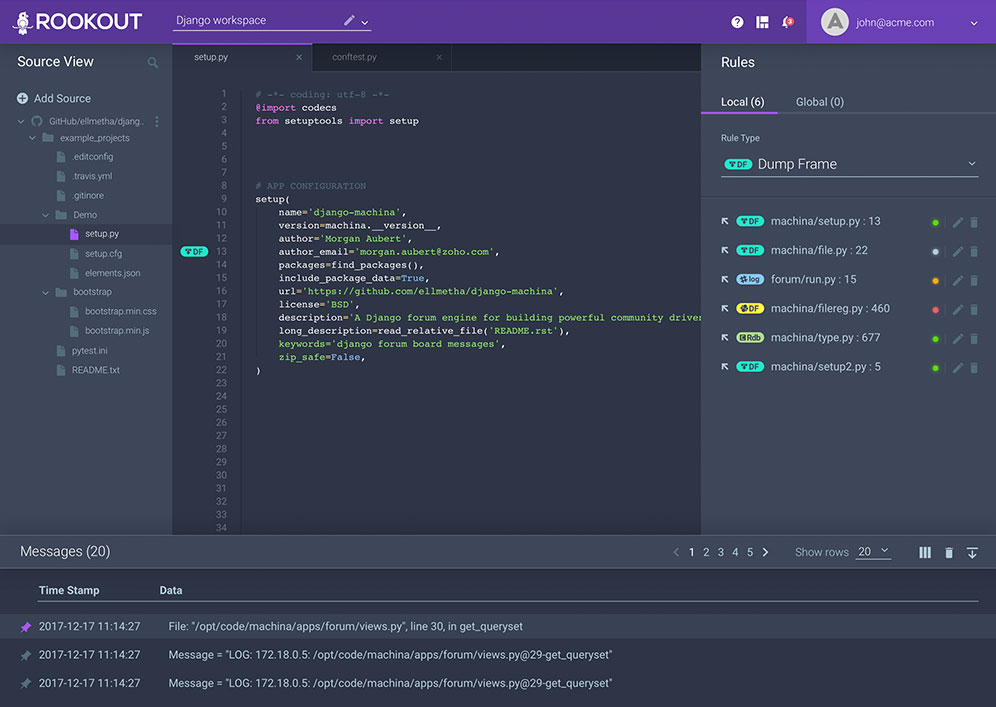
Rookout launches its live Kubernetes debugger

Rookout, a startup that offers debugging tools for applications that run on modern container and serverless platforms, is launching a new feature today that brings the equivalent of breakpoints to Kubernetes.

“Traditional debuggers leave developers helpless on Kubernetes, because they can’t debug multiple ephemeral, shifting, distributed concurrent instances of code,” the company argues in its announcement. “The powerful and familiar features that debuggers provide, like breakpoints, are missing.”

To get around this, developers tend to go for a more indirect way of diagnosing issues and debugging their apps running on Kubernetes. That mostly means logging and distributed tracing, both of which have spawned their own ecosystems of open source projects and startups. Rookout argues that these systems are hard to set up and can only give you a relatively high-level view of what’s happening inside a container.

While the company talks about this feature as ‘breakpoints,’ though, we’re not talking about the traditional breakpoints you are probably familiar with from your IDE. Instead, Rookout collects full-stack data but doesn’t actually stop the execution of the code. That may make it sound more like it’s closer to tracing and logging than the company makes it seem, but you can actually use the system to get data about a single variable state and the promise is that you can do so with just a few clicks. And since there are no real breakpoints, you can use the system on both development and production systems.

“Nobody wants to install and run complicated, high-overhead monitoring solutions just to be able to indirectly debug Kubernetes,” says Rookout CTO and co-founder Liran Haimovitch in today’s announcement. “Rookout goes beyond the trace level, giving developers and DevOps back the breakpoints they need to understand their applications, without having to stop the app to write new code.”

15 Nov 2018

RPA startup Automation Anywhere nabs $300M from SoftBank at a $2.6B valuation

The market for RPA — Robotic Process Automation — is getting a hat trick of news this week: Automation Anywhere has today announced that it has raised $300 million from the SoftBank Vision Fund. This funding, which values Automation Anywhere at $2.6 billion post-money, is an extension to the Series A the company announced earlier this year, which was at a $1.8 billion valuation. It brings the total size of the round to $550 million.

The news comes just a day after one of the startup’s bigger competitors, UiPath, announced a $265 million raise at a $3 billion valuation; and a week after Kofax, another competitor, announced it would be acquiring a division of Nuance for $400 million to beef up its business.

It’s also yet one more example of a one-two punch in funding. It was only in July that Automation Anywhere announced its $250 million raise.

This latest round adds some significant investors to the company’s cap table, specifically from the SoftBank Vision Fund, which counts a number of tech giants like Apple and Qualcomm as LPs, along with others. Specifically, the fund has been under fire for the last few weeks because of the fact that a large swathe of its backing comes from Saudi money.

The Saudi Arabian government has been in the spotlight over its involvement in the killing of journalist Jamal Khashoggi in its embassy in Turkey. By extension of that, there have been many questions raised in recent weeks over the ethics of taking money from the Vision Fund, with so many questions still in the air over that affair.

In an interview, Mihir Shukla, CEO and Co-Founder at Automation Anywhere, said that while what happened to Khashoggi was “not acceptable,” his conversations started with SoftBank before that and they did not impact the startup’s decision over whether to work with the Fund.

He declined to comment on the timing of the term sheet getting signed, when asked whether it was before or after the news broke of the murder.

What attracted us to SoftBank was that Masayoshi Son” — the CEO and founder of SoftBank — “has a vision and he is investing in foundational platforms that will change how we work and travel,” Shukla said. “We share that vision.”

He also pointed out that getting funding from SoftBank will “naturally” lead to more opportunities to partner with companies in SoftBank’s network of companies, which cover dozens of investments and outright ownerships.

While it feels like artificial intelligence is something that you see referenced at every turn these days in the tech world, RPA is an interesting area because it’s one of the more tangible applications of it, across a wide set of businesses.

In short, it’s a set of software-based “robots” that help companies automate mundane and repetitive tasks that would otherwise be done by human workers, employing AI-based technology in areas like computer vision and machine learning to get the work done.

Competition among companies to grab pole position in the space is fierce. Automation Anywhere has 1,400 organizations as customers, it says. By comparison, UiPath has 2,100 and claims an annual revenue run rate at the moment of $150 million. Shukla declined to disclose any financials for his company.

But in light of all that, the company will be using the funding to build out its business specifically ahead of rivals.

“With this additional capital, we are in a position to do far more than any other provider,” said Shukla in a statement. “We will not only continue to deliver the most advanced RPA to the market, but we will help bring AI to millions. Like the introduction of the PC, we see a world where every office employee will work alongside digital workers, amplifying human contributions. Today, employees must know how to use a PC and very soon employees will have to know how to build a bot.”

Automation Anywhere claims that its Bot Store is the industry’s largest marketplace for bot applications, designed both by itself and partners, to execute different business processes, with 65,000 users since launching in March 2018.

15 Nov 2018

Propel accelerates with $18M Series B to manage product lifecycle

We hear so much about managing the customer relationship, but companies have to manage the products they sell too. Propel, a Santa Clara startup, is taking a modern cloud approach to the problem, and today it landed an $18 million Series B investment.

The round was led by Norwest Venture Partners. Previous investors Cloud Apps Capital Partners, Salesforce Ventures, and Signalfire also participated. Today’s investment brings the total raised to over $28 million.

“We are focused on helping companies design and launch products, based on how you go through the life cycle of a product from concept to design to make, model, sell, service where everybody in a company gets involved in product processes at different points in time,” company co-founder and CEO Ray Hein told TechCrunch.

Hein says the company has three core products to help customers track products through their life. For starters, there is the product lifecycle management tool (PLM), used by engineering and manufacturing. Next, they have product information management for sales and marketing and finally they have service personnel using the quality management component.

The company is built on top of the Salesforce platform, which could account for Salesforce Ventures interest in the startup. While Propel looks purely at the product, Salesforce is more interested in the customer, whether from a sales, service or marketing perspective.

These same employees need to understand the products they are developing and selling and that is where Propel comes into play. For instance, when sales people are filling out an order, they need access to the product catalogue to get the right numbers or marketing needs to understand the products they are adding to an online store in an eCommerce environment.

Traditional PLM tools from companies like SAP and Oracle are on-prem or have been converted from on-prem to cloud services. Propel was born in the cloud and Sean Jacobsohn, partner at Norwest Venture Partners, who will be joining the Propel board, sees this as a key differentiator for the startup.

“With Propel’s solution, companies can get up and running faster than with on-premise alternatives and pivot products in a matter of seconds based on real-time feedback gathered from marketing, engineering, sales, customers and the entire supply chain,” Jacobsohn said in a statement.

The company was founded in 2015. It currently has 35 employees, which Hein intends to boost to 50 in the coming months flush with these new funds.

15 Nov 2018

Italic launches its marketplace for affordable luxury goods from top manufacturers

A new startup called Italic says it’s already received more than 100,000 signups for a marketplace where you can buy handbags, eyewear and other luxury products directly from the manufacturers who work with the world’s best-known brands.

The marketplace is officially launching today. Italic is also announcing that it’s raised $13 million in funding from Comcast Ventures, Global Founders Capital, Index Ventures, Ludlow Ventures and others.

Founder and CEO Jeremy Cai previously co-founded the Y Combinator-backed hiring startup OnboardIQ (now known as Fountain.com), so this sounds like a pretty big change. However, Cai said he comes from a family in the manufacturing business, so he was acutely aware of the challenges facing manufacturers.

“The history of manufacturing has been about margins,” he said. “Even though they make the final product, they barely make a profit.”

Under the traditional model, it’s the brands that buy the goods from the manufacturers and make the real profit by marking up prices. So Cai saw an opportunity to remove the brands from the equation — Italic handles the consumer-facing side of the business, like product design and marketing, but it doesn’t actually buy anything. Instead, it operates more like a marketplace, connecting consumers and manufacturers.

Jeremy Cai

This also means the manufacturers are assuming more of the risk around the initial cost of creating the products, but Cai said that in return, they get much more of the upside. And apparently, Italic’s initial partners “jumped at the opportunity”: “They’ve been waiting for an option like this to get to get direct-to-consumer.”

Under the Italic model, the manufacturers remain anonymous, but the company says customers will be able to purchase handbags and leather goods from factories that work with Prada, Christian Louboutin and Givenchy; eyewear from a factory that works with EssilorLuxottica; bedding factories that work with Ritz Carlton and Four Seasons; and leather jackets from the same factory as J Brand.

Cai said this model also means consumers will pay significantly less than they would for luxury goods — most of the handbags will cost less than $300, the prescription eyewear will cost less than $100, leather jackets will be around $425 and bedding will be priced between $80 and $120. You’ll certainly be able to find cheaper products elsewhere, but the idea is sell to “the middle 40 percent” of consumers who are interested in high-quality products but want to be “a lot more frugal and smart with their dollars.”

And while Cai declined to specify the commission that Italic is charging manufacturers, he did say it differs from industry to industry, and added, “Our manufacturers make several multiples more than they make with their current brand clients.”

During our conversation, Cai repeatedly emphasized the difference between Italic and many of the new direct-to-consumer brands that have emerged online (such as Warby Parker and Casper).

Italic

When I wondered whether the marketplace vs. brand distinction will be lost on most consumers, he replied, “On the design side, we’re extremely intentional. We’re designing it with the messaging that we operate differently, you’re buying from a merchant who is an anonymous manufacturer. The sole intention is that when someone asks you, ‘Where did you get that handbag?’ you say, ‘I got this handbag from Italic, on Italic.’ The goal is to operate more like a retailer without any brands.”

At the same time, he acknowledged that Italic is itself a sort of brand, albeit with a unique business model.

“At the end of the day, it’s impossible to say we aren’t building a brand,” he said. “But the brand of Italic [should be that] we can consistently bring you high quality products at an incredible price point.”

Italic will operate on a membership model, which Cai said will allow the company to control demand, since quantities are limited. It also allows the company to solicit product feedback from members, and there could be other benefits like shipping discounts. Members who signup initially will get a year for free, but it will eventually cost $120 annually.

15 Nov 2018

Spotify alums create Canopy content suggester that won’t steal your data

Personalization comes at a steep price. All your data gets sucked up into a company’s servers where they can do whatever they want with it. But Canopy is a new content discovery startup that’s invented impressive technology that lets it learn about you anonymously while all your data stays on your device. Built by the co-founder and CTO of Echo Nest, the music data startup Spotify acquired to power its recommendations, Canopy wants to turn privacy into a competitive advantage. It plans to equip any content app with its tech that crunches your biographical and behavior data on your phone or computer so all it sends along are clues to what you want to see or hear next.

But first, Canopy will launch its own proof of concept app early next year that suggests long-form articles and podcasts based on your taste and activity. “There hasn’t been a great solution to private discovery. We think the reason people haven’t been excited about privacy is that they haven’t seen the opportunities” says Canopy founder and CEO Brian Whitman. “We are totally changing the value exchange of the internet” adds Canopy’s head of product strategy and former Spotify Director Of Music Publishing Annika Goldman. Matrix Partners is betting on Canopy’s privacy-safe vision for the future, leading a $4.5 million seed round for the startup.

That seems wise considering Whitman built one of the world’s most beloved content recommendation engines: Spotify’s Discover Weekly. “I’ve been doing music recommendation stuff since 2000” Whitman tells me. He left in 2015, and started to become disallusioned about “how much power we had put in algorithmic decision making and personalization. All your information goes to their servers.” Facebook’s Cambridge Analytica scandal only confirmed his views. “All this data is now being used against people. You’re getting bad recommendations, bad ads, and people are being radicalized.”



A year or two ago he started discussing the idea of building a content recommendation engine that didn’t require your actual data as inputs. He came up with a solution where “Instead of sending thousands of data points to the server we can keep all that personal data on your phone” Goldman explains. “Take Spotify for example. You listen to a song. It knows where you listened to that, it know how long you listened to it, it knows what you did next — all this stuff they don’t need to know to make music recommendations. We condense and summarize all that information and send it as a single vector – a effectively a summary of things you might like and we make it impossible to reverse engineer the vector to understand the data behind it.”

She likens the system to a model of the content world on Canopy’s servers. Rather than sending it your past activity, personal info, and intentions, it just sends a set of coordinates of where you want the recommendations to go next. The 11-person Canopy team is now building out its app that will ask you questions and watch your consumption behavior to tune its suggestions. Since podcasts and longer articles aren’t owned by any one service, they’re an easy starting point for Canopy, though it eventually hopes to be content agnostic. And since it never has to suck up your data, there’s no risk of it being stolen in a breach.

That’s a big selling point for Canopy’s software-as-a-service it plans to license its tech to other apps.”Being able to build a platform that can understand your data without the liability of user data is gamechanging” Whitman declares.

Still, the biggest question facing the company is “Do people really care about privacy?” Every day we learn of a new hack attack, data exposure, or company selling our private info, but we go right on surfing. Even Facebook’s growth rate has only dipped slightly in the wake of all its privacy troubles. But Goldman believes that’s because it’s become so overwhelming that people “have a head in the sand view on privacy. ‘Hh my god, all my data is out there. I’m at risk. What do I do about it?’ Well I want to give people a way to do something about it”. Namely, trust Canopy instead of the data grabbers.

But if people can’t be tought the value of privacy, it’s hard to see partners going to the trouble of buidling in Canopy’s system. Whitman admits that services would take a modest hit to their recommendation accuracy if they adopt Canopy. He’s hoping the long-term goodwill of users will offset that. On the horizon, he predicts “there’s a great awakening of awareness.”

15 Nov 2018

These Bluetooth earbuds double as a charging cord

As I write this, I’m somewhere in Asia, with a bag full of assorted cables and devices. I’ve gotten better at packing light, but I’ve still got a ways to go. Certainly there’s something to be said for those products that can pull double duty — take the new Huawei phone or most recent iPad Pro update, all of which double as device chargers.

The Changer looks to be a clever take on the concept for the perpetually low on battery. The $89 yolked Bluetooth earbuds double as a charging cable. Snap the headphone bits off and you’ll find USB-C, microUSB and Lightning connectors.

The headphones sport a 12-hour battery, according to the company, and can be plugged directly into the wall. The cable can also be used to plug a mobile device into a battery pack or plugged into two different devices to share a charge.

I’ll admit I’m a bit skeptical about the efficacy of all this at this point, and the fact that its manufacturer, 49101, is opening up pre-orders through Indiegogo. The headphones are set to start shipping early next year.

15 Nov 2018

WeWork hires Prabhdeep Singh to lead operations for its startup program WeWork Labs

WeWork has hired Prabhdeep Singh to serve as the first global head of operations for its startup program WeWork Labs.

It’s a program that relaunched earlier this year, providing early-stage startups with desk space, educational programs and mentorship. Since the relaunch, the company says it’s opened in more than 24 locations in 14 cities across nine countries, and it’s already working with more than 1,000 startups.

“When you think about WeWork assets, it’s this massive global footprint that’s really at the nexus of startups, big corporations, small corporations, innovators, etc.,” Singh said. “With WeWork labs, you can think of it as an innovation platform that supports these early-stage startups.”

Singh was most recently at Uber, where he held a number of roles including head of enterprise at Uber Eats. He’s also led the corporate innovation division at Gerson Lehrman Group and co-founded the FinTech Innovation Lab, an incubator for financial tech startups.

While you can think of WeWork Labs as the coworking giant‘s take on an accelerator or incubator, Singh noted that there are a few key differences. For one thing, WeWork isn’t taking any equity: “We give you a really fair deal on discounted space in a WeWork area with a dedicated Labs manager.” (Pricing differs depending on the location — in Seattle, it’s $390 per person per month, while in Manhattan it’s $550.)

For another, WeWork labs is simply working with a lot more startups.

“We’re thinking about this fundamentally differently,” Singh said. “We’re not [Y Combinator with] a class of 100 startups where you get the TechCrunch writeup and that helps you scale … The idea isn’t necessarily that someone is going to say, ‘You should give me a million dollars in VC because I’m in WeWork labs.’ We hope to give them the tools to pitch to that VC, the tools for sales and marketing.”

Singh will be working with WeWork Labs’ global head Roee Adler — the company explained that while Adler is focused on the program’s bigger picture, Singh will be handling operations and overseeing the individual Labs managers in each location.

Singh said his background in corporate innovation could help WeWork Labs build more relationships with larger organizations looking to get connected with the startup community. For example, the program collaborated with Mercer over the summer on a “technology sprint.”

In addition, one of his goals is to continue expanding the programs to new locations — not just in the obvious startup hubs, but also “where we can add the most value.”

“One of the benefits of being part of WeWork is, we have this massive footprint already,” Singh said. “If you go to New York or Silicon Valley, there’s already 100 incubators or accelerators. If you go to the middle of the country, or China, or go to a place like Sao Paulo where we have four spaces already, this is really a filling a market need.”