Year: 2018

15 Nov 2018

Apex.ai raises $15.5 million for autonomous vehicle software

Apex.ai is emerging out of stealth today with quite the claim — an operating system for autonomous vehicles that will never fail Founded by long-time automated systems engineers Jan Becker and Dejan Pangercic, Apex.ai develops operating systems for various types of autonomous mobility platforms.

Today, Apex.ai is also announcing a $15.5 million Series A round led by Canaan with participation from Lightspeed Venture Partners, which invested in Apex.ai’s seed round.

Apex’s software stack is designed to easily integrate into existing systems and serve as the enterprise version of the Robot Operating System, an open-source software middleware for robotics.

“Most companies have expertise building consumer applications but not a lot of expertise, resources or people to work on safety-critical processes,” Becker told TechCrunch. “So we built a framework that allows developers that are not experienced building safe and secure systems to do just that.”

In order to never fail, Apex.ai has built redundancies into the system to ensure single failures don’t result in system-wide failures.

“We go through every line of code and guarantee that safety-critical processes get the amount of compute time needed to execute,” Becker said.

Apex.ai is application agnostic, meaning this can be used in all autonomous systems — ranging from cars to drones to flying taxis.

Apex.ai competes with the likes of Renovo, which unveiled AWare OS designed for Level 4 autonomous driving earlier this year.

“What excited us about Apex is they are solving a real problem,” Canaan Partner Rayfe Gaspar-Asaoka told TechCrunch. “Now that we have the right technological pieces in place, how do we move this from R&D into mass production — fully self-driving vehicles for the average consumer to use. As that happens, the number one question will be how do we ensure that this vehicle in this whole system works 100 percent of the time. Safe and reliable all of the time.”

15 Nov 2018

Roku’s voice-powered wireless speakers and tabletop remote start shipping

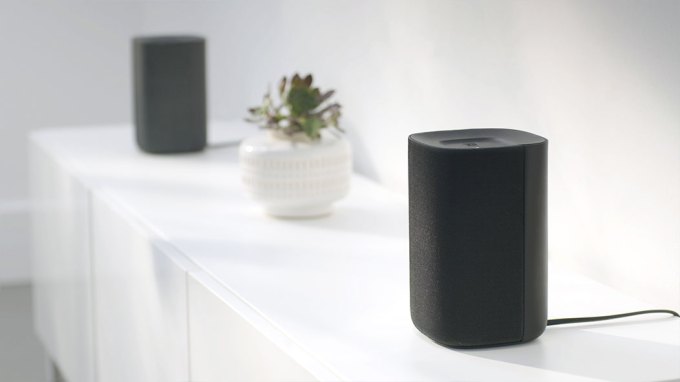
In July, Roku unveiled its entry into the voice-powered speaker market, with a pair of Roku TV Wireless Speakers designed to work with the company’s lineup of partner-built smart TVs. Those speakers will now begin to ship to customers starting on Friday, November 16. They’ll also go on sale in advance of Black Friday at a discounted price, Roku says.

The speakers were previously available for pre-order and will normally retail for $199.99.

However, Roku will sell them starting on Sunday, November 18 through “Cyber Monday,” November 26, for $149.99.

The company had earlier said the speakers would begin shipping in late October, so this is a bit of delay on its part. But they’re still here before the holidays and in time for Black Friday, which is what’s most important.

The company’s goal with its voice-powered speakers is not really one of trying to compete with Amazon Echo or Google Home devices, however. Instead, the company wants to leverage voice specifically to enhance the experience of browsing, searching and controlling Roku’s software, which runs on the TVs.

Roku’s voice assistant is nowhere near as powerful as Google Assistant or Alexa, but in terms of navigating your TV by way of voice, it’s sufficient enough.

The speakers ship with the Roku TV Voice Remote, allowing you to press a button to issue voice commands, without having to get up the convenience of using a remote control to navigate your TV.

Of course, consumers aren’t expected to buy the speakers just for voice control – that’s just an added perk. Instead, the draw is that speakers do the job of a soundbar in terms of improving the sound quality of the TV’s audio. The speakers additionally include Roku’s Automatic Volume Leveling technology, which brings the volume down when the movie or show gets loud, and increases the volume during the quieter scenes to provide a more even audio experience.

Roku is also shipping another new product, the Roku Touch, on Friday, it noted.

This is the company’s somewhat odd battery-powered remote that sits on a tabletop, which is designed to work with the wireless speakers. The remote includes a press-to-talk microphone for controlling your TV from afar and is sold separately for $29.99.

15 Nov 2018

Docker inks partnership with Mulesoft as Salesforce takes a strategic stake

Docker and Mulesoft have announced a broad deal to sell products together and integrate their platforms. As part of it, Docker is getting an investment from Salesforce, the CRM giant that acquired Mulesoft for $6.5 billion last spring.

Salesforce is not disclosing the size of the stake it’s taking in Docker, but it is strategic: it will see its new Mulesoft working with Docker to connect containerized applications to multiple data sources across an organization. Putting the two companies together, you can connect these containerized applications to multiple data sources in a modern way, even with legacy applications.

The partnership is happening on multiple levels and includes technical integration to help customers use the two toolsets together more easily. It also includes a sales agreement to cross-sell one another’s products and services and to work with systems integrators and ISVs, who help companies put these kind of complex solutions to work inside large organizations.

Docker chief product officer, Scott Johnston, said it was really about bringing together two companies whose missions were aligned with what they were hearing from customers. That involves tapping into some broad trends around getting more out of their legacy applications and a growing desire to take an API-driven approach to developer productivity, while getting additional value out of their existing data sources. “Both companies have been working separately on these challenges for the last several years, and it just made sense as we listen to the market and listen to customers that we joined joined forces,” Johnston told TechCrunch.

Uri Sarid, Mulesoft’s CTO, agrees that customers have been using both products and it called for a more formal arrangement. “We have joint customers and the partnership will be fortifying that. So that’s a great motion, but we believe in acceleration. And so if there are things that we can do, and we now have plans for what we will do to make that even faster, to make that even more natural and built-in, we can accelerate the motion to this. Before, you had to think about these two concerns separately, and we are working on interoperability that makes makes you not have to think about them separately,” he explained.

This announcement comes at a time of massive consolidation in the enterprise. In the last couple of weeks, we have seen IBM buying Red Hat for $34 billion, SAP acquiring Qualtrics for $8 billion and Vista Equity Partners scooping up Apptio for $1.94 billion. Salesforce acquired Mulesoft earlier this year in its own mega deal in an effort to bridge the gap between data in the cloud and on-prem.

The final piece of today’s announcement is that investment from Salesforce Ventures. Johnston would not say how much the investment was for, but did say it was about aligning the two partners.

Docker has raised almost $273 million before today’s announcement. It’s possible it could be looking for a way to exit, and with the trend toward enterprise consolidation, Salesforce’s investment may be a way to test the waters for just that. If it seems like an odd match, remember that Salesforce bought Heroku in 2010 for $212 million.

15 Nov 2018

LocalGlobe, the London seed-stage VC, is raising a new fund aimed at Series B

LocalGlobe, the seed-stage venture capital firm founded by father and son duo Robin and Saul Klein, and one of the most active firms in the U.K., is gearing up to launch a new separate fund aimed at Series B.

According to sources — and since confirmed by LocalGlobe — the VC firm is raising a sister fund to formally back the most promising startups in its portfolio to help them scale.

It isn’t unheard for LocalGlobe to follow on after seed during later funding rounds, having done so in successful companies such as Zoopla and TransferWise. However, the thinking here is to have a separate fund to make this more common, and provide LPs a way to double down on LocalGlobe’s most promising bets.

The new fund is to be called “Latitude,” whist a recent regulatory filing mistakenly and inadvertently surfaced “Senderwood,” the holding company of LocalGlobe and Latitude. It is not known how much Latitude is looking to raise from LPs, although this is aimed at Series B so I’d expect it to be larger than LocalGlobe’s most recent £75 million fund.

TechCrunch has also learned that Julian Rowe has joined Latitude as a Partner from JP Morgan, where having moved back from Silicon Valley he latterly was EMEA Head of Internet and Digital Media and worked closely with successful U.K. scale-ups like Farfetch and Deliveroo.

LocalGlobe’s Robin Klein will also be heavily involved in the new Series B fund, formalising a role he has increasingly taken at LocalGlobe. Saul Klein is the third member of the Latitude team.

LocalGlobe issued the following statement, confirming the existence of Latitude, but declined to comment further:

“LocalGlobe’s new and existing investors are excited about the opportunity to invest in UK tech companies, both at seed and as they scale up, justifiably since the U.K. has now produced 60 unicorns or 35% of the total from Europe and Israel. We are exploring the technicalities of laying the foundations of a new fund, to be known as Latitude, for launch in 2019. This will enable us to invest in the most successful companies that are coming through from previous LocalGlobe funds at Series B and beyond. Initial conversations with investors have been going well and they are excited about the prospect of a new way to invest in some of the UK’s best early stage tech companies.”

Update: Oscar Williams-Grut at Yahoo Finance reports that Latitude’s debut fund is looking to raise $200 million (£156.5m).

15 Nov 2018

Tech giants take seats on Homeland Security’s new supply chain task force

Homeland Security’s supply chain task force is finally off the ground..

The public-private coalition, set up earlier this year, now has representatives from more than two dozen companies and industry groups signed up to help the government try to combat risks faced by tech companies from threats in the supply chain.

Called the ICT Supply Chain Task Force, government officials hope to better understand to address security issues with global technology supply chains and make recommendations. By collaborating, the group aims to better understand the risks that companies face from industrial espionage, government interference, and other cybersecurity issues that could pose a threat to U.S national security.

One of those new members is Cisco’s Edna Conway, chief security officer for its global value chain. She told TechCrunch that enterprises and governments “can no longer effectively identify, defend against and mitigate the risks across that global value chain in isolation.”

She, like others, have called for a group effort to tackle the threats they face.

The task force couldn’t come soon enough. Although the government has long known of supply chain threats, the group’s official formation comes in the aftermath of Bloomberg’s controversial claims that Chinese intelligence had infiltrated the server hardware supply chain that with tiny chips. Bloomberg’s claims have been largely debunked — or not proven to the standard that many have called for. But it doesn’t diminish the long-known threat that the U.S. electronics and data industries face.

By working together, the task force aims to to create policy recommendations that would incentivize businesses to buy hardware and software directly from original vendors and vetted resellers to reduce the risk of having an unknown, untrusted third-party in the mix. One of the end goals is to ensure that only the trusted vendors, which stick to a strict set of criteria laid out by the task force, will be qualified to bid for contracts.

“Cisco brings to the task force this collaborative spirit, a deep understanding of the operation of global ICT value chains and my expertise in shifting security and risk from ‘limiting damage’ to key enabler of business differentiation,” said Conway.

Cisco joins other tech giants and major telcos at the table, including Accenture, AT&T, CenturyLink, Charter, Comcast, CTIA, CyberRx, Cybersecurity Coalition, Cyxtera, FireEye, Intel, ITI, IT-ISAC, Microsoft, NAB, NCTA, NTCA, Palo Alto Networks, Samsung, Sprint, Threat Sketch, TIA, T-Mobile, US Telecom and Verizon (which, as a reminder, owns TechCrunch).

They will be joined by representatives from Homeland Security, the Defense Dept., the Justice Dept., the Treasury, and the Office of the Director of National Intelligence, among others in government.

Homeland Security under secretary Christopher Krebs said that by bringing together representatives from the public and private sector, the task force has “a unique ability to confront today’s challenges by sharing information across government and industry in real-time and developing the ability to better plan for the risks of the future.”

15 Nov 2018

Bunch scores $3.8M to turn mobile games into video chat LAN parties

The best parts of gaming are the jokes and trash talk with friends. Whether it was four-player Goldeneye or linking up PCs for Quake battles in the basement, the social element keeps video games exciting. Yet on mobile we’ve lost a lot of that, playing silently by ourselves even if we’re in a squad with friends somewhere else. Bunch wants to bring the laughter back to mobile gaming by letting you sync up with friends and video chat while you play. It already works with hits like Fortnite and Roblox, and developers of titles like Spaceteam are integrating Bunch’s SDK to inspire longer game sessions.

Bunch is like Discord for mobile, and the chance to challenge that gaming social network unicorn has attracted a $3.8 million seed round led by London Venture Partners and joined by Founders Fund, Betaworks, North Zone, Streamlined Ventures, 500 Startups and more. With Bunch already cracking the top 100 social iOS app chart, it’s planning a launch on Android. The cash will go to adding features like meeting new people to game with or sharing replays, plus ramping up user acquisition and developer partnerships.

“I and my co-founders grew up with LAN parties, playing games like Starcraft and Counter Strike – where a lot of the fun is the live banter you have with friends” Bunch co-founder and CEO Selcuk Atli tells me. “We wanted to bring this kind of experience to mobile; where players could play with friends anytime anywhere.” 

Bunch Team

Atli was a venture partner at 500 Startups after co-founding and selling two adtech companies: Manifest Commerce to Rakuten, and Boostable to Metric Collective. But before he got into startups, he co-founded a gaming magazine called Aftercala in Turkey at age 12, editing writers twice his age because “on the internet, nobody knows you’re a dog” he tells me. Atli teamed up with Google senior mobile developer Jason Liang and a senior developer from startups like MUSE and Mox named Jordan Howlett to create Bunch.

Over a year ago, we built our first prototype. The moment we tried it ourselves, we saw it was nothing like what we’ve experienced on our phones before” Atli tells me. The team raised a $500,000 pre-seed round and launched its app in March. “Popular mobile games are becoming live, and live games are coming to mobile devices” says David Lau-Kee, general partner at London Venture Partners. “With this massive shift happening, players need better experiences to connect with friends and play together.”

When you log on to Bunch’s iOS app you’ll see which friends are online and what they’re playing, plus a selection of games you can fire up. Bunch overlays group voice or video chat on the screen so you can strategize or satirize with up to eight pals. And if developers build in Bunch’s SDK, they can do more advanced things with video chat like pinning friends’ faces to their in-game characters. It’s a bit like OpenFeint or iOS Game Center mixed with HouseParty.

For now Bunch isn’t monetizing as it hopes to reach massive scale first, but Atli thinks they could sell expression tools like emotes, voice and video filters, and more. Growing large will require beating Discord at its own game. The social giant now has over 130 million users across PCs, consoles, and mobile. But it’s also a bit too hardcore for some of today’s casual mobile gamers, requiring you to configure your own servers. “I find that execution speed will be most critical for our success or failure” Atli says. Bunch’s sole focus on making mobile game chat as easy as possible could win it a mainstream audience seduced by Fortnite, HQ Trivia and other phenomena.

Research increasingly shows that online experiences can be isolating, and gaming is a big culprit. Hours spent playing alone can leave you feeling more exhausted than fulfilled. But through video chat, gaming can transcend the digital and become a new way to make memories with friends no matter where they are.

15 Nov 2018

Standard Cognition raises $40M to replace retailers’ cashiers with cameras

The Amazon Go store requires hundreds of cameras to detect who’s picking up what items. Standard Cognition needs just 27 to go after the $27 trillion market of equipping regular shops with autonomous retail technology.

Walk into one of its partners’ stores and overhead cameras identify you by shape and movement, not facial recognition. Open up its iOS or Android app and a special light pattern flashes, allowing the cameras to tie you to your account and payment method. Grab whatever you want, and just walk out. Standard Cognition will bill you. It even works without an app. Shop like normal and then walk up to kiosk screen, the cameras tell it what items you nabbed, and you can pay with cash or credit card. That means Standard Cognition stores never exclude anyone, unlike Amazon Go.

“Our tagline has been ‘rehumanizing retail'” co-founder Michael Suswal tells me. “We’re removing the machines that are between people: conveyor belts, cash registers, scanners…”
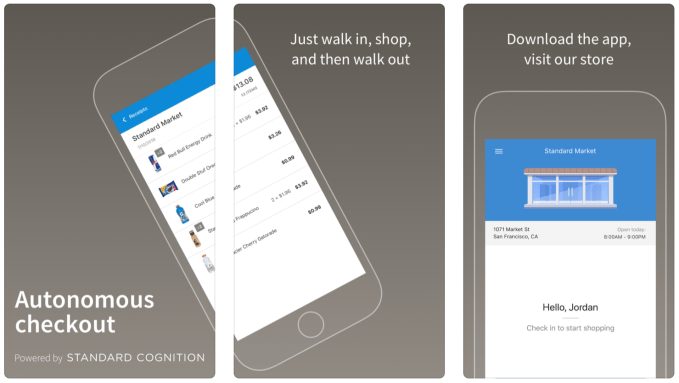
The potential to help worried merchants compete with Amazon has drawn a new $40 million Series A funding round to Standard Cognition, led by Alexis Ohanian and Garry Tan’s Initialized Capital . CRV, Y Combinator, and Draper Associates joined the round that builds on the startup’s $11 million in seed funding. Just a year old, Standard Cognition already has 40 employees, but plans to hire 70 to 80 more over the next 6 months so it can speed up deployment to more partners. Suswal wouldn’t reveal Standard Cognition’s valuation but said the round was roughly in line with the traditional percentage startups sell in an A round, That’s usually about 20 to 25 percent, indicating the startup could be valued around $160 million to $200 million pre-money.

Instead of some lofty tech solution that requires a whole new store to be built around it, Standard Cognition gets retailers to pay for the capital expenditures to install its low number of ceiling cameras and a computer to run them. They can even alter their store layout without working with an engineer as they pay a monthly SAAS fee based on their store’s size, SKUs, and product changes.
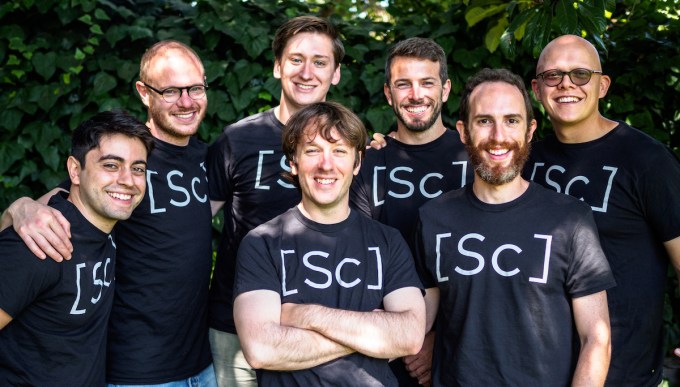
Standard Cognition’s founding team
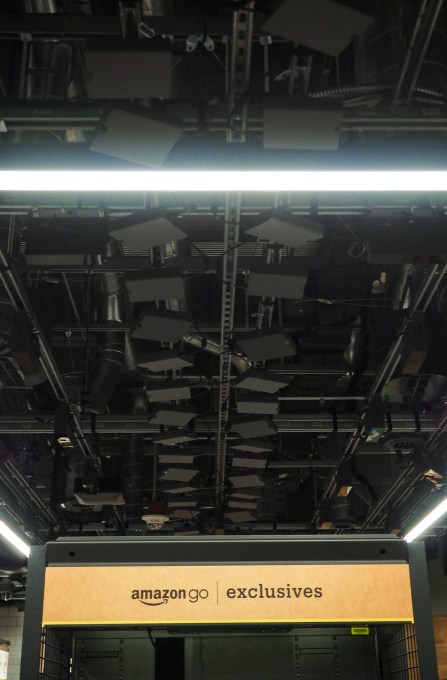
Amazon Go uses thousands of cameras to track what you pick up

Suswal tells me “Retailers’ two biggest complaints are long lines and poor customer service.” Standard Cognition lets stores eliminate the lines and reassign cashiers to become concierges who make sure customers find the perfect products. “It’s already fun to shop, but I think it’s going to become a lot more fun in the future” Suswal predicts.

Having seven co-founders is pretty atypical for startups, but it’s helped Standard Cognition move quickly. The crew came together while all working at the SEC. They’d meet up as part of a technology research group, discussing the latest findings on computer vision and machine learning. Suswal recalls that “After about a year, we said ‘if we were going to productize this somehow, what would we do?” They settled on retail, and narrowed it down to autonomous checkout. Then a bombshell dropped. Amazon Go, the first truly signficant cashierless store, was announced.

“We initially thought ‘oh no, this is bad.’ And then we quickly came to our senses that this was the best thing that could happen” Suswal explains. Retailers would be desperate for assistance to fight off Amazon. So the squad quit their jobs and started Standard Cognition.

Now with plenty of capital and eager customers, the company is equipping stores for its first four partners — all public companies. Three refuse to be named but include US grocery, drug store, and convenience store businesses. The fourth is Japan’s pharmacy chain Yakuodo. Standard Cognition is already working on its store mapping for its cameras and will begin camera installation next month, though it will be a little while until it opens.

Japan is the perfect market for Standard Cognition because their aging population has produced a labor shortage. “They literally can’t find people to work in their stores” Suswal explains. Autonomous checkout could keep Japanese retailers growing. And because 70 percent of transactions in Japan are cash-based, it also forced the startup to learn how to handle payments outside of its app. That could make Standard Cognition appealing for retailers that want to embrace the future without abandoning the past.

Getting long-running retail businesses to invest in evolving may be the startup’s biggest challenge. Since they have to pay up front for the installation, they’re gambling that the system will reliably increase sales or at least decrease labor costs. But if it makes their stores too confusing, they could see an exodus of customers instead of an influx.

As for Standard Cognition’s impact on the labor class, Suswal admits that “the major chains will have some reduction . . . no one is going to get fired but fewer people will get hired.” He believes his tech could actually save some jobs too. “I was walking around NYC talking to (small chains and mom-and-pop) retailers about problems they face, and an alarming number of them told me ‘we’re closing in a year. We’re closing in 6 months.’ And it was all tied to the next minimum wage hike” Suswal tells me.

Reducing labor costs could keep those shops viable. “These stores can stay open with a reduction of labor so people are keeping their jobs, not losing them” he claims. Whether that proves true will take some time, but at least Standard Cognition’s tech could incentivize merchants to retrain their clerks for more fulfilling roles as concierges.


15 Nov 2018

EnduroSat CEO to talk about making satellites more affordable at Disrupt Berlin

It has never been easier to launch a satellite into space. But EnduroSat wants to make it even easier by making CubeSats more affordable thanks to a unique platform. That’s why I’m excited to announce that EnduroSat CEO Raycho Raychev is coming to TechCrunch Disrupt Berlin to talk about his platform.

Many industries have gone through a standardization revolution. Decades ago, shipping stuff from one continent to another was costly because it was a manual process. Exporters now put everything into containers so that you can carry them seamlessly from a port to a cargo ship, a train or a truck.

Similarly, it became much easier to create a new data center thanks to standardized server racks. You can fit servers, routers, or disk arrays into a metal frames, and line all the server racks in a warehouse.

The same is happening with satellites. Thanks to CubeSats, you get to choose the list of components that you want to put in your satellite and they’ll all fit nicely in a cubical package.

EnduroSat is working on next-generation CubeSats. You first choose the frame of your CubeSat. You can then buy different modules to build the perfect satellite for your use case.

The company now has over 30 clients and the EnduroSat One is currently flying above our heads. If you want to hear Raychev tell you more about what they’ve been working on, you should come to Disrupt Berlin. The conference will take place on November 29-30 and you can buy your ticket right now.

In addition to fireside chats and panels, like this one, new startups will participate in the Startup Battlefield Europe to win the highly coveted Battlefield cup.

Raycho Raychev

CEO, EnduroSat

Raycho Raychev works in the field of space science, tech and business.

He founded EnduroSat – a fast-growing satellite company with unique market approach in the space sector. Prior to the company Raycho founded massive space educational platform – Spaceport and practice-oriented space course – Space Challenges.

His education includes Master of Science from International Space University and Innovation and Growth Program from Stanford University and Endeavor.

15 Nov 2018

Online SWATer will face 20 years in prison

Tyler Barriss aka SWAuTistic caused almost 100 SWATing attacks by calling the police on perceived online enemies and claiming that they were holding hostages and were heavily armed. One of these, in SWATs, launched in Wichita, Kansas last year, led to the death of a father of two named Andrew Finch.

Now Barriss is facing up to 20 years in prison after Barriss pled guilty “to making hoax bomb threats in phone calls to the headquarters of the FBI and the Federal Communications Commission in Washington, D.C.”

“He also made bomb threat and swatting calls from Los Angeles to emergency numbers in Ohio, New Hampshire, Nevada, Massachusetts, Illinois, Utah, Virginia, Texas, Arizona, Missouri, Maine, Pennsylvania, New Mexico, New York, Michigan, Florida and Canada,” wrote security researcher Brian Krebs.

U.S. District Judge Eric Melgren said he would give Barriss a 20 year sentence if he apologized to the Finch family. This may be a difficult proposition considering Barriss accessed the Internet in April from jail, writing “I am an eGod” and threatening to SWAT again.

Barriss is be sentenced January 20, 2019.

The instigators of the the deadly SWAT, two young men named Casey Viner from Ohio and Shane Gaskill from Wichita, are also facing charges after a Call Of Duty argument led Gaskill to dare Barriss and Viner to SWAT his old address where Finch then lived.

Image via Kansas.com

15 Nov 2018

Plus-sized clothing startup Dia&Co gets another $70M from Sequoia, USV

The retail industry has and continues to fail the growing number of American women size 14 or larger, says Nadia Boujarwah, the co-founder and chief executive officer of Dia&Co, a personal styling service for plus-sized women.

According to Plunkett Research, nearly 70 percent of women in the U.S. are plus-sized; Dia&Co wants to expand the options available to that growing demographic. Today, the New York-based startup is announcing that it’s brought in another $70 million in venture capital funding from existing backers Sequoia Capital and Union Square Ventures (USV).

“I’ve been a plus-sized woman my whole life and no one can convince me that this isn’t a failure of retail,” Boujarwah told TechCrunch. “The current state of the plus size market is in no way reflective of how [it] should look going forward. There is so much work ahead of us.”

Dia&Co co-founder and chief executive officer Nadia Boujarwah.

Boujarwah started Dia&Co in 2015 with Lydia Gilbert. To date, the pair have raised $95 million and accumulated 4 million users on the Stitch Fix-like direct-to-consumer marketplace. The latest investment represents a previously unannounced $30 million Series B led by Sequoia and a $40 million Series C led by USV. As part of the Series C, USV partner Rebecca Kaden will join the startup’s board of directors; Sequoia partner Alfred Lin already sits on the board.

Dia&Co has also hired Francis Nzeuton as its chief financial officer. Most recently, Nzeuton led finance for Amazon’s U.S. consumables business.

Boujarwah declined to disclose Dia&Co’s latest valuation.