Year: 2018

15 Nov 2018

Plus-sized clothing startup Dia&Co gets another $70M from Sequoia, USV

The retail industry has and continues to fail the growing number of American women size 14 or larger, says Nadia Boujarwah, the co-founder and chief executive officer of Dia&Co, a personal styling service for plus-sized women.

According to Plunkett Research, nearly 70 percent of women in the U.S. are plus-sized; Dia&Co wants to expand the options available to that growing demographic. Today, the New York-based startup is announcing that it’s brought in another $70 million in venture capital funding from existing backers Sequoia Capital and Union Square Ventures (USV).

“I’ve been a plus-sized woman my whole life and no one can convince me that this isn’t a failure of retail,” Boujarwah told TechCrunch. “The current state of the plus size market is in no way reflective of how [it] should look going forward. There is so much work ahead of us.”

Dia&Co co-founder and chief executive officer Nadia Boujarwah.

Boujarwah started Dia&Co in 2015 with Lydia Gilbert. To date, the pair have raised $95 million and accumulated 4 million users on the Stitch Fix-like direct-to-consumer marketplace. The latest investment represents a previously unannounced $30 million Series B led by Sequoia and a $40 million Series C led by USV. As part of the Series C, USV partner Rebecca Kaden will join the startup’s board of directors; Sequoia partner Alfred Lin already sits on the board.

Dia&Co has also hired Francis Nzeuton as its chief financial officer. Most recently, Nzeuton led finance for Amazon’s U.S. consumables business.

Boujarwah declined to disclose Dia&Co’s latest valuation.

15 Nov 2018

Mozilla adds website breach notifications to Firefox

Mozilla is adding a new security feature to its Firefox Quantum web browser that will alert users when they visit a website that has recently reported a data breach.

When a Firefox user lands on a website with a breach in its recent past they’ll see a pop up notification informing them of the barebones details of the breach and suggesting they check to see if their information was compromised.

“We’re bringing this functionality to Firefox users in recognition of the growing interest in these types of privacy- and security-centric features,” Mozilla said today. “This new functionality will gradually roll out to Firefox users over the coming weeks.”

Here’s an example of what the site breach notifications look like and the kind of detail they will provide:

Mozilla’s website breach notification feature in Firefox

Mozilla is tying the site breach notification feature to an email account breach notification service it launched earlier this year, called Firefox Monitor, which it also said today is now available in an additional 26 languages.

Firefox users can click through to Monitor when they get a pop up about a site breach to check whether their own email was involved.

As with Firefox Monitor, Mozilla is relying on a list of breached websites provided by its partner, Troy Hunt’s pioneering breach notification service, Have I Been Pwned.

There can of course be a fine line between feeling informed and feeling spammed with too much information when you’re just trying to get on with browsing the web. But Mozilla looks to sensitive to that because it’s limiting breach notifications to one per breached site. It will also only raise a flag if the breach itself occurred in the past 12 months.

Data breaches are an unfortunate staple of digital life, stepping up in recent years in frequency and size along with big data services. That in turn has cranked up awareness of the problem. And in Europe tighter laws were introduced this May to bring in a universal breach disclosure requirement and raise penalties for data protection failures.

The GDPR framework also generally encourages data controllers and processors to improve their security systems given the risk of much heftier fines.

Although it will likely take some time for any increases in security investments triggered by the regulation to filter down and translate into fewer breaches — if indeed the law ends up having that hoped for impact.

But one early win for GDPR is it has greased the pipe for companies to promptly disclose breaches. This means it’s helping to generate more up-to-date security information which consumers can in turn use to inform the digital choices they make. So the regulation looks to be generating positive incentives.

15 Nov 2018

Airtable, maker of a coding platform for non-techies, raises $100M at a $1.1B valuation

If data is the new oil, you might think of apps are the cars that need it to move. Now, a startup that has built a platform to let everyone — not just those with technical expertise — make and drive their own “cars” has raised a significant round of funding to grow its business. Airtable — which uses a simple interface built on spreadsheets and other tools familiar to knowledge workers as a frontend to produce apps and other web-based experiences — has raised $100 million in funding to expand its business with more talent and offices outside the US. Along with the funding, the company has now catapulted to a $1.1 billion valuation.

Catapult is the key word here: according to PitchBook the company was only valued at $152 million in its last round — eight months ago.

Airtable’s tools are now in use by some 80,000 businesses today, the company said, representing a real growth spurt. To put that into some context, when the company raised $52 million eight months ago, it said it had only 30,000 customers.

This latest round — a Series C — was led by Josh Kushner at Thrive Capital, Peter Fenton at Benchmark, and Philippe and Thomas Laffont at Coatue Management. Delphine Arnault, Emily Weiss, Alexa Von Tobel, Sarah Smith, Dan Rose, and previous investors CRV and Caffeinated Capital also participated — bringing the total raised by Airtable to $170 million.

Howie Liu, the CEO who co-founded Airtable with Emmett Nicholas (now CTO) and Andrew Ofstad, said that the initial idea for the product came out of their own experience. The tech world had already identified that most tools for building apps and software were too technical for the vast majority of people in the tech industry, but their solutions were still “too expensive and complicated to use.”

The vision was to democratise the value proposition,” he said. A database, the founders decided, “in its most flexible form, can be customised to what you need, and that would be better than using someone else’s existing database model.”

[gallery ids="1747138,1747139,1747140,1747142,1747143"]

Airtable is not the only company that has identified the problem and tried to solve it by building powerful macros under the hood of otherwise standard-looking database interfaces.

DashDash is building a similar concept out of Europe focused specifically on spreadsheets, and we’re even seeing Microsoft and partners building more functionality into the world’s leading spreadsheet provider, Excel.

Indeed, that’s not seen as stiff competition, but a sign for Airtable’s investors of just how much opportunity there is in the space. “Airtable has established itself as the leader in what will become a very large market,” Josh Kushner, managing partner at Thrive Capital, said in a statement.

One of the important aspects of Airtable is its Slack-like approach to the task of using its platform to build things.

The company has a platform called Blocks that not only lets its users bring in data from a number of sources, but also to select a number of different kinds of outputs for how and where would like the data to be used, whether it is in a marketing campaign across text messaging, an AI-based bot, or a VR experience. Liu confirmed for me that for now Excel is not one of its integration partners, for now.

Another notable point is that Airtable is yet another example of how the most promising startups are racking up funding in rapid rounds at the moment.

Just yesterday, no less than four different startups — Service Titan, UiPath, Nikola, and SAM — announced rounds of funding coming on the heels of fundraising mere months earlier. It’s a sign of how the market is very hot at the moment: VCs and other investment firms have raised fuelled by large sums of cash that now need to be put to use, and they are all looking for strong bets to do just that.

Fast-growing startups in areas that are on the rise present safe harbours to these investors, and with tens and hundreds of billions of dollars at these funds still in play, we’ll probably continue to witness this funding trend for some time to come.

15 Nov 2018

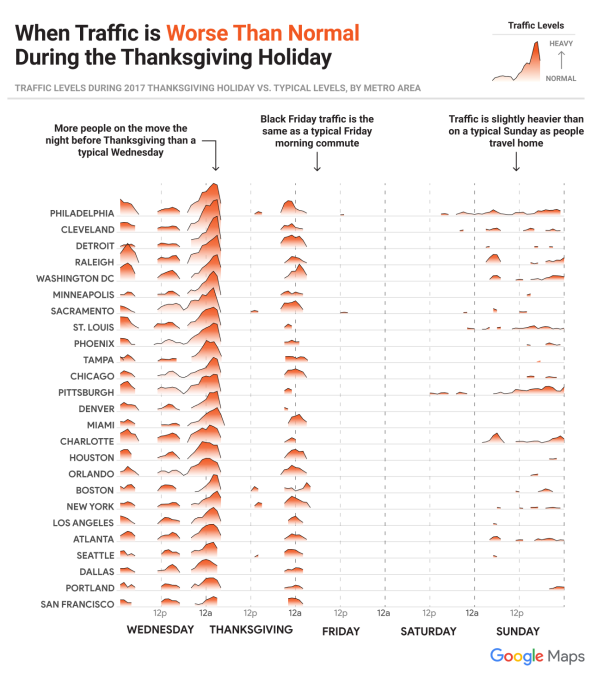
Google’s annual Thanksgiving report tells you the best times to avoid traffic jams

Google has released its annual Thanksgiving traffic and search trends report, created by analyzing data from last year’s holiday season. It breaks down the best and worst times to travel by state and also throws in information about when popular places, like grocery and liquor stores, are the most crowded. Even if you can’t avoid Thanksgiving travel hell, Google’s interactive site will at least let you know what level of hell to expect by showing traffic stats by state, day, and time.

Here are some highlights: not surprisingly, Wednesday between 3PM to 4PM is when traffic is at its most abysmal during Thanksgiving week, but it becomes significantly less packed by 6AM on Thursday, Thanksgiving Day. For return trips, Google’s report advises leaving Friday or Sunday morning, since most people don’t hit the road until the afternoon.

The crowds in bakeries and grocery stores are at their peak the afternoon before Thanksgiving as shoppers grab last-minute supplies. Trips to liquor stores also jump around the same time as people fortify themselves for the next day. On Black Friday, shopping centers are obviously crowded, but many people also chose to spend the afternoon catching a movie.

If you think you can avoid crowds by doing some early Christmas tree shopping or renting an all-terrain vehicle instead, you might want to think again. Using historic data from searches across the United States, Google found that tree farms, electronic stores, ATV rental services, and video game stores are among the “most uniquely popular stops” on Thanksgiving (apparently people enjoy views from high places the day before Thanksgiving, when rollercoasters and scenic overlooks are popular).

Google also shows the most popular search terms during Thanksgiving week last year on a state-by-state level. In California, it was “city courthouse,” while in Pennsylvania people looked up “electric vehicle charging.” Montanans searched for “breweries,” South Dakotans Googled “American restaurant,” and people in Nevada wanted to know more about “parking garages.” Meanwhile, “home improvement store” hit the top of the list in Nebraska, North Dakota, and Iowa.

15 Nov 2018

Ezra raises $4M to diagnose cancer with MRIs, not painful biopsies

1 in 41 men will die of prostate cancer. But sticking a needle through your rectum into your prostate to screen for cancer brings along a ton of bacteria and terrible side effects like pain, infection, urinary trouble, and even erectile dysfunction. It turns out you can detect cancer with Magnetic Resonance Imaging…it’s just prohibitively expensive to do one-off MRIs and have radiologists analyze the scans. But by buying MRI slots in bulk and using artificial intelligence to scan them, a new medtech startup called Ezra wants to replace blood tests and biopsies with MRIs as the new standard of care.

Today, Ezra launches v1 of its MRI prostate cancer screening subscription service in New York City. For $999 per year, patients get one MRI, access to medical staff and educational guides, and on-going support if the test finds they have cancer. For now, human radiologists still analyze the scans. However, Ezra is working to get FDA approval next year for its AI analysis that’s was initially found to be 90 percent as accurate as medical experts, and could turn Ezra into a lucrative and scalable medtech company.

Comparing Radiologist and AI detection of cancer in MRI scans

“One of the biggest problems in cancer is that there’s no accurate, fast, painless, way to scan for cancer anywhere in the body” says Ezra co-founder and CEO Emi Gal. He hopes that eventually, Ezra could offer full-body MRIs that make screening for all types of cancer easier to stomach so more cases can be caught early and more patients can survive.

To build out its team and market to potential patients at risk for prostate cancer, Ezra is also announcing it’s raised a $4 million seed round led by Accomplice, the health-focused VC that funded PillPack before it was acquired by Amazon for nearly $1 billion. The firm was attracted by Ezra’s 50 percent gross margin on subscriptions that could get even higher at lower subscription prices once its AI is approved. “We’re not losing money every sale” Gal tells me. And while $999 might sound steep, he says a prostate MRI will cost you $1500 if you book it yourself.

With 30 million men in the US alone at risk of prostate cancer, there’s urgent need for Ezra to fulfill its mission of “making MRI-based cancer screening affordable to everyone.”

Ezra’s Super Hero Origin

Gal has one of those startup founder super hero origin stories that gives him the grit necessary to see the problem through. “I developed hundreds of moles as a child that put me at very high risk of melanoma. Every year I’ve had to check for abnormalities and do a couple of biopsies” he candidly revealed. “I’ve been acutely aware of the importance of cancer screening since a young age.”

Ezra co-founder and CeO Emi Gal

After studying computer science and applied math in his home country of Romania, he built an adtech company at age 20 and sold it at 30. While working with terminally ill cancer patient charity Hospices Of Hope, he seized on the need for better cancer screenings and began his research about different methods. “The more scientists I spoke to, the more convinced I became to build a new screening modality” he recalls.

Typically, prostate cancer screenings involve a blood test for prostate-specific antigen, with an needle-through-the-rectum biopsy done if PSA levels are elevated. But PSA levels can be inaccurate, triggering painful and unnecessary biopsies. Gal discovered a recent study by a leading urologist that looked at 500 patients with some diagnosed the traditional way, and some with an MRI that when cancer is detected is then used to guide a biopsy. The latter method identified 18 percent more cases of cancer while reducing unnecessary biopsies and the associated side effects by 27 percent, the study found. MRIs could work.

So Ezra conducted its own investigation to see if AI could perform as well as a radiologist. It had three experts mark up a data set from the National Institute Of Health and trained its AI on the data set through the work of Gal’s co-founder Diego Canto, a PhD in deep learning applied to MRI. They found the AI was 90 accurate at agreeing with the experts on a new data set. Now an FDA regulatory expert on the team is trying to get the AI approved to assist radiologists to lower Ezra’s labor costs.

Magnetic Resonance Innovation

Rather than wait around, Ezra has partnered with the leading MRI facility network RadNet. It buys MRI time slots in bulk for a cheaper rate, starting with a location in Lenox Hill, Manhattan. Next year it will expand to more RadNet locations beyond New York City. If the AI gets approval, there’ll still be human medical experts involved. The AI eliminates the grunt work of doing measurements and annotating MRI scans so the human can focus on just making the cancer/not cancer call. And if the diagnosis sadly is positive, “What we don’t want to do is just drop a report on people that says ‘you likely have cancer’. We want to help with the treatment process and recommend the best urologists” Gal tells me.

A study found AI to agree with medical experts on prostate cancer detection 90 percent of the time

The combination of hard technology and the booming direct-to-consumer industry drew the $4 million round that also includes Founders Future, Credo Ventures, Seedcamp, Esther Dyson and a number of startup founders and angel investors like SoundCloud co-founder Alex Ljung. They see Ezra as differentiated from expensive overall health screening services like the $25,000 Human Longevity Inc. “Ezra’s uniqueness stands as much in the company’s investigational AI technology as it does in its innovative consumer-centric cancer screening model” says John Crues, M.D. RadNet’s Medical Director.

But the biggest threat to Ezra is insurance. If it can’t convince insurers that MRIs that are expensive up front but could be more accurate with fewer complications are more capital efficient long-term than the biopsy status quo, it may have a very tough time getting people to pay $1000 out of pocket. It will also have to find the right balance of margins and affordability that insurers will tolerate. “We want to focus on building a data set that proves [MRIs] are more accurate, less painful, and faster than that the standard of care” Gal concludes. If it can institute MRIs as the new standard for prostate screenings, Ezra will be on its way to offering a single painless test that could spot cancer early enough that it can be beaten. Cancer will kill 9.6 million people this year. It doesn’t have to be that way.

15 Nov 2018

Bitcoin and the crypto market is once again crashing hard

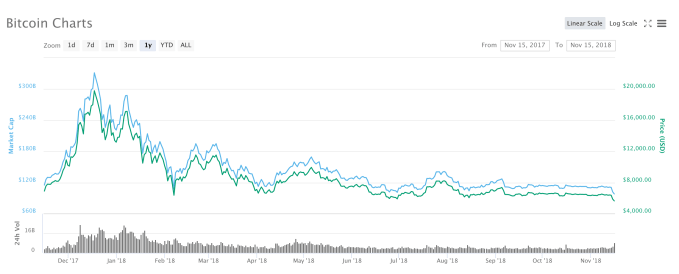
It’s not been a pretty year for anyone who owns Bitcoin, but the last 24 hours has been a period to forget as the cryptocurrency dropped below $100 billion in market cap for the first time in more than a year.

You have to go back to the end of October — the 29th to be precise — for the last time that the total circulation of Bitcoin in the market dropped below $100 billion.

It looks like this will be the first 24-hour period to hold that rate — so much for the relative price stability that many in the industry had complained about, be careful what you wish for!

The dip follows a decline that took Bitcoin’s price below the mark $6,000 for the first time this year — it has since plunged below $5,600. That, in turn, caused havoc in the altcoin market with valuations plummeting double-digit percentages nearly across nearly all of the top 100 valued tokens. Of the top ten, Cardano is down 14 percent, Litecoin 13 percent and Ethereum and EOS 12 percent. The changing prices also saw Ripple’s XRP token rise above Ethereum to become the second most valued cryptocurrency behind only Bitcoin.

As ever, the source of the malaise is tough to diagnose.

Bitcoin Cash, which is about to undergo a hard fork, looks to be the most likely cause.

Bitcoin Cash is about to undergo a hard fork that’ll result in two different chains — Bitcoin Cash ABC (BCHABC) and Bitcoin Cash SV (BCHSV) — and that has caused a great deal of uncertainty in the market.

You could argue that this situation caused the value of Bitcoin to decrease, that often draws owners of altcoins who trade their tokens for the cheaper Bitcoin. That movement can negatively impact both Bitcoin and the altcoins that are traded.

Of course, there are a wide number of theories as to what is happening out there. One thing that is for sure is that the markets are bleeding pretty hard today.

Note: The author owns a small amount of cryptocurrency. Enough to gain an understanding, not enough to change a life.

15 Nov 2018

Lies, damn lies, and HQ2

There are few things certain in our world except for the uplifting tendencies of technology. I’ve spent the past few years trying to prove this to myself, at least, by interviewing hundreds of thinkers on the topic. I’ve come to a singular conclusion: when tech moves into a city, be it an iOS dev shop or a robotic facility for making widgets, things change primarily for the better. Given the recent rush to gain 25,000 or so jobs from Amazon’s HQ2 and the subsequent grumbling by cities passed over, it is difficult to refute this, but I’d like explore it.

Many cities have gained from tech, both historically and recently. Pittsburgh, for example, had a plan to become a tech city back in the early 1990s after seeing the value coming out of Carnegie Mellon and the other universities in town. Anecdotally, Pittsburgh remained a fairly depressed steel town until at least 2000. I recall walking on CMU’s campus one weekend, long after my graduation in 1997, and marveling at how the small school had blossomed thanks to an influx of tech money. Next to halls named after dead and gone thinkers and makers was the Gates building, built with the largesse of the biggest tech maker in recent history. Then Uber moved in and all hell broke loose. In 19997 the Lawrenceville neighborhood was a rundown riverfront redoubt full of brown fields and finely-made hovels. Then Uber landed there. Now it’s become the hub for multiple research and tech companies and the neighborhood has blossomed, even rating it’s own corporation and team of boosters who invite you to dine in a spot once associated with dive bars and non-ironic pierogi. A few weeks ago I enjoyed Nashville hot chicken and Manhattans in what was once a funeral home for steel workers.

In short, having tech brings about what Richard Florida called the “creative class.” This group of makers, be they chefs, artists, coders, or engineers, all come to a place and almost inevitably improve it. In some cases this creative class is disparate, spreading throughout a city like a symbiotic fungus. In other places they are centered in a single neighborhood, working their magic from the core out. I’ve seen this in many places but none more clearly than in Toledo, Ohio or Flint, Michigan where a small core of artists are working mightily to turn a city in ruin into a place to live.

And I understand that all is not rosy in the world urban growth. Uber drivers in creative-classed cities are usually people displaced from their cheap rents by rich hipsters. As a friend noted, when you gentrify a place where to those who cannot afford artisanal kombucha, let alone the rent, go? They are either thrust into the suburbs – an irony that should give cities like Grosse-Point-ringed Detroit pause – or they vanish from view even though they exist in plain sight. Nowhere is this clearer then in the refuse-strewn streets of San Francisco.

Yet cities with deep, systemic problems still debase themselves to get tech jobs. They offer tax abatements, $1 land leases, and produce cloying videos to prove that they, alone, are the hardest working of the bunch. The first and most galling effort appeared when Foxconn, a massive manufacturing company, promised to land like an alien invasion force in rural Wisconsin. The idea there was simple: Foxconn wanted tax cuts in exchange for “creating” “jobs” – scare quotes in both cases necessary. As it had in Brazil before, Foxconn promised more than it could ever deliver. From a previous report:

Foxconn has created only a small fraction of the 100,000 jobs that the government projected, and most of the work is in low-skill assembly. There is little sign that it has catalyzed Brazil’s technology sector or created much of a local supply chain.

Manufacturing jobs are not tech jobs. In the end these true manufacturing jobs will end up going to countries with historically cheap labor pools and Foxconn will use its tax breaks to build a facilities in the US to help it abate future cross-border taxes. The jobs that it will create will be done by robots and only the smartest in these rural counties will get jobs… watching robot arms lift flatscreens off of an assembly line for years. Gone are the days of ubiquitous middle class manufacturing jobs and they will never come back. The sooner the heartland accepts this the better.

So cities turn to true tech. Cities know that tech helps and they bow to its captains of industry. But why won’t tech help cities?

Tech companies reduce inefficiencies. Self-driving car companies are aimed at reducing the number of inefficient truckers on the road. Drone companies are aimed at reducing the number of inefficient postal carriers on the sidewalk. And always-on audio assistants and smart devices are there to reduce our dependence on nearly every facet of a local ecosystem including the local weatherperson, the chef with an empty restaurant but hundreds of Seamless orders, and the local cinema. They know that when they land in a place they take over, much like Wal-Mart did in its early heyday. The benefits of this takeover are myriad but the erosion of culture they bring is catastrophic. Yet mayors still don silly hats and dance a merry jig to get them to move to their blighted areas. After all, it’s far easier than actually doing something.

The answer for cities, then, is to build from within. Pittsburgh didn’t get Uber because it prayed for that rude beast to stalk its shores. It got Uber because it built one of the best robotics programs in the country. Denver and Boulder aren’t tech hubs because they gave anyone a massive abatement. They became tech hubs because they became places that techies wanted to congregate and they built networks of technologists who left their cubicles on a weekly basis and met for lunch. That’s right: in many cases, all it takes for a tech scene to thrive is for the CTOs of all the major organizations to meet over curry. The network effects created by this are manifold. In fact, some of the biggest complaints I heard in many cities was that the CTOs of corporations who called those cities home – Chase Bank, GrubHub, etc. – rarely stepped out of their carefully manicured cubicle farms. An ecosystem cannot thrive if its most successful hide. Just ask Detroit.

Cities must subsidize creative districts, not creative destruction. Cities must woo technologists with a network of rich angels, not bribery. Cities must prepare for a future that doesn’t yet exist and hope that some behemoth will find a home there. Otherwise they’re sunk.

This sort of forward thinking is done in dribs and drabs across the country. Every city has its accelerators full of potential failure. These companies quickly discover that without seed capital, St. Louis or Chicago might as well be the Death Valley. Detroit has worked hard to create a startup culture and it seems to be working but in many cases these startups are folded, Borg-like into Quicken Loans and cannot stand on their own. The south is stuck in energy production and invests little in things that would draw technologists to the beautiful cities along the coast.

Maybe this is because startups make no money. Maybe this is because innovation is expensive. And maybe the lack of long-term strategy exists because mayoral staffs turn over so quickly in these convoluted times. These are valid excuses but woe betide the city that clings to them.

New York and Virginia got HQ2 because their cultures are mercenary at worst and transient at best. They already knew the hard bargain of technology versus culture and were willing to make the deal. The tens of thousands of folks who will walk through Amazon’s doors on the first day will change Long Island City for the better and no other city will claim those benefits (and detriments.) Tech is a business. It doesn’t care where it lands as long as there are enough college-educated behinds to sit on blue inflatable desk balls and enough mouths to drink free nitro coffee. It bypasses places that are seemingly entrenched in political infighting and failed innovation and it will continue to do so until cities do for themselves what Amazon will never do: future-proof their place in the world and create a place for generations to grow and change.


Photo by Michael Browning on Unsplash

15 Nov 2018

Snap up a spectator ticket to Startup Battlefield Africa 2018

Don’t miss your chance to bear witness as a cohort of sub-Saharan Africa’s exceptional entrepreneurs launch their early-stage tech startups to the world. Startup Battlefield Africa 2018, our premier pitch competition, takes place on 11 December in Lagos, Nigeria.

Join us to cheer on the competitors and enjoy a series of outstanding panel discussions from the region’s top tech and VC leaders. Spectator tickets cost $10 + VAT — they’re going fast, so grab your tickets today.

With more than 300 technology hubs connecting entrepreneurs across Africa, the continent’s startup scene continues to evolve and grow rapidly, which makes it an exciting time and place to be an early-stage startup founder or investor. That’s why — in addition to the Startup Battlefield competition — we’ve added exciting panel discussions to this action-packed day. We recruited a slate of experts to share their insight, discuss emerging trends and talk about what it takes to succeed in Africa’s diverse startup ecosystem.

You’ll hear from leading founders and investors alike. Here’s a sample of what to expect, and be sure to check out the full list of speakers.

  • Chris Folayan, the founder and CEO of Mall for Africa, a global economy e-commerce infrastructure company that lets Africans buy directly from international online retailers in the U.S. and Europe, as well as local online retailers in Africa
  • Nichole Yembra, chief financial, risk and investment officer for Venture Garden Group (VGG) and a managing partner at GreenHouse Capital
  • Olaoluwa Samuel-Biyi, co-founder at SureGifts, a Nigeria-based gift card retailer and technology provider

Of course, Startup Battlefield is the star of the show, and here’s a brief rundown of how it works. The format consists of three preliminary rounds with up to five startups going head-to-head in each round. Teams have just six minutes to pitch and present a live demo to a panel of judges consisting of top tech founders and VCs. Following each pitch, the judges get six minutes to ask in-depth questions.

No more than five teams move to the finals, where they’ll pitch again to a new set of judges — and answer a second round of Q&A. The judges confer and select one outstanding startup as the TechCrunch Startup Battlefield Africa 2018 champion. The winning founders receive US$25,000 in no-equity cash, plus a trip for two to compete in Startup Battlefield in San Francisco at TechCrunch Disrupt 2019 (assuming the company still qualifies to compete at the time).

The TechCrunch Startup Battlefield Africa 2018 action takes place in Lagos, Nigeria on 11 December. Tickets are limited; when they’re gone, you’re out of luck. Buy your spectator ticket today. We can’t wait to see you in Lagos!

15 Nov 2018

48-hours only: Early-bird prices for Disrupt Berlin 2018

Das ist super geil — this is awesome! Early-bird prices for Disrupt Berlin 2018 passes have returned to the roost. But you need to act fast, because our time-sensitive offer expires in just 48 hours. This opportunity translates to serious savings in any language — up to €500. Here’s even more good news. During this sale, anyone who buys a Startup Alley Exhibitor pass will receive three Founder passes instead of two.

The sale clock starts on 15 November at 12:00 a.m. and ends on 16 November at 11:59 p.m. (CET). Don’t waste another minute. Jump on this 48-hour flash sale and buy early-bird passes to Disrupt Berlin 2018 before they go extinct.

If there’s one thing you’ll find in abundance at Disrupt Berlin, it’s opportunity. From top-tier speakers and world-class networking to deep-dive panel discussions and Startup Battlefield — our world-renowned pitch competition — Disrupt Berlin is packed with people and events that shape the tech startup industry.

There’s no shortage of reasons to attend Disrupt, but don’t take our word for it. Listen to what your peers say about their Disrupt experience:

  • “TechCrunch Disrupt is one of the best startup conferences. It’s massive but so well organized, and the media exposure is much better than at other events. It’s a great place for startups to network for leads, investors, industry contacts and partnerships.” — Jana Rosenfelder, COO, Actijoy
  • “The exposure we received at TechCrunch Disrupt completely changed our trajectory and made it easier to raise funds and jump to the next stage.”— David Hall, co-founder and president of Park & Diamond.
  • “Disrupt was an amazing experience. It introduced us to a number of potential industries and partnerships that we would have never considered had we not had fresh sets of expert eyes looking at our technology.” — Amber Hopkins Grow, marketing consultant at Loji; principal, AHG Marketing.

And if that’s not enough to get you to pack your bags for Berlin, consider this. Founders who exhibit in Startup Alley might just win a shot to compete in the Startup Battlefield. Das ist super geil!

Disrupt Berlin 2018 takes place on 28-29 November, but this early-bird flash sale ends in just 48 hours. Don’t miss out, buy your passes today.

15 Nov 2018

Urban Massage re-brands to ‘Urban’ as it launches wellness services beyond massage

Urban Massage, the London-headquartered startup that lets you book a vetted massage therapist “on-demand”, is expanding into new wellness services in addition to changing its name.

Now simply called Urban, the company, which operates in several U.K. cities along with Paris, is adding the ability to book an expert nail technician, GOsC-regulated osteopath, or skin therapist. It will utilise the same logistics tech and app experience that enables therapists to be booked with as little as an hour’s notice.

Founder Jack Tang tells me the move into new wellness categories forms part of a wider strategy to build Europe’s leading “holistic wellness” platform. This will see the company add fitness, yoga and other mental wellbeing-focused activities in the near future, including meditation.

Further ahead, Urban has plans to integrate digital therapy services, such as counselling.

Urban founder Jack Tang

Urban founder Jack Tang

Tang says that since Urban launched back in 2014, it has provided 389,000 treatments, and today sees a 42 percent repeat rate for bookings. The company claims 101,000 active users, and 2,500 active therapists on its platform. Its wellness practitioners have collectively earned £16.4 million via Urban in the past four years, and, I’d suggest, in a much fairer deal than the “self-employed” terms often offered to massage therapists by hotels or spas.

As a side note, I’m a user of Urban, and book a regular massage after I injured my neck and shoulder earlier this year. Tang says this is pretty common, in that many people only embrace massage therapy to combat pain, but afterwards discover the longer term wellness benefits, especially in terms of managing stress within a major city.

He also says that customers were asking for additional wellness category products. Notably, many of Urban’s registered massage therapists have related expertise and treatment skills and also wanted a way to utilise them within a familiar platform.

Since TechCrunch last covered Urban, a lot has happened, including an announced funding round: In August 2016, Urban closed £3.5 million in a Series A led by Felix Capital. “We got on and focused on delivering best experiences to our customers,” says Tang, refreshingly. With no current neck pain, I reply that this was probably the right decision.

In February, Urban acquired two competitors: Milk Beauty, on the consumer side, and B2B focussed Freauty to bolster its corporate wellness offering. Most recently, the company raised a further £3.5 million in an equity crowdfunding campaign on Seedrs. This saw Urban add 800-plus new investors, the majority of whom are current customers, therapists, and staff, along with existing VC backers.

And this March, Urban launched “Urban Curates,” a collection of at-home treatments in collaboration with top beauty and wellness brands including the likes of Estee Lauder Companies, and Unilever Prestige. This, Tang explained, is viewed as a new retail channel for brands, whereby consumers want to make “experience-led” purchases as an alternative to the high street.