Year: 2018

15 Nov 2018

Google is closing its Schaft robotics unit after failing to find a buyer

Sad news for anyone into giant robots: Google is closing down Schaft, its secretive unit that develops bipedal robots aimed at helping out in disaster efforts and generally looking badass.

The news was first reported by Nikkei, but Google confirmed to TechCrunch that the business will be shuttered. It said it is helping staff find new roles, most of which will likely be outside of Google and its Alphabet parent.

Firstly up, many people — myself included — might have forgotten that Google owns Schaft .

The company was scheduled to be sold to SoftBank alongside Boston Dynamics — another of Google’s robotics ventures — through a deal that was announced last year. Boston Dynamics made the transition but Schaft didn’t. Softbank never shouted that omission from the rooftops, but a source with knowledge of the deal told us that certain conditions agreed for the deal were not fulfilled, hence Schaft remained with Google.

Our source explained that Google’s robotics focused shifted away from Schaft and instead to non-humanoid robots and industry-led solutions such as robotic arms. The departure of Andy Rubin, the controversial robotics evangelist who reportedly got a $90 million payout to leave amid sexual misconduct allegations, seemed to speed up its demise inside the organization.

Google shopped the Schaft business fairly widely — since 2016 and after the SoftBank deal collapsed — but to no avail, we understand. That left closing it down as the last remaining option.

Schaft was founded in 2012 by a group led by University of Tokyo professor Yuto Nakanishi.

Alphabet acquired Shaft and Boston Dynamics in 2013, the former was part of a group of seven acquisitions, in undisclosed deals.

There’s been plenty of attention on Boston Dynamics and its crazy, even scary, robots which can trek across all terrains and get up instantly when knocked over, but Schaft maintained a fairly quiet presence. Indeed, its first major prototypes weren’t revealed until some two years after its acquisition.
15 Nov 2018

Legrand acquires smart home startup Netatmo

French hardware startup Netatmo got acquired by the biggest manufacturer of switches and sockets in the world, Legrand. Terms of the deal are undisclosed.

Legrand and Netatmo already collaborated together on some products. Back in 2017, the company announced that it would work with industrial groups to connect everything in your home, starting with Legrand and Velux.

With Legrand’s “Céliane with Netatmo” switches and power outlets, you could build a house with a smart electrical installation from day one. This way, you could have a wireless master switch near your entrance, activate some outlets using Amazon Alexa and control your home from Messenger.

“Our strategy is the connected home. But there are some connected features that we can’t sell to consumers because those products are sold to professionals directly,” Netatmo founder and CEO Fred Potter told me at the time of the original announcement.

Netatmo’s team is going to be integrated into Legrand. Legrand plans to release more connected objects in the future. Netatmo founder and CEO Fred Potter is becoming CTO of Legrand’s research & development division. According to the announcement, Netatmo was generating $51 million (€45 million) in annual revenue.

Netatmo’s first product was a weather station. It works over Wi-Fi and was one of the first weather stations that you could check from your phone.

More recently, the company released security products, such as a connected camera that identifies faces on the device itself, a similar camera that works outdoor and a connected smoke alarm. Some people called Netatmo the “Nest of Europe” as the company also released smart thermostats and radiator valves.

15 Nov 2018

Welcome to the awkward future of the open office

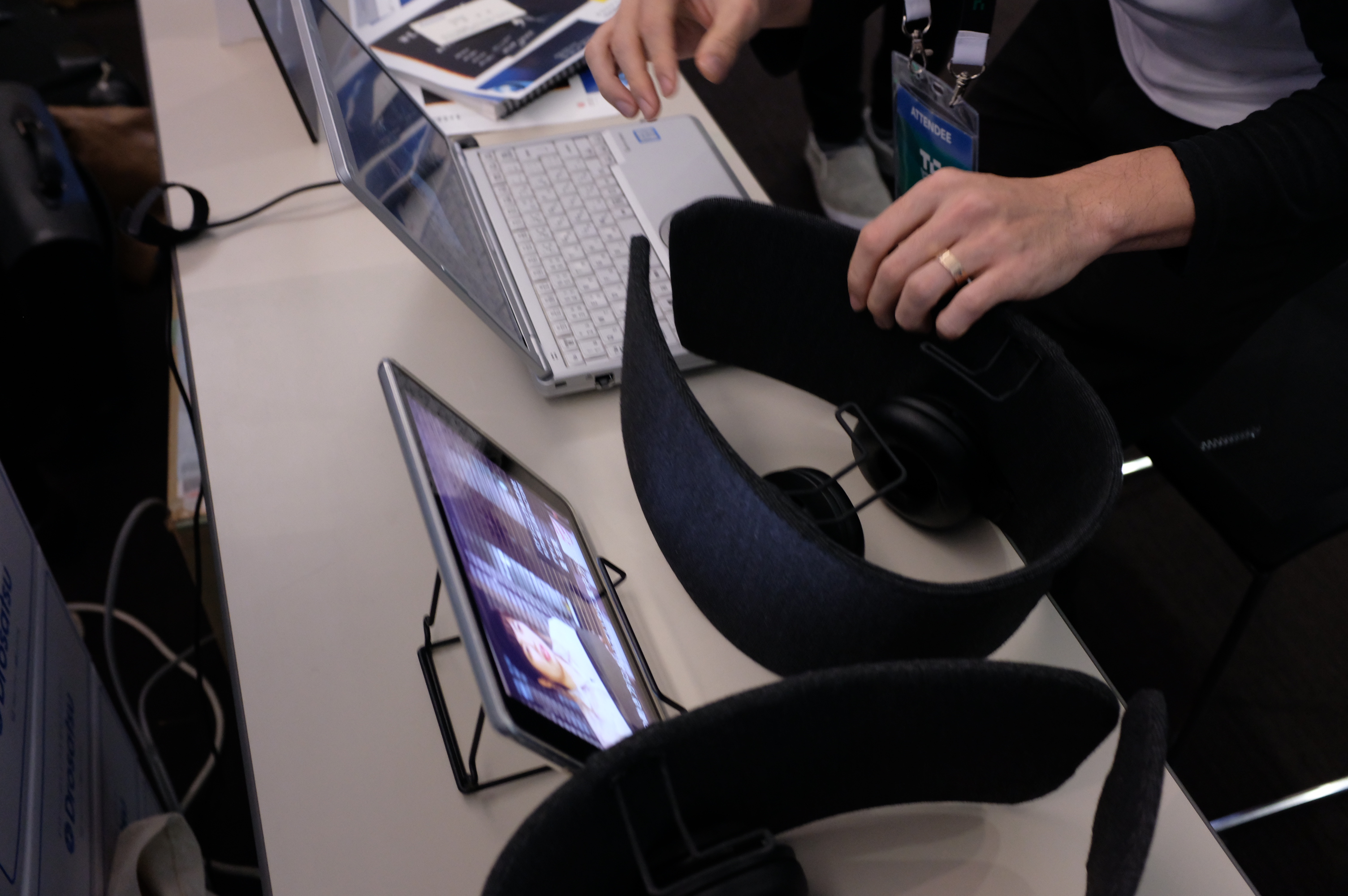
I have seen the future — in fact, I have worn it. It’s big and awkward kind of digs into the top of your head with little metal bars designed to hold it in place.

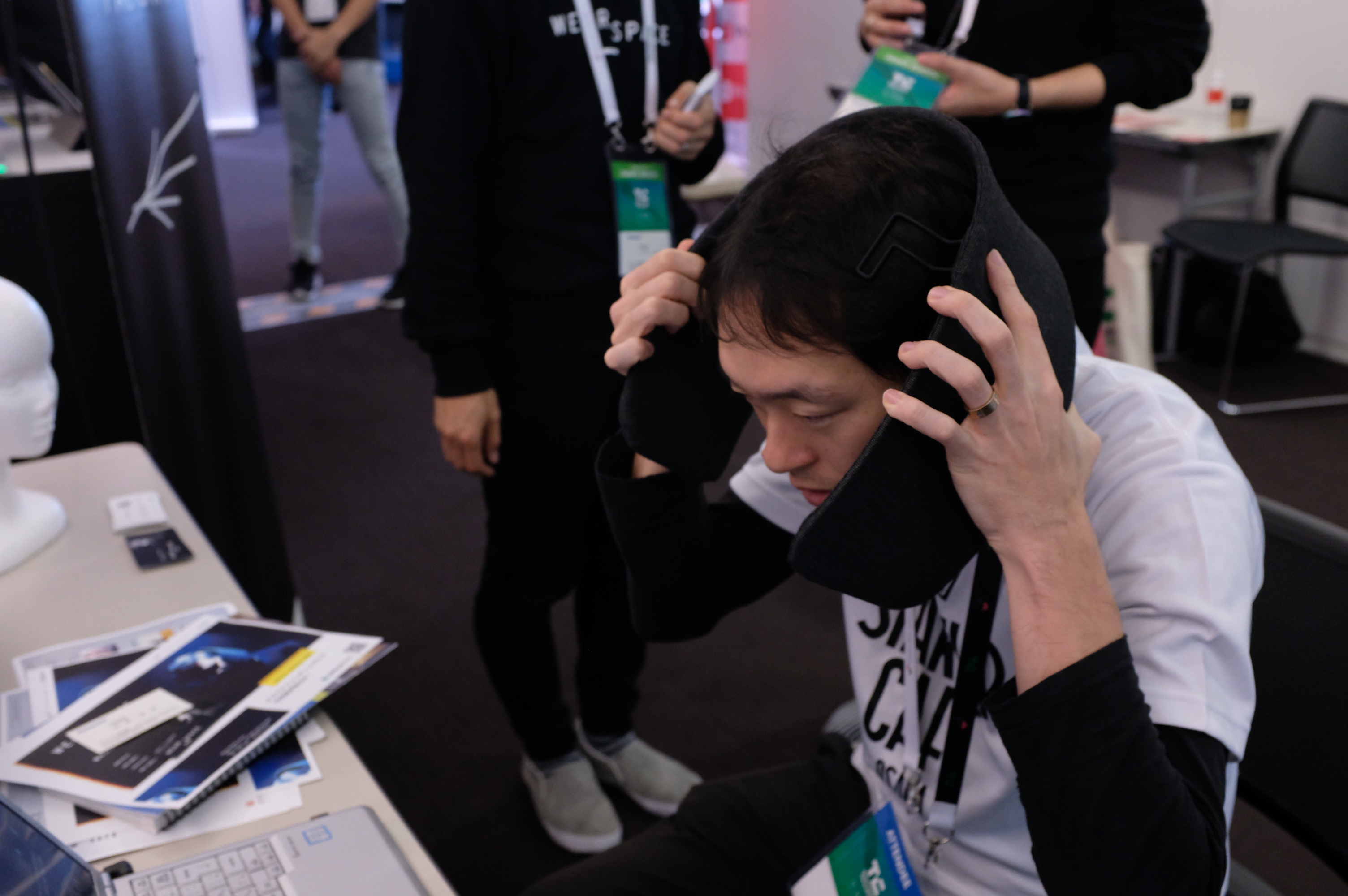
I was like 95 percent sure Wear Space was some viral bit of social commentary the first time it popped up online. And yet, here I am at a TechCrunch event in Tokyo and the horse blinder-style wearable was right there for all the world to see and try on. So try it on, I did.

The device is still very much in prototype mode, so the uncomfortable bit is something that will likely be resolved before the device starts shipping. The awkwardness of actually wearing the thing, on the other hand, is the sort of thing that takes time to dissipate.

The product is light weight — a good quality for something designed to be work on the head for hours at a time. It’s really just a wireframe with a cloth covering that blots out your peripheral vision, while still giving you plenty to look at in front of you. It somehow felt dystopian and weirdly comforting all at once. At very least, I feel like I have a new-found respect for horses.

Inside are a pair of on-ear headphones. They’re not noise canceling, so they won’t block out everything, but maybe having read on ambient noise is a net positive on something like this.

I will say this: having seen the bizarre things people will put on their heads for the 14 hour plane ride it took to get to Japan, nothing about the Wear Space feels out of the realm of possibility. I mean, if this can be a thing, why not, right?

Keep in mind, too, that we’ve done this to ourselves. Open offices were going to the be the great workplace revolution of the early 21st century, and all we got were these strange horse blinders for people.

15 Nov 2018

New York politicians push back on Amazon HQ2 plans

Amazon’s HQ2 process was bound to polarize (though I do enjoy a good dueling op-ed on these pages) no matter how it landed. But the decision to set up shop in New York City is likely ruffling more feathers than just about any other possible outcome.

As a resident of neighboring Astoria, Queens, the less I say about the matter the better — I’m going to assume you didn’t click on this story to read five paragraphs of me complaining about the N train and my rent.I will say I haven’t spoken to too many fellow NYC residents who are excited about the personal impact Amazon’s move will have on quality of life.

A number of local and state representatives are also finally starting to weigh in on the matter, and many of the comments don’t reflect the sort of capitalist cheerleading one anticipates from elected officials. Senator Kirsten Gillibrand took to Twitter to express “concern” with how the process played out.

In particular, the one-time Blue Dog Democrat (who handily won her latest Senate bid a few weeks back) singles out Amazon’s tax breaks, along with the impact on struggling families, writing, “One of the wealthiest companies in history should not be receiving financial assistance from the taxpayers while too many New York families struggle to make ends meet.”

New York assemblyman Ron Kim took things further, promising legislation aimed as using tax subsidies to help cancel student debt, rather than prop up Amazon. It’s a move that reflects Bernie Sanders’ recent successful bid to provide Amazon warehouse employees a $15 minimum wage.

Congress member-elect Alexandria Ocasio-Cortez expressed support for Kim and voiced her own disappointment in a deal that was brokered without community input.

“Amazon is a billion-dollar company,” Ocasio-Cortez wrote. “The idea that it will receive hundreds of millions of dollars in tax breaks at a time when our subway is crumbling and our communities need MORE investment, not less, is extremely concerning to residents here.”

15 Nov 2018

Sweet Escape connects travelers to photographers for truly Insta-worthy holiday pics

The rise of smartphone cameras and social media in recent years has fuelled a new level of marking and sharing memories using photos, but one startup is betting that people are prepared to go the next level and spend money to hire professional photographers to make their photos even better.

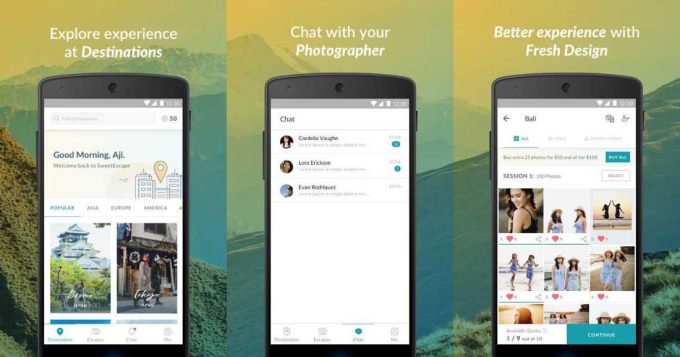
Focused on travel, Sweet Escape is an Indonesia-based startup that to work with over 2,000 photographers across over 400 cities in some 100 countries. The idea is simple. If you’re traveling — overseas or locally — and want high quality photos of your trip, or just part of it, you can use Sweet Escape to find and book out a local snapper for you and your group.

Photo shoots last for two hours and are charged at $300, Sweet Escape founder David Soong told TechCrunch in an interview, while activities vary from regular holiday snaps, to weddings and honeymoons, proposals, anniversaries, family get-togethers, graduations and more. While he didn’t disclose revenue, Soong said the three-year-old business has seen its revenue grow by 8X over the last year.

Sweet Escape has raised $1 million to date, including a recent seed round in August. Now it is aiming to raise its Series A to broaden its global focus, starting with more offices in Southeast Asia, and go beyond travel customers.

Though the thought of forking out $500 for photos doesn’t immediately appeal to me — the ultimate social media humbug — it isn’t hard to imagine a large demographic of travelers are open to it. Particularly when that cost is shared across a group and the photos are far higher quality than your average camera or selfie stick-mounted phone.

Already, Sweet Escape claims to have served 10,000 customers. It encourages users to book in advance but it also offers last-minute matching to photographers, all of whom are tightly vetted, with the photos themselves returned within three days. That’s a figure that Soong said will drop to 24 hours next year thanks to Sweet Escape’s in-house team, which handles all editing for the photographers.

But travel is just the starting point for Sweet Escape.

“Behavior has chained dramatically in the last 10 years,” Soong said. “We were more private but social media has changed the way people share — now, if you don’t have a picture of the trip then it isn’t real. But photos are an investment”

“More and more people are booking us for occasions like birthdays, holidays, graduations and others events, and we increasingly see more use cases than we originally envisaged. The travel angle allows us to scale much faster — if you look at Airbnb, you have to go global right away — but once we have a good amount of usage in a city, we can go deeper,” added COO and co-founder Emile Etienne.

Soong and his team of 70 are primarily in Jakarta with some staff located in the Philippines, but he is aiming to expand the on-the-ground presence in travel spots in Southeast Asia. That’s likely to include Singapore, Thailand and beyond, although the business isn’t just present in Asia — Sweet Escape already has a network of photographers covering 40 cities in the U.S. The idea is to help raise awareness of the service among consumers and photographers and explore more local services that the platform could host.

For photographers, Sweet Escape seems appealing because it can help remove the toil of having to bring clients in. Those for whom photography is a part-time hobby, in particular, can build it in and around their working and daily lives, Soong argued. Beyond taking quality photos — all photographers provide samples for assessment to join the platform — Soong said that would-be Sweet Escape snappers need to know their city, be proud of it and able to host guests who visit.

15 Nov 2018

These temporary electronic tattoos could redefine wearables

Wearables are great, sure, except you have to wear them. Wouldn’t it be nice if that functionality was printed right onto your skin? Well, even though it’s not for everybody, it sounds like it might soon be a possibility: CMU researchers have created a durable, flexible electronic temporary tattoo that could be used for all kinds of things.

This might sound familiar — we’ve been hearing about electronic tattoos for a while now. But previous methods were slow and limited, essentially painting oneself with conductive ink or attaching a thin conductive film. If the idea is going to take off, it needs to be easily manufactured and simple to apply. That’s what the team hopes they’ve accomplished here.

“We’re reporting a new way of creating electronic tattoos,” said CMU’s Carmel Majidi in a video from the university. “These are circuits that are printed on temporary tattoo film. We print circuits made of silver nanoparticles, and then what we do is we coat those silver nanoparticles with a liquid metal alloy. The liquid metal fuses with the silver to create these conductive wires on the tattoo; the tattoo can easily be transferred to skin, and the conductivity is high enough to support digital circuit functionality.”

The big advance, as co-author Mahmoud Tavakoli explained in a news release, is the ability to join the inkjet-printed nanoparticle patterns with the other metal (a gallium indium alloy) at room temperature.

“This is a breakthrough in the printed electronics area,” he said. “Removing the need for high temperature sintering makes our technique compatible with thin-film and heat sensitive substrates.”

In other words, it can easily be attached to fragile things like temporary tattoo film, cheap and abundant, or perhaps to a bandage. Fortunately the tattoos are also quite flexible, maintaining their functions when deformed, and won’t rub off easily.

The most obvious application is in the medical field, where a tattoo could perhaps replace a finger clip or armband heart monitor, or perhaps include chemical sensors that test blood sugar and alert the user if it gets too low. There are plenty of other ways that a skin-mounted circuit could be applied, but most haven’t been thought up yet. It may be time to brainstorm!

The paper describing the e-tattoo technique was published in the journal Advanced Materials.

15 Nov 2018

Indiegogo’s guaranteed shipping provides refunds for failed campaigns

For all the potential upsides of crowdfunding, backing a project always feels like a gamble. And some fairly high profile campaigns over the last few years have helped removed some of the model’s luster. Indiegogo’s hoping to curb some of those failures with guaranteed shipping, a new feature that suspends funding unless a product actual ships.

The crowdfunding site has laid out the terms of the program, which was first highlighted by The Verge. Guaranteed shipping will launch with a select number of campaigns early next year. Those Marketplace campaigns will feature a a badge letting users know they’re covered.

“Pre-Order sellers undergo an assessment for a period of up to 90 days to determine whether they will be able to ship on time,” the company writes on an FAQ page. “If Indiegogo isn’t satisfied with the results of that assessment, we’ll refund your order.”

The concept isn’t a rethink of crowdfunding exactly, but it does signal a shift in thinking for platforms in the wake of the first bubble. Indiegogo has spent the last few years attempting to diversify and reposition its offerings after former COO David Mandelbrot took over CEO duties from co-founder Slava Rubin back in 2016.

15 Nov 2018

Dolby releases branded wireless headphones

Dolby’s been making a bigger push for consumer recognition in the last few years, so it was really just a matter of time before it released a branded product. As far as those things go, headphones make as much sense as anything.

Even so, the over-ear bluetooth headphone market is a tough on to crack, between quality sets from Bose and Sony, along with the flashiness of Beats and its ilk. Dolby Dimension are working a pretty interesting angle here, however, as the “first wireless headphones perfected for home entertainment,” rather than going after the same frequent flier demo as most of the competition.

Reviews so far are pretty positive on both sound and comfort, which is nice, given the fairly astronomical $599 asking price. It’s a lot to ask for a pair of headphones catering to a relative niche in the overall market — after all, most of us likely find ourselves less inclined to wear a headset at home. It’s not like being on a plane or public transit where forcing others to listen to your music qualifies you as one of history’s greatest monsters.

The Dimension offers a premium build and the sort of sound quality one expects from Dolby calibrated devices. There’s also a number of different settings to let ambient sound in or block it out completely, along with some clever touches like head tracking, which keeps the sound source in place as you move.

The headphones are available online starting today and will be hit b8ta stores next month.

15 Nov 2018

Sweetgreen is officially a unicorn

Salad startup and retailer Sweetgreen recently raised a $200 million Series H round led by Fidelity that valued the company at more than $1 billion. This round brings Sweetgreen’s total amount of funding to $365 million.

With this additional $200 million in funding, Sweetgreen is setting its eyes on other food categories and looking to expand its delivery offerings. Sweetgreen is also looking at using blockchain technology to create more transparency in the supply chain.

“As a company we are focused on democratizing real food,” Sweetgreen co-founder and CEO Jonathan Neman said in a statement. “Our vision is to evolve from a restaurant company to a food platform that builds healthier communities around the world.

Sweetgreen has always been a tech-focused business with its order-ahead mobile app built in-house at the company. According to Forbes, Sweetgreen’s online ordering revenue is growing at 50 percent year over year. Since its launch in 2007, Sweetgreen has grown to 90 locations across eight states.

15 Nov 2018

Pirate Studios raises $20M from Talis Capital for its ‘self-service’ tech-enabled music studios

Pirate Studios, the music technology company that operates fully automated and self-service 24 hour music studios, has secured $20 million. The investment was led by Talis Capital, the London-based VC family office.

Talis was already an existing backer of Pirate Studios, with Talis’ Matus Maar also named as a co-founder of the startup. Other investors include Eric Archambeau (Spotify investor and ex-partner at Benchmark and Wellington Partners), Bart Swanson of Horizons Ventures, and partners of Gaw Capital, the $20 billion Hong Kong-headquartered proptech fund.

The new funding will enable Pirate Studios to continue to expand across the U.K., Germany and the U.S., where it has been building what the startup describes as a community of musicians, DJs, producers and podcasters who need access to professional rehearsal, production and recording studios at affordable rates. The company charges as little as £4 per hour, depending on what kind of music studio space and facilities you book.

However, what really sets Pirate Studios apart from a lot of existing rehearsal rooms and music production and recording studios, is that the startup is employing a lot of tech to power the logistics around its service and, in theory, make it a lot more scalable. This includes online booking, 24 hour keycode access, and other IoT controls for managing facilities.

Perhaps even smarter, Pirate Studios offers “automated recording” and live streaming from many of its studios. This means that bands or DJs rehearsing in one of the company’s rooms can easily record their session via built in room mics and other inputs, and the studio’s cloud software will handle mixing and mastering afterwards. Likewise, rooms are set up to be able to video and audio stream sessions, too.

Both options tap into the YouTube, SoundCloud, and Spotify generation’s unstoppable appetite for more content from their favourite upcoming and established acts, as well as the dreaded music industry’s favourite new metric: how much social media reach an act has, which can in turn make or break a recording contract opportunity or the chance to get booked at larger, more lucrative live events.

I say all of the above as someone who was previously in quite a serious band and used to book rehearsal rooms on a regular basis. I’m also still in touch and collaborating with a number of gigging musicians and professional acts. However, during the last ten years, I’ve seen quite a few studios in London go out of business as property owners look to cash in, and even though there is something a little WeWork about Pirate Studios’ model (and being backed by relatively large amounts of VC cash at this stage) which makes me slightly uneasy, overall I’m very bullish on what the company offers.

Without a place to practice, hone your craft, in addition to somewhere to perform, rock ‘n’ roll really would be dead.

To that end, in just three years, Pirate has grown to 350 studios in 21 locations, including London, New York, and Berlin.

Cue statement from David Borrie, co-founder and CEO of Pirate Studios: “When we founded Pirate Studios our dream was to create innovative spaces to support emerging talent. We want to see music thrive and help musicians get their music out to their fans, through whatever route they think is most appropriate. We are building both the physical space to create, as well as the technology to record and share, that puts power back into the hands of musicians in a period when the digitisation of music continues to radically upset the old order of this industry”.