Year: 2018

14 Nov 2018

Here’s the teaser trailer for Niantic’s Pokémon GO-style Harry Potter game

The good news: Niantic/WB Games/Portkey has released a trailer for Wizards Unite, the Harry Potter game built in the same spirit as Pokémon GO.

The bad news: It… doesn’t show much.

If you were hoping for gameplay footage or really anything detailing how the game will work, you’re out of luck. Alas! It’s just a teaser trailer, and tease it does.

The game’s newly expanded website, meanwhile, adds just:

Please resist the urge to panic. Traces of magic are appearing across the Muggle world without warning and in a rather chaotic manner. We worry it is only a matter of time before even the most incurious Muggles catch wind of it. We call on all witches and wizards to help contain the Calamity or risk the worst of times since You Know Who. Brush up on your spells, get your wand ready, and enlist immediately.

The one big new detail? The game’s launch timing. While Niantic was reportedly aiming for the end of 2018, this trailer puts it in no uncertain terms: it’ll land in 2019.

14 Nov 2018

MacBook Pro with updated GPU is now available

Apple recently unveiled a bunch of new products during a press event in New York. But the company also quietly shared a press release with new configurations for the 15-inch MacBook Pro. Customers can now get a MacBook Pro with an AMD Radeon Pro Vega 16 or Vega 20 graphics processing unit.

Before this update, users could only get Radeon Pro 555X or 560X GPUs. Those options are still available, but you can now pay a bit more money to get much better GPUs.

As the name suggests, Vega is a new generation of graphics processors. The iMac Pro comes with desktop-class Vega processors — the Vega 56 and Vega 64. The Vega 16 or Vega 20 are less powerful than the iMac Pro GPUs. But they also fit in a laptop and consume much less power.

In particular, Radeon Pro GPUs use GDDR5 memory just like the PlayStation 4 and Xbox One X. But Vega GPUs now take advantage of HBM2 memory, which provides more bandwidth and consumes less power.

It leads to a direct bump in performance. Apple says you can expect as much as 60 percent faster graphics performance. But we’ll have to wait for the benchmarks to know that for sure.

Vega GPUs are only available on the most expensive 15-inch MacBook Pro configuration that starts at $2,799 with a Radeon Pro 560X. Upgrading to the Vega 16 costs another $250, while the Vega 20 is $350 more expensive than the base model.

14 Nov 2018

Converscent wants to make it easier for companies to measure ethical behavior

It’s not always easy to do the right thing or to make ethical decisions in a complex business environment. People get lost inside large organizations and group think can overwhelm even normally ethical individuals. Converscent has created a platform to help, and today it announced a new benchmarking dashboard to allow companies to measure just how well they are doing from an ethical perspective.

In recent times, we’ve witnessed the impact it has when companies don’t behave ethically. Converscent CEO Patrick Quinlan says that there is real cost for behaving badly both in terms of dollars and reputation. He believes that it’s in a company’s best interest to stay on top of undesirable behavior before it spirals out of control.

Quinlan pointed out whether it’s the diesel scandal at Volkswagen or the sexual harassment revealed by Susan Fowler at Uber, it has changed the conversation about ethics. He says it’s no longer just about bottom line financial results, how you behave as a company matters too in the court of public opinion and in financial markets.

He believes this can be measured and the Converscent Ethics Dashboard is designed to provide metrics about how well your company is complying with a set of internal guidelines. The Conversent platform includes components to enable employees to safely report bad practices going on in a company such as bribery, corruption, sexual harassment and more. A more automated API driven system pulls in data from a variety of internal systems and analyzes that for ethical gaps.

Much like companies audit their financial systems, you can start to audit how ethical the organizational structure is and how negative behavior is being handled. The company not only looks at internal data, it can help customers benchmark against others in their industries. Quinlan says that it’s possible to spot a trend even before someone reports it.

“Sometimes you have this interactive code of conduct, where there’s a new vice president in a region and suddenly page views on the sexual harassment section of the Code of Conduct have increased 200% in the 90 days after he started. That’s easy, right? There’s a reason that’s happening, and our system will actually tell you what’s happening,” Quinlan explained.

He says trend reporting like this can help a company spot a problem before it spirals out of their control. In other cases, it may be more subtle, but Converscent can pick up less obvious trends as well.

Conversent, which launched in 2013, has raised almost $72 million. They have 630 customers with 6.4 million employees accessing the Converscent platform. Customers include Kimberly Clark, Microsoft, Capgemini and Under Armour.

14 Nov 2018

Wreck-It Ralph is getting a warehouse-sized VR game at Disney parks

For the last year or so, Disney has been dabbling with massive virtual reality experiences that let players strap on a portable VR rig and run around in a warehouse-sized environment. In partnership with The VOID (part of Disney’s 2017 accelerator class) and Lucasfilm’s ILMxLab, it launched a Star Wars-themed experience, Secrets of the Empire, at both Downtown Disney (California) and Disney Springs (Florida) back in November of 2017.

The next Disney property getting the VR treatment? Wreck-It Ralph.

Here’s the trailer, released this morning:

Based on the upcoming movie sequel “Ralph Breaks the Internet,” this one will be called, aptly, Ralph Breaks VR. Like Secrets before it, the Ralph game will support four players running around a shared VR environment — but rather than dodging blaster fire and outsmarting stormtroopers, they’ll be having food fights with kittens and outrunning security drones.

While I’m mostly neutral on Ralph, I’m… pretty excited for this. Secrets of the Empire is one of the most ridiculous experiences I’ve ever had in virtual reality. It’s hard to say much without spoiling some of the moments, but my jaw was on the damned floor for half of the time. Alas, there wasn’t much time to speak of; the entire thing only lasts about 25 minutes — which, at $30 per person, felt way too short. Tickets for Ralph cost roughly the same; depending on location, it’ll be $30 or $33 per person.

A representative for Disney confirms that Secrets of the Empire is not going away. It’s an upside of the game taking place almost entirely in VR — retune the physical space to be a bit less Star Wars-y, schedule things just right, and you’re all set.

(Oh, and while details are light: after Ralph, they’re working on a Marvel-themed experience set to debut in 2019.)

Tickets for the Ralph experience are available starting next week. In addition to VOID’s Disneyland/Disneyworld locations, it’ll also be running at their Glendale, Calif. and Las Vegas spots.

14 Nov 2018

Google My Business app revamp challenges Facebook Pages

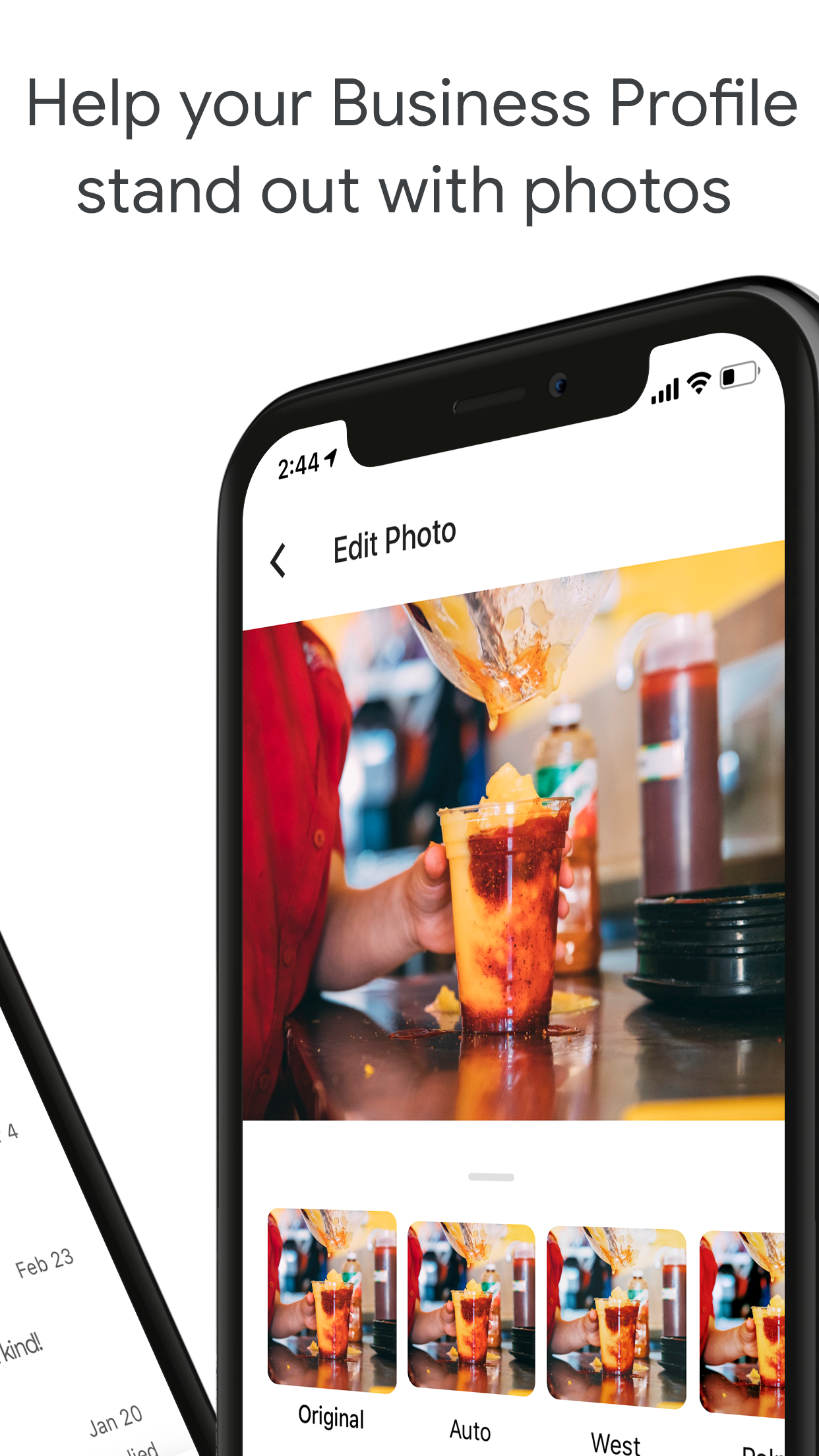
Google is giving its business customers a new way to reach their customers. The company is today starting the rollout of a revamped Google My Business mobile application for iOS and Android that will offer new tools for viewing customer info — including followers, reviews and messages — as well as a way to quickly create content to publish to their business profile on Google.

The changes arrive shortly after a recent update to Google Maps that introduced a new “Follow” button for tracking businesses, in order to stay informed about promotions, events and other news. The move made Google’s business profiles more of a direct competitor with Facebook Pages.

In the redesigned Google My Business app, a new “Customers” tab will centralize a business’s customers and their potential customers — like those who have chosen to follow the business, as noted above. Here, the business owner can track their reviews and view and respond to their messages.

Photocentric posting experience - Scale

To reach a business, customers are able to use a “Message” button on Google Maps or from Google Search to connect.

Before, businesses had to respond to these incoming messages from their device’s messaging platform. This is the first time they’ve been able to do so from within the Google My Business app. Messaging was also previously limited to the U.S., Canada, Brazil and India, but will now be available across most countries worldwide as of this week.

Also new is a “Posts” button that allows business owners a way to add content updates to their business profile on Google.

For example, a business may want to alert customers about an upcoming sale or promo, an event or new products they have for sale.

These are the sorts of updates they would have normally published elsewhere on social media, like Facebook, Instagram and Twitter, perhaps. Now, they’ll be encouraged to do the same on Google’s platform, too, because of the potential to reach a wide range of customers through Google Maps and Search.

Google says the updates to the Google My Business app will begin to roll out on iOS and Android starting today, November 14.

14 Nov 2018

Zuckerberg rejects facetime call for answers from five parliaments

Facebook has declined once again to send its CEO to the UK parliament — this time turning down an invitation to face questions from a grand committee comprised of representatives from five international parliaments.

MPs from Argentina, Australia, Canada, Ireland and the UK have joined forces to try to pile pressure on the company’s founder, Mark Zuckerberg, to answer questions related to his “platform’s malign use in world affairs and democratic process”.

The UK’s Digital, Culture, Media and Sport committee, which has been running an enquiry into online disinformation for the best part of this year, revealed the latest Facebook snub yesterday. It put out the grand committee call for facetime with Zuckerberg last week.

In the latest rejection letter to DCMS, Facebook writes: “Thank you for the invitation to appear before your Grand Committee. As we explained in our letter of November 2nd, Mr Zuckerberg is not able to be in London on November 27th for your hearing and sends his apologies.”

“We remain happy to cooperate with your inquiry as you look at issues related to false news and elections,” the company’s UK head of public policy, Rebecca Stimson, adds, before going on to summarize “some of the things we have been doing at Facebook over the last year”.

This boils down to a list of Facebook activities and related research that intersects with the topics of election interference, political ads, disinformation and security, but without offering any new information of substance or data points that could be used to measure and quantify the company’s actions.

The letter does not explain why Zuckerberg is unavailable to speak to the committee remotely, e.g. via video call.

Responding to the latest snub, DCMS chair Damian Collins expressed disappointment and vowed to keep up the pressure.

“Facebook’s letter is, once again, hugely disappointing,” he writes. “We believe Mark Zuckerberg has important questions to answer about what he knew about breaches of data protection law involving their customers’ personal data and why the company didn’t do more to identify and act against known sources of disinformation; and in particular those coming from agencies in Russia.

“The fact that he has continually declined to give evidence, not just to my committee, but now to an unprecedented international grand committee, makes him look like he’s got something to hide.”

“We will not let the matter rest there, and are not reassured in any way by the corporate puff piece that passes off as Facebook’s letter back to us,” Collins adds. “The fact that the University of Michigan believes that Facebook’s ‘Iffy Quotient’ scores have recently improved means nothing to the victims of Facebook data breaches.

“We will continue with our planning for the international grand committee on 27th November, and expect to announce shortly the names of additional representatives who will be joining us and our plans for the hearing.”

14 Nov 2018

Judge orders Amazon to turn over Echo recordings in double murder case

A New Hampshire judge has ordered Amazon to turn over two days of Amazon Echo recordings in a double murder case.

Prosecutors believe that recordings from an Amazon Echo in a Farmington home where two women were murdered in January 2017 may yield further clues to their killer. Although police seized the Echo when they secured the crime scene, any recordings are stored on Amazon servers.

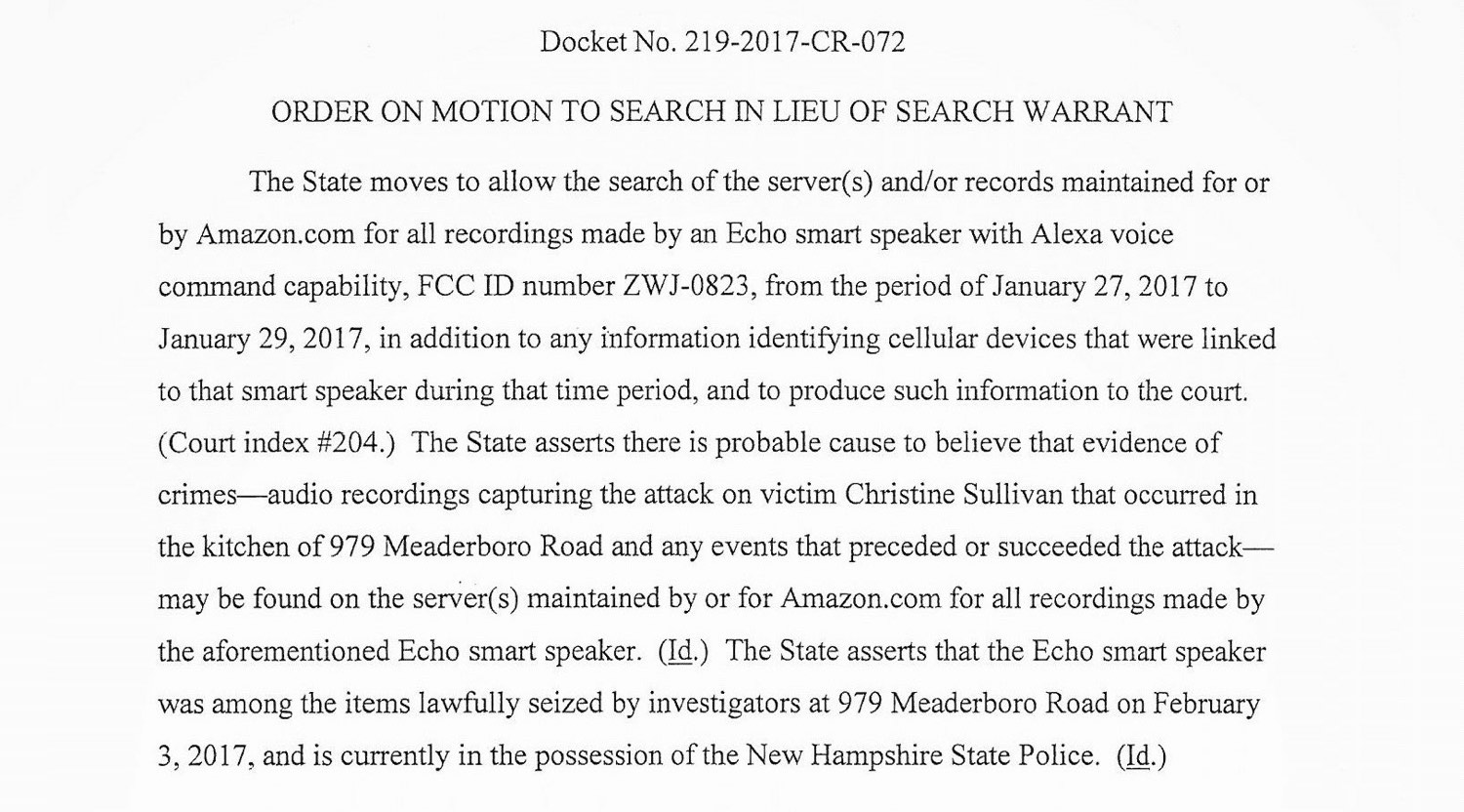
The order granting the search warrant, obtained by TechCrunch, said that there is “probable cause to believe” that the Echo picked up “audio recordings capturing the attack” and “any events that preceded or succeeded the attack.”

Amazon is also directed to turn over any “information identifying any cellular devices that were linked to the smart speaker during that time period,” the order said.

Timothy Verrill, a resident of neighboring Dover, N.H., was charged with two counts of first-degree murder. He pleaded not guilty and awaits trial.

When reached, an Amazon spokesperson did not comment — but the company told the Associated Press last week that it won’t release the information “without a valid and binding legal demand properly served on us.”

New Hampshire doesn’t provide electronic access to court records, so it’s not readily known if Amazon has complied with the order, signed by Justice Steven Houran, on November 5.

A court order signed by New Hampshire Superior Court on November 5 ordering Amazon to turn over Echo recordings. (Image: TechCrunch)

It’s not the first time Amazon has been ordered to turn over recordings that prosecutors believe may help a police investigation.

Three years ago, an Arkansas man was accused of murder. Prosecutors pushed Amazon to turn over data from an Echo found in the house where the body was found. Amazon initially resisted the request citing First Amendment grounds — but later conceded and complied. Police and prosecutors generally don’t expect much evidence from Echo recordings — if any — because Echo speakers are activated with a wake word — usually “Alexa,” the name of the voice assistant. But, sometimes fragments of recordings can be inadvertently picked up, which could help piece together events from a crime scene.

But these two cases represent a fraction of the number of requests Amazon receives for Echo data. Although Amazon publishes a biannual transparency report detailing the number of warrants and orders it receives across its entire business, the company doesn’t — and refuses — to break down how many requests for data it receives for Echo data.

In most cases, any request for Echo recordings are only known through court orders.

In fact, when TechCrunch reached out to the major players in the smart home space, only one device maker had a transparency report and most had no future plans to publish one — leaving consumers in the dark on how these companies protect your private information from overly broad demands.

Although the evidence in the Verrill case is compelling, exactly what comes back from Amazon — or the company’s refusal to budge — will be telling.

14 Nov 2018

ServiceTitan raises $165M for its home services software, now valued at $1.65B

ServiceTitan, a startup out of Glendale, CA that has built a software platform for home services businesses — in areas like air conditioning, plumbing and electrical repairs — to manage their work, has raised $165 million in what it claims is the “largest software raise in Southern California history.”

(That distinction might be specifically for B2B software, since Snap, as one example, raised billions before it went public, when it was still known as the app startup Snapchat.)

The company has confirmed that its valuation is now at $1.65 billion — making it the newest unicorn out of the region (and fulfilling a prediction we made earlier this year).

This latest round, a Series D, was led by Index Ventures. New backers Dragoneer and T. Rowe Price also participated, along with existing investors Battery Ventures, Bessemer Venture Partners and ICONIQ Capital.

It’s coming just 7 months after ServiceTitan raised its last round: rapid funding rounds of large sums of money, raised within months of each other, seems to be a trend at the moment, underscoring the current state of the market where VCs have themselves raised huge funds and are looking for safe harbours and fast-growing companies in which to invest them. (As two examples, just earlier today, UiPath announced another huge round, its third fundraising this year; and Nikola Trucking also raised its second round of the year.)

The funding will be used for bringing on more talent — it’s already hired from Google, Netflix, Adobe and Accel — as well as business development and to build more software to fill out a vision of becoming “the operating system for home services.” It’s also been making acquisitions, and this could help with that, too.

This is potentially a huge market, with some $400 billion spent on home service repairs annually in the US alone.

ServiceTitan was co-founded by two Armenian Americans, Ara Mahdessian and Vahe Kuzoyan, in 2012, after they met on a ski trip organized by the Armenian student associations at Stanford and the University of Southern California when they were still were in college. The startup was borne out of work both were doing after college to build software to help their fathers, who worked in air conditioning contracting, run their businesses. 

Small businesses often are some of the most overlooked when it comes to tech innovations, even more so when they come from relatively unsexy industries like air conditioning repair, but they need solutions as much as larger organizations. ServiceTitan’s rise has come from filling that gap in the market.

It says it is on track to double subscription revenues this year, with some 2,500 customers on board covering some 50,000 technicians and $10 billion of services in areas like plumbing, air conditioning, electrical and garage door repair, working out to nearly 20 percent of homes across the US and Canada.

“The ServiceTitan mission has always been personal to us,” said Ara Mahdessian, co-founder and CEO of ServiceTitan, in a statement. “Our software powers the tireless men and women of home services who ensure the world has the basic necessities of life: running water, relief from the scorching heat and biting cold, power and electricity, and more. We take it for granted today, until our toilets back up, our air conditioning goes out during the heat of summer, or our lights go out in the middle of the night. These are the heroes that come to our rescue, and we’re here to help them be more efficient and successful.”

ServiceTitan is not the only company eyeing up the space, of course: aggregators like Amazon and Angi Homeservices (formerly Angie’s List) are providing a way for independent contractors and small franchises to connect with customers, and they will inevitably also look to provide the accounting and other software to help these companies run their businesses in their two-sided marketplaces.

ServiceTitan believes it has an edge. “Our software helps our customers with nearly every workflow in their business, including CRM, scheduling, dispatch, mobile invoicing, payments, inventory, and more,” said Vahe Kuzoyan, co-founder and President of ServiceTitan, in a statement. “We’re now integrating with large partners to enable the future of home services, including real-time appointment booking integrations with partners like Yelp and others, as well as supply-chain integration with partners like Lennox and others.”

With this round, Index’s Nina Achadjian is joining the board. “Ara and Vahe started ServiceTitan because they wanted to solve the pain point they felt first hand running their fathers’ businesses,” she said. “Since then, the company has revolutionized how plumbers, electricians, air conditioning technicians and thousands of others in other trades run their businesses. The best part is that ServiceTitan is just getting started. We could not be more excited to be a part of their journey to transform the $400 billion home services market.”

14 Nov 2018

Mozilla ranks dozens of popular ‘smart’ gift ideas on creepiness and security

If you’re planning on picking up some cool new smart device for a loved one this holiday season, it might be worth your while to check whether it’s one of the good ones or not. Not just in the quality of the camera or step tracking, but the security and privacy practices of the companies that will collect (and sell) the data it produces. Mozilla has produced a handy resource ranking 70 of the latest items, from Amazon Echos to smart teddy bears.

Each of the dozens of toys and devices is graded on a number of measures: what data does it collect? Is that data encrypted when it is transmitted? Who is it shared with? Are you required to change the default password? And what’s the worst case scenario if something went wrong?

Some of the security risks are inherent to the product — for example, security cameras can potentially see things you’d rather they didn’t — but others are oversights on the part of the company. Security practices like respecting account deletion, not sharing data with third parties, and so on.

At the top of the list are items getting most of it right — this Mycroft smart speaker, for instance, uses open source software and the company that makes it makes all the right choices. Their privacy policy is even easy to read! Lots of gadgets seem just fine, really. This list doesn’t just trash everything.

On the other hand, you have something like this Dobby drone. They don’t seem to even have a privacy policy — bad news when you’re installing an app that records your location, HD footage, and other stuff! Similarly, this Fredi baby monitor comes with a bad password you don’t have to change, and has no automatic security updates. Are you kidding me? Stay far, far away.

All together 33 of the products met Mozilla’s recently proposed “minimum security standards” for smart devices (and got a nice badge); 7 failed, and the rest fell somewhere in between. In addition to these official measures there’s a crowd-sourced (hopefully not to be gamed) “creep-o-meter” where prospective buyers can indicate how creepy they find a device. But why is BB-8 creepy? I’d take that particular metric with a grain of salt.

14 Nov 2018

Amazon did exactly what it should have with its HQ2 process

I love my colleague Jon Shieber, he’s a great guy. But his arguments against Amazon’s HQ2 process are just wrong, and are part of an increasingly poisonous atmosphere around employment growth and prosperity in America.

Our normally-scheduled analysis of AI and semiconductors will (hopefully) restart tomorrow.

We are experimenting with new content forms at TechCrunch. This is a rough draft of something new – provide your feedback directly to the author at danny@techcrunch.com if you like or hate something here.

A tale of three arguments

Shieber’s pointed argument yesterday falls in line with the wider debate about gentrification and the steep inequality of today’s digital economy. “Amazon played everyone involved in the process: the governments that pandered to it and the media that covered it (including us),” he wrote. “Now it looks like the residents of these communities that will have to live with their new corporate neighbor are going to be left to pay for it.”

Shieber sees essentially three problems with Amazon’s HQ2 process and announcement:

  1. Amazon’s wealth drives its corporate power, which forces governments to do its bidding by applying to its reverse RFP process.
  2. The incentive packages lined up by NYC and Northern Virginia are a form of corporate welfare that would be better used for everyday citizens, plus Amazon would have come anyway.
  3. Amazon is not-transparent about its data or process, even while it collected data from hundreds of city governments.

Let’s take a look at that analysis.

Cities win and lose

In the normal world of economic development, cities post potential projects as Requests for Proposals (RFPs) and then wait for applications to come in, read through them, and select a winner. This is the process that New York City went through recently in selecting a group of firms to operate its new cybersecurity initiative. It’s reasonably transparent, and it is theoretically meritocratic, urban machine politics aside.

Increasingly though, companies have learned that cities will come far and wide to fight for jobs. In fact, rather than bidding for projects and having city governments or their economic development agencies select winners, companies can propose projects, have cities bid, and then the CEO can make the call. I call this a “reverse RFP.”

Almost three decades ago, United ran a reverse RFP process for the creation of a $1 billion maintenance facility which ended up being a fight between Oklahoma City and Indianapolis. As The Oklahoman wrote at the time: “United Airlines on Wednesday chose Indianapolis as the site of its $1 billion aircraft maintenance center, making Oklahoma City a loser in the race for what some termed the biggest industrial development project of the decade.” Sound familiar?

Last year, Foxconn extracted up to $4.8 billion in subsidies from Wisconsin as part of a process to build a new display manufacturing plant. And of course, Amazon ran its very public process over the past months.

Shieber wrote:

That Amazon felt comfortable enough to flip the script and instead have cities bid for the largesse of a corporation was galling enough. The fact that cities across America actually did the company’s bidding was proof of just how feckless, toothless, and seemingly powerless government at every level in this country has become.

Here’s the thing: Amazon is its own entity. It can make decisions for itself, in any way it chooses. Typically, corporate offices expand based on the personal decision of the CEO, maybe with some feedback from the board. When Square launched a customer operations office, it chose St. Louis, where its CEO Jack Dorsey is from. Such decisions get made every day with little input from cities.

Instead, Amazon opened that process up. It allowed cities to apply and provide information on why they might be the best location for its new headquarters. Maybe the company ignored all of the applications. Maybe it only ran the process to collect data. Maybe it just wanted the publicity. Maybe all of the above, and more. Regardless, it allowed input into a decision it has complete and exclusive control over.

Are cities “feckless” for applying? Should cities avoid competing tête-à-tête for jobs? Of course not. Cities compete every single day for individuals to move in, for small businesses to start, for federal tax funding. That competition is fundamentally a force for good, since it disciplines cities to make their residents — and future residents — happy. That’s one reason why Americans approve their local governments at 70%, and Congress remains mired in the single digits.

Amazon’s process hopefully woke up a number of slumbering city governments to the reality that their hometowns are not relatively as attractive as other cities.

Jobs and incentives

Photo: Chris Hepburn/Getty Images

Much of the ire over the Amazon announcement yesterday originated from the company’s combined multi-billion dollar incentive packages that it received from NYC and the DC metro. Amazon is already one of the wealthiest companies in the world, so why then does it need further incentives that divert tax dollars from other worthy causes?

As Shieber wrote:

As housing prices climb in Queens for rentals, cooperatives and condominiums, the neighborhood’s existing residents will likely be unable to afford the higher property prices. They’ll be moved out and essentially Amazon will be paying for infrastructure upgrades likely to be enjoyed solely by the company’s employees — again, at the expense of the broader tax base.

The challenge to that line of reasoning, which was common in many of the arguments against the HQ2 process, is failing to look at economic development holistically as a system. Opponents spend too much time focused on the tax receipts from income from new Amazon employees versus incentives, and not nearly enough time on all the spillover effects that will take place in these two regions.

These spillover effects are at the heart of agglomeration economies. With Amazon’s arrival, more software engineers will locate to NYC. They will start companies, join other tech firms, and expand the vitality of the community. As Edward Glaeser argues convincingly in his book The Triumph of the City, density of talent matters enormously for the success of the city. Amazon thickens the market for tech talent, and that is a huge win for both NYC and DC.

For a concrete example, Cornell Tech officially launched last year on NYC’s Roosevelt Island, which is located one subway stop from the proposed Amazon headquarters. What will the opening up of Amazon mean for the future of that new campus and its graduates? Does Cornell Tech have a better shot now at being a leading university in the computer sciences? Will more talent be drawn to Cornell Tech and ultimately into the NYC economy because of this co-location? It’s really hard to know or quantify, but the answer is almost certainly not zero.

Besides the lack of focus on spillovers, there is also this anti-gentrification line though that always grates on me. If Amazon’s plans are realized, it will deliver thousands of six-figure jobs into the city. As Enrico Moretti notes in his own book The New Geography of Jobs, it is exactly these sorts of jobs with high incomes that drive the economic vitality in cities. Killing the economy may be one way to lower housing prices, but it is a pretty foolish one.

Plus, I think there is a massive scale problem in people’s analysis of the incentives. Amazon’s incentive package for New York comes out to $1.5 billion or so. As a cost comparison, the East Side Access rail project, for instance, costs $3.5 billion a mile. New York’s incentive package is about 2,300 feet of rail, or roughly the distance between 2nd Ave and 6th Ave.

Tech jobs are bringing new wealth to cities, and obviously there are huge challenges with housing prices and affordability. But what a luxurious problem to have.

Transparency

The final point is about transparency and political decision-making. Shieber writes:

The question is less about whether Amazon’s decision to site its satellite offices in certain cities will be a boon to those cities. Instead, it’s whether the residents who already live there should be able to have a say in whether or not Amazon can come in and reshape their cities in radical ways.

But the residents in these cities did have a say — they elected mayors and governors to steer their cities and create widespread wealth. Hundreds of those elected leaders thought it prudent to apply for Amazon’s reverse RFP and sell their cities as great places for jobs.

If voters hate economic development incentives, then they can vote for politicians that will dismantle these programs. But the reality — which should be obvious — is that voters like jobs and income and employment. And they want their cities to compete and win the opportunity to bring large corporate offices to their cities, sometimes at a relatively high cost.

I frankly would love to see a more bottoms-up approach from cities around economic development, but there are frankly limits on how much the government can help small businesses. Plus, the math is often terrible — small businesses may create some local wealth, but they don’t create the kind of high-paying jobs that drive economies.

Ultimately, Amazon’s HQ2 process is a microcosm of larger forces, of technology, inequality, and democracy. The arguments against the reverse RFP are often just arguments for much broader structural change. That’s fine, but ultimately counter-productive from the municipal viewpoint. Cities aren’t going to lead the charge around structural reform — that has to happen at the federal level, and possibly even at a global context to be effective. Just ask Seattle about its city headcount tax and why Amazon might be looking at a second headquarters in the first place.