Year: 2018

14 Nov 2018

Unicorn shoe startup Allbirds debuts a high-top sneaker

Allbirds, the shoe startup that entered the unicorn club last month following a $50 million funding round, has unveiled its latest feet holders. Dubbed the Tree Topper, the high-top sneaker marks Allbirds’ fifth shoe style. The Tree Topper, which retails for $115, features merino wool knit, eucalyptus tree fiber fabric and sugarcane-based foam.

“The Tree Topper is a true representation of our approach to design and sustainability,” Allbirds Head of Design Jamie McLellan said in a press release. “With just the right amount of nothing and comfort as a non-negotiable, the Tree Topper is a playful canvas for showcasing our three hero materials.”

Allbirds, founded by Joey Zwillinger and Tim Brown, first launched in 2015. Since then, the shoe startup has raised $75 million in funding from investors like T. Rowe Price, Tiger Global, Fidelity Investments, Leonardo DiCaprio and others. Allbirds is worth a reported $1.4 billion.

The startup began as a direct-to-consumer online retailer but has since expanded into the traditional retail space with the launch of brick-and-mortar locations in San Francisco and New York.

14 Nov 2018

Another crypto exchange goes old school as KuCoin raises $20M from VCs

I’ve said it before but I’ll say it again: one of the biggest trends in crypto this year is companies raising money the old fashioned way through venture capitalists.

Hot on the heels of Binance raising money from Singapore’s Vertex Ventures, so KuCoin, a relatively new crypto exchange, has pulled in $20 million. The money comes from two big name investors — IDG Capital and Matrix Partners — and the venture capital arm of Chinese crypto organization Neo, and it’ll be used to expand KuCoin’s global reach, develop technology and launch an investment arm of its own.

We’ve confirmed that the deal is based on equity not a sale of tokens as is often the case with crypto investments.

Binance took its investment as part of its plan to introduce a fiat currency exchange in Singapore, and likewise KuCoin — which relocated from Hong Kong to Singapore this year — is turning to investors to help advance its business by tapping into networks and connections.

The deal will “open new doors” for the company, KuCoin CEO Michael Gan told TechCrunch in an interview.

KuCoin started trading in September 2017 following an ICO that raised 5,500 Bitcoin, then worth around $27.5 million. Still, the company is unlikely to be short of money. The exchange business is the most lucrative perch in the crypto space and while it hasn’t reached the size of Binance, KuCoin is ranked as the 49th largest exchange according to Coinmarketcap.com, which puts its daily trading at around $25 million.

Gan — who previously spent time with Alibaba’s Ant Financial affiliate — said that the capital will go towards hiring, both on new developers and doubling its 50-person support team. In particular, KuCoin is developing features for serious traders, including faster transactions, stop-loss features and more.

Decentralized exchanges — which remove the middleman to connect buyer and seller directly — are the big buzzword right now in the exchange world with figures like Binance making progress on offerings. Gan said that KuCoin will need “a little more time” to develop its ‘Dex.’ He declined to provide a timeframe. KuCoin, he explained, is focused on ensuring that it will offer a quality user experience and on a stable platform.

Elsewhere, the firm said it plans to offer its service in more languages. It claims that it is working closely with regulators in Europe to gain a license to offer its services in the region, although the company did not comment on whether it plans to adhere to regulations in New York where authorities are investigating a number of other exchanges for doing business unlawfully.

First up, KuCoin aims to launch ‘communities’ in Vietnam, Turkey, Italy, Russia and Spanish-speaking countries before the end of this year using online marketing and ads. It aims to grow its reach to 10 markets within the next six months while it is doubling down on in-house research to identify promising projects.

Linked to that last point, KuCoin is also getting into the investment game.

As I wrote earlier this year, cash-rich crypto companies are turning provider with investments in smaller organizations to build out platforms, establish relationships and more. Binance is perhaps the most notable mover — with a fund that it claims is worth $1 billion and an ambitious early-stage accelerator program. Gan confirmed the plan to launch a “VC arm” but he declined to detail its size or investment strategy at this point.

Note: The author owns a small amount of cryptocurrency. Enough to gain an understanding, not enough to change a life

14 Nov 2018

Self-flying camera drone Hover 2 hits Kickstarter

Two years after launching the original Hover, Zero Zero Robotics has returned for the sequel. In spite of landing a $25 million Series A back in 2016, the startup is going to the crowdfunding well on this one, launching a $100K Kickstarter campaign to launch the latest version of the self-flying drone.

Hover 2, which the company expects to arrive in April 2019, will feature updated obstacle avoidance, improved visual tracking and some updated internals, including a new Snapdragon processor on-board.

There’s a two-axis gimbal with electronic image stabilization for smoother shots that houses a camera capable of capturing 4K video and 12-megapixel photos. There are a number of different shot models on-board as well, including movie-inspired filters and music and a battery that’s capable of going 23 minutes on a charge.

Of course, Hover’s chief competition, the DJI Mavic line, has made some pretty massive leaps and bounds in practically all of those categories since launching the first Pro back in 2016, so the company’s got some stiff competition. Even Parrot has gotten more serious about their videography-focused Anafi line.

At $399 for early-bird pledgers, the Hover 2 is priced around the same as the handheld DJI Spark. That price includes a small handheld remote.

14 Nov 2018

UK watchdog has eyes on Google-DeepMind’s health app hand-off

The shock news yesterday that Google is taking over a health app rolled out to UK hospitals over the past few years by its AI division, DeepMind, has caught the eye of the country’s data protection watchdog — which said today that it’s monitoring developments.

An ICO spokesperson told us: “An ICO investigation and an independent audit into the use of Google Deepmind’s Streams service by the Royal Free both highlighted the importance of clear and effective governance when NHS bodies use third parties to provide digital services, particularly to ensure the original purpose for processing personal data is respected.

“We expect all the measures set out in our undertaking, and in the audit, should remain in place even if the identity of the third party changes. We are continuing to monitor the situation.”

We’ve reached out to DeepMind and Google for a response.

The project is already well known to the ICO because, following a lengthy investigation, it ruled last year that the NHS Trust which partnered with DeepMind had broken UK law by passing 1.6 million+ patients’ medical records to the Google owned company during the app’s development.

The Trust agreed to make changes to how it works with DeepMind, with the ICO saying it needed to establish “a proper legal basis” for the data-sharing, as well as share more information about how it handles patients’ privacy.

It also had to submit to an external audit — which was carried out by Linklaters. Though — as we reported in June — this only looked at the current working of the Streams app.

The auditors did not address the core issue of patient data being passed without a legal basis when the app was under construction. And the ICO didn’t sound too happy about that either.

While regulatory actions kicked off in spring 2016, the sanctions came after Streams had already been rolled out to hospital wards — starting with the Royal Free NHS Trust’s own hospitals.

DeepMind also inked additional five-year Streams deals with a handful of other Trusts before the ICO’s intervention, including Imperial College Healthcare NHS Trust and Taunton & Somerset.

Those Trusts are now facing being switched to having Google as their third party app provider.

Until yesterday DeepMind had maintained it operates autonomously from Google, with founder Mustafa Suleyman writing in 2016 that: “We’ve been clear from the outset that at no stage will patient data ever be linked or associated with Google accounts, products or services.”

Two years on and, in their latest Medium blog, the DeepMind co-founders write about how excited they are that the data is going to Google.

Patients might have rather more mixed feelings, given that most people have never been consulted about any of this.

The lack of a legal basis for DeepMind obtaining patient data to develop Streams in the first place remains unresolved. And Google becoming the new data processor for Streams only raises fresh questions about information governance — and trust.

Meanwhile the ICO has not yet given a final view on Streams’ continued data processing — but it’s still watching.

14 Nov 2018

Baidu leads $300M investment to bring its search smarts to elevator ads

China’s largest search engine Baidu is getting an offline revenue boost after it led a $300 million strategic round in Xinchao Media, a company that shows people ads when they’re waiting for an elevator – or stuck in one.

The tie-up will see the partners collaborate on data integration that knits reams of search data from Baidu with Xinchao’s offline data. Baidu also says it will “empower” Xinchao with its big data algorithms and artificial intelligence technology, which, in other words, could make elevator ads more relevant as Xinchao has now deciphered people’s online behavior.

Xinchao will also join Baidu’s expanding network of “screen” ads distributors that target audience across cinemas, office buildings, smart TVs, or the little display screen at one’s local supermarket.

The partnership appears to show promise given that Baidu commands 80 percent of China’s search market, according to Q1 data from market research firm Analysys. Xinchao, on the other hand, claims to run ads in 700,000 elevators in more than 100 Chinese cities.

The funding comes on the heels of Alibaba’s hefty $2 billion investment into Focus Media, a main rival to Xinchao that claims to have a reach of 200 million middle-class consumers across 300 cities in China.

Like Baidu, Alibaba makes a big chunk of its revenues by charging marketing fees. Despite its pivot to an “AI-first” firm, which has given birth to projects from autonomous driving to smart speakers, Baidu still devises most of its revenues from search ads. In the third quarter, online marketing made up 80 percent of Baidu’s total revenues.

Though Alibaba and Baidu do not compete directly in their main business – ecommerce and search engines, respectively – they do grapple with each other for the advertising market. Baidu’s alliance with Xinchao could help it fend off Alibaba’s growing partnerships with brick-and-mortar retailers, a setup that could potentially expand the ecommerce firm’s advertising footprint.

As of 2017, Alibaba controlled 33 percent of China’s online advertising market, while Baidu trailed behind at 24 percent, according to Analysys. Tencent held a less significant share at 13 percent.

14 Nov 2018

Uber launches rider loyalty Rewards like credits & upgrades 9 cities

Uber’s new loyalty program incentivizes you not to check Lyft or the local competitor. Riders earn points for all the money they spend on Uber and Uber Eats that score them $5 credits, upgrades to nicer cars, access to premium support, and even flexible cancellations that waive the fee if they rebook within 15 minutes.

Uber Rewards launches today in nine cities before rolling out to the whole US in the next few months, with points for scooters and bikes coming soon. And as a brilliant way to get people excited about the program, it retroactively counts your last six months of Uber activity to give you perks as soon as you sign up for free for Uber Rewards. You’ll see the new Rewards bar on the homescreen of your app today if you’re in Miami, Denver, Tampa, New York, Washington, DC, Philadelphia, Atlanta, San Diego, or anywhere in New Jersey, as Uber wanted to test with a representative sample of the US.

The loyalty program ties all of the company’s different transportation and food delivery options together, encouraging customers to stick with Uber across a suite of solutions instead of treating it as interchangeable with alternatives. “As people use Uber more and more in their everyday, we wanted to find a way to reward them for choosing Uber” says Uber’s director of product for riders Nundu Janikaram. “International expansion is top of mind for us” adds Holly Ormseth, Uber Rewards’ product manager.

As for the drivers, “They absolutely get paid their full rate” Ormseth explains. “We understand that offering the benefits has a cost to Uber but we think of it as an investment” says Janakiram.
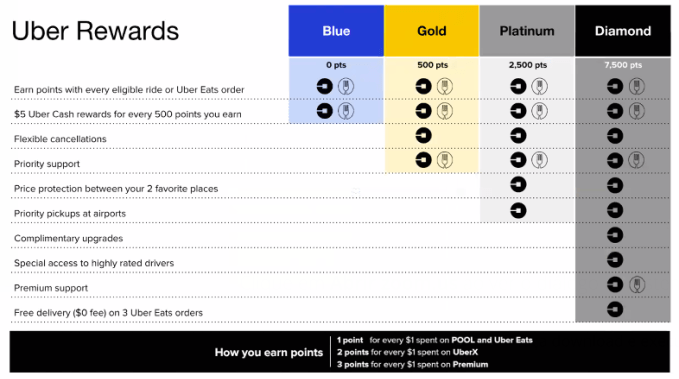
So how much Ubering earns you what perks? Let’s break it down:

In Uber Rewards you earn points by spending money to reach different levels of benefits. Points are earned during 6 month periods, and if you reach a level, you get its perks for the remainder of that period plus the whole next period. You earn 1 point per dollar spent on UberPool, Express Pool, and Uber Eats; 2 points UberX, Uber XL, and Uber Select; and 3 points on Uber Black and Black SUV. You’ll see your Uber Rewards progress wheel at the bottom of the homescreen fill up over time.

Blue: $5 Credits

The only Uber perk that doesn’t reset at the end of a period is that you get $5 of Uber Cash for every 500 points earned regardless of membership level. “Even as a semi-frequent Uber Rewards member you’ll get these instant benefits” Janakiram says. Blue lets you treat Uber like a video game where you’re trying to rack up points to earn an extra life. To earn 500 points, you’d need about 48 UberPool trips, 6 Uber Xs, and 6 Uber Eats orders.
Gold: Flexible Cancellations

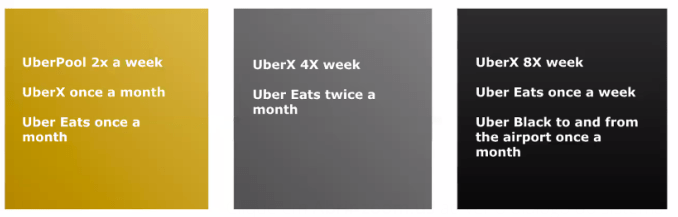
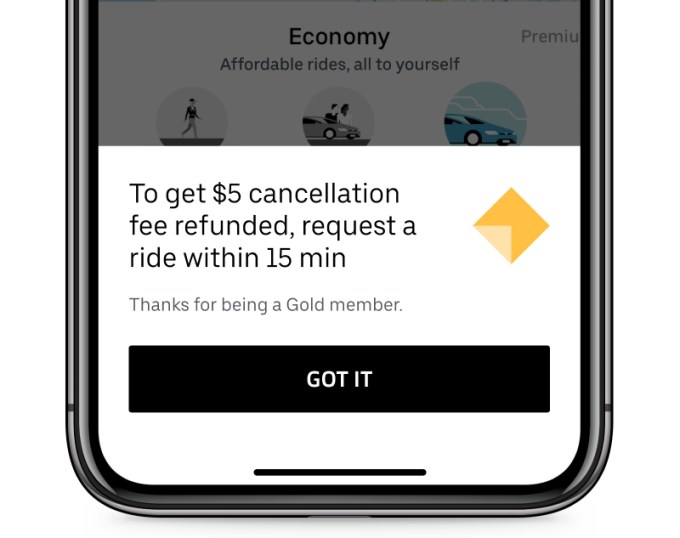
Once you hit 500 points, you join Uber Gold and get flexible cancellations that refund your $5 cancellation fee if you rebook within 15 minutes, plus priority support Gold is for users who occasionally take Uber but stick to its more economical options. “The Gold level is all about being there when things aren’t going exactly right” Janakiram explains. To earn 500 points in six months, you’d need to take about 2 UberPools per week, one Uber X per month, and one Uber Eats order per month.
Platinum: Price Protection

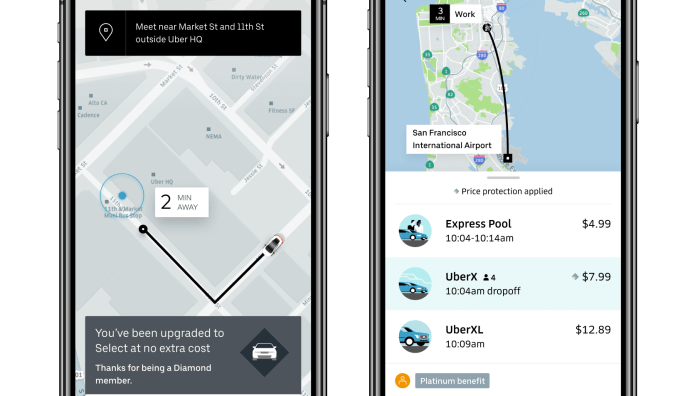
At 2,500 points you join Uber Platinum, which gets you the Gold benefits plus price protection on a route between two of your favorite places regardless of traffic or surge. And Platinum members get priority pickups at airports. To earn 2,500 points, you’d need to take UberX 4 times per week and order Uber Eats twice per month. It’s designed for the frequent user who might rely on Uber to get to work or play.
Diamond: Premium Support & Upgrades

At 7,500 points, you get the Gold and Platinum benefits plus premium support with a dedicated phone line and fast 24/7 responses from top customer service agents. You get complimentary upgrade surprises from UberX to Uber Black and other high-end cars. You’ll be paired with Uber’s highest rated drivers. And you get no delivery fee on three Uber Eats orders every six months. Reaching 7,500 points would require UberX 8 times per week, Uber Eats once per week, and Uber Black to the airport once per month. Diamond is meant usually for business travelers who get to expense their rides, or people who’d ditched car ownership for ridesharing.

Keeping Everyone Happily Riding

Uber spent the better part of last year asking users through surveys and focus groups what they’d want in a loyalty program. It found that customers wanted to constantly earn rewards and make their dollar go further, but use the perks when they wanted. The point was to avoid situations where riders says “Oh I’ve been an Uber user for years. When something goes wrong, I feel like I’m being treated like everyone else”, Janakiram tells me. When riders think they’re special, they stick around.

One big missing feature here is a Rewards calculator. Uber could better gamify earning its perks if there was an easy way to see how many more monthly or total rides it would take to reach the next level. It’d be great to have a few little sliders you could drag around to see if I just take Uber X, how many of my average length trips would it take to level up.

Uber managed to beat Lyft to the loyalty game. Lyft just announced that its rewards program would roll out in December, allowing you to earn discounts and upgrades. But Southeast Asia’s Grab transportation service started testing a loyalty program back in late 2016 where you could manually redeem points for discounts.. While Uber’s rewards are more predictable and automatic, it does seem to have cribbed Grab’s rewards period mechanic where you keep your perks through the end of the next cycle. We’ll see if Uber mistakenly gave too much away and will have to reduce the perks like Grab did, pissing off its most loyal riders.

One risk of the program is that Uber might make users at lower tiers or who don’t even qualify for Gold feel like second class citizens of the app. “One thing that’s important is that we don’t want to make the experience for people who are not in these levels poor in any sense” Janakiram notes. “It’s not like 80% of people will suddenly get priority airport pickups, but we do want to monitor very closely to make sure we’re not harming the service more broadly.”

Overall, Uber managed to pick perks that seem helpful without making me wonder why these features aren’t standard for everyone. Even if it takes a short-term margins hit, if Uber can dissuade people from ever looking beyond its app, the lifetime value of its customers should easily offset the kickbacks.

[Disclosure: Uber’s Janakiram and I briefly lived in the same three-bedroom apartment five years ago, though I’d already agreed to write about the redesign when I found out he was involved.]


14 Nov 2018

Tencent returns to profit growth despite concern around games

Chinese internet giant Tencent bounced back from a disappointing previous quarter, but for once the company didn’t have its gaming business to thank.

Tencent may be best known for conjuring up WeChat, China’s most popular messaging platform, but its revenue is driven by its gaming business, which includes top smartphone titles and a thriving PC unit. Its Q3 results announced today, however, saw its gaming income slacken and other units, including a booming advertising business, step up.

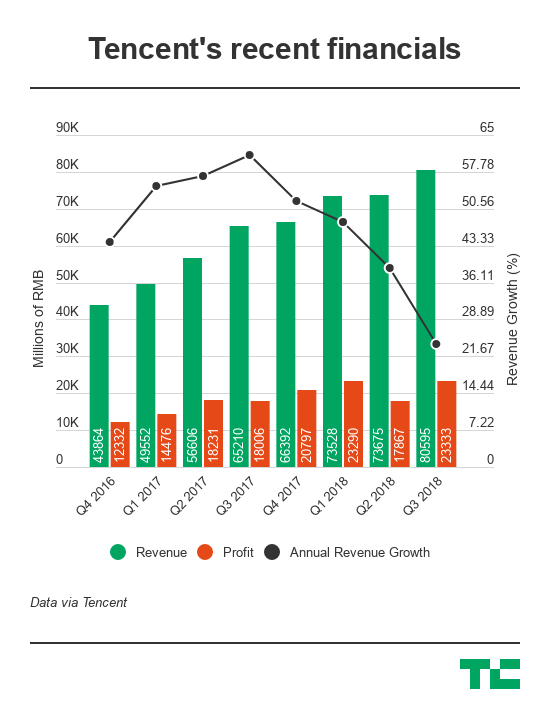
The firm posted a net profit of RMB 23.3 billion ($3.4 billion) on total revenue of RMB 80.6 billion ($11.7 billion), up 30 percent and 24 percent, respectively. Profit growth was back on track, mainly thanks to increased net gains from investments, including a blockbuster IPO of Meituan in September.

Advertising increased by 47 percent and generated 20 percent of total revenues, marking the first time that the segment has reached that mark. The jump is in part a result of strong ad revenue growth on Tencent’s two main chat apps, WeChat and QQ.

These changes are a sign that Tencent has begun to aggressively monetize its massive network of social networking users. As of September, Tencent had 1.08 billion monthly active users on WeChat worldwide, though the app’s spectacular growth has slowed to 2.3 percent quarter-to-quarter.

Tencent underwent an internal reorganization in October that saw it merge several business groups, which have resulted in a more unified system of advertising sales platforms, the company explained in today’s report.

“Our advertising, digital content, payment and cloud services sustained robust activity and revenue growth, and now account for the majority of our revenue,” chairman and CEO Pony Ma said in a statement.

In contrast, games, which have been Tencent’s major revenue driver for years, slid four percent this quarter due to a prolonged freeze on gaming licenses in China. The firm claims it has 15 games with monetization approval in its pipeline, which means that gaming revenues could rebound when it publishes those titles, although it said the same in the previous quarter so a lack of progress is fairly ominous.

The firm also pointed out that while mobile games continued to fuel revenue growth, PC games suffered a decline.

When asked about the situation with gaming licenses on a call with investors, Tencent President Martin Lau said the company is “waiting for the government to start the approval process.”

Tencent appears to have found a potential interim solution which involves allowing third-party publishers who secured a license before the freeze to publish games through its platform, but of course, that has limited use.

While games are the hot topic, Tencent was keen to push the story of its cloud computing business which it said is a key to widening its focus into IOT and other areas.

Emboldened by the reorganization in October, which seemed aimed at shifting Tencent from consumer-facing internet company into one that’s increasing serving industries, the firm said its cloud business more than doubled its revenue year-on-year. There was no raw revenue figure released for the quarter, but the company did disclose that the cloud unit has brought in more than RMB 6 billion, $860 million, over the last three quarters.

Furthermore, cloud computing and payment-related services helped its “Others” business increase its revenue 69 percent year-on-year to reach RMB 20.3 billion, $2.92 billion, for the quarter.

14 Nov 2018

Google Assistant picks up a few new tricks

Google Assistant, the voice-driven AI that sits inside Google Home (plus Android phones, newer Nest cameras, and a bunch of other devices) and awaits your “Hey, Google” commands, is already pretty clever. That doesn’t mean it can’t learn a few new tricks.

In a quick press briefing this week, Google told us a couple new abilities Assistant will pick up in the coming weeks.

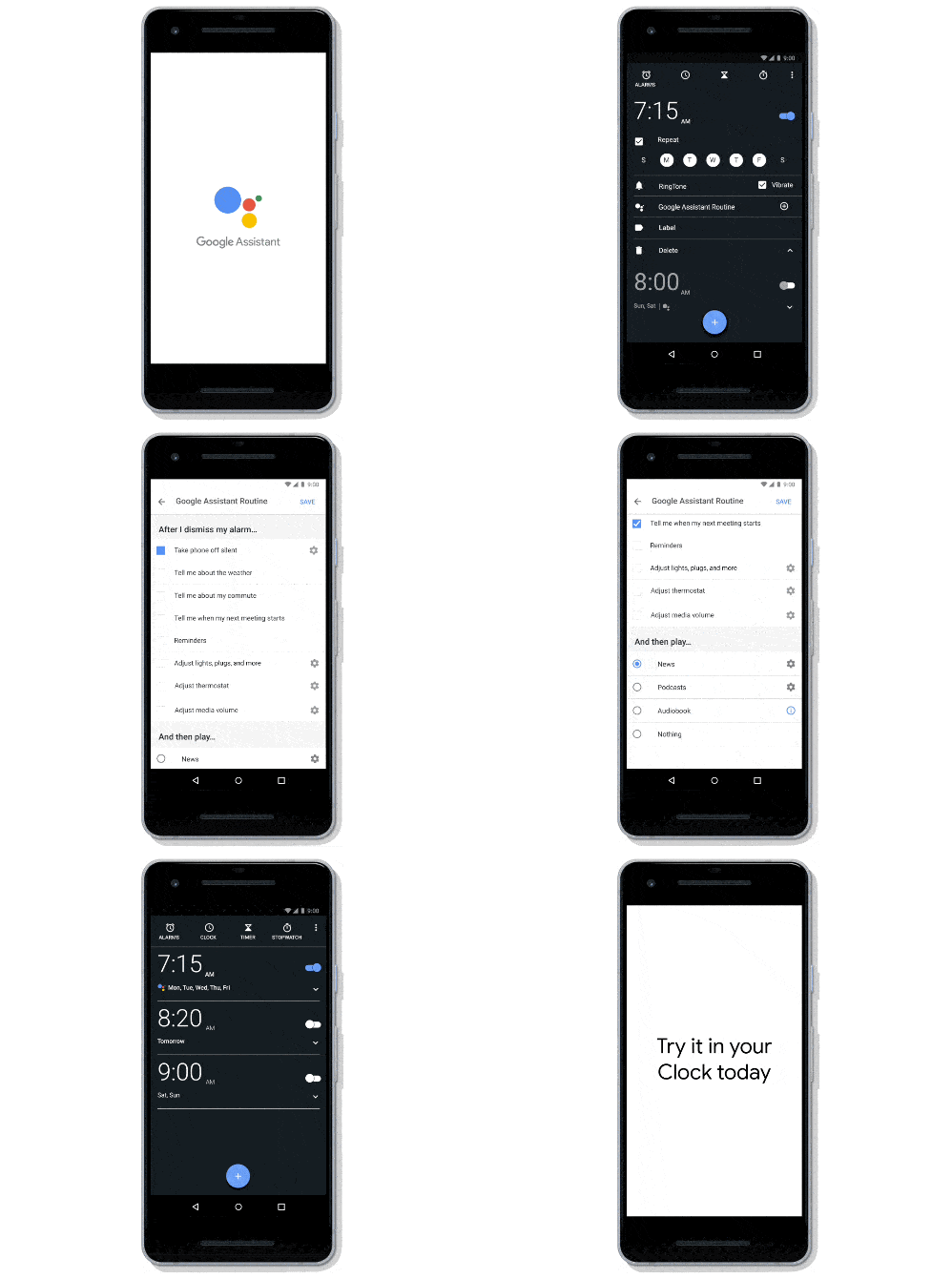
First, and perhaps most interestingly: routines can now be set to trigger the moment you dismiss an alarm on your phone. Routines are basically Google Assistant combo moves; you build them to trigger multiple actions at once. You can build a “Hey Google, I’m going to bed.” command, for example, that turns off your smart lights, shuts down the TV, and locks your smart locks. For a while now, you’ve been able to have routines triggered at specific times; now you can have them triggered by alarm dismissal.

The difference? If you snooze the alarm on your phone, the routine won’t go off just yet. So you can build a routine, for example, that turns on the lights and starts reading the news — but now it can go off when you’re really getting out of bed, roughly two snooze-buttons after when you probably should’ve gotten up. You’ll find this one hiding in Android’s Clock app.

Another feature, meanwhile, is getting an upgrade: broadcasts. If you’ve got multiple Google Home devices around your house, you can already “broadcast” to all of them to make house-wide announcements like “Dinners ready!” or “help I need toilet paper downstairs” (THE FUTURE!). Now you can broadcast messages back to your home while out and about via Google Assistant on your phone, and people inside the home can respond. You can say “Hey Google, broadcast ‘Do we need milk?'” and anyone inside your house can say “Hey Google, reply ‘no but please get eggnog, come on, please, it’s basically December, you said we could get eggnog in December’.”

Broadcast replies will be sent back to your phone as a voice message and a transcription.

Google is also starting to introduce “character alarms” — which are, as the name implies, alarms voiced by popular characters. Right now they’re adding the heroes in a half shell from Nickeloden’s Rise of the Teenage Mutant Ninja Turtles, and a bunch of LEGO animated series characters (alas, no LEGO Batman.) They’ll presumably expand this with more licenses if it proves popular.

And if you listen to podcasts or audiobooks on your Google Assistant devices, you can now adjust the playback speed by saying “Hey Google, play at 1.5x” or “1.8x” or whatever you want up to twice the speed. “Play faster” or “Play slower” also works if you’re not feeling specific.

Oh, and for good measure: Google Assistant can now silence all the phones in your house (or, at least, the Android phones tied to your Google account) with a quick “Hey Google, silence the phones” command.

14 Nov 2018

Tinder’s head of product has left

Tinder’s chief product officer Brian Norgard wants to get back to his entrepreneurial roots, citing former PayPal executive-turned-venture capitalist Keith Rabois as inspiration.

Norgard, who joined Tinder as part of the acquisition of his Kleiner Perkins-backed ephemeral messaging startup Tappy in 2014, has confirmed to TechCrunch that he’s left the app-based dating company to focus on building products and investing in early-stage businesses. Tinder has not yet identified his successor, but Norgard says “it’s all positive vibes” between him and the company.

Norgard began as Tinder’s head of revenue before being promoted to the chief product role in late 2016. Prior to joining Tinder via Tappy, he co-founded two other successful startups: Chill, a Facebook application that garnered 30 million users, and adtech startup Newroo, which was acquired by FOX Interactive in 2006.

“It’s been a great ride but my strength has always been in the early-stage game,” Norgard told TechCrunch. “What I’m trying to do now is take all the learnings from that wonderful experience and bring them into my investing.”

Though he’s yet to sign on in any official capacity, Norgard said he is in talks with several different entities about investing roles.

Brian Norgard has invested in Coinmine, a developer of a sleek cryptocurrency mining device.

Norgard said he’s invested in one company so far, a cryptocurrency mining startup called Coinmine founded by Justin Lambert, who helped design the second iteration of the Pebble watch, and Farb Nivi, the former chief product officer at Learnist. Coinmine is selling a crypto mining device, similar in size and look to an Xbox, that’s controlled by a mobile app. The device is meant to help anyone, crypto enthusiasts and otherwise, mine crypto easily. Nivi told TechCrunch the internet-connected device uses less energy than a PlayStation.

The Los Angeles-based startup is officially launching today with Norgard signed on as an active advisor.

“There are a lot of parallels I draw from Coinmine and Tinder,” Norgard said. “Online dating was very complicated six years ago. It was an arduous process and so is mining. You have to be pretty sophisticated, but this takes it down to the studs. A normal consumer with no technical knowledge can get into the crypto game.”

Coinmine, which raised a total of $2 million, is also backed by Coinbase Ventures, Social Leverage, Arrington Capital, Wonder VC and angel investors like Coinbase’s chief technology officer Balaji Srinivasan.

14 Nov 2018

Microsoft to acquire Xoxco as focus on AI and bot developers continues

Microsoft has been all in on AI this year, and in the build versus buy equation, the company has been leaning heavily toward buying. This morning, the company announced its intent to acquire Xoxco, an Austin-based software developer with a focus on bot design, making it the fourth AI-related company Microsoft has purchased this year.

“Today, we are announcing we have signed an agreement to acquire Xoxco, a software product design and development studio known for its conversational AI and bot development capabilities,” Lili Cheng, corporate VP for conversational AI at Microsoft wrote in a blog post announcing the acquisition.

Xoxco has raised $1.5 million and the company did not reveal the price acquisition, but it fits in nicely with its overall strategy this year and an announcement involving a new bot building tool to help companies build conversational bots more easily.

When you call into a call center these days, or even interact on chat, chances are your initial interaction is with a conversational bot, rather than a human. Microsoft is trying to make it easier for developers without AI experience to tap into Microsoft’s expertise on the Azure platform (or by downloading the bot framework from its newly acquired GitHub).

“With this acquisition, we are continuing to realize our approach of democratizing AI
development, conversation and dialog, and integrating conversational experiences where people communicate,” Cheng wrote.

The new Virtual Assistant Accelerator solution announced today also fits nicely with the Xoxco purchase. Eric Boyd, corporate VP for AI at Microsoft says the Virtual Assistant Accelerator pulls together some AI tools such as speech-to-text, natural language processing and an action engine into a single place to simplify bot creation.

“It’s a tool that makes it much easier for you to go and create a virtual assistant. It orchestrates a number of components that we offer, but we didn’t make them easy to use [together]. And so it’s really simplifying the creation of a virtual assistant,” he explained.

Today’s acquisition comes on the heels of a number of related AI acquisitions. The company bought Semantic Machines in May to give users a more life-like conversation with bots. It snagged Bonsai in June to help simplify AI development and it grabbed Lobe in September, another tool for making it easier for developers to incorporate AI in their applications.