Year: 2018

14 Nov 2018

Amazon’s Fire TV Recast is a decent DVR for antenna users

Amazon’s Fire TV companion DVR, the Fire TV Recast, is available today to the public, after previously having been only offered for pre-order. The new device offers a way for Fire TV owners to easily access free, over-the-air broadcast television directly from the Fire TV’s software. Starting at $229, this cord cutters’ DVR is something of a modern-day TiVo, as it combines access to live TV, recordings, and on-demand programming all in one interface. But while the Fire TV Recast works as advertised, channel reception in your area can hinder your experience.

The Fire TV Recast was one of many products Amazon introduced at its over-stuffed Alexa event this September.

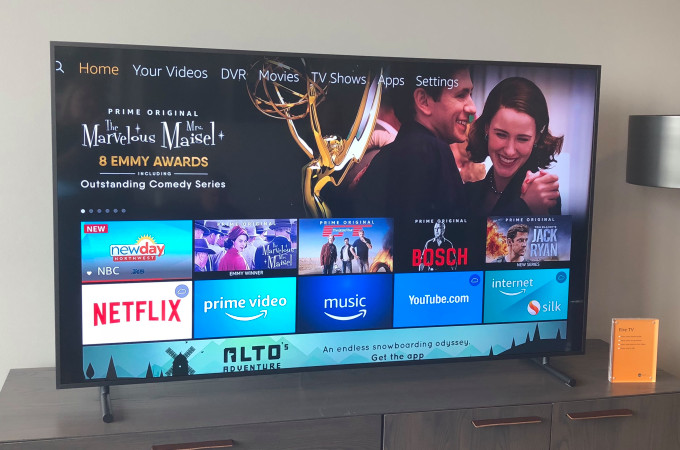
The device is designed to work with your existing Fire TV Edition television, Fire TV, or Fire TV Stick and a digital antenna, allowing you to watch live television directly in the Fire TV interface, as well as record programs.
Notably, the DVR recordings and live TV streams are also available via mobile, when you’re away from your home Wi-Fi network, even if you’re only on cellular.

This feature is available at no extra charge, just like the rest of what Recast offers – including its Live TV channel guide, DVR storage (either 500GB or 1TB with the option to expand through its USB port coming soon), and the companion mobile app.


If you’re already a Fire TV owner – or preparing to become one – it makes sense to consider the Recast over a competing solution like TiVo or a Plex DVR setup, because of how it integrates with your existing Fire TV. That means you’re using the same software you’re already familiar with, but enhanced with extra features like an “On Now” row that displays what’s currently airing and a “DVR” section to access your recordings.
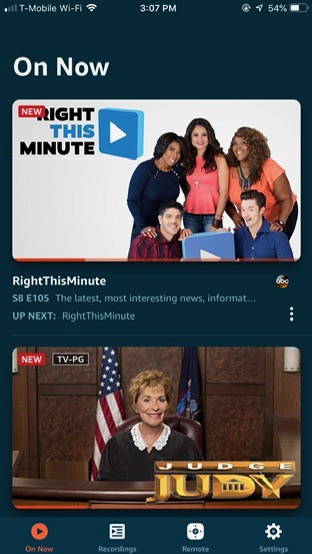
From a software design standpoint, these additions feel natural, easy to locate and easy to use.

But in terms of being a usable, real-world solution, the Fire TV Recast is ultimately hit-or-miss, simply because it depends on an antenna.

Antennas aren’t for everyone

The Recast is an HDTV antenna-dependant solution. Antennas aren’t the best way to watch TV, they’re just the cheapest. That will appeal to some users, but turn off others.

Channel reception is highly variable based on a number of factors, including your location, surroundings, terrain, distance to TV broadcast towers, and channel availability in your area.


Before spending a couple hundred dollars plus on Amazon’s new DVR, you’ll want to first check out Amazon’s Purchase Assistant to see what’s offered in your area, as well as the FCC’s reception maps. You could also just buy the digital antenna first to test reception at your home before plunking down the big money for the DVR.

I wasn’t favored with good reception, unfortunately. No matter where my antenna was mounted – walls, windows, the second story, etc. – some of the channels were still garbled and glitchy. This is really a “your mileage may vary” solution – I’m many miles from some broadcast towers. The better your reception, the more you’ll enjoy the Fire TV Recast.

Another factor to consider is that while adding a digital antenna to your cord cutting mix is cheaper than, say, a year of Hulu, you’re not getting high-quality content. While the FCC has approved a new broadcast standard (ATSC 3.0) that will support 4K UHD picture quality, there are no 4K over-the-air TV broadcasts available today – and that won’t likely change for some time

That means when you’re switching back and forth from 4K programming on your Fire TV Stick 4K to this lower-quality, over-the-air content, you’re really going to notice the difference.

That being said, there are things people want an antenna for – like live sports, local news and programming, and other live events, like award shows. While some of this content is moving to streaming, it’s not typically streaming for free.

Getting Started with Recast

The setup was extremely simple.

The antenna connects to the Fire TV Recast, and can be placed anywhere in your home. That’s actually the best part because no matter where you mount a digital antenna, it’s not exactly a thing of beauty. In fact, it pretty much junks up the room, aesthetically speaking.
Seriously, the best part is that using an antenna doesn’t have to ruin your living room anymore

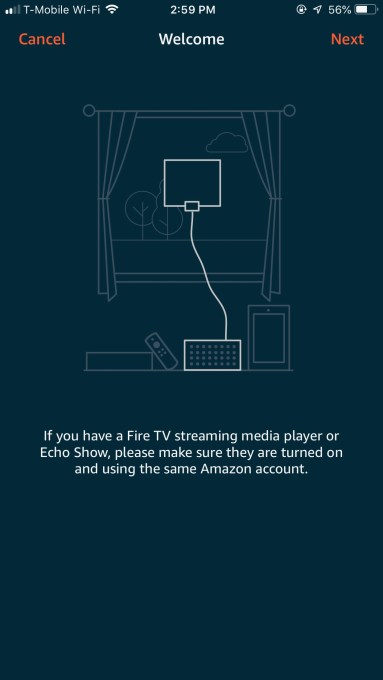
The newly updated Fire TV app walks you through a series of setup screens that helpfully offer tips on antenna placement, and helps you get the Recast connected to your Wi-Fi network. (It’s the same process as connecting an Amazon Echo, and only takes a minute).

When complete, the Recast scans for available channels.
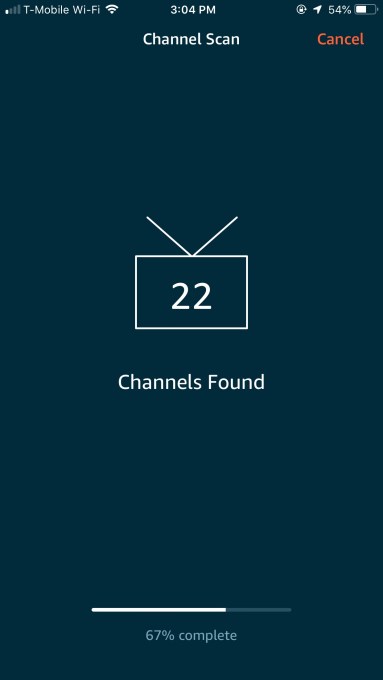
My app crashed once during this scanning process, but it’s a beta build. This may or may not still be bug when the public release arrives.

When finished, you can watch TV or recordings right in the Fire TV app, in addition to Fire TV itself. Soon, you’ll be able to record programs from the app, Amazon says.

Multiple people can stream from a Recast at the same time, but streaming to multiple iOS devices is rolling out shortly after launch, Amazon also noted.

Using the Recast with Fire TV

As far as browsing the Recast, everything is nicely organized on your Fire TV interface.

Scroll down on the Home screen, and a row of live TV shows is blended right in with your other options, like Amazon’s Prime programming or your Amazon Channels subscriptions.
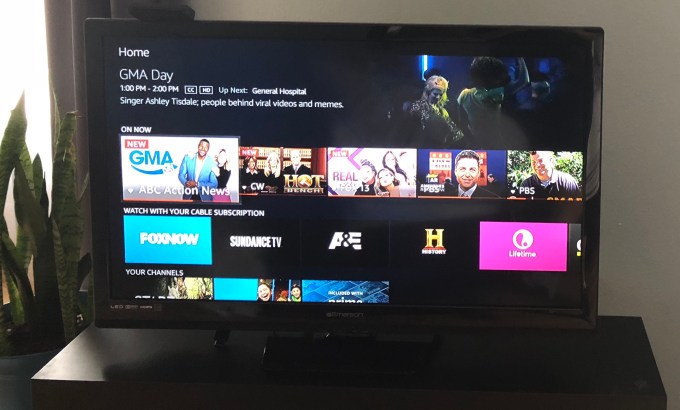
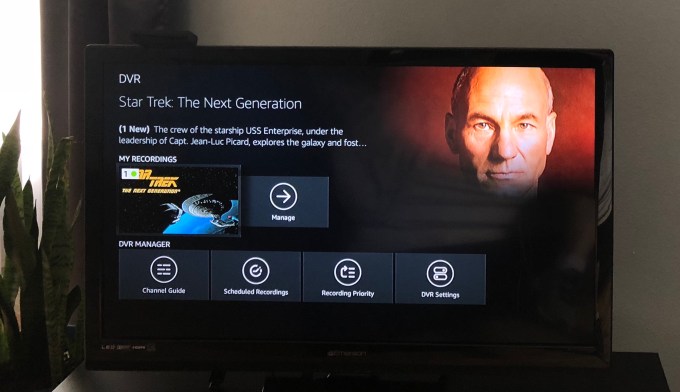
The “DVR” menu at the top lets you quickly get to your recorded programs, so you can watch or delete them, as desired.

And the Live TV channel guide lets you search ahead up to two weeks’ of programing to find things to record.

None of this feels tacked on at the last minute, and navigation is not confusing. It all fits in seamlessly with Fire TV’s other content and its user interface. There’s zero learning curve.
In my experience, the TV programs loaded fairly quickly, if slower than launching a show on Netflix, for comparison’s sake. I personally felt that watching on mobile was a better experience than viewing shows on the big screen, because you don’t notice the poor picture quality as much when on mobile.

The other key feature is voice control.

You don’t need a Fire TV Recast in order to voice control a TV, to be clear. That’s a Fire TV feature, too.
But Alexa has been updated to work with the Recast, so you can say things like “Alexa, open Channel Guide,” “Alex tune to NBC,” or “Alexa, show my recordings,” among other things. You can even record shows, cancel recordings, and delete recordings by voice commands, as well as rewind and fast forward by a period of time.

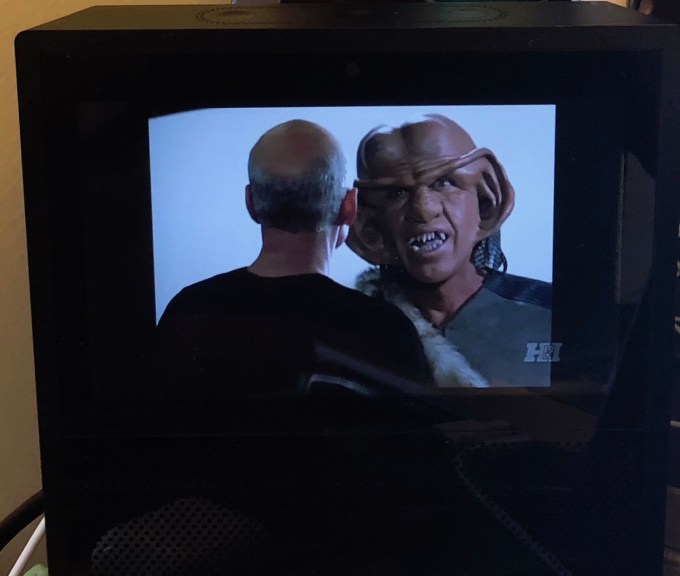
For giggles, I suppose, you can also stream live TV and watch recordings on an Echo Show, Amazon’s screen-based Alexa speaker. You can pair your Bluetooth headphones with an Echo Show and have a great desk accessory for the office, I guess, or catch up on shows while cooking dinner in your kitchen.

I am probably never going to watch TV on an Echo Show. But hey, have fun with that if you do.

A good addition, if you’re happy with antennas

If you’re in the market for a connected DVR and are a Fire TV owner, the Fire TV Recast can be a good addition to your setup – if you get reception and don’t already have another way to watch the TV you want – like through Hulu or Sling TV, for instance.

If you’re a Roku or Apple TV owner, however, it may not be worth abandoning your current platform just for the Recast, unless you’re really in need of cheaper access to live TV,  or on-the-go access to live TV and recordings.

For those who fit that description, it’s easy to recommend the Fire TV Recast over rivals for its well-designed software, easy of setup, mobile streaming, and the ability to hide the ugly antenna in another room.

Depending on how much you TV want to record, there are two Recast models to choose from: the $229.99 50GB Recast offers 2 tuners and up to 75 hours of HD storage, while the $279.99 1TB Recast offers 4 tuners and up to 150 hours of HD storage.

Amazon is also selling an equipment bundle with the Recast, Fire TV Stick 4K, and 35-mile HDTV antenna for 249.97, which is a good deal if you’re ready to commit.

Tech Specs

  • Size: 7.1″ x 7.1″ x 2.9″ (180 mm x 180 mm x 73 mm)
  • Weight: 2.4 lbs (1066 g)
  • ASTC Tuners: 2 or 4
  • Storage: 500GB or 1TB
  • Memory: 2GB
  • Wi-Fi: 2.4 G WiFi 2×2 Wi-Fi b/g/n and 5 G  Wi-Fi 2×2 Wi-Fi a/n/c
  • Ports: 1 x Type A USB 3.0 (storage support in the works); TV antenna input; Gigabit Ethernet, Power
  • Regional Support: US only
  • Accessibility Features:  VoiceView screen reader; Closed captioning, where available
  • Included in the box: Fire TV Recast, 50W Power Supply, Quick Start Guide

 

14 Nov 2018

Home insurance provider Hippo brings in $70M amid a record year in funding for insurtech startups

Felicis Ventures and Lennar Corporation have co-led the $70 million Series C funding round for Hippo, a tech-enabled home insurance marketplace.

Existing investors in the startup, like Comcast Ventures, Fifth Wall Ventures, Horizons Ventures and GGV Capital, also participated in the round.

Hippo has raised $109 million to date, including a $25 million Series B earlier this year. Co-founder and chief executive officer Assaf Wand declined to disclose Hippo’s valuation.

Wand, who co-founded the startup in 2015 with Eyal Navon, said he spent 14 years imagining the technology that would become Hippo, inspired by his father’s career in the antiquated insurance industry.

Hippo co-founder and chief executive officer Assaf Wand.

“I was born into insurance,” Wand told TechCrunch. “Now, the entire real estate ecosystem is changing and the industry is massive. We are getting a crazy good challenge. We think the sky’s the limit with this thing.”

The Mountain View, California-based company officially launched to consumers in 2017. It plans to use its latest investment to fuel the growth of its product, which sells home insurance plans at lower premiums. So far this year, Hippo has expanded into 10 new states and says its sales have grown 30 percent month-over-month since January.

“Hippo has set the bar for the future of insurance with its fully automated, proprietary policy management and proactive underwriting,” Felicis managing director Victoria Treyger said in a statement. “Insurance is the next big sector to undergo the dramatic transformation of customer experience and improved risk management enabled by access to real time data. We see Hippo’s current growth rate and efficient automated policy management system as just the beginning of driving this transformation.”

Treyger will join Hippo’s board of directors as part of the round.

The insurance industry is indeed undergoing a dramatic transformation as a result of technology companies targeting the sector, which are part of a relatively new category of startups dubbed insurtech.

According to PitchBook, insurtech startups have raised nearly $6 billion in venture capital funding since 2012. This year alone, companies in the space have brought in a record amount of capital at $1.8 billion across 94 deals.

Whether or not the hype for the emerging category will continue into 2019 remains to be seen.

14 Nov 2018

Wynd announces a new air purifier and desktop monitor

As far as goals for hardware startups go, you could do worse than ridding the air of allergens, pollutants and the like. Launched in 2016 as a Kickstarter project, Wynd is going back to the crowdfunding well this week for two new hardware products.

Wind Halo is a pretty nice-looking (from the press material) desktop air monitor featuring a set of 10 sensors. In fact, the design language on the thing really brings to mind the Echo Spot — still arguably the nicest-looking of Amazon’s Alexa devices.

The system relies on a technology Wynd calls Air ID, which “blends raw hardware sensor data with machine learning and cloud contextual information,” according to the company. That’s all buzzword-speak for the fact that the hardware utilizes readings to provide both metrics and a breakdown of what’s in the air, including pollen, smoke and smog.

Of course, knowing what’s in the air isn’t much use unless you can actually do something about it. For that, Wynd’s finally introducing a full-size counterpart to it is desktop purifier. The Wynd Home Purifier responds to readings from the Halo and adjusts accordingly. According to the startup, it should be able to clean a 1,200-square-foot space in around half an hour, filtering out allergens, mold, bacteria and various pollutants.

There’s also an auto mode for those who don’t care to invest in both devices. The Halo and Home Purifier run $89 and $239, respectively, and are set to start shipping in May. Both will work with Alexa and Apple HomeKit.

14 Nov 2018

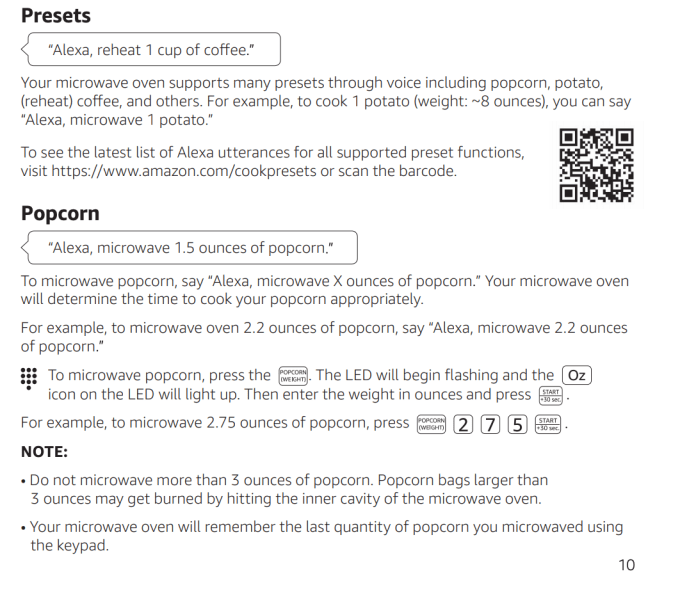
We tried Amazon’s bizarre Alexa microwave and weren’t convinced

I’m a fan of Alexa and of voice computing in general. But when Amazon said it was putting Alexa into a microwave, I wasn’t so sure. The value in voice computing is being able to get to news, information, music hands-free, as well as perform simple tasks, including those for the smart home – like changing the thermostat from downstairs, or taking a peek at your security camera video from your Echo Show. But a microwave? Really?

Microwaves, after all, are one of the most common kitchen appliances. And, unlike conventional ovens, they’re dead simple to use.

Amazon, however, would disagree.

The company believes consumers aren’t taking full advantage of their microwave’s more advanced settings, which are overly complicated. That’s where Alexa could help, the company says.

“Most people don’t use them for all the features that they’re able to do – like presets and ways you can do some more complicated cooking are beyond the reach of most people,” said Charlie Tritschler, Vice President, Amazon Devices. “And oftentimes folks just resort to pushing the ‘Add 30 seconds’ button a bunch of times,” he continued. [Microwaves] are great for cooking simple things like popcorn, but if you want to defrost or use some of the other presets, you sometimes have to go to the owner’s manual,” he said.

Of course that’s not universally true. Perhaps some microwaves may not have the most intuitive interfaces, but the learning curve isn’t steep. After the first time you learn to program the power level or enter in how many pounds of meat you’re defrosting, you generally retain that knowledge for later use.

But even if you don’t buy into the premise that microwave controls are a challenge to solve, there’s still the novelty aspect of the voice-activated microwave. If it takes the same or less time, but “feels fun,” some consumers may still buy it, I suppose. (???)

Unfortunately, it wasn’t really all that fun.

In fact, it was often frustrating.

The Alexa microwave is not like your Echo. It’s more like a companion device to your Echo, as it uses Alexa Connect Kit technology. To use it, you have to pair the microwave with an Echo speaker. Then, you can control it by voice commands that begin with “Alexa,” or you can push a button and omit the “Alexa” part of the command.

The Echo speaker also needs to be near-ish the microwave, I found. We first tried shouting over to the living room Alexa and half the time she didn’t hear us, despite our home’s open floor plan. That means you’ll probably have to buy an Echo for the kitchen to use this thing.

Amazon only gave us a day to play around with the microwave, so we didn’t try some of the fancier recipes – perhaps it has value there – but our initial impression is that this feels much more like a demo of Alexa technology than a future top seller on Amazon.com.

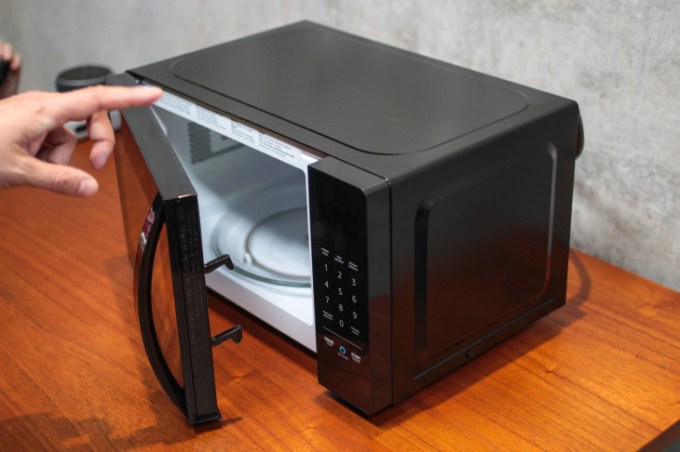
The AmazonBasics microwave itself is a small 700W tabletop device (17.3″ x 14.1″ x 10.1″) that weighs 21.9 lbs. It has 10 power levels and cleverly connects to your Wi-Fi network using Amazon’s brand-new Wi-Fi simple setup – which, honestly, was the most impressive feature. It retails for $59.99.

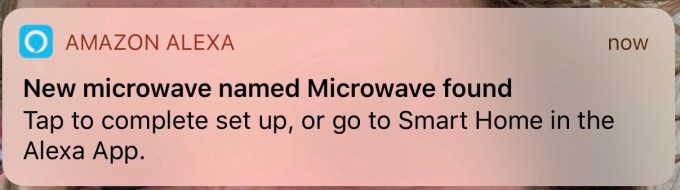
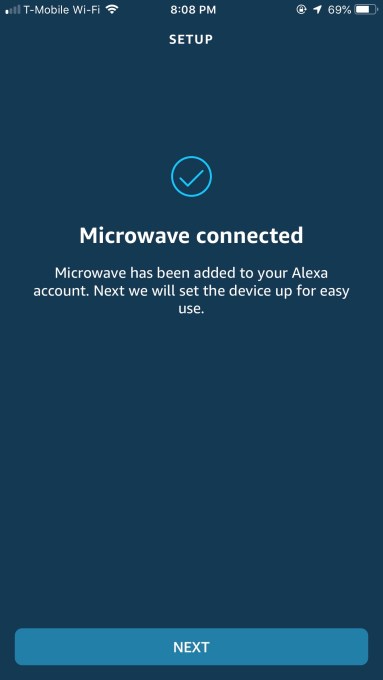
After turning the oven on, the clock flashed 0:00 for a few seconds, then, the next thing you know, it switched to the correct time and appeared as a new device in the Alexa app ready to be paired with an Echo. Can everything be this easy to set up in the future, please?

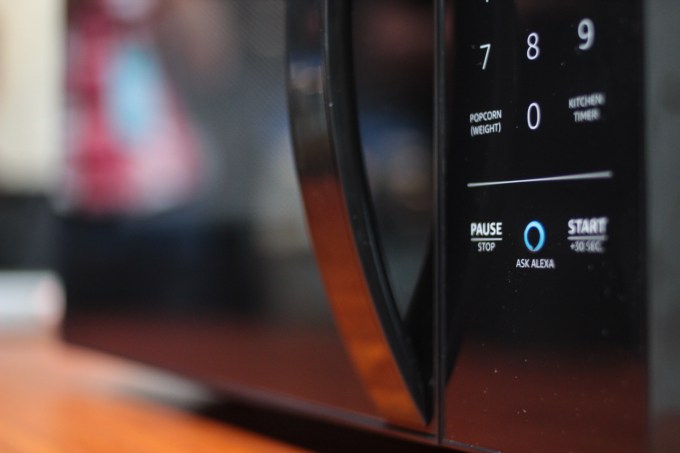
The device includes a ring and turntable and has a standard set of buttons on the front for manual control, including defrost buttons by time and weight, a power level button, dedicated popcorn button, timer, and Start/Stop and Pause buttons, in addition to the “Ask Alexa” button at the bottom.

You can also configure the microwave to re-order your popcorn through Amazon’s replenishment service, but this requires that you commit to a brand and pack size you always want to have on hand. I like popcorn as much as the next person, but I’m okay going without, too. If, however, you are some sort of popcorn monster, well…okay then, that’s a feature for you.

As far as actually using the microwave, it responds to a range of voice commands. For example, “Alexa, reheat one cup of coffee,” “Alexa microwave one cup of soup,” “Alexa microwave two potatoes,” “Alexa reheat one dinner plate,” “Alexa, reheat 8 ounces of pasta,” and so on, thanks to the dozens of quick-cook presets that come with the device.

You can also command Alexa to microwave something by indicating the time to cook.

The command set Amazon has built seems to indicate that people don’t know how long to microwave specific items...reheating a dinner plate? A cup of coffee? Some pasta?

But in reality, most people probably have a good guess by eyeballing their plate (or cup), and then mashing a number button on the microwave to turn it on for a minute, two, three or more, as needed.

I mean, sure, maybe if we took the time to adjust the power levels, things would cook better – but if we wanted “better,” we’d use a real oven, right?

In any event, pushing a single button is a lot simpler than talking to an oven.

Above: harder ways to do easy things

Once set up, you can use the Alexa commands as you would any other smart home gadget (i.e. “Alexa,” followed by the command), or you can push the microwave’s “Ask Alexa” button then give her a command without saying Alexa.

Having…umm…not read the manual at first – the very thing Amazon said people don’t do! – I didn’t even realize that was the case, initially.

So when the microwave didn’t perform as I expected to an “Alexa” voice command, I initially assumed the “Ask Alexa” button press was always required.

That’s not true, though: we had just said the command wrong. In this case, the proper voice command should have been: “Alexa, microwave for 2 minutes.” With the button push, it could have been just “two minutes.”

I do understand that an “Alexa, two minutes” command could be confused with a timer, but couldn’t Alexa tell I just shut the microwave door, then make a logical, A.I.-powered leap? (After all, she does seem to have some sort of “door awareness.” I asked her to microwave something after not using the oven for a bit – I had left a cup of water inside – and she told me the microwave door had been closed for too long – so, sorry, she won’t do it.)

After reading the manual, and learning of my error, I successfully started the oven both ways – with and without the button.

But sometimes Alexa’s ability to understand the commands was confounding.

For instance, Amazon’s manual says that you can also give voice commands while the microwave is cooking. But when I said simply, “Alexa, add 30 seconds” while the oven was cooking, Alexa said she “didn’t know that one.” (I then had to push the button for it to work.)

This seemed like a command Alexa should have figured out, though. The microwave was currently running! I had no timers! What on earth did Alexa not understand about “Add 30 seconds?” 

Again, the issue appears to be one of semantics. The voice command without a button push should have been “Alexa, add 30 seconds to the microwave.

I know.

ARGHHH!!!, is kinda how I felt too.

Being able to say “Alexa” sometimes and other times not adds a bit of cognitive overhead to using the voice commands. Instead of making things easier, it complicates them.

After, pushing the button, you can just say “2 minutes.”

But, surprisingly, it’s actually hard to remember to drop the “Alexa” bit when it’s been the precursor to using voice commands for so long.

Case in point:

I actually think the product would have worked better if there was one way to issue voice commands, not two. Or if the door opening and shutting would also trigger the same “button push,” instead of there being an actual button to push.

At the end of the day, there’s a much simpler way to do things on a microwave.

14 Nov 2018

Locked in a Tesla patent suit, Nikola nabs $210M at $1.1B valuation for hydrogen trucks

Nikola, the hydrogen trucking startup currently suing Tesla for patent infringement (those are the actual names, sorry spirit of real Nikola Tesla), today announced that it has raised $210 million in its Series C round of funding. The company had previously announced in August that it had raised $100 million of the round; now it has closed it out.

The company has confirmed to us that the round was done at a $1.1 billion valuation.

In a short note announcing the news, Nikola described it as “oversubscribed” after racking up $12 billion in pre-orders, with $380 million of those specifically for its newest model, called the Tre European designed for the Europe market.

Pending regulation in Europe that aims to reduce diesel emissions from heavy-duty vehicles — which produce one-quarter of all CO2 emissions in Europe — are leading transport companies and others to search for viable alternatives, and this has partly fuelled interest in the company, it seems.

Nikola said that the cost per-mile for its Tre truck is also expected to be 10-20 percent less than diesels. “Once the Nikola Tre arrives in Europe, diesel will finally be on its way out, ” said CEO Trevor Milton in a statement. Ultimately, Nikola aims to sell trucks in the US, Europe, Canada and Australia.

That rush for more efficient and eco-friendly trucking vehicles is also in part behind the lawsuit with Tesla. Nikola claims that Tesla has stolen its designs for its truck from its Nikola One and is winning business through market confusion.

“Tesla’s design has caused confusion among customers,” the company wrote in its suit. “The confusion has diverted sales from Nikola to Tesla. Further, any problems with the Tesla Semi will be attributed to the Nikola One, causing harm to the Nikola brand.” But in the meantime, Tesla has secured its own patents for its trucking design. Nikola would not comment on the case today, as it is still ongoing.

Existing investors in Nikola include the strategics Nel Hydrogen, a Norwegian company that is also helping it build filling stations; and Wabco, an automotive OEM, and Nikola has said that it is not releasing the names of any other investors at the moment.

14 Nov 2018

Google gobbling DeepMind’s health app might be the trust shock we need

DeepMind’s health app being gobbled by parent Google is both unsurprising and deeply shocking.

First thoughts should not be allowed to gloss over what is really a gut punch.

It’s unsurprising because the AI galaxy brains at DeepMind always looked like unlikely candidates for the quotidian, margins-focused business of selling and scaling software as a service. The app in question, a clinical task management and alerts app called Streams, does not involve any AI.

The algorithm it uses was developed by the UK’s own National Health Service, a branch of which DeepMind partnered with to co-develop Streams.

In a blog post announcing the hand-off yesterday, “scaling” was the precise word the DeepMind founders chose to explain passing their baby to Google . And if you want to scale apps Google does have the well oiled machinery to do it.

At the same time Google has just hired Dr. David Feinberg, from US health service organization Geisinger, to a new leadership role which CNBC reports as being intended to tie together multiple, fragmented health initiatives and coordinate its moves into the $3TR healthcare sector.

The company’s stated mission of ‘organizing the world’s information and making it universally accessible and useful’ is now seemingly being applied to its own rather messy corporate structure — to try to capitalize on growing opportunities for selling software to clinicians.

That health tech opportunities are growing is clear.

In the UK, where Streams and DeepMind Health operates, the minister for health, Matt Hancock, a recent transplant to the portfolio from the digital brief, brought his love of apps with him — and almost immediately made technology one of his stated priorities for the NHS.

Last month he fleshed his thinking out further, publishing a future of healthcare policy document containing a vision for transforming how the NHS operates — to plug in what he called “healthtech” apps and services, to support tech-enabled “preventative, predictive and personalised care”.

Which really is a clarion call to software makers to clap fresh eyes on the sector.

In the UK the legwork that DeepMind has done on the ‘apps for clinicians’ front — finding a willing NHS Trust to partner with; getting access to patient data, with the Royal Free passing over the medical records of some 1.6 million people as Streams was being developed in the autumn of 2015; inking a bunch more Streams deals with other NHS Trusts — is now being folded right back into Google.

And this is where things get shocking.

Trust demolition

Shocking because DeepMind handing the app to Google — and therefore all the patient data that sits behind it — goes against explicit reassurances made by DeepMind’s founders that there was a firewall sitting between its health experiments and its ad tech parent, Google.

“In this work, we know that we’re held to the highest level of scrutiny,” wrote DeepMind co-founder Mustafa Suleyman in a blog post in July 2016 as controversy swirled over the scope and terms of the patient data-sharing arrangement it had inked with the Royal Free. “DeepMind operates autonomously from Google, and we’ve been clear from the outset that at no stage will patient data ever be linked or associated with Google accounts, products or services.”

As law and technology academic Julia Powles, who co-wrote a research paper on DeepMind’s health foray with the New Scientist journalist, Hal Hodson, who obtained and published the original (now defunct) patient data-sharing agreement, noted via Twitter: “This isn’t transparency, it’s trust demolition.”

Turns out DeepMind’s patient data firewall was nothing more than a verbal assurance — and two years later those words have been steamrollered by corporate reconfiguration, as Google and Alphabet elbow DeepMind’s team aside and prepare to latch onto a burgeoning new market opportunity.

Any fresh assurances that people’s sensitive medical records will never be used for ad targeting will now have to come direct from Google. And they’ll just be words too. So put that in your patient trust pipe and smoke it.

The Streams app data is also — to be clear — personal data that the individuals concerned never consented to being passed to DeepMind. Let alone to Google.

Patients weren’t asked for their consent nor even consulted by the Royal Free when it quietly inked a partnership with DeepMind three years ago. It was only months later that the initiative was even made public, although the full scope and terms only emerged thanks to investigative journalism.

Transparency was lacking from the start.

This is why, after a lengthy investigation, the UK’s data protection watchdog ruled last year that the Trust had breached UK law — saying people would not have reasonably expected their information to be used in such a way.

Nor should they. If you ended up in hospital with a broken leg you’d expect the hospital to have your data. But wouldn’t you be rather shocked to learn — shortly afterwards or indeed years and years later — that your medical records are now sitting on a Google server because Alphabet’s corporate leaders want to scale a fat healthtech profit?

In the same 2016 blog post, entitled “DeepMind Health: our commitment to the NHS”, Suleyman made a point of noting how it had asked “a group of respected public figures to act as Independent Reviewers, to examine our work and publish their findings”, further emphasizing: “We want to earn public trust for this work, and we don’t take that for granted.”

Fine words indeed. And the panel of independent reviewers that DeepMind assembled to act as an informal watchdog in patients’ and consumers’ interests did indeed contain well respected public figures, chaired by former Liberal Democrat MP Julian Huppert.

The panel was provided with a budget by DeepMind to carry out investigations of the reviewers’ choosing. It went on to produce two annual reports — flagging a number of issues of concern, including, most recently, warning that Google might be able to exert monopoly power as a result of the fact Streams is being contractually bundled with streaming and data access infrastructure.

The reviewers also worried whether DeepMind Health would be able to insulate itself from Alphabet’s influence and commercial priorities — urging DeepMind Health to “look at ways of entrenching its separation from Alphabet and DeepMind more robustly, so that it can have enduring force to the commitments it makes”.

It turns out that was a very prescient concern since Alphabet/Google has now essentially dissolved the bits of DeepMind that were sticking in its way.

Including — it seems — the entire external reviewer structure…

A DeepMind spokesperson told us that the panel’s governance structure was created for DeepMind Health “as a UK entity”, adding: “Now Streams is going to be part of a global effort this is unlikely to be the right structure in the future.”

It turns out — yet again — that tech industry DIY ‘guardrails’ and self-styled accountability are about as reliable as verbal assurances. Which is to say, not at all.

This is also both deeply unsurprisingly and horribly shocking. The shock is really that big tech keeps getting away with this.

None of the self-generated ‘trust and accountability’ structures that tech giants are now routinely popping up with entrepreneurial speed — to act as public curios and talking shops to draw questions away from what’s they’re actually doing as people’s data gets sucked up for commercial gain — can in fact be trusted.

They are a shiny distraction from due process. Or to put it more succinctly: It’s PR.

There is no accountability if rules are self-styled and therefore cannot be enforced because they can just get overwritten and goalposts moved at corporate will.

Nor can there be trust in any commercial arrangement unless it has adequately bounded — and legal — terms.

This stuff isn’t rocket science nor even medical science. So it’s quite the pantomime dance that DeepMind and Google have been merrily leading everyone on.

It’s almost as if they were trying to cause a massive distraction — by sicking up faux discussions of trust, fairness and privacy — to waste good people’s time while they got on with the lucrative business of mining everyone’s data.

14 Nov 2018

‘Software robot’ startup UiPath expands Series C to $265M at a $3B valuation

UiPath, a startup that works in the growing area of RPA, or robotic process automation — where AI-based software is used to help businesses run repetitive or mundane back-office tasks, to free up humans to tackle more sophisticated work — has raised money for the third time this year. The company is today announcing that it has closed out its Series C at $265 million — $40 million higher than the amount it said it was aiming for two months ago.

The new total includes new investors putting in an additional $35 million — namely, IVP, Madrona Venture Group and Meritech Capital — and $5 million in secondary sales for employees to give them liquidity. In both cases, the company has confirmed to me that the transactions were done at the same valuation as the rest of the Series C, at $3 billion. The Series C is still led by CapitalG and Sequoia Capital as before.

For some context, earlier this year, the company also raised a Series B of $153 million at a $1.1 billion valuation.

UiPath’s strong valuation hike and the rapid pace of its funding come at a time when both the company and its rivals are all growing quickly, as enterprises rush to capitalise on the rise of artificial intelligence in the workplace. In the case of RPA, the promise is that it will help bring down the cost of doing business and improve organizations’ efficiency. UiPath’s mantra is to provide “one robot for every person,” essentially doubling a company’s workforce without the need to hire more people.

UiPath says that its current annual run rate is now $150 million, up from a $100 million ARR figure it put out just two months ago, with customers now numbering at 2,100 and including the US Army, Defense Logistics Agency, GSA, IRS, NASA, Navy, and the Department of Veterans Affairs. One source at the company tells me that it’s getting approached “almost daily” for more funding at the moment.

At the same time, the competitive landscape is most definitely heating up. We’ve heard that Automation Anywhere, which also just raised money — $250 million — earlier this year, may also be looking to raise more (we’re looking into it). And just earlier this week, we reported that another RPA player, Kofax, acquired a division of Nuance for $400 million to ramp up its image processing business.

“I am honored to have IVP, Madrona Venture Group and Meritech Capital as new investors in UiPath. Their leadership and guidance will no doubt help us continue to define and lead the Automation First era for customers everywhere. UiPath has had many funding options and I believe we have selected the investors that align best with our culture and beliefs. I am humbled as the syndicate of unquestionably top-tier venture capital firms who believe in UiPath and support our future,” said UiPath CEO and co- founder Daniel Dines said in a statement. “Additionally, it is a core UiPath principle to share the success of the company in a meaningful way with our hard-working and long-time employees and we were excited to be able to extend the opportunity, at their personal choice, to realize partial liquidity in this round.”

14 Nov 2018

The great Amazon swindle

Amazon has confirmed that it will open two massive new offices in New York City and Crystal City, Va., to complement its already massive headquarters in Seattle. And the verdict on the company’s decision is disgust.

Amazon played everyone involved in the process: the governments that pandered to it and the media that covered it (including us). Now it looks like the residents of these communities that will have to live with their new corporate neighbor are going to be left to pay for it.

In its search for a new office location or two, Amazon perverted the standard request-for-proposal process designed to provide transparency into how governments spend money on big projects. Either by design or happenstance, Amazon shat all over the process and the inherent transparency by which civic decisions are made.

That Amazon felt comfortable enough to flip the script and instead have cities bid for the largesse of a corporation was galling enough. The fact that cities across America actually did the company’s bidding was proof of just how feckless, toothless, and seemingly powerless government at every level in this country has become.

There couldn’t be a more perfect analogy for the return of the corporation as the central organizing principle in American life. And there couldn’t be a more perfect corporation to embody this than Amazon. City governments swooned, falling over themselves to offer even larger and more absurd concessions to Jeff Bezos’s behemoth.

The city of Stonecrest, Ga., offered to rename the town and make Jeff Bezos its permanent mayor should the company select it as the site for the new office “HQ2.” Birmingham, Ala., plastered fake Amazon boxes across the city and created a marketing campaign called “Bring A to B” to woo the “everything store.” Albany, N.Y.’s take was so pathos-inducing that it was eviscerated by The Onion.

There was some hope, early in the process, that Amazon would indeed settle on some location in the American heartland and serve as another catalyst for growth for regions that are beginning to climb out of the economic holes dug in the financial crisis of a decade ago.

Perhaps one of the Midwestern metropolises that are already seeing a resurgence would enjoy an even bigger jolt from Amazon bestowing 50,000 new jobs on a region that could use it.

Columbus, Ohio, has a burgeoning technology scene and is enjoying incredible growth. Denver and Boulder, Colo., are also reaping the fruit of a technology and startup renaissance in the state. Indeed, across the country hope sprung eternal that Bezos and Amazon would bring a torrent of job opportunities and investment to places that could be rejuvenated to make America great again.

Unfortunately it was all just a year of wishful, wistful, magical thinking.

There’s no doubt that Amazon, with its $797.6 billion market capitalization, is the unnecessary winner in all of this. Cities opened their books to the company to prove their viability as a second home for the retailing giant. In return, Amazon got reams of data on urban and exurban centers that it could use to develop the next wave of its white collar office space, and over $2 billion worth of tax breaks from the cities that it would eventually call home for its new offices. 

The big swindle?

New York City, which is offering up the bulk of the new tax incentives to Amazon, will be spending roughly $1.5 billion for the privilege of having Amazon strain its already overtaxed infrastructure with 25,000 new employees. Those tax breaks will cover things like the construction of a helipad for the new offices so executives won’t have to worry about the failing city subway system.

The city is giving Amazon its refundable tax credit through New York State’s Excelsior Program. That up-to-$1.2 billion grant was calculated as a percentage of the salaries Amazon expects to pay employees over the next 10 years and amounts to $48,000 per employee Amazon brings in.

New York also gave an additional cash grant from the Empire State Development Corp. of $325 million based on the square footage of buildings occupied over the next decade. The incentives are set to roll out over the 10-year timeframe based on the incremental jobs Amazon creates each year and as it reaches building occupancy targets.

The carrot that Amazon has dangled in front of New York (and Long Island City more specifically) is more than 25,000 full-time jobs and a $2.5 billion in investment from Amazon in 4 million square feet of office space (which could expand up to 8 million). Amazon estimates that tax revenue will bring in $10 billion over the next 20 years through investment and job creation with the jobs expected to pay out an average wage of $150,000.

With all of this, the devil is in the details. The company says New York is spending $48,000 in incentives for employees that will make $150,000 on average, while the median salary for an Amazon employee in 2017 was $28,446 (excluding Jeff Bezos who took in $1,681,840).

Advocates who follow the commercial development space aren’t so sure. “We are suspicious of the way the whole incentives news has been issued today,” said Greg LeRoy, executive director of the development subsidy watchdog group, GoodJobsFirst. “It’s very odd that the company itself put in the information itself. It looks to us that Amazon is trying to cook the cost-benefit books.”

LeRoy says that by checking the numbers that Amazon says New York will be spending, the total is closer to $61,000 per job, not $48,000. Then Amazon rushes out with the $150,000 average salary, but the numbers aren’t comparable. The tax bill on a $150,000 salary for the state of New York is roughly 31 percent. “They’re going to pay whatever the state rate is, which won’t begin to offset the $61,000,” says LeRoy. “If the deal succeeds, there’s going to be new public sector costs. And if Amazon isn’t paying its fair share then everyone else gets stuck with paying higher taxes or getting lousier services or a little bit of both.”

There’s another problem with the deal that Amazon struck in New York, according to LeRoy. Through the agreement, Amazon has said it will build some new infrastructure around Long Island City through something called a Payment In Lieu Of Tax program. That’s when a portion of Amazon’s property taxes are funneled directly into projects that are located in the Long Island City community. In its announcement, the company said that it would donate space on its campus for a tech startup incubator and for use by artists and industrial businesses, and that it will donate a site for a new primary or intermediary public school. The company will also invest in infrastructure improvements and new green spaces — all paid for by the PILOT program.

LeRoy calls it another subsidy.

As housing prices climb in Queens for rentals, cooperatives and condominiums, the neighborhood’s existing residents will likely be unable to afford the higher property prices. They’ll be moved out and essentially Amazon will be paying for infrastructure upgrades likely to be enjoyed solely by the company’s employees — again, at the expense of the broader tax base.

“Instead of going to development fund of the city instead it will go back to the PILOT district, diverting money to a small part of the city,” says LeRoy. “[Amazon is] getting more than $2 billion of subsidies for white collar workers to be part of the 2 percent.”

However, Amazon’s new offices will undoubtedly create new wealth for the cities that they settle in. An article in The Denver Post described how Seattle’s coffers had been enriched by becoming the epicenter of all things Amazon.

Amazon estimates its direct spending boosted Seattle’s economy by $38 billion from 2010 to 2016. Hotels are thriving thanks to visits by friends and family of Amazon workers, as well as by Amazon employees from elsewhere. The Downtown Seattle Association estimates $5 billion in construction activity was underway during the summer, with more than 30,000 residential units in the works.

If Amazon’s figures are correct, then New York City, and the Washington metropolitan area, are set to receive a windfall (with Nashville, Tenn., also looking to make out pretty well in the deal).

It’s all about transparency

The question is less about whether Amazon’s decision to site its satellite offices in certain cities will be a boon to those cities. Instead, it’s whether the residents who already live there should be able to have a say in whether or not Amazon can come in and reshape their cities in radical ways.

It’s this lack of transparency, as much as anything else that had commentators concerned, and local residents up in arms.

In fact, legislators in New York are already trying to find ways to have some say in the decision-making process, even, apparently after the fact.

In its defense Amazon and the officials who approved its deal have said that there would be no way to manage the process effectively if it went through normal channels. That’s the argument of autocrats and executives who want to move fast and break things, but the results of those policies are clear. When human lives and livelihood is at stake, perhaps it’s not the time to try and break things — especially in New York where everyone can tell you that everything is almost always already broken.

The tragedy for many citizens (who didn’t get a voice in the process), is that they understand something it seems their local politicians did not: Amazon would have likely come anyway.

Perhaps not in the same numbers, but certainly there would be no way for a company whose ambitions exceed almost every possible limit, to not have a significant presence in America’s media and political capitols.

There’s no better, or more succinct expression of Jeff Bezos’ goals with Amazon than this description of the company’s ambitions from The Nation. 

To think of Amazon as a retailer, though, is to profoundly misjudge the scope of what its founder and chief executive, Jeff Bezos, has set out to do. It’s not simply that Amazon does so much more than sell stuff—that it also produces hit television shows and movies; publishes books; designs digital devices; underwrites loans; delivers restaurant orders; sells a growing share of the Web’s advertising; manages the data of US intelligence agencies; operates the world’s largest streaming video-game platform; manufactures a growing array of products, from blouses to batteries; and is even venturing into health care.

Instead, it’s that Bezos has designed his company for a far more radical goal than merely dominating markets; he’s built Amazon to replace them. His vision is for Amazon to become the underlying infrastructure that commerce runs on.

Indeed, Amazon is pretty transparent about what its aims are. And its business units are beginning to rival those of its Chinese counterparts — although they’re far more beholden to the state.

What might have been

There’s an Earth 2 version of this current situation where Amazon actually didn’t engage in a cynical inversion of normal government practices. One where the company actually scoured the country and looked for places to put a slew of reasonably sized offices staffed with some of the best and the brightest. Or chose two or three (or four) locations around the country from which to consolidate its position as America’s engine of commercial activity.

The results may have been still more power and influence for Bezos. But it could have been done with the input of the community that it would be impacting. And the choice could have been made publicly, with comment and input from all corners in an openly transparent process. Typically, that’s how government requests for proposal work.

14 Nov 2018

Netflix is testing a mobile-only subscription to make its service more affordable

Netflix is testing a cut-price mobile-only subscription as it explores new packages aimed at widening its appeal in Asia and other emerging markets.

CEO Reed Hastings told Bloomberg last week that the company would test lower-priced packages and it hasn’t taken long for those experiments to come to light. The first reports are from Malaysia, where Netflix quietly rolled out a mobile-only tier priced at RM17, or around $4, each month. That’s half the price of the company’s next cheapest package — ‘Basic’ — which retails for RM33, or around $7.90, per month in Malaysia.

A Netflix spokesperson confirmed the Malaysia trial. They added that similar trials are “running in a few countries” although they declined to provide details. It remains to be seen if this new subscription tier will roll out to other parts of the world.

The mobile-only trial cuts the price of Netflix in Malaysia by around 50 percent

The move makes sense for Netflix. While it has added plenty of international users — those outside of the U.S. represent 79 million of its total base of 137 million customers — I have argued in the past that it is missing out on even more customers because its rigid pricing is too expensive in many parts of the world. Indeed, to prove that point, a number of rivals in Asia price their services more aggressively.

Rivals including fast-growing Hotstar in India, iFlix — which is backed by Sky and covers 28 countries — HOOQ and Viu are priced from $3 upwards per month. While it isn’t clear how many users they are pinching from Netflix, there’s clearly a pricing disparity which this new mobile-only offering goes some way to addressing. It also hones on millions of mobile-only users in India and other parts of Asia.

Aside from offering cheaper options, Netflix is also doubling down on local content in Asia. India is a key focus and the company this month revealed a slate of eight new Netflix Original movies and one new series from India.

The mobile-only package isn’t the first time Netflix has tinkered with its pricing strategy.

The company tested a strategy to bypass Apple’s App Store with its own web-based payment system over the summer. Rather than using in-app payments for billing, and in turn paying Apple a 30 percent share of the spoils, this approach enabled Netflix to collect all the money for itself. More money is better, of course, but the cost is that the user experience is clunkier without the App Store and that may put some prospective customers. It isn’t clear how well the test performed for Netflix.

14 Nov 2018

Bain Capital Ventures has a fresh $1B to invest in startups

Bain Capital Ventures (BCV), the venture capital arm of the private equity giant Bain Capital, has brought in $1 billion to invest in startups across industries and stages.

The capital has been spread across three funds: $650 million for its eighth flagship vehicle, $250 million for a co-investment fund focused on growth-stage investments and an additional $100 million directly from the partners at Bain Capital, which will be deployed on every investment out of the latest fund.

Founded in 1984, BCV is known for its investments in LinkedIn, Rent the Runway, SurveyMonkey, SendGrid and DocuSign. Initially, the firm was more of a growth-stage investor, though it’s warmed to early-stage companies, making a total of 106 early-stage investments, 52 of which were at the seed stage, since 2013. The firm says that’s triple its total volume of seed and Series A investments from previous years, thanks to the members of its West Coast investment team, who are responsible for striking a majority of BCV’s early-stage bets.

The firm opened its first office in San Francisco in 2016. BCV also has offices in New York, Boston and Palo Alto.

BCV’s seventh flagship fund closed on $600 million in 2016; its latest core vehicle is even larger. Ajay Agarwal, one of BCV’s eight managing directors since 2003, said that’s because of the bull market and lack of liquidity in venture capital, which has caused several VC funds to raise larger and larger pools of capital. Just look at Thrive Capital or GGV Capital, for example, VC funds that have surpassed $1 billion with recent fund closes.

Bain Capital Ventures is headquartered in San Francisco.

“We, like many of our peers, have far more demand for our funds than we have the capacity for,” Agarwal told TechCrunch. “Companies are taking longer to go public and therefore require more capital, but we don’t want the fund size to get too large.”

“It’s certainly an environment where lots and lots of capital is coming into the market … It puts even more of an emphasis on firms that have a real competitive differentiation — something unique to offer entrepreneurs.”

BCV invests in 12 to 14 companies per year, not including its seed-stage portfolio companies. Recent investments include Ribbon, a real estate tech startup that brought in $225 million in October; Basis, a cryptocurrency startup that raised $133 million in April; and messaging startup Attentive, which closed a $13 million round in February.

With the three additional funds, BCV has $4.9 billion in assets under management.