Year: 2018

14 Nov 2018

The forgotten ‘Facebook of China’ is sold for $20M

Renren, which was once heralded as the ‘Facebook of China’ and later became China’s answer to MySpace after falling out of fashion among its core young users, is selling its social networking business.

Renren’s parent company Beijing Qianxiang Wangjing has agreed to sell all tangible and intangible assets of renren.com to Beijing Infinities Interactive Media, according to a statement. As part of the deal, Qianxiang will receive $40 million worth of shares in Beijing Infinities, a $700 million firm that owns one of China’s major IT news sites DoNews.

“I am happy to find a home for renren.com,” says Renren’s chairman and chief executive officer Joseph Chen in the statement.

The social network won’t be foreign to its new home. On the list of the buyer’s shareholders is Oak Pacific Holdings, which Chen and James Liu, Renren’s executive director and chief operating officer, control.

Once a highflyer in China’s PC era, Renren’s prospects have faded as it fell behind peers like Tencent and Weibo in the mobile space. Its stocks hover around $2 today, compared with its spectacular moment at $84 when it debuted on the New York Stock Exchange in 2011. That put its market cap only behind Tencent and Baidu. Renren says it plans to remain listed in the US after disposing of its social networking arm.

Shedding its social network legacy, the company says, will allow it to focus on the more promising ventures. In recent years, Renren has diversified into areas outside the social space, including a used car platform in China, US-based transportation network Trucker Path, and a SaaS business in the US. The auto unit has been a key revenue driver, accounting for more than 90 percent of its total revenues in Q2 this year, a spike from 60 percent throughout 2017.

Renren has also been a prolific startup investor with a portfolio valued at $500 million (paywalled) after deducting debt, according to the Financial Times. The company was also mulling an ICO earlier this year but reportedly shelved the plan after talks with Chinese regulators.

A glorious past

These days, Chinese youngsters hang out on WeChat, QQ, Weibo, and increasingly Douyin – TikTok’s China version – but back in the PC days, teens and college students flocked to renren.com.

Like Facebook, Renren started from the dorm rooms at China’s top universities. Its founders aptly named it “Xiaonei”, which means “on campus”, when they started the site to target student users in 2005. Among its early founders was Wang Xing, who would go on to launch Meituan Dianping, a neighborhood services provider that has blossomed into a $300 billion giant listed on the Hong Kong Stock Exchange.

A year later, Chen bought out Xiaonei and merged it with his own Xiaonei rival. He later renamed the new entity to Renren, which means “everybody”. The social network flourished and got a further boost after China blocked its American competitor Facebook in 2009.

In its heyday, Renren had over 100 million active users. Today, it’s more like a time capsule, but its once loyal users haven’t erased it from their memories. In August, Renren staged a marketing stunt that got waves of internet users reminiscing their good old days on the site. Topics ranged from how they played browser games together and sent anonymous notifications to crushes. But the excitement was transient, and people soon resumed their routines on the mainstream social apps of 2018.

Renren has not mentioned plans to close down its forgotten social network, so users can still log in whenever they feel nostalgic, safe from the agony that their Path counterparts had to go through when the latter recently shuttered.

14 Nov 2018

Snap is being probed over its IPO because some investors are salty about losing money

Here’s something I didn’t expect to read today. The U.S. Justice Department and Securities and Exchange Commission has subpoenaed Snap for details on its IPO apparently in connection with a lawsuit from disgruntled shareholders who claim the company played down its rivalry with Instagram.

Reuters first reported on the subpoenas which Snap has confirmed. Precise details aren’t clear at this point but Snap told Reuters that the probe is likely “related to the previously disclosed allegations asserted in the class action about our IPO disclosures.”

Snap went public last March with sharing popping over 40 percent on its debut to give it a valuation of $30 billion. It’s market cap today is a more modest $8.9 billion due to numerous factors including, most prominently, the efforts of rival Facebook to compete with Instagram, which has rolled out a series of features that mimic Snap’s core user experience.

That cloning has taken its toll on Snap’s business.

Today, Instagram’s Stories — the feature that closely resembles Snap’s app — has some 400 million users, that’s more than double the users of Snap. But it is far-fetched to claim that Snap played down that threat when it went public, which is what the class action case claims.

The writing had been on the wall for some time as Snap noted in its S-1 filing ahead of the IPO:

We face significant competition in almost every aspect of our business both domestically and internationally. This includes larger, more established companies such as Apple, Facebook (including Instagram and WhatsApp), Google (including YouTube), Twitter, Kakao, LINE, Naver (including Snow), and Tencent, which provide their users with a variety of products, services, content, and online advertising offerings, and smaller companies that offer products and services that may compete with specific Snapchat features. For example, Instagram, a subsidiary of Facebook, recently introduced a “stories” feature that largely mimics our Stories feature and may be directly competitive. We may also lose users to small companies that offer products and services that compete with specific Snapchat features because of the low cost for our users to switch to a different product or service. Moreover, in emerging international markets, where mobile devices often lack large storage capabilities, we may compete with other applications for the limited space available on a user’s mobile device. We also face competition from traditional and online media businesses for advertising budgets. We compete broadly with the social media offerings of Apple, Facebook, Google, and Twitter, and with other, largely regional, social media platforms that have strong positions in particular countries.

But even if an investor something didn’t read that document or reports of it (not advised) there was ample press coverage of the growth of Instagram Stories, and Facebook’s general Snap cloning efforts, since its launch in August 2016.

In particular, TechCrunch covered the rivalry and cloning closely ahead of Snap’s IPO with reports that showed Instagram was “stealing” Snap users, that it was responsible for slowing user growth and more.

In short, it was fairly clear that Instagram was cloning Snap, which in turn was a key factor for Snap’s growth struggles.

Don’t get me wrong there’s certainly a lot to worry about over at Snap — those poor user numbers, a string of executive exits and a strange u-turn on a recent hire — but this lawsuit looks to be little more than sour grapes from investors who either didn’t fully understand the space they invested in, or simply made a poor decision to back Snap at whatever price they did.

On that note: anyone who invested at Snap’s peak valuation might have lost more money than betting on Bitcoin during this year’s January hype — that’s saying something — but ultimately they have no-one to blame but themselves.

14 Nov 2018

Meet Jennifer Tejada, the secret weapon of one of Silicon Valley’s fastest-growing enterprise software startups

PagerDuty, an eight-year-old, San Francisco-based company that sends companies information about their technology, doesn’t receive a fraction of the press that other fast-growing enterprise software companies receive. In fact, though it counts as customers heavyweight companies like Capital One, Spotify and Netflix; it employs 500 employees; and it has five offices around the world, it has largely operated out of the spotlight.

That’s changing. For one thing, the company is now a so-called unicorn, after raising $90 million in a September round led by Wellington and T. Rowe Price that brought its total funding to $173 million and its valuation to $1.3 billion. Crowded as the unicorn club may be these days, that number, and those backers, makes PagerDuty a startup of interest to a broader circle of industry watchers.

Another reason you’re likely to start hearing more about PagerDuty is its CEO of three years, Jennifer Tejada, who is rare in the world of enterprise startups because of her gender, but whose marketing background makes her even more of an anomaly — and an asset.

In a world that’s going digital fast, Tejada knows PagerDuty can appeal to a far wider array of customers by selling them a product they can understand.

It’s a trick she first learned at Proctor & Gamble, where she spent seven years after graduating from the University of Michigan with both a liberal arts and a business management degree. In fact, in her first tech job out of P&G, working for the bubble-era supply chain management startup I2 Technologies (it went public and was later acquired), Tejada says she became “director of dumb it down.”

Sitting in PagerDuty’s expansive second floor office space in San Francisco — space that the company will soon double by taking over the first floor — Tejada recalls acting “like a filter for very technical people who were very proud of the IP they’d created” but who couldn’t explain it to anyone without relying on jargon. “I was like, ‘How are you going to get someone to pay you $2 million for that?’”

Tejada found herself increasingly distilling the tech into plain English, so the businesspeople who have to sign big checks and “bet their careers on these investments” could understand what they were being pitched. She’s instilling that same ethos at PagerDuty, which was founded in 2009 to help businesses monitor their tech stacks, manage disruptions and alert engineers before things catch on fire but, under Tejada’s watch, is evolving into a service that flags opportunities for its customers, too.

As she tells it, the company’s technology doesn’t just give customers insights into their service ecosystem and their teams’ health, and it doesn’t just find other useful kernels, like about which operations teams are the most productive and why. PagerDuty is also helping its clients become proactive. The idea, she says, is that “if you see traffic spiking on a website, you can orchestrate a team of content marketers or growth hackers and get them in that traffic stream right then, instead of reading about it in a demand-gen report a week later, where you’re, like, ‘Great, we totally missed that opportunity.’”

The example is a bit analogous to what Tejada herself brings to the table, which includes strong people skills (she’s very funny) and a knack for understanding what consumers want to hear, but also a deep understanding of financing and enterprise software.

As corny as it sounds, Tejada seems to have been working toward her current career her whole life.

Not that, like the rest of us, she knew exactly what she was doing at all times. On the contrary, one part of her path started when, after spending four years as the VP of global marketing for I2 — four years during which the dot-com bubble expanded wildly, then popped — Tejada quit her job, went home for the holidays and, while her baffled family looked on, booked a round-trip ticket to Australia to get away and learn about yachts.

She left the experience not only with her skipper certification but in a relationship with her now-husband of 16 years, an Australian with whom she settled in Sydney for roughly 12 years.

There, she worked for a private equity firm, then joined Telecom New Zealand as its chief marketing officer for a couple of years, then landed soon after at an enterprise software company that catered to asset-intensive industries, including mining, as its chief strategy officer. When that private-equity backed company was sold, Tejada took a breath, then was recruited to lead, for the first time, another company: Keynote Systems, a publicly traded internet and mobile cloud testing and monitoring company that she steered to a sale to the private equity firm Thomas Bravo a couple of years later.

The move gave her an opportunity to spend time with her now teenage daughter and husband, but she also didn’t have a job for the first time in many years, and Tejada seems to like work. Indeed, within one year, after talking with investors who’d gotten to know her over the years, as well as eager recruiters, Tejada —  who says she is “not a founder but a great adoptive parent” — settled on the 50th of 51 companies she was asked to consider joining. It was PagerDuty.

She has been overseeing wild growth ever since. The company now counts more than half of the Fortune 50 as its customers. It has also doubled its headcount a couple of times since she joined roughly 28 months ago, and many of its employees (upwards of 43 percent) are now women, as well as engineers from more diverse backgrounds than you might see at a typical Silicon Valley startup.

That’s no accident. Diversity breeds diversity, in Tejada’s view, and diversity is good for business.

“I wouldn’t say we market to women,” offers Tejada, who says diversity to her is not just about gender but also age and ethnic background and lifestyle choice and location and upbringing (and functional expertise).

“We’ve made a conscious effort to build an inclusive culture where all kinds of people want to work. And you send that message out into the market, there’s a lot of people who hear it and wonder if it could possibly be true. And then they come to a PagerDuty event, or they come into the office, and they see something different than they’ve seen before. They see people they can relate to.”

Why does it matter when it comes to writing code? For one thing, because a big part of coding is problem-solving, says Tejada. “When you have people from diverse backgrounds chunking through a big hairy problem together, those different perspectives will get you to a more insightful answer.” Tejada also believes there’s too much bias in application development and user experience. “There’s a lot of gobbledygook in our app that lots of developers totally understand but that isn’t accessible to everyone — men, women, different functional types of users, people of a different age. Like, how accessible is our mobile app to someone who’s not a native-first mobile user, who started out on an analog phone, moved to a giant desktop, then to a laptop and is now using a phone? You have to think about the accessibility of your design in that regard, too.”

What about the design of PagerDuty’s funding? We ask Tejada about the money PagerDuty raised a couple of months ago, and what it means for the company.

Unsurprisingly, as to whether the company plans to go public any time soon, her answers are variously, “I’m just building an enduring company,” and, “We’re still enjoying the benefits of being a private company.”

But Tejada also seems mindful of not raising more money for PagerDuty than it needs to scale, even while there’s an ocean of capital surrounding it.

“Going back to the early ’90s, in my career I have not seen a market where there has been more ready availability to capital, between tax reforms and sovereign cash and big corporates and low interest rates and huge venture funds, not to mention the increased willingness of big institutional investors to become LPs.” But even while the “underlying drivers and secular trends and leading indicators” suggest a healthy market for SaaS technology for a long time to come, that “doesn’t mean the labor markets are going to stay the same. It doesn’t mean the geopolitical environments are not going to change. When you let the scarcity issue in the market drive your valuation, you’re also responsible for growing into that valuation, no matter what happens in the macro environment.”

Where Tejada doesn’t necessarily want to be so measured is when it comes to PagerDuty’s place in its market. And that can be challenging as the company gains more traction — and more attention.

“If you do the right thing for your customers, and you do the right thing by your employees, all the rest will fall into place,” she says. “But the minute you take your eye off the ball, the minute you don’t earn the trust of your customer every day, the minute you stop innovating in service of them, you’re gonna start going backwards,” she says with a shrug.

Tejada recalls a conversation she had with her executive team last week, including with Alex Solomon, the company’s CTO and the one of three PagerDuty founders who remains actively engaged with the company. (Co-founder Andrew Miklas moved on to venture capital last year; Baskar Puvanathasan meanwhile left the company in March.) “They probably wanted to kill me,” she says laughing. “I told them I don’t think we’re disrupting ourselves enough. They’re like, ‘Jenn, let up.’ But that’s what happens to companies. They have their first success and they miss that second wave or third wave, and the next thing you know, you’re Kodak.”

PagerDuty, she says, “is not going to be Kodak.”

14 Nov 2018

Roivant Sciences, a four-year-old biotech holding company, just raised $200 million in fresh funding at a whopping $7 billion valuation

Roivant Sciences has had a bumpy couple of years, but that isn’t stopping investors from pouring more money into the four-year-old company, which aims to one day be a giant holding company for dozens of independent biopharmaceutical spinoffs — and is fulfilling that vision by creating one independent company at a time.

Roivant’s newest financing event: a $200 million raise at a post-money valuation of $7 billion, led by NovaQuest Capital Management, which is an investor in two of Roivant’s companies; RTW Investments, a young investment firm focused on biopharma; and an unnamed “large U.S. insurance company,” according to a company spokesman.

The round follows a $1.1 billion round led last year by SoftBank’s Vision Fund, which Roivant now says was closed at a post-money valuation of $5.6 million, though it didn’t necessarily look like money well spent at the time. To wit, roughly one week after the financing closed last August, Axovant Sciences, one of Roivant’s companies, received news that its much-hyped, experimental Alzheimer’s drug, intepirdine, doesn’t work.

It seemed a devastating outcome for Axovant, which Roivant had taken public in 2015 in what was then the biggest biotech IPO ever in the U.S. Its shares plummeted 75 percent on the news.

Worse, Axovant subsequently produced negative results in a phase 2b trial in Lewy body dementia (DLB), prompting former Medivation chief David Hung — who joined Axovant as CEO at the outset — to resign. (The company has yet to recover. Its shares, once trading at $25 a piece, are currently priced at $1.95. In what looks like a related move, Roivant staged layoffs in June and reassigned other employees, though the company has contested the reported scope of the cuts.)

For what it’s worth, SoftBank did not invest in Axovant or any other Roivant subsidiary, and neither have the investors who just committed to pour $200 million into the company. They’re shareholders instead in the privately held umbrella company, which suddenly oversees 14 subsidiaries, all of them involving the word “vant,” and some of which Roivant has supported financially at times.

For example, in addition to Axovant, which is broadly focused on neurology, Roivant has also created Myovant Sciences, which is focused on women’s health and endocrine diseases; Dermavant Sciences, which is focused on dermatology; Enzyvant Sciences, which is focused on rare diseases; Urovant Sciences, focused on urology; and Datavant, an AI-driven initiative that’s trying to unlock insights in healthcare data sets by improving the design of clinical trials.

Earlier this year, Datavant raised $40.5 million in financing led by Roivant itself.

Much newer spin-offs include Immunovant, which was created in July to focus on treating autoimmune disorders; Altavant, which was created in June and aims to develop treatments for pulmonary arterial hypertension; and Sinovant, created in July, which is working on a way to reign in community-acquired bacterial pneumonia.

Altogether, says the company, Roivant’s companies now employ 750 people who are working on 34 drugs in development.

Whether Roivant’s portfolio approach will pay off for investors — who received common shares for their newest investment — remains to be seen. But there’s little doubt that Roivant’s persuasive 33-year-old CEO and founder, Vivek Ramaswamy, has convinced them that anything is possible. As he told this editor during an interview last year, “Given the history of failure [on the part of drug companies to produce effective products for Alzheimer’s and other disesases], I can’t blame someone who is skeptical from the outside. I would be, too.” Still, he’d continued, “I do think the model is one that stands on its own feet, irrespective of the success or failure of any one of the given clinical trials.”

Ramaswamy has had an interesting career to date. He was a biology major at Harvard who went on to nab his law degree from Yale before going to work as a hedge fund analyst, where he says he noticed pharmaceutical firms abandoning promising drugs for various reasons having nothing to do with their efficacy.

Seeing an opportunity to complete the development of some of these overlooked drug candidates and get them to market quickly, he struck out on his own in 2014.

One of his first moves was to acquire the Alzheimer’s pill around which he built the now-beleaguered Axovant. He procured it from GlaxoSmithKline as it was dialing down its neuroscience research with the financial backing of several hedge funds, including his former employer.

Roivant and its subsidiaries have now raised more than $3 billion altogether.

You can check out our conversation with Ramaswamy below.

14 Nov 2018

Prolific swatter and bomb hoaxer who broke up FCC’s net neutrality vote pleads guilty

It was a dramatic moment during the FCC’s net neutrality proceedings last December when the Commission’s public meeting was abruptly evacuated and bomb squads moved in — all while thousands watched on the live stream. The person who called in that threat has just entered a guilty plea to that and numerous other crimes, including a SWAT hoax that killed a man last December.

Tyler Barriss is a Kansas resident who has racked up dozens of charges of swatting, calling in bomb threats and other “pranks” that have proven to be anything but.

Swatting is the practice of calling the police and convincing them a dangerous armed person is at a given address in order to provoke an aggressive response by police or SWAT officers — a response that can be disastrous or fatal.

The latter was the result of one particular call Barriss made in December of 2017. He had done it like he’d done many others, for a favor or for money — this time sending the police to the former home of an acquaintance’s Call of Duty rival. The officers shot and killed the current resident of that home, and Barriss — who made no secret of his involvement — was arrested shortly afterwards. It had only been about a year since he was released from prison for similar crimes.

Today Barriss, who was 25 when he was arrested in January, pleaded guilty to a number of charges that had been filed under a variety of jurisdictions. Among them was the bomb threat called in to the FCC, but the sheer variety of schools, malls and homes he threatened, as documented in an indictment, is disturbing.

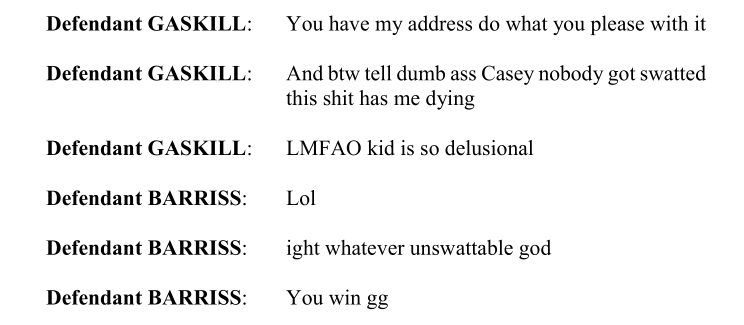
In simultaneously depressing and haunting Twitter conversations disclosed during the trial, Barriss and his target are seen exchanging direct messages, sparring over each other’s cred and making light of the swatting attempt.

Barriss had in fact called the cops, and convinced them to show up to the address Gaskill had given.

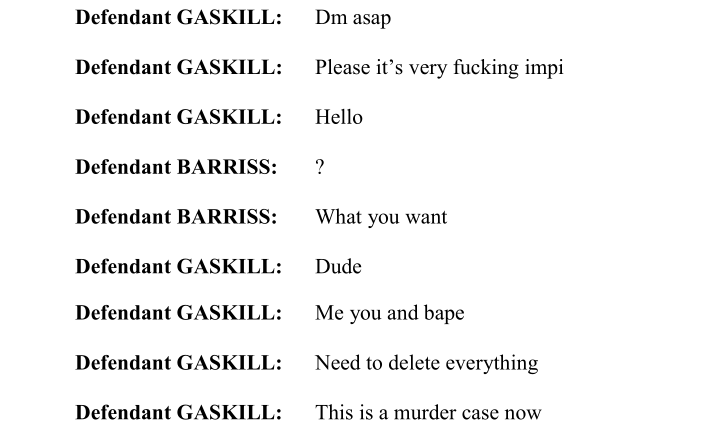
And Gaskill soon found out that his attempt to troll Barriss had resulted in a man’s death:

All three were charged with various crimes, but Barriss with his long, well-documented history of swatting and bomb threats, was the clear priority. The terms of his guilty plea aren’t documented yet but it would be hard to get away from significant time in prison even if he managed to dodge half of the charges he faced.

It’s a sad story from start to finish, but at least the bad guy didn’t get away.

14 Nov 2018

Skincare startup Heyday raises $8M

Heyday, a startup aiming to make facials more affordable and personalized, announced today that it has raised $8 million in Series A funding.

I first wrote about the company a year ago, when it raised its $3 million seed round. At the time, co-founder and CEO Adam Ross said his goal was to offer something that sits between expensive, high-end facials and “random little places that are generally cheap in a bad way.” (Heyday pricing starts at $65 for a 30-minute session.)

The company currently operates six brick-and-mortar locations — it started in New York City but recently opened its first Los Angeles store. At the same time, Ross said the website was recently redesigned to offer a more “frictionless” booking experience, and the company also says it can use its “Facial Record” of customers to personalize the treatment and products.

Moving forward, the goal is to both open new physical locations (particularly in LA), but also to continue investing in the technology.

“It’s not an either/or — we see mutual growth and expansion across both channels,” Ross said. “The physical footprint is always going to be a key pillar of our brand strategy, but to win and service customers’ needs in this space, you need to be online.”

Ross also suggested that Heyday is changing the way customers look at facials. For one thing, 30 percent of its customers say they’ve never had a facial before. In addition, Ross said they’re starting to see facials not as an occasional luxury, but as a regular part of their wellness routine: “Most of our clients think about us like an Equinox membership.” And they should, he argued, especially since “your skin is your largest organ.”

The new funding was led by Fifth Wall Ventures, with participation from Lerer Hippeau, Brainchild Funding, M3 Ventures and CircleUp. Fifth Wall partner Kevin Campos is joining Heyday’s board of directors.

“We are in the midst of a significant shift in the retail industry, where marquee brands are moving from digitally native to an omnichannel model,” Campos said in the funding announcement. “We believe the team at Heyday is offering the best experience across both digital and physical touchpoints, and we are thrilled to partner with them to help navigate this complex process and position them for success.”

13 Nov 2018

Meet the Magecart hackers, a persistent credit card skimmer group of groups you’ve never heard of

There have been few hacker groups that have been responsible for as many headlines this year as Magecart.

You might not know the name, but you probably haven’t missed their work — highly targeted credit card skimming attacks, hitting Ticketmaster and British Airways, as well as consumer electronics giant Newegg and likely many more sites that have been silently hacked to scrape consumer credit card data at the checkout.

Nobody knows those attacks better than Yonathan Klijnsma, a threat researcher at security firm RiskIQ, who’s been tracking Magecart for more than a year.

In a new report published with risk intelligence firm Flashpoint, Klijnsma has exposed the inner workings of the hackers — a group of groups, rather than a single entity — all with different modus operandi and targets, which he described as a “thriving criminal underworld that has operated in the shadows for years.”

“Magecart is only now becoming a household name,” the researcher said.

Chief among Klijnsma’s findings is that there are at least six distinct groups operating Magecart skimming scams, each taking their own approach. Group 1 began as early as 2014 by targeting thousands of sites with attacks and single-use servers for hosting the malware and storing the collected data, while Group 2 and Group 3 expanded their reach and honed their attacks to hook their card skimming malware on a greater range of payment providers. Group 4 took the bulk of the victims — more than 3,000 sites hacked — with its scattergun approach, grabbing as many cards as it could from as many sites as it could.

The groups have been going where the money is — breaking into websites using known server vulnerabilities, injecting card payment skimming code and siphoning off credit card numbers, names and security codes on an attacker-controlled server, often for months at a time.

If they get caught, they just move on to their next victim.

Magecart’s most high-profile victims were the work of Group 5, which carried out supply chain attacks by hitting third-party code providers — like customer service chat boxes — that are installed on thousands of sites and carrying the group’s malware with it, expanding the group’s reach on a massive scale. It was Group 5 that RiskIQ blames on targeting many of Ticketmaster’s global sites. Group 6, meanwhile, also began highly selective attacks that only targeted major players — including British Airways and Newegg.

Between the half-dozen groups that RiskIQ has identified so far, at least 6,400 sites have been affected.

And that’s just the start.

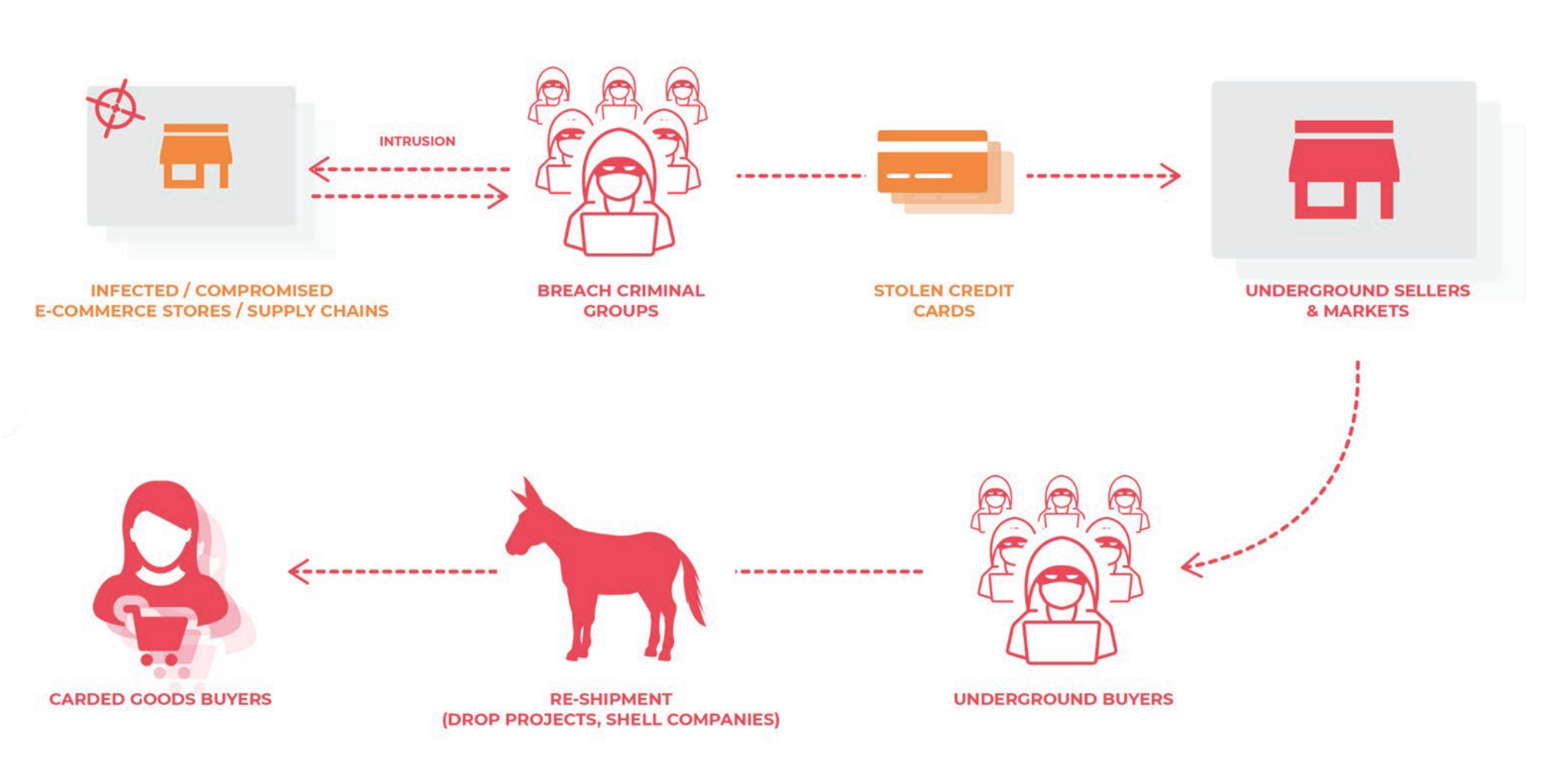
Once a steady stream of credit card numbers come in, the hackers will sell the data — often on the dark web, making it easier to hide their activities from the law.

Magecart’s credit card skimming cycle. (Image: RiskIQ/Flashpoint)

Klijnsma warned that there will be many more card skimming groups and many more websites affected — larger and lesser-known sites alike that have yet to be discovered.

Case in point: Earlier this year, little-known New Jersey-based electronics retailer TechRabbit disclosed a data breach. Like so many other sites, it went largely unnoticed — except, upon closer inspection, the breach had all the hallmarks of Magecart. Willem de Groot, a security researcher cited in the Magecart report, confirmed on Twitter — and independently verified by TechCrunch — that the site had been hit again months later.

We reached out to the company’s chief executive, Joel Lerner, to inform him of the card skimming malware. “Who is TechCruch [sic] and what do you know about TechRabbit?” he said.

After several emails back and forth, including a screenshot sample of the malware on the site’s checkout pages, he expressed concern but stopped responding.

Klijnsma conceded that although his research has given an unprecedented insight into how the Magecart groups work, “that doesn’t mean we will be able to spot every instance and every attack,” he said. There are likely many more sites affected by card skimming malware — as of yet undetected. “We’d like to call on the industry and everyone who encounters these attacks to help take it down,” he said.

To combat the threat from Magecart, RiskIQ and other cybersecurity firms can sinkhole domains associated with Magecart infrastructure, pulling them offline and out of operation.

Klijnsma said it requires a layered approach — like website owners improving their security with security patches and segregating servers. “You don’t catch this with just one security control but rather you stack them and try to catch it at at least one of these steps,” he said.

“Basically any vector is game among these groups with some groups utilizing all of them to reach their goal of breaching a target,” he said.

13 Nov 2018

This $199 PS4 and ‘Spider-Man’ Black Friday bundle has my bargain-sense tingling

I’m calling it — this is the best deal of this year’s Black Friday season, for gamers anyway. It’s amazing. It’s spectacular. Sony is selling a PlayStation 4 Slim with the new Spider-Man game for $199. That’s way too little money.

The 1TB PS4 slim currently retails for $300, and that used to be the cost of the 500 GB one. So a $199 price for the improved, terabyte-capacity console would already be a great deal. But throwing Spider-Man in there? I’m not usually one to call out individual details for Black Friday (we’ll have a roundup) but this is ridiculous.

That game came out just the other day, and has garnered absolute rave reviews; plenty of TechCrunch staff have lost dozens of hours to it, and expansions are on the way to suck even more time. It’s still going for full price most places, so that’s worth $50 or $60 right there.

I own a PS4 already and I’m going to do this. The Slim update didn’t change a lot, but it’s quieter, easier to use (no more invisible buttons!), and of course considerably smaller. Getting it for $139 is a no-brainer. Comes with a controller too, obviously. Then I trade in the old one and pick up Tetris Effect on store credit!

For comparison, both Microsoft and Nintendo are offering their basic consoles with a popular game bundled in for $299. Obviously Sony is looking to eat their lunch.

Sure, you could also save your money for a PS4 Pro. But the benefits there, while I wouldn’t call them dubious by any means, aren’t really must-haves for most gamers. Red Dead Redemption 2 isn’t going to look that much better unless you’ve also got a 4K HDR setup and all that jazz. If you’re super into the AAA games and best possible graphics, by all means go for it, but for the rest of us who’d rather buy another 4 or 5 games with the money we saved? Slim it is.

There’s also a PSVR bundle for $200 and controllers are cheaper too. But the Slim is obviously the centerpiece here. You’ll have to go to “participating retailers” and probably fight people like me to get the deal, which goes live on November 18 like all the others.

13 Nov 2018

Blue Apron lays off 4 percent of employees as it seeks profitability next year

Meal kit company Blue Apron announced small layoffs today as part of its Q3 2018 financial results. The layoffs, which affected four percent of Blue Apron’s workforce, are part of Blue Apron’s path to profitability.

“We are taking decisive actions to prioritize our highest-impact opportunities and build a stronger, sustainable business,” Blue Apron CEO Brad Dickerson said in a press release. “As a result of these actions now underway, we expect to be profitable on an adjusted EBITDA basis in 2019. This included the difficult decision to part ways with valued employees. On behalf of the entire company, I thank these colleagues for their many contributions to the business.”

Blue Apron expects to spend about $1.6 million in employee-related expenses — mostly severance payments. That, however, will lead to an estimated $16 million in savings next year.

Blue Apron Chief Marketing Officer Jared Cluff also left the company, though he was not technically laid off.

“We came to a mutual agreement that this was the appropriate time for Jared to part ways with the business knowing he has a strong team to absorb his responsibilities,” a Blue Apron spokesperson told TechCrunch. “We are incredibly thankful for his contributions to the business.”

Blue Apron reported a Q3 loss of $33.9 million compared to $87.2 million last year during this time. Meanwhile, revenue declined to $150.6 million compared to $210.6 million in the year-ago period.

Looking forward, Blue Apron wants to expand its direct to consumer business by prioritizing relationships with its “best customer” segment.

“We expect this focus to create a more efficient business, as well as increase key customer metrics, including order rate and revenue per customer,” Dickerson said in a statement. “We believe this strategic focus will have a meaningful and positive impact on our current and future customers and deliver value to our shareholders.”

13 Nov 2018

Facebook Lasso app lead Brady Voss leaves for Netflix right after launch

Facebook Lasso has a steep uphill climb ahead as it hopes to chase the musical video app it cloned, China’s TikTok (which merged with Musically). Lasso lets you overlay popular songs on 15-second clips of you lip syncing, dancing, or just being silly — kind of like Vine with a soundtrack. It’s off to a slow start since launching Friday, having failed to reach the overall app download charts as it falls from #169 to #217 on the US iOS Photo and Video App chart, according to App Annie.

Forme Facebook Lead Product Designer Brady Voss

And now one of the Lasso team’s bosses Brady Voss is leaving Facebook for a job at Netflix. He’d spent five years as a lead product designer at Facebook working on standalone apps like Hello and major feature launches like Watch, Live, 360 video, and the social network’s smart TV app. He previously designed products for TiVo and Microsoft’s XBox.

“After five life-changing years at Facebook, my last day will be this Friday, 11/16” Voss wrote on Facebook. “Following our launch of our new app, Lasso, a project I’ve been working on for a while now, the timing works well to explore what’s coming next . . . As for what’s next? I have accepted a position at Netflix in Los Gatos, California.” A Facebook spokesperson responded that “Yes, I can confirm that Brady is leaving Facebook.”

Voss added some color about joining Facebook, noting  “There was actually a discussion about whether or not I’d be a great culture fit because I wore a tie to my interviews–which is funny because we don’t believe dressing like that is what enables people to bring their best everyday. Thankfully, they saw past the common clichés–because suits and ties are not me.” As for Facebook’s troubles, he wrote that “I was even there for the big freak out moments along the way–we’ll keep them unnamed ?”, which could refer to his work on Facebook Live that spawned big problems with real-time broadcasts of violence and self-harm.

While it’s reasonable for anyone to want a change of pace after five years, especially after the brutal year Facebook’s had in the press, his departure just a week after Lasso’s launch doesn’t inspire a ton of confidence in the app’s trajectory. It might have been a sensible stopping point haven gotten the app out the door, but you’d also think that if Lasso had a real shot at popularity, he’d have wanted to stick around to oversee that growth.

Lasso’s First Rodeo

TechCrunch first broke the news that Lasso was in development last month, citing Voss as one of the team’s heads. But in the meantime, the world’s highest valued private startup Bytedance managed to push its TikTok app past Instagram, Snapchat, and YouTube on the download charts. It’s now at #5 on the US iOS overall charts and #1 in Photo and Video. Facebook seems to have shooed Lasso out a little prematurely before losing more ground, given it lacks many of the augmented reality features and filters found in Instagram, Snapchat, and TikTok .

Facebook Lasso

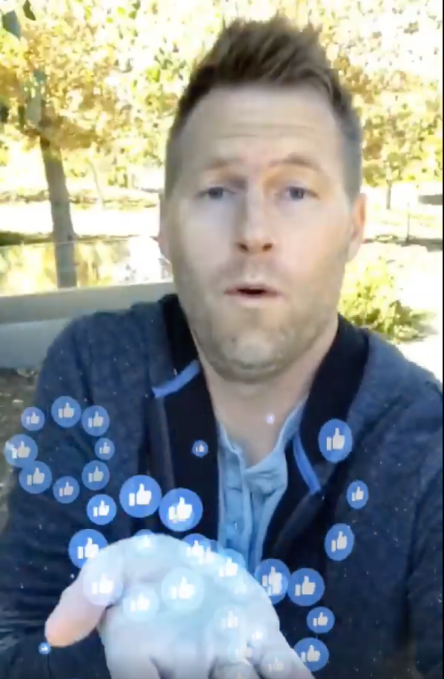
TechCrunch asked the company for some more details about the Lasso roadmap. A spokesperson told me that Facebook will be evolving Lasso and adding new features with time, and may test a feature for uploading videos instead of being restricted to shooting them in-app right now. In fact, Voss’ departure post includes a “Made With Lasso” video featuring an augmented reality effect with him conjuring Facebook Like thumbs-ups out of his hand.

As for monetization, Facebook tells me there are no plans to show ads right now. Typically, Facebook tries to build products to have hundreds of millions of users before it potentially endangers growth by layering in revenue generators. I asked if users might be able to pay their favorite video creators with tips, and the company says that while that’s not currently available, it hopes to explore ways to allow creators to earn money in the future. Instagram said the same thing about IGTV when it launched in June, and we still haven’t heard anything on that front. Facebook likely won’t be able to lure creators to new platforms with smaller audiences than their main channels unless it’s going to let them earn money there.

If Facebook is truly serious about challenging TikTok, it may need to build closer ties between Lasso and Instagram. Facebook left its previous standalone video apps like Slingshot and Poke out to dry, eventually shuttering them after providing little cross promotion. Given the teen audience Lasso craves is already on Instagram, it will be fascinating to see if former VP of News Feed Adam Mosseri who’s now running Instagram will insert some links to Lasso. A Facebook spokesperson says that Facebook may investigate promoting Lasso on its other apps down the line.

And one final concern regarding Lasso is that Facebook isn’t doing much to prevent underage kids below 13 from getting on the app. Tweens flocked to Musically, leading to some worrisome content. 10-year-old girls in revealing clothing singing along to the scandalous lyrics of pop songs frequently populated the Musically leaderboard. That prompted me to question Musically CEO Alex Zhu on stage at TechCrunch Disrupt London 2015 about whether his app violated the Child Online Privacy Protection Act (COPPA) that prohibits online services from collecting photos or videos of kids under 13. He denied wrongdoing with flimsy excuses, claiming parents were always aware of what kids were doing, and stormed out of the backstage area after our talk.

So I asked Facebook how it would prevent such issues on Lasso, where all content is public and adults can follow children. A spokesperson told me that you need a Facebook or Instagram account to sign up for Lasso, and those services require people to be 13 older. But “require” isn’t exactly the right word. It asks people to state they’re of age, but doesn’t do anything to confirm that. Lasso does have a report button for flagging inappropriate content, and the company claims to be taking privacy and safety seriously.

But if the tech giants are going to build apps purposefully designed for young audiences, asking for kids to merely promise they’re old enough to join may not be sufficient.