Year: 2018

13 Nov 2018

Google’s Project Fi gets an improved VPN service

Google’s Project Fi wireless service is getting a major update today that introduces an optional always-on VPN service and a smarter way to switch between Wi-Fi and cellular connections.

By default, Fi already uses a VPN service to protect users when they connect to the roughly two million supported Wi-Fi hotspots. Now, Google is expanding this to cellular connections, as well. “When you enable our enhanced network, all of your mobile and Wi-Fi traffic will be encrypted and securely sent through our virtual private network (VPN) on every network you connect to, so you’ll have the peace of mind of knowing that others can’t see your online activity,” the team writes in today’s announcement.

Google notes that the VPN also shields all of your traffic from Google itself and that it isn’t tied to your Google account or phone number.

The VPN is part of what Google calls its “enhanced network” and the second part of this announcement is that this network now also allows for a faster switch between Wi-Fi and mobile networks. When you enable this — and both of these features are currently in beta and only available on Fi-compatible phones that run Android Pie — your phone will automatically detect when your Wi-Fi connection gets weaker and fill in those gaps with cellular data. The company says that in its testing, this new system reduces a user’s time without a working connection by up to 40 percent.

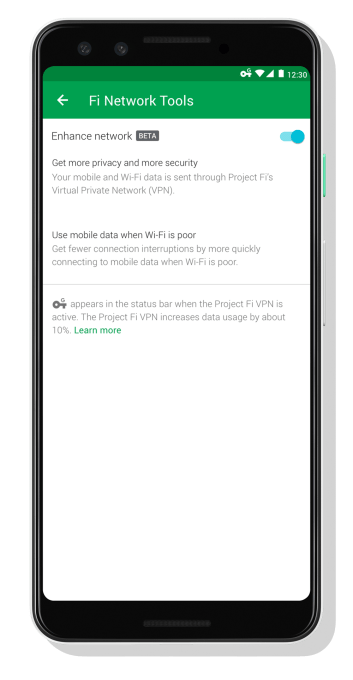
These new features will start rolling out to Fi users later this week. They are off by default, so you’ll have to head to the Fi Network Tools in the Project Fi app and turn them on to get started. One thing to keep in mind here: Google says your data usage will likely increase by about 10 percent when you use the VPN.

13 Nov 2018

RideCell expands funding round to $60 million

RideCell, a transportation software startup, has doubled its previously announced Series B funding round to $60 million, a sign that investors believe demand for cloud-based mobility platforms will grow as more companies try to scale up car-sharing, ride-hailing and even robotaxi businesses.

The company, which has developed a platform designed to help car-sharing, ride-sharing and autonomous technology companies manage their vehicles, announced it raised $28 million in May.

Activate Capital led this round; its co-founder and managing director Raj Atluru has joined RideCell’s board. Reinsurance group Munich Re’s ERGO fund, LG Technology Ventures, BNP Paribas, Sony Innovation Fund, Ally Ventures and Khosla Ventures joined this extended round. Denso also upped its investment in the Series B round.

Nearly half a dozen other companies had already invested in the Series B round, including Cox Automotive, Initialized Capital, Denso, Penske, Deutsche Bahn and Mitsui.

“Investor interest in cloud-based mobility platforms and autonomous vehicles increases almost daily as the disruptive potential of these new technologies are realized,” RideCell CEO Aarjav Trivedi said in a statement.

The company recently received a permit from the California Department of Motor Vehicles to test its Auro autonomous vehicles on public roads. RideCell acquired self-driving car company Auro in October 2017. Auro initially developed and operated driverless shuttles for private geo-fenced locations such as corporate and university campuses. The company has since expanded its focus to include passenger vehicle models and minivans, although it still plans to target low-speed urban use cases focused on solving last-mile transportation.

The company’s real-world trials will start on Ford Fusion vehicle platforms equipped with Auro’s autonomous driving system.

13 Nov 2018

Open sourcing analysis, plus US, China and HQ2

The big news today is that — finally — we have Amazon’s selection of cities for its dual second headquarters (Northern Virginia and NYC). Then some notes on China. But first, semiconductors and open sourcing analysis.

We are experimenting with new content forms at TechCrunch. This is a rough draft of something new – provide your feedback directly to the authors: Danny at danny@techcrunch.com or Arman at Arman.Tabatabai@techcrunch.com if you like or hate something here.

Pivot: Future of semiconductors, chips, AI, etc.

Last week, I focused on SoftBank’s debt and Form D filings by startups. On Friday, I asked what I should start to analyze next. There were several feedback hotspots, but the one that popped out to me was around next-generation chips and the battle for dominance at the hardware layer.

As a software engineer, I know almost nothing about silicon (the beauty of abstraction). But it is clear that the future of all kinds of workflows will increasingly be driven by capabilities at the hardware/silicon level, particularly in future applications like artificial intelligence, machine learning, AR/VR, autonomous driving, and more. Furthermore, China and other countries are spending billions to go after the leaders in this space such as Nvidia and Intel. Startups, funding, competition, geopolitics — we’ve got it all here.

Arman and I are now diving deeper into this space. We will start to post once we have some interesting things to share, but if you have ideas, opinions, companies or investments in this space: tell us about them, as we are all ears: danny@techcrunch.com and Arman.tabatabai@techcrunch.com.

Open-source analysis at TechCrunch

Since I launched this daily “column” last week, I have included the text near the top that “We are experimenting with new content forms at TechCrunch.” One of those forms is what might be called open-source journalism. Definitions are fuzzy, but I take it to mean working “in the open”: allowing you, the audience of this column, to engage in not just feedback around finalized and published posts, but to actually affect the entire process of analysis, from sourcing and ideation to data science and writing.

I am thankful to work at a publication like TechCrunch where my readers are often working in the exact sectors that I am writing about. When I wrote about Form Ds last week, a number of startup attorneys reached out with their own thoughts and analysis, and also explained key aspects of how the law is changing around SEC disclosure for startups. That’s really powerful, and I want to apply it to as many fields as possible.

This thesis is ultimately intentional — now I have to operationalize it. There aren’t good tools (yet!) that I know of that allows for easy sharing of data and notes that doesn’t rely on a hacked together set of Google Docs and Github. But I’m exploring the stack, and will publish more things publicly as we have them.

Amazon HQ2 – the future of corporate relations with cities
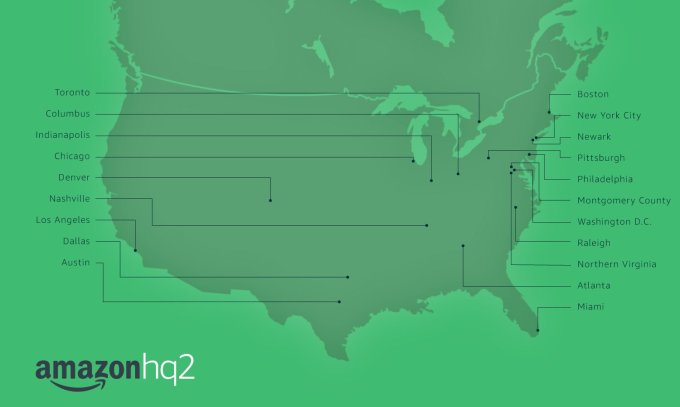
Amazon’s long process for selecting an HQ2 is finally over, and the official answer is two: Northern Virginia and NYC. Tons of words have been spilled about the search, and I am sure even more analysis will strike today about what put those two locations over the top.

To me, the key for mayors is to start using these reverse searches (where a company seeks a city and not vice versa) as leverage to actually get resources to fund infrastructure and other critical services.

This is a theme that I discussed about a year ago:

Take Boston’s bid for GE’s new headquarters. Yes, the city offered property tax rebates of about $25 million , but GE’s move also pushed the state to fund a variety of infrastructure improvements, including the Northern Avenue bridge and new bike lanes. That bridge adds a critical path for vehicles and pedestrians in Boston’s central business district, yet has gone unfunded for years.

Ideally, governments could debate, vote, and then fund these sorts of infrastructure projects and community improvements. The reality is that without a time-sensitive forcing function like a reverse RFP process, there is little hope that cities and states will make progress on these sorts of projects. The debates can literally go on forever in American democracy.

So if you are a mayor or economic planning official, use these processes as tools to get stuff done. Use the allure of new jobs and tax revenues to spur infrastructure spending and get a rezoning through a recalcitrant city council. Use that “prosperity bomb” to upgrade old parts of the urban landscape and prepare the city for the future. A healthier, more humane city can be just around the corner.

Take DC. The city has seen one of the best-run Metro systems deteriorate to abysmal levels over the past few years due to a complete dumpster fire of organizational design (the DC transit agency WMATA is funded by inconsistent revenue sources that ensure it will never be sustainable). Here is an opportunity to use Amazon’s announcement to get the tax framework and operations figured out to ensure that real estate, transportation, and other critical urban infrastructure are designed effectively.

China’s mobile internationalization

Timothy Allen/Getty Images

Talking about second headquarters, the technology industry clearly has separated into poles, one based around the United States and the other based around China. Two articles I read recently gave good insights of the benefits and challenges for China in this world.

The first is from Sam Byford writing at The Verge, who investigates the native OS options that Chinese consumers receive from companies like Xiaomi, Huawei, Oppo, and others. The headline is much more shrill than the text, so don’t let that frighten you.

Byford provides an overview of the lineage of Chinese mobile OSes, and also notes that what might look like design gaffes in Western consumer eyes might be critical needs for Chinese buyers:

But what is true today is that not all Chinese phone software is bad. And when it is bad from a Western perspective, it’s often bad for very different reasons than the bad Android skins of the past. Yes, many of these phones make similar mistakes with overbearing UI decisions — hello, Huawei — and yes, it’s easy to mock some designs for their obvious thrall to iOS. But these are phones created in a very different context to Android devices as we’ve previously understood them.

The article is perhaps a tad long for what it is, but Byford’s key viewpoint should be repeated as a mantra by any person connected to the technology sector today: “The Chinese phone market is a spiraling behemoth of innovation and audacity, unlike anything we’ve ever seen. If you want to be on board with the already exciting hardware, it’s worth trying to understand the software.”

Of course, while China may be a huge country, its leading technology companies do want to globalize and expand their user bases outside of the Middle Kingdom’s borders. That may well be a challenging proposition.

Writing at Factor Daily, Shadma Shaikh dives into the failure of WeChat to break into the Indian market. The product lessons learned by WeChat’s owner Tencent could be applied to any Silicon Valley company — cultural knowledge and appropriate product design are key to entering overseas markets.

Shaikh gives a couple of examples:

Another design feature in the app allowed users to look up and send add-friend requests to WeChat users nearby. During initial onboarding when users were just checking app’s features, many would tap the “people nearby” feature, which would switch on location sharing by default – including with strangers. Once location sharing with strangers was switched on, it wasn’t very intuitive to turn it off.

“Women used to get a lot of unwarranted messages from men, which was a major turn off and many of them left the platform,” Gupta says. “China probably didn’t have this stalking problem.”

And

In China, where the internet was cheaper than in India in 2012, sending video files of, say, 4 MB was not a challenge. WhatsApp compresses a 5 MB photo to 40 kilobytes. WeChat did not compress the files and took many minutes and data to send and receive media files.

Internationalization will never be easy, but the lessons that Silicon Valley has slowly learned over the past two decades will need to be learned again by Chinese companies if they want to export their software to other countries.

Reading Docket

13 Nov 2018

WeRecover, the Kayak for addiction recovery, raises $2M

Approximately 90 percent of people in need of rehabilitation services for drug and alcohol abuse don’t have access to them, according to a Substance Abuse and Mental Health Services Administration survey. Why? Often, because they don’t know where to look.

Santa Monica-based WeRecover wants to fill that information gap with its Kayak-like online booking engine for rehab centers. The startup’s matching algorithm pairs people with an accredited rehab center with open beds, tailored to that person’s budget, insurance, clinical needs and location. The goal is to make it easier for anyone seeking treatment for themselves or otherwise to quickly discover and secure a spot at a facility, streamlining what can be a daunting and logistically complicated process that prevents people from receiving the care they need.

Today, WeRecover is announcing another $2 million fundraise led by Crosslink Capital, bringing its total venture capital backing to $4.5 million. Box Group, Wonder Ventures, Struck Capital and others also participated in the round.

“It’s a really obvious idea … but truly no entrepreneurs anywhere were working to build a marketplace for addiction recovery centers,” WeRecover co-founder and chief executive officer Stephen Estes told TechCrunch. “There’s an overwhelming need for a simpler way to connect with patients.”

WeRecover co-founder and chief executive officer Stephen Estes.

Founded in 2016 by Estes and Max Jaffe, WeRecover has rapidly grown from connecting a few hundred people seeking treatment per month to roughly 4,000 users last month. The startup now provides information on 11,000 treatment centers in 29 states. The goal is to have at least 1 program listed in every state by the end of 2018. Currently, most of the programs the company tracks are located in California, Florida, Arizona and Colorado.

Estes said the WeRecover database is the most comprehensive database of free, nonprofit and state-funded treatment programs in existence, simply because no one had set out to aggregate this particular set of information until now.

The startup plans to use the latest round of venture financing to continue hunting down treatment centers to add to its database, expand its 16-person team and, eventually, Estes said, WeRecover would like to craft and integrate content into the experience.

“We play a really important role in somebody’s journey,” he said. “They find treatment through us and we are part of one of the most important decisions they make in their life, so we should keep them engaged. We do think there’s room to build an app to help people sustain their sobriety and connect them with their peers.”

13 Nov 2018

Fintonic users offered 0% interest on Amazon.es purchases

Personal finance management app maker Fintonic has teamed up with ecommerce behemoth Amazon to offer users in Spain interest free purchases on the local Amazon .es marketplace.

The 0% finance offer is being timed to coincide with the annual Black Friday shopping fest that kicks off later this month.

Qualifying Fintonic users can apply for Amazon Gift cards ranging from €200 to €1,000 via the app — and be able to defer payments for up to four months.

The balance of the offered gift cards has a shelf life of ten years before expiry.

Fintonic is asking interested users to sign up to a guest list in time for the offer to launch on November 23.

The Madrid-based fintech startup offers a free app for consumers to manage their money, focusing on Spanish speaking markets. It pairs a financial assistant app with a brokering business model that’s based on taking a commission for any third party financial products its users sign up for.

Product suggestions are powered by a proprietary credit score derived from the visibility its app gets once users link their bank and credit card accounts.

This FinScore index assigns users a rate of between 0 and 900 points, based on analyzing more than 160 variables, including via accessing users’ financial history. And it’s using the score to underpin the Amazon interest free offer now.

Fintonic says users will need a FinScore of 450 or higher to obtain the 0% interest Amazon offer.

Its system means even new Fintonic users could obtain the 0% financing deal.

“That is the beauty,” says founder an CEO Lupina Iturriaga. “From the very first moment that you are a Fintonic user you can start shopping at Amazon interest free and payback within four months.

“When you launch Fintonic’s app, in less than two minutes you have all your financial data aggregated, and in less than five minutes you can obtain the interest free funding.”

The collaboration — via the Amazon Incentives team in Spain — looks intended to give Fintonic’s app a boost in the region, given the general brand visibility and clout of Amazon.

Fintonic says it has more than 500,000 active users at this stage, although it also operates in Chile and Mexico. (A year ago it reported 400,000+ users in its first two markets). It also raised a €25M Series B round a year ago.

At the same time, the collaboration looks good for Amazon — encouraging regional shoppers to spend more than they might otherwise via its local marketplace. Given that the Amazon experience in Spain can be a tad hit and miss.

The local marketplace is definitely less slickly functioning than other European markets where the company has invested more in local warehouse and shipping. For Spanish shoppers that translates into limited inventory, variable prices and often very slow shipping times. But 0% finance does offer a new incentive.

13 Nov 2018

WeWork picks up ANOTHER $3B from SoftBank

WeWork has picked up another $3 billion in financing from SoftBank Corp, not to be confused with SoftBank Vision Fund. The deal comes in the form of a warrant, allowing SoftBank to pay $3 billion for the opportunity to buy shares before September 2019 at a price of $110 or higher, ultimately valuing WeWork at $42 billion minimum.

In August, SoftBank Corp invested $1 billion in WeWork in the form of a convertible note.

According to the Financial Times, SoftBank will pay WeWork $1.5 billion on January 15, 2019 and another $1.5 billion on April 15.

SoftBank is far and away WeWork’s biggest investor, with SoftBank Vision Fund having poured $4.4 billion into the company just last year.

The real estate play out of WeWork is just one facet of the company’s strategy.

More than physical land, WeWork wants to be the central connective tissue for work in general. The company often strikes deals with major service providers at ‘whole sale’ prices by negotiating on behalf of its 300,000 members. Plus, WeWork has developed enterprise products for large corporations, such as Microsoft, who tend to sign longer, more lucrative leases. In fact, these types of deals make up 29 percent of WeWork’s revenue.

The biggest issue is whether or not WeWork can sustain its outrageous growth, which seems to have been the key to its soaring valuation. After all, WeWork hasn’t yet achieved profitability.

Can the vision become a reality? SoftBank seems willing to bet on it.

13 Nov 2018

Movile raises $400 million for its iFood delivery business

The Brazilian technology conglomerate Movile has just raised one of the largest rounds ever recorded for a Latin American startup, pulling in an additional $400 million for its iFood subsidiary from existing investors including Naspers and Innova Capital.

Founded roughly 20-years ago by chief executive officer Fabricio Bloisi, the company which began as a digital content studio for mobile device has grown into a mobile services and content empire with aspirations of reaching 1 billion people.

The company is on its way with estimated revenues over $240 million and over 150 million monthly active users. iFood alone recorded 10.4 million delivery orders for the month of October and the growth of the business is nothing short of explosive.

According to data from the company, iFood received 390,000 orders per day in Brazil in the last weeks of October – representing 109% growth, compared to 183,000 from October 2017. The company’s 10.8 million monthly orders have fed 9 million Brazilian customers and iFood boasts a network of 50,000 restaurants and 120,000 couriers. 

“Movile is very fortunate to have long-term investors who have supported us for the past decade to help achieve our goal of transforming the lives of more than one billion people and thus we are able to continually back iFood to ensure it remains the market leader,” said Fabricio Bloisi, the company’s chief executive in a statement. “Our entire ecosystem of companies is focused on allocating resources and energy towards our one billion people goal, and iFood is leading the way fueling unprecedented growth through its innovative technology platform, providing consumers, couriers and restaurants with the best experience in food ordering and delivery.”

Delivery is central to Movile’s expansion plans and it serves as a gateway to many of the company’s other business lines.

While the engine of growth in the company’s earliest days was Playkids, its mobile content business focused on children’s entertainment, it has moved well beyond content and entertainment. Now it counts the payment business Zoop; delivery company Rappido; and the ticketing business, Sympla, among its many and varied business units.

In an interview onstage at TechCrunch’s Startup Battlefield Latin America event last week, Bloisi attributed the company’s success to its aggressive mergers and acquisitions strategy across the region and an ability to rapidly spin up and shut down business units as it experimented with what could work for Latin American consumers.

The goal, for Bloisi was always to create a multi-billion business that could span the globe and compete with any of the technology giants hailing from Silicon Valley or, increasingly, China.

Indeed, as Movile expands, its model is looking more and more similar to another Naspers portfolio company, the Chinese mammoth of mobile messaging and services, Tencent.

Leveraging its messaging platform, WeChat, Tencent has become a multi-billion powerhouse — and a platform for exchanging goods and services for a huge percentage of China’s mobile internet users.

Movile hopes to follow the same path, with operations in content, payments, and delivery all housed under its roof. And as the connections between online and offline commerce increase, food delivery is emerging as the central hub for that plan, as our contributor, Nathan Lustig wrote for us earlier this year.

The insights and data that Movile gathered during its strategic venture capital investments in iFood were critical. During this time, Movile built the foundation for its investments that followed shortly after, and learned how to make them a success. With each new investment, Movile’s goal was simple: take a fast-moving startup and help it grow beyond what the founding team ever thought possible by infusing cash, human capital and any technical resources or expertise that the startup could possibly need.

Movile quickly solidified its M&A strategy, its processes and its position as a leader in Latin America’s mobile market. To continue financing its growth through acquisitions, Movile raised another $55 million from Innova Capital, Jorge Paulo Lemann and FINEP in its Series D round in 2014. This new round of financing led to even more acquisitions, including the acquisition of Rapiddo, ChefTime and FreshTime. It also allowed the company to make additional investments in LBS Local, the owners of Apontador, MapLink, Cinepapaya and TruckPad.

“We want our consumers to have an amazing delivery experience from the moment they order their food to the moment it arrives, and our partners – the restaurants and delivery fleet – make that happen by living our purpose of improving people’s lives using our services,” said Carlos Moyses, iFood’s chief executive in a statement.  “iFood exists for our customers and with an increased investment commitment of this size, we will be able to build out our state of the art technology platform, and increase our courier and restaurant partners to even better serve our current and future customers in Latin America.”

13 Nov 2018

Digital ad spending grew to $49.5B in the first half of 2018, according to IAB

The online advertising business continues to grow at double-digit rates, according to the latest report from the Interactive Advertising Bureau (a trade group for online advertisers and publishers).

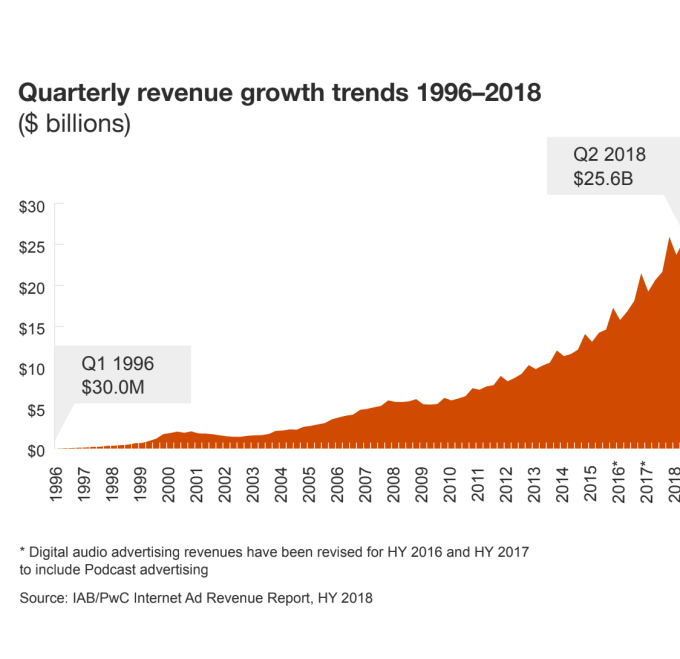
According to the report, which was prepared for the IAB by PricewaterhouseCoopers, digital ad revenue in the U.S. reached $49.5 billion in the first half of 2018, up 23 percent year-over-year. And more of those ad dollars are shifting to mobile, which accounted for 63 percent of the total, compared to 54 percent during the same period last year.

“We’re really looking at that as advertisers catching up to consumer behavior,” said Sue Hogan, the IAB’s senior vice president of research and measurement.

PwC U.S. partner David Silverman suggested that the growth of mobile commerce and direct-to-consumer brands are also playing a big role, with new technologies giving digital advertisers “the ability to efficiently and effectively target consumers who are likely to be interested in a purchase, driving the cost of acquiring that customer down.”

“You can then plow that profit back into your business … the digital advertising market is helping to fuel that growth,” Silverman said.

IAB 2018 report

Meanwhile, video advertising is up 35 percent to $7 billion, with mobile video accounting for 60 percent of the total. Digital audio ad revenue is up 31 percent to $935 million, and social media revenue is up 38 percent, to $13.1 billion.

Although the IAB report is only focused on ad spend in the United States, many U.S. companies are likely affected by GDPR regulations in Europe — one recent study suggested that the regulations have reduced ad tracking in Europe while helping Google. When I brought this up, Silverman said there hasn’t been a big impact in the numbers thus far. (GDPR took effect in May.)

“I do believe this is one of the headwinds that the industry will be facing and we will need to have response to those challenges,” he said. “But we have not, to date, seen a major impact on growth.”

13 Nov 2018

Former Beats Music CEO is back with an electric scooter startup

About a year ago, David Hyman, former Beats Music CEO and co-founder of music startup Mog that eventually sold to Beats Music, did something that was “very abnormal for me — career-wise,” he told TechCrunch. Hyman was an entrepreneur in residence at a giant real estate company. Because the music industry has changed so much, he said he didn’t want to do another music company.

While at this real estate company, Hyman said he started riding electric scooters everywhere, realizing that “it was so much better to get on a rideshare scooter than to drive my car or take an Uber.”

One day, Hyman rode one of these shared electric scooters to a grocery store in Oakland to buy some ice cream. Once he got back outside, the scooter was gone. He proceeded to look for the closest scooter, which was about one-quarter mile away, he said. But as he was approaching the scooter, someone scooped it up. That’s when Hyman said he had his epiphany.

“I just want one when I open my door and I want to take it on BART (Bay Area Rapid Transit) and jump off and go wherever I want,” Hyman said. “And so that embarked on a journey to find one to buy, but I couldn’t find a good one to buy in the U.S.”

Hyman was looking for one that was portable and lightweight, with good range, torque and motor power. He landed on one he found on Alibaba, but still wasn’t completely jazzed about it.

That’s where Unagi, founded by Hyman, comes in. Launching on Kickstarter today, Unagi is looking to raise $30,000 and start shipping the scooters in January.

Unlike the other electric scooter startups that have cropped up over the past year, Unagi is taking a different approach. Hyman is betting that after people become accustomed to riding electric scooters via the likes of Bird, Lime, Spin, Skip and so forth, they’ll realize it’s cheaper to just buy their own. Though, Hyman admits he does not have any data to back up that hypothesis.

“A lot of people are going to go through the decision cycle I went through, which is that they prefer ownership,” he said. “I don’t know if that’s one percent of the market or five percent of the market or 10 percent. I actually have nine UC Berkeley MBA students right now helping me figure out the market size.”

The Unagi scooter itself is undoubtedly beautiful. That’s in part thanks to a design partnership the company formed with a firm out of China. The scooters are manufactured across 15 different Chinese plants, but Hyman said the company might start assembling the scooters in the U.S.

“There’s this tax people talk about called the Trump tax,” he said.

Right now, Unagi’s minimum production goal is 300 scooters upon launch, but Hyman thinks it’ll probably be somewhere between 500 to 1,000.

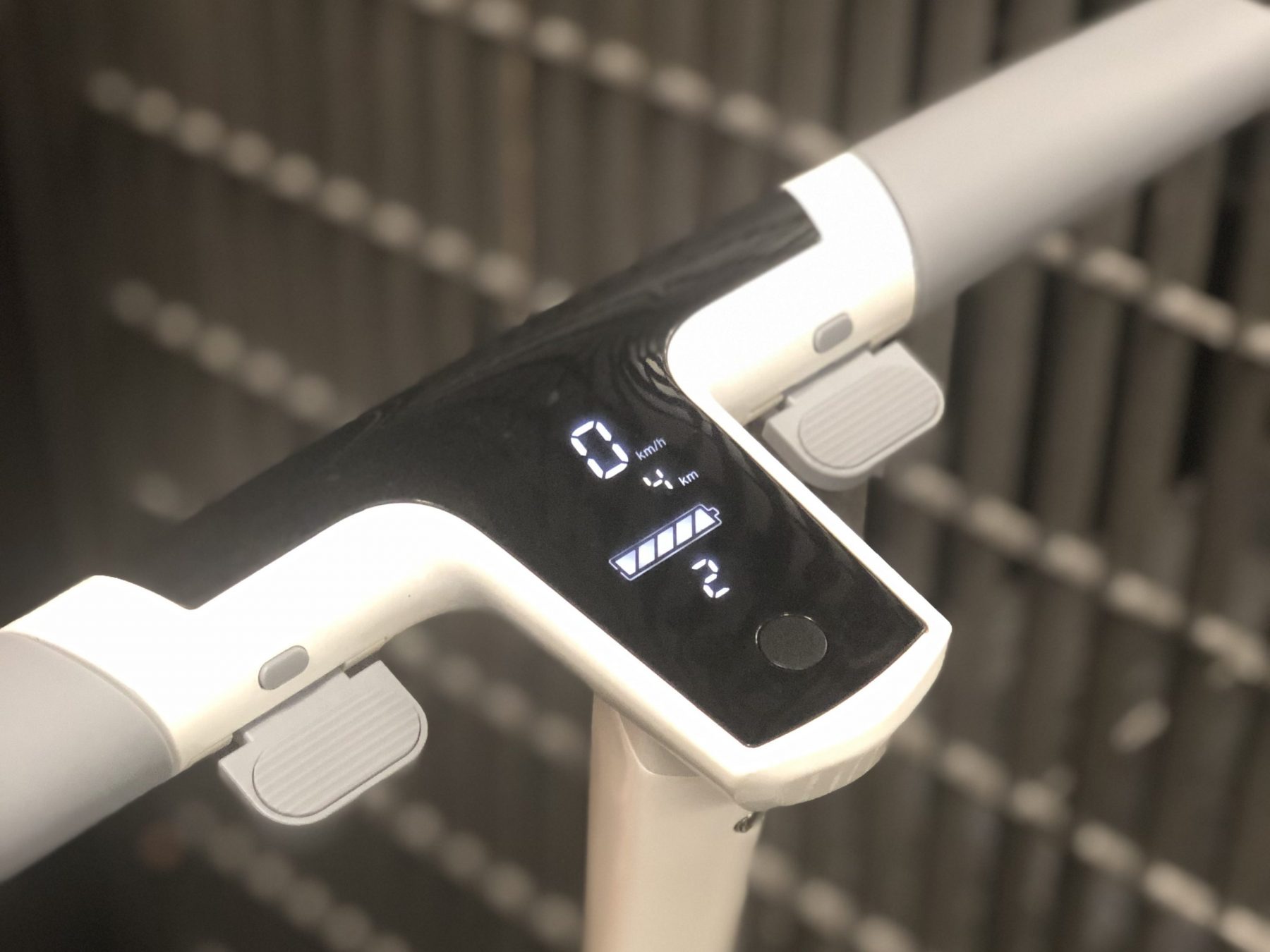
Unagi comes in a couple of different models — a 250 watt for $890 and a $450 watt for $1,190. Both of the models have three riding modes: beginner (9.3 mph max speed), intermediate (12.4 mph max speed) and advanced (15.5 mph max speed).

Compared to other electric scooters you could own, Unagi is a bit more expensive than its competitors. The Xiaomi Mi retails for $599 on Amazon while the Ninebot scooter costs $777.

But Hyman said he’s not necessarily looking to get the price down, noting how you “pay a premium for beautiful design. That’s just the reality of it.”

Hyman also pointed out that Unagi is built with carbon fiber instead of aluminum, as well as magnesium alloy handles.

I rode the scooter once and didn’t feel entirely confident about the brakes, which are all electric (versus electric plus mechanical, or electric plus disc brake), on the downhill. Hyman took a look at the scooter I’d been riding and didn’t see any apparent problems with it. Minus the braking issue, the Unagi is fun to ride and will even get you up some hills in San Francisco.

For future models, Hyman said he’s thinking about security and locking mechanisms. He envisions including GPS tracking to make it easier to recover your scooter if it gets lost or stolen. Unagi is entirely bootstrapped but is today launching a $30,000 Kickstarter campaign.

13 Nov 2018

Atolla uses machine learning to address your skin care needs

Atolla, a skin care startup that got its roots at MIT, is launching a Kickstarter campaign to help people achieve their skin goals. Atolla uses machine learning to identify skin health issues and then recommend the right skin care products based on what affects your skin.

Atolla comes as a monthly subscription, with the idea being that you test your skin every month to see how it changes depending on the season. The kit allows you to test for oil, moisture and pH. Every month, you receive a customized product based on the data extrapolated from your skin.

“So we’re thinking that if we do this measurement for people like just once a month, after about a year we can start to predict how their skin’s going to change,” Atolla co-founder Meghan Maulpin told TechCrunch. “It’s like, we know that your skin gets this percent dryer in the winter so before you actually have the issue of super dry skin, we already know that you need to use something that’s like this.”

Testing your skin takes just about 10 minutes (I tried it) and is pretty straightforward, thanks to on-screen directions from Atolla’s mobile app.

Atolla’s vision is to build a longitudinal data set that looks at skin concerns across demographics, geographies and lifestyles. Atolla use two distinct machine learning models. The first is to create skin archetypes based on all the factors that may affect someone’s skin, and the second is to predict how someone’s skin may change.

“What we’re really trying to build is a database that represents all different types of like skin attributes, and understand what the actual skin types are,” Maulpin told TechCrunch. “So it’s not just about like, number of data, it’s also diversity.”

Maulpin and her co-founder Sid Salvi met at MIT while in graduate school last year. Following acceptance into MIT’s Delta V accelerator for students, the two opened a handful of pop-up shops in New York City. Fast-forward to today, and Atolla is gearing up to start shipping to consumers in February.