Year: 2018

13 Nov 2018

Mercaux bags $4.5M to help bricks-and-mortar retail tool up to sell more

Retail tech SaaS platform Mercaux has closed a £3.5 million (~$4.5M) Series A funding round led by European VC fund Nauta Capital. 

The 2013 founded London-based startup sells software for retailers to tap into digital capabilities in their physical retail stores — offering a modular platform that’s intended to support digital transformations at a pace of the retailer’s choosing.

“Historically offline retail was just a sales channel. But with the rise of e-commerce, and ability to communicate with clients digitally at any moment of time, offline stores (and in-store employees) have started to play multiple roles,” says founder and CEO Olga Kotsur.

Physical stores are “not just a sales channel but also an e-commerce window, marketing channel, customer relationship centre” and much more, she argues.

Or, well, they can be — if retailers spend to upgrade legacy IT systems that have not been designed with more expansive digital shopping capabilities in mind.

Mercaux’s platform offers a pick n mix of services intended to empower retailers’ employees to sell more — such as by tapping into up-to-the-minute style suggestions — and thereby “improve and personalise the in-store customer journey”.

On a practical level this translates into real-time access to inventory levels in-store and online at one end; through merchandising content via cross-sell suggestions and styling ideas (powered by crowdsourcing); digital marketing content; all the way up to customer profiles and preferences, pulling on personal data to better inform and steer the in store shopping experience.

At the business end, the platform plugs into retailers’ POS and e-commerce systems to power instant online and checkout sales. On top of that its value-add is assistant tools and analytics for in-store sales people, as well as a channel through which they can communicate with each other and Head Office.

By capturing the usage of the app, the platform also provides retailers with an overview of store analytics — serving up insights on shoppers’ behaviour, most popular products, lost sales and so on.

The SaaS platform can be deployed on a variety of hardware touchpoints, including in-store kiosks.

“Mercaux integrates across all retailers digital touchpoints, making existing data (CRM, Inventory, or Marketing) actionable in-store and enhancing it further,” says Kotsur. “It also follows a ‘lego approach’: modularity in terms of features, flexible configuration and easy integration allow retailers to launch first what they can or need most (for example real-time inventory and recommendations for effective selling), and gradually enhance the platform subject to their new needs (for example customer profiles and preferences for personalised experience).”

The company claims its platform drives an up to a 14% increase in direct store sales — achieved via store conversion and basket size uplift as well as new omni-channel sales.

It also reckons it can quantify its “sales people efficiency” gains — claiming to eke out up to a fifth more productivity from your humans thanks to digital aids like its mobile sales assistant app. (It offers “help” with initial training of salespeople but Kotsur suggests the app is intuitive enough that sales people “normally adopt it in a matter of days”.)

“Conversion increases due to more effective sales people who do not waste time walking away from a customer, can confidently offer alternative if something is not available, or can show all options via catalogue,” she continues. “Basket size increases due to cross-sell and styling suggestions. Omni-channel sales means new online orders directly from stores or e-commerce purchase by a customer after receiving a follow up email post store visit.

“Our most recent UK customer Karen Millen, realised +9% store sales increase in less than 3 months.”

Deployment time for integrating the platform varies depending on the retailer. Kotsur says it can take up to a month to integrate with systems, plus another couple of weeks for retail prep. So it “normally” takes clients between one to two months to go live, although rolling the platform out across all stores can take “between a month and a year” — depending on the number of stores and infrastructure readiness.

Mercaux has more than 15 customers at this stage, across markets including the UK, continental Europe, LatAm and Russia.

Other current customers include the likes of French Connection, United Colors of Benetton, Nike and Under Armour, and it says its platform is being used more than 100,000 times per day in more than 250+ stores around the world. 

Fashion remains the company’s largest segment but Kotsur says the platform can operate in any retail vertical that requires “service selling” (or where sales people are expected to have “at least basic product knowledge”), and is looking to grow usage in other verticals.

“Currently we work with Apparel & Fashion, Sports, Department stores, Cosmetics, and even Alcohol segments,” she says, adding: “We are planning to expand to Home & Furniture as well as Electronics over the next few months.”

The Series A funding will be used to drive growth in existing and new markets, as well as being put into R&D to further develop the platform.

On the competition front, Kotsur names Canada based Tulip Retail and US PredictSpring as also addressing similar challenges around digital transformation but she suggests a modular approach and attention to analytics is helping it stand out.

“Mercaux approach is different as not only our in-store solution is modular and easily configurable, which means faster integration and more flexibility for our clients, but we also provide a powerful tool for Head Office teams that allows them to get in-store analytics, control stores performance and execution, and allows real-time connection between stores and retail management teams.”

Commenting on the funding in a statement, Carles Ferrer, Nauta Capital’s London-based general partner — who now joins Mercaux’s board — added: “We have been fans of Olga and Mercaux over the past years, as they have achieved a fantastic commercial traction by tackling a large industry in need of a transformative digital disruption. Within our broader software approach, we have developed a very strong thesis around the massive transformation the retail industry is currently facing.

“Having led several deals within this space — both in the offline retail tech market and in the online-enabled technology retail vertical — we are building another fundamental block that supports our broader view of the space with Olga and Mercaux’s value proposition.”

13 Nov 2018

Netskope raises $168.7M at a $1B+ valuation for its cloud security platform

As organizations continue to grapple with security risks posed by employees using a range of apps and devices in the workplace, a startup that has built a platform to help them to this has raised a significant round of funding. Netskope, which provides a cloud security platform to help set and run policies around different apps and devices, has closed a round of $168.7 million to grow its business, expand its R&D, and bring on more global data centers.

The valuation was not disclosed in Netskope’s announcement, but the company has confirmed to us that it is now over $1 billion. This is a big jump: Netskope in its previous round last year ($100 million) was valued at $525 million post-money in what the CEO Sanjay Beri told us at the time was a significant upround. On a straight line of growth, that would have put the company’s pre-money valuation at $694 million. But the fact that security risks and the predicament that Netskope is addressing have only grown has both helped bump the company’s valuation above that.

As with the previous round, this Series F was led by Lightspeed Venture Partners. Accel, Geodesic Capital, Iconiq Capital, Sapphire Ventures and Social Capital — all existing investors — also participated, alongside new investor Base Partners. Fueled by the vision to tackle the toughest enterprise security challenges, the investment will enable R&D and global data center expansion of the company’s leading enterprise security cloud platform. The round brings Netskope’s total amount raised to just over $400 million.

The issue that Netskope is tackling is one that has become the norm in most businesses: people use a variety of devices at work, ranging from hardware issued by their companies through to phones, tablets and other equipment that they are bringing in themselves. On top of this, they are all also using a mix of apps, with those issued by their organizations sitting alongside apps that have been downloaded by the workers themselves, sometimes for productivity, sometimes for the exact opposite.

While some companies will try to lock down their networks and prohibit anything except what they have issued themselves, in other cases businesses might do the opposite, hoping that providing a more flexible environment will prove to be one way of attracting top talent.

But in both the cases of apps and devices “approved” by companies and those that have not, the same predicament exists: a proliferation of different services makes for a difficult security landscape, and trying to control and monitor all the data and potential leaks of it that can take place becomes a huge challenge.

Netskope aims to provide a way to do this, by creating a layer — based in the cloud — that oversees the full range of all network activity. Once Netskope is turned on by an IT department, it monitors in real time all off the apps and web sites that are visited by people on the network — currently it can ‘see’ thousands of apps and millions of web pages, it says, including all of the well-known workforce collaboration, CRM, accounting and sales apps, as well as those less well known; and also now cloud service providers such as AWS by way of a recent acquisition of Shift.

A dashboard will show to security and IT teams what information is being accessed and where, and allows them to set policies to limit usage, warn of bad practices and more.

“We look at any transactions that are happen between users and applications,” Beri has said previously. “For any activity where data traverses between you and a server, Netskope can perform data analysis on that.”

While some of this might have seemed like a useful application when Netskope launched six years ago, these days, having a tool to do this kind of monitoring has become essential. It’s not the only one addressing that, though. Competitors offering similar services include Microsoft (by way of Adallom), Blue Coat and McAfee.

“Transforming enterprise security is no longer a nice-to-have, but a requirement in order to protect and secure a company’s most important assets,” said Arif Janmohamed, Partner, Lightspeed Venture Partners, in a statement. “Netskope consistently leads the market and is disrupting and transforming the industry landscape through solving some of the toughest enterprise challenges today. Since its launch, the company has continued to adapt to the evolving security landscape and bring innovative solutions to market.”


13 Nov 2018

Poynt raises $100M for its smart payment terminal

Elavon, a U.S. Bank-owned payment processing company, and National Australia Bank have participated in the $100 million Series C for Poynt, a developer of smart payment terminals and an open operating system that powers any payment terminal worldwide.

Palo Alto-based Poynt was launched in 2014 by Osama Bedier, the former vice president of Wallet and Payments at Google. Prior to joining Google in 2011, Bedier had been the head of platform, mobile and new ventures at PayPal.

In four years, Poynt has brought in a total of $133 million from backers such as Google Ventures, Matrix Partners, Oak HC/FT, Webb Investment Network and Nyca Partners. In the last 16 months, it has shipped some 150,000 terminals. The company says total payment volume will exceed $25 billion in the next year.

“Our vision is to transform retail by becoming that innovation platform for payment terminals everywhere,” Bedier wrote in a statement. “We give developers a technical canvas to build the experiences merchants and their customers have come to expect and ultimately, make visiting your local store the personal experience it was always meant to be.”

With the investment, Poynt plans to bring its technology to Asia, Europe and South America.

13 Nov 2018

“Rent tech” focused RET closes first fund; pours $5M into management platform SmartRent

Today, Real Estate Technology Ventures (RET) Ventures announced the final close of $108 million for its first fund.  RET focuses on early-stage investments in companies that are primarily looking to disrupt the North American multifamily rental industry, with the firm boasting a roster of LPs made up of some of the largest property owners and operators in the multifamily space.

RET is one of the latest in a rising number of venture firms focused on the real-estate sector, which by many accounts, has yet to experience significant innovation or technological disruption. 

The firm was founded in 2017 by managing director, John Helm, who possesses an extensive background as an operator and investor in both real estate and real estate technology.  Helm’s real-estate journey began with a position right out of college and eventually led him to the commercial brokerage giant Marcus Millichap, where he worked as CFO before leaving to build two venture-backed real estate technology companies.  After successfully selling both companies, Helm worked as a Venture Partner at Germany-based DN Capital, where he invested in companies such as PurpleBricks and Auto1. 

Speaking with investors and past customers, John realized that there was a need for a venture fund specifically focused on the multifamily rental sector.  RET points out that while multifamily properties have traditionally fallen under the commercial real estate umbrella, operators are forced to deal with a wide set of idiosyncratic dynamics unique to the vertical.  In fact, outside of a select group, most of the companies and real estate investment trusts that invest in multifamily tend to invest strictly within the sector.

Now, RET has partnered with leading multifamily owners to help identify innovative startups that can help the LPs better run their portfolios, which account for nearly a million units across the country in aggregate.  With its deep sector expertise and its impressive LP list, RET believes it can bring tremendous value to entrepreneurs by providing access to some of the largest property owners in the US, effectively shortening a notoriously lengthy sales cycle and making it much easier to scale.

Photo: Alexander Kirch/Shutterstock

One of the first companies reaping the benefits of RET’s deep ties to the real estate industry is SmartRent, the startup providing a property analytics and automation platform for multifamily property managers and renters.  Today, SmartRent announced it had closed $5 million in series A financing, with seed investor RET providing the entire round. 

SmartRent essentially provides property managers with many of the smart home capabilities that have primarily been offered to consumers to date, making it easier for them to monitor units remotely, avoid costly damages and streamline operations, all while hopefully enhancing the resident experience through all-in-one home controls.

By combining connected devices with its web and mobile platform, SmartRent hopes to provide tools that can help identify leaks or faulty equipment, eliminate energy waste, and provide remote access control for door locks.  The functions provided by SmartRent are particularly valuable when managing vacant units, in which leaks or unnecessary energy consumption can often go unnoticed, leading to multimillion-dollar damage claims or inflated utility bills. SmartRent also attempts to enhance the leasing process for vacant units by pre-screening potential renters that apply online and allowing qualified applicants to view the unit on their own without a 3rd party sales agent.

Just like RET, SmartRent is the brainchild of accomplished real-estate industry vets. Founder and CEO, Lucas Haldeman, was still the CTO of Colony Starwood’s single-family portfolio when he first rolled out an early version of the platform in around 26,000 homes.  Haldeman quickly realized how powerful the software was for property managers and decided to leave his C-suite position at the publicly-traded REIT to found SmartRent.

According to RET, the strong industry pedigree of the founding team was one of the main drivers behind its initial investment in SmartRent and is one of the main differentiators between the company and its competitors.

With RET providing access to its leading multifamily owner LPs, SmartRent has been able to execute on a strong growth trajectory so far, with the company on pace to complete 15,000 installations by the end of the year and an additional 35,000 apartments committed for 2019.  And SmartRent seems to have a long runway ahead.  The platform can be implemented in any type of rental property, from retrofit homes to high rises, and has only penetrated a small portion of the nearly one million units owned by RET’s LPs alone.

SmartRent has now raised $10 million to date and hopes to use this latest round of funding to ramp growth by broadening its sales and marketing efforts.  Longer-term, SmartRent hopes to permeate throughout the entire multifamily industry while continuing to improve and iterate on its platform.

“We’re so early on and we’ve made great progress, but we want to make deep penetration into this industry,” said Haldeman.  “There are millions of apartment units and we want to be over 100,000 by year one, and over a million units by year three.  At the same time, we’re continuing to enhance our offering and we’re focused on growing and expanding.”

As for RET Ventures, the firm hopes the compelling value proposition of its deep LP and industry network can help RET become the go-to venture firm startups looking to disrupt the real estate rental sector.

13 Nov 2018

Wattpad launches a new program offering paid access to exclusive stories

Steve Jobs famously once said that people don’t read anymore, but it turns out younger people are, in fact, reading quite a lot – just in different ways than expected. Case in point: 70 million readers log in to online community Wattpad each month, where they spend over 22 billion minutes engaged in its original stories. 80 percent of that user base is either Millennial or Gen Z and 70 percent are female. Today, Wattpad is going after its most avid readers with the launch of new program offering exclusive stories, called Wattpad Next.

Currently in beta, Wattpad Next will initially be available to Wattpad’s 13 million monthly users in the U.S. It will then roll out to Spanish-speaking countries, followed by a global launch in 2019.

The company has also tested the program before today in Canada, Great Britain, Mexico, and the Philippines.

The program offers users a new way to support favorite writers by offering a selection of stories that you have to pay to read.

The stories span genres and completion status, as some are still being written in the serialized format known to Wattpad readers, while others are finished.

These are purchased using Wattpad’s new virtual currency called Coins, which are bought in-app in packs starting at 99 cents for 9 coins and ranging up to $7.99 for 230 coins. Users can then choose to purchase the stories by chapter, or in full for those works that are completed.


At launch, there are 50 exclusive stories available, with plans to further grow that selection and participating writers in early 2019.

Writers are being invited to join Next – they can’t choose to sign up. Wattpad says it selected stories based on data science.

“Specialists from our Story DNA machine learning teams collaborated with our editorial experts to find stories and writers with exceptional potential for Wattpad Next,” a spokesperson said.

The revenue generated by the stories goes largely to the writers, but the company declined to disclose the split.

“Wattpad users around the world have overwhelmingly embraced the chance to support their favorite writers through the Wattpad Next (beta) program,” said Allen Lau, Wattpad CEO and co-founder, in a statement.

“This program is part of our commitment to helping writers earn money from their stories, monetizing stories both on and off of Wattpad. Along with opportunities to connect with brands, and work with Wattpad Studios to turn their stories into books, TV shows, films, and digital projects, writers can now make money directly from the fans that have supported them since their first page. The beta phase of Wattpad Next is just the beginning, as we look at new ways to help support Wattpad writers around the world,” he said.

Wattpad Next is one of several ways the company has chosen to generate revenue. The company also monetizes via ads, which users can opt out of by subscribing to Wattpad Premium.

Wattpad declined to say how many members have converted to that program, but notes it “exceeded expectations.”

The company has gotten involved in Hollywood deal-making through its studio arm, too, and has turned some of its top stories into books.

This has led to nearly a thousand of its stories to date being published as books or turned into TV shows, movies, and other digital media projects, the company claims. A few of its recent high-profile wins on that front include Wattpad’s co-producing of Hulu’s “Light as a Feather” with AwesomenessTV; the Netflix success story that was “The Kissing Booth” movie; and Sony Pictures Television acquisition of the rights to Wattpad story “Death is my BFF,” which was read more than 92 million times.

Wattpad this year raised $51 million from Tencent and others, and has signed new partnerships with iflix, Sony, SYFY, and others.

Wattpad Next (beta) is available on the web, iOS and Android.

13 Nov 2018

Flipkart CEO Binny Bansal resigns over allegations of ‘serious personal misconduct’

Flipkart, the India-based e-commerce firm owned by Walmart, has lost its Group CEO Binny Bansal after he resigned from the company following an investigation into “serious personal misconduct.”

Bansal founded Flipkart in 2007 with Sachin Bansal (no relation) and he had served as its CEO since 2016, before going on to become CEO of the Flipkart Group — which spans its core e-commerce, fashion and payments divisions — one year later.

Walmart said in a statement that Bansal denied the allegation and that an investigation into it “did not find evidence to corroborate the complainant’s assertions.” However, the retailer did uncover “other lapses in judgement, particularly a lack of transparency, related to how Binny responded to the situation” which is why it has accepted his resignation.

Walmart, Flipkart and Bansal aren’t providing details on exactly what happened, but Walmart cautioned that “recent events risked becoming a distraction.”

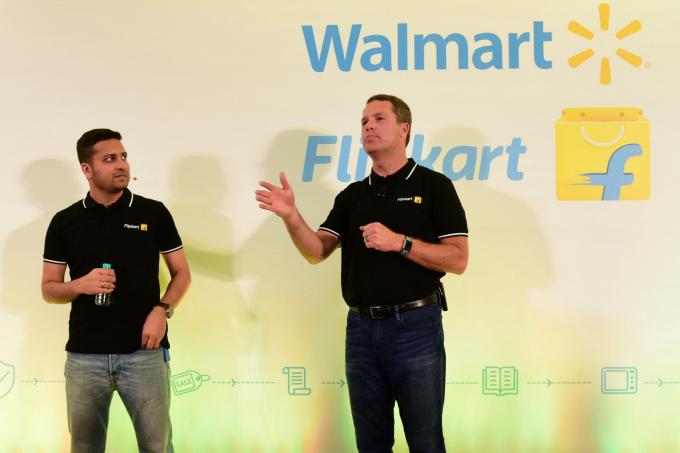
This photo taken on May 9, 2018 shows Walmart CEO Doug McMillon (R) speaking next to Flipkart co-founder and CEO Binny Bansal at an event in Bangalore, as a deal was announced for Walmart to buy a stake in Flipkart (Photo by AFP/Getty Images)

Alongside Flipkart CEO Kalyan Krishnamurthy and Tiger Global’s Lee Fixel, Bansal was widely seen as a key figure in securing the deal that saw Walmart agree to fork out $16 billion for a majority 77 percent stake in Flipkart. The transaction, which closed in August and is the largest in Walmart’s history, cemented Flipkart’s position in India and pitted Walmart against its arch-enemy Amazon for a new battle outside of the U.S.

While Sachin Bansal left the company following the deal, Binny Bansal was expected to stay on and, according to reports, he was viewed as a very key part of the future of the business.

Despite that, Walmart couched the exit as expected.

“Binny has been contemplating a transition for some time and we have been working together on a succession plan, which has now been accelerated,” it said.

There’s no word on Bansal’s successor at this point. Walmart said that the existing leadership will remain in place — that includes former Tiger Global executive Krishnamurthy as head of Flipkart, Ananth Narayanan as CEO of Myntra and Jabong, its fashion portals, and Sameer Nigam as CEO of its PhonePe unit.

13 Nov 2018

Calm heads to the airport, invests $3 million in XpresSpa

Wellness app Calm has today announced a $3 million equity investment in XpresSpa Group, a fast-spa service you may have noticed in your local airport. Calm sees the investment as a way to expand its offline presence, growing awareness of the app as well as its retail products like Sleep Mist and the Calm Book.

Calm subscribers will have access to a variety of in-store benefits and treatments at one of 52 XpresSpa locations in cities like Atlanta, Chicago, Los Angeles, Miami and New York.

As investor and general interest around mental health and wellness grows, Calm has carved out its slice of the pie. The company has raised $28.5 million from investors Insight Venture Partners and Ashton Kutcher’s Sound Ventures, with a $250 million valuation.

The app is, for all intents and purposes, a content hub for folks looking to bring more calm into their life. This can range from in-the-moment meditation sessions to tracks to help you sleep. The company has also introduced a music hub and a video hub for “mindful movement and gentle stretching.”

A Calm subscription costs $69.99/year. The app has 36 million users, with more than 1 million paid users.

“The greatest challenge (and opportunity) for Calm is waking people up to mental fitness,” said Dun Wang, VP of Product & Growth, in an email. “It’s becoming more and more common now, but it’s definitely been a challenge for us. We have a massive poster of a 1970s People Magazine cover in our office. Farrah Fawcett is on the cover in this crazy 70s workout get up and the cover reads “the craze of jogging.” Mental fitness is growing in both importance and popularity, similarly to physical fitness in the 70s.”

Here’s what cofounder and co-CEO Michael Acton Smith had to say in a prepared statement:

The need for mental fitness in our stressed, fast-paced world is clear, and we’ve already seen a tremendous increase in our digital user base, growing 110% percent in downloads this year. By partnering with XpresSpa, we’re expanding beyond our core app offering to reach more offline consumers, and dialing in on a common consumer pain point: traveler stress.

With the XpresSpa partnership, Calm can capitalize on the stress of travel, not only converting people over to the app but doing so at a time when the user is likely to engage.

13 Nov 2018

China’s NetEase raises $600M for its music streaming business

As Tencent Music, China’s largest streaming firm, reportedly stalls on its proposed U.S. IPO, one of its closest challengers is doubling down.

NetEase Cloud Music, a rival operated by games and publishing giant NetEase, just closed a fresh $600 million injection from a bevy of investors that include Baidu and General Atlantic, the company announced this week.

NetEase will maintain a majority share in the company following this deal although it isn’t clear what the valuation is. The business is already valued at over $1 billion, that landmark was reached last year when it raised 750 million RMB, that was around $108 million at the time.

Tencent Music operates a constellation of streaming and live-streaming music apps which Tencent claims reach a cumulative audience of 800 million users. That’s quite a generous figure since China’s official stat keeper recognizes that the country has 800 million internet users, and it seems unlikely that any single business would be able to reach every single one of them. (Yes, stats can often lie.) 

Five-year-old NetEast Cloud Music, meanwhile, says it reaches 600 million users, a figure that it claims has increased by 200 million over the past year. With this new money in the bank, the company said it plans to go after more user growth and develop its platform, which includes over 10 million songs. The company has put focus on independent music, and it claims 1.2 million tracks from around 70,000 indie musicians.

Tencent, which has a tie-in with Spotify, submitted documents last month to go public via a U.S. IPO that could raise at least $1 billion. However, the Wall Street Journal reported a week later that the process had been paused amid challenging market conditions which saw stocks sink, including those of Tencent and Alibaba. The plan was to resume the process this month, according to the report, but so far there has been no update from the company.

Alibaba’s Xiami music service is widely considered to be another major music streaming contender in China, and it teamed up with NetEase Cloud Music earlier this year to share libraries in order grow their respective repositories of songs.

It makes sense that two rivals would team up to increase their rivalry with Tencent, which operates no fewer than four music services: Q Music, Kugou Music, Kuwo Music and WeSing.

Up for grabs is a streaming industry that, while nascent, is showing potential to grow among China’s 800 million internet users. Indeed, iResearch data cited by NetEase forecasts music spending in China to triple between 2017 and 2023. The music industry as a whole is poised to gross 376 billion RMB ($54 billion) in total sales this year with digital the fastest-growing source of income.

Tencent Music’s IPO opened the books on the leading contender in the space with some interesting points to note. Unlike Spotify and others, the business is profitable — $199 million on total sales of $1.7 billion last year — while subscriptions, the core source of revenue in the West, is just 30 percent of all sales. Instead, Tencent Music capitalizes on virtual gifts that are sent to live streamers and premium memberships.

However, the company’s revenue is well short of Spotify, which grossed $1.5 billion in its most recent quarter alone. Those in China are opting to see that gulf as an opportunity and that goes some way to explaining this new round for NetEase Cloud Music.

13 Nov 2018

Kaspersky starts processing threat data in Europe as part of trust reboot

Security firm Kaspersky Labs has opened its first self-styled ‘Transparency Center’ and begun processing threat-related data from European users in data centers located in Switzerland — flipping the switch on the start of a relocation commitment it announced late last year in the face of suspicion that its antivirus software had been compromised by the Russian government and used to suck up US intelligence. 

The first stage of its fightback strategy to reboot trust, a code review plan, was announced a year ago.

Then, in May, the company announced it would be moving some core infrastructure processes to Zurich in Switzerland, saying also that it would arrange for its processes to be independently supervised by a third party qualified to conduct technical software reviews.

This facility has now begun processing data, starting with European users. Although this is just the start of the reconfiguration.

Software assembly will also move to Zurich in time — but not until phase two of the project, after processing for customers in other regions has also been relocated there.

It writes today:

From November 13, threat-related data coming from European users will start to be processed in two datacenters. These provide world-class facilities in compliance with industry standards to ensure the highest levels of security.

The data, which users have actively chosen to share with Kaspersky Lab, includes suspicious or previously unknown malicious files and corresponding meta-data that the company’s products send to Kaspersky Security Network (KSN) for automated malware analysis.

Files comprise only part of the data processed by Kaspersky Lab technologies, yet the most important one. Protection of customers’ data, together with the safety and integrity of infrastructure is a top priority for Kaspersky Lab, and that is why the file processing relocation comes first and is expected to be fully accomplished by the end of 2019. The relocation of other types of data processed by Kaspersky Lab products, consisting of several kinds of anonymized threat and usage statistics, is planned to be conducted during later phases of the Global Transparency Initiative.

By the end of 2019 the company has said the Zurich facility will be storing and processing all information for users in Europe, North America, Singapore, Australia, Japan and South Korea, with more countries slated to follow in future. Kaspersky is not exiting Russia entirely, though, as products for the Russian market will continue to be developed and distributed out of Moscow.

The Zurich Transparency Center will also provide authorized partners with access to reviews of Kaspersky code, and software updates and threat detection rules — as well as functioning as a secure location where governments and partners can come and ask questions and review documentation.

We’d wager journalists will also be invited on inspection tours.

Commenting in a statement, CEO Eugene Kaspersky claims: “Transparency is becoming the new normal for the IT industry — and for the cybersecurity industry in particular.”

“We are proud to be on the front line of this process. As a technological company, we are focused on ensuring the best IT infrastructure for the security of our products and data, and the relocation of key parts of our infrastructure to Switzerland places them in one of the most secure locations in the world,” he goes on, reiterating that the the intent of the Global Transparency Initiative is to increase “the resilience and visibility of our products”.

Which of course sounds a lot better than saying it’s responding to a trust crisis.

“Through the new Transparency Center, also in Switzerland, trusted partners and governments will be able to see external reviews of our products and make up their own minds. We believe that steps such as these are just the beginning – for the company and for the security industry as a whole. The need to prove trustworthiness will soon become an industry standard,” he adds.

Kaspersky says it has engaged “one of the Big Four professional services firms” to conduct an audit of its engineering practices around the creation and distribution of threat detection rule databases — “with the goal of independently confirming their accordance with the highest industry security practices”.

We’ve asked which third party has been selected to oversee the facility.

“The assessment will be done under the SSAE 18 standard (Statement of Standards for Attestation Engagements). The scope of the assessment includes regular automatic updates of antivirus records, created and distributed by Kaspersky Lab for its products operating on Windows and Unix Servers. The company is planning the assessment under SSAE 18 with the issue of the SOC 2 (The Service and Organization Controls) report for Q2 2019,” it further notes.

A year ago the security firm also announced a hike in its bug bounty rewards — saying it would now pay up to $100K per discovered vulnerability in its main Kaspersky Lab products.

Since then it says it has fixed more than 50 bugs reported by security researchers, claiming several were “acknowledged to be especially valuable”.

13 Nov 2018

Sojern raises another $120M led by TCV to expand its travel marketing platform

Travel continues to be one of the biggest verticals online, projected to be worth over $1 trillion by 2022, and today a startup that helps travel-related businesses connect the dots between their products and would-be customers is raising a large round of funding to capitalise on that. Sojern, a company that works with businesses in the travel industry — hotels, airlines, tourist agencies, booking portals and others — to build and run campaigns to find and market their services to people as they are planning travel, is today announcing that it has raised another $120 million in funding.

Sojern, which started out by putting ads on boarding passes, today covers the range of places where businesses place ads to find interested “eyeballs”. Typical media it targets marketing to today includes native advertising; display, mobile and video ads; and social media. But in an interview, CEO Mark Rabe said that the plan for the funding will be to expand to more “emerging” platforms, like connected TV (where it’s already active).

“Our plan is to continue expanding solutions for existing clients as well as accelerate into developing markets like local tourism and attractions,” he said. “Overall we want to keep proving our performance as a late-stage, high-growth company with expanding profit margins and cash flow.”

The round, a Series D, is being led by Technology Crossover Ventures, a key and potentially very strategic investor since TCV has a long history of backing large travel and marketing startups, including Airbnb, Expedia, HomeAway, TripAdvisor, SiteMinder, ExactTarget, Act-On and Ariba, some of which already work with Sojern, and some who well might work with it in the future.

Other investors are not being disclosed, but Sojern has previously had backing from Norwest Venture Partners, Trident, Treeptop and other VCs; and also has a list of strategic partners, with some holding equity stakes in the business, including Alaska Airlines, American Airlines, Carlson Wagonlit, Delta Air Lines, Hawaiian Airlines, Kayak, Travelport, United Airlines and US Airways. (As we’ve pointed out before, the relationship it has with some of these stems back to the founding of the company, and part of what airlines, for example, receive is a cut on the advertising revenues that appear on their boarding passes.)

Prior to this latest round, Sojern had raised some $42.5 million. Rabe said that the company is not disclosing its valuation with this round, but as a guide, he noted that the company has been profitable for the last 13 quarters and it made $100 million in net revenues in 2017. Also of note: Sojern’s last valuation was $158 million after raising a round in 2013, according to PitchBook, so — at a very conservative estimate — its valuation post-money is around $280 million. (But my guess is that it is higher considering Sojern’s growth and profitability.)

“We’re going after a total addressable market that we believe is at least $100 billion,” he said, citing a combination of the dollars travel brands are spending in digital and programmatic advertising worth roughly $20 billion and what they’re paying to online intermediaries in the distribution markets worth $80 billion. “So far we’ve driven over $13 billion in bookings for our clients, and we aren’t slowing down anytime soon,” he added.

The company competes not just with other companies big in advertising like Google (which itself has made a very big play to do more specifically in the travel search vertical) but also other companies working in the big data-fuelled analytics space as it interests with the world of travel marketing, such as Adara.

Rabe believes Sojern is unique in the space. “We don’t see anyone out there delivering direct bookings in travel at this scale, and doing it successfully across the industry from the biggest enterprise brands all the way down to independent properties and local tourism providers,” he said.

“When we think about the competitive set, we’re looking at companies with proven business models demonstrating that they can deliver strong results at scale and retain clients over the long term. And what’s become clear is that today’s independent adtech and martech companies have to differentiate to provide value. Because Sojern has been focused on travel from the very beginning, we understand the challenges and complexities of the industry and offer more specialized solutions than a generalist player ever could.”

The predicament that it is addressing remains a messy one: from every segment of the market — from luxury down to budget travellers — we as consumers are spoiled for choice these days when it comes to thinking not just of where and how we might want to travel, but also how to find the best deals and options that match what we want to do. On the side of suppliers, they are all scrambling to connect with their would-be customers before someone else does.

Sojern says that its wider database and reach covers some 350 million travellers, making it one of the more accurate platforms to identifying and connecting with those users.

Interestingly, this could potentially one day get applied to more than just travel, but maybe not for Sojern.

“I get asked this question a lot,” Rabe said when I asked him about expanding to other areas. “But what people don’t often realize is that the travel and tourism industry is actually the largest industry in the world. Conservatively we believe our immediate total addressable market is $100 billion, and on top of that the overall industry is growing with digital continuing to pull share from offline transaction channels like phone and traditional travel agencies.”

That focus is also what attracted TCV, it seems.

“We have been watching Sojern’s rapid rise in the travel technology space for several years, and we were impressed with Sojern’s leadership position in the space and its unique, scalable model for influencing travelers worldwide,” said Woody Marshall of TCV in a statement.

“Sojern’s ability to both conceptualize a better marketing experience for travel organizations and their steady execution over the past decade, as well as their innovative business strategy, strong executive team, and inspiring company culture made them a natural fit for us.” Marshall is joining the board with this round.