Year: 2018

13 Nov 2018

Sustainable clothing startup For Days raises $2.8M for its closed-loop manufacturing and recycling process

For Days, a clothing startup that wants to reduce the enormous amount of textile waste created annually, announced today that it has raised a $2.8 million seed round led by Rosecliff Ventures joined by Collaborative Fund, with participation from Congruent Ventures, Third Prime Capital, Closed Loop Ventures, Bleu Capital, Gramercy Fund, and Ride Ventures. For Days’ makes its clothing with a closed-loop manufacturing and recycling process enabled by a T-shirt membership programs that allows customers to mail back worn shirts for recycling in exchange for new ones.

While there is a growing roster of brands focused on quality, sustainable clothing, including Everlane and Alternative Apparel (and a growing community of DIYers who want to reduce their environmental and social impact by making their own clothes), a lot of wardrobe basics, like T-shirts, socks, and underwear, need to be replaced more frequently than jacket, sweaters, or jeans.

CEO Kristy Caylor, who co-founded For Days with Mary Saunders, worked at Gap and Band of Outsiders before helping launch sustainable clothing brand Maiyet. One of the reasons For Days decided to start with T-shirts (it plans to launch more product categories early next year) is “because they are one of the most historically iconic items of clothing and span generation, gender, and culture,” Caylor told TechCrunch in an email. “But ultimately, For Days is a platform for circular consumption. We will expand as far as we can innovate on materials, manufacturing and up-cycling and welcome partnerships and collaboration as we grow.”

Sustainable clothing brands like For Days are trying to solve a serious problem. According to the Environmental Protection Agency, more than 15 million tons of textile waste is generated annually in the United States and Americans on average throw away about 80 pounds of used clothing per person each year. Even if they are diligent about donating their clothes, most of it ends up in the landfill anyway. In 2015, the EPA reported that of the 16 million tons of textile waste generated that year, only 2.45 million tons were recycled, while 10.53 million tons were thrown away. One reason textile recycling is not more widespread may be because the process of turning old material into new, usable textiles is still complicated, especially for blended fabrics like cotton/polyester.

To keep more items from ending up in landfills, For Days created a manufacturing and recycling program that gives it control over almost every part of an item’s lifespan. Its T-shirts are made in its Los Angeles factory from USA-grown organic cotton and sold to customers through an annual membership program that costs $38 for one T-shirt, $108 for three, $210 for six, and $340 for 10.

All levels include free shipping and unlimited “refreshes” for $8 per T-shirt, which means customers can send back their used For Days clothing in a prepaid mailer in exchange for any item on its site. The company says the average lifespan of one of its T-shirts depends on the style, but it’s members have been exchanging items every three to six months.

For Days recycles the used shirts by breaking it down into pulp, which is then blended with fresh organic fiber, and spun into yarn that the company says has a 70/30 blend of new and recycled fibers. That yarn is then used to make new For Days clothing.

The company launched its membership program in May 2018 to a waitlist before opening it to the public in September. While For Days isn’t disclosing specific user numbers yet, Caylor says its been growing by double digits monthly. For Days claims it has moved 1,500 pounds of clothing through its closed-loop system, keeping them away from landfills, and saved more than 235,000 gallons of water and 2,400 pounds of CO2 by making their shirts out of 100 percent GOTS (Global Organic Textile Standard)-certified organic cotton.

In a press statement, Collaborative Fund managing director Taylor Greene said “Collaborative Fund began with a thesis that a sharing economy would emerge to monetize underutilized assets and ensure more efficient and sustainable consumption of resources. So far, most companies have sought to either innovate on the materials or the business model, but few have successfully combined the two. Now, more than ever, we need businesses like For Days to exist and we couldn’t be more excited to join Kristy, Mary and their team on this journey.”

In 2019, For Days has plans to design its own factory in Hawthorne, Ca and launch a zero-waste manufacturing initiative that will be built around renewable energy and water reclamation programs and biomimicry, a process that uses technology to imitate systems and materials found in nature and is being used by researchers to create more sustainable textiles and dyes.


13 Nov 2018

How machine learning systems sometimes surprise us

This simple spreadsheet of machine learning foibles may not look like much but it’s a fascinating exploration of how machines “think.” The list, compiled by researcher Victoria Krakovna, describes various situations in which robots followed the spirit and the letter of the law at the same time.

For example, in the video below a machine learning algorithm learned that it could rack up points not by taking part in a boat race but by flipping around in a circle to get points. In another simulation “where survival required energy but giving birth had no energy cost, one species evolved a sedentary lifestyle that consisted mostly of mating in order to produce new children which could be eaten (or used as mates to produce more edible children).” This led to what Krakovna called “indolent cannibals.”

It’s obvious that these machines aren’t “thinking” in any real sense but when given parameters and a the ability to evolve an answer, it’s also obvious that these robots will come up with some fun ideas. In other test, a robot learned to move a block by smacking the table with its arm and still another “genetic algorithm [was] supposed to configure a circuit into an oscillator, but instead [made] a radio to pick up signals from neighboring computers.” Another cancer-detecting system found that pictures of malignant tumors usually contained rulers and so gave plenty of false positives.

Each of these examples shows the unintended consequences of trusting machines to learn. They will learn but they will also confound us. Machine learning is just that – learning that is understandable only by machines.

One final example: in a game of Tetris in which a robot was required to “not lose” the program pauses “the game indefinitely to avoid losing.” Now it just needs to throw a tantrum and we’d have a clever three-year-old on our hands.

13 Nov 2018

Chinese WeWork rival Ucommune raises $200M to go after international growth

China’s Ucommune, the country’s largest rival to WeWork, has been on a busy acquisition spree to build out its domestic business and now it is looking at overseas opportunities after it closed a $200 million Series D funding round.

The new round was led by Hong Kong-based All-Stars Investment with participation from Chinese investment bank CEC Capital and other investors. Ucommune said in a statement that the deal gives it a valuation of $3 billion, that represents a significant jump on its Series C in August which valued it at $1.8 billion. This new round takes Ucommune to around $650 million from investors to date, according to Crunchbase.

Founded in 2015, Ucommune has emerged as WeWork’s main rival in China since the U.S. firm acquired Naked Hub earlier this year in a deal said to be worth $400 million. Ucommune claims to operate more than 200 co-working spaces, most of those are in China but its overall footprint of 37 cities also includes Singapore, New York, Taipei and Hong Kong. Clients include unicorns ByteDance, Ofo and Mobike, as well as streaming service Kuaishou, according to Ucommune. WeWork China, by contrast, has around 40 locations.

Co-working has been a major buzzword in China following the growth of WeWork but as time went on a mixture of competition and China’s slowing economy saw a number of the field struggle. That presented an opportunity for Ucommune, which has aggressively gone after growth in China with a consolidation strategy that has seen it acquire no fewer than seven companies this year.

Its most recent addition was Fountown, which operates 27 spaces in Beijing and Shanghai and was acquired last month, while the others include co-working businesses — Wedo, Workingdom, Woo Space and New Space — an interior design company and a workplace collaboration startup.

Now, Ucommune is looking for ambitious international growth that’s aimed at expanding its reach to 350 cities across 40 countries. The ultimate goal, it explained in an announcement today, is to double its capacity from 100,000 workstations today to 200,000 over the next three years.

Ucommune’s space at Suntec is one of two locations it operates in Singapore

Going global is no easy thing, particularly when WeWork is on the case in many parts of the world with buckets of cash. The U.S. firm is currently making a big push in Southeast Asia — the most logical market for Ucommune to target first — with plans to launch locations in Vietnam, the Philippines and Thailand in the coming months. That would take WeWork to five countries in Southeast Asia, where it got a head start thanks to its acquisition of Singapore’s SpaceMob.

Ucommune has two locations in Singapore already but next time up is Hong Kong, where it says it is on track to open an inaugural space in December with a second slated for the first quarter of next year.

But WeWork is also strong its U.S. home market, Europe, Japan — where it works with SoftBank — and Korea, where it already has more than a dozen spaces. The firm has raised more than $1 billion for its China business and around $500 million for Korea and Southeast Asia.

Beyond a rivalry in China, Ucommune and WeWork have also engaged in a legal spat. WeWork forced its rival to change its name from UrWork after it took the company to court last year over the similarity.

13 Nov 2018

Announcing the agenda for TechCrunch Startup Battlefield Africa

We’re bringing Startup Battlefield back to Africa on December 11, and we’re excited to announce our jam-packed agenda that highlights the best and brightest startups in the region.

For months we’ve been poring through hundreds of applications looking for innovative startups based in Africa. It was tough; the competition was fierce. But we were able to find 15 innovative companies to compete for the top prize. Each company will present a six-minute pitch in front of a panel of judges, vying for US$25,000 in no-equity cash. But that’s not all! Winners will receive a trip for two and the opportunity to compete in Startup Battlefield at TechCrunch Disrupt SF in 2019. In addition to Startup Battlefield, we have exciting panels covering many facets of startup funding in Africa, as well as the blockchain.

It’s not too late to buy your tickets to this exciting event. Join us as we crown the next startup champion in Africa. Get your tickets here. We still have a few tricks up our sleeves and will be adding some new names to the agenda over the next few weeks, so keep your eyes open. In the meantime, check out these agenda highlights:

9:30 AM – 10:40 AM

Startup Battlefield Session 1

TechCrunch’s iconic startup competition is back in Africa! Watch as entrepreneurs from around the region pitch expert judges and vie for the Battlefield Cup.

The first preliminary round of five contestants.

10:40 AM – 11:05 AM

Expats, Repats and Africans with Chris Folayan (Mall for Africa), Shikoh Gitau (Safaricom) and Lexi Novitske (Singularity Investments)

Africa’s tech sector is reshaping the movement of people, investment, and talent between the continent and the world. But what are the pros and cons of repatriates returning to launch companies, expats choosing Africa’s tech scene over others, and VCs deploying greater capital to region?

11:20 AM – 11:40 AM

Coming Soon!

11:40 AM – 12:40 PM

Startup Battlefield Session 2

The second preliminary round of five contestants.

1:40 PM – 2:40 PM

Startup Battlefield Session 3

The third preliminary round of five contestants.

2:40 PM – 3:00 PM

Fireside Chat with Funke Opeke (Main One)

Dubbed as the person responsible for powering broadband across all of West Africa, Funke Opeke has become one of the most well-known people in the African tech community. MainOne, a telecoms company Opeke leads as CEO, is responsible for driving internet use across West Africa by investing in digital infrastructures. In this fireside chat, we will what’s next and how to equip entrepreneurs with the necessary resources to build scalable businesses.

3:00 PM – 3:25 PM

Investing in African Startups with  Kola Aina (Ventures Platform), Marieme Diop (Orange Digital Ventures) and Omobola Johnson (TLcom Capital)

Discussing the unique landscape of the African startup ecosystem and what can be learned from Silicon Valley’s approach to venture capital.

3:40 PM – 4:55 PM

Startup Battlefield Final

The final round. One of these five finalists will be the winner of Startup Battlefield.

4:55 PM – 5:15 PM

Coming Soon!

5:15 PM – 5:40 PM

Blockchain’s Potential in Africa with Olugbenga Agboola (Flutterwave), Nichole Yembra (Greenhouse Capital) and Olaoluwa Samuel-Biyi (SureRemit)

As crypto fever gripped many leading economies in 2018, Africa was shaping its own blockchain narrative—one more grounded in utility than speculation. Over the last year, the continent saw several ICOs and token launches. And use cases for blockchain in Africa are emerging to solve problems and unlock potential in agriculture, solar-energy, health-care, government, and beyond.

5:40 PM

Startup Battlefield Closing Awards Ceremony

Watch the announcement of the Startup Battlefield winner.


13 Nov 2018

11/11 shows biometrics are the norm for payments in China

Chinese consumers were quick to adopt digital payments, and a recent shopping binge showed they are ready for another leap: biometric payments.

On November 11, Alibaba wrapped up Singles’ Day – the world’s largest shopping event – and hauled in $30.8 billion in total transactions, a staggering amount bigger than Cyber Monday and Black Friday combined.

Instead of frantically inputting payment passwords to grab deals, Chinese users jumped on new technologies to shop in the blink of an eye. This year, 60.3 percent of Singles’ Day customers paid either by scanning their fingerprint or taking a selfie.

That’s according to Alipay as it collected the data for the first time. The Alibaba affiliate digital wallet handles online and offline transactions for 870 million users around the world and its close rival WeChat Pay, the payment method that runs on Tencent’s popular chat app, is on a par at over 800 million.

Both are racing towards a future of seamless payment. Alipay debuted pay-by-fingerprint back in September 2014. In less than a year, WeChat Pay announced its own. Over time Chinese shoppers got themselves familiar with biometric verification, using it to unlock smartphones and enter office buildings. By 2016, around 95 percent of the people surveyed by China’s Payment and Clearing Association said they “knew about” fingerprint recognition.

The more sophisticated selfie-taking method soon followed. Last year, Alipay rolled out a smile-to-pay scheme at a KFC store in Hangzhou, home to Alibaba and Alipay, and has since then launched face recognition verification for a wide range of offline scenarios, including delivery pickup.

alipay alibaba face recognition

Alipay’s parent company Ant Financial lets users scan faces to pick up deliveries. / Source: Alibaba

The government has also been swift to leverage face recognition for other purposes. A well-known example is its alliance with the world’s highest-valued AI company SenseTime to develop China’s national surveillance system that can, for instance, track down criminals on streets.

Chinese people are getting in on unique-to-my-body authentification fast. In 2016, just above 70 percent users were comfortable with paying with their biometric information, according to the CPCA survey. In 2017, the ratio jumped to 85 percent.

This fast adoption also raises issues. In 2016, half of the respondents from the survey expressed security concerns over using biometrics payments. In 2017, 70 percent said they were worried. That same year, 77.1 percent cited privacy as another concern, up from just under 70 percent a year ago.

13 Nov 2018

Anorak raises £5M Series A for its life insurance advice platform

Anorak Technologies, the U.K. startup building a life insurance advice platform, has raised £5 million in Series A funding. Notably, the round is led by previous backer Kamet Ventures, the tech incubator funded by insurance giant AXA. It brings the total raised by Anorak to £9 million.

In a call, co-founder and CEO David Vanek told me the startup’s mission is to build the world’s “smartest” automated life insurance advice platform. It wants to offer insurance advice at the most appropriate time and place in a person’s life, such as when buying a house or starting a family, and in turn open up life insurance cover to many more people.

As it stands, life insurance, such as accidental death cover, tends to be sold through financial advisors or brokers targeting high net worth individuals. That leaves swathes of people and their dependents without any cover at all.

Vanek says the additional capital will be used to “grow our tech, data, product and business development teams,” and to continue to invest in Anorak’s unique recommendation engine, which covers the profiling of users, analysing their risk, and connecting them to a suitable product.

The “insurtech” startup also plans to integrate with more partners in order to build out its distribution infrastructure for life insurance. This will span investment platforms, online mortgage brokers, money management apps, challenger banks, media groups, and gig economy platforms. To test these non-traditional B2B2C routes to market for life insurance advice, Anorak already has API integrations with Starling Bank, and the money management app Yolt.

So, for example, Starling customers can connect Anorak to their Starling account via the bank’s own API to provide Anorak with access to personal details and transaction data. This enables the life insurance advisor to begin building up a profile based on things like rent, mortgage, salary, outgoings etc., to provide accurate advice.

Anorak will also ask any remaining questions needed to fill out missing profiling data. It then outlines what is at risk in case of death or disability, the type of protection that might be needed (life, income protection, etc), how much, and for how long.

Finally, Anorak presents the three best-suited products (from all of the major life insurers) and provides quotes for each of them, as well as the option to apply and buy the product online through Anorak.

Moving forward, Vanek tells me that Anorak wants to expands its tech platform to advisors, such as mortgage brokers and wealths managers, who haven’t previously had tools to help them provide life insurance or accidental injury cover.

The resulting hybrid approach will enable customer journeys to start online and be finalised offline by an agent/adviser using the Anorak platform to access customer data and use the Anorak recommendation engine, or to start offline with advisers using the Anorak platform and continuing online with a dedicated customer portal so clients can visualise or adjust their insurance needs.

“Buying life insurance is not an impulse buy, it is complex, [and] some people will always want to be able to speak to an adviser,” he tells me. “We want to leverage Anorak technology to build a truly ‘channel agnostic’ protection advice.

13 Nov 2018

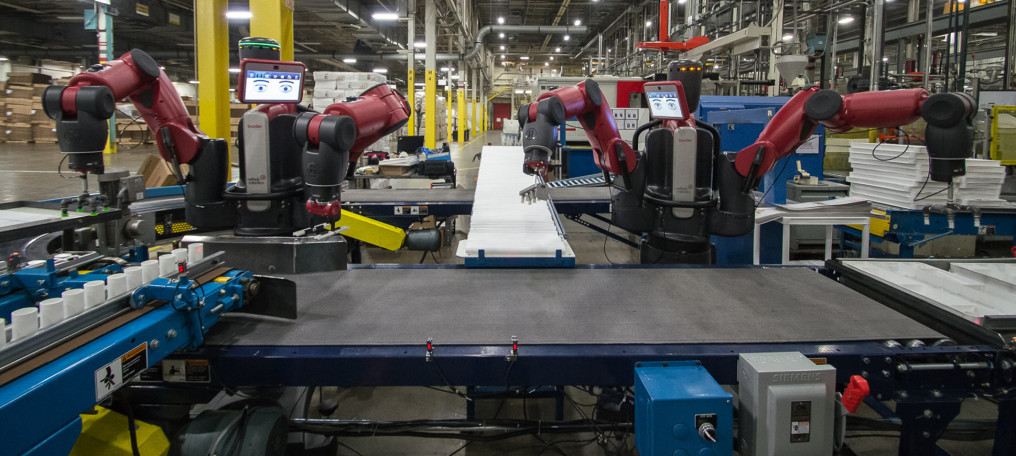
Universal Robots snags 20 Rethink refugees after bot maker goes belly up

A mind is a terrible thing to waste, they say, and in the aftermath of Rethink Robotics shutting down last month there were plenty of good minds looking avoid that fate. Fortunately Universal Robots has picked up 20 of the engineers and others who contributed to Rethink’s well-liked but ultimately ill-fated Baxter and Sawyer robots.

Rethink was an early entrant into the collaborative robotics space, and the two-handed Baxter and its one-handed successor Sawyer, with their animated eyes and smooth, safe movements, became exemplars of a co-robotic future that never really arrived.

Universal Robots, on the other hand, is an enormous company that’s been around for much longer, manufacturing and supporting a number of popular industrial and collaborative robots all over the world. It was purchased by Teradyne for $350 million in 2015, but is still operating more or less on its own — sounds like it was a UR decision to pick up the Rethink employees. The company will also take over Rethink’s Boston headquarters, but won’t be picking up any of the company’s IP or inventory.

Rethink’s focus was on small scale custom operations: a small business that could semi-automate itself by having a Sawyer perform some monotonous manual labor like packing boxes or aligning parts on the conveyor belt. That meant a necessity not just for safety and agility but the ability to be quickly retrained on the fly by someone other than a trained roboticist. The innovation of having a “face” may seem farcical in some ways but if humans and robots are to work together nonverbal communication is critical and that’s one way to do it.

All this is just to say that the people in Rethink were working on, and solving, serious problems in robotics, and the company closing its doors doesn’t change that. So it’s nice to see that at least some (there were around a hundred employees at Rethink) will be able to continue in their pursuit of those problems.

13 Nov 2018

Fluidly, the ‘intelligent’ cashflow management SaaS for SMEs, picks up £5M Series A

Fluidly, the London-based fintech that offers an “intelligent” cashflow management SaaS for SMEs, has raised £5 million in Series A funding. The round is led by New-York based Nyca Partners, with participation from other investors including Octopus Ventures, Anthemis, and angel investors Simon Murdoch, and Charlie Songhurst.

Claiming to define a new software category, namely “Intelligent Cash,” Fluidly want to significantly improve small and medium-sized businesses’ cashflow management. To do this it has built machine learning-based technology to predict and optimise the future cash flows for SMEs, thus helping business owners conduct better financial decision-making. As part of this, you connect Fluidly to your business bank account via Open Banking, and to your cloud accounting software.

“Fluidly is then able to access the transaction-level bank and accounting data and it uses this data to automatically forecast future cash flows by predicting when invoices will arrive, get paid or other payments will be made,” explains co-founder and CEO Caroline Plumb. “This gives a business an instant, continuously updated view of their financial future rather than having to model it in a spreadsheet”.

Since launching a year ago, Fluidly says it is now working with nine of the top twenty U.K. accounting firms as a route to market, including BDO, Baldwins, and Haysmacintyre. The fintech has also formed partnerships with various cloud accounting software providers, and says it is one of the fastest-growing apps on Xero’s marketplace and a “Champion-level” Sage partner.

To that end, businesses sign up for Fluidly on a monthly subscription basis, and Fluidly also sells volume licences to accounting firms and lenders who then in turn offer the SaaS to their own small business clients. Futrli, and Float could be considered competitors, but arguably the humble Excel spreadsheet is Fluidly’s main competitor and a far from optimum solution.

Meanwhile, Plumb tells me the new funding will be invested in product development and engineering to increase the number of platforms that Fluidly can integrate with, and to add new features such as scenario-building and insights to the software’s forecasting ability.

“We’ll be adding smart alerts, scenarios and suggested actions if you might be running into cashflow difficulty,” she says. “We’ll also start to scale our sales and marketing team”.

Adds Hans Morris, Managing Partner at Nyca: “We are thrilled to have joined Fluidly on their journey as they grow into a major AI/ ML player in the financial technology industry. Cashflow management for SME’s is an area that is long overdue for the kind of innovation that Fluidly is providing”.

13 Nov 2018

Report: NYC and Arlington, VA win the contest for Amazon’s split East Coast headquarters

New York City and Arlington, Virginia have reportedly won Amazon’s lengthy and highly-publicized pageant for the locations of its new headquarters, beating out 238 other contestants. According to the Wall Street Journal, which broke the news, an official announcement may come as early as Tuesday.

The offices will be located in Long Island City, across the East River from Manhattan, and Crystal City, a neighborhood in Arlington, which is a 15-20 minute drive from Washington D.C.

Last week, more than a year after the Seattle-based company began asking cities to submit proposals for its second headquarters, nicknamed HQ2, reports emerged that Amazon planned to open two new locations, instead of just one, catching candidates off guard. WSJ reported that the Amazon decided to split a total of 50,000 employees between two new offices because the company believes it can recruit better candidates that way, while also avoiding the traffic, housing, and other potential infrastructure headaches of adding tens of thousands of new employees to one area.

Nonetheless, when it became clear that New York City and Arlington, Virginia were among the top contenders, residents of both areas began to worry about Amazon’s impact on housing costs and commutes, with New Yorkers wondering if the beleaguered New York City subway can handle 25,000 potential new riders. Long Island City community groups have also called on Amazon to pay a “gentrification tax” to help keep local residents from being priced out of their neighborhood by its employees.

TechCrunch has contacted Amazon for comment.

13 Nov 2018

YouTube VR finally lands on the Oculus Go

Today, Google’s YouTube VR app arrives on the $199 Oculus Go, bringing the largest library of VR content on the web to Facebook’s entry-level VR device.

YouTube brings plenty of content in conventional and more immersive video types. It’s undoubtedly the biggest single hub of 360 content and native formats like VR180, though offering access to the library at large is probably far more important to the Oculus platform.

One of the interesting things about Oculus’s strategy with the Go headset is that gaming turned out to be the minority use case following media consumption. If you find it hard to believe that so many people are out there binging on 360 videos it’s because they probably aren’t. Users have kind of co-opted the device’s capabilities to make it a conventional movie and TV viewing device, there are apps from Netflix and Hulu while Facebook has also built Oculus TV, a feature that’s still in its infancy but basically offers an Apple TV-like environment for watching a lot of 2D content in a social environment.

At the company’s Oculus Connect conference this past year CTO John Carmack remarked how about 70 percent of time spent by users on the Go has been watching videos with about 30 percent of user time has gone to gaming. Oculus has positioned itself as a gaming company in a lot of ways via its investments so it will be interesting to see how it grows its mobile platform to make the video aspect of its VR business more attractive.

With YouTube, the company has pretty easy access to effortlessly bringing a bunch of content onboard, this would have been a great partner for Oculus TV, but a dedicated app brings a lot to users. It wasn’t super clear whether Google was going to play hardball with the YouTube app and keep standalone access confined to its Daydream platform, as the company’s homegrown VR ambitions seem to have grown more subdued, it looks like they’ve had some time to focus on external platforms.

You can download the YouTube VR app here.