Chappy, the dating app for gay men, has today announced a partnership with GLAAD. As part of the partnership, Chappy will make a donation to GLAAD for each conversation initiated on the dating app, from now throughout 2019.
The company won’t disclose the amount of the donation, but said that it hopes to raise “hundreds of thousands of dollars.”
Chappy launched in 2017 to give gay men an authentic, discrimination-free way to connect with one another. The app uses a sliding scale to let users indicate what they’re looking for in a relationship, ranging from ‘Cute’ to ‘Sexy.’ The app has more than 650,000 registered users, and has seen more than 1 billion swipes.
Chappy is backed by Bumble and controlled by Bumble shareholders, falling under the Badoo umbrella of dating apps. Last month, Bumble named Chappy its official dating app for gay men. As part of that relationship, Bumble and Chappy will be cross-promoting each other’s apps.
Adam Cohen-Aslatei, Managing Director at Chappy, says that the donations to GLAAD will be unrestricted, and can be used by GLAAD however they see fit. Cohen-Aslatei also hopes to contribute to GLAAD’s research projects, and said that he sees the opportunity for the Chappy community to provide data-based insights to that research.
Cohen-Aslatei joins the Chappy team from Jun Group, where he was Vice President of Marketing. He was appointed to the position last month.
“There are a lot of dating apps out there and a lot of gimmicks out there,” said Cohen-Aslatei. “We’re trying to improve the way the gay community meets each other and thinks about relationships, but also the way they think about their commitment to the community. We’re a relationship and advocacy app, and we want to partner with the right organizations to drive awareness to what we are.”
French President Emmanuel Macron gave a speech at the Internet Governance Forum at the UNESCO in Paris. While the IGF has been around for a while, it hasn’t been as active as some would have hoped.
That’s why the French government is issuing the Paris Call, a short three-page document on cybersecurity. President Macron hopes to foster the IGF and create a subgroup of countries (and companies) that can agree on cybersecurity issues.
“Fist, internet works and is here. And even though news bulletins are riddled with cyber incidents, we blindly trust tech tools,” Macron said.
And yet, according to him, if the global community can’t agree on appropriate regulation, there’s a risk for the integrity of democratic processes. He thinks that there are currently two sides. Authoritarian governments already filter internet requests to restrict the web to a subset of the internet, while democratic countries let anyone browse a (mostly) unfiltered web.
“Today’s cyberattacks can compromise health services. And if we don’t know for sure that the system is secure at all times, the system is going to fragment into multiple spaces.”
In other words, cyberattacks could lead democratic countries to imitate China and block many web services in order to protect the network.
“That’s why I came today to suggest a new collegiate method. This forum should produce more than debates and talks. It should become something new to support concrete decisions,” Macron said.
He’s suggesting that the IGF should report to the Secretary-General of the United Nations directly. And he’s also supporting the Paris Call, an agreement between countries, companies and NGOs.
Hundreds of organizations have already signed the Paris Call, such as most European countries, Microsoft, Cisco, Samsung, Siemens, Facebook, Google, the ICANN, the Internet Society, etc. But China and the U.S. have yet to sign the Paris Call.
You can read the full text of the Paris Call here. Members of the Paris Call mostly agree to prevent cyberattacks of all sorts — it’s a peace offer.
When it comes to content, Macron didn’t want to say that he was against the web. He mentioned that the web enabled the Democratic Spring, greater mobilization against climate change and women’s rights. But he also said that extremists are now leveraging the web for hate speech.
“Giant platforms could become not just gateways but also gatekeepers,” Macron said.
There have been efforts in the past when it comes to removing terrorist content and hate speech. But Macron now thinks that it should go further.
That’s why Facebook and the French government are going to cooperate to look at Facebook’s efforts when it comes to moderation:
Finally, Macron used this opportunity to talk once again about France’s digital efforts. The French government has been working hard on a new way to tax tech giants in Europe so that tech giants are taxed more fairly. Macron framed it as a way to protect smaller companies from unfair competition. But negotiations are stuck for now.
Macron also defended a third way when it comes to artificial intelligence investments and innovation.
Black Friday may be still be 10 days away, but shopping season started early in the enterprise this year. We have seen acquisitions totaling almost $50 billion in the last couple of months alone, topped by the mega $34 billion IBM-Red Hat deal two weeks ago. What exactly is going on here?
While not every deal has been for that kind of money, we are seeing an unusually large number of mega deals this year, something that some folks were predicting would happen when the big tech companies were allowed to repatriate their money as part of last year’s tax deal.
Let’s look at some of the multi-billion deals we have seen so far this year:
Big companies are opening their checkbooks in a big way right now, buying everything from marketing to analytics to security. They are grabbing open source and proprietary. They are looking at ways to bridge the cloud and an on-prem. There is a whole host of software and not much rhyme or reason across the deals.
What they have in common is that they are enormous, offers that are simply too huge to refuse. These companies flush with cash see opportunities to fill holes, and they are going for one piece after another.
One of the reasons that the prices are going so high is that there is a limited number of companies available to buy, and that is driving up the price, says Ray Wang, founder and principal analyst at Constellation Research. As he sees it, there are only 3-5 decent players per category right now. He compares that with 10 years ago when we were seeing 10-15 players per category. With a limited number of viable startups, companies seem to be going after these companies harder. Combine that with fat wallets full of cash, and you suddenly have this wave of super-sized deals.
The companies being acquired by large organizations can justify selling in the usual ways. They can reward shareholders and investors. These larger organizations allow them to push their product roadmaps much more quickly than they could on their own. They give them access to international markets and mega sales teams.
Buy versus build
Still, companies have been spending unusually large sums for relatively small amounts of revenue. In deals over the last 3 weeks, we have seen IBM pay $34 billion for a company with around $3 billion in revenue. We saw SAP paying $8 billion for a mere $400 million in revenue.
This certainly seems on its face to be a massive overpay, but Constellation’s Wang says ultimately this is often comes down to a classic build versus buy decision. SAP could build a similar product to Qualtrics, or they could simply buy it and put the massive SAP salesforce to bear on it. “SAP can sell into 100,000 customers. They only have a 10% overlap with Qualtrics. The numbers work, and it beats taking a new product to market,” Wang told TechCrunch.
Wang believes this could be the strategy behind many of these acquisitions, while admitting that the numbers sound a bit crazy. As he says, the formula used to be three times, three years trailing revenues. Now it’s 15-20 times. While those may be hard numbers to justify, he believes it’s a win-win for buyer and acquired — and investors win big too, of course.
Staying the course
In many instances like Red Hat, GitHub and Qualtrics, the companies will likely remain separate independent units inside the larger organization, at least for the time being, while looking for meaningful crossover inside the larger company when it makes sense.
But Tony Byrne, founder and principal analyst at Real Story Groups says these large companies tend to listen to Wall Street and customers should be wary of what they hear when it comes to their favorite products and services. “You cannot trust the initial pleasantries about continuity that come out of the first press release. These are huge vendors that listen first and foremost to Wall Street. If there’s an offering that doesn’t totally align with their story to investors, it is not going to get much love and is at risk for getting eliminated or calved off,” Byrne explained.
It’s also hard to know how well two companies are going to fit together until the deal actually closes. Sometimes the acquiring company doesn’t know what they have or how to sell it. Sometimes the two companies don’t fit well together or the founders or key executives don’t fit smoothly into the new hierarchy. They try to figure this all out beforehand, but it’s not always easy to know how it will play out in reality.
Regardless, we are seeing an unusually high level of massive acquisitions and chances are, there are more coming.
Tel Aviv-based Audioburst has been developing a search engine for audio news, which allows users to locate audio content within podcast and other talk radio programs. Today, the company is capitalizing on its technology to launch personalized playlists that deliver custom newsbriefs that get better over time the more you use the product.
The feature has been built using deep A.I. learning, the company says.
The content itself is drawn from top podcasts and the radio stations in Audioburst’s index, and will alert you to new information based on your chosen keywords and topics.
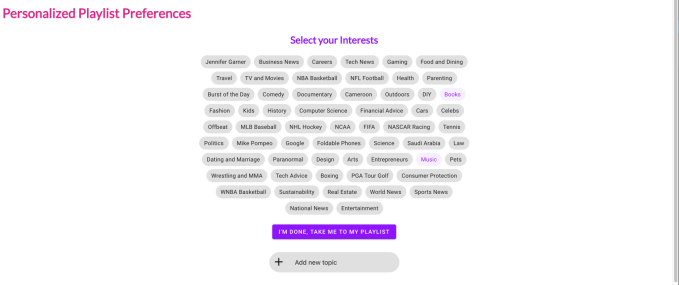
To use the feature, you first sign up on the Audioburst website, then select from a set of interests or add your own. When you’re finished with the selection process, you just hit the “I’m done” button to be taken to your personalized playlist of audio clips.
The end result is being about to listen to the parts of the podcasts or other audio programs you would actually care about, rather than slogging through half an hour or more of chatter, for the one tidbit of news you were interested in.
For example, when testing the feature this morning, I chose a variety of topics like “tech news,” “movies,” “entertainment,” “tech news,” “science,” “parenting,” and more, and was delivered a set of audio clips that included a discussion of Disney’s “Star Wars” spinoff series starring Diego Luna; a chat about the 2018 MacBook Air overhaul; an assessment the smog in L.A.; and a lot of other clips I chose to skip (but will hopefully train the A.I. further.)
You can try the feature yourself at search.audioburst.com by clicking on “Personalized Playlist” in the top left.
The results were hit or miss, which is expected – to some extent – fresh out of the gate. But there were also times when the clips didn’t actually serve up too much information. That is, you’d still need to turn to the podcast itself for the full story.
However, the feature itself isn’t necessarily going to be used by consumers directly on Audioburst’s website.
Instead, its development came about thanks to requests from partners using its API.
The company says you can expect to see the personalized playlists integrated into its partners’ products in the smart speaker, mobile, in-car infotainment, and wearable tech space in 2019.
Audioburst currently has partnerships with Bytedance, Nippon, Bose, Harman, Samsung and more.
“Our mission is to deliver the most interesting news and audio content to our users wherever they are and personalization is the key ingredient. Through this feature, Audioburst is changing the way people consume audio in the same way that users consume music on Spotify,” said Assaf Gad, VP Marketing and Strategic Partnerships at Audioburst. “Expanding this experience through our partnerships with top OEMs, media companies and content creators means this has the power to reach users wherever they are,” he added.
Ride-sharing service Lyft is today announcing its new plan to encourage repeat use: the launch of a loyalty program for riders, Lyft Rewards. The program, which will begin rolling out next month to select riders across the U.S., will let riders earn points for each dollar spent, which can then be used for upgrades to nicer cars or savings on future rides, among other things.
The new rewards program will aim for everyday riders, in order better retain their business as a part of Lyft’s larger battle with Uber .
According to Lyft, riders will soon be able to earn points as they ride in Lyft, which can be accumulated over time then used for upgrades. Initially, this including getting upgraded to Lyft Lux or getting discounts on future rides. The company says it’s considering how to offer other passenger perks, like access to more experienced drivers and double points days, for example. It’s also listening to customer feedback to hear about other rewards people may want.
Riders will be able to check their points progress in the app, once enrolled.
The program hasn’t yet launched, but will do so in December 2018, says Lyft.
It will be available to select riders in various cities to start, before rolling out to more riders in 2019.
If invited to join, riders will have an email or a notification from Lyft with the offer.
The launch of Lyft’s loyalty program comes shortly after the company announced its 1 billion rides milestone in September, a couple of months after Uber hit 10 billion trips.
Uber, meanwhile, has also been working on ways to better cater to its most frequent customers, including with last year’s launch of an Uber credit card that offers cash back on rides and UberEats dining. It has also dabbled with merchant offers, and rolled out its own subscription program, too.
Tiger Global has returned to backing early-stage Indian startups after it wrote a $3 million check for CheckMate, a U.S.-Indian startup the helps restaurant deals with the pain of multiple food ordering platforms.
The deal is a Series A and it represents the first time that CheckMate has raised outside funding for its business. It is also a return to early-stage investing in India — where CheckMate’s largest office is — for Tiger Global following a period of relative inactivity.
Founded 2.5 years ago initially as a bill-splitting app, CheckMate provides a platform that unifies food and payments to ease the chaos of working with modern consumer platforms. In this current age, restaurants simply must work with platforms like Uber Eats, Postmates, GrubHub, DoorDash and others to get orders, but the services don’t play together, or even with, existing restaurant systems.
That means that each service requires its own tablet for managing orders. On top of that, none integrate with order systems that print receipts for chefs or point-of-sale software. That means that restaurant staff must not only operate a bunch of iPads to handle the orders, but they have to manually enter them into their ordering systems (to ensure the ticket is processed so the order is cooked) then handle point of sale and bank the order for accounts.
That’s a lot of manual hassle and it’s the core issue that CheckMate aims to solve.
It effectively operates like a bridge that connects the various delivery platforms to a restaurant’s management system. It feeds orders from multiple food delivery services into the ordering system automatically, and feed the sales back into the restaurant management system. That helps keep the orders moving quickly, whilst managing account and sales without manual input.
“Online orders are still treated as a stepchild that’s alien to the business,” CheckMate founder and CEO Vishal Agarwal told TechCrunch in an interview. “With our solution, we inject online orders into the true heart and center of these businesses.”
A ‘wall’ of tablets is commonplace in restaurants as food delivery apps become an increasingly important source of orders
Headquartered in New York, where Agarwal is based, CheckMate has rolled out to over 1,000 locations in the U.S. and it counts Five Guys among its customers. The company recently expanded to Australia with its first customers and Agarwal — previously with e-commerce company Choxi.com — said he is looking for further international growth. The plan to get it, however, is by piggybacking the POS systems it supports, including Brink, Toast, and Revel, rather than establishing CheckMate’s own sales team.
That makes a lot of sense since the POS providers have a major incentive for linking their restaurant customers up with CheckMate because it streamlines their operations and makes their life easier. It also helps keep CheckMate lean and mean.
The team itself is already lean and international. While Agarwal, who comes from India, is based in New York, the rest of his 10-person U.S. team is distributed while the operations and tech team of 25 is located in CheckMate’s India-based office.
Since there are no public APIs, CheckMate has built its own platform in conjunction with food delivery services and now Agarwal — who said he has invested his own money in CheckMate — plans to double down on R&D, and in particular more integrations, by using this Series A raise for hiring.
“Technology in the restaurant sector is under-utilized — I was coming from e-commerce background where technology is everywhere,” he explained. “We quickly realized how much resistance to tech there is and we want to make it easy as possible for operators to adopt our product.”
That simplicity also applies to CheckMate’s pricing model which was recently adjusted. Previously, the company charged a setup fee but that has been abolished in favor of two tiers: $85 per restaurant for up to two platforms, and $100 for unlimited platforms per location.
“As restaurants streamline their operations to take advantage of rapidly increasing online orders, we
expect hundreds of thousands of restaurants to benefit from Checkmate’s unique solution,” Tiger Global partner Scott Shleifer said in a prepared statement.
The deal is an interesting one for Tiger Global, the 17-year-old New York investment firm that just closed a new $3.75 billion fund. The firm became well known for writing bold checks that backed ambitious startups in India a couple of years ago before it put the brakes on that strategy.
According to a multitude of media reports, the firm’s management grew concerned that it was overexposed in India, where it had deployed some $2 billion via deals in unicorns like Flipkart and Uber rival Ola. Flipkart’s exit via a majority investment from Walmart, however, made the firm around $3 billion in returns while it also retained a small stake in the business, which is tipped to have its own IPO in the future.
Tiger Global executive Lee Fixel, who spearheaded the India strategy, is said to have spent the last year working closely with Flipkart to realize the deal. Now that it is done, Tiger Global is said to be returning to investment mode in India, according to a recent Economic Times story. That means that CheckMate may be the first of many as the tiger begins roar again.
Tiger Global has returned to backing early-stage Indian startups after it wrote a $3 million check for CheckMate, a U.S.-Indian startup the helps restaurant deals with the pain of multiple food ordering platforms.
The deal is a Series A and it represents the first time that CheckMate has raised outside funding for its business. It is also a return to early-stage investing in India — where CheckMate’s largest office is — for Tiger Global following a period of relative inactivity.
Founded 2.5 years ago initially as a bill-splitting app, CheckMate provides a platform that unifies food and payments to ease the chaos of working with modern consumer platforms. In this current age, restaurants simply must work with platforms like Uber Eats, Postmates, GrubHub, DoorDash and others to get orders, but the services don’t play together, or even with, existing restaurant systems.
That means that each service requires its own tablet for managing orders. On top of that, none integrate with order systems that print receipts for chefs or point-of-sale software. That means that restaurant staff must not only operate a bunch of iPads to handle the orders, but they have to manually enter them into their ordering systems (to ensure the ticket is processed so the order is cooked) then handle point of sale and bank the order for accounts.
That’s a lot of manual hassle and it’s the core issue that CheckMate aims to solve.
It effectively operates like a bridge that connects the various delivery platforms to a restaurant’s management system. It feeds orders from multiple food delivery services into the ordering system automatically, and feed the sales back into the restaurant management system. That helps keep the orders moving quickly, whilst managing account and sales without manual input.
“Online orders are still treated as a stepchild that’s alien to the business,” CheckMate founder and CEO Vishal Agarwal told TechCrunch in an interview. “With our solution, we inject online orders into the true heart and center of these businesses.”
A ‘wall’ of tablets is commonplace in restaurants as food delivery apps become an increasingly important source of orders
Headquartered in New York, where Agarwal is based, CheckMate has rolled out to over 1,000 locations in the U.S. and it counts Five Guys among its customers. The company recently expanded to Australia with its first customers and Agarwal — previously with e-commerce company Choxi.com — said he is looking for further international growth. The plan to get it, however, is by piggybacking the POS systems it supports, including Brink, Toast, and Revel, rather than establishing CheckMate’s own sales team.
That makes a lot of sense since the POS providers have a major incentive for linking their restaurant customers up with CheckMate because it streamlines their operations and makes their life easier. It also helps keep CheckMate lean and mean.
The team itself is already lean and international. While Agarwal, who comes from India, is based in New York, the rest of his 10-person U.S. team is distributed while the operations and tech team of 25 is located in CheckMate’s India-based office.
Since there are no public APIs, CheckMate has built its own platform in conjunction with food delivery services and now Agarwal — who said he has invested his own money in CheckMate — plans to double down on R&D, and in particular more integrations, by using this Series A raise for hiring.
“Technology in the restaurant sector is under-utilized — I was coming from e-commerce background where technology is everywhere,” he explained. “We quickly realized how much resistance to tech there is and we want to make it easy as possible for operators to adopt our product.”
That simplicity also applies to CheckMate’s pricing model which was recently adjusted. Previously, the company charged a setup fee but that has been abolished in favor of two tiers: $85 per restaurant for up to two platforms, and $100 for unlimited platforms per location.
“As restaurants streamline their operations to take advantage of rapidly increasing online orders, we
expect hundreds of thousands of restaurants to benefit from Checkmate’s unique solution,” Tiger Global partner Scott Shleifer said in a prepared statement.
The deal is an interesting one for Tiger Global, the 17-year-old New York investment firm that just closed a new $3.75 billion fund. The firm became well known for writing bold checks that backed ambitious startups in India a couple of years ago before it put the brakes on that strategy.
According to a multitude of media reports, the firm’s management grew concerned that it was overexposed in India, where it had deployed some $2 billion via deals in unicorns like Flipkart and Uber rival Ola. Flipkart’s exit via a majority investment from Walmart, however, made the firm around $3 billion in returns while it also retained a small stake in the business, which is tipped to have its own IPO in the future.
Tiger Global executive Lee Fixel, who spearheaded the India strategy, is said to have spent the last year working closely with Flipkart to realize the deal. Now that it is done, Tiger Global is said to be returning to investment mode in India, according to a recent Economic Times story. That means that CheckMate may be the first of many as the tiger begins roar again.
Test Pilot is Mozilla’s program for experimenting with some of its more outlandish ideas for Firefox and beyond. Some of those experiments make it into the browser itself, some become stand-alone extensions and others get unceremoniously canned. Today, the organization is announcing two new Test Pilot projects: Price Wise, which lets you track the price of items in online stores, and Email Tabs, a tool for making it easier to send links to people by email.
Price Wise is a pretty self-explanatory service. It works for Best By, eBay, Amazon, Walmart and Home Depot and lets you track price changes right in Firefox. That’s obviously not a novel idea. Plenty of other extensions do the same. Still, it’s nice to see a tool like this from a relatively neutral source. Mozilla tells me that all of the work happens on the user’s machine and that all of the development was done in-house, without relying on third-party tools. Mozilla also notes that it’s not monetizing this service through affiliate links.
One interesting side note here is that Mozilla is using machine-learning to power Price Wise. “We leverage machine learning outside the extension to make it happen,” a spokesperson told me. “You’ll be hearing more from us about machine learning as we evaluate more use cases to help Firefox users in their day to day without sacrificing privacy.”
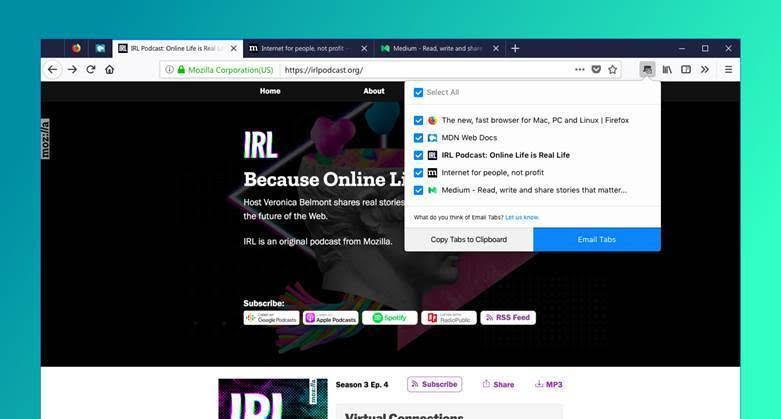
While the idea behind Price Wise isn’t exactly new, Email Tabs is a more novel concept. The idea here is to make it easier for you to send links by email, which is apparently still the most popular way to share links, even today. Typically, that’s a process of copying and pasting links, which gets the job done, but isn’t exactly an elegant solution — or at least that’s what the engineers at Mozilla clearly thought. When you click the Email Tabs button, the extensions lets you choose which tabs you want to share and how much of the content from a link you want to be part of the email it creates for you. That could be just the link, but also a screenshot or the full text of the page you’re linking to.
Right now, this only works with Gmail, but you can also copy all the info to the clipboard and then paste it at will.
These two new experiments are now available for anybody who signs up to the Test Pilot program.
As Mozilla also announced today, two of its previous experiments are about to graduate. Send, which lets you encrypt and share large files up to 1GB will be updated and relaunched later this year. Color, which lets you customize the look of Firefox to your heart’s content, will become a stand-alone extension and Side View, which lets you view two browser windows side-by-side inside the same Firefox window, is joining Color as a stand-alone extension, too.
Test Pilot is Mozilla’s program for experimenting with some of its more outlandish ideas for Firefox and beyond. Some of those experiments make it into the browser itself, some become stand-alone extensions and others get unceremoniously canned. Today, the organization is announcing two new Test Pilot projects: Price Wise, which lets you track the price of items in online stores, and Email Tabs, a tool for making it easier to send links to people by email.
Price Wise is a pretty self-explanatory service. It works for Best By, eBay, Amazon, Walmart and Home Depot and lets you track price changes right in Firefox. That’s obviously not a novel idea. Plenty of other extensions do the same. Still, it’s nice to see a tool like this from a relatively neutral source. Mozilla tells me that all of the work happens on the user’s machine and that all of the development was done in-house, without relying on third-party tools. Mozilla also notes that it’s not monetizing this service through affiliate links.
One interesting side note here is that Mozilla is using machine-learning to power Price Wise. “We leverage machine learning outside the extension to make it happen,” a spokesperson told me. “You’ll be hearing more from us about machine learning as we evaluate more use cases to help Firefox users in their day to day without sacrificing privacy.”
While the idea behind Price Wise isn’t exactly new, Email Tabs is a more novel concept. The idea here is to make it easier for you to send links by email, which is apparently still the most popular way to share links, even today. Typically, that’s a process of copying and pasting links, which gets the job done, but isn’t exactly an elegant solution — or at least that’s what the engineers at Mozilla clearly thought. When you click the Email Tabs button, the extensions lets you choose which tabs you want to share and how much of the content from a link you want to be part of the email it creates for you. That could be just the link, but also a screenshot or the full text of the page you’re linking to.
Right now, this only works with Gmail, but you can also copy all the info to the clipboard and then paste it at will.
These two new experiments are now available for anybody who signs up to the Test Pilot program.
As Mozilla also announced today, two of its previous experiments are about to graduate. Send, which lets you encrypt and share large files up to 1GB will be updated and relaunched later this year. Color, which lets you customize the look of Firefox to your heart’s content, will become a stand-alone extension and Side View, which lets you view two browser windows side-by-side inside the same Firefox window, is joining Color as a stand-alone extension, too.
Facebook and the French government are going to cooperate to look at Facebook’s efforts when it comes to moderation. French regulators will launch an informal investigation on algorithm-powered and human moderation. Facebook is willing to cooperate and give unprecedented access to its internal processes.
This announcement is the result of informal talks between Facebook’s top executives and the French government that started with the Tech for Good Summit back in May. Former British Prime Minister and Facebook Vice-President for Global Affairs and Communications Nick Clegg unveiled the program during a lunch reception at the Élysée.
“It is in that context significant and welcome that the French government and Facebook are going to announce a new initiative,” Clegg said. “That model of co-regulation of the public tech sector is absolutely key.”
French President Emmanuel Macron’s vision of tech regulation can be summed up in three words: inclusion, trust and cooperation. In his closing remarks at lunch, he once again said that there needs to be a third way to regulate tech — not the Chinese one, not the American one. President Macron also mentioned the program during a speech at the Internet Governance Forum in Paris.
Regulators will look at multiple steps: how flagging works, how Facebook identifies problematic content, how Facebook decides if it's problematic or not and what happens when Facebook takes down a post, a video or an image.
This type of investigation is reminiscent of banking and nuclear regulation. It involves deep cooperation so that regulators can certify that a company is doing everything right.
According to a source close to Macron, current internet regulation is broken. Governments are asking for results and social networks have to deal with moderation issues on their own — regulators aren't doing enough.
It's still unclear who's going to be in charge of this investigation. There could be regulators from France's telecom regulator (ARCEP), from the government’s tech team (DINSIC), from the TV and radio regulator (CSA)… There's one thing for sure, the French government wants to focus on hate speech for now, so don't expect anyone from the privacy regulator (CNIL).
The investigation isn't going to be limited to talking with the moderation teams and looking at their guidelines. The French government wants to find algorithmic bias and test data sets against Facebook’s automated moderation tools.
By focusing on a small scope and starting with an informal investigation, the French government managed to convince Facebook to accept to collaborate. But it could still lead to new regulations down the road.
According to a source close to the French President, this is also in Facebook’s interest. Regulators could introduce widespread regulation without consulting the company. But this process should lead to fine-grained regulation.