Year: 2018

12 Nov 2018

Kofax to buy Nuance’s imaging division for $400M in cash

Some consolidation and subsequent divestment are in play in the worlds of imaging and voice recognition. Today, Kofax and Nuance announced that Kofax would be acquiring Nuance’s imaging division, for $400 million in cash. The deal, which had been rumoured in recent days, is expected to close in Q1 2019.

The acquisition is a notable move for Kofax — itself acquired by Thoma Bravo last year in a $1.5 billion deal — as it continues to build up its business in Robotic Process Automation (RPA), the area of enterprise IT services that uses machine learning, computer vision and other AI-based tools to bring automation to repetitive or mundane back-office tasks that would have in the past been done by humans. (The idea is that this frees up the humans to make more sophisticated assessments in specific cases, or focus on entirely different tasks.)

On the side of Nuance, the company is a leader in voice recognition services that served as an early partner to the likes of Apple with Siri, and has also worked on a number of other AI-based solutions to improve how enterprises build services and work.

Publicly-traded Nuance’s imaging division accounted for about 11 percent of its revenues last year, and it has stated would be making several changes in its business to rationalise it and focus on more profitable operations. The biggest parts of its $5 billion business today are healthcare solutions, enterprise and automotive.

Kofax is bringing on Nuance Document Imaging, as the division is officially called, specifically to bring more services in the area of imaging services, which include services like providing security and compliance around any image scanning or printing that takes place across an organization. NDI, Kofax said, is one of the biggest companies of its kind in the field, covering 6 million knowledge workers and over 100,000 active deployments of its Print Management solutions.

“Through the acquisition of Nuance’s document imaging division, Kofax will drive customer value by adding key technologies, including cloud compatibility, scan-to-archive, scan-to-workflow, print management and document security, to our end-to-end Intelligent Automation platform,” said Reynolds C. Bish, Chief Executive Officer of Kofax. “In addition we will now be able to combine the best capture and print management capabilities available in the market into one product portfolio.”

Kofax said this makes it the leader in this area globally: and indeed it is racing to keep ahead of competition.

RPA has been one of the fastest-growing areas in IT, fuelled by the rising interest in bringing more AI into enterprise services. UIPath, one of the leading startups in the space, has raised close to $400 million in two separate rounds this year on the back of its rapid growth. Just last week, UIPath just last week expanded its own imaging capabilities.
12 Nov 2018

Sony filed a patent for a touchscreen-equipped PlayStation controller

According to a patent application continuation filed in 2017 and published recently, Sony may have tentative plans to build out a touchscreen-equipped PlayStation controller.

Whether the value added from having a touchscreen right on the controller will be worth the added cost is not yet clear.

Right now, PlayStation controllers have a touch-enabled center button that allows users to navigate through menus and other activities with a touch-based interface. The center button also lets gamers access more information, such as game stats, when clicked.

This patent application also leaves us wondering what type of content might be displayed on the touchscreen. As you can imagine, controller content could include in-game information that is usually shown on a heads-up display on the main screen.

However, it’s far more likely that a touchscreen-equipped PlayStation controller would offer a new interface for console-based information and actions, such as sharing a video broadcast or dealing with incoming invites and friend requests.

Interestingly, Nintendo’s own experiment with a touchscreen-enabled controller failed miserably. Remember the Wii U? Nintendo eventually corrected the mistake with the launch of the Switch, which has found its place among casual gamers as a sort of hybrid console and sold more than 20 million units since launch.

Of course, Sony’s touchscreen controller is nothing more than a patent application for now, so there’s a solid chance that the same controllers we’ve grown to know and love ship alongside the next-gen PlayStation with no update to be seen. But just in case someone at Sony decides to get inventive, the patent is in place for the company to start thinking about touchscreen controllers.

Reports suggest that the next-generation Sony console could arrive as early as 2019 or as late as 2021.

[via DualShockers]

12 Nov 2018

Vista snaps up Apptio for $1.94B, as enterprise companies remain hot

It seems that Sunday has become a popular day to announce large deals involving enterprise companies. IBM announced the $34 billion Red Hat deal two weeks ago. SAP announced its intent to buy Qualtrics for $8 billion last night, and Vista Equity Partners got into the act too, announcing a deal to buy Apptio for $1.94 billion, representing a 53 percent premium for stockholders.

Vista paid $38 per share for Apptio, a Seattle company that helps companies manage and understand their cloud spending inside a hybrid IT environment that has assets on-prem and in the cloud. The company was founded in 2007 right as the cloud was beginning to take off, and grew as the cloud did. It recognized that companies would have trouble understanding their cloud assets along side on-prem ones. It turned out to be a company in the right place at the right time with the right idea.

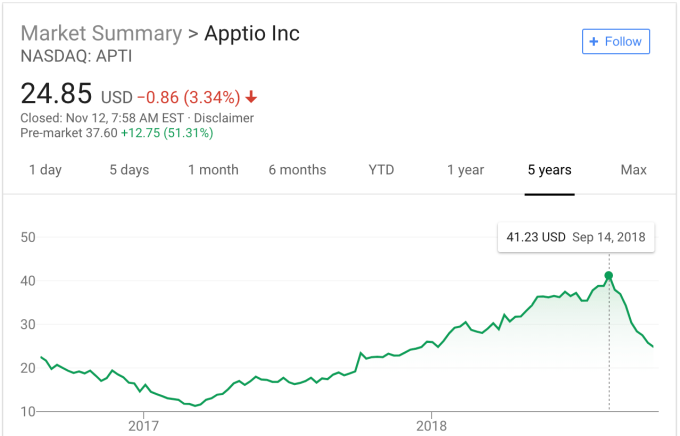
Investors like Andreessen Horowitz, Greylock and Madrona certainly liked the concept, showering the company with $261 million before it went public in 2016. The stock price has been up and down since, peaking in August at $41.23 a share before dropping down to $24.85 on Friday. The $38 a share Vista paid comes close to the high water mark for the stock.

Stock Chart: Google

Sunny Gupta, co-founder and CEO at Apptio liked the idea of giving his shareholders a good return while providing a good landing spot to take his company private. Vista has a reputation for continuing to invest in the companies it acquires and that prospect clearly excited him. “Vista’s investment and deep expertise in growing world-class SaaS businesses and the flexibility we will have as a private company will help us accelerate our growth…,” Gupta said in a statement.

The deal was approved by Apptio’s board of directors, which will recommend shareholders accept it. With such a high premium, it’s hard to imagine them turning it down. If it passes all of the regulatory hurdles, the acquisition is expected to close in Q1 2019.

It’s worth noting that the company has a 30-day “go shop” provision, which would allow it to look for a better price. Given how hot the enterprise market is right now and how popular hybrid cloud tools are, it is possible it could find another buyer, but it could be hard to find one willing to pay such a high premium.

Vista clearly likes to buy enterprise tech companies having snagged Ping Identity for $600 million and Marketo for $1.8 billion in 2016. It grabbed Jamf, an Apple enterprise device management company and Datto, a disaster recovery company last year. It turned Marketo around for $4.75 billion in a deal with Adobe just two months ago.

12 Nov 2018

Five reasons why you should be at Disrupt Berlin this November

Are you ready to experience Disrupt Berlin 2018? Our premier tech startup conference takes place on 29-30 November and draws international participants from more than 50 countries across Europe, Asia and beyond. No matter what role you play in the startup universe, you’ll enjoy two days packed with action, insight, inspiration and opportunity.

Still need convincing? We’ve got you covered with these five reasons to attend Disrupt Berlin 2018. And if you act quickly, you can take advantage of Late Registration prices and save up to €350.

  1. Top-Tier Programming

We’ve recruited an impressive lineup of speakers, panel discussions and deep-dive conversations to address the most compelling startup, tech and business issues. You’ll hear tech titans, up-and-coming founders, innovative investors and more speak on the Main Stage. People like Frank Salzgeber from the European Space Agency, Lizzie Chapman from ZestMoney, an Indian fintech startup and Rafal Modrzewski from satellite company, ICEYE.

Looking for an opportunity to delve even deeper into issues raised on the Main Stage? Don’t miss our Q&A Sessions — smaller, intimate and very popular gatherings where a moderated panel of speakers takes questions from the audience.

Just some of the speakers you’ll hear at the Q&A Sessions include Jamie Burke, CEO and founder, Outlier Ventures; Kaidi Ruusalepp, CEO and founder, Funderbeam; Ricky Knox, CEO and co-founder, Tandem and Niko Bonatsos, managing director, General Catalyst.

Check out the conference agenda.

2.Best in Class Networking

No matter where you roam at Disrupt Berlin, the networking is world-class and nonstop. If you’re wondering how you’ll find the right connections among the more than 2,500 attendees, we’ve got you covered. We’re making CrunchMatch, our free business-matching service, available to all attendees.

Who can benefit? For starters, developers in search of employment, founders hunting for collaborators or startups recruiting tech talent and, of course, founders and investors looking to connect. CrunchMatch can save you valuable time and help you make valuable connections.

You simply fill out a profile (we’ll email you instructions) detailing your role and the type of connections you want to make. The CrunchMatch algorithm makes suggested connections and then — subject to your approval — the platform handles all the scheduling details.

3.The Renowned Startup Battlefield Competition

Don’t miss Startup Battlefield — the crown jewel of Disrupt. Our global pitch-competition has launched more than 750 companies — like Vurb, Dropbox, Mint and Yammer. Watch as this year’s Battlefield cohort takes the stage to pitch and wow the judges in front of a large, live and very rowdy crowd.

The winning founders will hoist the coveted Disrupt Cup, receive invaluable media and investor exposure and take home a sweet, $50,000 non-equity cash prize. Who knows? You might just witness the birth of a future unicorn.

4.Hundreds of Early Stage Companies in Startup Alley

Startup Alley lies at the heart of the Disrupt Alley Expo floor, and it’s home to hundreds of early-stage startups showcasing the latest technology products, platforms and services. It’s also where you’ll find this year’s cadre of TC Top Picks — up to five exceptional startups representing each of these tech categories: AI/Machine Learning, Blockchain, CRM/Enterprise, E-commerce, Education, Fintech, Healthtech/Biotech, Hardware, Robotics, IoT, Mobility and Gaming.

5.Build Your Community

Community building goes beyond simple networking. It’s like-minded people sharing their ideas, philosophies and dreams. It’s about learning from each other and returning to the work with renewed focus. Here’s what Vlad Larin, co-founder of Zeroqode said about his Disrupt experience.

“It was wonderful. I spoke with all kinds of people looking for new ideas, collaboration and inspiration. Everyone was there to help and support each other and look for mutually beneficial ways to collaborate. It was refreshing, and you just don’t experience that every day.”

Disrupt Berlin 2018 goes down on 29-30 November. We just gave you five reasons to go. Here’s another: buy your pass now, and you’ll save up to €350.

12 Nov 2018

Framer, the interactive design platform, scores $24M Series B led by Atomico

Framer, the Amsterdam-based startup behind interactive design platform Framer X, has raised $24 million in Series B investment. The round is led by European VC firm Atomico, with participation from Accel, and AngelList. The startup says it will use the new capital to continue building out its platform for designers and product teams. It brings the total raised to date by Framer to $33 million.

Founded by ex-Facebookers Koen Bok and Jorn van Dijk, Framer has set out to ride (and power) a trend that is seeing every company having to become a digital business and often a product-first company, as consumers become accustomed to high quality apps and other desirable digital experiences. This means that better tools are required to prototype news apps or features, and therefore help shorten the feedback loop and speed up the development process overall.

To that end, Framer X is described as a “fully integrated design, prototyping and developer handoff tool” that makes it easy to create app designs and prototypes that are as visually polished as a production app. Designs created in Framer X are powered by the React framework, and the platform enables a lot of off-the-shelf interactivity, rather than prototypes simply being static wireframes or designs with limited transitions or hotspots. You can also export front-end code for use in your production apps, should you so desire.

However, as explained during a video presentation by Bok and Dijk, what potentially sets Framer X apart from other competing app design and prototyping tools is that you can also import production components and assets into the software for re-use so that designers aren’t continually re-inventing the wheel. Via the “Framer X Store,” these React-based components can also come from and be shared by the wider developer community. Examples include video players (such as YouTube), live maps and data generators, to UI kits and interactive design systems.

This means that Framer is attempting to be a platform play in the true sense of the word, while in turn the Framer X Store is a clever way of creating network effects. Tech brands that have their own developer ecosystems (and are in part “API businesses”) can make components and visual assets available in the store to further lower the barriers for third-party app developers who want to build integrations.

Related to this, the company is announcing the beta launch of a private design store for teams on Framer X. The Team Store enables members of teams at the same company to collaborate and share brand assets, design components, and more, so as to allow for internal interactive design systems to also live within the Framer platform.

Cue a statement from Atomico Partner Hiro Tamura, who led on behalf of the London-based venture capital firm: “The world’s best digital products, like Google, Facebook, Dropbox, Twitter and Snap, are designed and built by teams. Those teams are already using Framer X. We are excited about partnering with Koen, Jorn and the Framer team to help make that level of digital product excellence and innovation accessible to any company in any traditional industry, from financial services to retail and beyond.”

Meanwhile, the Framer founding back story is worth noting. Bok and Dijk previously founded app and design studio Sofa, which they sold to Facebook in 2011. As part of the deal they relocated to Facebook’s headquarters in the U.S., and worked on various products, reporting directly to Facebook founder Mark Zuckerberg. However, seeing an opportunity to help more companies transition to becoming digital-first and product-led, the pair left to found Framer in 2014.

12 Nov 2018

London’s transport regulator looks to startups to help fix urban mobility

London’s transport regulator, TfL has announced a partnership with Bosch for its forthcoming co-working space in Shoreditch.

The civic tech project is intended to run for 18 months as a pilot — though Bosch’s ‘Connectory’ co-working facility won’t open until the end of January. A company spokeswoman confirmed the partnership is nonetheless up and running now.

The aim of the collaborative project is to share data and expertise, including by tapping into London’s startup ecosystem, to land on new ideas for tackling urban mobility issues — from traffic jams to awful air quality.

Transport issues are especially pressing for the city as London’s population is forecast to reach a staggering 10.8 million by 2041 — which would mean around six million additional trips being generated per day.

Specific issues TfL is looking for help with include developing more efficient, greener and safer vehicles; reducing congestion; and encouraging more people to walk, cycle and take public transport across London, it said today.

TfL will be providing technical knowledge and “a wide range” of datasets throughout the pilot to allow participating companies to test ideas and “understand patterns in more detail than has previously been possible”, it added.

The data will be based on its existing Unified API and open data platform, which it notes is already underpinning nearly 700 apps used by approaching half (42 per cent) of Londoners.

Startups selected for the collaboration will be provided with dedicated space within Bosch’s Connectory, alongside TfL staff who will also be based there during the pilot.

Commenting in a statement, Arun Srinivasan, executive VP and head of mobility solutions at Bosch UK said: “We believe that the collaboration between Bosch and TfL will enable us to accelerate the development of technologies, products and services that have a positive impact on city life.”

Startups will be selected by Bosch, according to a TfL spokesman. We’ve asked for more details on selection criteria.

Update: A Bosch spokeswomen told us: “There will be a number of programmes running for start ups in the Connectory. These programmes will be around specific mobility challenges and many will have open calls for start ups to enter. We also welcome direct approaches by small business/start ups who want to be part of the Connectory community feel they have something to offer that will help solve London’s transport challenges. Get in touch!”

She said there is no fixed number of startup planned to be selected for the pilot, saying they will have rolling cohorts “designed around specific London mobility challenges” — launching this process in the New Year.

“This new ‘urban mobility’ lab is the first of its kind with a primary focus on urban mobility, and will provide the forum for private sector partners, academia and public sector to work together to tackle a range of problems facing Londoners in years to come,” the pair added in a press release today.

“By facilitating closer collaboration, TfL and Bosch hope to support start-ups to develop a range of smart products and help them identify ways to bring them to market more quickly through open procurement.”

The entire co-working facility is focused on urban mobility — but will also be open to other interested companies and startups to rent or bag a space (i.e. via Bosch’s scouting programs where it does take equity), not just to the startups selected for the TfL pilot.

Bosch’s network of Connectory co-innovation spaces also links out to cities internationally, including Chicago and Stuttgart, further expanding potential knowledge-sharing opportunities.

Commenting in a statement, the mayor of London, Sadiq Khan, said: “This initiative will foster closer working between London’s tech sector and other leading tech cities. If we are to use data and smart technology to help solve the biggest problems our city faces, it’s crucial we take a more collaborative approach. I see London’s future as a global ‘test-bed city’ for civic innovation, where the best ideas are developed, amplified and scaled.”

Depending on the outcome of the pilot, TfL said the Greater London Authority may seek similar collaborative approaches to support other aspects of its work — including housing, environment and policing, aligning with the mayor of London’s strategic priorities.

“I’ve been clear I want London to become the world’s smartest city and this is a further step towards realising that ambition,” Khan added.

This report was updated with additional detail about startup selection; and to correct that the lab will focus exclusively on urban mobility — but is also open to interested companies to rent space, as well as to startups Bosch selects to take a stake in  

12 Nov 2018

Nigerian data analytics company Terragon acquires Asian mobile ad firm Bizense

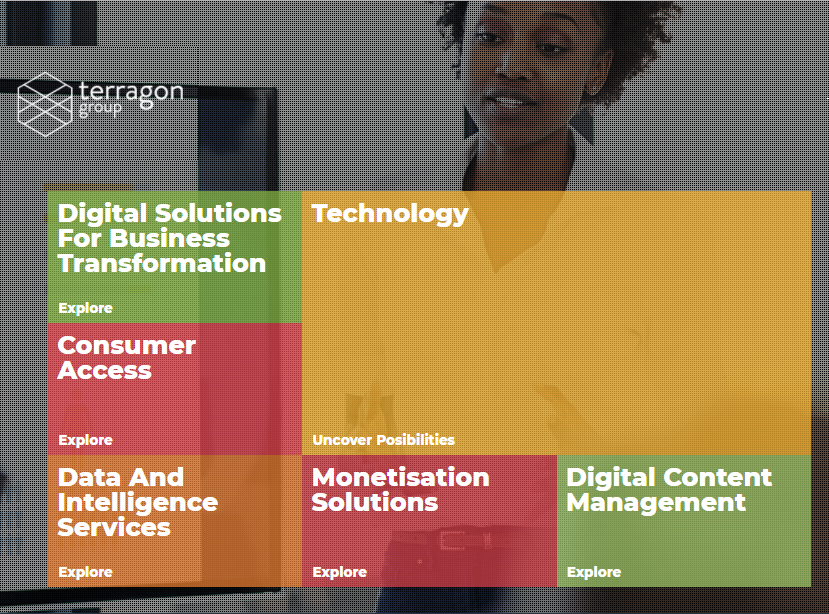
Nigerian consumer data analytics firm Terragon Group has acquired Asian mobile marketing company Bizense in a cash and stock deal.

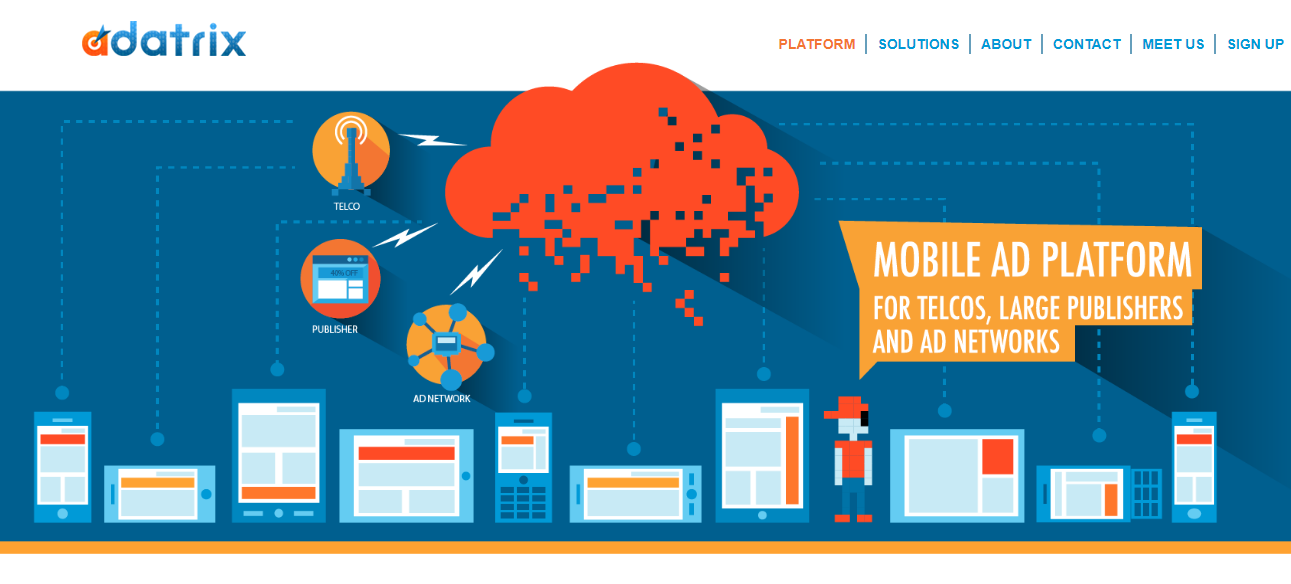
Based in Singapore, with operations in India and Indonesia, Bizense specializes in “mobile ad platform[s] for Telco’s, large publishers, and [e-commerce] ad networks” under its proprietary Adatrix platform—according to its website and a release.

The price of the acquisition was not disclosed.

The company lists audience analytics, revenue optimization, and white label SSP services among its client offerings.

Headquartered in Lagos, Terragon’s software services give its clients — primarily telecommunications and financial services companies — data on Africa’s growing consumer markets.

Products allow users to drill down on multiple combinations of behavioral and demographic information and reach consumers through video and SMS  campaigns while connecting to online sales and payments systems.

Terragon clients include local firms, such as Honeywell, and global names including Unilever, DHL, and international agribusiness firm Olam.

The company’s founder and CEO Elo Umeh sees cross-cutting purposes for Terragon services in other markets.

“Most of the problems we seek to solve for our clients in Africa also exist in places like South East Asia and Latin America,” Umeh told TechCrunch.

The Bizense acquisition doesn’t lessen Terragon’s commitment to its home markets, according to Umeh.

“We are…super focused on Africa right now, building out propriety platforms powered by data and artificial intelligence to help Telco’s, SMEs, FMCGsand financial institutions …increase their customer base and drive more transaction volumes,” he said.

Terragon’s CEO would not divulge the acquisition value, saying only that it consisted of  “a combination of cash and stocks, with the actual amount not disclosed.”

In an interview with TechCrunch earlier this year, Umeh confirmed the company was looking into global expansion.

Tarragon already has a team of 100 employees across Nigeria, KenyaGhana and South Africa.

Umeh indicated the company is contemplating further expansion in Asia and the Latin America, where Terragon already has consumer data research and development teams.

With the Bizense acquisition Terragon plans to “build out platforms, tools and machine learning models to help businesses…acquire new customers and get existing customers to do more.”

Bizense founder and CEO Amit Khemchandani will be involved in this process. “We are excited about the next phase of this journey as we innovate for Africa and other emerging markets,” he said.

With the exception of South African media and investment giant Naspers, acquisitions of any kind—intra-continental or international—are a rarity for Sub-Saharan African startups and tech companies.

Terragon’s acquisition in Singapore, and other moves made by several other Nigerian startups this year, could change that. African financial technology companies like Mines and Paga announced their intent to expand in and outside Africa. They would join e-commerce site MallforAfrica, which went global in July in a partnership with DHL.

12 Nov 2018

Clearbanc raises $70M to fund startups with ad money for a rev share

Selling equity to buy Facebook and Google ads is a bad deal for startups. Clearbanc offers a fundraising alternative. For fast-growing businesses reliably earning sales from their marketing spend, Clearbanc offers funding from $5,000 to $10 million in exchange for a steady revenue share of their earnings until its paid back plus a 6 percent fee. Clearbanc picks what merchants qualify by developing tech that scanns their Stripe, Facebook ads, and other accounts to asses financial health and momentum. It’s already doled out $100 million this year.

“As a business successfully scales, we continue to provide them ongoing capital” co-founder and CEO Andrew D’Souza tells me. “Our goal is the be the first and last backer of a successful business and save the entrepreneur from having to take hundreds of pitch meetings to keep their company funded.”

After largely flying under the radar since being found in 2015, now Clearbanc has some big funding news of its own. It’s now raised $70 million from a seed and new Series A round from Emergence Capital, Social Capital, CoVenture, Founders Fund, 8VC, and more with Emergence’s Santi Subotovsky joining the board.

“Venture capital has shifted. Instead of funding true research and development, today 40% of venture capital goes directly to buying Google and Facebook ads” D’Souza explains. “Equity is the most expensive way to fund digital ad spend and repeatable growth. So we created something new.”

Clearbanc emerged from an angel investing alliance between two serial entrepreneurs. D’Souza had built Andreessen Horowitz-funded social recruiting site Top Prospect, USV-backed education tech company Top Hat, and Mastercard portfolio  biometric authentication wearable startup Nymi. He’d helped raise over $300 milliion in venture after a stint at McKinsey. He had begun co-investing with Michele Romanow, a VC from Canada’s version of the TV show Shark Tank called Dragons’ Den. She’d bootstrapped shopping hub Buytopia that acquired 10 other ecommerce companies, and discount-finder SnapSaves that she sold to Groupon in 2014.

“We started investing together in some of the deals we would see from Dragons’ Den and often found that an equity investment wasn’t the right structure for these consumer product companies. They had great economics and had found a niche of customers, but often didn’t want to exit the business at any point” D’Souza recalls. “They needed money to acquire more customers, scale up their marketing efforts and online ad spend. So we started to do these revenue share deals.”
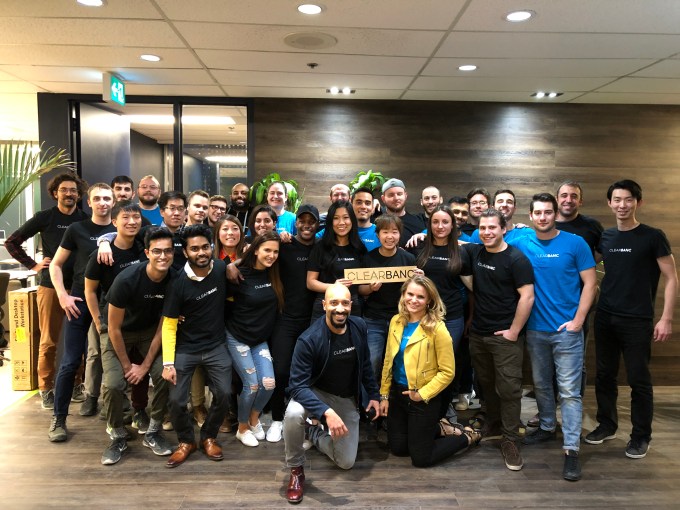
Both engineers, they built tech to automate the due dilligence and find companies with healthy unit economics and customer acquisition costs. The partnership blossomed into Clearbanc, and romance. “We’re also a couple, so we spend a lot of time together :)” D’Souza writes.

Now Clearbanc has poured over $100 million into 500 companie in 2018 like Vinebox. The subscription wine box company used Clearbanc to grow its membership numbers while raising a Series A for developing new products. Clearbanc’s companies pay out 5 percent in revenue share until the investment plus 6 percent is paid back. That’s a great deal for companies that are already proven money makers like Hunt A Killer, a murder mystery game subscription box that had raised $10,000 and was selling swiftly. Derisked, it didn’t need venture, and has now taken $8 million to ramp its business.

Clearbanc is rising up at a time when organic growth channels are shutting down. The ruthless optimization of algorithmic feeds on Facebook, Instagram, and Twitter suppress marketing content unless businesses are willing to pay. Without free virality opportunities, companies must take venture funding or loans just to turn around and pay that money to big ad platforms. With the new cash that also comes from iNovia Capital, Real Ventures, Portag3, Precursor, WTI, Berggruen, and FJ Labs, Clearbanc plans to expand abroad after doing deals in the US and Canada. It’s also going to invest in building awareness as well as its data science capabilities.

D’Souza and Romanow must have confidence in their tech, as a wrong investment means they might never get their cash back. “We pay a lot of attention to our underwriting and decision-making process because if we make a mistake, we can lose a lot of money. Unlike a VC, we don’t expect the majority of our companies to fail and have the winners make up for the losses” says D’Souza. One big misstep could wipe out the gains from a bunch of other investments.

Meanwhile, it has to break the norms of how businesses find funding. Startups immediately seek traditional venture or debt financing that can depend on the flashy names already on their captable, while merchants turn to exploitative online lenders that require a personal guarantee and base their decisions on the founders’ own credit histor instead of the business.

While riskier hard tech startups that will take years to get to market will still need to rely on venture, a new crop of direct-to-consumer products and other fast-monetizing startups that are already humming can avoid diluting their team and investors by using Clearbanc. D’Souza concludes, “We’ve spent our entire careers as entrepreneurs and wanted to build a new asset class to help entrepreneurs grow.”

12 Nov 2018

Alibaba rival JD sees Singles’ Day revenue jump 27% thanks to offline push

Alibaba may have pioneered the concept of Singles’ Day, the world’s largest shopping day based on sales, but it very much not the only e-commerce giant involved. JD.com, Alibaba’s biggest rival in China, just announced that it sold RMB 159.8 billion ($23 billion) in goods for its Singles’ Day campaign.

Unlike Alibaba, which racked up $31 billion in GMV in the 24-hour sale on November 11, JD’s festival ran for 11 days starting on November 1. That said, a large chunk of Alibaba’s sales are queued up in the days ahead of November 11 as retailers aggressively push deals, but JD is more open about its shopping period beyond the core 24 hours.

The firm’s 2018 numbers are up 26 percent on last year when it recorded 127.1 billion RMB in GMV — then worth around $19.14 billion. That was the first year that JD went public with its 11.11 sales. JD’s annual growth is about on par with Alibaba, which saw its Singles’ Day growth drop to an all-time low of 27 percent this year. That’s perhaps to be expected given the huge amount of GMV already being generated. It is worth noting — however — that JD’s GMV is about the same as its mid-year sale in June, which grossed 159.2 billion.

Alibaba shipped over one billion packages for the first time this year, but JD isn’t saying how many it handled. It did push out 400 million items from its FMCG and food business, and some of the brands it worked with across its business included Apple, Dell, Dyson, L’Oréal, SK-II and Pampers.

“There is a noticeable shift in China toward quality over price, which we see in the growing numbers of consumers who are willing to pay more for branded and imported goods,” JD.com CMO Lei Xu said in a statement.

JD’s approach to 11.11 has parallels with Alibaba but also there are differences. Like its rival, JD has pushed its presence into physical retail with its fresh food supermarket brand 7FRESH, unmanned convenience stores and ‘Retail Experience Shops’ — Alibaba has its Hema markets and InTime mall stores — while it claims that 600,000 stores used its tech and infrastructure to host their own Singles’ Day events.

While Alibaba has grown its business using both its Tmall platform for brands and Taobao marketplace, JD has taken a more managed approach to e-commerce. Most of its efforts are focused on working with brands which is why it claims to have avoided the counterfeit goods issue that has plagued Alibaba, which remains on the U.S. government’s ‘Notorious Markets’ list.

12 Nov 2018

The Ceph storage project gets a dedicated open-source foundation

Ceph is an open source technology for distributed storage that gets very little public attention but that provides the underlying storage services for many of the world’s largest container and OpenStack deployments. It’s used by financial institutions like Bloomberg and Fidelity, cloud service providers like Rackspace and Linode, telcos like Deutsche Telekom, car manufacturers like BMW and software firms like SAP and Salesforce.

These days, you can’t have a successful open source project without setting up a foundation that manages the many diverging interests of the community and so it’s maybe no surprise that Ceph is now getting its own foundation. Like so many other projects, the Ceph Foundation will be hosted by the Linux Foundation.

“While early public cloud providers popularized self-service storage infrastructure, Ceph brings the same set of capabilities to service providers, enterprises, and individuals alike, with the power of a robust development and user community to drive future innovation in the storage space,” writes Sage Weil, Ceph co-creator, project leader, and chief architect at Red Hat for Ceph. “Today’s launch of the Ceph Foundation is a testament to the strength of a diverse open source community coming together to address the explosive growth in data storage and services.”

Given its broad adoption, it’s also no surprise that there’s a wide-ranging list of founding members. These include Amihan Global, Canonical, CERN, China Mobile, Digital Ocean, Intel, ProphetStor Data Service, OVH Hosting Red Hat, SoftIron, SUSE, Western Digital, XSKY Data Technology and ZTE. It’s worth noting that many of these founding members were already part of the slightly less formal Ceph Community Advisory Board.

“Ceph has a long track record of success what it comes to helping organizations with effectively managing high growth and expand data storage demands,” said Jim Zemlin, the executive director of the Linux Foundation. “Under the Linux Foundation, the Ceph Foundation will be able to harness investments from a much broader group to help support the infrastructure needed to continue the success and stability of the Ceph ecosystem.”

cepha and linux foundation logo

Ceph is an important building block for vendors who build both OpenStack- and container-based platforms. Indeed, two-thirds of OpenStack users rely on Ceph and it’s a core part of Rook, a Cloud Native Computing Foundation project that makes it easier to build storage services for Kubernetes-based applications. As such, Ceph straddles many different worlds and it makes sense for the project to gets its own neutral foundation now, though I can’t help but think that the OpenStack Foundation would’ve also liked to host the project.

Today’s announcement comes only days after the Linux Foundation also announced that it is now hosting the GraphQL Foundation.