Year: 2018

11 Nov 2018

Alibaba sets new Singles’ Day record with $31B in sales, but growth is slowing

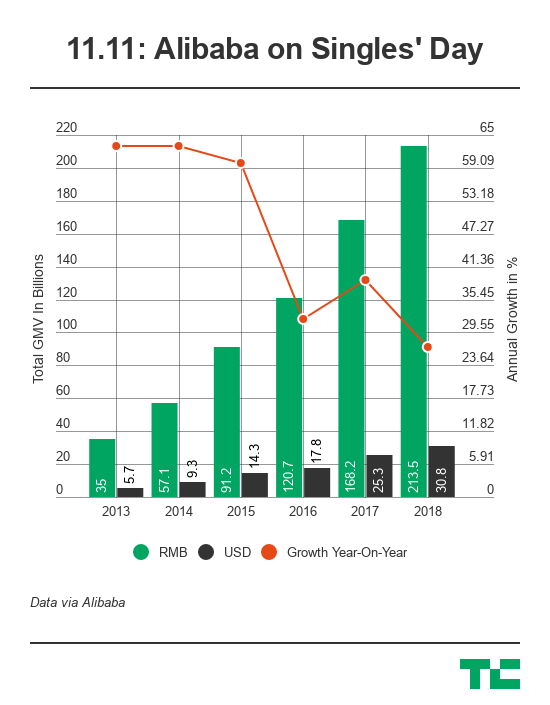
Alibaba scored another blockbuster Singles’ Day after customers around the world shopped in stores and online on the tenth edition of its November 11 shopping festival. That puts this year’s gross merchandise volume – a measure for the dollar value of total transactions – at a staggering $30.8 billion, although the company recorded its lowest-ever annual growth rate for the event.

The figure makes the spending bonanza more than twice the size of Cyber Monday and Black Friday combined in 2017.

This is by far the largest-ever Singles’ Day to date. Just 15 hours and 49 minutes into the spending spree, transactions leapfrogged that of 2017’s tally of $25 billion, the company announced on Twitter.

As the world anticipates when the supercharged shopping day will hit a ceiling, sales are already cooling. The final total of 2018 represents a 27 percent increase from last year. That’s the lowest Alibaba has seen in the history of Singles’ Day sales, and a drop from 36 percent in 2017 — still, it remains impressive given how large the target is each year.

The slowdown came on the heels of Alibaba’s weakest revenue growth since seven quarters ago and a cut in annual revenue forecast – though revenues were still increasing at a healthy rate of 54 percent year-over-year in its latest quarter.
New growth fuel

Consumers are expected to tighten their purse strings as an economic downturn hits China. The ecommerce giant is, however, unconcerned for it’s betting on the country’s rising middle class in the long run.

Shoppers “are looking for new ways to upgrade their lifestyles and make their lives better,” Alibaba executive chairman Joe Tsai said at a media event on Sunday. “This will really offset a lot of the short-term cyclical effects.”

More than 300 million of China’s 1.4 billion people have entered the middle-income bracket, according to the national statistics bureau. That means discretionary items will drive much of the growth in the Chinese retail titan – and the upmarket trend is already underway. Health supplements, small home appliances, and skincare items are among the fastest growing categories by GMV during Singles’ Day this year.

Alibaba has also tapped into physical stores. The online retailer is poised to “digitize the whole consumer retail market,” Daniel Zhang, current CEO and incoming chairman as Jack Ma hands over the helm next year, told media on Sunday. Over the past two years, Alibaba has been jostling with close rival JD.com to snap up strategic partnerships with brick-and-mortar retailers who remain keen to reach Chinese consumers.

Alibaba CEO Daniel Zhang started the Singles’ Day shopping festival in 2009 when he was in charge of the company’s Tmall business (Photo Vivek Prakash/Bloomberg via Getty Images)

There are nuances in the sheer size of GMV, however, as it doesn’t reflect final revenues. A slew of factors could boost the figure. For one, refunds cannot be processed on November 11. Many vendors run pre-sales weeks in advance, taking deposits for items at the time but only processing full payments on Singles’ Day.

Alibaba also aired a star-studded gala on the night of November 10 to drum up sales. It said that over 240 million people – that’s almost one in five people in China – watched the show and its Singles’ Day commercials through two of China’s top TV broadcasters and Alibaba’s own Youku video streaming site.

Next ten years

As Alibaba enters its 19th year, it’s turning to new channels to sell. “Voice will be an important entry point,” said Zhang. The firm’s efforts to brace for China’s transition from a mobile-first age into an AI-powered one include a tie-up with voice assistant startup Rokid.

Alibaba also has its sights set on international consumers. This year, merchants from over 200 countries participated in Singles’ Day, including those on Alibaba’s Southeast Asia-based Lazada platform. “From day one, our dream was to create a global shopping day,” suggested Zhang.

An 11.11 advertisement in New York

Alibaba celebrated another big milestone this year: over one billion packages were shipped throughout the shopping day. But the company is also under mounting pressure to address its packaging waste problem.

“We have to redefine packaging,” said Zhang. That means more than using recycled material. More important, the CEO wants items to travel at a closer distance. This is made possible by algorithms that optimize inventory management. Alibaba could also lean on Ele.me, which it acquired this year and runs a fleet of food delivery staff, to process neighborhood orders which may require less or no packaging at all.

Singles’ Day was first popularized as an antidote to Valentines’ Day for the way the date is written numerically: 11.11, which represents four single people. Nearly a decade after Zhang first turned it into a sales promotion for Tmall, Alibaba’s online sales platform for brands, the one-day event has swollen into the world’s largest online shopping festival.

“We created this day for people who are lonely. Today, we totally redefined the day for how people shop,” concluded Zhang.

11 Nov 2018

Alibaba sets new Singles’ Day record with $31B in sales, but growth is slowing

Alibaba scored another blockbuster Singles’ Day after customers around the world shopped in stores and online on the tenth edition of its November 11 shopping festival. That puts this year’s gross merchandise volume – a measure for the dollar value of total transactions – at a staggering $30.8 billion, although the company recorded its lowest-ever annual growth rate for the event.

The figure makes the spending bonanza more than twice the size of Cyber Monday and Black Friday combined in 2017.

This is by far the largest-ever Singles’ Day to date. Just 15 hours and 49 minutes into the spending spree, transactions leapfrogged that of 2017’s tally of $25 billion, the company announced on Twitter.

As the world anticipates when the supercharged shopping day will hit a ceiling, sales are already cooling. The final total of 2018 represents a 27 percent increase from last year. That’s the lowest Alibaba has seen in the history of Singles’ Day sales, and a drop from 36 percent in 2017 — still, it remains impressive given how large the target is each year.

The slowdown came on the heels of Alibaba’s weakest revenue growth since seven quarters ago and a cut in annual revenue forecast – though revenues were still increasing at a healthy rate of 54 percent year-over-year in its latest quarter.

New growth fuel

Consumers are expected to tighten their purse strings as an economic downturn hits China. The ecommerce giant is, however, unconcerned for it’s betting on the country’s rising middle class in the long run.

Shoppers “are looking for new ways to upgrade their lifestyles and make their lives better,” Alibaba executive chairman Joe Tsai said at a media event on Sunday. “This will really offset a lot of the short-term cyclical effects.”

More than 300 million of China’s 1.4 billion people have entered the middle-income bracket, according to the national statistics bureau. That means discretionary items will drive much of the growth in the Chinese retail titan – and the upmarket trend is already underway. Health supplements, small home appliances, and skincare items are among the fastest growing categories by GMV during Singles’ Day this year.

Alibaba has also tapped into physical stores. The online retailer is poised to “digitize the whole consumer retail market,” Daniel Zhang, current CEO and incoming chairman as Jack Ma hands over the helm next year, told media on Sunday. Over the past two years, Alibaba has been jostling with close rival JD.com to snap up strategic partnerships with brick-and-mortar retailers who remain keen to reach Chinese consumers.

Alibaba CEO Daniel Zhang started the Singles’ Day shopping festival in 2009 when he was in charge of the company’s Tmall business (Photo Vivek Prakash/Bloomberg via Getty Images)

There are nuances in the sheer size of GMV, however, as it doesn’t reflect final revenues. A slew of factors could boost the figure. For one, refunds cannot be processed on November 11. Many vendors run pre-sales weeks in advance, taking deposits for items at the time but only processing full payments on Singles’ Day.

Alibaba also aired a star-studded gala on the night of November 10 to drum up sales. It said that over 240 million people – that’s almost one in five people in China – watched the show and its Singles’ Day commercials through two of China’s top TV broadcasters and Alibaba’s own Youku video streaming site.

Next ten years

As Alibaba enters its 19th year, it’s turning to new channels to sell. “Voice will be an important entry point,” said Zhang. The firm’s efforts to brace for China’s transition from a mobile-first age into an AI-powered one include a tie-up with voice assistant startup Rokid.

Alibaba also has its sights set on international consumers. This year, merchants from over 200 countries participated in Singles’ Day, including those on Alibaba’s Southeast Asia-based Lazada platform. “From day one, our dream was to create a global shopping day,” suggested Zhang.

An 11.11 advertisement in New York

Alibaba celebrated another big milestone this year: over one billion packages were shipped throughout the shopping day. But the company is also under mounting pressure to address its packaging waste problem.

“We have to redefine packaging,” said Zhang. That means more than using recycled material. More important, the CEO wants items to travel at a closer distance. This is made possible by algorithms that optimize inventory management. Alibaba could also lean on Ele.me, which it acquired this year and runs a fleet of food delivery staff, to process neighborhood orders which may require less or no packaging at all.

Singles’ Day was first popularized as an antidote to Valentines’ Day for the way the date is written numerically: 11.11, which represents four single people. Nearly a decade after Zhang first turned it into a sales promotion for Tmall, Alibaba’s online sales platform for brands, the one-day event has swollen into the world’s largest online shopping festival.

“We created this day for people who are lonely. Today, we totally redefined the day for how people shop,” concluded Zhang.

11 Nov 2018

How issues of microtransit, congestion and parking are closing in on cities

Earlier this week in a new experimental newsletter I’ve been helping Danny Crichton on, we briefly discussed transit pundit Jarrett Walker’s article in The Atlantic arguing against the view that ridesharing and microtransit will be the future of mass transit. Instead, his thesis is that a properly operated and well-resourced bus system is much more efficient from a coverage, cost, space, and equality perspective.

Consider this an ongoing discussion about Urban Tech, its intersection with regulation, issues of public service, and other complexities that people have full PHDs on.  I’m just a bitter, born-and-bred New Yorker trying to figure out why I’ve been stuck in between subway stops for the last 15 minutes, so please reach out with your take on any of these thoughts: @Arman.Tabatabai@techcrunch.com.

From an output perspective, Walker argues that by operating along variable routes based on at-your-door pick ups, microtransit actually takes more time to pick up fewer people on average. Walker also gives buses the edge from a cost and input perspective, since labor makes up 70% of transit operating costs in a pre-autonomous world and buses allow you to service more customers for the price of one driver.

“The driver’s time is far more expensive than maintenance, fuel, and all the other costs involved.  In almost every public meeting I attend, citizens complain about seeing buses with empty seats, lecturing me about how smaller vehicles would be less wasteful. But that’s not the case. Because the cost is in the driver, a wise transit agency runs the largest bus it will ever need during the course of a shift. In an outer suburb, that empty big bus makes perfect sense if it will be mobbed by schoolchildren or commuters twice a day.”

But transit is not solely an issue of volume and unit economics, but one of managing public space. Walker explains that to ensure citizens don’t use more than their fair share of space, cities can either provide vehicles that are only marginally bigger than a human body, i.e. bikes and scooters, or have many people share large-scale vehicles, i.e. mass transit. Doing the latter through a mass fleet of on-demand microtransit solutions, Walker argues, increases congestion and makes it harder to manage scheduling and allocate infrastructure.

While the article offers an effective comparison of unit economics and acts as a useful primer on the various considerations for city transit agencies, some of the conclusions are a bit binary.  The discussion is a bit singular in its focus of microtransit as a replacement of public transit rather than an additive service and doesn’t give much credit to the trip planning and space management capabilities of many microtransit services, nor changes in consumer expectations towards transportation.

But despite some of the gaps in the piece, Walker highlights two ideas that spill over to some broad areas that have caught my interest lately: Tolls and Parking.

Tolls

Photo by Michael H via Getty Images

“To succeed, microtransit would have to help people get around cities better, not just make them feel good about hailing a ride on a phone. Full automation of vehicles, if indeed it ever arrives, might solve the labor problem—although it would put thousands of drivers out of work. But the congestion problem will remain.”

Like many, Walker argues that ridesharing aggravates city traffic rather than alleviates it.  Even though ridesharing’s long-term impact on traffic is widely contested, nearly everyone agrees that a solution to urban congestion is desperately needed.

What’s interesting is that regardless of the discourse that surrounds them, trends in US tolling mechanisms seem to suggest American cities may be moving closer to congestion pricing methods.

As an example, solutions to congestion are top of mind behind the New York state election that saw Democrats taking control of both state legislative houses. Though it seems like the argument resurfaces every few years, the elections have brought renewed debate over the possible implementation of congestion pricing in New York City.  In essence, congestion pricing is a system where drivers would pay higher prices for using high-traffic streets or entering high-traffic zones, allowing cities to better dictate the flow of drivers and reduce congestion.   

Outside of the obvious political tension created by effectively implementing a new tax, some lawmakers have pushed back on the effectiveness of a congestion pricing policy, with some arguing that it can aggravate income inequality or that a policy addressing construction and pedestrians, rather than vehicles, would have a bigger impact on traffic.

However, over the past year or so, an increasing number of states have been rolling out highway tolls that are priced dynamically, instead of using traditional fixed-price tolls. The exact drivers behind the toll prices vary, with some cities charging prices based on traffic conditions and others charging varying prices for the use of express and HOV lanes.

Several new technologies and companies have also made it easier for local governments to implement more sophisticated, adjustable toll pricing or congestion fees at a much lower cost. In the past, congestion pricing systems around the world have required physical detection systems that can be extremely costly to implement.

Now, companies like ClearRoad are helping governments use a wide range of connected vehicle technologies to establish and collect road usage pricing from any location without the need for physical infrastructure. Oregon is one geography working with ClearRoad to manage its new opt-in road usage program where the state is able to calculate drivers’ usage of certain roads and their gas consumption, and then reimburse them for gas taxes they’re paying.

So even though people are still screaming at each other in state capitols, it seems like we may be closer to seeing congestion pricing in major cities than we think. And while executing these programs can be difficult and painfully slow (often needing to satisfy city regulations and tax laws forty layers deep), if these smaller-scale programs we’re seeing in the US are actually effective, congestion pricing may be a solution to plug chunky budget gaps, better finance infrastructure projects and replace lost gas tax revenue in an electric vehicle future.

Parking

In his piece, Walker goes back to some basic principles of urban design, highlighting that at their core, functioning cities come down to how millions of people share a comparatively tiny amount of space.  

Walker explains that city dwellers that travel with cars and solo rideshare trips rather than with large-scale shared transit are effectively taking up more than their fair share of public space.  While the argument is made in the context of ridesharing and congestion, the same idea applies to the less-discussed impact mass-transit ridesharing can have on city parking.

At least in the near-term, certain cities have seen ridesharing actually increase vehicle usage rather than reduce it (a claim rideshare companies dispute), resulting in an even wider gap between the supply and demand for available parking spots.  And if people are using ridesharing but still choosing to own cars regardless, in an indirect fashion, they are similarly reducing the stock of available parking space by more than their fair share.

And while it makes sense that rideshare vehicles should receive a larger portion of the parking stock, given that it serves more passengers, the use of available parking by these vehicles can and has caused tension with local residents that have to store their cars further away.

There are companies like the mobility-focused data platform, Coord, that are working on tools geared towards helping cities and citizens more effectively allocate and plan parking strategies for the future multi-modal transportation network. And theoretically, ridesharing should reduce the number of vehicles in search of parking in the long-term. But at least for now, the impact on parking congestion is just another unintended consequence that weakens the argument for ridesharing as mass transit.

And lastly, some reading while in transit:

11 Nov 2018

Bubble lets you create web applications with no coding experience

Meet Bubble a bootstrapped startup that has been building a powerful service that lets you create a web application even if you don’t know how to code. Many small and big companies rely on Bubble for their website.

I have to say I was quite skeptical when I first heard about Bubble. Many startups have already tried to make coding as easy as playing with Lego bricks. But it’s always frustratingly limited.

Bubble is more powerful than your average website building service. It recreates all the major pillars of web programming in a visual interface.

It starts with a design tab. You start with a blank canvas and you can create web pages by dragging and dropping visual elements on the screen. You can put elements wherever you want, resize maps, text boxes, images and more. You can click on the preview button to see the development version of your time whenever your want.

In the second tab, you can create the logic behind your site. It works a bit like Automator on the Mac. You add blocks to create a chronological action. You can set some conditions within each block.

In the third tab, you can interact with your database. For instance, you can create a sign up page and store profile information in the database. At any time, you can import and export data.

There are hundreds of plugins that let you accept payments with Stripe, embed a TypeForm, use Intercom for customer support via chat, use Mixpanel, etc. You can also use your Bubble data outside of Bubble. For instance, you can build an iPhone app that relies on your Bubble database.

Many small companies started using Bubble, and it’s been working fine for some of them. For instance, Plato uses Bubble for all its back office. Qoins and Meetaway run on Bubble. Dividend Finance raised $365 million and uses Bubble.

The startup takes care of hosting your application for you. Every time you resize your instance as your application gets bigger, you pay more.

Even though the company never raised any money, it already generates $115,000 in monthly recurring revenue. Bubble is still a small startup, which can be scary for bigger customers. But the company wants to improve the product so that customers don’t see the limitations of Bubble. Now, the challenge is to grow faster than customers’ needs.

11 Nov 2018

Bubble lets you create web applications with no coding experience

Meet Bubble a bootstrapped startup that has been building a powerful service that lets you create a web application even if you don’t know how to code. Many small and big companies rely on Bubble for their website.

I have to say I was quite skeptical when I first heard about Bubble. Many startups have already tried to make coding as easy as playing with Lego bricks. But it’s always frustratingly limited.

Bubble is more powerful than your average website building service. It recreates all the major pillars of web programming in a visual interface.

It starts with a design tab. You start with a blank canvas and you can create web pages by dragging and dropping visual elements on the screen. You can put elements wherever you want, resize maps, text boxes, images and more. You can click on the preview button to see the development version of your time whenever your want.

In the second tab, you can create the logic behind your site. It works a bit like Automator on the Mac. You add blocks to create a chronological action. You can set some conditions within each block.

In the third tab, you can interact with your database. For instance, you can create a sign up page and store profile information in the database. At any time, you can import and export data.

There are hundreds of plugins that let you accept payments with Stripe, embed a TypeForm, use Intercom for customer support via chat, use Mixpanel, etc. You can also use your Bubble data outside of Bubble. For instance, you can build an iPhone app that relies on your Bubble database.

Many small companies started using Bubble, and it’s been working fine for some of them. For instance, Plato uses Bubble for all its back office. Qoins and Meetaway run on Bubble. Dividend Finance raised $365 million and uses Bubble.

The startup takes care of hosting your application for you. Every time you resize your instance as your application gets bigger, you pay more.

Even though the company never raised any money, it already generates $115,000 in monthly recurring revenue. Bubble is still a small startup, which can be scary for bigger customers. But the company wants to improve the product so that customers don’t see the limitations of Bubble. Now, the challenge is to grow faster than customers’ needs.

11 Nov 2018

Placing bets beyond the venture hubs of New York and Silicon Valley

If geographies were companies, Silicon Valley and New York would be the incumbents — successful today and possibly impregnable — and, like all incumbents, their outsized advantages obscure significant vulnerabilities. Not least of these are high prices and entrenched thinking that can make adapting to new situations difficult.

A dozen venture capitalists spent three days in the South — Charlotte, Columbia, and Atlanta — to learn what it might take to begin investing in the region as an alternative. It was the sequel to a trip some of us took earlier this year to the heartland. And yet again, we saw places and met people with assets Silicon Valley can only dream about.

The cities we visited represent a new breed of challenger to the geographic dominance of venture capital’s leading centers, who — if they can cover the table stakes — bring advantages the Valley may struggle to capture.

First; diversity. It helps startups to bring people together with a range of life experiences, so places like Columbia, Charlotte, and Atlanta should be natural winners. Racial diversity, yes — anchored in part by the strong presence of historically black colleges and universities, of which we visited several — and also diversity of their economies.

In Atlanta (the second-largest majority-black metro in the country) in particular, there’s a wide range of corporate partners (read: customers for startups). Atlanta has the third-most Fortune 500 companies of any city, and you need to go down to #11 before you get any two in the same industry. (Think UPS, Coca-Cola, Delta, Home Depot, and so forth.)

Second; these places have a history of overcoming adversity. Many students we met were first-generation college kids, whose parents and grandparents learned to climb over the brick wall of racism and passed on that grit. The startups that thrive despite the rocky soil become less fragile, less precariously perched on the peak of this month’s hype cycle.

If a startup can make it in Orangeburg, SC, a manufacturing town with a median household income of $29k, it can make it anywhere. Many founders in Silicon Valley have had it so good they can no longer smell money. Startups, unlike many other kinds of projects (like learning to play music), simply require the right timing and dosage of adversity.

What will it take for these places to realize their potential?

Their engines are warm and running. We were floored by the consistently exceptional quality of the startups marshalled by Kathryn Finney at Atlanta’s digital undivided, and felt right at home with the founders who Collective Hustle’s Sam Smith gathered around a table in Charlotte.

A few drops of mentorship and capital will crystallize even more progress. We met students who devoured every word of the tech blogs we all read, and still craved someone with first-hand knowledge, to warn them away from dead ends or confirm their intuitions. Several of us said we’d be happy to videoconference in to classes, or come back again and visit.

We invited our hosts in the South to spend a few days with us in the bubble. We realize that providing mentorship at scale is another matter, and we’re thinking about how to do that. We did notice that big technology companies — Google, Microsoft, Bloomberg — have already done a good job of showing up for recruiting or startup-support programs.

While there are angel investors in every market, it’s clear that most rich people (understandably) need a basic understanding of that strange bird of startup investing. We heard story after story of angels who focus on safe bets (good luck!), ask for control over startups in modest five-figure investments, and fail to take advantage of the worthwhile standards from more developed ecosystems. Even the local angel groups, where they exist, tended to reinforce bad behavior as often as they shared good ones (as organized angel groups often do).

Government participates more actively in these ecosystems — starting with the hosts of our trip, Representatives Tim Ryan (OH), Ro Khanna (CA), and Jim Clyburn (SC). Creating an environment for startups is a completely different beast than traditional “smokestack chasing” economic development (where a city tries to lure big employers to bring a massive facility).

It’s more about identifying individual champions (one mayor struggled to tell us who the active investors were in their community), creating the living conditions that technology employees want (art, food, and fast, reliable internet among others), and protecting the green shoots that bust their way through the concrete. Governments can use the bully pulpit to draw attention to nascent victories at zero cost to taxpayers.

Investors from Silicon Valley or New York need to stop asking founders to relocate. So many founders had heard the tired “I’ll consider investing… if you move” story. This is borderline bad behavior — asking a founder to uproot their life because it’s more convenient for the investor. While investors might believe they’re making a recommendation in the company’s best interest (“it’s easier to succeed in a more established place”), founders have unfair home court advantages (knowing talent, customers, etc.).

What will we investors need to learn, if we’re to participate in the growth of these markets?

We need to watch the assumptions our words reveal. People who live in coastal cities talk like a duck. We’ll benefit from reading the room when words like “SaaS” or “LP” need explanation. Getting “ramen profitable” may assume a founder has family with whom they can live — one founder told us that “it feels like you need $500k in funding to even try to do that.”

Often the first step is something other than a direct investment. Investors might participate in a few local events, or encourage a portfolio company to open a second office (as one did from our last trip to South Bend), or build relationships through mentoring and coaching. Direct investments can start small — we had founders asking for investment rounds in the tens of thousands of dollars, i.e., with one fewer zero than the smallest rounds in bubbleland.

We’ll need to embrace the communities that hold these places together: Churches are especially important outside the coasts. More than one founder told us about the role The Creator plays in their startup’s creation. Baptist, AME, and Methodist churches have long undergirded economic development in these cities. Startups harness those trusted networks to find teammates and customers. Investors who see the importance of churches will find deals. (Silicon Valley’s atheist streak makes this a new muscle for us out-of-towners.)

Every place has its own shape. Charlotte, despite being near Research Triangle, gets relatively little flow of talent from Raleigh-Durham. The economic boom there also, ironically, can make it harder for a startup to compete for talent and attention. In Orangeburg, we saw a strong startup that planned to move to Baltimore — and none of us could fault those founders for choosing to go to a more active startup place. Several others in Columbia banded together to occupy SOCO, in a new real estate development, planting seeds.

Atlanta almost has it all right now — talent, experienced angels, role model founders who actively mentor rookies, and quality of life (the BeltLine felt like what the High Line wishes it were). Atlanta has that most-important and elusive startup quality: momentum. (Fund LPs may actually have some of the best opportunities there, because just a couple of slightly bigger local venture funds would smooth the transition between different stages in a company’s life. More investors might get to bet on a Mailchimp before it prides itself on not needing them.)

In our country, where everyone is supposed to have a real chance at extraordinary opportunity, one question hung over our trip: is geography… destiny? Can a kid at Benedict College in Columbia create one of the world’s defining startups? Fast forward the clock, and we believe we may see that. Our goal is to participate and support it. Some of the places we visited — with their combination of diversity and overcoming adversity — are irresistible bets on the future of startups in America, maybe even on the future of America.

Additional credit to Karin Klein, Bloomberg Beta; Shiyan Koh, Hustle Fund; and Scott Shane, Comeback Capital. 

11 Nov 2018

Placing bets beyond the venture hubs of New York and Silicon Valley

If geographies were companies, Silicon Valley and New York would be the incumbents — successful today and possibly impregnable — and, like all incumbents, their outsized advantages obscure significant vulnerabilities. Not least of these are high prices and entrenched thinking that can make adapting to new situations difficult.

A dozen venture capitalists spent three days in the South — Charlotte, Columbia, and Atlanta — to learn what it might take to begin investing in the region as an alternative. It was the sequel to a trip some of us took earlier this year to the heartland. And yet again, we saw places and met people with assets Silicon Valley can only dream about.

The cities we visited represent a new breed of challenger to the geographic dominance of venture capital’s leading centers, who — if they can cover the table stakes — bring advantages the Valley may struggle to capture.

First; diversity. It helps startups to bring people together with a range of life experiences, so places like Columbia, Charlotte, and Atlanta should be natural winners. Racial diversity, yes — anchored in part by the strong presence of historically black colleges and universities, of which we visited several — and also diversity of their economies.

In Atlanta (the second-largest majority-black metro in the country) in particular, there’s a wide range of corporate partners (read: customers for startups). Atlanta has the third-most Fortune 500 companies of any city, and you need to go down to #11 before you get any two in the same industry. (Think UPS, Coca-Cola, Delta, Home Depot, and so forth.)

Second; these places have a history of overcoming adversity. Many students we met were first-generation college kids, whose parents and grandparents learned to climb over the brick wall of racism and passed on that grit. The startups that thrive despite the rocky soil become less fragile, less precariously perched on the peak of this month’s hype cycle.

If a startup can make it in Orangeburg, SC, a manufacturing town with a median household income of $29k, it can make it anywhere. Many founders in Silicon Valley have had it so good they can no longer smell money. Startups, unlike many other kinds of projects (like learning to play music), simply require the right timing and dosage of adversity.

What will it take for these places to realize their potential?

Their engines are warm and running. We were floored by the consistently exceptional quality of the startups marshalled by Kathryn Finney at Atlanta’s digital undivided, and felt right at home with the founders who Collective Hustle’s Sam Smith gathered around a table in Charlotte.

A few drops of mentorship and capital will crystallize even more progress. We met students who devoured every word of the tech blogs we all read, and still craved someone with first-hand knowledge, to warn them away from dead ends or confirm their intuitions. Several of us said we’d be happy to videoconference in to classes, or come back again and visit.

We invited our hosts in the South to spend a few days with us in the bubble. We realize that providing mentorship at scale is another matter, and we’re thinking about how to do that. We did notice that big technology companies — Google, Microsoft, Bloomberg — have already done a good job of showing up for recruiting or startup-support programs.

While there are angel investors in every market, it’s clear that most rich people (understandably) need a basic understanding of that strange bird of startup investing. We heard story after story of angels who focus on safe bets (good luck!), ask for control over startups in modest five-figure investments, and fail to take advantage of the worthwhile standards from more developed ecosystems. Even the local angel groups, where they exist, tended to reinforce bad behavior as often as they shared good ones (as organized angel groups often do).

Government participates more actively in these ecosystems — starting with the hosts of our trip, Representatives Tim Ryan (OH), Ro Khanna (CA), and Jim Clyburn (SC). Creating an environment for startups is a completely different beast than traditional “smokestack chasing” economic development (where a city tries to lure big employers to bring a massive facility).

It’s more about identifying individual champions (one mayor struggled to tell us who the active investors were in their community), creating the living conditions that technology employees want (art, food, and fast, reliable internet among others), and protecting the green shoots that bust their way through the concrete. Governments can use the bully pulpit to draw attention to nascent victories at zero cost to taxpayers.

Investors from Silicon Valley or New York need to stop asking founders to relocate. So many founders had heard the tired “I’ll consider investing… if you move” story. This is borderline bad behavior — asking a founder to uproot their life because it’s more convenient for the investor. While investors might believe they’re making a recommendation in the company’s best interest (“it’s easier to succeed in a more established place”), founders have unfair home court advantages (knowing talent, customers, etc.).

What will we investors need to learn, if we’re to participate in the growth of these markets?

We need to watch the assumptions our words reveal. People who live in coastal cities talk like a duck. We’ll benefit from reading the room when words like “SaaS” or “LP” need explanation. Getting “ramen profitable” may assume a founder has family with whom they can live — one founder told us that “it feels like you need $500k in funding to even try to do that.”

Often the first step is something other than a direct investment. Investors might participate in a few local events, or encourage a portfolio company to open a second office (as one did from our last trip to South Bend), or build relationships through mentoring and coaching. Direct investments can start small — we had founders asking for investment rounds in the tens of thousands of dollars, i.e., with one fewer zero than the smallest rounds in bubbleland.

We’ll need to embrace the communities that hold these places together: Churches are especially important outside the coasts. More than one founder told us about the role The Creator plays in their startup’s creation. Baptist, AME, and Methodist churches have long undergirded economic development in these cities. Startups harness those trusted networks to find teammates and customers. Investors who see the importance of churches will find deals. (Silicon Valley’s atheist streak makes this a new muscle for us out-of-towners.)

Every place has its own shape. Charlotte, despite being near Research Triangle, gets relatively little flow of talent from Raleigh-Durham. The economic boom there also, ironically, can make it harder for a startup to compete for talent and attention. In Orangeburg, we saw a strong startup that planned to move to Baltimore — and none of us could fault those founders for choosing to go to a more active startup place. Several others in Columbia banded together to occupy SOCO, in a new real estate development, planting seeds.

Atlanta almost has it all right now — talent, experienced angels, role model founders who actively mentor rookies, and quality of life (the BeltLine felt like what the High Line wishes it were). Atlanta has that most-important and elusive startup quality: momentum. (Fund LPs may actually have some of the best opportunities there, because just a couple of slightly bigger local venture funds would smooth the transition between different stages in a company’s life. More investors might get to bet on a Mailchimp before it prides itself on not needing them.)

In our country, where everyone is supposed to have a real chance at extraordinary opportunity, one question hung over our trip: is geography… destiny? Can a kid at Benedict College in Columbia create one of the world’s defining startups? Fast forward the clock, and we believe we may see that. Our goal is to participate and support it. Some of the places we visited — with their combination of diversity and overcoming adversity — are irresistible bets on the future of startups in America, maybe even on the future of America.

Additional credit to Karin Klein, Bloomberg Beta; Shiyan Koh, Hustle Fund; and Scott Shane, Comeback Capital. 

11 Nov 2018

Mattereum, perhaps the world’s weirdest and most daring startup, intends to own literally everything

How’s this for eyebrow-raising? In London, for the last year and a half, a team of lawyers, cryptographers, software engineers, and/or former military consultants have been brewing a bizarre and/or brilliant plan for a bridge between the blockchain and the real world — a system whose success is directly proportional to the extent to which it achieves legal title over every physical object in the world.

Wait. Let me explain. Their name is Mattereum, and they are not Bond villains seeking to conquer the planet. Rather, they are trying to bridge the gap between programmable blockchain “smart contracts” and actual legal contracts. As you might imagine, that gap consists of an almost infinitely knotty tangle of legal precedents, gray areas, and jurisdictions.

Mattereum has came up with a remarkable way to sever this Gordian knot. A legal concept universal across almost all jurisdictions is that assets have owners, who can decide (within legal limits) how to dispose of them. If registrars of the Mattereum network are granted legal title over assets, the thinking goes, they can then establish on-chain smart contracts with which physical assets can be programmatically bought, sold, rented, assigned, and partitioned — and use their ownership of these assets to resolve disputes and enforce those resolutions.

That all sounds pretty abstract. Let’s talk about some real-world examples. Their flagship object right now is a Stradivarius violin valued at $9 million. Assigning legal title over that violin to one of Mattereum’s registrars (say, Mattereum itself) which then licenses control via a set of smart contracts (say, on the Ethereum blockchain) means the violin instantly becomes not just a physical asset but a digital one, which can now be programmatically tokenized and sold to multiple investors — and also means that other contractual restrictions regarding its use can be required and enforced, such as that it be played for the public X times a year in Y countries, rather than locked perpetually into a vault.

Similarly, artists could sell their work to consortiums of investors with the enforceable requirement that their art be displayed in galleries open to the public for at least 25% of every year, built-in digital interfaces for galleries and museums to book that time, income percentages allocated for foundations and to the artist themselves, and so forth. And, of course, in passing, the art’s provenance is maintained, too.

Could you do all this already, via a whole lot of legal paperwork followed by a whole lot of glacially-paced lawsuits when disputes inevitably arose? Sure. But to quote their summary white paper (PDF), which is very worth reading:

Clichés like “data is the new oil” conceal a fundamental truth: efficient discovery of availability and price radically changes the value of assets. Auctions on eBay gave value to enormous seas of illiquid assets … Some classes of illiquid assets, such as idle cars and briefly empty flats, found markets through Uber and Airbnb, liberating billions in value … the pattern is very clear: assets with a proper digital interface and history are more valuable than assets without them.

Mattereum boasts an impressive team led by Vinay Gupta, the mad-or-visionary-depending-on-who-you-talk-to global resilience guru turned Ethereum launch coordinator turned CEO, and including Ian Grigg, inventor of the Ricardian contract. And, of course, a lawyer or three. Obviously whole clouds of question marks still hover around them, notably regarding just how these smart contracts will intersect with the existing legal world(s), and how to establish trust in asset registrars to not abuse their legal title, or neglect their responsibilities — a trust which will need to rival or exceed that which accountholders have in banks.

But, like Ethereum itself, this is still a wildly ambitious, genuinely innovative, and deeply weird project; that’s much to admire. Restructuring the concept of physical asset ownership to include programmatic contracts may seem like a subtle change, but it’s one which could conceivably have massive structural repercussions and unlock enormous amounts of currently untapped potential. It’s early baby-iterative-steps yet, of course, with a panoply of pitfalls on all sides; but it’s big and bold and hopeful, and it just might do a lot of good.

11 Nov 2018

eBay adds home services to its site via new partners Handy, Porch and InstallerNet

eBay shoppers will now be able to buy installation services along with their purchases. The company this morning announced new partnerships with HandyPorch and InstallerNet which will allow online shoppers the option of booking installation and assembly services when buying items that require a bit of extra work – like TVs, bikes, furniture, and more.

The option will be presented during checkout and, if selected, eBay will then follow up with an email from its partners so the customer can proceed to schedule the installation.

New York-based Handy will be available to handle things like TV mounting, smart home setup, furniture assembly, and more. Meanwhile, Boston-based InstallerNet can coordinate installation of consumer and commercial electronics through independent contractors.

And Seattle-based Porch’s network of professionals can handle over 1,000 different types of projects, also including TV mounting, furniture assembly, and more.

“A massive amount of home and electronic items are sold on eBay daily, many of which require professional installation,” said Alyssa Steele, Vice President of Merchandising at eBay, in a statement. “With these new partnerships, we’re able to combine our incredible selection of inventory with easy access to affordable and trusted service professionals, making eBay a one-stop shop for our customers.”

This is not the first time eBay has offered installation services on its site. It launched tire installation services in late 2017. The company says it plans to expand its services offering in the future.

Home services is a growing area of opportunity for e-commerce players. Amazon has offered home services on its site for years, and Walmart more recently partnered with Handy to do the same.

Handy currently has a similar deal with Walmart both in-store and online. The company was also recently acquired by Angie’s List parent company, ANGI Homeservices, owned by IAC, which gives it more opportunity to pursue these high-profile deals.

“We are thrilled to add eBay to the growing roster of top retail brands who rely on our platform to provide fast and convenient assembly and installation services,” said Oisin Hanrahan, CEO of Handy, in a separate statement. “The integration with Handy will enhance the shopping experience on eBay with seamless access to service professionals who can help buyers avoid headaches and enjoy their home goods purchases without the hassle,” Hanrahan added.

11 Nov 2018

Cloudflare rolls out its 1.1.1.1 privacy service to iOS, Android

Months after announcing its privacy-focused DNS service, Cloudflare is bringing 1.1.1.1 to mobile users.

Granted, nothing ever stopped anyone from using 1.1.1.1 on their phones or tablets already. But now the app, now available for iPhones, iPads and Android devices, aims to make it easier for anyone to use its free consumer DNS service.

The app is a one-button push to switch on and off again. That’s it.

Cloudflare rolled out 1.1.1.1 earlier this year on April Fools’ Day, no less, but privacy is no joke to the San Francisco-based networking giant. In using the service, you let Cloudflare handle all of your DNS information, like when an app on your phone tries to connect to the internet, or you type in the web address of any site. By funneling that DNS data through 1.1.1.1, it can make it more difficult for your internet provider to know which sites you’re visiting, and also ensure that you can get to the site you want without having your connection censored or hijacked.

It’s not a panacea to perfect privacy, mind you — but it’s better than nothing.

The service is also blazing fast, shaving valuable seconds off page loading times — particularly in parts of the world where things work, well, a little slower.

“We launched 1.1.1.1 to offer consumers everywhere a better choice for fast and private Internet browsing,” said Matthew Prince, Cloudflare chief executive said. “The 1.1.1.1 app makes it even easier for users to unlock fast and encrypted DNS on their phones.”

You can download the app from Apple’s App Store and Google Play.